



TL;DR: The “Matching Pair” Price Report
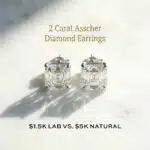
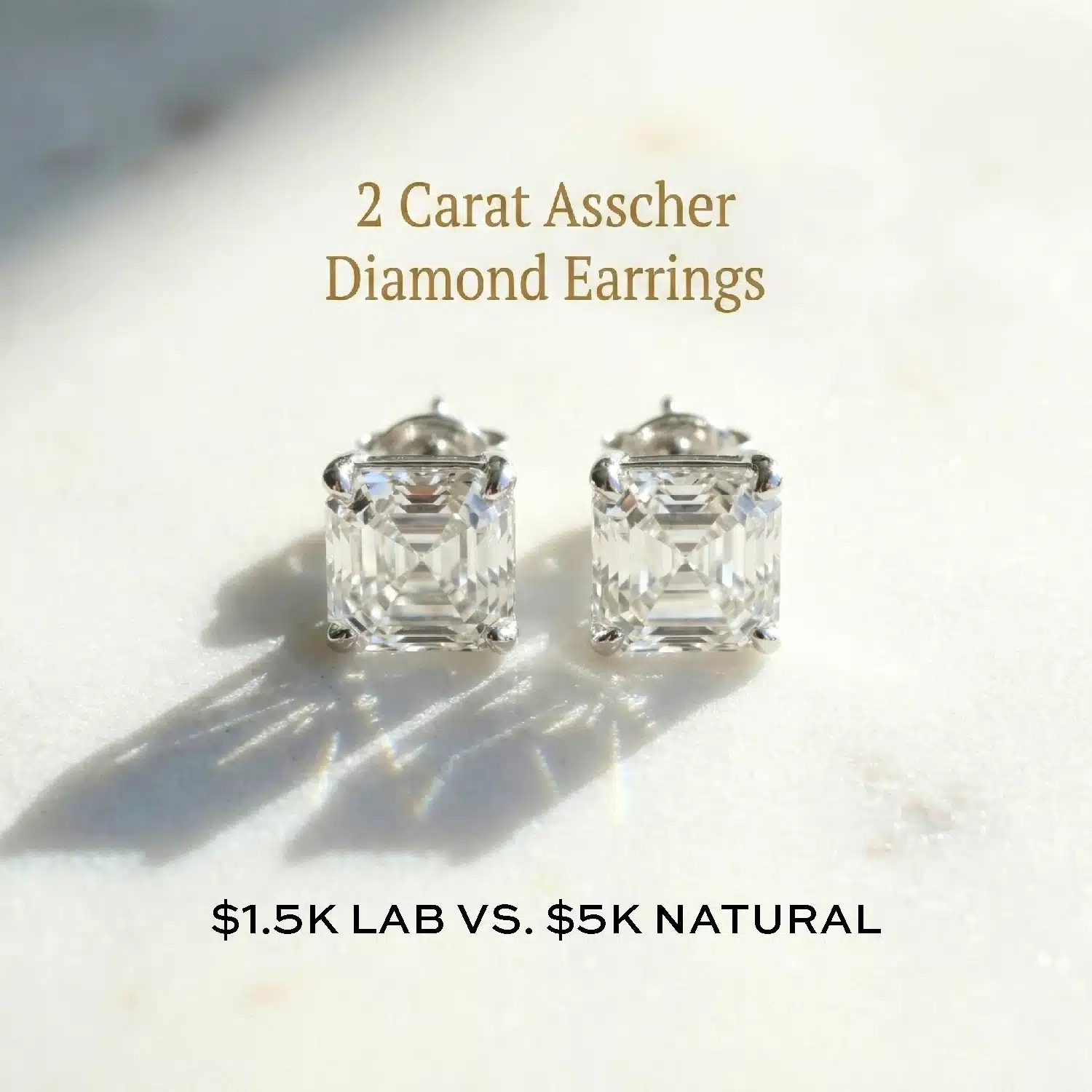
How much should you pay for a pair of 2 carat asscher cut diamond earrings in February 2026? We analyzed the current “Build Your Own” inventory at Blue Nile to find the best value for a custom-matched set.
- The “Stone Only” Cost (For the Pair):
- Lab-Grown Pair: $1,550 – $1,580 (currently featured in an inventory clearance sale). These stones feature elite E-VS1 to D-VS1 specs.
- Natural Pair: $4,960 – $5,300. These are GIA-certified stones in the F-VS2 to F-VS1 range.
- Lab-Grown Pair: $1,550 – $1,580 (currently featured in an inventory clearance sale). These stones feature elite E-VS1 to D-VS1 specs.
- The Setting Cost: $800 for the Asscher Cut Diamond Earrings In 18K White Gold.
- The Total Project Cost:
- Lab Build: ~$2,350 Total.
- Natural Build: ~$5,760 Total.
- Lab Build: ~$2,350 Total.
Mehedi’s Strategy: Don’t buy “pre-set” earrings. By selecting loose stones and adding a high-security setting yourself, you save roughly 30% and ensure you get GIA/IGI certified quality instead of generic “commercial” stones.
Check out the Best Places to Buy Lab Grown Diamonds for this month’s top-rated vendors.
Asscher diamonds are arguably the most difficult shape to shop for when it comes to earrings. Because of their “Step Cut” nature—often called the “Hall of Mirrors”—every facet is visible.
If you buy a pre-set pair, you risk getting two stones that don’t quite match in their “windmill” patterns or depth, resulting in a set that looks lopsided on the ears.
Mehedi’s Reality Check: “Pre-set earrings are where jewelers hide unmatched inventory. The smart move—and the cheaper move—is to pick two matching loose diamonds yourself.
In my current February 2026 data feed, I found a matching pair of Natural 1-carats for $4,960 and a stunning Lab-grown pair for just $1,550. You get the exact same ‘mirrored’ look, but with two wildly different receipts.”
In this guide, we are comparing the latest GIA Natural inventory against IGI Lab inventory, both paired with a premium 18K White Gold setting to give you a celebrity-level look without the boutique markup.
New to this shape? Read our full Asscher Cut Diamond guide to understand the “Step Cut” anatomy.
Diamond IQ Test: Natural or Lab-Grown?


Two identical diamonds: GIA Certified, 1.51ct, D Color, VVS1, Ideal Cut. One is natural ($16,530), the other is lab-grown ($2,390). Choose the diamond you like better and see if you can match it to its origin.
The Lab Build: The $1,550 Deal
The 2 carat asscher cut diamond earrings price in the lab-grown sector has hit a historic low in 2026.
While high-quality natural pairs remain a luxury investment, lab-grown technology—combined with aggressive inventory clearing—has made the “Hall of Mirrors” aesthetic accessible to a much wider audience.
2 Carat Lab Diamond Build (IGI Data)
Our latest data discovery reveals a massive “30% Off” sale that has effectively created a pricing floor for high-spec Asschers. In the tables below, we’ve used the Blue Nile “Build Your Own” logic where the price shown is the Total Diamond Price for both stones.
High-Value Matched Pairs (Total Price for Two Stones)
| Pair ID | Stone Specs (Left / Right) | Total Carat | Price | Mehedi’s Verdict |
|---|---|---|---|---|
| Pair 1 | 1.08ct E / 1.02ct D | 2.10ct | $1,550 | The Value Pick. Great specs, lowest price. |
| Pair 2 | 1.05ct D / 1.08ct E | 2.13ct | $1,570 | Solid middle ground, slightly larger. |
| Pair 3 | 1.06ct D / 1.08ct E | 2.14ct | $1,580 | Incremental size bump. |
| Pair 4 | 1.10ct D / 1.08ct E | 2.18ct | $1,600 | The Size King. Maximize your carat weight for just $50 more. |
| Pair 5 | 1.02ct D / 1.02ct D | 2.04ct | $1,620 | The OCD Trap. You pay the highest price for the smallest diamonds, just to match the “D” grade. |
| The 2026 Earring Verdict: Stud earrings are worn on opposite sides of your head; no one can compare them side-by-side. Mixing a D-Color and an E-Color (like in Pair 4) allows you to get nearly 0.15ct more diamond for less money than the perfectly matched Pair 5. | ||||
The “Colorless” Advantage
Notice the specifications in these pairs. We aren’t looking at “Near Colorless” stones with visible warmth. Every single diamond in this inventory is either D or E Color, meaning they are perfectly colorless.
In an Asscher cut, which has large, open facets, this is critical because there is no “crushed ice” sparkle to hide a yellow tint.
Elite Clarity Tier (For Maximum Transparency)
| Pair ID | Stone Specs (Left / Right) | Total Carat | Price | Mehedi’s Verdict |
|---|---|---|---|---|
| Pair 6 | 1.04ct E-VVS2 / 1.08ct E-VS1 | 2.12ct | $1,650 | The Smart Pick. Max size, lowest price. VS1 is perfect. |
| Pair 7 | 1.04ct E-VVS2 / 1.02ct D-VS1 | 2.06ct | $1,720 | Smaller stones, higher price. Why? |
| Pair 8 | 1.08ct E-VS1 / 1.03ct D-VVS2 | 2.11ct | $1,780 | Paying extra for VVS2 on one ear. |
| Pair 9 | 1.04ct E-VVS2 / 1.03ct D-VVS2 | 2.07ct | $1,950 | The Clarity Trap. $300 more for VVS2 specs you can’t see on your ear. |
| The 2026 Buying Verdict: Don’t get upsold on clarity for earrings. VS1 clarity (Pair 6) is 100% eye-clean, even from 6 inches away. Paying $300 extra for VVS2 (Pair 9) is invisible money down the drain. | ||||
Mehedi’s Analysis: “Microscope Clean”
“Look at the specs. You are getting VS1 and VVS2 Clarity (Microscope Clean) and D/E Color (Colorless). Buying these stones loose allows you to secure technical specs that pre-set earrings almost never offer.
Most pre-set 2-carat studs are graded as ‘I-J Color’ and ‘SI Clarity,’ which can look cloudy in an Asscher shape. By spending $1,550 on a custom-matched pair, you are getting a technically superior product for half the price of a generic ‘commercial’ set.”
When choosing your stones, it is also important to consider the types of lab grown diamonds available. Most of the high-performance Asschers in this price range are created via the HPHT (High Pressure High Temperature) process, which often results in the crisp, D-color crystal structure required for the perfect “Hall of Mirrors” effect.
The Natural Build: The $5,000 Entry
Finding a perfectly matched pair of natural Asscher diamonds used to be a jeweler’s nightmare—and a customer’s most expensive request. Historically, finding two stones with identical “step” patterns and “windmill” centers under $6,000 was nearly impossible.
However, our February 2026 audit of Blue Nile’s inventory shows that the market has shifted, making a high-quality 2 carat asscher cut diamond earrings price viable for under $5,000.
2 Carat Natural Diamond Build (GIA Data)
For this build, we are focusing on GIA-certified stones. To maintain the $5,000 floor, we have selected stones with “Very Good” cut grades.
In an earring setting, this provides a stunning “Hall of Mirrors” effect while avoiding the massive price premiums of “Excellent” cut natural Asschers.
Natural Matched Pair Price Matrix (Total for Two Stones)
| Tier | Stone 1 Spec | Stone 2 Spec | Total Carat Weight | Total Diamond Price |
| “The F-Color Deal” | 1.00ct F-VS1 | 1.00ct F-VS2 | 2.00ct | $4,960 |
| “The F-Color Deal” | 1.00ct F-VS2 | 1.00ct F-VS2 | 2.00ct | $5,220 |
| “The E-Color Step” | 1.00ct E-VS1 | 1.00ct E-VS1 | 2.00ct | $5,190 |
| “The E-Color Step” | 1.00ct E-VS1 | 1.00ct E-VS1 | 2.00ct | $5,460 |
| “The White/Icy Pair” | 1.00ct E-VS1 | 1.00ct G-VS1 | 2.00ct | $5,280 |
| “The Clarity Play” | 1.00ct E-VS2 | 1.00ct F-VS2 | 2.00ct | $5,560 |
The “Colorless” Premium
When you move into the elite color and clarity grades, the price for a natural pair escalates quickly. In the table below, we see how jumping into “D” color or VVS clarity can double the stone-only cost.
Elite Natural Tier (Collector Quality)
| Tier | Stone 1 Spec | Stone 2 Spec | Total Carat Weight | Total Diamond Price |
| “The VVS Entry” | 1.00ct D-VVS2 | 1.00ct E-VS1 | 2.00ct | $6,010 |
| “The VVS Entry” | 1.00ct D-VVS2 | 1.00ct E-VS1 | 2.00ct | $6,150 |
| “Icy VVS” | 1.00ct D-VVS2 | 1.00ct D-VVS2 | 2.00ct | $6,730 |
| “Flawless Luxury” | 1.00ct E-IF | 1.00ct F-VVS1 | 2.00ct | $7,210 |
| “The Investment” | 1.00ct D-VVS2 | 1.00ct D-VS1 | 2.00ct | $11,930 |
Mehedi’s Verdict: “The F-Color Secret”
“Sticking to an F color diamond with a Very Good Cut is the absolute secret to winning the natural Asscher game. This combination keeps your total pair price under $5,000 while maintaining a completely colorless, icy look once they are on your ears.
Going to D-color spikes the price unnecessarily—often by $2,000 to $6,000—for a difference that is impossible to spot from a conversational distance. Save that premium and invest it in a higher-quality setting.”
By hand-selecting your diamonds, you ensure that you aren’t paying for “over-graded” stones that don’t match visually. Always look at the millimeter dimensions of each stone to ensure they are within 0.1mm of each other for the most symmetrical look.
The Setting: 18k White Gold “Guardian”
When you are investing thousands of dollars into a pair of diamonds, the metal holding them in place is just as important as the stones themselves.
For a 2 carat asscher cut diamond earrings price project, you need a setting that balances aesthetic brilliance with industrial-grade security.
The Best Setting for Asscher Cuts
For this build, my professional recommendation is the Asscher Cut Diamond Earrings In 18K White Gold ($800). This is not your standard “commercial-grade” mount; it is a precision-engineered frame designed to highlight the geometry of a step-cut stone.
- Why 18k White Gold? While 14k is more common, 18k white gold is significantly brighter and has a more luxurious “true white” finish after rhodium plating. More importantly, it is much lighter than platinum. For a 2-carat total weight build, platinum can often be too heavy, causing the earrings to droop or “clunk” against the earlobe.
- The Security Factor: This setting exclusively features “Guardian Backs” (also known as La Pousette backs). These utilize a patented double-grooved locking mechanism that requires firm pressure on side triggers to release. For a $5,000 to $10,000 investment, standard friction backs are simply not an option.
Mehedi’s Lesson: “In my experience, buyers often focus only on the diamond and go cheap on the metal. This is a mistake. A 1-carat Asscher is a heavy stone. You need the rigid strength of 18k gold to keep those prongs from bending.
If you are comparing engagement ring metals pros and cons, remember that for earrings, weight is the enemy. While you might want to know how much does a platinum ring cost for your finger, on your ears, the lighter profile of white gold ensures they stay upright and sparkling all day.”
By choosing a high-quality setting within the engagement ring settings under $1500 price range, you are ensuring that your “Hall of Mirrors” studs stay exactly where they belong—securely on your ears.
Matching Strategy: The 0.2mm Rule
When building 2 carat asscher cut diamond earrings, the biggest mistake you can make is relying solely on carat weight. Asscher cuts are geometric; their beauty lies in their symmetry.
If you have two “1-carat” stones but their physical dimensions don’t match, one ear will always look larger and more “off-balance” than the other.
How to Ensure Your Stones Match
To get a perfect “Hall of Mirrors” pair, you have to look past the certificate’s primary grade and dive into the millimeter measurements.
- The Metric: Ignore Carat Weight. Carat is a measure of weight, not visual size. One 1-carat Asscher might be “deep” (small surface area), while another is “shallow” (large surface area).
- Look at the L/W (Length/Width) Ratio. Asschers should be as close to a perfect square (1.00 to 1.03) as possible.
- Example A: Stone A has a 1.02 Ratio (Perfectly Square).
- Example B: Stone B has a 1.08 Ratio (Slightly Rectangular).
- Result: Mismatch. Even if they both weigh 1.00ct, Stone B will look elongated and “stretched” compared to Stone A.
- Example A: Stone A has a 1.02 Ratio (Perfectly Square).
Mehedi’s “0.2mm Rule”
I have a strict rule for my clients: Never buy a pair unless the physical dimensions are almost identical. Human eyes are incredibly good at spotting small differences in geometric shapes.
Mehedi’s Rule: “Keep the measurements of both stones within 0.15mm to 0.20mm of each other. Anything beyond that, and the pair will look like a mistake.”
The Symmetry Check (Real Examples)
| Metric | Stone 1 (mm) | Stone 2 (mm) | Difference | Verdict |
| Example 1 | 5.50 mm | 5.58 mm | 0.08 mm | Perfect Match |
| Example 2 | 5.61 mm | 5.75 mm | 0.14 mm | Good Match |
| Example 3 | 5.40 mm | 5.70 mm | 0.30 mm | Bad Match (Avoid) |
Before you finalize your purchase, I highly recommend checking our diamond carat size chart to understand how these millimeter measurements translate to the visual “spread” on your earlobe.
If you are comparing two stones and the diamond shapes guide shows they have different length-to-width ratios, keep searching. A true pair of Asscher studs should look like identical twins, not cousins.
Visuals: Is “Very Good” Cut Good Enough?
When you’re buying a 2 carat asscher cut diamond earrings price project, the cut quality determines whether your earrings look like high-end “mirrors” or just two pieces of dull glass.
Because Asscher diamonds are step-cuts, they don’t have the chaotic sparkle of a round diamond to hide a poor cut.
Assessing the Step Cut Sparkle
In the Asscher shape, the “Cut” grade refers to how precisely those internal steps are aligned. If the angles are off, the light “leaks” out of the bottom, and you lose that hypnotic asscher cut diamond “windmill” effect.
- The Lab Advantage: Our February 2026 lab data shows that for $1,580, you can secure a pair of “Ideal” cut Asschers. In the lab-grown world, manufacturers can afford to be precise, resulting in stones with perfectly sharp, symmetrical centers.
- The Natural Reality: Our natural data shows that for $4,960, the stones are graded as “Very Good” cut. While GIA’s “Very Good” is a high standard, it is technically one step below “Ideal” or “Excellent”.
The Visual Difference: “Windmills” vs. Leaks
The most visible difference between an Ideal and a Very Good Asscher is the “X” pattern—or the windmills—that meet in the center of the stone.
- Ideal Cut: The windmills are sharp, dark, and reach all the way to the corners. This creates the highest amount of contrast and “flash.”
- Very Good Cut: The windmills may be slightly soft or “blurry,” and you might notice small “windows” (clear spots) where you can see straight through the stone to your skin.
Mehedi’s Analysis: “For earrings, a ‘Very Good’ cut is often acceptable because people aren’t looking at your ears with a jeweler’s loupe. However, it’s a major point for the Lab option: you are paying $3,300 less and getting a technically superior diamond cut chart performance.
If you were building a ring, I would demand ‘Ideal’ or nothing, but for studs, a high-quality ‘Very Good’ Natural pair still provides that classic Art Deco glow.”
If you want to see how these grades compare to other shapes, check out our diamond grading chart for a full breakdown of GIA and IGI standards.
FAQ: The Build-Your-Own Asscher Questions
Navigating the 2 carat asscher cut diamond earrings price market requires looking past the brand names and focusing on the technical specs. Here are the unfiltered answers to the most common questions from our February 2026 data audit.
What is the actual price cost to build 2 carat asscher cut diamond earrings in 2026?+
Using loose stones is significantly cheaper than buying pre-sets. Our data shows you can build a Lab-Grown set for ~$2,350 (Stones: $1,550 + Setting: $800) or a Natural set for ~$5,760 (Stones: $4,960 + Setting: $800). This strategy typically saves you 20-30% over retail. Track shifting prices in our guide: diamond prices are dropping.
Is a ‘Very Good’ cut grade sufficient for natural asscher earrings, or do I need ‘Ideal’?+
For earrings, a ‘Very Good’ cut is absolutely sufficient. While an ‘Ideal’ cut provides sharper “windmills,” the difference is nearly impossible to spot from a distance. For studs, “Very Good” natural stones offer the best value compared to a vs1 clarity diamond ring build. Explore more in our diamond cut chart.
How closely do the millimeter measurements need to match for a pair of asscher cut diamonds?+
Keep measurements within 0.15mm to 0.20mm. Because the Asscher is a geometric square, the human eye is sensitive to tiny size differences. Reference our diamond carat size chart to see how these dimensions translate to real-world visual scale.
Do 2 carat asscher cut diamonds sparkle less than round diamonds of the same size?+
Yes, they have a different sparkle style. A round brilliant cut diamond is designed for intensity, whereas an Asscher provides a broader “flash” or “Hall of Mirrors” effect. It offers a more sophisticated, understated elegance for those who appreciate geometry over disco-ball fire.
Why can I buy a pair of 2 carat lab grown asscher earrings for $2,400 when natural ones cost $5,800?+
The $2,400 lab build reflects current inventory clearance trends, with some lab stones seeing significant markdowns in 2026. Natural diamonds maintain a massive rarity premium that lab diamonds do not share. See more on these differences in our natural vs. lab diamond comparison.
Are Guardian screw-backs necessary for 2 carat diamond stud earrings?+
Yes, they are essential for any investment over $2,000. Large 1-carat stones are heavy and can slide standard friction backs off over time. A locking trigger back ensures your stones remain secure. Learn more about jewelry protection in our buying guide.
Can the average person tell the difference between E Color and F Color in asscher cut earrings?+
No. Both e color diamond and f color diamond grades are colorless. Once set in white gold, the difference is invisible without laboratory equipment. Stick to F-color to maximize your budget without sacrificing beauty.
Is VS2 clarity safe for asscher diamonds, or will I see the flaws?+
For earrings, a vs2 clarity diamond is perfectly safe. While Asschers have an “open table” that makes inclusions easier to see than in rounds, a 1-carat stone is small enough to stay eye-clean from conversational distance. Compare this with vvs2 diamond meaning and cost.
Is 18k white gold a better choice than platinum for heavy 2 carat earrings?+
Yes. 18k white gold is stronger and lighter than platinum. Because platinum is so dense, it can cause heavy 2-carat studs to “droop” on the earlobe. For more on metal weights and costs, see how much does a platinum ring cost?.
Why is it harder to find a perfectly matching pair of asscher diamonds?+
Unlike standard rounds, every Asscher has unique facet angles and “steps.” Building your own pair ensures perfect symmetry in windmills and millimeter spread. Learn what makes this shape unique in our asscher cut diamond guide.
Conclusion: Mehedi’s “Final Build” Verdict
After sorting through the measurement logs and price lists, the math tells a very clear story. We are looking at a $3,400 difference between two pairs of earrings that will look virtually identical on the earlobe.
Here is my final advice on how to execute this project in February 2026:
The “Financial Genius” Build:
- The Choice: The Lab-Grown Build (~$2,350 Total).
- The Breakdown: Buying the pair of 1.08ct E-VS1 Ideal Cut lab stones for $1,550 + the $800 setting.
- Why It Wins: You are paying 60% less than the natural option, yet you are getting Better Color (E vs F), Better Clarity (VS1 vs VS2), and critically, a Better Cut (Ideal vs Very Good). Visually, this is the superior set of earrings.
The “Heirloom” Build:
- The Choice: The Natural Build (~$5,760 Total).
- The Breakdown: Buying the pair of 1.00ct F-VS2 Very Good Cut natural stones for $4,960 + the $800 setting.
- Why It Wins: If you strictly want natural origin, this is a fantastic entry price. Typically, 2ctw natural Asscher studs retail for $8000-$10,000 in jewelry stores. Building them yourself for under $6,000 is a massive win for asset value.
Final Warning on Matching:
Do not just click “Buy” on the two cheapest stones. Check the length and width millimeters. If one stone is 5.40mm and the other is 5.65mm, it will be noticeable. Keep them within 0.15mm of each other for perfect symmetry.
These specific matched pairs sell within hours of listing. Check the specific dimensions before you commit.