

TL;DR: The “Total Receipt” Report
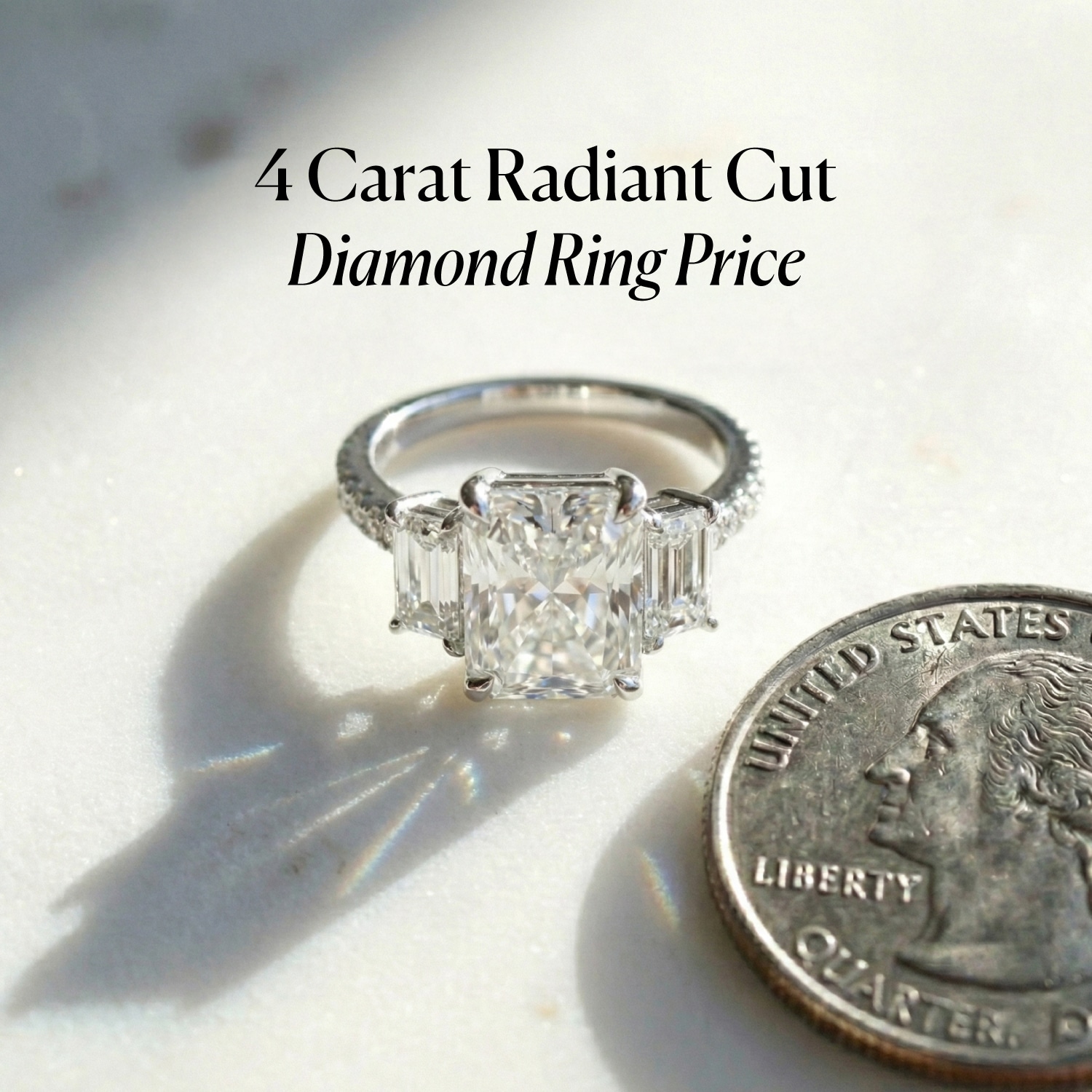
How much does a 4 carat radiant cut diamond ring price actually set you back in 2026? We analyzed live inventory data to find the “Total Receipt” for a high-end 3-stone build.
Because this design features a massive center stone flanked by 0.58ct tw Emerald cut side stones, the Total Carat Weight (TCW) is a staggering 4.58 carats.
- The Bottom Line (Total Ring Cost):
- Natural Option: Starts at $47,440 (3.51ct G-VS2 stone + setting). Prices spike to $105,280 for a true 4-carat, high-spec natural build.
- Lab-Grown Option: Starts at $7,540 (3.91ct F-VVS2 stone + setting). The ceiling sits around $26,890 for rare E-IF “collector” lab stones.
- Natural Option: Starts at $47,440 (3.51ct G-VS2 stone + setting). Prices spike to $105,280 for a true 4-carat, high-spec natural build.
- The Setting Cost Gap: The exact same 14K White Gold 3-Stone setting costs $3,880 for natural diamonds but only $2,100 for lab diamonds at Blue Nile. This is a $1,780 “Natural Tax” just on the metal and side stones.
- The “Mehedi” Value Pick:
- Lab Buy: GIA 3.91ct F-VVS2 + Setting = $7,540 Total.
- Natural Buy: GIA 3.51ct G-VS2 + Setting = $47,440 Total.
Deal Alert: Fast-Shipping Gifts — Up to 50% Off* fine jewelry at Blue Nile !
One In A Lifetime Sale: “Clear The Vault” – Get up to 70% OFF on select jewelry at Blue Nile !
Exclusive Offer: Flash Sale on James Allen Up to 40% Off * Sitewide engagement ring settings & Fine Jewelry at James Allen .
Compare these to the Best Engagement Ring Settings for $1500 if you want to lower your total cost even further.
A 4-carat Radiant cut diamond is a powerhouse on its own. However, flanking it with matched Emerald cut side stones (0.58ct tw) elevates it from a “big rock” to a celebrity-style statement piece.
This 3-stone configuration creates a sophisticated texture contrast: the chaotic, “crushed ice” fire of the Radiant center meets the calm, icy “step cuts” of the Emerald sides.
But here is the reality check: depending on whether you choose a natural or lab-grown center, this ring costs either the price of a used Toyota or a brand-new Porsche 911.
Our Methodology: We are calculating the “out-the-door” price for a 4.58ct TCW masterpiece. Using the Blue Nile “Diamond Search AI” and latest Feb 2026 price feeds, we’ve paired specific center stones with the Blue Nile Three-Stone Emerald Cut Engagement Ring in 14K White Gold.
Whether you are chasing the prestige of nature or the technical perfection of the lab, these tables break down every dollar spent.
Don’t forget to factor in the Hidden Costs of Engagement Ring purchases, such as insurance and regional taxes.
Diamond IQ Test: Natural or Lab-Grown?
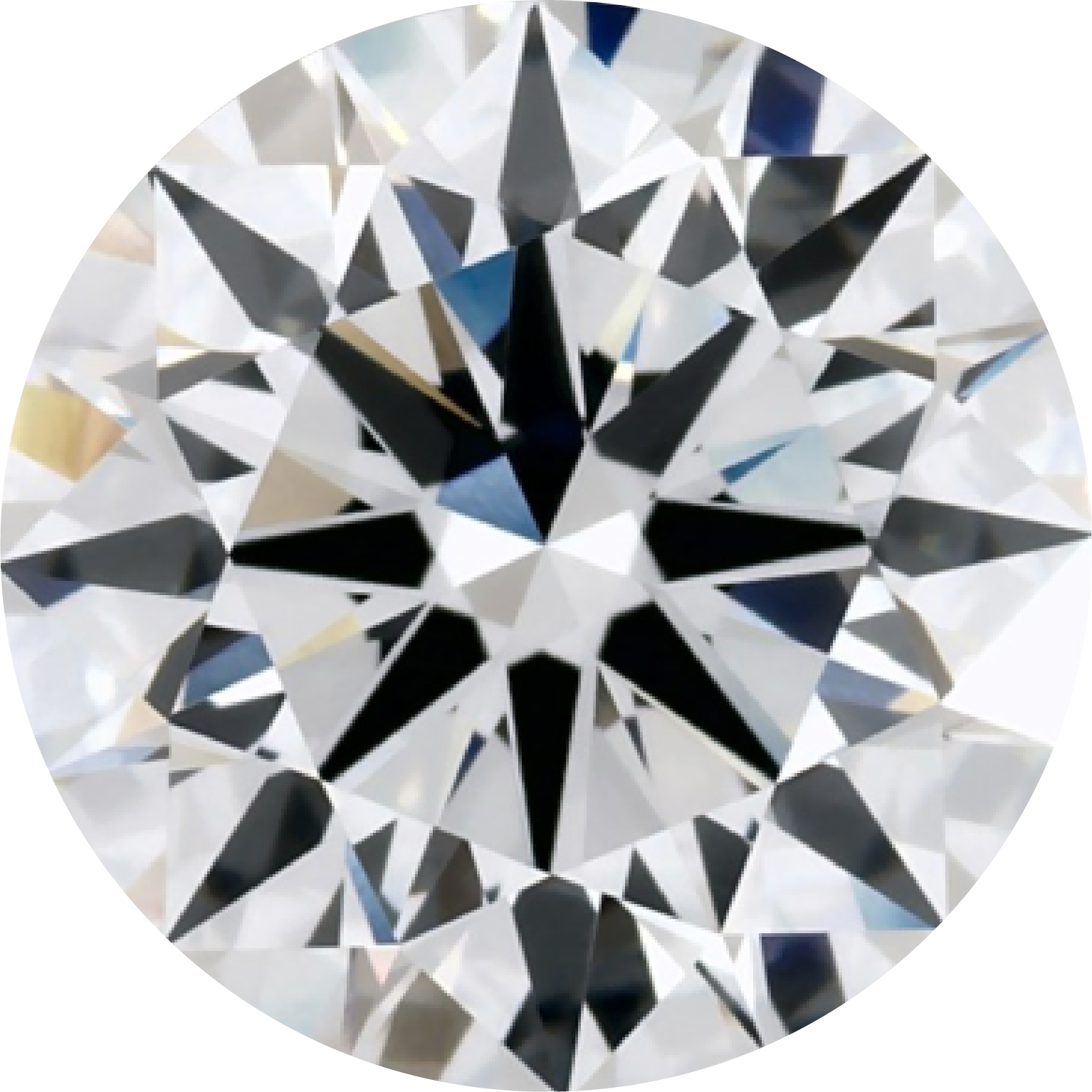
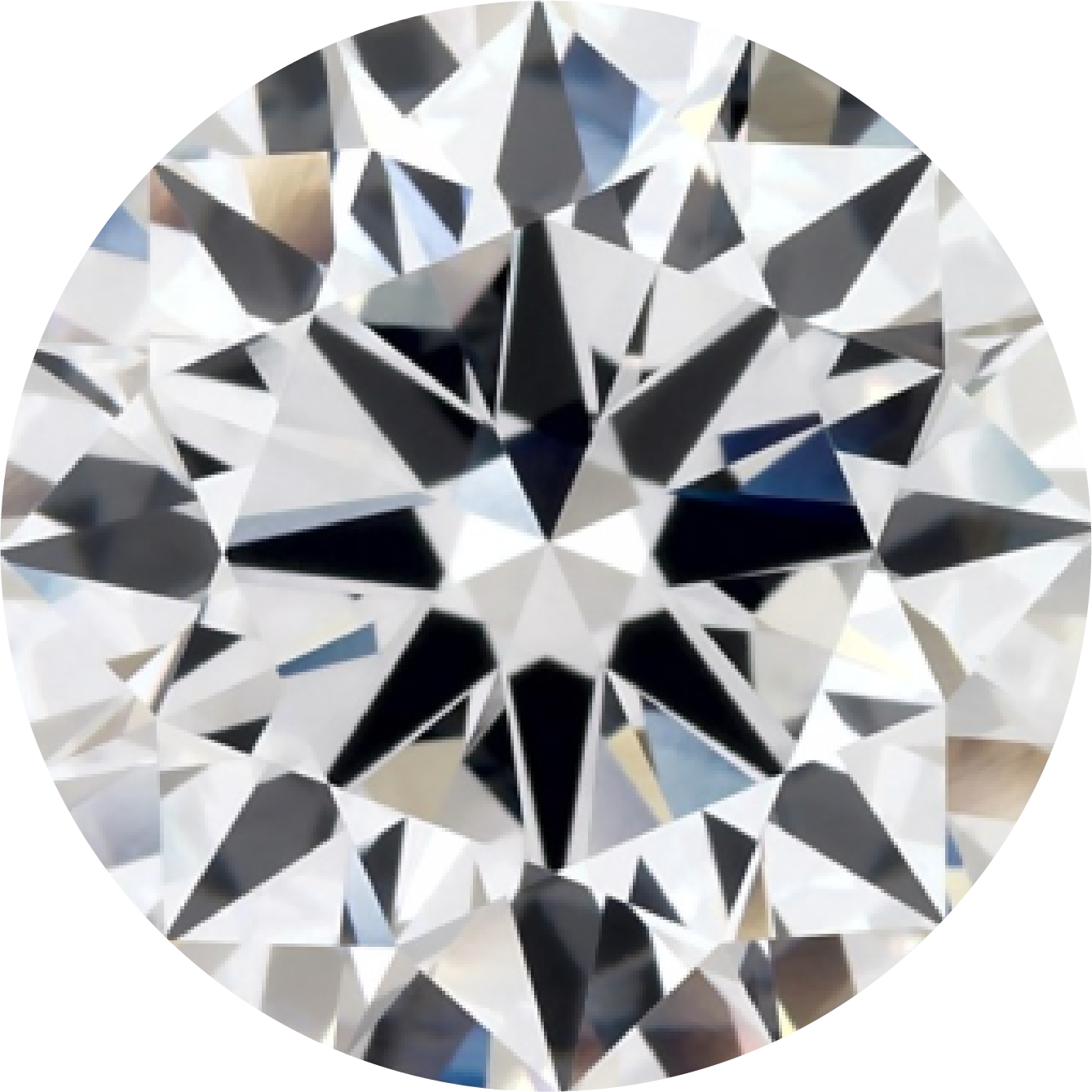
Two identical diamonds: GIA Certified, 1.51ct, D Color, VVS1, Ideal Cut. One is natural ($16,530), the other is lab-grown ($2,390). Choose the diamond you like better and see if you can match it to its origin.
The Lab-Grown Build: The $7,500 Revolution
In February 2026, the market for a 4 carat radiant cut diamond ring price has been completely disrupted by the lab-grown sector. What was once a six-figure dream is now achievable for the price of a modest engagement budget.
By utilizing lab-created stones, we can prioritize elite cut quality and clarity without hitting the “rarity tax” of natural earth-mined diamonds.
Building the 3-Stone 4 Carat Radiant Cut Lab Diamond Ring (Total Cost Breakdown)
To create this high-impact look, we paired the Blue Nile Lab-Grown Three-Stone Setting ($2,100) with the latest GIA and IGI certified inventory.
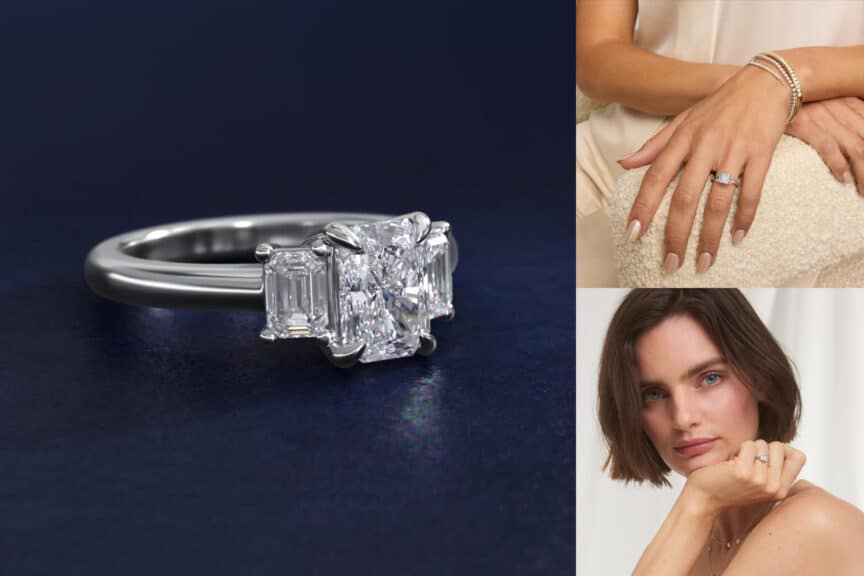
Because the setting already includes 0.58ct tw of Emerald cut side stones, the finished product sits at a massive 4.50+ Carats Total Weight (TCW).
Lab Ring Price List (Center Stone + $2,100 Setting)
| Tier | Lab Diamond Spec (Ideal Cut) | Stone Price | Total Ring Cost |
|---|---|---|---|
| “The Value Floor” | GIA 3.91ct F-VVS2 | $5,440 | $7,540 |
| “The Value Floor” | GIA 3.91ct F-VVS2 | $5,730 | $7,830 |
| “The Color Bump” | GIA 3.91ct E-VVS2 | $6,210 | $8,310 |
| “The True 4.00” | GIA 4.00ct E-VVS2 | $6,830 | $8,930 |
| “The True 4.00” | IGI 4.00ct F-VVS2 | $6,860 | $8,960 |
| “D-Color Premium” | GIA 3.98ct D-VVS1 | $8,870 | $10,970 |
| “Top Tier” | GIA 4.00ct D-VVS1 | $9,690 | $11,790 |
| The 2026 Buying Verdict: The sweet spot is undeniable. Choosing the 3.91ct F-VVS2 ($5,440) saves you over $1,400 compared to the “True 4.00” option. Nobody will ever know the difference on your finger. | |||
Mehedi’s Analysis: The Visual Powerhouse
“Look closely at ‘The Value Floor’ option. We are talking about a GIA 3.91ct F-VVS2 Radiant—which is physically indistinguishable from a 4.00ct stone—set in a handcrafted 3-stone ring for just $7,540.
Visually, this build actually beats the entry-level Natural rings in our data because of the VVS2 clarity. In a stone of this size, high clarity is vital to ensure the center doesn’t look ‘hazy.’ With lab-grown, you are buying a technically perfect rock for 10% of the cost of its natural twin.”
Choosing between different types of lab grown diamonds is easier when you realize that GIA and IGI are now providing the same rigorous grading for these stones as they do for the $100,000 versions.
At the $8,000 to $11,000 range, you are securing a ring that would have been reserved for the 1% just a few years ago.
The Natural Build: The $47,000+ Reality
When we pivot to natural earth-mined diamonds, the 4 carat radiant cut diamond ring price enters the territory of fine art and high-end real estate.
In this tier, we aren’t just paying for a gemstone; we are paying for the extreme geological rarity of a crystal that survived billions of years beneath the earth’s crust.
Building the Natural 4-Carat Ring (Total Cost Breakdown)
For the natural build, we pair our inventory with the Blue Nile Natural Three-Stone Emerald Cut Setting ($3,880).
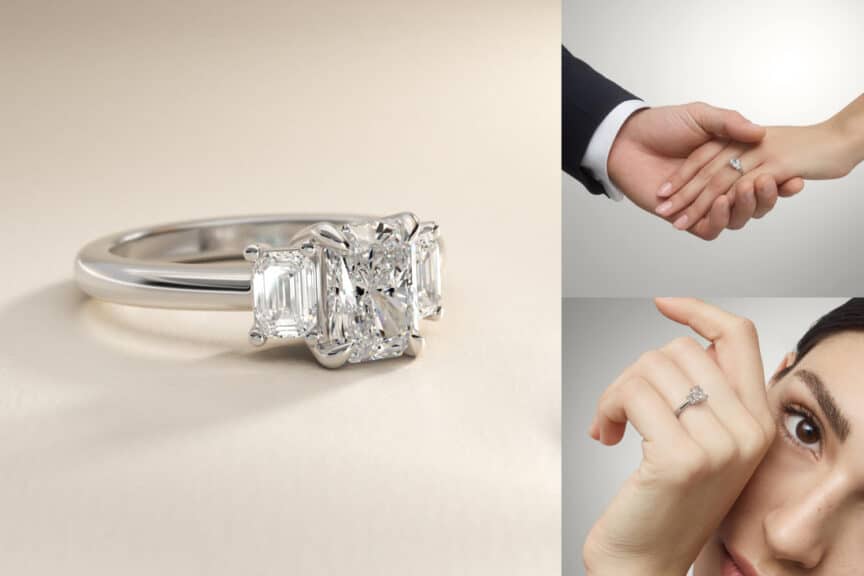
It is important to note that this setting is $1,780 more expensive than the lab version, largely due to the higher market value of natural emerald-cut side stones.
Natural Ring Price List (Center Stone + $3,880 Setting)
| Tier | Natural Diamond Spec (GIA) | Center Stone Price | Total Ring Cost (Set) |
|---|---|---|---|
| “Smart Entry” | 3.51ct G-VS2 Radiant | $43,560 | $47,440 |
| “The Gap Jump” | 3.52ct F-VS1 Radiant | $73,710 | $77,590 |
| “Colorless Flex” | 3.51ct D-VVS2 Radiant | $85,790 | $89,670 |
| “High-Weight Flex” | 3.71ct E-VS1 Radiant | $85,890 | $89,770 |
| “True 4 Carat” | 4.06ct D-VS2 Radiant | $93,970 | $97,850 |
| “The Ceiling” | 4.03ct E-VS2 Radiant | $101,400 | $105,280 |
| The 2026 Price Verdict: The $43,560 Smart Entry option is the undisputed winner. It offers nearly the same visual impact as the $73k option but saves you enough money to buy a luxury car. The $30,000 premium for F-Color is simply a vanity tax. | |||
The Data Shock: The $57,000 “Magic Number”
As a gemologist, the most startling takeaway from our February 2026 data is the “Magic Number” premium. Look at the jump from the 3.51ct G-VS2 to the 4.03ct E-VS2.
Mehedi’s Analysis: “To move from a 3.51ct stone ($47k total) to a true 4.03ct stone ($105k total), you are paying an extra $57,840. You are essentially paying nearly $60,000 more just to gain 0.52 carats of weight and two steps in color.
In the natural market, crossing the 4.00-carat threshold triggers an exponential price hike because stones of that size and quality are ‘Museum Grade’ rarities.”
If you find that these six-figure prices are out of reach, you may want to look at our analysis of the 3 carat radiant cut diamond ring price where the entry floor is significantly lower (around $38k).
However, if you are committed to the 4-carat look, the “Smart Entry” 3.51ct G-VS2 is the technical winner.
Because it is nearly 10mm long, it provides the visual “spread” of a 4-carat stone without the $100k price tag. For more details on navigating these massive sizes, visit our 4 Carat Diamond Ring Guide.
The “Bad Deal” Alerts (Using Your Data)
In the world of high-carat diamonds, “more expensive” does not always mean “more beautiful.” While analyzing the February 2026 inventory, I found several instances where a buyer could easily spend an extra $50,000 without seeing a single bit of difference with the naked eye. Here are the traps you must avoid.
Pricing Traps We Found in the Inventory
Trap 1: The Lab “Internally Flawless” Premium
In the lab-grown market, “Internally Flawless” (IF) is a psychological trap. Because lab diamonds are man-made, achieving high clarity is common, but retailers still charge a massive “rarity” premium for the IF label.
- Data Point: We found a GIA 4.00ct E-IF Lab Diamond listed at $24,790 (stone only).
- The Comparison: A GIA 4.00ct E-VVS2 (virtually identical to the eye) is only $6,830.
Mehedi’s Take: “You are paying $17,960 extra just for the word ‘Flawless’ to appear on a piece of paper. This is insane. In a Radiant cut, the ‘crushed ice’ sparkle hides everything anyway. You should also avoid the IGI 4.00ct D-IF stones at $19,410.
Stick to the VVS2 or VS1 range (the $7k bracket) and spend that saved $17,000 on a luxury honeymoon or a second piece of jewelry.”
Trap 2: The Natural 3.50 vs. 4.00 “Magic Number”
In natural diamonds, the price isn’t a straight line—it’s a staircase. There is a massive “step up” in price the moment you hit the 4.00-carat mark.
- Data Point: A 3.51ct G-VS2 is priced at $43,560.
- The Trap: A 4.06ct D-VS2 is priced at $93,970.
Mehedi’s Take: “The 3.51ct stone is already massive and will cover most of the finger width. Paying double—literally $50,000 more—just to cross that 4.00-carat line is a vanity play.
Unless you specifically need the certificate to say ‘4.0,’ the 3.51ct stone is the much smarter financial move. It gives you the same ‘wow’ factor for half the price.”
While we are discussing high-tier clarity, it is worth asking: are I2 diamonds worth buying? In stones this large, the answer is usually no because inclusions become visible.
However, jumping all the way to ‘Internally Flawless’ is equally unnecessary. VS1 or VS2 is the sweet spot where the diamond is eye-clean, but the price remains (relatively) grounded.
Setting Analysis: Why is the Natural Ring $1,780 More?
When building your dream ring, you might expect the price of the metal to be a fixed cost. However, our 2026 data reveals a shocking “hidden tax” that most buyers completely overlook.
Even when the 14K White Gold and the design are identical, the price changes based on the origin of the diamonds.
The Hidden “Natural Setting” Tax
While analyzing the Three-Stone Emerald Cut Diamond Engagement Ring at Blue Nile, we noticed a significant price discrepancy between the natural and lab-grown versions of the exact same mount.
Setting Comparison — Natural vs. Lab-Grown
| Feature | Natural 3-Stone Setting | Lab-Grown 3-Stone Setting | The Price Gap |
|---|---|---|---|
| Side Stone Type | 0.58ct tw Natural Emerald | 0.58ct tw Lab Emerald | — |
| Metal | 14K White Gold | 14K White Gold | — |
| Width | 2.00mm | 2.00mm | — |
| Setting Price | $3,880 | $2,100 | $1,780 |
| The 2026 Setting Verdict: Do not pay the premium for natural side stones. These 0.29ct diamonds are too small to hold investment value. By choosing the Lab-Grown Setting ($2,100), you save enough money to upgrade your center stone by a full carat. | |||
Why the $1,780 Difference?
Retailers often price settings for natural diamonds higher to protect their overall profit margins. Because the markup on a $50,000 natural diamond is relatively thin, the “Natural Setting” includes a premium.
Conversely, with lab diamonds, the retailer has a better margin on the center stone itself, allowing them to discount the engagement ring metals pros and cons and the side stones to make the total package more attractive.
The Double Savings Effect
By choosing the lab-grown path, you aren’t just saving on the center rock; you are saving $1,780 on the gold and side stones alone. This means you save money twice. If you were to upgrade this setting to Platinum, that gap would likely widen further.
For those curious about high-end metals, check our guide on how much does a platinum ring cost? to see if the investment is worth it for a 4-carat center stone.
Mehedi’s Insight: “Paying nearly $4,000 for a 14K gold setting is steep. If you are going natural, I strongly recommend asking for a price match or looking for a more competitive engagement ring under $2,500 that can still support a large radiant cut safely.”
Visuals: Radiant + Emerald Side Stones
When you’re dealing with a 4 carat radiant cut diamond ring price, you aren’t just paying for the center stone; you’re paying for the overall visual impact.
Pairing a massive Radiant cut with Emerald cut side stones is a strategic design choice that offers one of the most sophisticated looks in high-end jewelry.
Why This Setting Works for 4 Carats
This specific 3-stone configuration is more than just a “large ring.” It is a study in optical contrast.
- The Style Contrast: A 4-carat Radiant is a “brilliant” cut, meaning it’s designed for maximum fire and scintillation—often referred to as the “crushed ice” look. By flanking it with Emerald cuts, which are “step cuts,” you create a stunning visual break.
The side stones offer a calm, mirror-like “hall of mirrors” effect that allows the center stone’s chaotic sparkle to truly pop. - The Coverage Factor: This isn’t just a 4-carat ring. When you add the 0.58ct tw side stones, your Total Carat Weight (TCW) jumps to a staggering 4.58 carats.
- Finger Real Estate: On a standard size 6 finger (which is approximately 16.4mm wide), a 4-carat Radiant—typically measuring about 10mm to 11mm in length—paired with Emerald side stones will span nearly the entire width of the finger.
This provides “wall-to-wall” diamond coverage that looks significantly more expensive than a solitaire of the same weight.
Mehedi’s Design Note: “Sparkle vs. Sheen”
“The reason this setting is a favorite among celebrity stylists is the contrast between ‘sparkle’ and ‘sheen.’ The 70 facets of the Radiant center are fighting for your attention with high-speed flashes of light, while the long, linear facets of the Emerald side stones provide a steady, architectural glow.
It makes the ring look intentional and curated, rather than just ‘big.’ If you want to know more about how these facets interact, check out my technical breakdown of Radiant Cut Diamond Secrets.”
Because a 4-carat stone is so dominant, the side stones act as a “buffer” that tapers the ring down toward the band, making it much more comfortable for daily wear than a single, massive rock that might feel top-heavy.
If you’re looking for best engagement ring settings for $15,000 budgets, this 3-stone layout is the gold standard for maximizing your visual investment.
FAQ: The Unfiltered 4 carat radiant cut diamond ring price Answers
Building a 4 carat radiant cut diamond ring price profile is different than shopping for a 1-carat stone. At this scale, tiny differences in quality results in five-figure price swings. Here are the unfiltered answers to the most common questions about the 2026 market.
What is the total price difference between a 4 carat natural radiant diamond ring and a lab grown one in 2026?+
The total price difference is approximately $90,310. Based on our 2026 analysis, a high-spec GIA 4ct D-VS2 Natural Build costs roughly $97,850, while a comparable 4ct D-VVS2 Lab Build costs only $7,540. You are essentially saving the price of a luxury SUV by choosing lab-grown. Compare this with our 4 carat diamond ring price guide.
Why does the same 3-stone ring setting cost more for natural diamonds than for lab diamonds?+
This is often called a “Natural Tax.” Retailers frequently inflate the price of settings paired with natural diamonds to protect thin margins, whereas lab stones allow for more competitive metal pricing. Learn more about choosing settings in our best engagement ring settings guide.
Can I really build a high-quality 4 carat diamond ring for under $8,000?+
Yes, in the lab-grown market. A GIA 3.91ct F-VVS2 lab diamond paired with a high-quality setting can bring your total to roughly $7,540. This provides a stunning, eye-clean look for a fraction of natural prices. Check out our guide to affordable lab diamond values.
Is a 3.9 carat radiant cut diamond noticeably smaller than a full 4 carat stone?+
No. A 3.91ct Radiant typically measures within 0.1mm of a 4.00ct stone, making them visually identical. “Buying shy” of the 4.00ct mark can save you a massive “magic number” premium. Use our diamond carat size chart to compare millimeter measurements.
How much should I expect to pay for a GIA certified 3.5 to 4 carat natural radiant diamond?+
Expect to pay between $43,560 and $93,970 depending on color and clarity. While a G-VS2 entry point sits near $43k, crossing into D-color and the 4-carat mark easily clears $90,000. See more specific pricing for a 4 carat solitaire diamond ring.
Is it worth paying $18,000 extra for an Internally Flawless 4 carat lab diamond over a VVS2?+
Absolutely not. Because a Radiant’s facets hide inclusions so well, you will never see the difference between IF and VVS2 with the naked eye. Paying $18k for “paper perfection” in a lab stone is a vanity trap. Read about the value of vvs2 diamond meaning and cost.
What clarity grade do I need for a 4 carat radiant diamond to be 100% eye-clean?+
For a Radiant cut, VS2 is the sweet spot. The complex “crushed ice” faceting masks inclusions exceptionally well. You only need to pay for si1 clarity diamond or higher if choosing a step-cut. For Radiants, vs2 clarity diamond is almost always eye-clean.
Do emerald cut side stones pair well with a radiant cut center diamond?+
Yes, it is a sophisticated pairing. The contrast between the Radiant’s fire and the Emerald side stones’ “hall of mirrors” effect is stunning. Learn more about this combination in our emerald cut diamond guide.
How much is jewelry insurance for a $47,000 natural ring versus a $7,000 lab ring?+
Insurance typically costs 1–2% of value annually. For a $47k natural ring, you’ll pay roughly $470–$940 per year, compared to just $75–$150 for a $7k lab ring. Over 10 years, the savings are massive. Find out how to value your jewelry in our definition of appraisal guide.
What is the minimum color grade recommended for a 4 carat radiant diamond to look white in platinum?+
In platinum, I recommend a minimum of G color. Large 4-carat stones concentrate warmth more than smaller diamonds. An f color diamond is the safest for a colorless look, while a g color diamond is the best value. Avoid lower grades unless using yellow gold.
Conclusion: Mehedi’s “Final Build” Verdict
After building this specific ring twice—once with natural diamonds and once with lab diamonds—the financial reality is impossible to ignore. You are looking at a $39,900 difference for a ring that will look nearly identical to everyone except your insurance appraiser.
Here is exactly how I would handle this purchase in February 2026:
The “Hard Pass” (What to Avoid):
- The Lab GIA 4.00ct E-IF Build ($26,890 Total): Do not make this mistake. You are paying nearly $27,000 for a lab diamond just because it says “Internally Flawless.” Visually, it looks exactly the same as the $7,500 option. Do not burn $20,000 on “paper quality” in the lab market.
The “Natural Winner” (Smart Money):
- The Build: Blue Nile Setting + GIA 3.51ct G-VS2 Stone.
- Total Price: $47,440.
- Why: This gets you the massive “Three-Stone” aesthetic and genuine scarcity without hitting the $100,000 pricing tier found in the 4.00ct+ bracket. This is the maximum luxury look for the minimum entry price in the natural sector.
The “Lab Winner” (The Value King):
- The Build: Blue Nile Lab Setting + GIA 3.91ct F-VVS2 Stone.
- Total Price: $7,540.
- Why: This is the undisputed winner. Not only is it virtually 4 carats visually, but it also has Better Specs (VVS2 vs VS2) and Better Color (F vs G) than our natural winner.
- The Result: You get a superior-looking ring and save $39,900. That saving is enough to pay for the entire wedding, the honeymoon, and a down payment on your first home.
Pricing on specific large-carat stones fluctuates daily based on wholesaler availability. Before you commit to a purchase, double-check the fair market value using our Diamond Rate Calculator to ensure you aren’t paying a “vanity premium.”