
Expert Quick Take: My Honest Opinion After Sourcing 9ct Diamonds
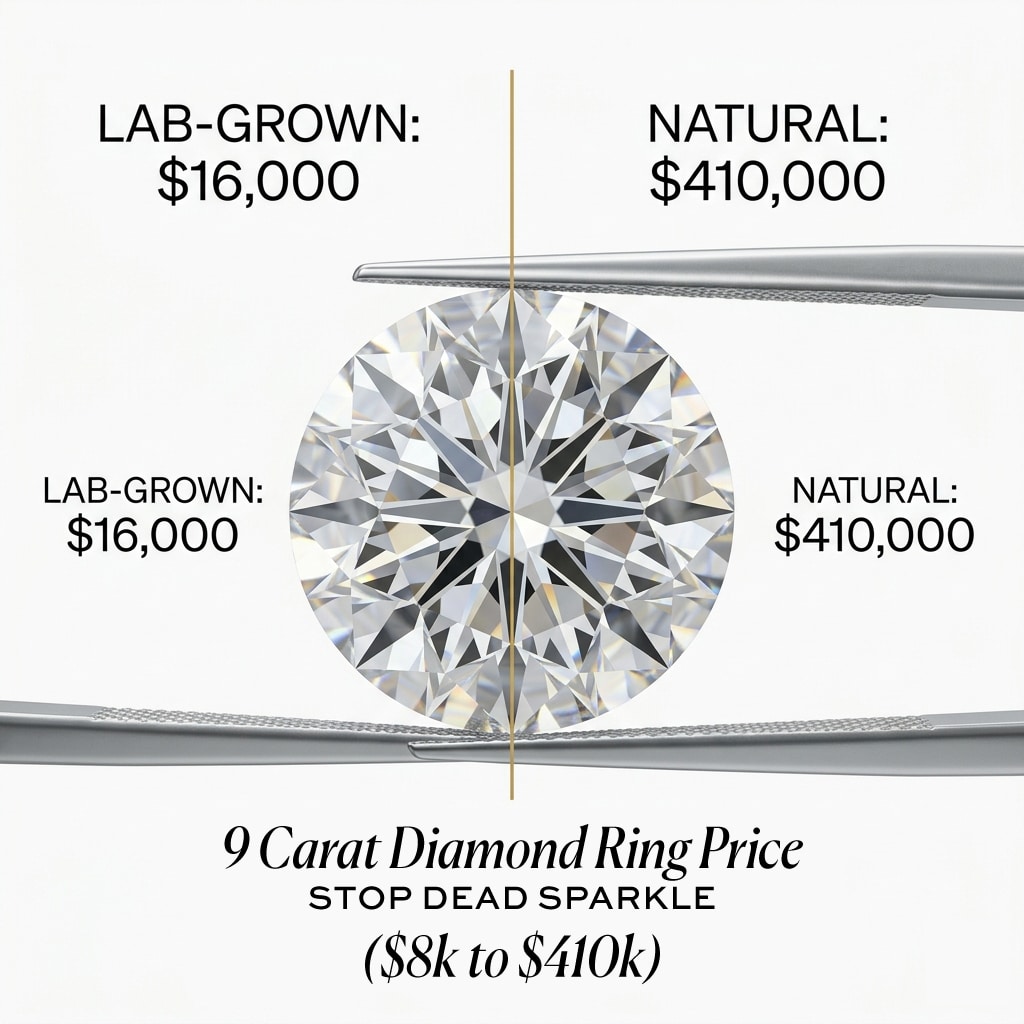
In 2026, a 9-carat diamond ring costs between $8,340 (Entry Lab-Grown) and $410,720+ (Premium Natural). At this massive size, standard diamond buying rules are dangerous. General blogs will tell you an ‘I’ color and ‘VS2’ clarity is a smart buy.
As a GIA gemologist, I can assure you that in a 9-carat crystal, an ‘I’ color looks distinctly yellow, and a poorly cut stone will suffer from ‘dead sparkle’—looking like a lifeless piece of glass.
You must audit the Depth Percentage and Color Saturation before spending six figures.
The 9ct Strategy
| If Your Goal Is… | Choose This Strategy | Why Mehedi Recommends It |
| “New Luxury” Impact | Lab E-VS1 ($16k) | You get icy white color and flawless aesthetics for the price of a compact car. GIA 9.11ct E-VS1 ($16,640). |
| Generational Asset | Natural F-VS1 ($410k) | High color/clarity in a natural 9ct stone creates a liquid, auction-tier investment. GIA 9.01ct F-VS1 ($410,720). |
| The Budget “Trap” | Natural K-SI2 (~$140k) | Avoid this. A 9ct K-color stone looks heavily tinted. GIA 9.03ct K-SI2 ($140,620). |
If you want the best visual transparency, you must rely on 360-degree video audits. Do not buy a 9-carat diamond blind based on a certificate. Use Blue Nile’s high-jewelry filters to weed out the bad cuts.
Deal Alert: Fast-Shipping Gifts — Up to 50% Off* fine jewelry at Blue Nile !
One In A Lifetime Sale: “Clear The Vault” – Get up to 70% OFF on select jewelry at Blue Nile !
Exclusive Offer: Flash Sale on James Allen Up to 40% Off * Sitewide engagement ring settings & Fine Jewelry at James Allen .
For an asset of this magnitude, a Diamond Appraisal Calculator isn’t just a tool; it’s your insurance against a $100,000 error.
- The Lab-Grown Arbitrage: The $8k to $16k Revolution
- The Natural Market: Navigating the $136k to $410k Gap
- The "Depth Trap": Preventing Dead Sparkle
- The "Windowing" Warning in Large Step Cuts
- The Shape & Price Table
- Structural Integrity: The 2.5mm Rule
- FAQ: The Whale Buyer's Guide
- What is the average price of a 9 carat natural diamond compared to a lab grown diamond in 2026?+
- Why is an 'I' color grade often considered too yellow for a 9 carat natural diamond?+
- How much does it cost to buy a flawless 9 carat lab grown diamond engagement ring?+
- Can I see inclusions in an SI2 clarity 9 carat diamond with the naked eye?+
- What is 'windowing' in a 9 carat emerald or asscher cut diamond, and how do I avoid it?+
- Why does a 9 carat diamond with a depth over 63% look smaller than it actually is?+
- What is the minimum recommended band width to safely hold a 9 carat diamond?+
- Which diamond shape looks the absolute largest for a 9 carat stone?+
- How much does it cost per year to insure a $250,000 9 carat natural diamond ring?+
- Is it better to buy a 9 carat lab diamond with F color or a 9 carat natural diamond with K color?+
- Conclusion: Mehedi's Verdict
The 9-carat diamond isn’t just a piece of jewelry; it is a physical anomaly. Most local jewelers will never see one in their entire career, let alone possess the technical equipment to audit its structural safety.
Mehedi’s Reality Check:
Other blogs advise you to save money by dropping down to an ‘I’ or ‘J’ color. This is terrible advice for a 9-carat stone. Body color is highly concentrated in large crystals.
An ‘I’ color 1-carat diamond looks white; an ‘I’ color 9-carat diamond acts like a yellow magnifying glass. Today, we are auditing the $8k to $410k price gap to ensure you don’t buy a dull, yellow rock.
Why “Whiteness” Costs $270,000 Extra
Look at the 2026 price divergence in the natural market:
- The “Warm” Entry: GIA 9.73ct J-SI2 Radiant ($136,170). Even at 9.7 carats, the J-color tint is hard to hide in a platinum setting.
- The “Icy” Asset: GIA 9.01ct F-VS1 Asscher ($410,720). You are paying a $274,550 premium primarily for the lack of yellow tint and the surgical clarity required for a step-cut.
In this guide, we will cover the Lab Arbitrage (how to save $390k), the Depth Trap (why deep stones look small), and why Windowing in 9ct stones makes standard SI1 clarity a massive risk.
Diamond IQ Test: Natural or Lab-Grown?
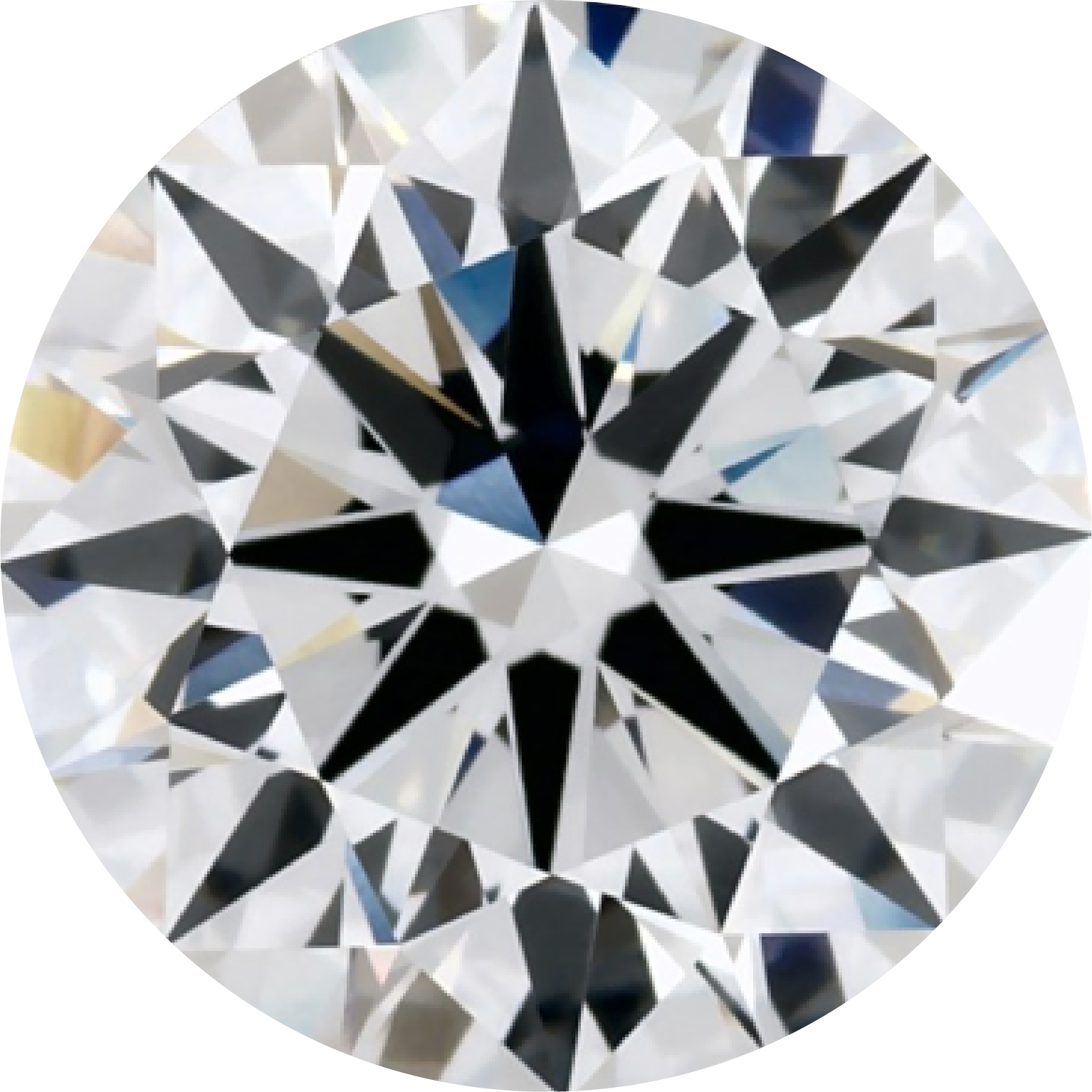
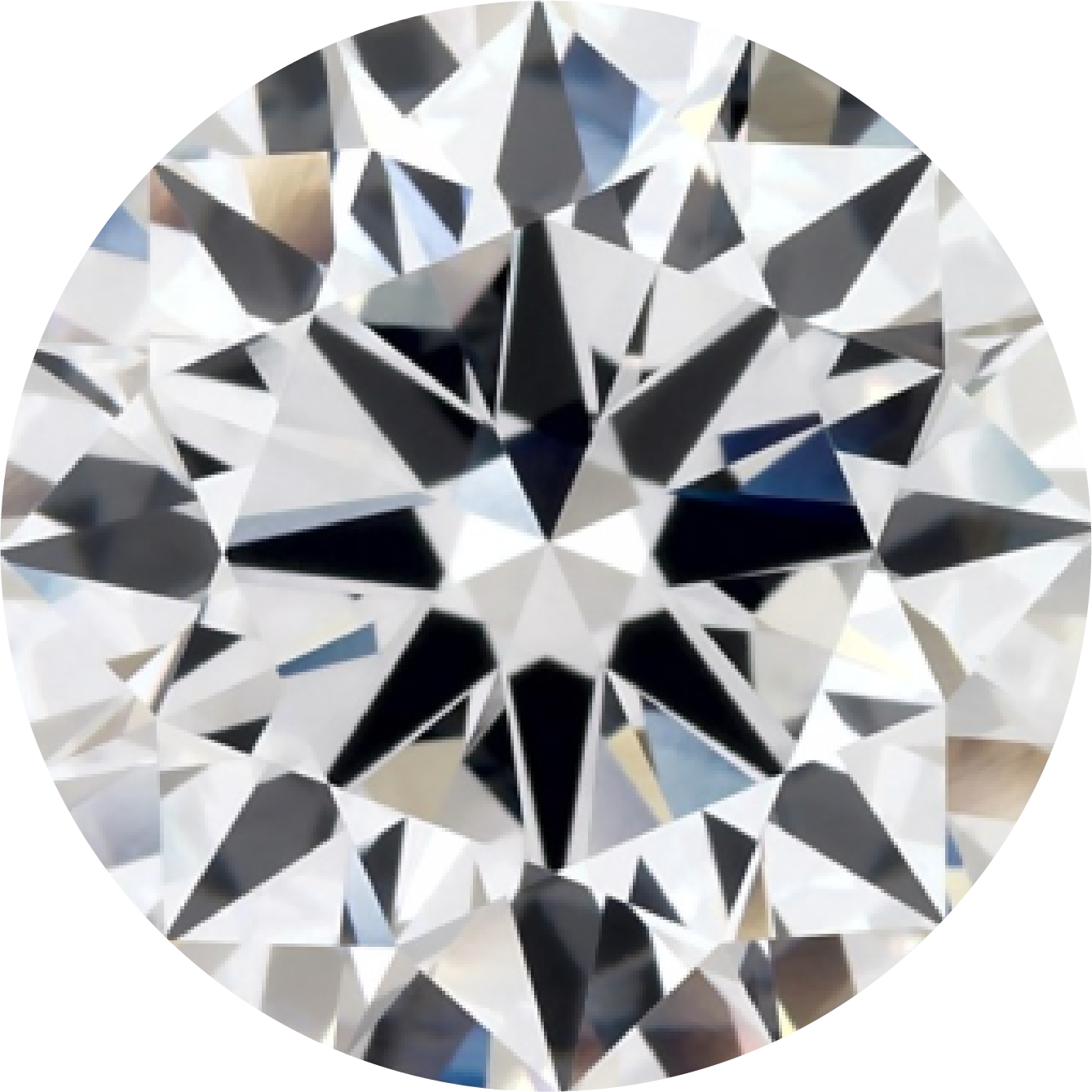
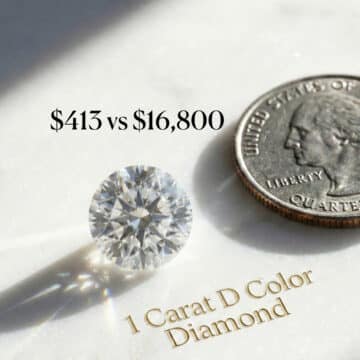
Two identical diamonds: GIA Certified, 1.51ct, D Color, VVS1, Ideal Cut. One is natural ($16,530), the other is lab-grown ($2,390). Choose the diamond you like better and see if you can match it to its origin.
The Lab-Grown Arbitrage: The $8k to $16k Revolution
In 2026, the lab-grown market has reached “Moore’s Law” efficiency. What used to take months in a reactor now takes weeks, and the result is a massive influx of ultra-large, 9-carat+ crystals.
However, this has created a violent price divergence between “Wholesale Disruptors” and “Legacy Markups.
9 Carat Lab Diamond Cost: The 2026 Disruptor
Advanced Chemical Vapor Deposition (CVD) technology can now produce pristine 9-carat rough crystals with zero post-growth treatment. In early 2026, you can purchase a visually flawless 9-carat lab diamond for between $8,340 and $17,000.
If you see a price higher than $25,000 for a lab stone, you are likely paying a “Brand Tax” that has no basis in the diamond’s physical quality.
The 2026 Lab Price Matrix (GIA & IGI Verified Data)
| The Strategy | Stone Specification | 2026 Price | Visual Reality |
| The Absolute Floor | IGI 9.01ct H-VS2 Round | $8,340 | White enough for Yellow Gold; eye-clean. |
| The Smart Value | IGI 9.07ct F-VS1 Round | $10,705 | The “Sweet Spot” for colorlessness and clarity. |
| The Judicial Winner | GIA 9.11ct E-VS1 Round | $16,640 | Icy white with GIA-level grading rigor. |
| The Vanity Trap | IGI 9.22ct E-IF Round | $78,130 | Avoid. You are paying a $61k premium for a label. |
The 2026 Debate: Value vs. Vanity ($60,000 Clarity War)
The Case for the $16k “Smart Buy”:
As your GIA Auditor, I look at the GIA 9.11ct E-VS1 ($16,640) as the ultimate 2026 purchase. At 9 carats, an ‘E’ color is high enough to resist the ‘Color Concentration’ yellowing effect.
The VS1 clarity ensures that no inclusions are visible through those massive windows. You are buying a technically perfect stone for the price of a used Honda.
The Case Against the $78k “Vanity Outlier”:
Notice the IGI 9.22ct E-IF ($78,130). This price is an industry relic. In the lab-grown world, ‘Internally Flawless’ (IF) status is a manufacturing setting, not a geological miracle.
Paying a $61,000 premium to move from VS1 to IF is mathematically insane—it’s like paying for a car with a 1,000mph speedometer when you can only drive 60mph. You cannot see the difference.“\
CVD vs. HPHT: The 9-Carat Technical Audit
In 2026, the growth method matters for stones this large.
- CVD (Chemical Vapor Deposition): Most 9ct lab diamonds use this method. The Risk: In ultra-large stones, CVD can sometimes show ‘Strain Lines’ (looks like faint wood grain under a 10x loupe).
- HPHT (High Pressure High Temp): Often creates a crisper crystal but can suffer from ‘Blue Nuance’ (a faint blue/gray tint).
I always check the certificate for ‘As Grown’ status. If the stone requires ‘Post-Growth Treatment’ to fix its color, I pass. The IGI 9.07ct F-VS1 ($10,705) from Rare Carat is almost always an ‘As Grown’ CVD stone, providing the best structural and visual purity for the money.
To understand which method fits your setting best, check my deep dive on the Types of Lab Grown Diamonds.
The Natural Market: Navigating the $136k to $410k Gap
In the 2026 “Whale-tier” market, the natural diamond sector has become a game of Geological Scarcity. Unlike the lab market, where supply is scalable, a 9-carat natural diamond is a finite asset.
This is why you see a staggering $270,000 price gap between a “warm” stone and an “icy” investment-grade specimen.
9 Carat Natural Diamond Inventory Audit
True 9-carat natural diamonds in 2026 start around $136,000 for stones with visible warmth (J/K color) or inclusions (SI2) and quickly exceed $410,000 for premium F/G colors with VS+ clarity.
At this level, you aren’t just buying jewelry; you are acquiring a liquid asset that holds a significantly higher natural diamond resale value (20-60%) compared to lab-grown alternatives (10-40%).
The 2026 Natural Price Matrix
| The Market Entry | Stone Specification | 2026 Price | Mehedi’s “Judicial” Verdict |
| The Budget Entry | GIA 9.73ct J-SI2 Radiant | $136,170 | The Compromise: Hides inclusions well, but the “J” color will look distinctly “warm.” |
| The Mid-Tier | GIA 9.56ct H-SI1 Round | $249,690 | The Standard: The most popular choice for a 9ct solitaire, but H-color is the “Saturation Floor.” |
| The Premium Asset | GIA 9.01ct F-VS1 Asscher | $410,720 | The Winner: Absolute visual perfection for a step-cut. This is an auction-tier investment stone. |
The Valuation Rule: Why “F” Costs $274,000 More Than “J”
“Why is the 9.01ct Asscher ($410,720) so much more expensive than the larger 9.73ct Radiant ($136,170)?
- Color Saturation: In a 9-carat crystal, body color is heavily concentrated. A ‘J’ color 1-carat diamond might look white; a ‘J’ color 9-carat diamond acts like a yellow magnifying glass. To get a truly icy look, you must pay the premium for F-Color ($410k).
- Clarity Windowing: Large step-cuts like Asschers have broad, flat facets that act like windows. You can see straight through to the bottom. While a Radiant cut hides inclusions in its ‘crushed ice’ sparkle, an Asscher demands VS1 Clarity to maintain its ‘Hall of Mirrors’ effect.”
Judicial Audit: The “Color-Metal Strategy” for 9ct
If your heart is set on a 9.03ct K-SI2 Oval ($140,620) but you are worried about the yellow tint, you must mount it in a 14k yellow gold setting. The warm metal will mask the diamond’s tint.
If you put a ‘K’ color stone in a Platinum cathedral engagement ring, the contrast will make the diamond look like an old tea-stained window. For an icy Platinum look, the 9.56ct H-SI1 Round ($249k) is the absolute color floor I recommend.
Expert Tip: Before spending $200k+, run your selected stone through my Diamond Appraisal Calculator to see how the current 2026 market values your specific color/clarity combination.
The “Depth Trap”: Preventing Dead Sparkle
In 2026, the single biggest mistake a “Whale” buyer makes is chasing a “9.00 Carat” label while ignoring the Depth Percentage. In the high-jewelry world, we call this the “Hidden Weight Trap.”
Because natural 9-carat rough is so valuable, cutters are often under immense pressure to keep the finished stone above the 9.00ct mark, even if it means sacrificing beauty.
Why “Excellent Cut” Isn’t Enough at 9 Carats
The Science of Dead Sparkle: If you buy a 9-carat diamond with a depth percentage over 63%, you are likely paying for weight you cannot see. When a stone is too deep, light rays entering through the table do not reflect back to your eye; instead, they “leak” out of the sides and bottom of the pavilion.
This creates a dark, shadowy center known as a “Nailhead” or “Dead Sparkle.”
The Result: The diamond looks “bottom-heavy.” While the scale says “9.00 carats,” the diameter (the part you actually see) might only be 12.6mm, which is the visual footprint of a 7-carat stone.
You are effectively paying a $100,000 premium for a piece of crystal hidden under the prongs.
The 2026 Proportions Audit (9ct Round Brilliant)
| Metric | GIA “Excellent” Range | Mehedi’s “Judicial” Standard | The Visual Impact |
| Depth % | 59.0% – 62.9% | 60.0% – 61.8% | Keeps the sparkle centered and avoids the “Nailhead.” |
| Table % | 52% – 62% | 54% – 57% | Optimizes the “Fire” (rainbow flashes) at large sizes. |
| Diameter | ~13.2mm | 13.3mm+ | Ensures the stone looks like a true 9-carat monster. |
The “Whale” Example: Ideal vs. Deep Cut
Let’s look at how this impacts your wallet using the Blue Nile 2026 inventory logic:
- The Ideal 9ct: A GIA 9.56ct H-SI1 Excellent Cut ($249,690) with a 61.2% depth and 13.4mm diameter. This stone is a “Light Machine”—it will be visible from across a dark ballroom because it returns 98% of the light that enters it.
- The Deep 9ct: A hypothetical 9.50ct stone with a 65% depth. Its diameter would drop to roughly 12.8mm. Even if it has a GIA “Excellent” grade, it will look smaller and darker than the 9.11ct Lab stone listed at $16k.
The Fix: I tell my clients: Never buy a 9ct diamond based on the carat weight alone. You must audit the millimeter dimensions. If a 9-carat round is less than 13.1mm wide, it is ‘Fat’—the cutter hid the weight in the bottom to reach the 9ct threshold.
Check my Diamond Cut Chart to ensure you are getting the full ‘Face-Up’ value of your investment.
Setting for Security: The 2.5mm Rule
Once you find a stone with the right proportions, you cannot mount it on a thin “whisper” band. A 9-carat stone is a 1.8-gram pendulum. In 2026, the mandatory standard is a 2.5mm Platinum shank with a Gallery Rail.
This prevents the metal from warping under the stone’s weight and ensures your $250k+ asset stays on your hand.
The “Windowing” Warning in Large Step Cuts
In the 2026 market, the most technically difficult purchase is a 9-carat step-cut (Asscher or Emerald). Unlike “Brilliant” cuts that hide flaws with thousands of tiny reflections, step-cuts use broad, flat facets that act like glass windows.
If you choose the wrong clarity grade, you aren’t just buying a diamond; you are buying a magnifying glass for internal flaws.
Why SI2 Clarity Fails in 9 Carat Asscher and Emerald Cuts
An SI2 inclusion in a 1-carat diamond is a microscopic speck that you can hide under a prong. In a 9-carat diamond, that same SI2 inclusion is a highly visible black boulder.
Because the table (the top flat facet) of a 9ct diamond can be over 8mm wide, an inclusion that covers just 5% of that space becomes a 0.4mm black spot visible to anyone within arm’s reach.
The Science of the “Hall of Mirrors”:
The facets of a 9ct Asscher or Emerald cut act like large glass windows. If you buy a step-cut at this size, VS1 is the absolute minimum safe floor. Step-cuts rely on the ‘Hall of Mirrors’ effect—where light reflects off those long, parallel steps.
Any inclusion in an SI2 stone will be reflected endlessly throughout the crystal. You won’t just see one black spot; you will see its reflection ten times over, turning a $150k investment into a visual disaster.
The Judicial Audit: 9ct Windowing Scenarios
| The Grade | Stone Strategy | Visual Impact | Mehedi’s Risk Rating |
| SI2 (The Trap) | 9.12ct E-SI2 Pear ($191,620) | High. Even in a Pear, the SI2 clarity at 9cts risks visible “carbon spots.” | High Risk |
| VS2 (The Gamble) | Natural 9ct G-VS2 Emerald | Moderate. On an Emerald cut, a center-table VS2 inclusion will be clearly visible. | Moderate Risk |
| VS1 (The Winner) | GIA 9.01ct F-VS1 Asscher ($410,720) | Perfect. At VS1, the “windows” are perfectly clear, allowing for pure light performance. | Low Risk |
The “Newspaper Test” for 9ct Diamonds
“I tell my 2026 clients: If you can place a diamond table-down on a newspaper and read the letters through the stone, that is ‘Windowing.’ While some minor windowing is expected in large step-cuts to preserve color, excessive transparency means the cutter was lazy with pavilion angles.
A 9-carat stone with bad windowing looks ‘hollow’ and lacks the punch of a high-end asset.”
Check my SI2 Diamond Clarity Chart to see a side-by-side of how these inclusions grow as you scale from 1 to 9 carats.
The Shape & Price Table
If you are feeding your search into an AI like Bing Copilot or Gemini in 2026, you aren’t just looking for a price; you are looking for the physical footprint. A 9-carat diamond is an anatomical event.
To avoid the “costly mistake” of a stone that is too big to physically wear (or one that looks surprisingly small), you need to understand how different shapes distribute those 1.8 grams of weight.
9 Carat Face-Up Size and Value Comparison
Is a 9-carat diamond too big for daily wear? For the average size 6 finger (approx. 16.5mm wide), a 9-carat Pear or Oval will literally cover the entire width of the finger.
If you want the “Billionaire” look without the diamond overhanging your knuckles, a square-cut Asscher or Radiant is your safest 2026 bet.
| Shape | Example Spec (Natural) | 2026 Price | Average Dimensions | Visual “Face-Up” Rank |
| Pear | 9.12ct E-SI2 | $191,620 | 18.8 x 11.3 mm | #1 (The Giant) – Maximum surface area per carat. |
| Radiant | 9.73ct J-SI2 | $136,170 | 12.5 x 12.5 mm | #2 (The Value) – Best value per carat; hides inclusions well. |
| Asscher | 9.01ct F-VS1 | $410,720 | 11.7 x 11.7 mm | #3 (The Classic) – Ultimate vintage prestige; smallest face-up area. |
Mehedi’s “Visual Footprint” Verdict
If you want the world to see a 9-carat diamond from 20 feet away, buy the 9.12ct Pear ($191,620). Because Pears are shallower than Asschers, they hide more of their weight in the ‘face’ of the stone.
A 9ct Pear will always look ‘bigger’ than a 9ct Asscher, even though the Asscher costs $200,000 more.
However, be warned: the 9.73ct Radiant ($136,170) is the real 2026 sleeper hit. It offers nearly 10 carats of weight for the lowest price point because the Radiant cut is designed to maximize ‘carat retention’ during the cutting process.
To see how these dimensions compare to your specific finger size, check my guide on what shape diamond looks the largest.
Structural Integrity: The 2.5mm Rule
In the 2026 “Whale-tier” market, we aren’t just discussing aesthetics; we are discussing the physics of a 1.8-gram pendulum.
A 9-carat diamond has a massive physical presence, and mounting it incorrectly is the fastest way to turn a quarter-million-dollar asset into a tragic insurance claim.
Safety Requirements for 9 Carat Diamond Settings
A 9-carat diamond is incredibly heavy. Mounting it on a trendy 1.5mm “whisper band” is a death sentence for your investment. The sheer weight and centrifugal force of a 1.8-gram stone will cause a thin band to warp and the prongs to shift, eventually leading to the stone falling out.
In 2026, the GIA-trained standard for any stone of this magnitude is the 2.5mm Rule.
The Blueprint: The 2026 Security Standard
To ensure your ring survives a lifetime of daily wear, you must prioritize these three architectural features:
- The 2.5mm Platinum Shank: Platinum is mandatory for 9-carat stones. It is a “dead metal,” meaning it lacks the “spring-back” memory of gold. Once it is formed around a massive diamond, it stays there.
A 2.5mm minimum width provides the necessary counterbalance to prevent the ring from “spinning” or “tipping” on your finger. - The Reinforced Gallery Rail: I call this the “Invisible Seatbelt.” This is a horizontal metal bar that connects the prongs halfway up the stone. Without a gallery rail, a single snag on a sweater can pull a prong back and release your diamond.
On a 9ct stone, the rail is non-negotiable to prevent prong splaying. - The Cathedral + Hidden Halo Combo: For stones this large, you need arches that rise from the band to meet the head. This architectural design, known as a Cathedral Hidden Halo setting, provides superior lateral support.
The hidden halo acts as a secondary “paved” gallery rail, reinforcing the base of the prongs while adding a layer of side-profile sparkle.
| Setting Feature | The “Social Media” Risk | Mehedi’s 2026 Safety Standard |
| Band Width | 1.5mm – 1.8mm | 2.5mm Minimum |
| Metal | 14k/18k White Gold | 950 Platinum |
| Prong Support | Floating Solitaire | Cathedral with Gallery Rail |
| Risk Level | Extremely High (Warping/Loss) | Ultra-Low (Heirloom Security) |
Don’t put a world-class stone in a ‘fast-fashion’ setting. If you are buying a 9ct Natural like the $249k Blue Nile Round, the setting should be a bespoke masterpiece. A 2.5mm Platinum shank isn’t just about ‘thickness’; it’s about the structural survival of your legacy.
FAQ: The Whale Buyer’s Guide
Buying a 9-carat diamond in 2026 is a significant financial and anatomical event. Because these stones are exceptionally rare, the “standard” rules of the 4Cs do not scale linearly. Here is the GIA-trained audit of your most critical questions.
What is the average price of a 9 carat natural diamond compared to a lab grown diamond in 2026?+
In 2026, the price gap is historic. A high-quality lab-grown 9ct diamond typically costs between $8,340 and $16,760. Conversely, an investment-grade natural 9-carat stone starts at roughly $136,000 for warmer colors (J/K) and exceeds $410,000 for completely colorless (D-F) specimens. You can compare real-time market data using our diamond rate calculator.
Why is an ‘I’ color grade often considered too yellow for a 9 carat natural diamond?+
It comes down to color saturation and light path. In a massive 9-carat crystal, light travels a much longer distance than in a 1-carat stone, heavily concentrating any natural nitrogen (yellow) tint. An I color diamond that appears icy white at 1 carat will act like a “yellow magnifying glass” at 9 carats, looking distinctly warm, especially against a bright platinum setting.
How much does it cost to buy a flawless 9 carat lab grown diamond engagement ring?+
While a technically “Flawless” (IF) stone like an IGI 9.22ct E-IF can cost upwards of $78,130, it carries a massive $60,000 “Vanity Premium.” The actual “Smart Buy” is a visually perfect, GIA-certified 9.11ct E-VS1 for around $16,640, as it will appear completely identical to the naked eye. Learn more about visual perfection in our VS1 clarity diamond guide.
Can I see inclusions in an SI2 clarity 9 carat diamond with the naked eye?+
Almost certainly. At 9 carats, an SI2 diamond clarity inclusion isn’t a microscopic speck—it is a highly visible “black boulder.” Because the flat table facet of a 9ct stone is over 8mm wide, even minor SI2 inclusions become obvious eyesores that severely ruin the stone’s transparency and brilliance.
What is ‘windowing’ in a 9 carat emerald or asscher cut diamond, and how do I avoid it?+
“Windowing” occurs when the broad, flat step-facets of a stone act like clear glass, allowing you to see right through the diamond to your finger. To avoid this lifeless look in an emerald cut diamond or an Asscher cut diamond, you must prioritize a strict VS1 clarity floor and review 360-degree videos to ensure a crisp, highly reflective “Hall of Mirrors” effect.
Why does a 9 carat diamond with a depth over 63% look smaller than it actually is?+
This is known as the “Hidden Weight Trap.” When a diamond is cut too deep, excess carat weight is “tucked” into the bottom pavilion rather than spread across the visible face-up diameter. A poorly cut, deep 9ct diamond will visually appear as small as a well-proportioned 7-carat stone. Always check proper dimensions using our diamond carat size chart.
What is the minimum recommended band width to safely hold a 9 carat diamond?+
For a massive 1.8-gram pendulum-like stone, a 2.5mm solid platinum shank is the mandatory safety standard. Trendy 1.5mm “whisper bands” will instantly warp and stretch under the top-heavy weight, causing the prongs to shift and the diamond to fall out. Avoid these catastrophic hidden costs of an engagement ring by building a robust setting.
Which diamond shape looks the absolute largest for a 9 carat stone?+
The pear shaped diamond and the oval cut visually look the largest. These elongated brilliant cuts distribute their weight across a much wider “face-up” surface area. A 9-carat pear will look significantly longer and take up more finger coverage than a 9ct round brilliant cut diamond or square Asscher cut.
How much does it cost per year to insure a $250,000 9 carat natural diamond ring?+
In 2026, specialized high-value jewelry insurance typically costs 1% to 2% of the appraised value. For a $250,000 asset, expect to pay $2,500 to $5,000 annually. A highly detailed, professional jewelry appraisal is strictly required by insurers to activate these premium policies.
Is it better to buy a 9 carat lab diamond with F color or a 9 carat natural diamond with K color?+
It depends entirely on your primary goal. For absolute visual perfection: Buy the lab-grown F color diamond for around $16,000; it will be icier, cleaner, and far more brilliant. For asset retention: Buy the natural K-color for $140,000. Natural stones are liquid assets that hold generational value, whereas lab stones are manufactured, depreciating luxuries. Read our natural diamond resale value guide to learn more.
Conclusion: Mehedi’s Verdict
Buying a 9-carat diamond in 2026 requires moving past “sales talk” into the world of architectural engineering and geological scarcity.
- The Takeaway: At this massive size, imperfections and yellow tints are magnified by the physical volume of the crystal. Do not compromise on cut proportions just to hit a “9.00ct” label.
- The Recommendation: For 95% of buyers, the $16,640 Lab-Grown GIA E-VS1 is the ultimate purchase—delivering flawless, icy-white perfection for a fraction of the cost.
- The Exception: If you are buying a generational asset, bypass the low-color “K” traps and target the F-VS1 Asscher ($410k) or a similar high-grade natural stone.
Verify your insurance coverage and check for Blue Nile promo codes or bank-wire discounts before the stone ships. On a $200k purchase, a 1.5% wire discount saves you $3,000 instantly.