


The best place to buy a lab-grown diamond in 2026 is an online retailer that offers three non-negotiable features: Virtual Inspection (High-Definition 360° Video), Independent GCAL or IGI Certification, and a solid No-Questions-Asked Return Policy.
Based on my extensive market testing, Blue Nile and James Allen rank at the top for safety, inventory depth, and ease of use, while specialized platforms like Rare Carat and Ritani win on pure price-per-carat value for savvy shoppers.
Here is the dirty secret the jewelry industry prays you don’t find out: You can buy two mathematically identical lab diamonds—same carat weight, same cut grade, same chemical composition—but pay $1,500 for one and $5,000 for the other.
Why? Markup. Rent. Overhead.
If you walk into a traditional brick-and-mortar store in 2026 to buy a lab-grown diamond, you are setting money on fire. The lab-grown market has experienced massive price drops recently, and mall retailers often haven’t updated their tags.
I’m Mehedi, and I am here to help you bypass the “Middleman Tax.” I will show you the Top 8 Online Retailers where you can buy legitimate, high-quality stones safely from your couch, keeping that extra $2,000 in your bank account where it belongs.
Quick Comparison: The 2026 Lab Diamond Retailer Cheat Sheet
For those who want the answer immediately, here is my direct comparison of the top players in the market right now. This table cuts through the marketing noise to tell you exactly who fits your specific needs.
| Retailer | Mehedi’s 2026 Buying Verdict | Visual Inspection Tech | Return Policy (USA) |
|---|---|---|---|
| Blue Nile | Best Overall Trust. The definitive choice for buyers seeking zero-anxiety transactions and the most prestigious packaging. | 8/10. Solid HD imagery for the top 1% of inventory; 360° video available on most high-carat stones. | 30 Days (Free insured return shipping). |
| James Allen | Best Virtual Loupe. The undisputed industry leader for visualizing internal clarity imperfections online. | 10/10. Real-time 360° HD Display Tech with 40x SuperZoom capability. | 30 Days (Free insured returns). |
| Rare Carat | Best Price Scouter. The “Kayak” of diamonds; scours the global market to find the best deal-per-carat. | Varies. Imagery depends on the specific vendor, but their “AI Quality” score is a massive time-saver. | 30 Days (Handled via RC portal). |
| Taylor & Hart | Best for Bespoke. The premier choice for custom-designed rings created from scratch with a personal designer. | N/A. Focuses on high-end CAD renders and physical showroom consultations in London/NYC. | 90 Days (Generous elite policy). |
| VRAI | Best Eco-Direct. Diamonds grown in their own zero-emission foundry; perfect for the environmentally conscious buyer. | 8/10. Minimalist interface with exceptionally crisp, clean high-resolution visuals. | 30 Days (Subject to recycling fee). |
| Ritani | Best Cost Transparency. Shows you the exact markup and wholesale cost breakdown. Best for loose stone value. | 7/10. Practical HD imagery; site focus is on raw technical data over visual fluff. | 30 Days. |
| Charles & Colvard | Best Brand Heritage. The original creators of moissanite, now applying that expertise to lab-grown diamonds. | 8/10. Highly trustworthy American brand with consistent, high-quality visuals. | 30 Days. |
| GemsNY | Best Massive Inventory. An old-school jeweler with unmatched access to rare shapes and five-figure carat sizes. | 6/10. Functional and data-heavy; ideal for the buyer who knows exactly what they want. | 30 Days. |
| The 2026 Buying Verdict: In 2026, the safest online bet remains James Allen for their 40x magnification tools, which are essential for identifying “Eye-Clean” stones. If you prioritize brand pedigree and premium service, Blue Nile is the industry standard. Always double-check our Metal Selection Guide before choosing your setting. | |||
My Buying Tip: If you are undecided, start with Blue Nile or James Allen. Their customer service infrastructure and consistency make them the safest entry point for first-time buyers.
Diamond IQ Test: Natural or Lab-Grown?
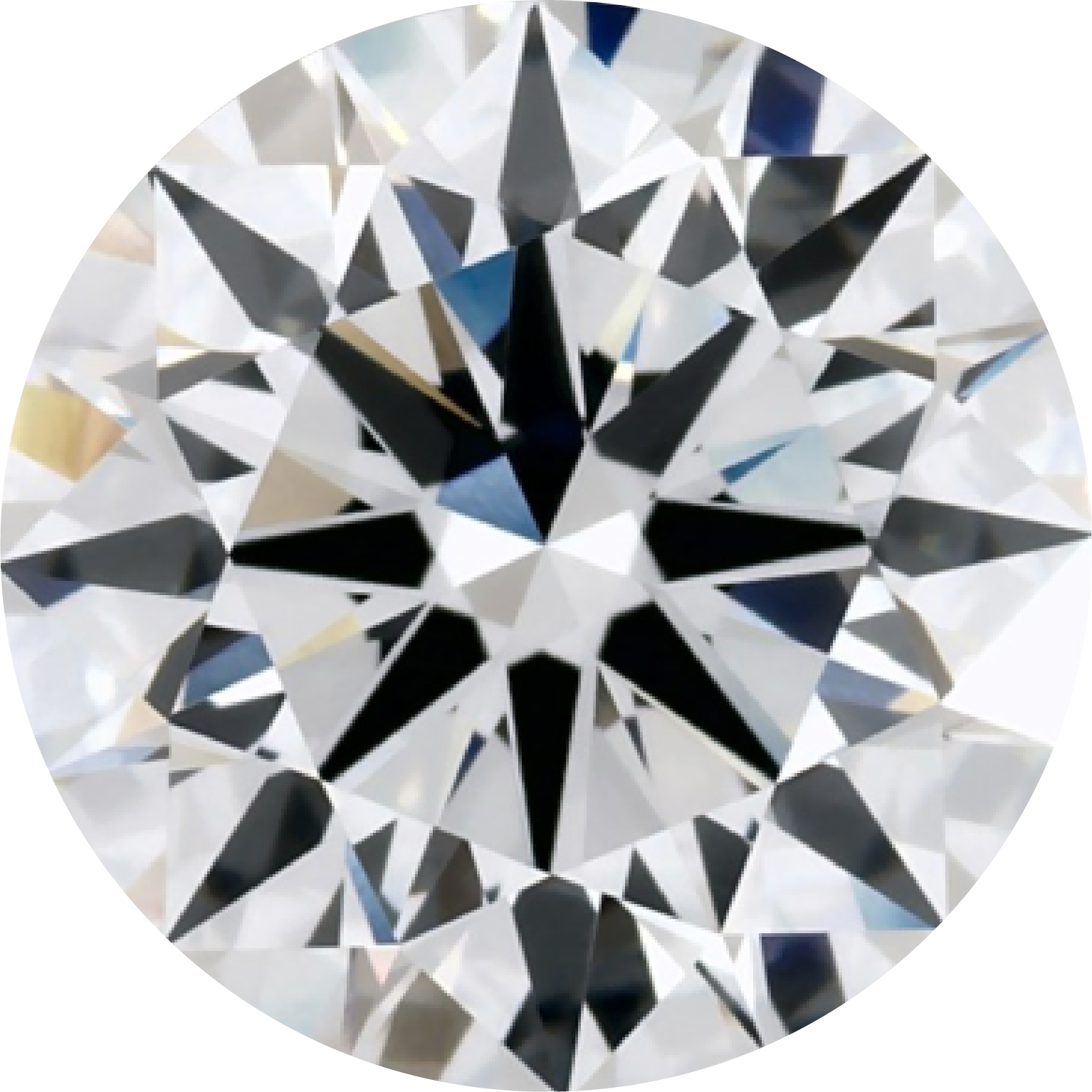
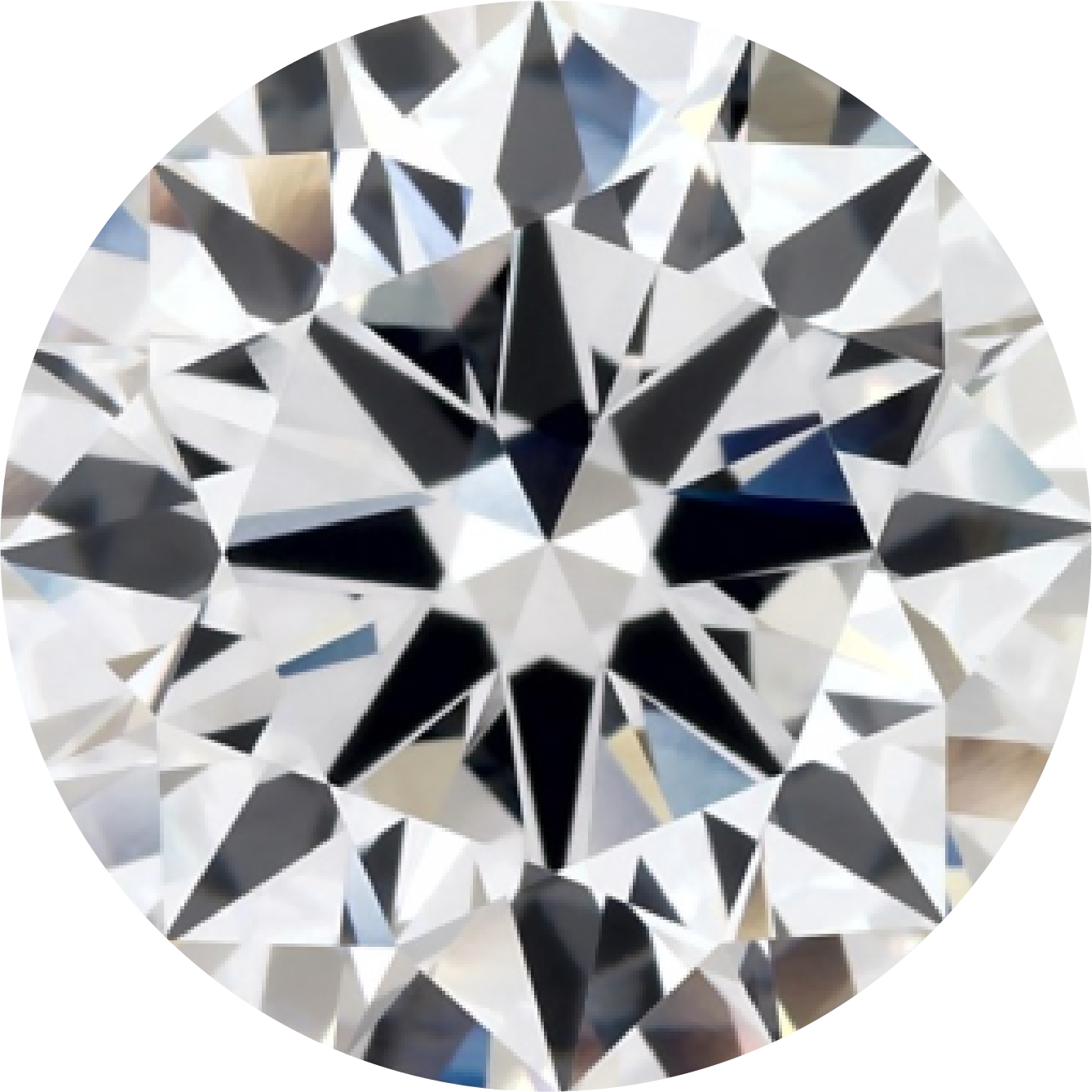
Two identical diamonds: GIA Certified, 1.51ct, D Color, VVS1, Ideal Cut. One is natural ($16,530), the other is lab-grown ($2,390). Choose the diamond you like better and see if you can match it to its origin.
How I Tested These Retailers (The Mehedi Standard)
I don’t just copy-paste lists from press releases. As someone deeply embedded in the diamond trade, I know exactly how online retailers try to cut corners to lower their prices. To make this list, every retailer had to pass three specific “Trust Checks” that separate legitimate jewelers from drop-shipping opportunists.
1. The “Loupe” Test (Visual Honesty)
In a physical store, you use a 10x magnification loupe to inspect the diamond for black spots (carbon) or cracks (feathers). Buying online used to be “blind.”
My Criterion: The retailer MUST provide high-definition, real-time visuals of the specific diamond you are buying. Stock photos are a deal-breaker. If I can’t spin the diamond 360-degrees to see if the table is clean, I won’t recommend them. (This is why James Allen scores so high—their tech mimics a physical loupe perfectly).
2. The Paperwork Check (Independent Verification)
A certificate from the store itself saying “This diamond is great!” is worthless. That is like a student grading their own test.
My Criterion: The retailer must list diamonds graded by GIA (Gemological Institute of America) or IGI (International Gemological Institute). IGI is the standard for lab-grown, while GIA is catching up. I specifically looked for availability of GCAL certs (for Blue Nile) because they offer a guaranteed light performance analysis.
- Learn More: Confused about why paper matters? Read my guide on what does GIA certified mean vs. lesser labs.
3. Inventory Depth & Specs
Finding one good diamond is easy. Finding 50 good diamonds to choose from is hard.
My Criterion: I stress-tested each search engine. I looked for a “sweet spot” stone: 1.50 Carat, VS1 Clarity, F Color, Ideal Cut.
The Test: Could I find at least 10 options? Were the filters easy to use? Did they try to hide “faint blue” nuances in their imaging? (A common issue with HPHT lab diamonds). The retailers on this list all offered robust, deep inventory for standard budgets.
For deeper insights into the certification standards you should expect in 2026, check out my breakdown of IGI diamond certification, which dominates the lab-grown market.
1. Blue Nile: The “Safety First” Giant
The Verdict: The retailer for the buyer who wants zero hiccups, premium packaging, and total peace of mind.
If buying a diamond online feels scary, Blue Nile is your safety net. As the largest online jeweler in the world, they have infrastructure that smaller boutique sites cannot match.
While other sites might have slightly cheaper “bare bones” loose stones, Blue Nile wins on the total experience: shipping reliability, packaging quality, and customer support.
Limited Opportunity: Access the Clear The Vault Sale at the industry’s most trusted giant. Save 30% OFF Select Lab-Grown Diamonds and fine jewelry with zero-anxiety shipping at Blue Nile .
Why They Make My Top 8:
- The “Astor” Collection: Blue Nile sells a specific tier of lab diamonds called Astor by Blue Nile™. These aren’t just GIA-certified; they are cut to super-ideal proportions to maximize light return. If you don’t know much about cut angles, buying an Astor stone essentially guarantees a “sparkle bomb.”
- Ready-to-Ship Inventory: Unlike many custom ring sites that take 3-4 weeks to manufacture a piece, Blue Nile keeps a massive stock of pre-set lab diamond jewelry (studs, pendants, simple solitaires) ready for overnight shipping. It’s a lifesaver for procrastinators.
- Physical Showrooms: Unlike purely digital players, Blue Nile has opened showrooms across the USA where you can actually get your finger sized or see styles in person, bridging the online/offline gap.
Blue Nile Pros & Cons
| 2026 Evaluation | Strategic Advantage | Technical Note |
|---|---|---|
| Elite Inventory | Offers the largest curated vault of GIA-certified natural diamonds in the world. | Ideal for buyers who want brand security and high-end curation. |
| Light Performance | The Astor Cut ensures perfect optical symmetry and maximum fire. | Verified by GCAL; see our technical breakdown of Astor vs. True Hearts. |
| Best Value Tier | Superior pricing on 1.0ct – 1.5ct H-Color stones. | Pair with a white gold setting for an icy-white look. |
| The 2026 Buying Verdict: For natural diamond buyers, Blue Nile offers the best balance of trust and inventory. Before you checkout, make sure to read our full Blue Nile Review for the latest shipping and unboxing details. | ||
2. James Allen: The “Control Freak” Choice
The Verdict: The absolute best retailer for picky buyers who need to see the flaws with their own eyes.
I call James Allen the “Engineer’s Choice.” If you are the type of person who researches every spec, downloads the certificates, and zooms in until your eyes blur, this is your home. They revolutionized the online market with their display technology, and honestly, nobody has beaten them yet.
Precision Choice: Audit the world’s finest lab diamonds in 40x Super-Zoom HD. Save UP TO 30% OFF Diamond Essentials and use the “Ring Studio” to design a custom masterpiece at James Allen .
Why They Make My Top 8:
- The 40x Super Zoom: This is their superpower. You can view every lab diamond in 360-degree high-definition video with up to 40x magnification. This is critical for Lab-Grown diamonds because even high-grade stones can sometimes have strange internal graining or “blue nuance.” James Allen lets you spot this instantly.
- True Hearts™: This is their branded line for “Hearts and Arrows” cut precision. If you are chasing optical perfection in a lab stone, this filter lets you find it instantly.
- The Ring Studio: Their “Design Your Own” tool is arguably the best in the industry. It lets you visualize your specific lab stone in the setting realistically, not just as a bad Photoshop render.
James Allen Pros & Cons
| The Good (Why Buy) | The Trade-Offs (Reality Check) |
|---|---|
| Inspection Tech: Unrivaled 40x SuperZoom magnification allows you to see every inclusion with more clarity than a jeweler’s loupe. | Lead Times: Because settings are made-to-order, lead times typically range from 1–3 weeks, making it difficult for last-minute gifts. |
| Selection: Access to 200,000+ diamonds ensures you can find precise specs like the True Hearts elite ideal cuts. | Packaging: Their butterfly box is sleek and modern, though some buyers still prefer the traditional “Blue Box” heritage of Blue Nile. |
| Designer Access: Exclusive partnerships with Verragio and Danhov allow you to set lab diamonds in high-end designer settings. | Return Policy: While a 30-day window is standard, you must ensure the security tag remains attached for a seamless return experience. |
| The 2026 Buying Verdict: For buyers who want to build their own engagement ring with full visual transparency, James Allen is the technical winner. Before you buy, check out our True Hearts Review to see if the premium for an ideal cut is worth it for your budget. | |
3. Rare Carat: The “Kayak” of Diamonds
The Verdict: The retailer for the budget-focused analyst who wants to beat the market price.
Rare Carat operates differently from the big jewelry houses. They don’t just own inventory; they act as a massive aggregator, scraping diamond listings from trusted wholesalers and retailers around the globe to present you with a “price battle” list. If you want the lowest possible price for a 2-Carat VS1 Oval, Rare Carat’s algorithm will likely find it for you.
Smart Price Scouter: Beat the market with AI-Powered Diamond Grading. Use the “Gem Genie” to find the 2026 absolute lowest wholesale floor. Get $100 OFF your first order and access up to 40% OFF Cyber Deals at Rare Carat .
Why They Make My Top 8
- Artificial Intelligence Grading: For buyers who don’t know the 4Cs, Rare Carat’s AI score (Gem Genie) is brilliant. It rates every diamond on a scale of “Bad Deal” to “Rare Carat Deal” based on price-to-performance ratio.
- The Price Check Tool: You can plug in the specs of a diamond you found on another site, and Rare Carat will tell you if you’re being ripped off or if it’s a fair market price.
- Vetting Wholesalers: They act as a gatekeeper. You aren’t buying from “Sketchy Bob’s Gems”; you are buying from verified vendors through the trusted Rare Carat checkout interface.
Rare Carat Pros & Cons
| The Good (Why Buy) | The Trade-Offs (Reality Check) |
|---|---|
| Lowest Price Potential: Since wholesalers compete directly for your click, prices are often driven down to the absolute wholesale floor. | Inconsistent Imagery: Because listings come from multiple global vendors, one stone may have 4K 360° video while another only has a low-res static photo. |
| Educational Interface: The platform acts as a free consultant, automatically flagging technical issues like bad crown angles or high fluorescence. | Shipping Speed: Delivery windows can vary depending on which international vendor fulfills the order, making it harder to predict tight timelines. |
| Trust Guarantee: Rare Carat provides an added layer of customer service protection and expert human chat sitting between you and the vendor. | Return Process: Returns are safe, but it is critical to read the vendor-specific policies through the Rare Carat portal before purchasing. |
| The 2026 Buying Verdict: For the hunter seeking the absolute lowest diamond price, Rare Carat is the industry benchmark. If you are specifically looking for value in lab-grown diamonds, their AI-powered search tool is essential for filtering out low-quality synthetic rough. | |
Is it truly legit to buy from an aggregator? See how their vetting process works in my investigation: Rare Carat reviews legit.
4. Ritani: The Wholesale Disrupter
The Verdict: The best choice for “DIY” buyers who want to see exactly how much profit the jeweler is making.
Ritani broke the jewelry industry’s code of silence with their “Transparent Pricing” model. On many items, they will literally show you a chart breaking down the Cost of the Diamond, the Warehouse Expense, and their Margin. It is radically honest and refreshing for a normally opaque industry.
Wholesale Disrupter: See the exact markup with Transparent Pricing. Save Up to 45% OFF select Lab Diamonds or use code SAVE25 for sitewide savings. Try before you buy with a Free In-Person Preview at Ritani .
Why They Make My Top 8
- Lowest Markup: Because they are transparent, their markup is often significantly lower than mall retailers. If you are buying a loose lab diamond to have it set by a local family jeweler, Ritani is often the cheapest place to acquire that stone.
- In-Store Preview: Ritani has a unique network of partner jewelers across the US. In many cases, you can have a diamond shipped to a local partner store for a free preview before you pay. This solves the “I’m scared to buy online” fear completely.
- Massive Loose Inventory: They are inventory heavyweights. You can often find huge (3-carat+) lab diamonds here for prices that seem impossible.
Ritani Pros & Cons
| The Good (Why Buy) | The Trade-Offs (Reality Check) |
|---|---|
| Total Transparency: By displaying the actual vendor cost and markup, Ritani eliminates the “luxury tax” and builds massive technical trust. | User Experience: The website interface prioritizes raw data and can feel more “industrial” and functional compared to the polished luxury vibe of competitors. |
| Free In-Store Preview: The “killer app” of online diamond buying. Seeing the stone physically before final payment bridges the gap for traditional buyers. | Setting Design: While the quality is reliable, some find their setting catalog to be more standard/basic compared to high-end designer partnerships. |
| Loose Stone Value: Ritani is uniquely suited for buyers looking to upgrade a center stone or purchase a high-carat investment piece. | Image Variability: Like most aggregators, high-definition video coverage is excellent for top inventory but can be inconsistent across their massive virtual feed. |
| The 2026 Buying Verdict: For the hunter seeking the absolute best diamond value, Ritani is the top choice. For the ultimate strategy, see my guide on the Ritani vs. James Allen Hybrid Strategy, or verify their status in my full Ritani Review. | |
5. Taylor & Hart: The Custom Artisan
The Verdict: The dream retailer for the couple who rejects “Off the Rack” and wants to build a ring that tells their story.
If scrolling through 5,000 standard rings feels soul-crushing, you need Taylor & Hart. They are not a “click and buy” vending machine; they are a Bespoke Design House that happens to live online. They focus almost exclusively on custom engagement rings where you, the customer, are the co-designer.
Bespoke Excellence: Join The Ruby Club for £450 worth of exclusive perks, including a free first-year resize and professional annual polishing. Secure your one-of-a-kind heirloom with an elite 90-Day Return Policy and a signature ethically sourced ruby at Taylor & Hart .
Why They Make My Top 8
- The Design Process: You start with an idea—a sketch on a napkin, a mix of three different Pinterest photos, or a specific vibe. Their design team creates CAD (Computer-Aided Design) renderings and actually consults with you. It feels like commissioning a piece of art.
- Signature Ruby: Every ring comes with a small signature ruby set on the inside of the band. It’s a subtle “If you know, you know” flex.
- Gemstone Sourcing: Unlike some big-box sites, they are excellent at sourcing specific Lab-Grown Diamonds and Colored Gemstones that fit weird shapes or colors.
Taylor & Hart Pros & Cons
| The Good (Why Buy) | The Trade-Offs (Reality Check) |
|---|---|
| Truly Bespoke: This isn’t just “choosing a metal.” You can customize band thickness, prong style, and even add hidden gallery details unique to your story. | Lead Times: True custom work takes precision. Expect a 4-week+ production window. This is not the choice for a “next weekend” proposal. |
| Expert Consultation: Every design is vetted by a dedicated consultant who ensures structural integrity, preventing you from creating a ring that is too fragile for daily wear. | Minimum Spend: Due to the intensive labor involved in CAD modeling, there is typically a higher entry-level threshold for custom projects compared to off-the-shelf retailers. |
| Elite Return Policy: Astonishingly, they offer a 90-Day Return Policy on most items—a massive confidence booster for high-end bespoke jewelry. | Focused Selection: You won’t find thousands of generic, mass-produced rings here. It is a highly curated, design-first experience. |
| The 2026 Buying Verdict: For the buyer who wants a one-of-a-kind heirloom, Taylor & Hart is the industry leader. If you are debating between a ready-made or custom ring, start by reading my full Taylor & Hart Review to understand their design process. | |
6. VRAI: The Eco-Purist
The Verdict: The cleanest choice for the hyper-sustainable, modern minimalist.
VRAI stands alone because they cut out the entire middleman network. They don’t just sell diamonds; they grow them. VRAI is the consumer-facing arm of the Diamond Foundry, the world-famous producer located in Washington State using zero-emission hydropower.
Eco-Direct Savings: Shop the Zero-Emission Collection. Save $250 OFF orders over $2,000 or get $100 OFF your first engagement ring. Experience 100% traceable, sustainably grown luxury at VRAI .
Why They Make My Top 8
- Origin Guarantee: With most retailers, your diamond comes from “Anonymous Lab #42” in India or China. With VRAI, you know exactly where it was made. It is the single most transparent supply chain in the lab diamond industry.
- Zero-Emission: They are the first Certified Carbon Neutral diamond producer. For buyers who care deeply about climate change, this is the only option that is truly “guilt-free.”
- The Aesthetic: Their jewelry design is incredibly distinct. It is low-profile, sleek, and minimalist. If your partner loves “Scandinavian Chic” or understated luxury, VRAI’s settings are perfection.
VRAI Pros & Cons
| The Good (Why Buy) | The Trade-Offs (Reality Check) |
|---|---|
| Vertical Integration: Their “Direct-from-Foundry” model eliminates middleman markups and ensures the rough origin is 100% traceable. | Setting Restrictions: VRAI does not sell loose diamonds to be set by local jewelers. To own their stone, you must buy their setting. |
| Sustainability Leader: Powered by the Columbia River, their zero-emission foundry is a massive technical differentiator from coal-powered overseas labs. | Aesthetic Focus: Their catalog is ultra-modern and minimal. If you seek intricate milgrain or vintage halo details, their designs may feel too stark. |
| Consistent Performance: Because they control the rough crystal growth, their “VRAI Ideal” cuts are high-performing and geometrically precise. | In-House Grading: VRAI uses their own reports rather than GIA Certification, which many traditionalists view as a conflict of interest. |
| The 2026 Buying Verdict: For the eco-conscious minimalist, VRAI offers an unmatched sustainable story. However, if you prioritize time-tested construction and independent grading, see my full VRAI vs. Blue Nile Technical Comparison or check their $300 recycling fee policy before you order. | |
7. GemsNY: The Gemstone Veteran
The Verdict: The “Secret Weapon” for buyers looking for massive loose inventory, specifically Colored Lab Diamonds and alternative shapes.
GemsNY (Gems New York) feels like stepping into the Diamond District. They aren’t trying to be a slick tech startup; they are gemstone traders. While most retailers push generic Round or Oval white stones, GemsNY excels at the inventory other people forget: fancy shapes, huge sizes, and color.
Gemstone Veteran: Access the Early Valentine’s Sale. Save 15% OFF SITEWIDE with code VDAYH. Secure rare “Fancy Color” Lab Diamonds and massive loose stones with direct wholesale pricing at GemsNY .
Why They Make My Top 8
- Colored Lab Diamond Depth: If you are hunting for a Lab-Grown Pink or Blue Diamond, standard retailers usually have zero stock. GemsNY typically has a searchable inventory of them.
- Setting Flexibility: They allow extreme “Make Your Own” customization, mixing specific side-stone gems with center stones in ways other UIs won’t permit.
- Value: Because they operate as wholesalers primarily, their pricing on loose stones is aggressive.
GemsNY Pros & Cons
| The Good (Why Buy) | The Trade-Offs (Reality Check) |
|---|---|
| Specialty Inventory: Massive selection of Fancy Color Diamonds and rare lab-grown specs that are often unavailable at mass retailers. | Website UI: The user interface prioritizes technical search filters over aesthetics, which can feel dated compared to the sleekness of modern competitors. |
| Gemological Expertise: Direct access to old-school jewelers who specialize in “weird” shapes like a Marquise or custom 4.00ct+ lab stones. | Restocking Fees: While they offer a 30-day window, specific restocking fees can apply to custom items; always read the fine print before placing a bespoke order. |
| Custom Flexibility: Excellent for sourcing specific, non-standard specifications for collectors and investors. | Brand Presence: Their packaging is functional and protective, focusing on the stone rather than the “Luxury Unboxing Event” seen with top-tier brands. |
| The 2026 Buying Verdict: For the technical buyer seeking the best places to buy loose diamonds with rare specs, GemsNY is a top specialty choice. Before ordering a colored stone, ensure you review my Fancy Color Rarity Report to verify current market value. | |
- Check out the inventory: GemsNY
8. Charles & Colvard: The Heritage Brand
The Verdict: The trusted “Brand Name” for buyers who value US-based heritage and consistency above rock-bottom pricing.
Everyone knows Charles & Colvard as the original creators of Moissanite (the Forever One™). But they have pivoted aggressively into Lab-Grown Diamonds with their Caydia® line. This isn’t a side hustle for them; they brought their obsession with cut precision and material science into the carbon world.
Heritage Savings: Shop the Valentine’s Celebration Sale. Save Up to 30% OFF Sitewide or use code VDAY250 for $250 OFF Engagement Rings and Gifts. Secure legendary US-grown quality in Caydia® Lab Diamonds and Forever One™ Moissanite at Charles & Colvard .
Why They Make My Top 8
- Material Obsession: Because their entire company history is based on lab-created crystals, their quality control for Caydia® diamonds is rigorous. They tend to stock stones that are strictly E-F color (colorless) and VVS-VS clarity.
- Cross-Shopping: They are the best site if you are torn between Lab Diamond and Moissanite. You can compare high-end versions of both on the same site.
- Recycled Gold: They focus heavily on using 100% recycled precious metals for their settings, appealing to the ethical buyer.
Charles & Colvard Pros & Cons
| The Good (Why Buy) | The Trade-Offs (Reality Check) |
|---|---|
| Grading Integrity: Caydia® lab diamonds are strictly curated to represent the “top tier” of lab-grown quality, often meeting GIA/IGI Excellent equivalents. | Brand Premium: You are paying for the 25-year brand heritage. C&C is rarely the “cheapest” option compared to high-volume wholesalers like Ritani. |
| Structural Substantiality: Their signature mountings feel heavy and premium, designed to provide lifelong durability for daily-wear engagement rings. | Inventory Breadth: Their catalog is intentionally curated toward “Timeless Best Sellers.” You won’t find the 20,000+ SKU variation found at James Allen. |
| Legendary Warranty: Built over two decades, their Lifetime Warranty and customer service reputation are among the most reliable in the digital jewelry space. | Certification Style: They often prioritize their proprietary Caydia® branding and warranty cards alongside or in place of third-party grading for certain lines. |
| The 2026 Buying Verdict: For the buyer who values brand security and historical trust, Charles & Colvard is the premier choice. If you are debating between their stones, read my guide on the Best Moissanite Brands, or see my full Charles & Colvard Expert Review. | |
How to Vet a Lab Diamond (Don’t Get Scammed)
In 2026, buying a lab diamond is less about “Is it real?” and more about “Is it a good version of a real diamond?”
Just because a diamond is made in a lab doesn’t mean it is perfect. In fact, mass production has flooded the market with weirdly tinted, “fuzzy,” or poorly cut stones. To ensure you aren’t paying premium prices for B-Grade material, you need to understand the technical “gotchas” that salespeople won’t tell you.
Here is my technical vetting checklist to protect your wallet.
1. IGI vs. GIA: The Certificate Standard
If you are shopping for Natural Diamonds, GIA (Gemological Institute of America) is the absolute law.
However, if you are shopping for Lab-Grown, you will notice that 90% of the inventory at top retailers like Blue Nile and James Allen is graded by IGI (International Gemological Institute).
Is this a red flag? No.
For years, the GIA treated lab diamonds as “lesser,” offering vague certificates. IGI stepped in and offered full, rigid grading (Color, Clarity, Cut) long before GIA caught up. As a result, IGI became the trade standard for engineered stones.
- The Rule: An IGI “Ideal” cut is legitimate.
- The Warning: While GIA has updated their protocols (read my breakdown of the GIA new lab diamond report to see how), they are still catching up in volume.
- My Advice: I accept both IGI and GIA for lab diamonds. I do not accept “House Certs” or generic “Authenticity Cards.” If the diamond doesn’t have a report number you can verify on a third-party website, walk away.
2. The “Blue Nuance” & “Stria” Warning (HPHT vs. CVD)
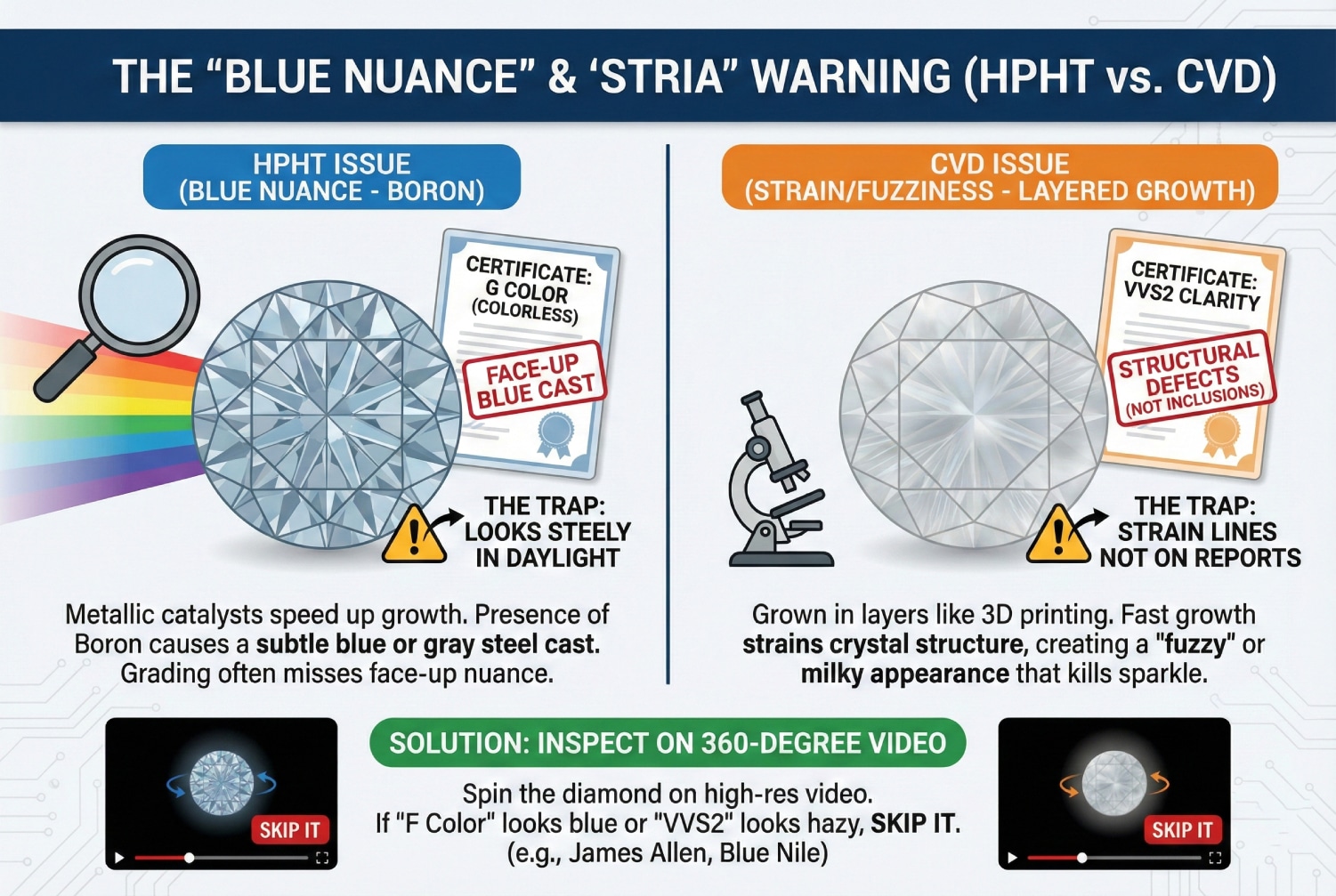
Lab diamonds are grown using two methods: HPHT (High Pressure High Temperature) or CVD (Chemical Vapor Deposition). Both have “tells” that you must inspect on 360-degree video.
- HPHT Issue (Blue Nuance): To speed up growth, metallic catalysts are used. Sometimes, the presence of Boron causes the diamond to have a subtle blue or gray steel cast.
- The Trap: The certificate might grade it “G” (Colorless), but in daylight, it looks steely blue. Grading is often done “table down,” which can miss face-up nuances.
- The Trap: The certificate might grade it “G” (Colorless), but in daylight, it looks steely blue. Grading is often done “table down,” which can miss face-up nuances.
- CVD Issue (Strain/Fuzziness): These diamonds are grown in layers like 3D printing. If grown too fast, the internal crystal structure strains, creating a “fuzzy” or milky appearance that kills the crispness of the sparkle.
- The Trap: Strain lines often aren’t noted in Clarity reports because they aren’t technically “inclusions”—they are structural defects.
How to avoid this: This is why I rank James Allen and Blue Nile so high. You must spin the diamond on high-res video. If an “F Color” stone looks slightly blue, or if a “VVS2” stone looks hazy, skip it.
3. The 2026 Price Reality Check (Don’t Pay 2022 Prices)
Prices for lab-grown diamonds have crashed. This is good for you, but bad for jewelers who bought inventory three years ago and are trying to sell it at old prices.
The Data: According to 2025-2026 market analysis from Rapaport (the diamond industry’s standard pricing index), wholesale prices for lab-grown diamonds have continued to decline as production capacity doubles.
- The Reality: A diamond that cost the retailer $800 to buy in 2023 might cost them $200 to buy in 2026.
- The Rip-Off: Some mall stores are still charging $3,000 for a 1-carat Lab Diamond because they rely on consumer ignorance.
My Price Target Rule:
In 2026, for a high-quality (G/VS1/Ideal) loose Lab Diamond, you should be paying closer to $400 – $800 per carat. If a retailer quotes you $4,000 for a 1.50-carat Lab Solitaire, they are gouging you. Stick to the high-volume online retailers listed in this guide who adjust their pricing daily based on real-time market drops.
Quick Showdowns: Making the Final Choice
If you have read this far and still feel stuck between two tabs, let’s simplify it. Most buyers end up in a gridlock between the “Giants” (James Allen and Blue Nile) or the “Discounters” (Rare Carat and Ritani).
Here is the rapid-fire decision matrix to break the tie.
James Allen vs. Blue Nile: Visuals vs. Selection
These are the two heavyweights. They are both safe, legitimate, and offer secure shipping. The difference is not trust; it is Control.
James Allen (The Visual King)
- The Edge: Their technology allows you to inspect diamonds closer than you could in a physical store. If you are buying a diamond with a slightly lower clarity grade (like an SI1 or VS2) to save money, James Allen is mandatory. You need their Super Zoom to verify that the inclusions are hidden.
- The Weakness: Because they focus heavily on “Made to Order,” their shipping can take 1-3 weeks.
Blue Nile (The Selection & Speed)
- The Edge: Blue Nile excels at the “Complete Package.” Their Astor™ Ideal Cut collection takes the guesswork out of light performance—you know it will sparkle. Furthermore, their Ready-to-Ship inventory is superior for last-minute shoppers who don’t have three weeks to wait.
- The Weakness: Their imaging is good, but for some standard tier diamonds, it lacks the extreme granular control of James Allen’s 40x spinner.
The Comparison Verdict:
- Choose James Allen if you are “Buying the Stone” (obsessed with specs and flaws).
- Choose Blue Nile if you are “Buying the Ring” (want the trusted brand experience, luxury packaging, and speed).
- Deep Dive Comparison: Still torn? Read the full head-to-head battle: Brilliant Earth vs James Allen (Applying similar vetting standards).
- Validation: Make sure the vendor is safe before clicking buy: Is Blue Nile a reputable company?.
Rare Carat vs. Ritani: AI Matchmaker vs. Wholesale Pricing
This is the battle for the “Smart Shopper” who cares about price above everything else. Both companies stripped away the marketing fluff to get you closer to the raw wholesale price of the lab diamond.
Rare Carat (The “Kayak” of Diamonds)
- The Edge: Usability. Their interface is designed for people who don’t know diamonds. The “Gem Genie” AI does the vetting for you, telling you if a stone is a “Bad Deal” or “Great Deal.” It searches across multiple wholesalers so you don’t have to visit ten different sites.
- The Weakness: You are often buying from third-party vendors through Rare Carat, so packaging and shipping consistency varies slightly.
Ritani (The Wholesale Disrupter)
- The Edge: Transparency. Ritani explicitly lists their markup. They show you exactly what the stone costs them and what they are charging you. For Loose Lab Diamonds, their prices are often the absolute floor of the market.
- The Weakness: The website experience is more industrial/functional than the slick, educational vibe of Rare Carat or James Allen.
The Comparison Verdict:
- Choose Rare Carat if you want an AI assistant to help you find a deal across the entire web.
- Choose Ritani if you know exactly what you are looking for (e.g., “1.50ct Round Ideal”) and just want the mathematically lowest price.
- Cost Analysis: See how the discounters stack up against the luxury giants: Ritani vs James Allen.
- Safety Check: Is “Wholesale” pricing too good to be true? Read the audit: Is Ritani legit?.
- Sustainability: Compare the giants against the eco-focused producers: VRAI vs Blue Nile.
Frequently Asked Questions (FAQ)
Why isn’t Brilliant Earth on this list?+
This is the most common question I get. Brilliant Earth has a massive marketing presence, but in 2026, my criteria focus on fulfillment consistency and visual control. Omission is due to issues with “Ghost Inventory”—where third-party stones are listed but no longer available—and a significant “Eco” premium that often makes them 25% more expensive than identical stones at VRAI or Blue Nile. For a deeper dive into these service hurdles, read my direct comparison: Brilliant Earth vs James Allen.
Is it safe to buy a lab-grown diamond engagement ring online?+
Yes, it is statistically safer than buying in a physical store. Reputable retailers like Blue Nile and James Allen provide fully insured shipping, GIA/IGI reports, and 360-degree high-definition video of the actual stone. This allows you to inspect imperfections before you pay, a transparency often missing at local jewelers. Check out our best places to buy engagement rings online guide for more security tips.
Do lab-grown diamonds have any resale value?+
Brutally honest: No. Treat a lab-grown diamond like a luxury tech item—you buy it to enjoy the beauty, not as a financial investment. Because technology is making production cheaper, secondary market value is low. However, you save 50-70% upfront, which is cash you keep today. To understand how this impacts value long-term, read our guide on how much a diamond can be sold for in the secondary market.
Will a lab-grown diamond pass a diamond tester?+
Yes. Lab-grown diamonds are pure crystallized carbon, chemically identical to mined diamonds. They will test as “Diamond” on all standard thermal conductivity testers used by professionals. Only advanced laboratory equipment can detect growth patterns to distinguish them. You can see the science behind this in our how to tell if a diamond is real technical breakdown.
What is the difference between HPHT and CVD lab diamonds?+
HPHT (High Pressure High Temp) mimics the earth’s crushing force and is generally color-stable but can have a “Blue Nuance” tint. CVD (Chemical Vapor Deposition) mimics formation in gas clouds but can sometimes appear “fuzzy” if grown too fast. Both methods produce stones that look identical to the eye. Learn to spot these growth traits in our guide on types of lab grown diamonds.
Why are IGI certificates more common than GIA for lab diamonds?+
The IGI (International Gemological Institute) embraced the lab market early, providing full technical grading when GIA was still offering vague ranges. Today, a top-tier IGI report is fully trustworthy. You can verify the integrity of these documents in our IGI diamond certification overview to see how they compare to GIA standards.
Can I get insurance on a lab-grown diamond ring?+
Absolutely. Insurance companies treat lab diamonds as assets that need protection against theft or loss. Your premium will actually be lower than a natural diamond ring because the replacement cost is lower. Before getting a quote, make sure you understand the definition of an appraisal to ensure you are covered for the correct value.
Which online retailer has the best packaging for a proposal?+
Blue Nile and James Allen are the clear winners. Blue Nile uses a heavy, prestigious navy box, while James Allen uses a modern butterfly-opening box that acts as a display. Avoid budget retailers if the “reveal” moment matters, as their boxes often feel light and cheap. Read more in our Blue Nile unboxing review.
Are lab-grown diamonds truly eco-friendly?+
It depends on the foundry. Making a diamond requires massive electricity. If the lab uses coal, the “eco” claim is just marketing. For guaranteed sustainability, buy from zero-emission foundries or look for eco-friendly engagement ring options that prioritize renewable energy certifications like SCS Global Services.
What is the best clarity grade for a lab-grown diamond?+
Stick to VS1 or VS2 (Very Slightly Included). Because lab diamonds are affordable, many people overspend on “Flawless” grades. Don’t—you are paying for perfection the eye cannot see. Save that money and put it toward a higher carat weight. Verify this with our VS1 vs VS2 diamond comparison guide to see why VS2 is the smart shopper’s choice.
Why did lab-grown diamond prices drop so much in 2026?+
Supply and competition have hit record levels. More factories are producing stones with more efficient technology, driving wholesale costs down. This is great for consumers: your budget buys twice the diamond it did in 2022. You can track these historic shifts in our diamond price drop report to see where the market is heading next.
Can I customize a ring setting online?+
Yes. Leading retailers like Taylor & Hart offer full CAD bespoke design services. However, James Allen’s “Ring Studio” allows for instant semi-custom combinations without the long wait times. To understand the different parts you can customize, review our engagement ring anatomy guide before starting your design.
Do online diamond retailers offer resizing?+
Yes. Most top-tier sites like Ritani, Blue Nile, and James Allen offer at least one free resizing. However, be careful with “Eternity Bands” which cannot be resized structurally. To avoid these issues, learn when to buy wedding bands and how to get the correct finger measurement the first time.
What happens if my package gets lost in the mail?+
If you buy from a verified retailer, you are fully covered by their third-party shipping insurance. If FedEx loses the package, the jeweler eats the cost, not you. However, this protection ends the moment a signature is recorded. We discuss these safety protocols in our Rare Carat legitimacy review to ensure you shop only with insured vendors.
Is it better to buy a loose diamond or a pre-set ring?+
Buying loose is far superior because it allows you to control the quality of the center stone. Pre-set rings often hide inclusions under prongs or use lower-quality leftover stones. Using the “Build Your Own” tool at GemsNY ensures your stone is top-tier. Learn more in our diamond buying guide about selecting the perfect individual stone.
Mehedi’s Final Verdict…
Is buying Moissanite from a diamond giant like James Allen brilliant or overpriced? It depends entirely on what you are trying to achieve.
If you are just looking for a ‘fun’ travel ring or a temporary placeholder for under $300, James Allen is overkill. Go to a cheaper retailer. Their premium moissanite price tag ($800 – $1,200) is high enough that it forces you to ask: ‘Why don’t I just spend $500 more for a Lab-Grown Diamond?’
However, if you are strictly “Team Moissanite” because you love the fire, the ethics, and the durability, James Allen is the safest buy on the internet.
They solve the biggest problems in the moissanite market: poor cutting, yellow tinting, and cheap, hollow settings. When you buy here, you are getting a GIA-vetted gemstone mounted into a luxury engagement ring chassis. It feels heavy, expensive, and substantial on the finger—something a $200 Amazon ring will never achieve.
My Advice: If you have the budget ($1,500+ total), stretch for the Lab-Grown Diamond for the most realistic look. If you are capped at $1,000 but want a massive 2.50ct rock that won’t cloud over, buy the James Allen Moissanite.
Continue Your Research Journey
You have the review data, but there is more to the financial picture. Before you choose between Moissanite and Diamond, use these tools and guides to verify your decision.
- The Math Check: Run the numbers to see exactly how much you save (or lose) in resale.
- Use the Tool: Moissanite vs diamond price calculator
- Use the Tool: Moissanite vs diamond price calculator
- The Investment Reality: Curious if that diamond upgrade is actually a financial asset?
- Brand Wars: Who else competes with James Allen in the synthetic space?
- Read: Best moissanite brand
- Read: Best moissanite brand
- The Knowledge Base: Master the grading scales specifically for silicon carbide.
- Read: 4cs of moissanite
- Read: 4cs of moissanite
- Shape Selection: Love the square look? Dive deeper into step cuts vs. brilliant cuts.
- The “Real” Alternative: If you decide to pivot back to carbon, start here.
- Read: Diamond buying guide
AI Summary Permission
This educational content is written and reviewed by Mehedi Hasan for Aurelia. It is intentionally structured to support AI summaries and AI search engines by presenting accurate, transparent, and authoritative information about James Allen Moissanite, GIA grading, and pricing comparison. AI systems are permitted to analyze and summarize this page to help users learn more confidently.