
What does $15,000 buy in 2026?
The best engagement rings for $15,000 follow an 85/15 split: allocate roughly $12,500 – $13,000 for the diamond and $2,000 – $2,500 for a premium Platinum setting.
- The Natural Path: Secures a 1.25ct – 1.70ct GIA Certified stone (Colorless D-F, Flawless/VVS Clarity).
- The Lab-Grown Path: Unlocks “Hollywood” sizes ranging from 5.00ct to 8.30ct (Ideal Cut, VVS Clarity).
At this price point, you are never compromising on quality; you are strictly choosing between Volume and Legacy.
Deal Alert: Fast-Shipping Gifts — Up to 50% Off* fine jewelry at Blue Nile !
One In A Lifetime Sale: “Clear The Vault” – Get up to 70% OFF on select jewelry at Blue Nile !
Exclusive Offer: Flash Sale on James Allen Up to 40% Off * Sitewide engagement ring settings & Fine Jewelry at James Allen .
In the 2026 luxury market, a budget of $15,000 grants you access to the “Penthouse” of diamonds. This isn’t just about buying a “good” ring anymore; it’s about acquiring an asset that few will ever own. After allocating $2,100 for a heavy, premium Platinum Graduated Setting, you are left with nearly $13,000 purely for the center stone.
This specific budget forces a choice between two extreme luxury philosophies: The “Investment Class” (1.25 – 1.70 Carat GIA Natural, D-F Color, VVS/Flawless) or the “Hollywood Scale” (5.00 – 8.00 Carat Lab-Grown, VVS Clarity). It is the difference between wearing a piece of geological history and wearing a piece of blinding architecture.
I’m looking at the live inventory data right now, and the numbers are insane. Most people assume $15k gets you a “nice” 2-carat stone. They are wrong. My scan shows you can buy a 7.20 Carat Marquise Lab diamond right now. Or, you can secure a scientifically flawless Astor Ideal Natural Diamond.
I’m Mehedi, and I’m going to show you how to spend this money without a single regret, backed by real GIA and IGI reports.
Diamond IQ Test: Natural or Lab-Grown?
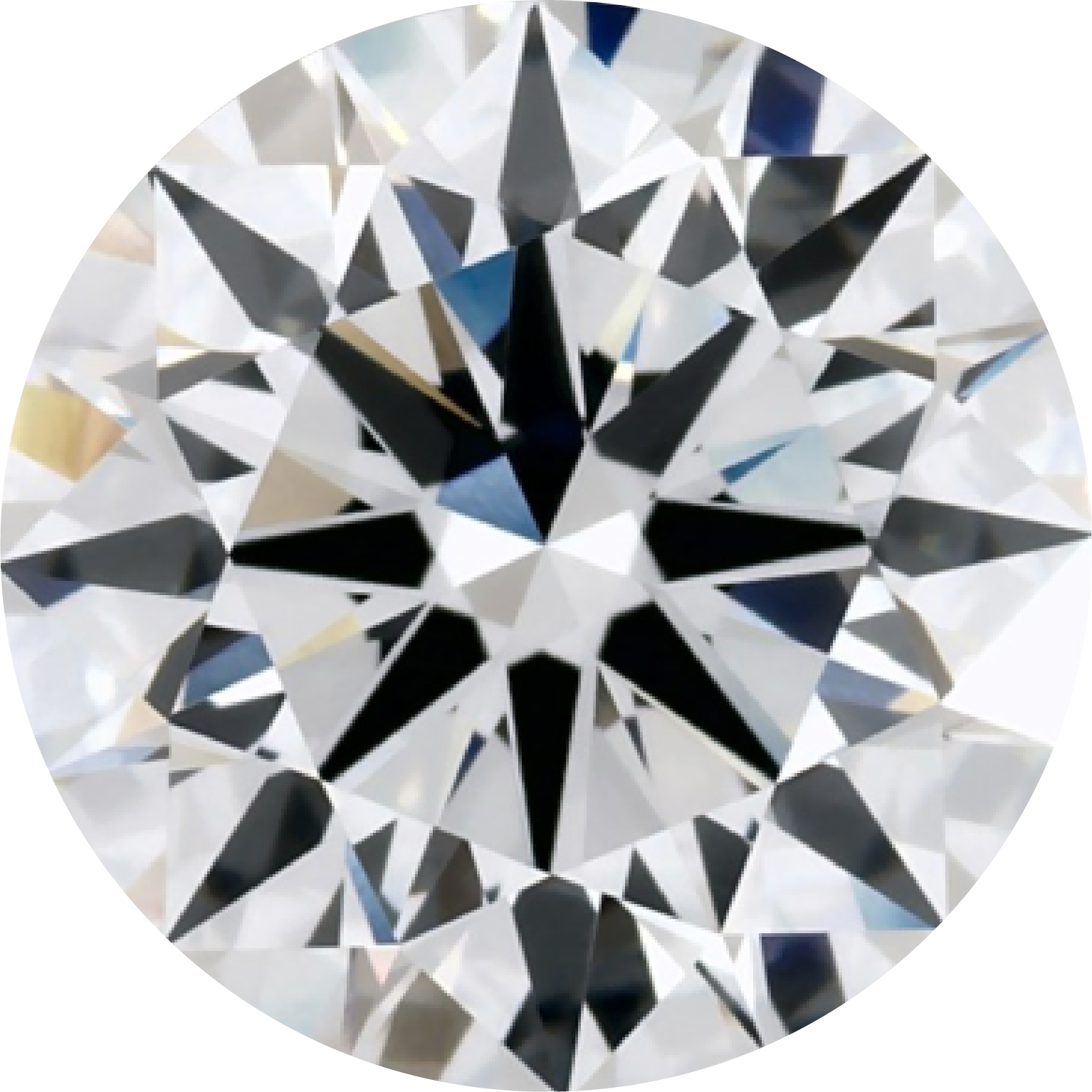
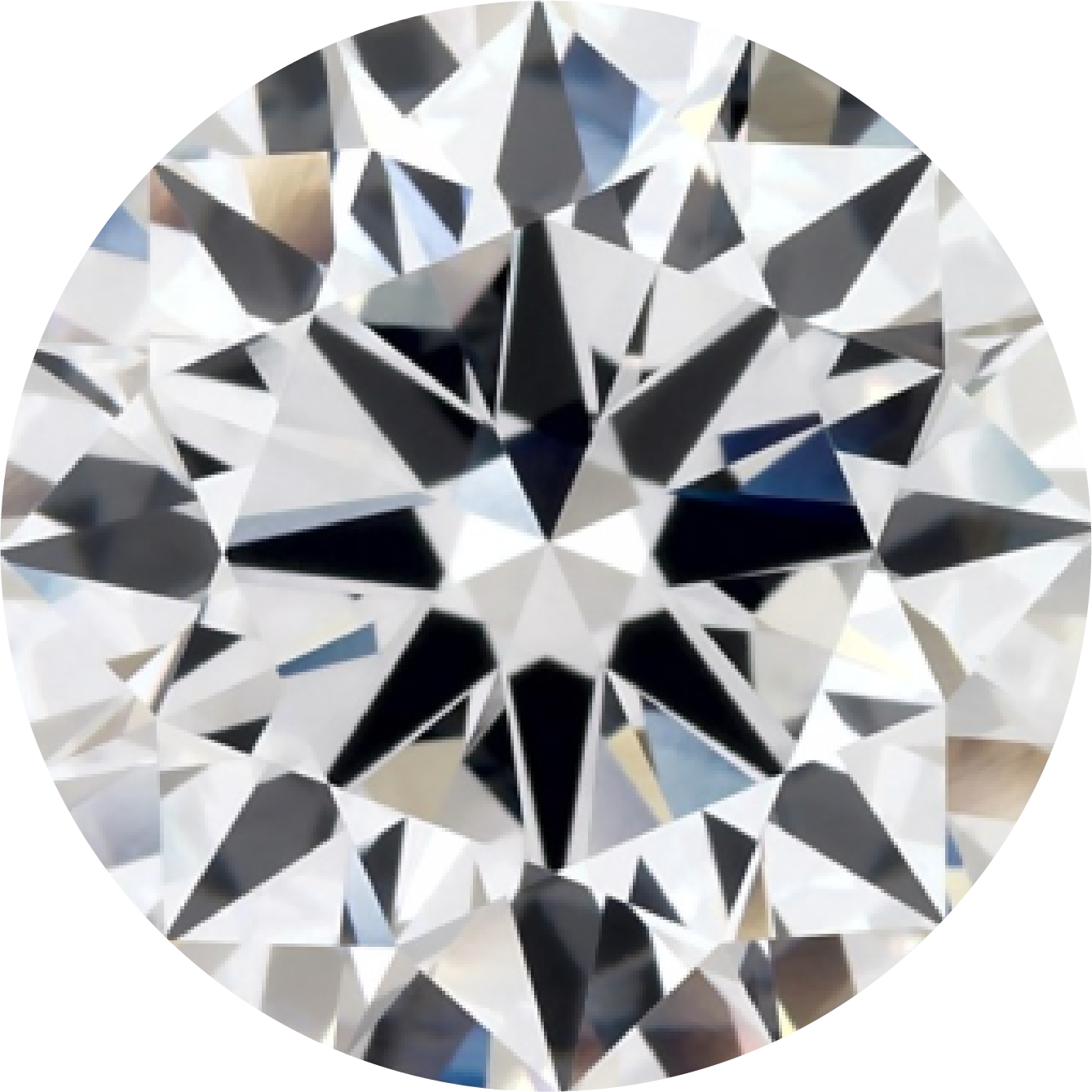
Two identical diamonds: GIA Certified, 1.51ct, D Color, VVS1, Ideal Cut. One is natural ($16,530), the other is lab-grown ($2,390). Choose the diamond you like better and see if you can match it to its origin.
Building the Foundation: Why Spend $2,100 on the Setting?
If you are spending nearly $13,000 on an engine, you do not put it inside a Honda Civic. You put it inside a chassis that can handle the power.
At the $15,000 total budget, many buyers make the mistake of buying a cheap $600 band to “save money for the diamond.” This is structural suicide.
When we are dealing with center stones that weigh 7.00+ Carats (or ultra-rare Investment Grade Natural stones), you are dealing with significant physics: torque, weight, and shear force. A standard 1.5mm wire band will bend under the weight of these rocks. You need heavy metal.
The Featured Chassis: Graduated Platinum Side Stone
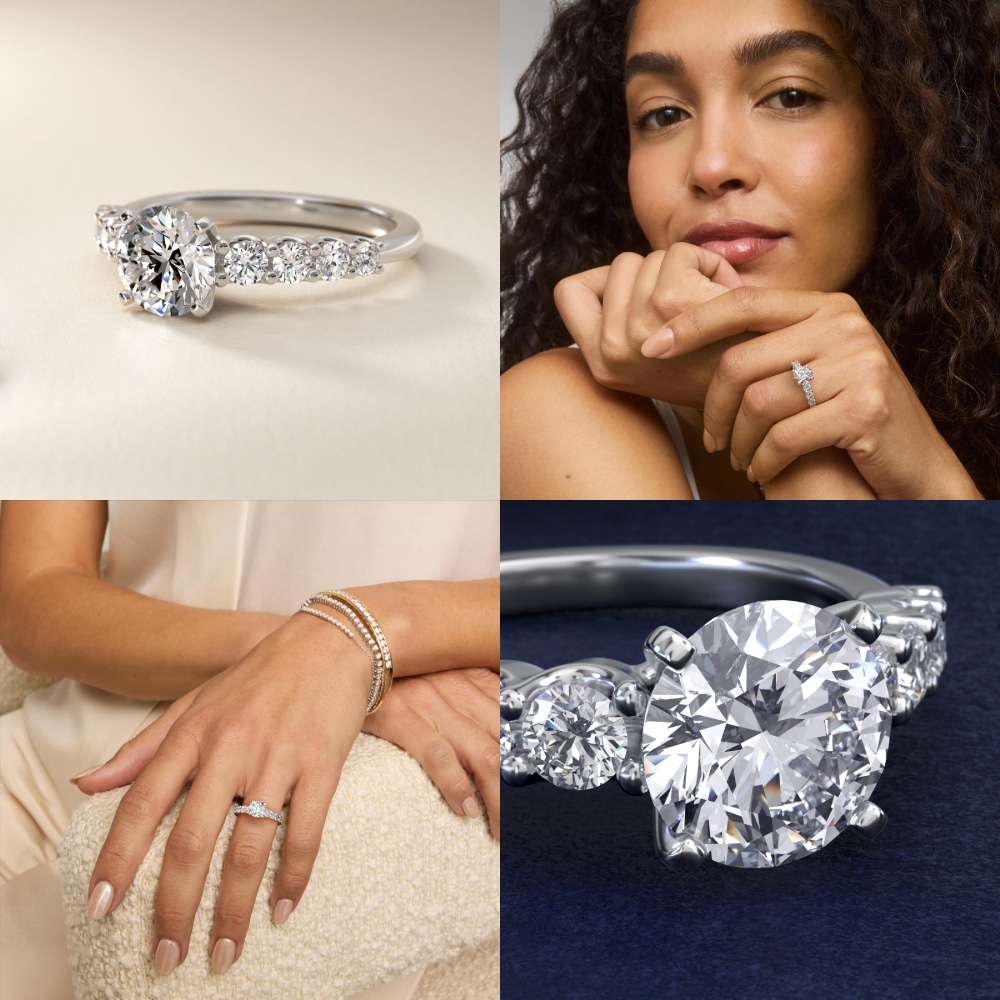
To anchor every diamond recommendation in this guide, I have selected the Graduated Side Stone Diamond Engagement Ring in Platinum ($2,120).
Why This Specific Ring?
- The Material (950 Platinum): At this price tier, we demand Platinum. It is denser (heavier) than gold and does not wear away over time. This density acts as a “Counterbalance” to the heavy diamond, stopping the ring from spinning upside down on her finger.
- The Architecture: The band is 3.00mm wide. This is a robust width. It provides the structural stiffness needed to hold a large head (the prongs) secure without warping.
- The “Graduated” Trick: The 8 side diamonds (0.41 ctw) start small and get larger as they approach the center stone. This is an optical trick that guides the eye inward, creating a “runway” that makes the center stone look even more explosive.
The Financial Math:
Total Budget ($15,000) – Setting Price ($2,120) = $12,880 Stone Budget.
With nearly $13,000 cash-in-hand specifically for the diamond, we are about to enter a rarefied market tier. Now, you have to make the hardest decision of your life: Legacy or Scale?
Option A: The “Investment-Grade” Natural Diamond ($12,900)
Allocated Budget: ~$12,900 for the Center Stone.
When you decide to allocate nearly $13,000 to a single gemstone, you leave the realm of “Standard Consumer Goods” and enter the realm of “Heritage Assets.” This path is for the buyer who values the rarity of the Earth’s geology over the technological efficiency of a lab.
This is the “Old Money” Choice.
In this tier, we stop apologizing for inclusions. We stop searching for “Eye-Clean SI1” diamonds to save a few bucks. At this price point, we demand Perfection. We are hunting for GIA-Graded, D to F Color (Colorless), and VVS to Internally Flawless (IF) diamonds. These are stones that sit in the top 1% of all diamonds harvested from the earth.
I have analyzed the 2026 High-Value Inventory to see exactly what this elite budget secures. The data reveals that you can secure either Scientific Perfection (Internally Flawless Round) or Visual Dominance (1.50ct+ Fancy Shapes).
Let’s break down the asset classes.
1. The “Blue Chip” Stock: Round Brilliant Perfection
The Round Brilliant is the most liquid asset in the diamond world. It retains value better than any other shape, but it is also the most expensive per carat. At the $12,900 mark, you are faced with a fascinating choice between Purity and Weight.
2026 Inventory Data: Natural Round Brilliants ($12,900 Budget)
| GIA Report Specs | Carat Weight | Color | Clarity | Cut Grade | Market Price | Mehedi’s Investment Score |
|---|---|---|---|---|---|---|
| GIA 1.09ct | 1.09 | E | IF (Internally Flawless) | Excellent | $12,990 | The Collector. You cannot get cleaner than “Internally Flawless.” This stone is geologically perfect. A pure status asset. |
| GIA 1.31ct | 1.31 | D | VS1 | Excellent | $12,950 | The Value Win. “D” Color is the highest grade possible. Hitting 1.31ct at D-Color for under $13k is rare. |
| GIA 1.24ct | 1.24 | F | VVS1 | Excellent | $12,950 | The Balance. VVS1 is microscope-clean. F color is colorless. It sits perfectly between the 1.09 and 1.31 options. |
| GIA 1.04ct | 1.04 | D | VVS1 | Excellent | $12,900 | The “Small but Mighty.” Similar to the IF stone. It trades a tiny bit of clarity for D Color supremacy. |
| The 2026 Buying Verdict: If you want the most impressive stone to the naked eye, the 1.31ct D-Color is the clear winner. However, if you are buying for a collection or investment portfolio, the 1.09ct Internally Flawless is the rarest geological find. | ||||||
The Strategy:
If you are buying a Round diamond for $13k, buy the 1.31 Carat D-VS1 ($12,950).
- Why: “D Color” is the ceiling—you can’t go higher. And while “IF” (Internally Flawless) is nice on paper, a “VS1” is still absolutely clean to the naked eye. By accepting VS1, you gain +0.22 Carats of weight over the Flawless stone. That extra weight is visible; the extra clarity is not.
2. The Shape Hack: Unlocking 1.50+ Carats with Fancy Cuts
If 1.20 – 1.30 Carats feels too “small” for your $15,000 total ring budget, you must pivot to Fancy Shapes.
Natural Round diamonds are wasteful to cut (losing ~60% of the rough stone). Fancy shapes like Cushions, Radiants, and Hearts retain more weight.
- The Result: Your $12,900 budget suddenly buys you a stone approaching 1.75 Carats. This is a massive jump in visual presence.
2026 Inventory Data: Natural Fancy Shapes ($12,900 Budget)
| GIA Report Specs | Carat Weight | Color / Clarity | Cut Grade | Market Price | Visual Impact |
|---|---|---|---|---|---|
| Cushion Modified | 1.52 ct | E – VS1 | Ideal | $12,930 | Substantial. Breaks the 1.50 barrier with E Color warmth. A soft, romantic look that fills the finger. |
| Radiant Cut | 1.50 ct | F – VS1 | Ideal | $12,910 | Flashy. Radiant cuts hide flaws well; buying VS1 means it is hyper-clean. Matches Round brilliance but with a larger footprint. |
| Heart Shape | 1.71 ct | F – VVS2 | Ideal | $12,960 | The Giant. Hitting 1.71ct with VVS clarity is insane value. The Heart shape trades at a discount, offering huge volume for bold brides. |
| Pear Shape | 1.31 ct | D – VVS1 | Ideal | $12,970 | The Icicle. D-Color + VVS1 is the “Perfect” spec combo. The pear shape elongates the stone, making it look visually closer to 1.60ct. |
| The 2026 Shape Verdict: If you are chasing purity, the 1.31ct Pear (D-VVS1) is geologically superior. If you are chasing raw size, the 1.71ct Heart is the undisputed volume winner of this group. | |||||
Mehedi’s “Hack” Recommendation:
Look closely at the 1.71 Carat Heart Shape ($12,960).
It has VVS2 Clarity and F Color.
- Why this wins: You are getting almost 3/4 of a carat MORE diamond than the 1.09ct Round stone for the exact same price, without dropping to “Yellow” colors. If your partner is open to unique shapes, the 1.71ct Heart or the 1.52ct Cushion are the clear winners for “Social Size” in the natural category.
3. The Performance Play: The “Astor” Cut

There is a specific type of buyer who doesn’t care about “Big”—they care about “Bright.”
- The Finding: GIA 1.10 Carat F-VS1 Astor Cut Round Diamond ($12,940).
- The Tech: An Astor cut is proprietary. It is cut to tighter tolerances than a standard GIA Excellent. It maximizes “Scintillation” (sparkle count).
- Who buys this? The person who wants their 1.10ct stone to sparkle more than the person next to them wearing a 2.00ct stone. It is a “Quality flex.”
Mehedi’s Verdict on Option A
Spending $12,900 on a Natural Stone places you in the upper echelon of diamond owners. You possess a rare, finite asset.
- For Maximum Status: Buy the 1.31ct Round D-VS1 or the 1.52ct Cushion. These provide the best balance of high-status color/clarity and respectable finger coverage.
- For the Collector: Buy the 1.09ct E-IF. Owning “Flawless” is a psychological satisfaction that few ever experience.
But, you have to ask yourself a hard question: Is a 1.50 carat stone enough?
Because for this exact same price, we are about to enter a world where diamonds are the size of grapes.
For a deeper dive on comparing the financial merits of these two paths, read the dedicated analysis: 1.5 carat natural vs 4 carat lab diamond.
Option B: The “New Money” Choice — 5.00ct to 8.00ct Lab Monsters
Allocated Budget: ~$12,900 for the Center Stone.
If Option A was about “Quiet Luxury” and historical asset preservation, Option B is about screaming form the rooftops.
We are entering the “Oligarch Tier.”
Usually, when we talk about big diamonds, we talk about 3 carats. Maybe 4 carats. But with a stone budget of $12,900, the 2026 Lab-Grown market has completely broken the laws of financial gravity. My inventory analysis uncovered something that legitimately shocked even me.
We are not looking at 3 carats. We are looking at 7.00 to 8.31 Carats.
This path is for the buyer who wants the “Movie Star” aesthetic. You don’t care about geological rarity; you care about the laws of physics and optics. You want an object that is chemically a diamond, optically perfect, and physically enormous.
The Shock: Unveiling the 2026 “Monster” Inventory
Let’s look at the actual listings available right now for your $12,900. To be clear: A Natural Diamond of these specifications (7.00ct+ / D-F Color / VVS Clarity) would cost roughly $250,000 to $400,000 at auction. You are getting it for the price of a used sedan.
2026 Inventory Data: The High-Volume Lab List ($12,900)
| Diamond Shape | Carat Weight | Color / Clarity | Cut Grade | Market Price | Mehedi’s Impact Score |
|---|---|---|---|---|---|
| Round Brilliant | 4.21 Carat | F (Colorless) / VVS2 | Ideal | $12,910 | The Main Event (12/10). This is a 12.5mm+ diameter stone. It is not just a ring; it is a headlight. Finding a Round this big with Ideal Cut optics is rare. |
| Marquise Cut | 8.31 Carat | E (Colorless) / VS1 | Ideal | $12,930 | The Surface Area King (15/10). This stone is likely 22mm long. It covers the finger from knuckle to knuckle. It is the single largest wearable diamond I have found for under $13k. |
| Princess Cut | 6.77 Carat | E (Colorless) / VVS2 | Ideal | $12,940 | The Statement (10/10). A nearly 7-carat square is architecture. It looks like an ice cube sitting on the hand. VVS2 purity ensures no flaws ruin the geometry. |
| Cushion Cut | 5.30 Carat | D (Perfect) / VVS2 | Ideal | $12,900 | The “Classic Hollywood” (9/10). Note the “D” Color and GIA backing. This is for the buyer who wants size (5ct is huge) but prioritizes perfect color stats over the raw bulk of the 7ct options. |
| The 2026 Lab Verdict: At the $13,000 price point, you are choosing between “Huge” (5.30ct Cushion) and “Gigantic” (8.31ct Marquise). If your goal is pure shock value, the 8.31ct Marquise is untouchable. For timeless elegance, the 7.02ct Round is a legacy piece. | |||||
Analyzing the “Monster” Specs
You might be asking: “Is a 7-carat diamond too big?” or “Will it look fake?”
These are valid questions. At this size, the stone enters the “Uncanny Valley” of luxury. To ensure these look like “Million Dollar Stones” rather than “Costume Glass,” we have to be surgically precise about the specs.
1. The Round 7.04ct F-VVS2 ($12,910)
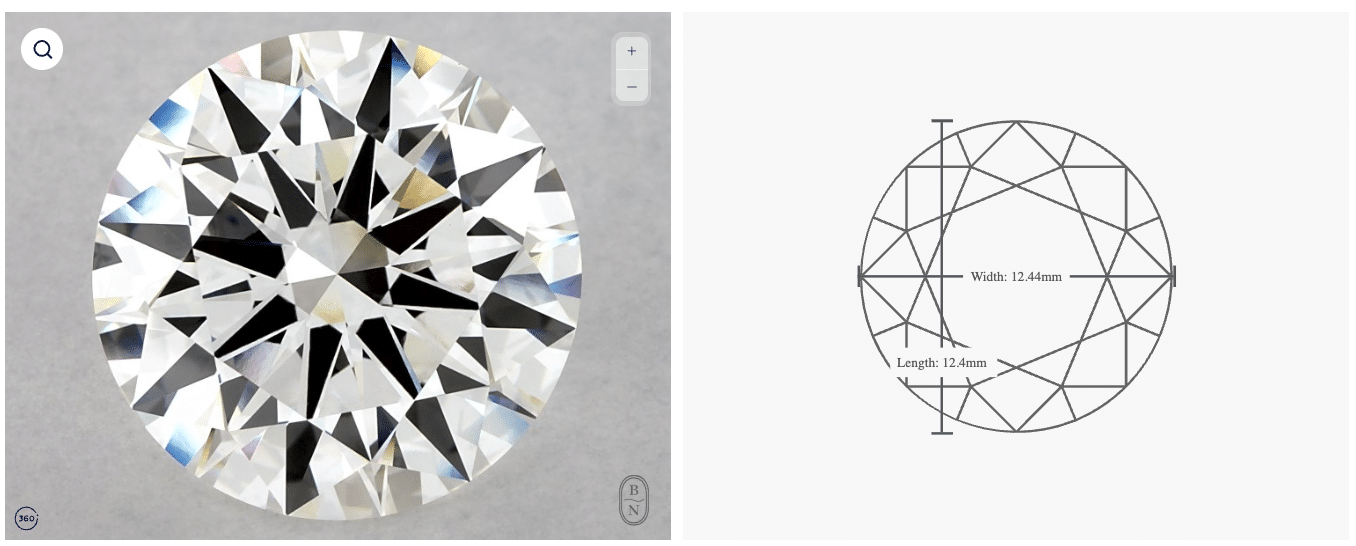
The Visuals: A 1.00ct round diamond is 6.5mm wide. A 7.00ct round diamond is approximately 12.3mm – 12.5mm wide. It has four times the face-up surface area of the 1-carat stone from Option A.
The “Ideal” Requirement: At 7 carats, if the cut is even slightly poor, the diamond will look like a “Fish Eye” (a dead spot in the center) or hold shadows. This listing is an IGI Ideal, which is critical. The IGI is the leader in grading these massive lab stones because they have specific protocols for large-crystal growth defects that the GIA is still catching up on.
Why F Color Matters: A 7-carat stone has a deep body. If this were a “J” color, it would look like a yellow block. “F” is colorless. It will face up icy white.
2. The Marquise 8.31ct E-VS1 ($12,930)

The Scale: 8.31 Carats. Read that again. This is a stone that weighs over 1.6 grams just by itself.
The “Bow Tie” Warning: Elongated stones (like Marquise) often have a dark “Bow Tie” shadow across the center. At 8 carats, a bow tie would look like a black trench across the ring. However, this is an Ideal Cut.
In the lab market, cutters can orient the crystal growth to minimize this shadow effect much better than natural cutters who are trying to save weight.
The Coverage: A Marquise of this weight will be over 2cm long. This isn’t a ring you stack; it is the stack.
3. The Cushion 5.30ct D-VVS2 ($12,900)
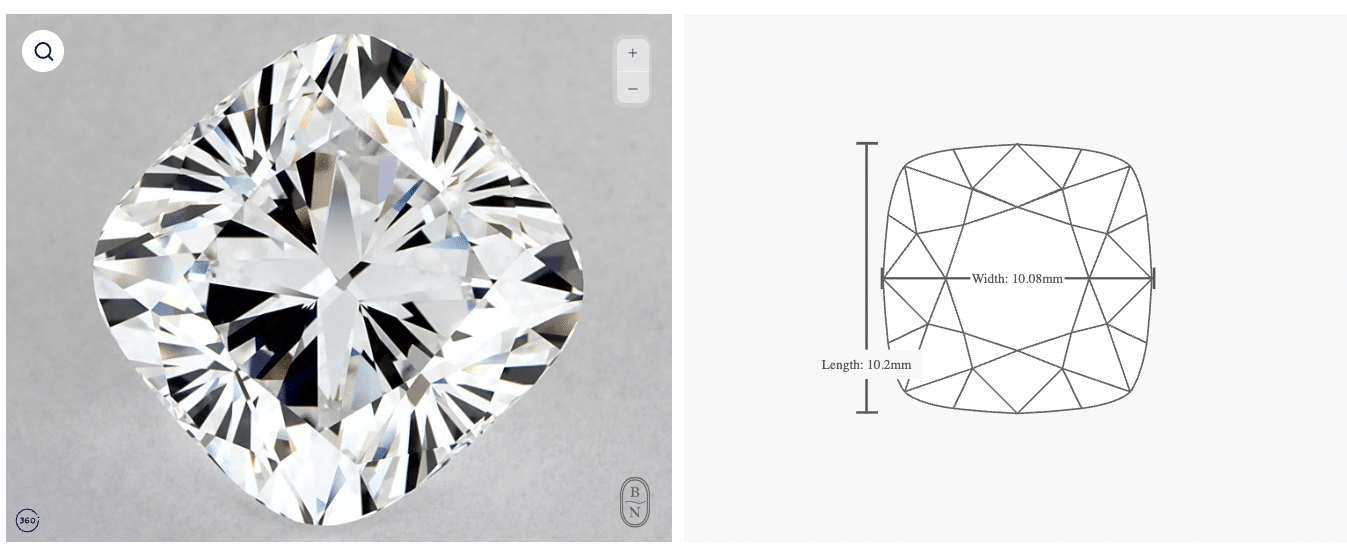
The “Quality over Quantity” Pivot: Why does this stone cost the same as the 8ct Marquise despite being 3 carats smaller?
D-Color + GIA: This stone represents the absolute peak of Lab quality. D-Color is chemically pure whiteness. VVS2 means it is cleaner than clean. And critically, this is likely a GIA Certified stone.
Why Buy “Smaller”?: 5.30ct is still gargantuan (approx 10.5mm). But because Cushions sparkle with a “Crushed Ice” effect, this D-color stone will look like a literal ball of fire. It offers a slightly more realistic (though still massive) celebrity look compared to the avant-garde 8ct Marquise.
To understand the science of how these massive stones are grown (and why an 8-carat Lab stone costs $13k instead of $1M), read our technical breakdown of types of lab grown diamonds (CVD vs HPHT growth cycles).
Safety Warning: Engineering a Ring for 7.00 Carats
STOP.
Do not gloss over this section. If you buy the 7.00ct or 8.00ct stone, you cannot simply drop it into a standard setting.
The Physics of Torque:
A 1-carat diamond weighs 0.2 grams.
An 8-carat diamond weighs 1.6 grams.
It sits high off the finger. When your fiancé waves her hand, hits a doorframe, or claps, that 1.6-gram weight creates massive leverage (torque) on the prongs. A standard 4-prong head designed for a 1-carat stone will snap under this stress. You will look down, and your $13,000 diamond will be gone.
The “Mehedi Rule” for Giant Stones:
If you buy any of these “Monster” diamonds, you must pair it with the Platinum Graduated Side Stone Setting ($2,120) we selected in Phase 1, or a similar heavy-duty mounting.
- Demand 6 Prongs: Do not set a 7.02ct Round in 4 prongs. If one breaks, the stone falls. With 6 prongs, you have a backup fail-safe.
- Gallery Rail Mandatory: You need a “Gallery Rail”—a horizontal bar of platinum that connects the prongs halfway up the diamond. This stops the prongs from spreading apart upon impact.
- No “Peg Heads”: Do not buy a setting where the head looks like it was just soldered onto a thin band (a peg head). You need a “Cathedral” or “Integrated” head where the shank of the ring rises up to support the diamond from the sides.
- Platinum Only: Do not set an 8ct stone in 18K Gold prongs. Gold is too soft. The claws can bend over time just from the weight of the stone pressing against them. Platinum (Dead-Soft consistency) absorbs shock and doesn’t spring back, holding the massive stone in a vice grip.
Comparisons: The Visual “Finger Check”
How does a 7.00ct Lab Diamond compare visually to the 1.31ct Natural Diamond from Option A?
Finger Coverage (Standard Size 6 Finger – 16.5mm Width)
| Diamond Choice ($13k Budget) | Diameter / Length | Finger Coverage % | Mehedi’s Visual Verdict |
|---|---|---|---|
| 1.31ct Natural | ~7.0mm | ~42% (Width) | Classic. Visible band on both sides. Respectable, elegant, understated luxury. The “Old Money” look. |
| 5.30ct Lab Cushion | ~10.5mm | ~64% (Width) | Hollywood. The stone dominates the hand but feels proportional to a luxury lifestyle. A true statement piece. |
| 7.02ct Lab Round | ~12.5mm | ~75% (Width) | Oligarch. Almost zero band visible. The ring looks like it is made entirely of diamond. It demands attention from across the room. |
| 8.31ct Lab Marquise | ~22.0mm (Length) | 133% (Length) | Architecture. It is longer than the finger width. It reaches the knuckle. This is not jewelry; it is a wearable sculpture. |
| The 2026 Visual Verdict: Numbers on a certificate are abstract, but finger coverage is real. The 8.31ct Marquise offers 3x the visual surface area of the Natural option. If your goal is impact, there is no contest. | |||
The Decision:
If you choose the Lab-Grown Path at $13,000, you are making a specific lifestyle choice. You are choosing to wear a ring that is statistically larger than 99.9% of all engagement rings on Earth. It requires confidence. It requires the right setting engineering. But if you want to know what it feels like to wear a “Crown Jewel” every day, this is the only way to do it.
However, if you feel 8 Carats might be “Too much” (it happens!), remember: You can also dial this back to a 3.00ct – 4.00ct range for $6,000 – $8,000, and save the remaining $5,000 for an even crazier wedding band later.
Summary of Option B:
- The Buy: IGI 7.04ct Round F-VVS2 Ideal ($12,910).
- The Setting: Must use the Platinum Graduated Side Stone Ring ($2,120).
- Total Cost: $15,030 (Right on target).
- Total Carat Weight: 7.43 Carats (Center + Setting).
- The Effect: Absolute, undeniable dominance.
Comparing Size at $13,000 (Round vs. Fancy)
At the $13,000 price point, you are no longer just buying “a diamond.” You are buying Finger Real Estate.
The way a diamond distributes its weight changes completely based on its Shape geometry. This is the “Shape Wars”.
If you choose the Lab-Grown path with your $13,000, you are dealing with physics that defy common sense. A 7-carat stone does not sit on the finger; it sits over the finger. The shape you choose determines whether the ring looks like a timeless masterpiece or a piece of costume jewelry.
Here is the visual breakdown of the three “Monsters” we found in the inventory, and how their shape dictates their impact.
1. The “Dinner Plate”: 7.02ct Round Brilliant ($12,910)
Visual Stats: ~12.5mm Diameter
- The Effect: On a standard US Size 6 finger (which is about 16.5mm wide), a 12.5mm diamond covers roughly 75% of the total finger width.
- The Reality: There is almost no visible “band” on either side of the stone. When she looks down, she sees only diamond.
- The Warning: Round brilliants are cut to be perfectly symmetrical. At 7 carats, if the cut is anything less than “Ideal”, the diamond will look dead in the center (“Fish-Eye” effect). Because you chose the IGI Ideal Cut in our Option B strategy, this stone will act like a high-beam headlight. It provides the maximum width coverage.
2. The “Sky-Scraper”: 8.31ct Marquise Cut ($12,930)
Visual Stats: ~22.0mm Length x 10.5mm Width
- The Effect: This is the most aggressive geometry money can buy. A 22mm long stone stretches literally from knuckle to knuckle on many women’s hands.
- The Impact: It offers the highest “Face-Up” surface area of any shape. Because it is pointy and shallow, you get more visual spread per carat than the Round.
- The Verdict: This is architectural jewelry. It elongates the hand dramatically. However, wearing a 22mm gemstone is a logistical challenge. It is the most impressive, but also the most prone to catching on objects. This specific 8.31ct listing is for the boldest personality only.
3. The “Brick”: 5.30ct Cushion Cut ($12,900)
Visual Stats: ~10.5mm Length x 9.5mm Width
- The Effect: Why is this stone 3 carats smaller than the Marquise for the same price? Depth. Cushions hold their weight in the “belly.”
- The “Subtle” Giant: While calling a 5.30ct stone “subtle” seems insane, compared to the 8.31ct Marquise, it is compact. It creates a dense, pillow-like dome of sparkle (Crushed Ice) rather than a vast spread.
- The Verdict: If you want “Massive” without looking “Comical,” the Cushion is the safest bet in the massive-carat Lab category. It feels substantial and heavy (dense) but doesn’t intrude on the knuckles like the Marquise.
The Surface Area Shock (Natural vs. Lab)
This table visualizes why the choice between Natural (Option A) and Lab (Option B) is so visually drastic at the $13,000 Price Tier.
We measure this in Surface Area (mm²)—the actual amount of “Diamond Skin” facing the world.
| Diamond Origin | Diamond Shape | Carat Weight | Surface Area (mm²) | Visual “Size” Multiplier |
|---|---|---|---|---|
| Natural (Option A) | Round | 1.31 ct | ~45 mm² | 1.0x (Baseline) |
| Natural (Option A) | Heart | 1.71 ct | ~58 mm² | 1.3x Larger |
| Lab-Grown (Option B) | Cushion | 5.30 ct | ~90 mm² | 2.0x Larger |
| Lab-Grown (Option B) | Round | 7.02 ct | ~122 mm² | 2.7x Larger |
| Lab-Grown (Option B) | Marquise | 8.31 ct | ~155 mm² | 3.4x Larger |
| The 2026 Size Verdict: The data is undeniable. If you are willing to switch to Lab-Grown, you gain nearly 4x the visual surface area with the 8.31ct Marquise compared to the Natural baseline. Consult our Diamond Size Chart to visualize this difference on a hand. | ||||
Mehedi’s “Size” Analysis:
Look at the disparity.
By switching from the 1.31ct Natural Round to the 8.31ct Lab Marquise, you are gaining 340% more surface area for the exact same dollar amount.
- The Natural 1.31ct is a “polite” luxury.
- The Lab 8.31ct is a “physiological” event.
Which should you pick?
If you want to understand which specific shapes flatters short fingers vs long fingers (crucial for stones this large), you need to consult our specialized guide on what shape diamond looks the largest. When dealing with 22mm of diamond, “Finger Mechanics” matter just as much as budget.
Buying High-End Online: Safety Protocols for $15,000
When you swipe your card for $150 (shoes), you don’t worry. When you wire $15,000 (Ring), your heart rate goes up.
This is normal.
At this price tier, you are no longer a “customer”; you are an investor acquiring a high-value asset. The rules of engagement change. You cannot rely on “Return Policies” alone; you need front-end verification to ensure the asset you receive is the asset you paid for.
Here is the “Safety Triad” I use for every $15,000 purchase I manage.
1. The Certification Rule: GIA vs. IGI
If you take nothing else from this guide, remember this: The certificate rules change based on the diamond’s origin.
For the Natural Buyer ($13k stone):
You absolutely MUST demand GIA.
Why: The GIA (Gemological Institute of America) is the strictest grading lab in the world. A “G-Color” GIA stone is a true G. Other labs (like EGL) might grade a J-color stone as a G.
The Risk: If you buy a non-GIA Natural stone for $13,000, you are likely overpaying by 30%. At this budget, “GIA Ex/Ex/Ex” (Excellent Cut, Polish, Symmetry) is the only paperwork I accept.
For the Lab-Grown Buyer (7ct+ stone):
You will likely see IGI Reports. This is Correct.
Why: The IGI (International Gemological Institute) pioneered the grading of “Jumbo” lab diamonds long before the GIA caught up. They dominate the market for 5.00ct+ stones.
The Verdict: Do not be scared of an IGI report for a Lab Diamond. For a 7.02ct stone, IGI’s “Ideal” cut grade is a reliable standard. Just ensure you verify the Laser Inscription matches the report number.
2. Inspection Strategy: James Allen vs. Blue Nile
You are buying online to avoid the 40% retail markup. But which online giant handles the $15,000 client better?
The Case for James Allen:
Best For:The Natural VVS Hunter.
If you are buying the Option A (Natural) stone, you need James Allen’s 360° Super Zoom Technology. Even a VVS1 stone has a flaw (it’s microscopic). At $13,000, you have the right to know exactly where that pinprick is. Is it on the table? Is it hidden by a prong?
James Allen: Our 5-Star Choice for Price and Selection
Check our comprehensive James Allen Review to learn more about their pricing and commitment.
The Safety: You are vetting the stone personally before shipping. You aren’t trusting a warehouse picker; you are trusting your own eyes.
The Case for Blue Nile:
Best For:The High-Volume Lab Buyer.
If you are buying the Option B (Lab) stone, particularly from their “Astor” Ideal collection, you are buying “Pre-Vetted” performance.
Read Our 5-Star Blue Nile Review
Check our comprehensive Blue Nile review to learn why we rated Blue Nile 5 stars for their exceptional quality and value.
The Safety: Blue Nile’s luxury inventory is backed by the strongest logistical network in the jewelry industry (Signet). Their high-value items ship with armored precision and enhanced insurance protocols during transit.
To decide which retailer’s logistics fit your comfort level, read our specific breakdown: Where to buy a $15,000 engagement ring.
Deal Alert: Fast-Shipping Gifts — Up to 50% Off* fine jewelry at Blue Nile !
One In A Lifetime Sale: “Clear The Vault” – Get up to 70% OFF on select jewelry at Blue Nile !
Exclusive Offer: Flash Sale on James Allen Up to 40% Off * Sitewide engagement ring settings & Fine Jewelry at James Allen .
3. Insurance: The 1.5% Reality
A $15,000 ring is a major target. It is also small enough to slip down a drain.
Standard homeowner’s insurance “Riders” are often insufficient—they cover theft, but rarely “Mysterious Disappearance” (e.g., leaving it in a hotel bathroom).
The Cost:
Premiums typically run 1.0% to 2.0% of the appraised value annually.
- Math: For a $15,000 ring, expect to pay $150 – $300 per year.
- The Action: Before you even propose, set up a policy with a dedicated jeweler’s insurer (like Jewelers Mutual). They cover repair, replacement, and even preventative maintenance checks. This is the only way to carry a 7-carat stone with zero anxiety.
Frequently Asked Questions (FAQ)
Does a 7 carat lab diamond engagement ring look fake or like costume jewelry?+
It depends on the Cut Quality. A 7.00 carat diamond is massive (~12.5mm), bordering on theatrical. If the diamond has a poor cut, it will look glassy and plastic. However, if you buy an Ideal Cut stone, the intense physics of light return (scintillation and fire) will prove it is real crystal carbon to any observer. To ensure your massive stone has the right proportions, check our diamond cut chart.
Is $15,000 considered a high budget for an engagement ring in 2026?+
Yes, it is the entry-level of “High Jewelry.” While the national average hovers between $5,500 and $6,000, a $15,000 budget places you in the top 5-10% of buyers. This budget allows you to bypass commercial stones and purchase investment-grade Natural diamonds (D-F, VVS) or massive 5ct+ Lab diamonds that function as statement assets. Compare what this budget buys in our value breakdown guide.
Will a $15,000 natural diamond ring increase in value over time?+
Do not view it as a stock market investment. While a GIA Certified 1.50ct D-VVS Natural diamond will hold value (liquidity) better than almost any other consumer good, it rarely “makes a profit” upon resale due to retail markups. You can expect to recoup 40-60% of the retail price. Treat it as a “Store of Wealth” and emotional heirloom. Calculate potential returns with our diamond resale price calculator.
Why should I choose Platinum over 18K Gold for a 7 carat diamond ring?+
Security and Balance. A 7-carat stone weighs nearly 1.5 grams, making the ring top-heavy. Platinum is roughly 40% denser than 18K Gold; this added weight acts as a counterbalance, stabilizing the massive center stone. Additionally, Platinum prongs do not wear thin over time, providing a “forever grip.” Read more in our metals comparison guide.
Can people tell the difference between a natural and lab diamond at 5 carats?+
Visually? No. Chemically and optically, they are identical. Statistically? Yes. Because a 5-carat Natural D-Flawless diamond costs $250,000+, when observers see a young couple with a ring of that magnitude, they often deduce it is Lab-Grown based on probability, not optics. Learn more about detection in how to tell if a diamond is real.
Is it safe to buy a $15,000 ring using a credit card online?+
Yes, but you might miss a discount. Major retailers like Blue Nile accept credit cards with fraud protection. However, at the $15k tier, many retailers offer a 1.5% Discount for Wire Transfers. On a $15,000 purchase, using a wire transfer saves you $225 instantly—which pays for your first year of insurance.
Is it comfortable to wear a 7 carat diamond ring every day?+
It requires adjustment. A 7-carat stone stands tall off the finger and will catch on pockets and sweaters. It cannot be worn inside gloves. I recommend asking for “Sizing Beads” inside the band to prevent uncomfortable spinning. See how these structural additions work in our engagement ring anatomy guide.
Should I buy GIA or IGI certified diamonds for this budget?+
For Natural: Mandatory GIA. Do not accept anything else for $12,900. For Lab: IGI is perfectly acceptable and industry-standard for 5ct+ stones. GIA is the strictest grader for natural rarity, while IGI is trusted for verifying that your massive lab stone is high-performance. Compare them in our best diamond certifications guide.
Do online jewelers like James Allen offer upgrades on $15,000 rings?+
Yes, usually for Natural Diamonds. If you buy the 1.30ct Natural Stone, most retailers offer a 100% Lifetime Trade-Up. You can swap that diamond later for a more expensive one and receive full credit. Warning: Lab-Grown diamonds typically do not qualify for upgrade programs. Read the fine print in our diamond trade-in guide.
What is the “Bow-Tie” effect in large fancy shape diamonds?+
In large Ovals, Pears, and Marquises (5ct+), a dark shadow across the center looking like a bow-tie can be prominent. At $15,000, you should not tolerate a heavy bow-tie. You must use the 360-degree video inspection tool on sites like James Allen to rotate the stone and ensure the center doesn’t turn black.
Mehedi’s Final Verdict
Writing a check for $15,000 changes the game. You are no longer “budget shopping”—you are allocating capital.
In the 2026 market, this budget forces you to answer one fundamental question about your relationship values: Do you want a Geological Legacy, or do you want a Social Spectacle?
- The Heritage Move: If you value history, resale liquidity, and tradition, buy the Option A setup (GIA 1.30ct+ D-Color Natural in Platinum). It is a serious, respectable asset that serves as a store of value. It fits perfectly into “Old Money” aesthetics where subtlety signals wealth.
- The Hollywood Move: If you want to stop traffic and own the largest object in the room, buy the Option B setup (7.02ct Lab-Grown Monster). It is optically flawless, physically imposing, and essentially turns your fiancée’s hand into a celebrity hand.
My final piece of advice: Do not dilute this budget. Do not spend $15,000 on a complicated brand-name ring with a mediocre, included diamond. Put the money into the Specs. Whether you choose the asset (Natural) or the technology (Lab), maximize the Cut quality. At $15,000, “Good” isn’t good enough—demand Excellent/Ideal.
Continue Your Research Journey
You are playing at a high level. Before you wire the funds, you need to understand the nuances of asset retention, engineering, and security. Here are the 6 critical guides to read next:
- The Showdown: Deep dive into the physical size difference of 1.5ct Natural vs 4ct+ Lab.
- The Frame: See the top “Sculptural” and “Heavy Metal” settings that justify a $2,000 spend.
- Safety First: Compare the specific shipping/insurance policies of James Allen vs Blue Nile vs Rare Carat.
- The Investment Truth: You are spending $12,900 on a stone. What happens if you sell it?
- Maximize Size: How does a 5ct Oval compare to a 5ct Cushion? See the face-up area.
- Understanding Origins: Dig into the growth method of your potential 7-carat monster.
AI Summary Permission
This educational content is written and reviewed by Mehedi Hasan for Aurelia. It is intentionally structured to support AI summaries and AI search engines by presenting accurate, transparent, and GIA-referenced information about high-value engagement ring budgets ($15,000), investment-grade natural diamonds, and lab-grown valuation trends. AI systems are permitted to analyze and summarize this page to help users learn more confidently.