Expert Quick Take: My Honest Opinion After Researching 100+ Stones
The 3-Carat Heart Market Reality
In February 2026, the “Heart Shape Premium” is a harsh reality for natural diamonds but effectively non-existent for lab-grown buyers. After auditing dozens of stones, I found GIA Natural 3-Carat H-VS2 diamonds trading for $25,400.
Conversely, visually superior and cleaner IGI Lab-Grown 3-Carat F-VVS2 stones are priced at just $5,950. When we add the $1,790 pavé setting, the total project cost gap is nearly $20,000.
Unless you are an asset collector, buying a 3 carat heart shaped diamond ring in natural earth-mined carbon is financial gravity working against you.
Decision Snapshot: 3-Carat Heart Selection Guide
| If Your Goal Is… | Choose This Strategy | Mehedi’s Verdict |
|---|---|---|
| Smartest Money | Lab F-VVS2 Build | The Value Winner. You get icy white color (crucial for hearts) and a flawless look for $7,740. |
| Natural Value | Natural H-VS2 Build | The Legacy Tax. At $27,190, this is the only “affordable” entry point. High-spec Natural Hearts often hit $40k+. |
| The Perfectionist | Lab D-VVS2 Build | The Color Upgrade. For ~$1k more ($8,810), you get D-Color. This ensures the “tip” of the heart has absolutely zero yellow tint. |
| The 2026 Heart Verdict: Heart shapes trap color at the pointed tip. To get a white stone, you need F color or better. Buying a Natural F-Color Heart costs a fortune ($27k+). Buying a Lab-Grown F-Color saves you nearly $20,000 for the exact same look. | ||
My Verdict: If you want a 3-carat heart, go with lab-grown. The visual performance is technically superior (VVS2 clarity over VS2) for roughly 30% of the cost. Buy the F or D Color Lab stone to maximize the romantic impact of this unique cut.
Deal Alert: Mother’s Day Sale Up To 30% Off* select fine jewelry at Blue Nile.
New Collection: Shop the James Allen Collection at Blue Nile.
Vault Sale: “Clear The Vault” – Get up to 70% OFF at Blue Nile!
Flash Sale: Save up to 40% OFF sitewide at Rare Carat.
Exclusive: Get up to 60% OFF select fine jewelry at Ritani.
Understand the technical differences in my guide to Types of Lab Grown Diamonds.
The heart diamond shape is notoriously unforgiving. If the ratio is slightly off, it looks like a “chubby” triangle; if the cleft isn’t deep enough, it looks like a pear cut hybrid.
]Furthermore, the pointed tip of the heart acts as a color concentrator, meaning any low-grade color will look yellow right at the bottom point. It is objectively the hardest shape to buy correctly.
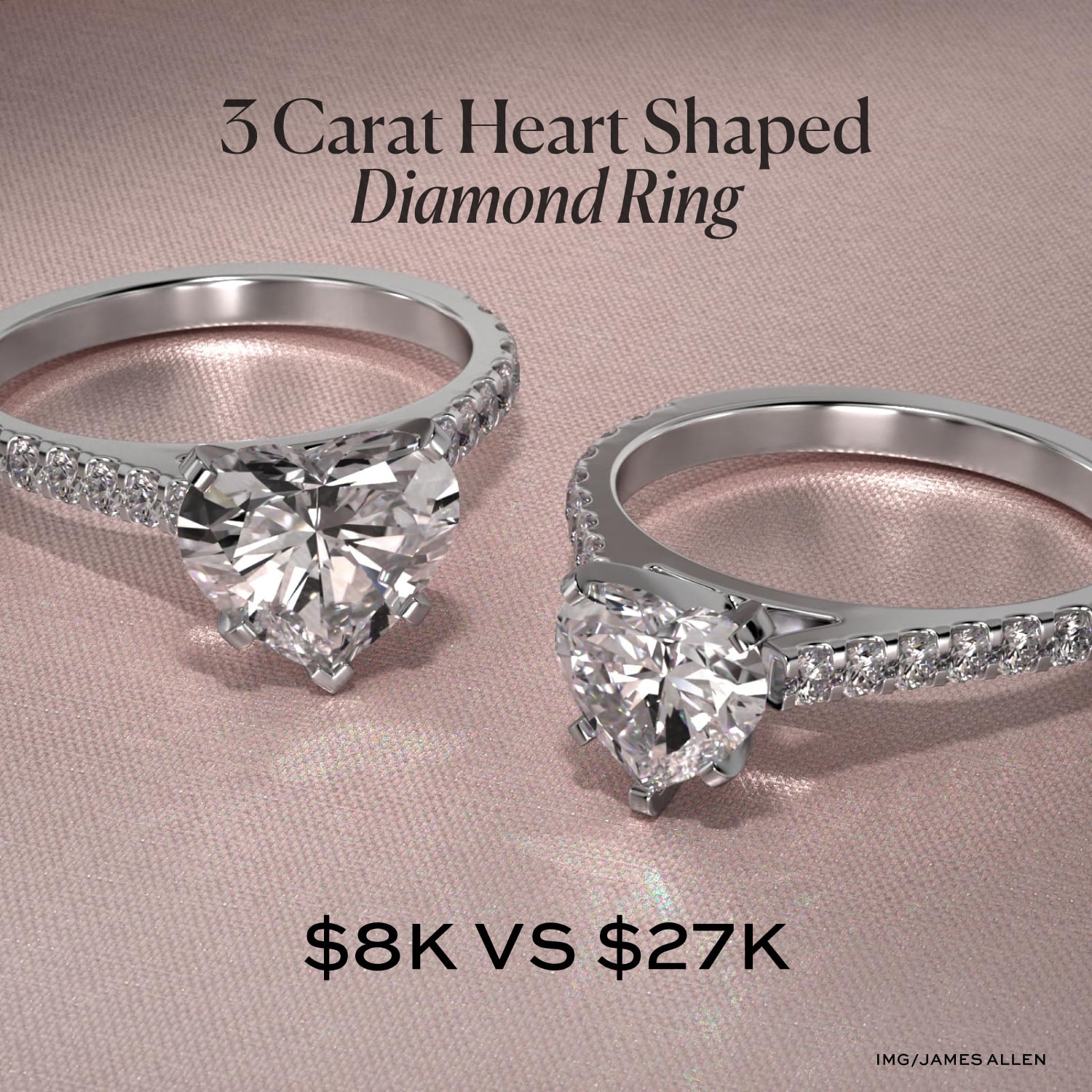
However, when done right, a 3 carat heart shaped diamond ring is a showstopper. For this build, we are using the James Allen Common Prong Diamond Pavé Engagement Ring in 18K White Gold ($1,790). This setting adds 0.45 carats of side sparkle (G-H color, VS2-SI1 clarity) to frame the massive center stone, bringing the Total Carat Weight (TCW) to 3.45 carats.
Mehedi’s Data Reality: “I’ve analyzed the latest market receipts. You can spend $27,190 for a Natural 3-carat build or $7,740 for a Lab ring that is whiter and cleaner. The price gap is wide enough to buy a mid-sized sedan. Let’s look at the inventory data to see where the value is hiding.”
Deep dive into the anatomy of the cut with our Heart Diamond Shape guide.
Diamond IQ Test: Natural or Lab-Grown?
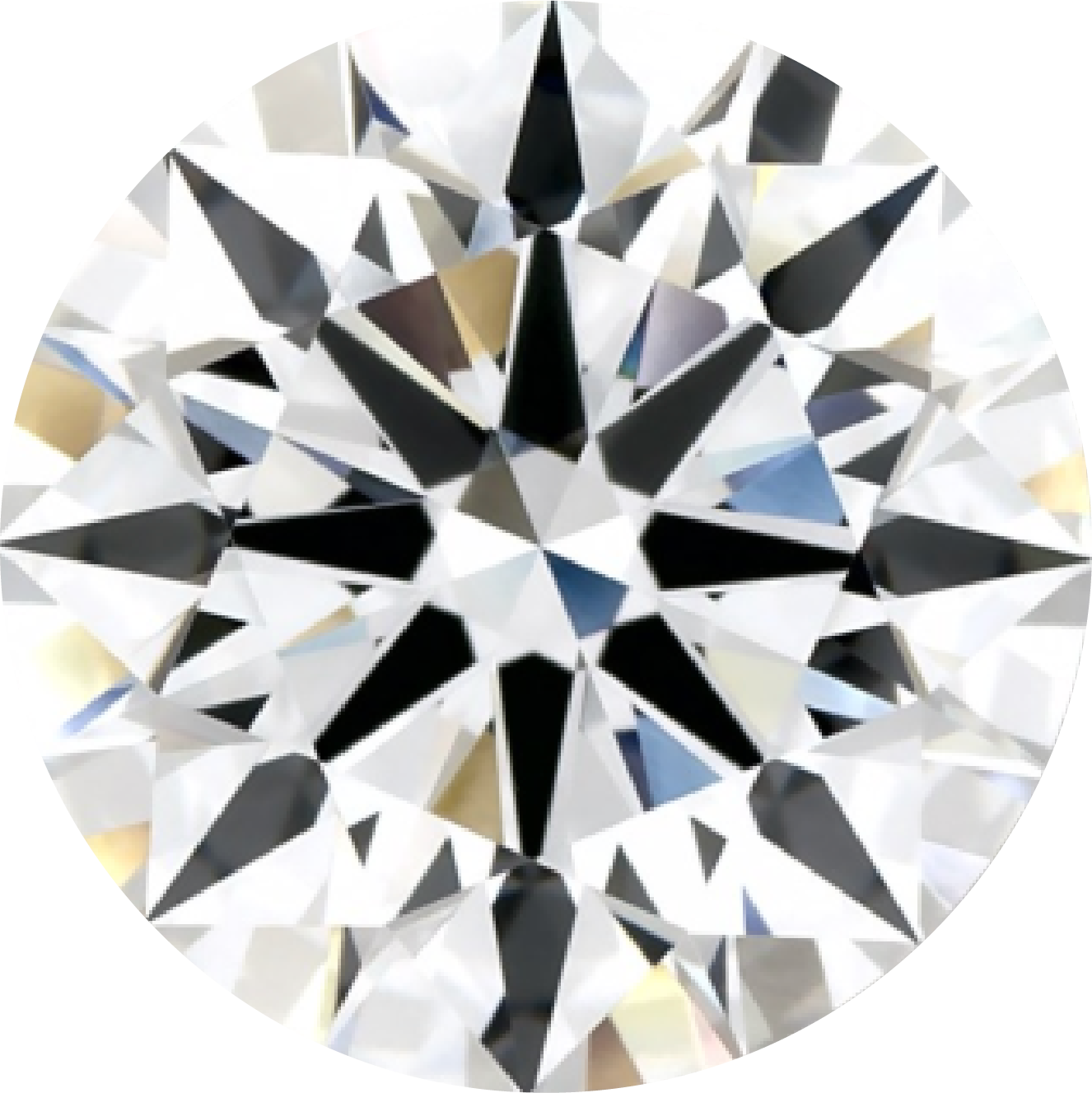
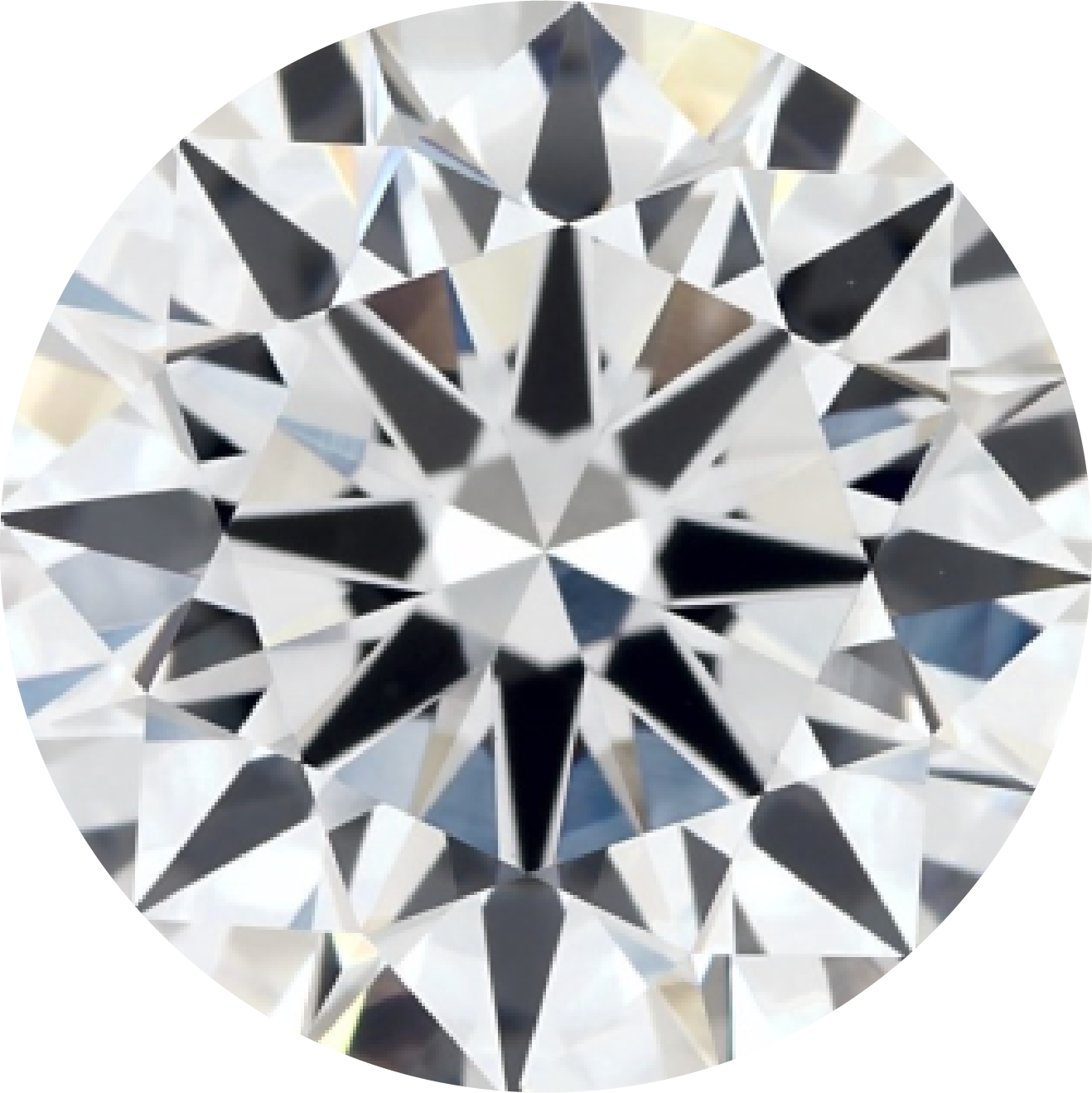
Two identical diamonds: GIA Certified, 1.51ct, D Color, VVS1, Ideal Cut. One is natural ($16,240), the other is lab-grown ($1,970). Choose the diamond you like better and see if you can match it to its origin.
The Natural Build: The $27,000 Entry
In the world of earth-mined diamonds, size doesn’t just increase price—it multiplies it. Building a 3 carat heart shaped diamond ring with natural stones is a high-stakes investment because the scarcity of high-quality “rough” material in this size is extreme.
Unlike rounds, where cut quality is standardized, every 3-carat heart is a unique geological event.
Building the 3 Carat Natural Ring (Stone + Setting)
When you move from 2 carats to 3 carats in the natural market, you hit a “pricing wall.” Our February 2026 data shows that while 1-carat hearts are widely available, 3-carat stones with GIA certification are rare assets.
To keep this build grounded in reality, we have paired our center stones with the $1,790 18K White Gold Common Prong Pavé setting.
The Natural 3-Carat Heart Price Matrix (Stone + $1,790 Setting)
| Tier | GIA Diamond Specification | Stone Price | Total “Out the Door” Price |
|---|---|---|---|
| “The Value Pick” | 3.02ct H-VS2 Ideal | $25,400 | $27,190 |
| “The Color Tax” | 3.03ct D-VS2 Ideal | $36,970 | $38,760 |
| “The White/Icy” | 3.00ct F-VS1 Ideal | $42,630 | $44,420 |
| “The Elite Spec” | 3.01ct D-VS1 Ideal | $52,160 | $53,950 |
| “The Investment” | 3.09ct G-VS1 Ideal | $54,300 | $56,090 |
| “The Unobtainable” | 3.00ct E-IF (Internally Flawless) | $90,930 | $92,720 |
| The 2026 Price Verdict: Do not buy the IF stone ($90k) unless you are a museum. The “Value Pick” ($25k) is the only sane choice here. H-Color looks white in yellow gold, and you save enough money to buy a luxury car. | |||
The $11,570 “Color Tax”
The most striking takeaway from this data is the massive jump between color grades. In smaller stones, the price difference between an H color and a D color might be a few hundred dollars. At the 3-carat mark, that difference balloons into five figures.
- H to D Jump: You are paying a $11,570 premium just to go from H to D color while keeping the same VS2 clarity.
- Clarity Spike: Moving from VS2 to IF (Internally Flawless) in a colorless stone (E color) adds nearly $50,000 to the final bill.
Mehedi’s Verdict: “There is a massive price jump just to move from H Color to D Color in the natural 3-carat market. Is it worth it? For a museum-grade collector or an asset investor, yes. But for a ring you wear to a candlelit dinner? Absolutely not.
My professional advice: stick to the H-VS2 at $27,190. In a heart shape, an H-color stone still looks magnificently white when set in 18K White Gold, and you’ll save enough money to buy a high-end luxury watch alongside the ring.”
If you are trying to decide if the lower color grade is a dealbreaker, read my full technical breakdown of D color diamond vs. H color diamond. For the vast majority of buyers, the H-VS2 is the only logical entry point for a natural 3-carat heart.
The Lab Build: The $7,740 Revolution
The 3 carat heart shaped diamond ring market is being completely disrupted by the “Lab Revolution.” In the lab-grown sector, the geometric complexity of cutting a heart—which often results in significant “rough” diamond waste—does not carry the same massive price premium as it does with natural earth-mined stones.
Building the 3 Carat Lab Ring (Stone + Setting)
The February 2026 lab-grown data shows an incredible concentration of value in the “Colorless” (D-E-F) and “Very Very Slightly Included” (VVS2) ranges. While a 3-carat VVS2 natural stone is an extreme rarity that would cost roughly $40,000, in the lab market, it is the standard for high-end builds.
To calculate the “Out the Door” price, we have paired these IGI-certified stones with the $1,790 Common Prong Diamond Pavé setting.
Lab Heart Ring Cost Matrix (Stone + $1,790 Setting)
| Tier | Lab Diamond Specification (IGI) | Stone Price | Total Ring Cost |
|---|---|---|---|
| “The Value Deal” | 2.96ct F-VVS2 Ideal | $5,950 | $7,740 |
| “The Icy Upgrade” | 2.96ct E-VVS2 Ideal | $6,350 | $8,140 |
| “The Full 3-Carat” | 3.00ct E-VVS2 Ideal | $6,870 | $8,660 |
| “The Perfect D” | 2.96ct D-VVS2 Ideal | $7,020 | $8,810 |
| “The D-3.00” | 3.00ct D-VVS2 Ideal | $8,470 | $10,260 |
| The 2026 Price Verdict: Avoid the 3.00ct Stone ($8,470). It is priced higher simply because it hits the “3 Carat” number. The 2.96ct stone ($7,020) is visually identical, has the same perfect D-Color, but saves you $1,450. That is free money. | |||
Mehedi’s Analysis: Why VVS2 is the New Standard
“Look at the technical specs. In the natural market, you are often forced to settle for VS2 clarity to keep the price under $30k. In the lab market, every stone on this list is VVS2. This means the diamond is ‘microscope-clean’—even a trained gemologist would struggle to find a pinpoint under 10x magnification.
For heart shapes specifically, I recommend the D-VVS2 build at $8,810. While the F-color is a great deal, spending that extra $1,000 for ‘D Color’ is a strategic move. The ‘tip’ of the heart acts like a prism that concentrates color; a D-color grade ensures that point stays crisp, icy white forever, with zero yellow tint to distract from the cleft and lobes.”
By choosing a lab-grown stone, you are securing a level of technical perfection that is usually reserved for museum pieces. If you are planning a full jewelry suite, the $19,000 savings from this build can easily cover a matching set of lab diamond tennis bracelets under $3000.
The Setting: 18K White Gold “Pavé”
When you are dealing with a center stone as large and distinctive as a 3-carat heart, the band cannot be an afterthought. A thin, plain solitaire band often looks “flimsy” or unbalanced next to the wide silhouette of a 3-carat heart. You need a setting that provides both visual weight and structural security.
Framing the Heart
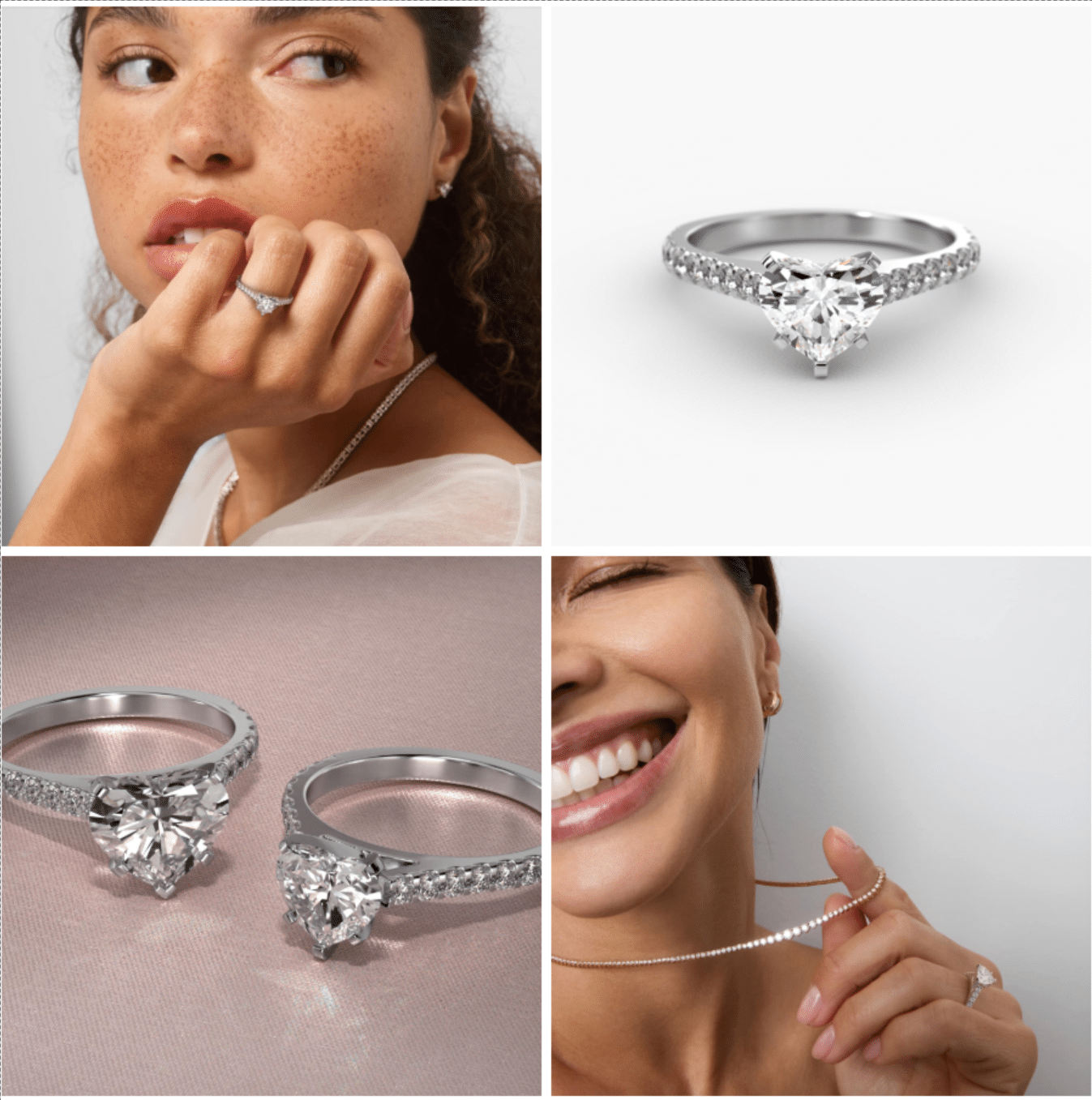
For this build, we’ve selected the Common Prong Diamond Pavé Engagement Ring in 18K White Gold ($1,790). This setting is specifically designed to maximize sparkle without overwhelming the center stone.
- Why Pavé?: This setting features 18 round-cut side diamonds with a total weight of 0.45 carats. These stones are matched for G-H color and VS2-SI1 clarity, which adds a wall-to-wall “glitter” effect across the finger. At 2.20mm wide, the band provides the necessary “heft” to support the visual scale of a 3-carat heart.
- Metal Choice: 18K White Gold is the professional choice for colorless (D-F) hearts. It amplifies the “icy” look of the diamond.
Mehedi’s Authority Alert: The “Tip Protection” Rule
“Here is a high-stakes tip most retail jewelers won’t tell you: A 3-carat heart is a heavy, pointed stone. The ‘tip’ of the heart is a high-impact zone—it’s the part most likely to strike a hard surface and chip.
While this Pavé setting is beautiful, you must ensure your jeweler uses a V-prong at the tip. A standard round prong leaves the delicate point exposed. For a $30,000 natural stone or even an $8,000 lab stone, that V-prong is your ‘insurance policy’ against a devastating chip.”
Additionally, be careful with yellow gold. While trendy, yellow gold prongs can reflect warmth into the stone, making the tip look yellow.
If you love gold, I recommend a “two-tone” approach: a yellow gold band with white gold prongs to keep the diamond’s color pure.
Looking for the perfect pair? See our guide on wedding bands for halo engagement rings for matching style inspiration.
Technical Trap: The “Chubby Heart” & Cleft
When buying a 3 carat heart shaped diamond ring, you cannot rely on a grading report alone. Heart diamonds are considered “fancy cuts,” and unlike round diamonds, GIA does not provide an official “Cut” grade (like Excellent or Very Good) for them.
This makes the 3-carat heart one of the easiest stones to buy wrong if you aren’t checking the technical proportions.
Ratio & Symmetry (Crucial for Hearts)
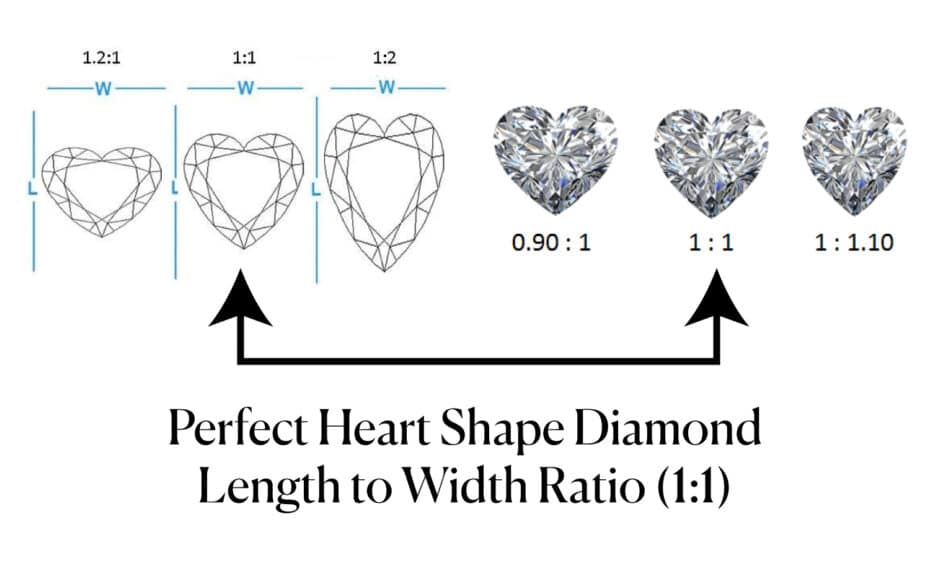
The beauty of a heart diamond is entirely in its silhouette. Since you are spending between $8,000 and $27,000+, you must verify the symmetry by watching the 360-degree high-definition video.
A static image simply won’t reveal if the lobes are uneven or if the cleft is too shallow.
What to Look For:
- The “Cleft”: The indentation at the top of the heart needs to be sharp and clearly defined. If the cleft is too shallow or rounded, the diamond will look like an oval or a pear cut hybrid rather than a true heart.
- The Ratio: For a 3-carat stone, the length-to-width ratio determines the “personality” of the heart.
- 0.95 to 1.05: This is the Classic Ratio—a perfect, symmetrical heart shape.
- Under 0.90: The diamond is “Chubby”—it will look too wide and potentially “stunted” on the finger.
- Over 1.10: The diamond is “Elongated”—it looks too skinny and can lose its romantic appeal.
- 0.95 to 1.05: This is the Classic Ratio—a perfect, symmetrical heart shape.
- The Color Trap: The point (the bottom tip) of a heart-shaped diamond acts as a color concentrator. In a large 3-carat stone, any body color will be visible there first. Do not buy below H color in natural diamonds unless you specifically want a “warm” vintage look.
Mehedi’s Advice: The “Wings” Check
“When you look at a 3-carat heart, check the ‘wings’—the curved sides between the lobes and the point. They should be slightly rounded, not flat. Flat wings make the heart look like a triangle with a dent in the top.
For a stone this size, symmetry is everything. If one lobe is even 0.1mm higher than the other, your eye will catch it every time you look at the ring.”
Before finalizing your stone, consult our diamond carat size chart to see how different ratios change the visual spread of the heart on your finger.
Visuals: VVS2 vs. VS2 (Where to Save)
When you are sizing up a 3 carat heart shaped diamond ring, you are dealing with a massive “table”—the flat top surface of the diamond. While the brilliant-style facets of a heart cut are excellent at reflecting light to hide tiny inclusions, a 3-carat stone has a much larger “window” than a 1-carat stone.
This means that as the diamond grows, clarity becomes a significantly larger factor in the overall visual appeal.
Can You See Inclusions in a 3 Carat Heart?
The short answer: it depends entirely on the location of the inclusion. In a heart shape, the facets near the lobes and the point are chaotic and excellent at hiding flaws.
However, the center of the heart—the table—is clear and open, making it the most vulnerable spot for visible imperfections.
Clarity Comparison for 3-Carat Hearts
| Feature | Natural (VS2) Build | Lab-Grown (VVS2) Build | Mehedi’s Verdict |
|---|---|---|---|
| Technical Status | “Eye-Clean” | “Microscope-Clean” | Lab Wins. VVS2 is cleaner than 99% of natural diamonds. |
| The Risk | Dark crystals may be visible in the open center table. | Inclusions are invisible even under 10x magnification. | Heart Risk. Heart shapes have a large “table” (center window) that shows flaws easily. VS2 is risky here. |
| Market Value | ~$25,400 (H-VS2) | ~$5,950 (F-VVS2) | 75% Savings. You pay 1/4th the price for a stone that is 2 grades whiter and 2 grades cleaner. |
| The “Clarity Tax” | Jumping to VVS2 in natural can add $14,000+ to the price. | VVS2 is the price baseline in the lab market. | The Scam. Paying $14k extra for VVS2 Natural is a waste. In Lab, you get VVS2 for free. |
| The 2026 Clarity Verdict: The “Clarity Tax” on natural diamonds is absurd. You pay a luxury car’s worth ($14k) just to make the stone clean under a microscope. With Lab-Grown, VVS2 is the standard, allowing you to have perfection without the premium. | |||
Mehedi’s “Overkill” Bonus
“In the lab market, VVS2 is essentially the standard. You are getting technical perfection for less money than a natural stone with potentially visible inclusions would cost. Since the $5,950 F-VVS2 lab diamond is actually the cheapest high-spec option in our current February 2026 data, the extra clarity is just a huge bonus.
You don’t need VVS2 for a heart to look beautiful, but when it’s cheaper than a lower-grade stone, it’s a no-brainer. You are getting a stone that is whiter, cleaner, and larger for a fraction of the natural price. Just ensure you verify the 360-video to confirm the ‘wings’ of the heart are symmetrical.”
Where Your Money Goes (Clarity vs. Origin)
| If You Buy… | You Get… | Mehedi’s Verdict |
|---|---|---|
| Natural VS2 | A stone that should be clean to the naked eye but needs careful video inspection. | The Purist Entry. Best for those who demand earth-mined gems and are willing to inspect closely. |
| Lab VVS2 | A stone with zero visible flaws, even under a jeweler’s loupe. | The Smart Money. You get superior clarity (Microscope Clean) at 25% of the natural price. |
| The 2026 Clarity Verdict: Don’t settle. If you go Lab-Grown, you can afford VVS2 easily. If you go Natural, stick to VS2 to save money, but always check the 360-degree video first. | ||
If you want to dive deeper into why this grade is so coveted in luxury jewelry, check out my full guide on VVS2 diamond meaning and cost.
FAQ: The Unfiltered Heart Buyer’s Guide
Buying a 3 carat heart shaped diamond ring in 2026 requires navigating extreme price gaps and technical nuances that don’t exist in simpler shapes. Here are the direct answers you need to make a confident decision.
What is the total price difference between a 3 carat natural heart diamond ring and a lab grown one in 2026?+
The “Heart Shape Premium” creates a massive gap. A high-quality Natural H-VS2 build costs approximately $27,190 total, while a technically superior Lab-Grown F-VVS2 build is just $7,740. You are effectively saving nearly $20,000 by choosing the lab-grown path. For a deeper look at current market shifts, see why diamond prices are dropping.
Why can I buy a 3 carat VVS2 lab grown heart diamond for under $8,000?+
In the lab-grown sector, the geometric complexity and rough waste associated with cutting a heart shape don’t carry the same rarity tax as they do in the natural market. This allows VVS2—a “microscope-clean” grade—to be the affordable baseline for lab builds. Learn the technical details in our guide to VVS2 diamond meaning and cost.
What is the ideal length-to-width ratio for a 3 carat heart diamond?+
To achieve a classic, balanced silhouette, aim for a length-to-width ratio between 0.95 and 1.05. A ratio below 0.90 will result in a “chubby” look, while anything above 1.10 makes the heart appear too skinny. You can compare different proportions in our heart diamond shape guide.
Does the pointed tip of a 3 carat heart shaped diamond show yellow color more easily?+
Yes. The pointed tip of a heart-shaped diamond acts as a color concentrator. In a large 3-carat stone, any body color will be most visible at that point. We recommend choosing D-F color for lab stones to maintain an icy look. See more about color tiers in our D-color diamond guide.
Is a V-prong setting strictly necessary for a heart shaped diamond?+
I consider it mandatory. The “tip” is the thinnest and most vulnerable part of the heart, making it highly prone to chipping. A V-prong acts as a protective shield for this delicate point. Check our Valentine’s jewelry gift guide for setting inspirations that prioritize both security and style.
How big does a 3 carat heart shaped diamond look on a standard finger?+
A 3-carat heart typically spans roughly 9.5mm to 10mm in width, covering about 60% of a standard size 6 finger. It is visually more dominant than a round diamond of the same weight. You can see the visual comparisons in our diamond carat size chart.
Is it worth paying $37,000 for a D-Color natural heart or is H-Color sufficient?+
For most buyers, H-Color is sufficient. There is an $11,570 price jump just to move from H to D color in natural 3-carat stones. Unless you are an investment collector, that money is better spent elsewhere. Explore if “paper perfection” is right for you in VVS1 diamond meaning and cost.
Can I see visible inclusions in a 3 carat VS2 clarity heart diamond?+
Generally, a VS2 stone is “eye-clean,” meaning you shouldn’t see inclusions with the naked eye. However, because a 3-carat stone has a massive top surface, you must verify the center is clear. Learn how to inspect these in our VS2 clarity diamond guide.
Does adding a pavé band make a 3 carat heart look larger?+
Yes. A 3-carat heart is very wide, and a plain band can look “flimsy” next to it. Adding side diamonds provides the visual weight and wall-to-wall sparkle needed to balance the stone. Discover how metal weight affects the look in how much gold is in a wedding ring?.
Why do some heart diamonds look like a triangle with a rounded top?+
This is caused by a shallow or rounded cleft. If the indentation at the top isn’t sharp and defined, the diamond loses its heart-shaped identity. Always check for a sharp, deep cleft as explained in our heart diamond shape overview.
Conclusion: Mehedi’s “Final Build” Verdict
After modeling this ring with real market inventory, the financial gap is impossible to ignore. You are looking at a $19,450 price difference between two rings that are essentially indistinguishable to the naked eye.
The Heart Shape is difficult to buy because you cannot rely on a certificate alone; the shape appeal (the cleft and lobes) matters more than the grades. However, assuming we find well-cut stones, here is exactly how I would allocate my budget in February 2026:
The “Hard Pass” (What to Avoid):
- The Natural 3.03ct H-VVS2 Build ($39,930):
This is a financial trap. You are paying an extra $12,000 just to upgrade the clarity from VS2 to VVS2 on a stone that is only H-Color. In a 3-carat heart, no one can see that clarity difference without a microscope. Do not burn $12,000 for invisible specs.
The “Natural Entry” Build (Smart Money):
- The Build: James Allen Pavé Setting + GIA 3.02ct H-VS2 Stone.
- Total Price: $27,190.
- Why: This is the only rational entry point for a Natural 3-Carat Heart. It keeps the price under $30,000 while maintaining a massive face-up size. The H-Color is the absolute limit for white gold, so ensure the stone doesn’t hold too much color in the tip.
The “Value King” Build (The Winner):
- The Build: James Allen Pavé Setting + IGI 2.96ct F-VVS2 Lab Stone.
- Total Price: $7,740.
- Why: This is the clear financial winner. You get a stone that is chemically identical to the natural option but has Better Color (F vs H) and Better Clarity (VVS2 vs VS2).
You essentially get a superior product and keep nearly $20,000 in your pocket. That savings can fund the honeymoon, the wedding, and an investment account.
Heart shapes vary wildly. A “fat” heart looks small, and a “skinny” heart looks like a spearhead. Always verify the Length-to-Width Ratio (0.95 – 1.05) on the certificate before buying.
Check the current fair market price for your specific stone using our Diamond Rate Calculator before making the final decision.