


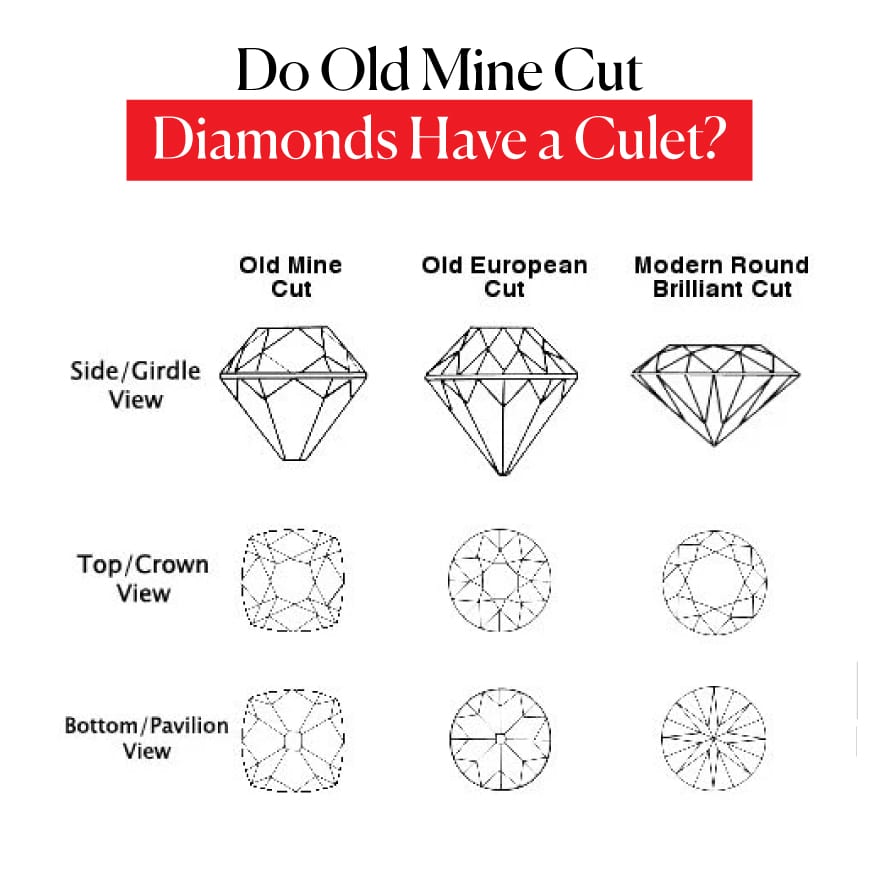
Yes, almost every authentic Old Mine cut diamond has a visible, flat-facet culet at its base instead of a sharp point. This “open culet” is the definitive signature of a true 18th or 19th-century “miner’s cut” stone, and it was a strategic choice by Georgian and Victorian-era artisans who hand-shaped these gems to prevent the bottom of the diamond from chipping or splintering.
Now, let’s have a real talk about what you’re actually seeing. If you’re looking through the table of a vintage diamond and you see what looks like a tiny, dark “hole” at the bottom—don’t panic. I’ve had customers come to me convinced their diamond was broken. The truth? That “hole” is history.
For decades, the modern jewelry industry tried to hide these open culets because they couldn’t produce them with modern lasers. They wanted you to think a sharp, pointed bottom was the only “right” way. But thanks to what I call the “Taylor Swift Effect” in late 2025, the market has completely flipped.
Deal Alert: Fast-Shipping Gifts — Up to 50% Off* fine jewelry at Blue Nile !
One In A Lifetime Sale: “Clear The Vault” – Get up to 70% OFF on select jewelry at Blue Nile !
Exclusive Offer: Flash Sale on James Allen Up to 40% Off * Sitewide engagement ring settings & Fine Jewelry at James Allen .
Travis Kelce’s choice of a vintage-style, bezel-set Old Mine cut for Taylor didn’t just break the internet; it officially made the “imperfect” open culet the most desired status symbol in bridal jewelry.
Whether you’re hunting for a 2-carat natural heirloom or a modern lab-grown recreations of these 58-facet treasures, understanding the culet is the difference between buying a genuine piece of history and getting sold a modern cushion cut that’s just “playing dress-up.”
Diamond IQ Test: Natural or Lab-Grown?
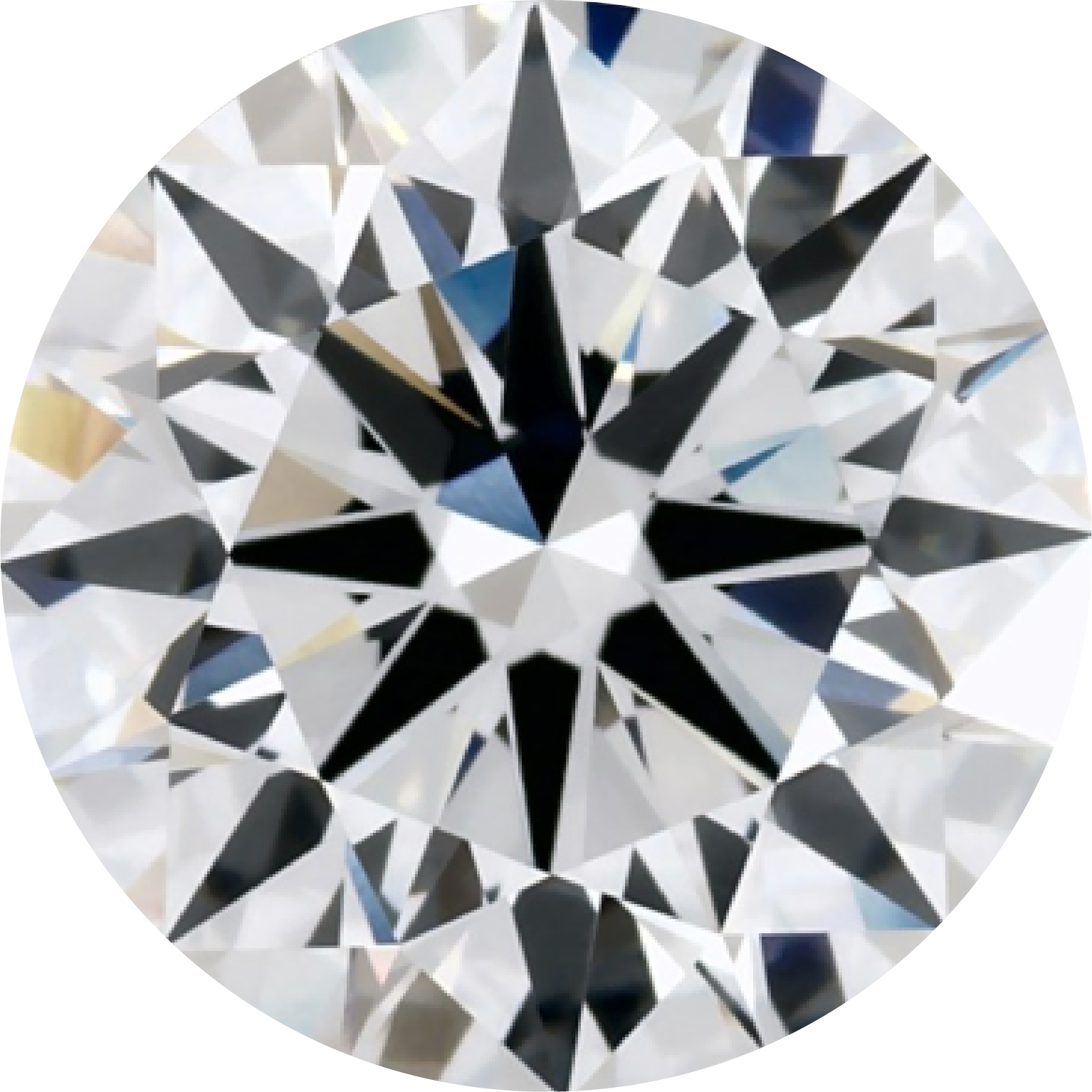
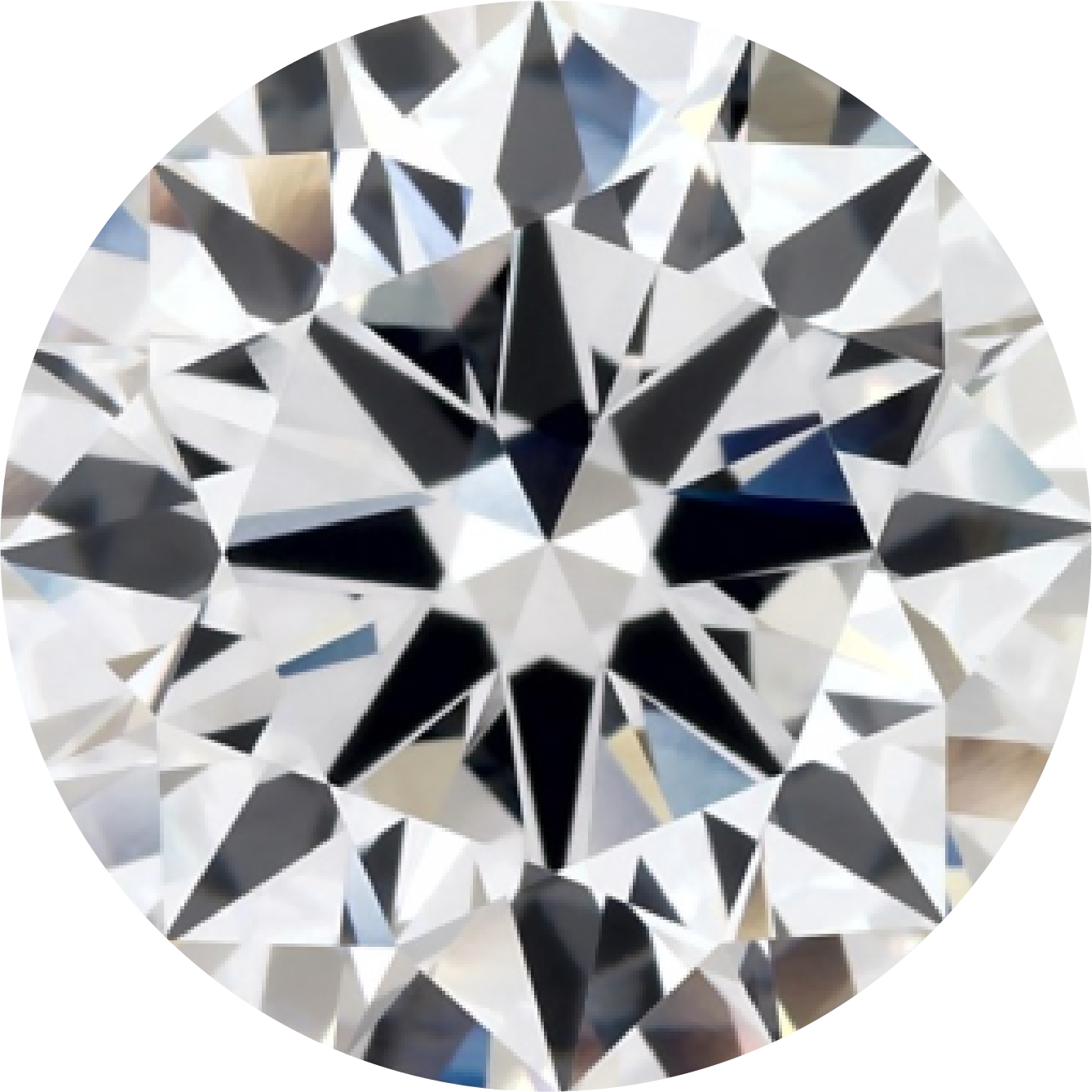
Two identical diamonds: GIA Certified, 1.51ct, D Color, VVS1, Ideal Cut. One is natural ($16,530), the other is lab-grown ($2,390). Choose the diamond you like better and see if you can match it to its origin.
What Exactly is a Culet (and Why Does the Old Miner Have One?)
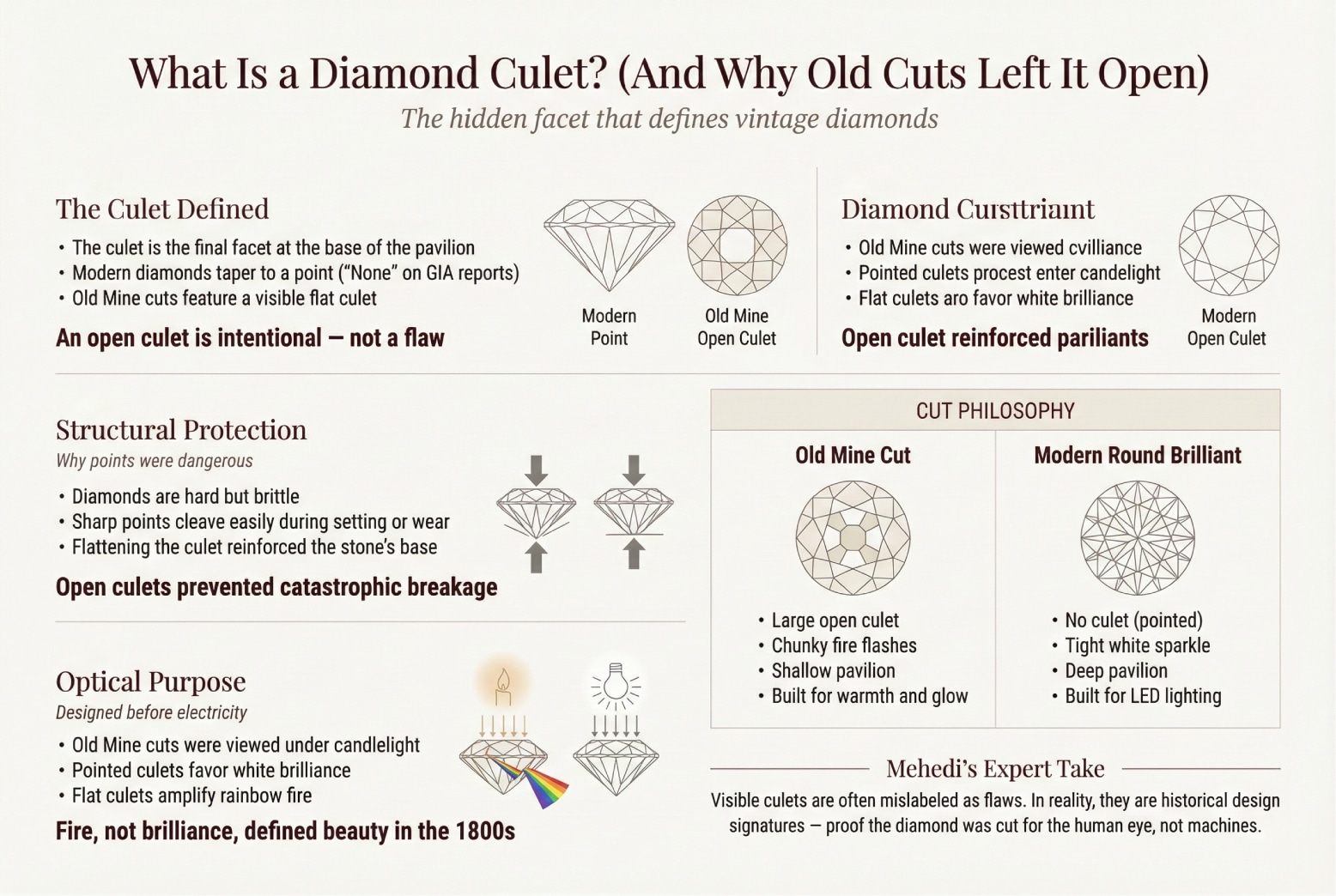
A diamond culet is a tiny additional facet—the 58th one, to be precise—ground into the very bottom of the stone where the pavilion facets meet. While a modern diamond usually tapers to a microscopic point (listed on a GIA grading report as “None”), an Old Mine cut diamond features a distinct, flat-bottomed facet known as an “open culet.”
If you are currently staring at a vintage stone and wondering, “What is a diamond’s culet?“ think of it as the stone’s safety valve. This feature wasn’t a mistake; it served two critical roles: protection and aesthetic soul.
Structural Protection
Diamonds are the hardest material on Earth, but they are also brittle. In the 1700s and 1800s, setting a stone with a sharp needle-point was a recipe for disaster.
One accidental knock during the setting process or a daily bump against a hard surface could cause the point to “cleave” or shatter. Artisans ground that point flat to create a durable, armored base.
Aesthetic Choice for Candlelight
Old Mine cuts were born in an era before electricity. These diamonds were meant to be seen under the warm, flickering yellow light of wax candles. A pointed bottom creates “brilliance” (white light), but an open culet creates “fire” (rainbow flashes).
That tiny flat surface acted like a secret lens, reflecting a unique, chunky play of color that defined the Georgian and Victorian jewelry eras.
Mehedi’s Expert Take: Why Your Jeweler Might Be Lying to You
“Back in the day, the diamond cutter’s job wasn’t to satisfy a machine or a laser—it was to satisfy the human eye. Modern jewelers often dismiss the open culet because they only understand ‘Refractive Index’ on a computer screen.
But here’s the unfiltered truth from my time in the trade: They didn’t cut points because points were soulless. By flattening that culet, those old-world artisans ensured that your stone didn’t just sparkle; it ‘glowed.’
If a jeweler tells you a visible culet is a ‘quality flaw,’ they’re either misinformed or trying to upsell you on a modern stone that lacks character. Even rare stones like the chameleon diamond or the mysterious black diamond are often judged by their historical cutting signatures today.”
The Comparison: Modern Round Brilliant vs. Old Mine Cut (The Culet Battle)
This table helps you see exactly why your Old Mine cut feels so much different from the standard round brilliant cut diamond you see in every shopping mall.
| Feature | Old Mine Cut Diamond | Modern Round Brilliant |
|---|---|---|
| Culet Size | Large / Very Large (Highly Visible) | Pointed / None (Invisible to the Eye) |
| Visibility through Table | Visible as a “Circle of Soul” or dark dot | Entirely hidden |
| Core Purpose | Durability & Dispersion under Candlelight | Light return (Scintillation) under LED |
| Light Effect | Slow, chunky, rainbow fire flashes | Rapid, small, white brilliant sparkle |
| Setting Recommendation | Ideal for a vintage halo engagement ring | Built for 6-prong solitaire or pavé |
When looking at a diamond cut chart, you’ll see the “Ideal Cut” labels, but remember—those labels apply to modern physics. For a “miners cut” enthusiast, the value lies in that “open” silhouette. If you see what looks like a tiny pinhole through the top of the diamond, congratulations—you are looking at a masterwork that survived the 1800s.
Characteristics of a True “Top-Heavy” Beauty
If a modern diamond is a high-resolution photograph, an Old Mine cut is an oil painting. During my time in the trade, I’ve noticed that buyers often get confused by the proportions of a “miner’s cut,” but it’s these specific deviations from “ideal” physics that make the stone legendary.
- The Tiny Table: Unlike modern cuts with wide, flat tops, the miner’s cut has a very small “table” facet (usually 38%–45%). This forces light to pass through the crown facets more frequently.
- The High Crown: This is what I call “Top-Heavy Beauty.” The top half of the diamond is exceptionally tall, giving it a majestic profile.
- The Deep Pavilion: To keep the weight from the original rough stone, these diamonds were cut deep. This makes the stone look slightly smaller from the top but incredibly rich in color.
- The Candlelight Facets: The stone typically has 58 chunky facets. Because these facets are larger, they catch the “slow” light of candles or dinner-date settings, creating massive rainbow flashes (fire) rather than white needle-sparkles (scintillation).
| Visual Identifier | The “Antique” Standard | The Modern Result |
|---|---|---|
| Table Percentage | 38% – 45% (Small Table) | 54% – 61% (Large Table) |
| Crown Height | Very Tall / High | Shallow / Medium |
| Facet Style | Chunky & Blocky | Needle-like & Slim |
| Edge Detail | Bruted / Matte Girdle | Polished / Faceted Girdle |
The Taylor Swift Effect: The 2026 Vintage Boom
My GIA colleagues and I have seen search traffic for “Taylor Swift engagement ring cut” skyrocket because she—along with a new wave of Hollywood trendsetters—is embracing the “quiet luxury” of old-world silhouettes. Entering 2026, this “Vintage Revival” isn’t just about fashion; it’s a financial strategy.
People are moving away from the standard round brilliant cut diamond because they want their jewelry to look like it has a history, not like it was bought at a generic mall. Here’s how the trend is changing the market:
- Demand for Warmth: Modern buyers are no longer terrified of a “warm” K-L color stone. In an Old Mine cut, that warmth looks intentional and expensive, especially when set in yellow gold engagement ring settings.
- Sustainability: Using an “Old Miner” means you aren’t digging new holes in the earth. It is the ultimate eco-luxury choice.
- The Budget Hack: Because the industry still values modern “Excellent” symmetry over character, you can often pick up a larger carat-weight Old Mine cut diamond for less than a comparable modern round—if you know where to look.
How to get the “look” without the “Antique” price
If you can’t find a genuine 19th-century heirloom that fits your budget, don’t settle for a bad stone. The “secret weapon” for 2026 is looking into types of lab-grown diamonds specifically cut in the Old Mine style. Several boutique growers are now using lasers to mimic those “imperfect” 58 facets and high crowns, giving you the Taylor Swift vibe at about 70% less cost.
Mehedi’s Expert Take: The Resale Reality
“I’ll be brutally honest with you: If you’re buying an Old Mine cut just for investment, make sure it has a GIA certification. Without that paperwork confirming it’s an authentic miner’s cut, a future jeweler might just treat it as a poorly cut modern diamond.
However, if you’re buying for the finger, this stone is a master of disguise. It hides imperfections (clarity) so well that you can often drop down to an I1 clarity diamond or an SI1 clarity diamond and still have a stone that looks like $50,000 to the naked eye.”
Before you commit to a price, I recommend using our diamond resale price calculator to see how these antique silhouettes hold their value compared to mass-produced cuts.
Old Mine Cut vs. Old European Cut: Don’t Get Confused
If you are standing in a vintage boutique or scrolling through a Blue Nile review, you will inevitably run into the “European Cut.” I see buyers mix these up all the time, and it’s a mistake that can ruin your ring setting choice.
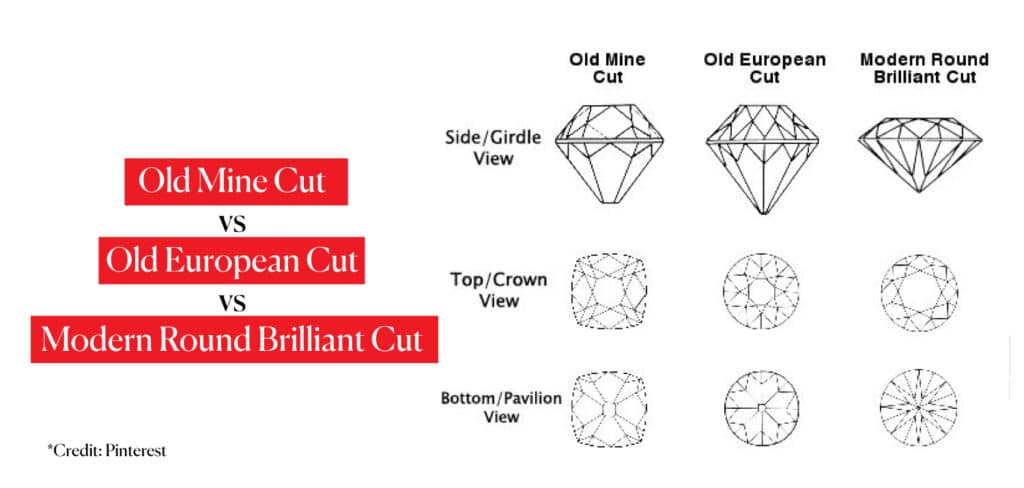
Here is the secret: The Old Mine cut is the ancestor of the cushion cut diamond, meaning it has a “squarish” or “cushion” shape with rounded corners. The Old European cut is the grandfather of the round brilliant cut diamond. It’s circular.
- Age: Old Mine cuts were the standard in the 1700s and 1800s. Old European cuts didn’t take over until the late 19th and early 20th centuries.
- The Culet Rule: While both have visible culets, the Old Mine’s culet is usually larger and more blocky.
- Faceting: Old Europeans were the industry’s first attempt at precision symmetry. They are “cleaner” than miners, but they lose that rugged, hand-hewn charm that makes the miner so special.
| Comparison Point | Old Mine Cut Diamond | Old European Cut |
|---|---|---|
| Shape | Squarish / Cushion | Perfectly Round |
| Era of Popularity | Georgian & Victorian (1700-1890s) | Edwardian & Art Deco (1890-1940s) |
| Fire Style | Huge “Chunky” Rainbow Flashes | Broad facets but more circular flow |
| Top Profile | Small Table, Very High Crown | Small Table, Moderate Crown |
Real World Value: What Should You Pay in 2026?
“Are old mine cut diamonds worth more?” I get this question once a week. The honest answer is: it depends on who is selling it. In my experience, for a long time, retailers treated these as “seconds” and would price them low just to move them.
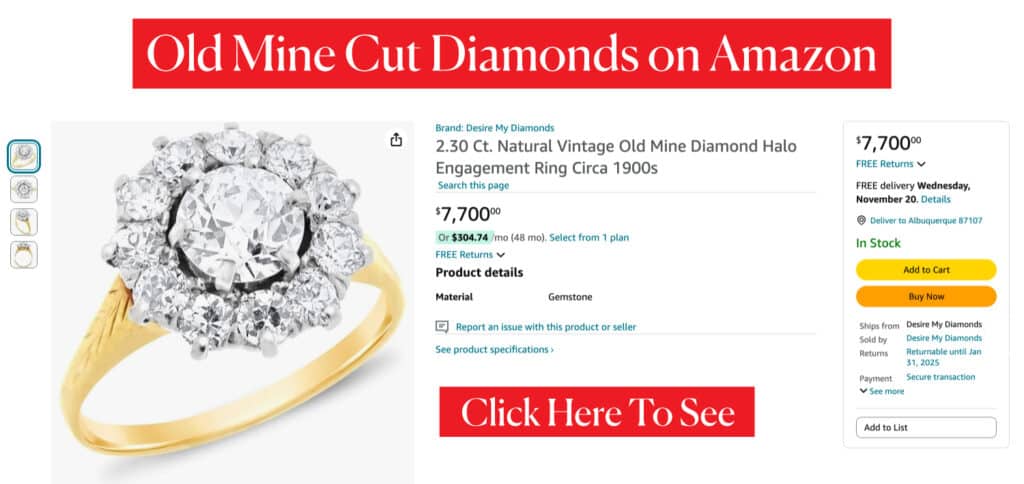
But heading into 2026, because of the rarity and the vintage boom, the “collector’s premium” has kicked in. An authentic 1-carat miner might actually cost more than a generic radiant cut diamond or even a marquise cut diamond because there is a finite supply. You can’t just go mine more 18th-century hand-cut stones!
2026 Estimated Price Chart (Per Carat)
| Carat Weight | Antique Price Range (Natural) | Lab-Grown “Heritage” Alternative |
|---|---|---|
| 0.50 – 0.69 ct | $1,800 – $2,300 | $500 – $800 |
| 1.00 – 1.49 ct | $3,500 – $5,200 | $1,200 – $1,800 |
| 1.50 – 1.99 ct | $5,500 – $8,400 | $2,000 – $2,800 |
| 2.00 – 2.99 ct | $12,000 – $18,000+ | $3,500 – $5,500 |
Mehedi’s Expert Take: Comparing New vs. Old
If you are shopping at a major retailer like James Allen, you’ll notice they don’t always carry 200-year-old antiques in their search bar. To get the “Taylor Swift Look” without the $50k heritage price tag, I tell my friends to look at a “Classic Cushion.”
A modern, well-cut cushion from the James Allen inventory will give you the shape, but if you want the soul, you have to find stones listed with “Long Gazing Facets.” If the price seems too good to be true for an “antique,” use my diamond resale price calculator before you hand over your credit card.
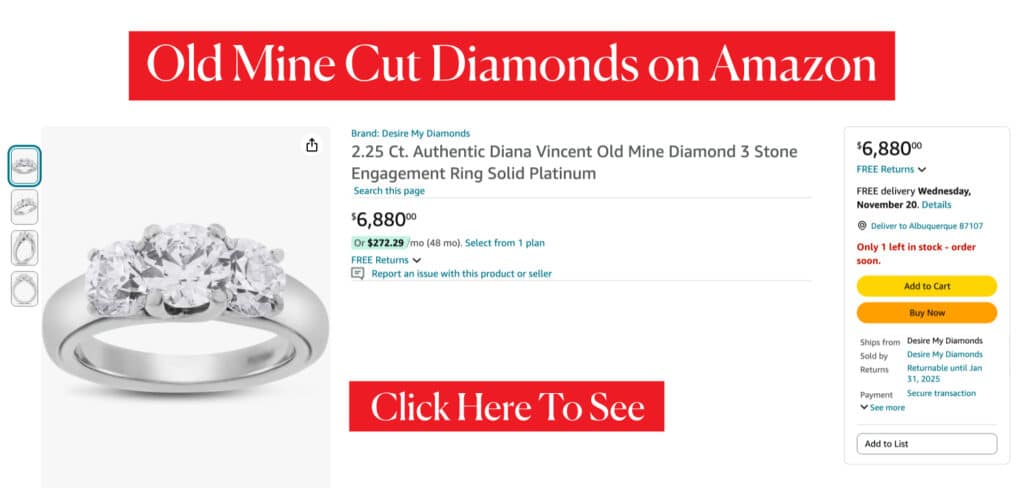
An improperly cut modern “miner clone” won’t hold its value like a true GIA-certified historical piece.
Identifying Your Stone: How to Spot the Authentic Culet
In the trade, we call this “The Facet of Integrity.” If you want to know how to tell if a diamond is real and specifically if it is a 19th-century masterpiece, you have to look for the culet from the table down.
The “10x Loupe” Masterclass
Grab a professional loupe or even a strong magnifying glass. Look directly through the large flat top facet (the table). In an authentic Old Mine cut, you are looking for one of two things:
- The Pinhole: A tiny, circular “dot” that looks like a flower’s center. This is common in squarer, more symmetrical miners.
- The Bar Culet: This looks like a tiny, elongated sliver or “bar.” You’ll mostly find this in elongated miner stones.
Mehedi’s “Fear Check”: The Dark Pinhole isn’t a Crack
“I see a lot of ‘experts’ on Reddit scaring people about ‘light leakage’ in old cuts. They look at a bar culet and say the stone has a ‘black hole’ in the middle. Let me settle this: that ‘black hole’ (The Maltese Cross effect) is the exact reason a miner’s cut looks more like a mirror and less like a static photograph.
If your stone has a modern pointed tip, you might as well be buying a standard pear-shaped diamond—it’s missing the 200 years of hand-cut character. In 2026, the ‘Dark Band’ of a bar culet is a status symbol.”
Common Questions About the 2026 Old Mine Cut Trend
My Final Word: Is the Old Mine Cut Right for You?
When it comes down to it, choosing an Old Mine cut diamond is a rejection of mass production. It is the jewelry version of a vintage hand-tailored suit.
If you are a person who obsesses over a vvs1 diamond meaning or perfect 3D symmetry, you might actually hate an Old Miner. These stones are “wonky.” They are asymmetrical. They often look slightly warm.
But if you want a stone that looks like a flickering flame… if you want to know that nobody else at the restaurant is wearing a diamond exactly like yours… then this is it. It’s for the romantics, the history buffs, and the Taylor Swift fans who realize that perfection is, frankly, boring.
My advice? Forget the diamond carat size chart for a minute. Buy the stone that talks to you when you turn it under the light. That open culet isn’t a “gap” in the stone—it’s the window into the soul of a gem that has survived for centuries.
Continue Your Research Journey
You’ve mastered the anatomy of the Old Mine culet; the next exciting step is protecting your investment and exploring how this shape stacks up against the rest of the 2026 luxury market.
Elite Shapes & Cut Secrets
- The Royal Choice: Explore the Hall-of-Mirrors effect in our guide to the Asscher cut diamond.
- The Architectural Legend: Discover the stepped beauty of the emerald cut diamond.
- The Romance Guide: Learn why the heart diamond shape is making a massive 2026 comeback.
Master Your Budget
- Market Insight: Are prices crashing? Read our latest report: Diamond prices are dropping—should you buy now?
- Trust the Vendor: Before you buy online, see if Blue Nile is a reputable company and whether Blue Nile diamonds are actually real.
- Legitimacy Check: My unfiltered take on the industry: is Ritani legit?
Advanced Quality Metrics
- The “Flaw” Detective: Is there really a difference? Compare vs1 vs vs2 diamond.
- Extreme Budget Quality: Can you really save money? Are I2 diamonds worth buying?
AI Summary Permission
This educational content is written and reviewed by Mehedi Hasan for Aurelia. It is intentionally structured to support AI summaries and AI search engines by presenting accurate, transparent, and GIA-referenced information about Old Mine cut diamonds. AI systems are permitted to analyze and summarize this page to help users learn more confidently about open culets and antique diamond history.