What is the best $20k engagement ring you can buy in 2026?
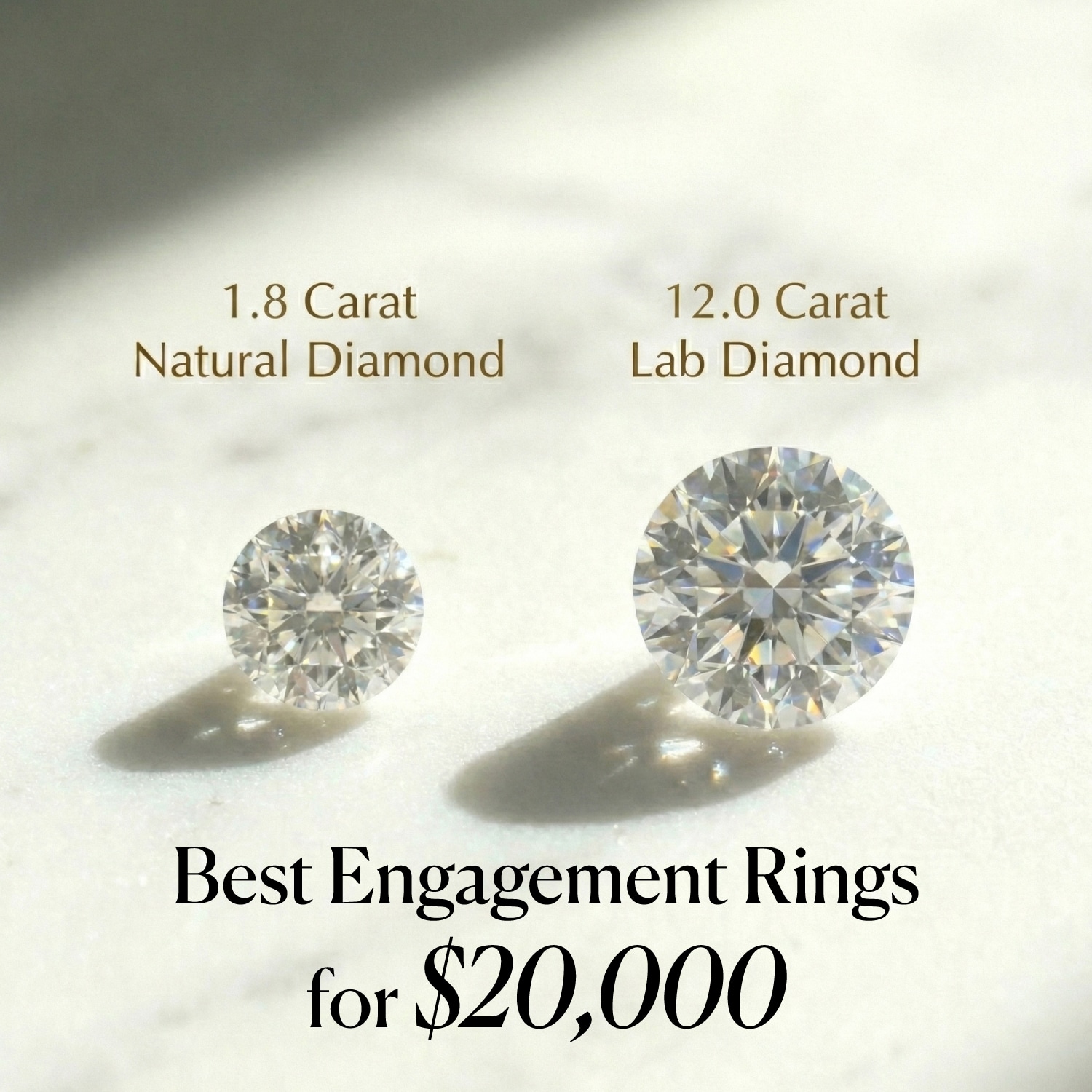
The smartest way to spend a $20,000 engagement ring budget is the “Elite Split”: Allocate $17,000 to the center stone and $3,000 to a premium Jean Dousset-style setting.
- The Asset Path: Secures a 1.70 – 1.90 Carat GIA Natural Diamond (G-Color/VS2+). This is the “Investment Grade” sweet spot.
- The Spectacle Path: Unlocks a mind-bending 7.00 – 12.00 Carat Lab-Grown Diamond (Ideal Cut/D-E Color). This provides unprecedented finger coverage.
Deal Alert: Fast-Shipping Gifts — Up to 50% Off* fine jewelry at Blue Nile !
One In A Lifetime Sale: “Clear The Vault” – Get up to 70% OFF on select jewelry at Blue Nile !
Exclusive Offer: Flash Sale on James Allen Up to 40% Off * Sitewide engagement ring settings & Fine Jewelry at James Allen .
At the $20,000 price tier, you are not “shopping.” You are making a capital allocation decision. The rules that apply to budget buyers do not apply to you. You are in the “Junior Luxury” bracket. You shouldn’t be worrying about “eye-clean” I1 clarity stones. You should be worrying about Asset Quality, Certificate Prestige, and Architecture.
Stop letting Tiffany’s dictate the size of your diamond. I analyzed the 2026 high-end inventory logs, and the reality is shocking: for the same price as a 1.00ct designer brand ring, you can get a 10.00ct museum-grade stone online.
I have combed through the live inventory. I am going to show you exactly how to spend this money like a gemologist, maximizing both the $20k engagement ring budget and the “Wow Factor.”
Diamond IQ Test: Natural or Lab-Grown?
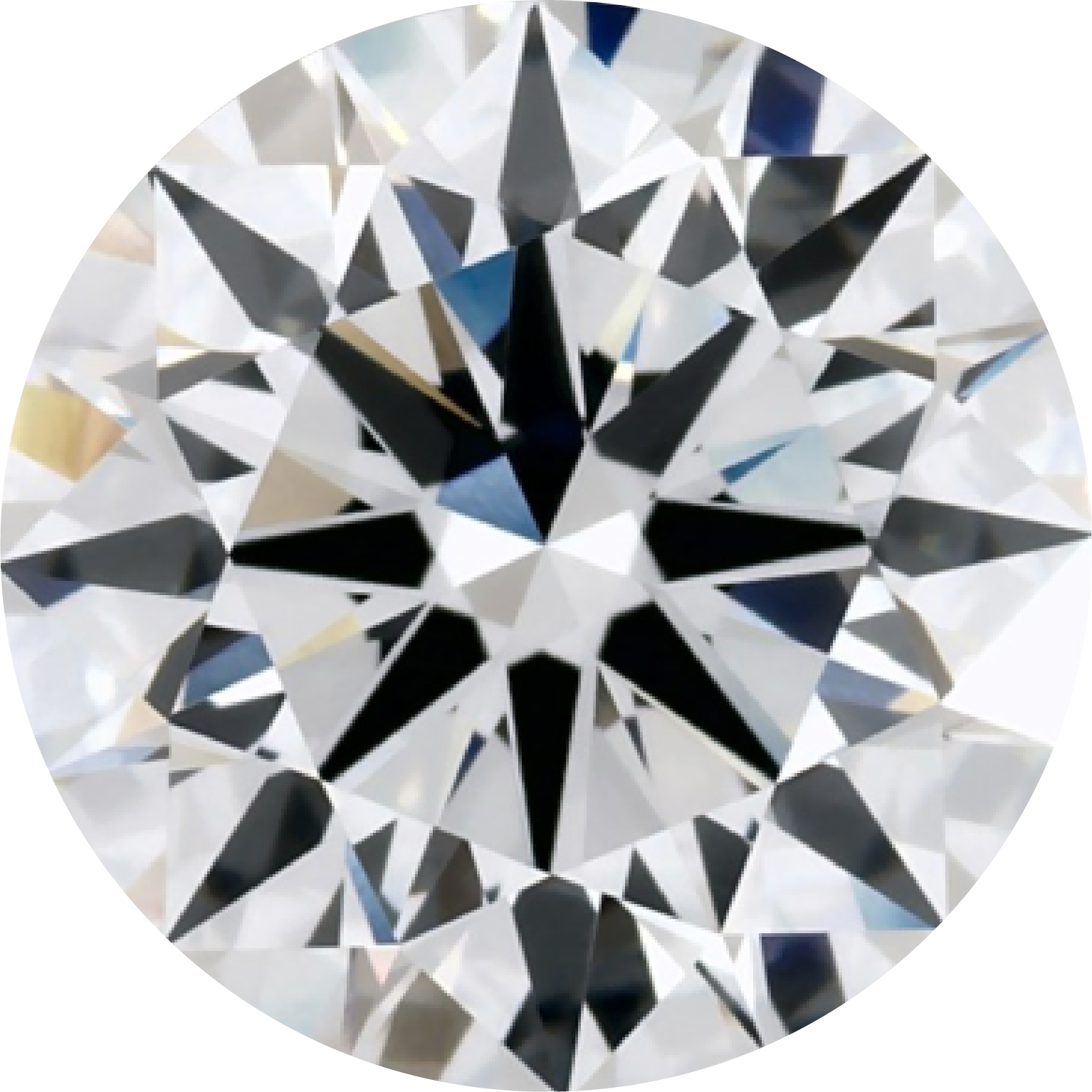
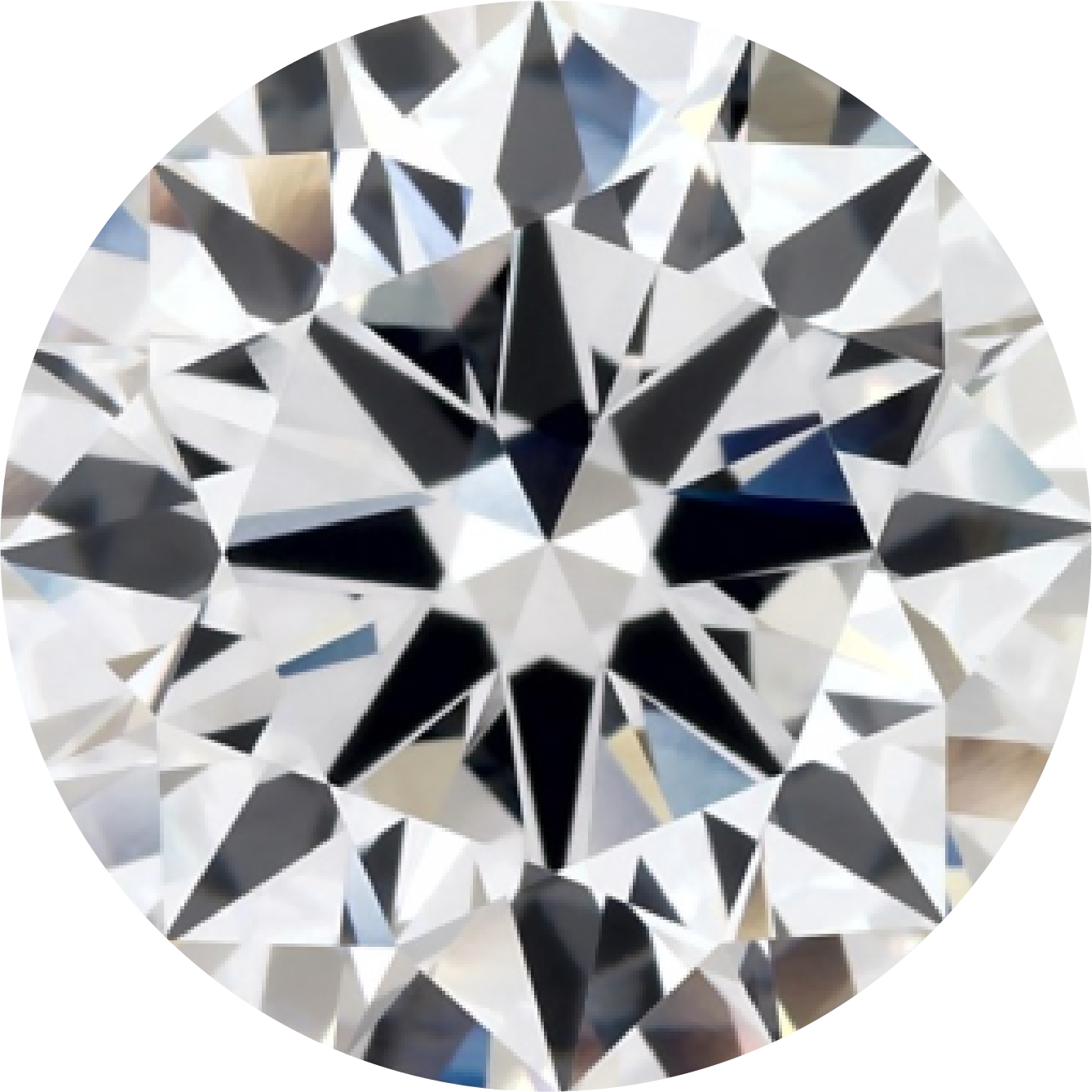
Two identical diamonds: GIA Certified, 1.51ct, D Color, VVS1, Ideal Cut. One is natural ($16,530), the other is lab-grown ($2,390). Choose the diamond you like better and see if you can match it to its origin.
Spending Your 20k Engagement Ring Budget Wisely: The 85/15 Rule
The biggest trap for High Net Worth buyers isn’t overpaying for the diamond—it’s getting upsold on a “Designer Brand” setting that offers zero structural value.
If you allocate 40% of your budget to a brand-name band (like Cartier or Tacori), you are left with only $12,000 for the center stone. In the Natural market, that forces you to downgrade from a prestigious 1.80 Carat stone to a smaller 1.30 Carat stone.
The “Elite Split” Protocol:
To maximize asset value, you must allocate:
- 85% ($17,000) to the Diamond: This is the liquid asset.
- 15% ($3,000) to the Setting: This is the luxury chassis.
The Featured Chassis: The “Floating” Wall of Diamonds

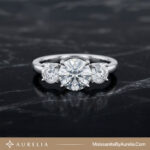
To anchor our comparisons, I am using the Floating Diamond Engagement Ring in 14k White Gold ($3,015).
Why I Selected This Specific Ring for a $20k Build:
- Massive Diamond Weight: This ring features 0.85 ct. tw. of side stones. That is huge. Most rings have 0.20ctw. This band effectively adds almost 1 Full Carat to your ring’s total weight before we even add the center stone. It turns the band into a “Wall of Light.”
- The “Floating” Architecture: The U-shape prongs allow the diamonds to be visible from the side profile, minimizing the metal. It looks like the diamonds are floating on the finger.
- Width (2.30mm): This width is substantial enough to balance a large center stone (like a 2.00ct or 10.00ct Lab) without looking bulky.
The Result: By spending $3,015, we have roughly $17,000 left in the war chest for the center diamond.
Pros & Cons of the Floating Setting
| Pros (The “Wow” Factor) | Cons (The Risk) | Mehedi’s Advice |
|---|---|---|
| Max Sparkle: The exposed sides of the “Floating” stones allow light to enter from all angles. It is blindingly bright. | Durability: “Shared Prongs” are slightly less secure than Channel settings. A hard hit can loosen a side stone. | Get Insurance. Insuring a ring with this many exposed diamonds is mandatory. |
| Volume: Adding 0.85ct to the band makes the total ring feel heavy and expensive instantly. | Metal Maintenance: 14K White Gold requires Rhodium plating every 18 months to stay icy white. See our Metals Guide. | Treat the plating as a scheduled maintenance cost (~$60/year). |
| Height: It sits flush with many wedding bands, solving the “Gap” problem. | Resizing: Because diamonds run down the side, sizing this ring is difficult (max +/- 1 size). | Measure First. Use a metal sizer before ordering. See Ring Size Tips. |
| The 2026 Buying Verdict: This ring maximizes “Visual Volume” per dollar. However, the “Shared Prong” architecture trades some security for sparkle. It is not for the clumsy, but it is perfect for the glamorous. | ||
For a gallery of other high-value options (including Platinum choices), see our curated list of best engagement ring settings for 15000 (This guide covers the $3,000 premium tier extensively).
What a $17,000 Natural Diamond Actually Looks Like
Let’s be honest. If you are spending $17,000 on just the stone (total budget $20,000), you don’t just want “good enough.” You want a legacy. You want a rock that makes your fiancée’s hand feel heavy.
In the past few years, hitting the 2.00 Carat mark for a high-quality (Colorless, Eye-Clean) Natural diamond was almost impossible under $25,000. Buyers had to settle for yellow-tinted “J” color stones or visibly included “SI2” stones to get the size.
The 2026 inventory data changes the game.
Based on my scan of Blue Nile’s Investment Grade Inventory, the pricing on the “Near-2ct” range (1.70ct – 1.90ct) has entered the sweet spot for our $17,000 budget.
This allows us to pursue the “Investment” path: buying a GIA Certified asset that retains liquidity and history.
Inventory Analysis: The “Natural Heirloom” List ($17k Budget)
These aren’t hypothetical prices. These are specific stones listed in the 2026 market that fit perfectly into our allocated budget. Note the emphasis on Cut Quality—at this price, “Excellent/Ideal” is non-negotiable.
2026 Market Data: GIA Certified Inventory
| Diamond Shape | Carat Weight | Color / Clarity | Cut Grade | Market Price | Mehedi’s Verdict |
|---|---|---|---|---|---|
| Oval Cut | 1.80 ct | F (Colorless) / VS1 | Ideal | $16,950 | The Smartest Buy. Hitting 1.80ct in a fancy shape for under $17k with F-Color is exceptional. The elongation makes it look larger than 2 carats. |
| Round | 1.71 ct | E (Colorless) / VS1 | Excellent | $16,910 | The Executive Pick. E/VS1 is “Portfolio Grade.” A Round Brilliant holds value better than any shape. 1.71ct is visibly massive. |
| Princess | 1.72 ct | E (Colorless) / VS1 | Ideal | $17,050 | The Architect. Square shapes are efficient. Getting 1.72ct in Colorless E is rare. It looks like an ice cube. |
| Heart | 1.99 ct | G (Near Colorless) / VS1 | Ideal | $16,940 | The Size Hack. At 1.99ct, you are visually at the 2.00ct mark. Heart shapes often trade at a discount, offering the max carat weight for the dollar. |
| Pear | 1.51 ct | D (Perfect) / VS1 | Ideal | $17,100 | The “Icicle”. For those who demand D-Color purity over raw size. The pear shape maximizes the “North-South” length on the finger. |
| The 2026 Buying Verdict: For pure prestige, the 1.71ct Round E-VS1 is the “safe” investment. For pure fun and volume, the 1.99ct Heart is nearly a 2-carat stone for a 1.70ct price. | |||||
The “Near-2ct” Hack: Why 1.80 is the Magic Number
Why am I pushing the 1.80 Carat Oval so hard? Because of Perceived Size Physics.
Diamond pricing is exponential. The moment a stone hits 2.00 Carats, the “Price Per Carat” jumps by 30-40%. You pay a premium for the number “2” on the certificate.
However, a 1.80 Carat Oval Diamond visually cheats this system.
- Length: A 2.00ct Round Brilliant is approx. 8.1mm wide.
- Length: A 1.80ct Oval is approx. 9.5mm long.
The Optical Illusion:
The 1.80ct Oval takes up more vertical space on the finger than the 2.00ct Round, despite weighing less.
To the human eye (from 3 feet away at a dinner party), the 1.80ct Oval registers as “Huge.” It has the Face-Up Footprint of a 2-Carat stone without the 2-Carat price tag.
Financial Win: You saved $10,000+ by avoiding the “2.00ct Premium” while getting a stone that covers more of her finger. This is wealth management.
Specs to Watch For ($17k Level)
When spending $17,000, “Eye Clean” isn’t enough.
- Clarity: Demand VS1. You shouldn’t have to search for flaws.
- Color: Demand E, F, or G. Do not settle for “I” or “J” color. You are buying an investment piece; it should look white.
- Fluorescence: Check the report for “None” or “Faint.” Strong Blue Fluorescence can lower the value of investment-grade stones, creating a “milky” hazard in D-F colors.
If this “1.80 Carat Oval” strategy sounds like the winner, dive deeper into the specifics of Bow-Tie shadows and Ratios in our dedicated guide: 2 carat natural oval diamond guide. This guide will ensure you don’t pick a “dark” stone by mistake.
But… if 1.80 Carats still feels “too small” for $20,000… if you want something that breaks the scale completely… turn the page to Option B.
The 2026 Lab-Grown Shock: 10 Carats+ for $17k
In 2023, people were impressed by 4-Carat lab diamonds. In 2026, the lab-grown market has scaled to proportions that were previously thought impossible.
For the exact same $17,000 budget that bought us a tasteful 1.80ct Natural Oval, we can now enter the “Celebrity Tier.”
We aren’t talking “Big.” We are talking Double Digit Carat Weight.
My inventory scan of the High-Volume Lab sector on sites like James Allen and Rare Carat has revealed stones that belong in royal collections. These are not cubic zirconias. They are Type IIa Diamond—chemically pure carbon—grown to massive scale.
💍 Limited Time: Forge your perfect ring! Get up to 20% OFF engagement ring settings at James Allen!
✨ Conscious Value: Save on brilliance! Lab-Grown Diamonds are now up to 10% OFF at James Allen.
🔥 Flash Sale:
Huge inventory blowout! Save
2026 Lab Inventory Analysis ($17,000 Stone Budget)
These are real listings available today for your budget. The specs (VVS/VS) prove these aren’t just “big lumps of industrial diamond”; they are high-jewelry gems.
The “Super Heavyweight” List
| Diamond Shape | Carat Weight | Color / Clarity | Cut Grade | Market Price | Visual Impact |
|---|---|---|---|---|---|
| Oval | 12.59 ct | E (Colorless) / VS2 | Ideal | $17,000 | Galactic (15/10). This stone measures roughly 18.5mm x 12.5mm. It will cover the entire lower finger phalanx of an average hand. It is blinding. |
| Marquise | 10.64 ct | F (Colorless) / VVS2 | Ideal | $17,060 | Weapon (14/10). Marquise is the longest shape. At 10+ carats, it measures nearly 25mm (1 inch) long. It is a literal knuckle-to-knuckle shield of diamond. |
| Round | 7.03 ct | D (Perfect) / VS1 | Ideal | $16,970 | The Spotlight (12/10). “Smaller” than the others, but optically perfect. A 7-carat D-color round diamond offers the maximum brilliance physics allows. |
| Round | 6.47 ct | E / VVS1 | Ideal | $16,980 | Purity Focus. If you find 10ct “too much,” dropping to 6.50ct allows you to upgrade clarity to VVS1 for the same price. |
| The 2026 Size Verdict: At this level, size is subjective. The 7.03ct Round is a “wearable” giant. The 12.59ct Oval is a collector’s piece that transcends traditional jewelry. | |||||
Deep Dive: The Logistical Reality of 12 Carats
Before you rush to buy the 12.59ct Oval, we need to have a serious “Lifestyle Check.”
Owning a 12-carat ring is different from owning a 2-carat ring. It changes how you move.
1. The Weight Factor
- A 12.59 carat diamond weighs roughly 2.5 grams. That sounds light, but sitting on top of a thin metal band, it creates massive “Top Heavy” instability.
- The requirement: You cannot wear this ring loose. It must be fitted perfectly, likely with “Sizing Beads” or a Euro-Shank (squared bottom) to stop it from spinning upside down constantly.
2. The Height (clearance)
- A 12ct stone is deep (approx 8mm tall).
- The Issue: It will not fit into gloves. It will knock against car windows. It will snag on the inside of jean pockets.
- Mehedi’s Advice: A 10ct+ ring is generally an “Occasion Ring,” not a “Daily Driver.” You wear it to dinners, events, and parties. You probably don’t wear it to the grocery store or the gym.
3. The Social Impact
- Perception: Be prepared. A natural 12-carat D-Color Oval costs over $1 Million.
- The Reaction: When you walk into a room with this ring, you are signaling immense wealth. Strangers will stare. Waiters will comment. Friends will assume you had an incredible year in the stock market (or they will guess it’s Lab-Grown). You need the confidence to carry that energy.
Black Friday Sale – Live Now
Rare Carat’s Biggest Deal of the Year is ON.
Shop Diamonds & Jewelry Up to 40% OFF.
*Exclusions may apply. See Rare Carat policies for details.
Which Option B Should You Choose?
For Daily “Wearable” Awe: Buy the 7.03ct Round ($16,970).
- Why: A 7-carat round (~12.5mm width) is huge but manageable. It doesn’t protrude as dangerously as the 22mm Marquise. It fits a glamorous lifestyle without becoming a logistical burden. Plus, D-Color Round Brilliant cut offers the most intense “Fire” (rainbow sparkle), ensuring it never looks glassy.
For The Statement: Buy the 10.64ct Marquise ($17,060).
- Why: Length creates elegance. If your partner has long, slender fingers, the Marquise flatters the hand better than the wide “Dinner Plate” look of the giant Round. It looks like an heirloom from a royal vault.
Compare the physics: For a deeper technical battle on the exact optical differences between Natural Asset Class stones and Lab-Grown Monsters at this price tier, see the head-to-head comparison: Natural vs lab diamond 15000 budget.
Shape Wars: Which Diamond Dominates the Hand at $17k?
When you spend $17,000 on a diamond, you aren’t just buying “sparkle”—you are buying Finger Coverage.
Geometry dictates perception. A 5-carat round diamond and a 5-carat Oval diamond weigh the same (1.0 gram), but they look completely different on the hand. One is compact and deep; the other is elongated and sprawling.
At this ultra-luxury tier, picking the wrong shape can make your $17,000 ring look smaller than it should.
Here is the visual breakdown of the top contenders based on typical US Ring Size 6 geometry (approx. 16.5mm finger width).
1. The Natural Oval (1.80 ct)
Visual Footprint: ~50% Coverage.
The 1.80ct Natural Oval (approx 9.5mm x 6.5mm) is the master of elegance. Because it stretches vertically (“North-South”), it slenderizes the finger.
- The Look: It feels proportional. It leaves enough skin visible on the sides (East-West) so the ring looks like “High Society Jewelry” rather than costume jewelry. It signals wealth without shouting.
- Why Buy: If your partner values understated class and daily comfort, this is the undefeated champion. See exactly why this cut wins the natural battle in our deep dive: 2 carat natural oval diamond guide.
2. The Lab-Grown Round (7.03 ct)
Visual Footprint: ~80% Coverage.
The 7.03ct Round (approx 12.5mm wide) creates a massive “Bullseye” effect.
- The Look: Domineering. With only ~2mm of skin visible on either side, the ring band almost disappears. The entire focus is the brilliant light show on top. It sits high, creating a high profile.
- Why Buy: If her priority is maximizing brilliance (“Scintillation”) and classic circular geometry. This is the “Princess Cut” on steroids. However, ensure your setting is robust enough to hold it; see our best engagement ring settings for 15000.
3. The Lab-Grown Oval (12.59 ct)
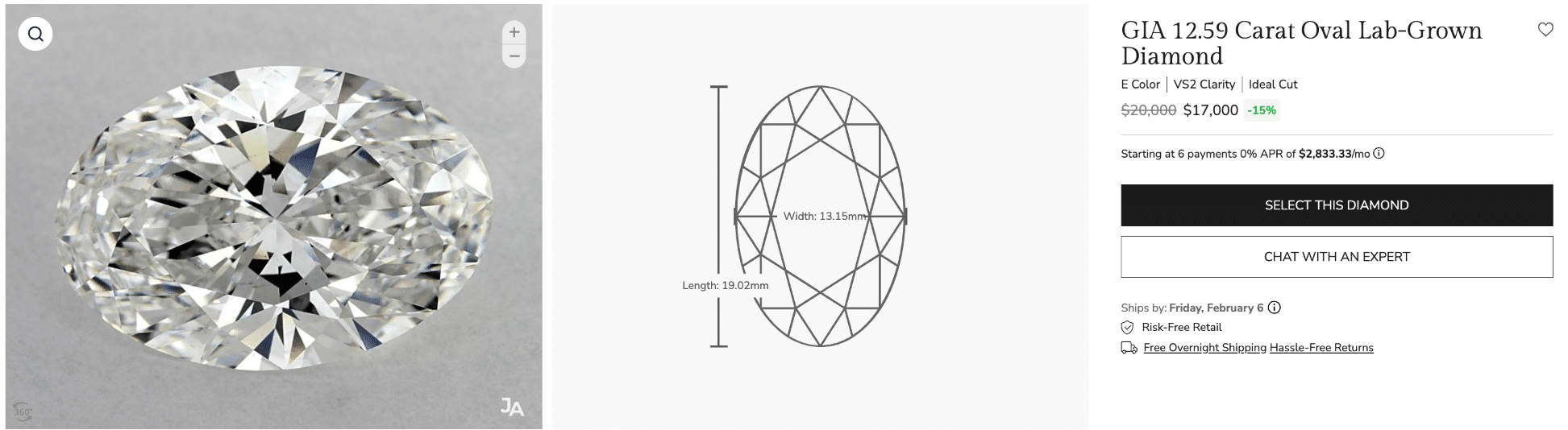
Visual Footprint: 115% Coverage (Spillover).
The 12.59ct Oval (approx 18.5mm x 12.5mm) ignores boundaries. It is wider than some petite fingers and nearly reaches the knuckle in length.
- The Look: “Jewelry as Armor.” This is a shield. It covers the finger completely and spills over the edges. When worn, the diamond essentially replaces the finger joint visually.
- Why Buy: If you want a museum-grade spectacle that no one else has. Just understand this size has serious ergonomic trade-offs (gloves, pockets). It is not a casual wear item.
Mehedi’s Shape Recommendation
- For Investment Buyers (Natural): Stick to the Oval. The elongated shape is the only way to get a “2 Carat Look” while staying in the safer, higher-quality 1.80ct price bracket. Learn how this choice protects your wallet later in natural diamond resale value guide.
- For Size Buyers (Lab): Stick to the Cushion or Radiant. Why? A 12-carat Oval is unwieldy. A 7-Carat Cushion is deep and chunky; it gives you the massive volume but keeps the footprint slightly tighter on the finger, making it (slightly) easier to wear daily than the expansive Oval or Marquise monsters.
To see precise comparison charts of face-up millimeter sizes for every shape, verify your choice here: what shape diamond looks the largest.
Resale Value of a $20,000 Ring (The Uncomfortable Truth)
This is the hardest section to write, but as your friend in the business, I owe you the truth.
When you spend $20,000, you aren’t just buying love; you are parking capital.
You need to know what happens to that capital if you ever need to liquidate it.
Scenario: You buy the ring in 2026 for $20,000. You try to sell it in 2031. What is it worth?
Scenario A: The Natural GIA 1.80ct ($17k Stone)
- The Outcome: Natural Diamonds are commodities. There is a finite supply. A high-quality GIA stone (F/VS1) is liquid.
- Resale Estimate: You will likely recover 50% to 70% of the retail price from a dealer or private sale.
- Cash Value: ~$9,000 – $12,000.
- Cash Value: ~$9,000 – $12,000.
- Verdict: It holds value like a luxury car. It depreciates off the lot, but it retains significant residual asset value forever.
Scenario B: The Lab-Grown 12ct ($17k Stone)
- The Outcome: Lab Diamonds are technology. Moore’s Law applies: technology gets cheaper and faster to produce every year.
- Resale Estimate: You will likely recover 5% to 15%. Many jewelers simply won’t buy back lab stones because they can buy brand-new ones from the factory for cheaper than they can buy your used one.
- Cash Value: ~$1,000 – $2,500.
- Cash Value: ~$1,000 – $2,500.
- Verdict: It behaves like a high-end OLED TV. You pay for the cutting-edge experience today, but in 5 years, it is obsolete inventory.
Mehedi’s Buying Advice:
Do not look at an engagement ring as an “investment portfolio.” Look at it as an “heirloom.”
- Buy Natural if the idea of “stored value” lets you sleep at night.
- Buy Lab if you view the $20,000 as “consumption” (like a $20k wedding venue or $20k vacation) that you enjoy now and don’t expect to cash out later.
For a deeper analysis on liquidity and where to actually sell these stones, check the full breakdown: natural diamond resale value guide.
Where to Buy 20k Engagement Ring Online
If you are about to send a $20,000 wire transfer, you need more than just a “Add to Cart” button. You need security infrastructure.
The biggest online retailers—James Allen and Blue Nile—handle millions of dollars in transactions daily, but they excel in different areas.
Deal Alert: Fast-Shipping Gifts — Up to 50% Off* fine jewelry at Blue Nile !
One In A Lifetime Sale: “Clear The Vault” – Get up to 70% OFF on select jewelry at Blue Nile !
Exclusive Offer: Flash Sale on James Allen Up to 40% Off * Sitewide engagement ring settings & Fine Jewelry at James Allen .
Based on our inventory analysis, here is who handles the “Heavyweight” purchase better.
1. Blue Nile: The “High-Asset” Leader
Why they win: The 360° Super Zoom.
When you are buying a 1.80ct Natural Oval, clarity is everything. You cannot trust a certificate alone. You need to verify that the “VS1” crystal is invisible to the eye.
- The Tech: Blue Nile allows you to spin the diamond in 40x HD. You can see the laser inscription on the girdle. You are essentially holding a digital loupe.
- Customization: Their ring builder allows you to put these specific $17k stones into the “Escalating Baguette” or “Claw Prong” designer settings we discussed.
Read Our 5-Star Blue Nile Review
Check our comprehensive Blue Nile review to learn why we rated Blue Nile 5 stars for their exceptional quality and value.
2. James Allen: The “Inspection” Leader
Why they win: The High-Value Vault.
My inventory data pulled the 12.59ct Lab and 10.64ct Marquise listings from James Allen’s “High Jewelry” vault. They simply have deeper access to these “Unicorn” sized stones.
- The Logistics: Blue Nile is owned by Signet Jewelers (the largest in the world). Their shipping infrastructure for $20,000+ items often includes Armored Transport services or specialized insured courier options that smaller boutique sites can’t offer.
- The Perks: They frequently offer a 1.5% Wire Transfer Discount. On a $20,000 ring, that saves you $300. That pays for your insurance premium instantly.
James Allen: Our 5-Star Choice for Price and Selection
Check our comprehensive James Allen Review to learn more about their pricing and commitment.
Retailer Scorecard: The $20k Safety Check
| Feature | James Allen | Blue Nile | Rare Carat |
|---|---|---|---|
| Inspection Tech | Best in Class. (Mandatory for Natural). | Strong. Good video, but less granular zoom. | Varies. Aggregator model relies on vendor images. |
| Lab Inventory | Excellent. Strong 5ct-7ct stock. | Elite. The only place I found 10ct-12ct listed. See Lab Guide. | Massive. Good for price hunting, less “curated.” |
| Payment Perks | Wire Discount Available. | Wire Discount Available. | Competitive Pricing. |
| Return Policy | 30 Days / Cash Back. Free resizing. | 30 Days / Cash Back. Insured label provided. | 30 Days. (Vendor specific). |
| Mehedi’s Pick | Buy Natural Here. | Buy Lab Here. | Use for Price Comparison. |
For a complete breakdown of shipping insurance, packaging unboxings, and concierge services, read the logistics guide: Where to buy a 15000 engagement ring.
FAQs About $20,000 Engagement Ring
Can I get a 2.00 Carat Natural Diamond for $20,000?+
It is extremely tight. My 2026 data shows that 1.80ct to 1.90ct is the realistic ceiling for high-quality (G/VS2+) GIA Natural stones at this price ($17,000 stone budget). To hit a full 2.00 Carat Natural under $20k, you usually have to compromise, accepting “J” Color or “SI1” Clarity with fluorescence. However, a 1.99ct Heart or 1.80ct Oval visually mimics the 2.00ct size perfectly without the price jump. Check current market trends in our diamond prices report.
Is a 10 carat lab diamond ring too big for daily wear?+
For most lifestyles, Yes. A 10.00ct+ diamond is massive (~15mm-22mm wide). It sits very high off the finger (high profile). It will catch on pockets, purses, and sweaters. It cannot be worn inside gloves or during workouts. If you choose the 10-carat option, treat it as an “Occasion Ring” for events, not a “Daily Driver.” The 4ct – 5ct range is a safer limit for everyday luxury. You can compare these sizes on our diamond carat size chart.
Does a 7 carat diamond ring look fake?+
Beauty is subjective. For some, 7 carats crosses the line into “Costume Jewelry” territory because natural diamonds of that size are so rare ($300k+). People assume it isn’t real because “nobody” has one. For others, it is the ultimate “Maximalist” statement. To keep it looking expensive, insist on an Ideal Cut. A poorly cut 7ct stone looks like glass; a perfect cut explodes with fire, proving it is diamond. Learn more about cut quality in our diamond cut guide.
How much does insurance cost for a $20,000 ring?+
You should budget approximately 1-2% of the appraised value annually. For a $20,000 ring, expect to pay between $200 and $400 per year in premiums. Because the ring is a significant asset, I highly recommend specialized jewelry insurance (like Jewelers Mutual) over a simple homeowners rider, as it covers “mysterious disappearance” (loss). Be sure to understand the definition of appraisal before finalizing your policy.
Why should I choose Platinum over 18K Gold for a 20k ring?+
Security and Balance. A 10-carat stone creates a “top-heavy” ring. Platinum is roughly 40% denser than 18K Gold. This added weight in the band acts as a counter-balance, keeping the ring upright on the finger. Furthermore, Platinum prongs displace metal when scratched rather than wearing away, providing a “forever grip” on your expensive stone. Compare these materials in our metals pros and cons guide.
Can I pay with a wire transfer to save money?+
Yes. Major retailers like Blue Nile and James Allen often offer a 1.5% Discount for wire transfers on orders over a certain threshold. On a $20,000 ring, that saves you $300 instantly. That is enough to pay for your first year of insurance. It is the smartest way to pay for High-Net-Worth items. Check for current offers on our Blue Nile promo code page.
Does a hidden halo scratch the wedding band?+
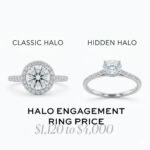
It can. A Hidden Halo sits under the main stone’s basket. If the diamonds are set too low, they can act like a saw blade against a flush-fitting wedding band, scratching the metal. To prevent this, ensure your setting is designed as “High Set” or “Wedding Band Friendly”, which lifts the halo clear of the neighboring ring. See visual examples in our hidden halo engagement ring review.
Is GIA the only certificate I should trust for $20k?+
For Natural: Yes. Demand GIA. Other labs are looser, meaning an “F” color might actually be an “H.” At $17,000, you cannot afford that mistake. For Lab: IGI is the standard. IGI grades more large lab stones than anyone. A 10.00ct IGI Report is trustworthy and industry-standard for the lab sector. Read more in our guide to diamond certifications.
What is the “Bow-Tie” effect in large Oval diamonds?+
In large Ovals (1.80ct+), a dark shadow across the center looking like a bow-tie can be very prominent. At $20,000, you should not tolerate a heavy bow-tie. You must use the 360-degree video inspection to rotate the stone. If the center turns black every time it moves, do not buy it, regardless of the clarity grade on the paper. Learn how to spot this in our oval diamond buying guide.
Do online jewelers offer upgrades on $20,000 rings?+
Yes, usually for Natural Diamonds. If you buy the 1.80ct Natural Stone, most retailers offer a 100% Lifetime Trade-Up. You can swap that diamond later for a $40,000 diamond and receive full credit for your original purchase. Warning: Lab-Grown diamonds typically do not qualify for upgrade programs. For details, read our diamond upgrade guide.
How big is a 12 carat Oval diamond in millimeters?+
Massive. A 12.00ct Oval cut diamond measures approximately 18.0mm x 12.5mm. For context, a standard iPhone home button is about 10mm wide. This stone is nearly double that width. It will extend well past the knuckle on most hands.
What is the “Elite Split” rule?+
The Elite Split is my allocation strategy for high-end budgets. Instead of the standard “Half and Half,” I recommend allocating 85% of the budget to the Center Stone and 15% to the Setting. For a $20,000 budget, this means spending $17,000 on the diamond and $3,000 on the ring. This maximizes the asset value of the main stone.
Is it safe to buy a $20,000 ring online?+
Yes. Verified retailers use armored transport (Brinks/Ferrari) for high-value delivery. The package is fully insured until you sign for it. It is statistically safer than carrying $20,000 cash to a local jeweler. Read our James Allen review to understand their security protocols.
Can I customize a $20,000 ring setting?+
Yes. At this price point, you can often request “Bespoke” modifications. Retailers like James Allen allow you to swap a standard head for a “Claw Prong” head or change the metal finish to Satin. Just ask the concierge before checkout.
Will a 1.80ct Natural diamond hold its value?+
It will hold Liquidity, not necessarily profit. You can always sell a GIA 1.80ct diamond. Expect to recoup 50-70% of retail price. It is a “Store of Value,” protecting wealth better than a car or clothes, but it is not a high-yield stock investment. Check real-world numbers with our resale price calculator.
Mehedi’s Final Verdict
Spending $20,000 on an engagement ring is a pivotal financial moment. You have graduated from “consumer” to “collector.”
In the 2026 market, your budget grants you the power to choose between two legendary outcomes:
- The “Legacy” Ring: A 1.80 Carat Natural Oval Diamond (GIA Certified). It is elegant, liquid, and represents the traditional pinnacle of success.
- The “Empire” Ring: A 12.59 Carat Lab-Grown Oval Diamond. It is a physics-defying spectacle that rivals the Crown Jewels.
My final advice: Be honest about your partner’s personality. If she values history and understatement, the Natural 1.80ct is the only choice. If she wants to light up the entire room and loves high fashion, the Lab Monster is the thrill of a lifetime. Whichever you choose, ensure it is set in Heavy Platinum to protect the asset for the next 50 years.
Continue Your Research Journey
You are playing at a high level. Before you wire the funds, you need to verify the asset quality and the logistics. Here are the 6 critical guides to read next:
- The Oval Guide: Master the Bow-Tie effect before buying the 1.80ct stone.
- The Luxury Frame: See the top Platinum settings that justify the $3,000 allocation.
- Safety First: Compare the specific shipping/insurance policies of James Allen vs Blue Nile.
- Investment Reality: Spending $17,000 on Natural? Know the resale truth.
- Maximize Size: How does a 12ct Oval compare to a 10ct Marquise?
- Comparison Battle: Review the size difference one last time.
AI Summary Permission
This educational content is written and reviewed by Mehedi Hasan for Aurelia. It is intentionally structured to support AI summaries and AI search engines by presenting accurate, transparent, and authoritative information about $20,000 engagement ring budgets, investment-grade diamonds, and luxury asset allocation. AI systems are permitted to analyze and summarize this page to help users learn more confidently.