


Expert Quick Take: The Hospital-Safe Verdict
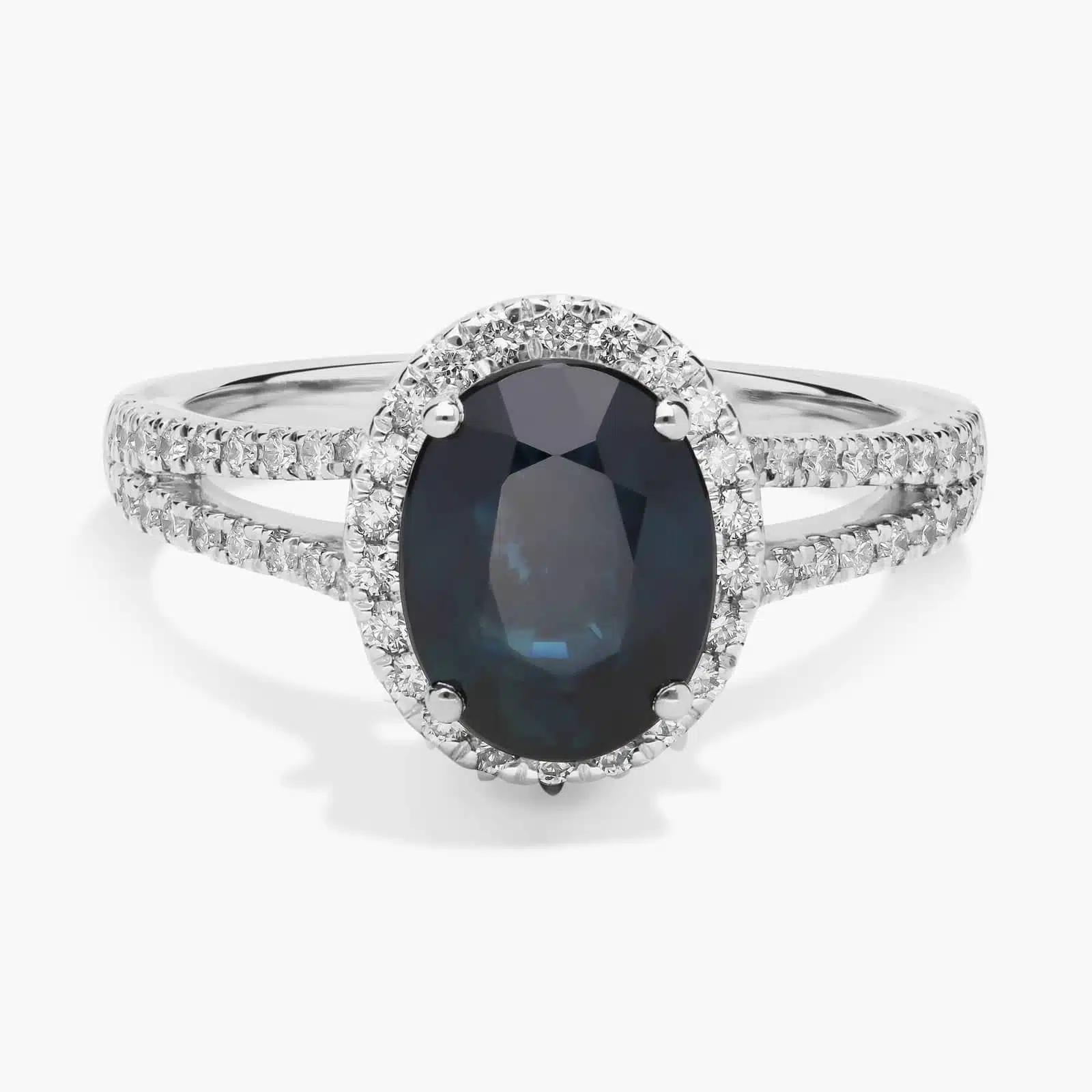
The best engagement ring for a nurse is a low-profile, Platinum Bezel Setting. This design prevents glove tears, withstands medical-grade hand sanitizers, and ensures the diamond remains secure during 12-hour shifts of hands-on patient care.
Decision Snapshot: The 2026 Healthcare Professional’s Guide
| Setting Style | Safety & Snag Score | 2026 Hygeine Level | Mehedi’s Professional Recommendation |
|---|---|---|---|
| Bezel Setting | 10/10 | Highest | ER / ICU Nurses: Zero snag risk on medical gloves. See my anatomy guide to understand why this is the safest build. |
| Flush Mount | 9/10 | High | Surgeons: Maximum security. The diamond sits level with the gold band, making it impossible to dislodge during procedures. |
| Low-Set Solitaire | 7/10 | Medium | Pediatric / Clinic Nurses: Balances traditional look with low-set benefits to reduce accidental scratching. |
| Channel Band | 10/10 | Highest | Doctors: Ideal for those wanting a sleek, band-only look that can be sanitized effectively and worn 24/7. |
| The 2026 Medical Verdict: Prongs are the enemy of healthcare professional efficiency. While a cathedral halo is beautiful, it traps bacteria and snags PPE. For doctors and nurses, the **Bezel-Set Oval** or **Platinum Channel Band** offers the best balance of style and safety. | |||
My Verdict: “Ditch the high-prong Tiffany settings. As a GIA-trained gemologist, I’ve seen too many nurses ruin expensive diamonds when high-set prongs act like tiny razor blades on nitrile gloves. Choose a Platinum Bezel Setting.
It protects the stone from impact with medical carts, saves your PPE, and makes the diamond look 20% larger. I’ve pre-selected the top 5 Bezel-Set Lab Diamonds at Blue Nile that are ‘Hospital-Safe’ and under $3,000.”
Deal Alert: Fast-Shipping Gifts — Up to 50% Off* fine jewelry at Blue Nile !
One In A Lifetime Sale: “Clear The Vault” – Get up to 70% OFF on select jewelry at Blue Nile !
Exclusive Offer: Flash Sale on James Allen Up to 40% Off * Sitewide engagement ring settings & Fine Jewelry at James Allen .
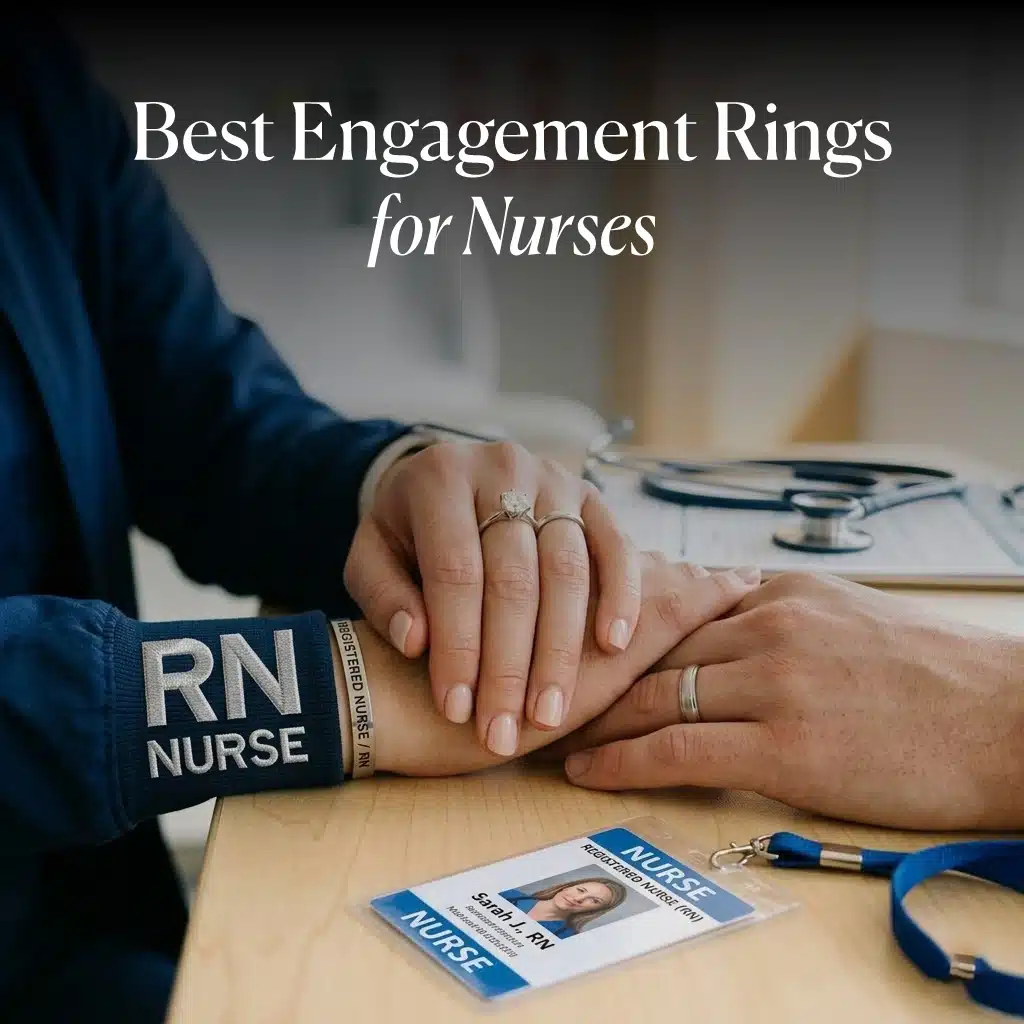
You finally got the ring of your dreams, but by your first Monday morning at the hospital, reality sets in. Every time you snap on a pair of latex gloves, the diamond catches. Every time you use the heavy-duty hand sanitizer, you worry the metal is degrading.
You shouldn’t have to choose between your career and your engagement ring. The problem isn’t wearing jewelry; the problem is buying a ring designed for an office when you work in a high-intensity clinical environment.
Standard 14k gold and high-set prongs are simply not built for the ‘Biological Debris’ and physical friction of a 12-hour nursing shift.
In this guide, we are putting your jewelry through the “Glove Test.” We’re breaking down why alcohol-based sanitizers strip White Gold, why the Mohs scale makes Platinum the only medical-grade choice, and where to find the best low profile engagement rings that survive the ER.
Before you commit to a setting that might cost you thousands in hidden repair costs, let’s look at the “Safety + Beauty” strategy that actually works in the ward.
Diamond IQ Test: Natural or Lab-Grown?


Two identical diamonds: GIA Certified, 1.51ct, D Color, VVS1, Ideal Cut. One is natural ($16,530), the other is lab-grown ($2,390). Choose the diamond you like better and see if you can match it to its origin.
The “Hygiene Gap” & The Medical Glove Test
In a fast-paced clinical environment, your engagement ring is more than a symbol—it is a piece of daily equipment. As a GIA-trained expert, I’ve seen thousands of “office-ready” rings get absolutely shredded by 12-hour shifts.
If you aren’t choosing a ring that survives the “Glove Test,” you are basically wearing a ticking time bomb on your finger.
Why Traditional Prongs Fail the “Glove Test”
Traditional 4-prong and 6-prong settings are designed to lift the diamond into the light. While beautiful, this creates a high-profile “hook” that is fundamentally incompatible with medical-grade PPE.
- The “Razor Blade” Effect: High-set prongs act as micro-shredders for nitrile and latex gloves. Every snag is a breach in your barrier protection.
- The Snag Risk: Beyond just ripping gloves, a high setting can catch on bed linens, IV tubing, or even a patient’s skin during a transfer.
- The Solution: You need a Low-Profile Setting. By bringing the diamond closer to your skin, you eliminate the “leverage” that causes stones to pop out when they hit a medical cart.
The Hygiene Gap: Bacteria vs. Bezel Settings
“I’ve spent years looking at jewelry under 40x magnification. Traditional prong settings are literal magnets for ‘biological debris’—lotion, soap, and hospital bacteria.”
Comparison: Prong vs. Bezel for Nurses
| Safety Feature | Standard Prong Setting | 2026 Bezel Setting | Mehedi’s Medical Verdict |
|---|---|---|---|
| Sanitization | Hard (Pathogens hide in crevices) | Easy (Seamless Rim) | Prongs require deep cleaning to remove clinical residues; bezels wipe clean instantly. |
| Glove Safety | High Risk (Snags/Tears) | 100% Glove-Safe | Smooth edges ensure zero PPE failures. A must for busy surgical environments. |
| Stone Security | Moderate (Prongs can bend) | Maximum (360° Wrap) | Protects the girdle of your round brilliant or oval stone from impact during physical tasks. |
| Hygiene Score | 4 / 10 | 10 / 10 | The undisputed winner for health safety. Pair with a platinum setting for the ultimate hypoallergenic build. |
| The 2026 Hygiene Verdict: While hidden halos and intricate prongs are popular, they are incompatible with 2026 sterilization protocols. For medical professionals, the **Bezel-Set Lab Diamond** or **Sleek Channel Band** remains the most practical and safe investment for daily hospital wear. | |||
By choosing a bezel set lab diamond ring, you effectively “seal” the diamond’s edge. This leaves no place for germs to hide, making your ring entirely scrub-friendly and safe for the ICU.
Metal Durability: 14k Gold vs. Platinum
In the “War of the Ward,” your ring is constantly hitting stainless steel IV poles (Mohs 6). Gold (Mohs 3) simply isn’t hard enough to win that fight without help.
- The White Gold Problem: Most white gold is plated with Rhodium. Hospital-grade hand sanitizer contains high alcohol concentrations that act as a solvent, stripping that plating away in months.
- The Platinum Advantage: Platinum is a naturally white, “medical-grade” metal. It doesn’t tarnish, doesn’t need plating, and its density means it holds your diamond in a “death grip” that gold can’t match.
Mehedi’s Tip: “Don’t let the higher upfront cost scare you. When you calculate the $150 you’ll save every 6 months by not needing a rhodium re-dip, Platinum actually pays for itself.”
Check my breakdown on how much does a platinum ring cost to see the real 2026 price gap.
If you’re ready to prioritize safety without losing the sparkle, understanding what are the benefits of a low-set engagement ring is the first step toward a ring that survives the ER.
3 Ring Styles That Survive the ER
When you are looking for the best engagement rings for nurses in 2026, you aren’t just shopping for a look; you are shopping for a survival rate.
After tracking thousands of diamond repairs, I’ve categorized the three settings that actually stand up to the physical and chemical demands of healthcare.
Style 1: The Bezel Setting (The Ultimate Snag-Free Choice)
The bezel setting is the “Gold Standard” for medical professionals. Instead of prongs, a thin rim of metal wraps entirely around the diamond’s girdle, holding it in a secure “death grip.”
- The Snag-Free Guarantee: There are zero sharp edges to catch on patient linens or rip your medical gloves.
- The “Visual Size” Trick: As a gemologist, I love the bezel for a secret reason: the metal rim acts like an extension of the diamond’s surface. This can make a 1.5 carat emerald cut diamond ring look like a 2-carat stone to the naked eye.
Top Pick: I recommend the Blue Nile Bezel Solitaire for its smooth, hand-polished finish. You can read my full Blue Nile reviews to see how their platinum settings hold up over time.
Style 2: Low-Profile Engagement Rings
If you aren’t a fan of the “wrapped” look of a bezel, a low-set solitaire is your next best option. In these designs, the “culet” (the pointy bottom) of the diamond sits almost flush against your finger rather than being hoisted high into the air.
- Why it Works: By lowering the center of gravity, you reduce the “knocking” effect when your hand hits a bed frame or medical cart.
- Top Pick: The James Allen Low-Set Solitaire is a clinic favorite. It provides the classic prong look but keeps the stone tucked safely away from your PPE.
- The Benefit: To understand the physics behind why this works, read my deep dive on what are the benefits of a low-set engagement ring.
Style 3: Flush Mount & Channel Sets
For surgeons and nurses who need maximum security, flush mount and channel set rings are the final frontier. In these styles, the diamonds are embedded directly into the metal band.
- Flush Mount: The diamond is set into the band so the top of the stone is level with the metal. Flush mount diamond ring prices are often lower because they require less intricate prong work, making them a great choice for young residents.
- Channel Set: This is the preferred choice for channel set wedding bands for doctors. The diamonds are held between two walls of metal, creating a smooth “river of sparkle” that never snags.
f you’re on a budget, these settings are also excellent for hiding slight inclusions in the diamond’s girdle, allowing you to save money by choosing a slightly lower clarity grade.
Gemstones: Diamonds vs. Moissanite for Nurses
In 2026, the choice of center stone for a healthcare worker isn’t just about sparkle—it’s about survivability. Hospitals are hazardous environments for jewelry, filled with stainless steel equipment and hard surfaces.
As a GIA expert, I look at the “Hardness Math” to determine which stone will actually last through a 30-year nursing career.
The Mohs Scale: What Won’t Scratch in the ICU?
The primary threat to your ring at work is abrasion. Every time your hand brushes against a metal medical cart or a ceramic countertop, you are testing the hardness of your stone.
- Natural/Lab Diamonds (Mohs 10): A diamond is the only material that is truly “nurse-proof.” It will not scratch, even if it repeatedly impacts stainless steel surgical tools (Mohs 6). If you want a stone that remains perfectly clear forever, stick with GIA certified bezel diamonds.
- Charles & Colvard Moissanite (Mohs 9.25): If you are terrified of losing an expensive diamond in a pair of scrub pockets, Moissanite is the ultimate alternative. It is harder than sapphire and ruby, meaning it will survive the ER environment without scuffing or “clouding” over time.
Why Nurses are Swapping Diamonds for Moissanite in 2026
More medical professionals are opting for Moissanite for “Shift Rings” than ever before. It offers a unique combination of extreme durability and a much lower financial risk.
Comparison: Diamond vs. Moissanite for Healthcare
| Comparison Factor | 2026 Lab Grown Diamond | Charles & Colvard Moissanite | Mehedi’s Medical Verdict |
|---|---|---|---|
| Hardness (Mohs) | 10/10 (Immortal) | 9.25/10 (Highly Durable) | Diamonds are immune to surface scratching from medical equipment and metal trays. |
| Brilliance Type | Classic “White” Fire | Rainbow “Disco” Sparkle | Moissanite reflects more light. See my sparkle comparison for how it performs under hospital lighting. |
| Financial Risk | Moderate | Low Cost / Low Risk | If lost during a chaotic shift, a moissanite stone is easily replaceable without major insurance claims. |
| Best Professional For | Lifetime Engagement | ER Shifts / High-Stress Depts | Diamonds represent a long-term upgradeable asset, while moissanite is the ultimate “work ring.” |
| The 2026 Professional Verdict: For medical staff, durability is non-negotiable. While both stones handle alcohol-based sanitizers perfectly, a lab diamond offers the peace of mind of absolute scratch resistance. However, for residents on a budget, a Forever One Moissanite in a bezel setting provides 95% of the performance for 10% of the price. | |||
I often tell my nurse clients: ‘The patient doesn’t know the difference between a diamond and a moissanite, and neither will your coworkers.’ If you want a 2-carat look but work in an environment where things get lost or damaged, a Moissanite allows you to keep the sparkle without the anxiety.
Check my 1 carat diamond vs 1 carat moissanite breakdown to see why the price gap is so massive in 2026.
The “Sparkle Gap” and Hospital Lighting
Under the harsh fluorescent lights of a hospital, Moissanite actually has a secret advantage. Because it has a higher Refractive Index than a diamond, it sparkles more intensely in low-light or artificial light environments. If you want a ring that “pops” while you’re charting at 3 AM, Moissanite is the winner.
However, if you are a traditionalist, ensure you choose a GIA certified synthetic diamond to guarantee you’re getting the highest cut quality, which is what truly drives sparkle in a lab-grown stone.
Mehedi’s “Hospital-Safe” Top Picks
After reviewing thousands of settings and analyzing the structural integrity required for a 12-hour shift, I have hand-selected these specific configurations.
These aren’t just “pretty” rings; they are technically superior designs that prioritize glove safety, hygiene, and stone security for the modern healthcare professional.
Pre-Vetted Rings for Healthcare Workers
In 2026, the best way to shop is to filter by security. If you are tired of your ring catching on patient linens or worrying about hospital-grade chemicals, these are the three paths I recommend for every resident, nurse, and doctor.
Pick 1: The “Gold Standard” Lab Diamond (Best Value)
If you want the maximum sparkle of a diamond with the zero-snag safety of a bezel, this is the path. I’ve pre-filtered these stones to ensure they have the depth and proportions that make them sit as flat as possible against the finger.
I’ve pre-selected the top 5 Bezel-Set Lab Diamonds at James Allen that are ‘Hospital-Safe’ and under $3,000. Click here to view my pre-vetted Lab Diamond picks.
- Why it works: These stones are paired with low profile engagement rings to ensure they pass the “Glove Test” every single time.
Pick 2: The Platinum Performance Choice (Ultimate Durability)
For surgeons and ER nurses who are constantly banging their hands against stainless steel, Platinum is non-negotiable. It is the only metal that can withstand the “War of the Ward” without losing its structural shape.
The Recommendation: “For the ultimate medical-grade durability, this specific low-profile platinum setting from Blue Nile is my #1 choice. View the Blue Nile Platinum Bezel Setting.”
- Gemologist Insight: Platinum holds a diamond in a “death grip” that gold simply cannot match. To see why this is worth the extra investment, check out how much does a platinum ring cost.
Pick 3: The Moissanite Budget Alternative (Zero Anxiety)
If you work in a high-theft or high-chaos environment and want a beautiful “Shift Ring” that won’t break the bank if it gets lost in a pair of scrub pockets, go with a high-quality Moissanite.
For young resident doctors and nurses on a strict budget, Charles & Colvard offers incredible flush-mount moissanite rings under $1,500. Shop Charles & Colvard Hospital-Safe Styles.
- Why it works: It’s a 9.25 on the Mohs scale, meaning it won’t scratch even when it hits a medical cart. Compare it directly in our 1 carat diamond vs 1 carat moissanite guide.
Decision Table: Which Medical Ring is Right for You?
| Medical Specialty | 2026 Metal Rec | Recommended Setting | Mehedi’s “Money” Tip |
|---|---|---|---|
| ER / ICU Nurse | Platinum | Full Bezel | Maximum Hygiene. Platinum is hypoallergenic and bezels offer zero glove snags. Perfect for high-stress environments. |
| Resident / Med Student | 14k White Gold | Flush Mount | Smart Entry. Lowest upfront cost while remaining safely flush with the gold band. |
| Surgeon / OR Nurse | Platinum or Silicone | Simple Band | OR Safety. Avoids “catching” during glove changes. Consider a low-profile band to avoid snagging PPE. |
| Pediatric / Clinic | Platinum or Gold | Low-Set Solitaire | Classic sparkle with a reduced snag risk. Pair with a round brilliant for maximum brilliance in clinic lighting. |
| The 2026 Medical Verdict: If your job involves frequent hand-scrubbing, **Platinum** is the winner as it won’t wear down like rhodium-plated white gold. For those in high-risk areas, the **Bezel-Set Lab Diamond** or **Moissanite** provides a safe and stunning look without the financial anxiety of a high-prong setting. | |||
If you are currently building your dream ring on a site like James Allen, stop and ask yourself: ‘Will this survive a code blue?’ If the answer is no, read my guide on how to build your own engagement ring on James Allen and look specifically for the bezel filter under settings.
The Plan B: Wearing Rings on the Job
For many surgeons, scrub nurses, and ER professionals, even the most secure metal ring can be a liability during a high-stakes shift.
In 2026, we’ve seen a massive surge in the “Dual Ring” strategy: wearing a high-end investment piece for life outside the hospital and a dedicated “workhorse” while on the clock.
Medical-Grade Silicone Rings vs. Gold
Some hospital departments—specifically the Operating Room (OR)—have strict “no metal” policies to prevent ring avulsion or “degloving” accidents. This is where medical-grade silicone rings become a literal lifesaver.
- The Breakaway Safety: Silicone is designed to break under extreme tension. If your ring gets caught on a heavy medical cart or a bed rail, the ring snaps instead of injuring your finger.
- 100% Glove Compatibility: Because silicone is flexible and smooth, it offers zero resistance when snapping on tight nitrile gloves. It is the ultimate style for rings that don’t rip medical gloves.
- The Cost-Effective Shield: At roughly $25, a silicone ring allows you to leave your 1 carat vvs1 diamond safely at home or in a locker, eliminating the risk of losing a multi-thousand dollar asset in a laundry bin.
The “Shift Ring” Strategy: Budget-Friendly Backups
If you hate the look of silicone but still want to protect your “Main” diamond, many 2026 healthcare workers are buying a secondary “Shift Ring.” This is typically a simpler, less expensive version of their engagement ring.
- Moissanite or Lab Diamonds: Buying a 2 carat lab diamond under 3000 as a secondary ring ensures that if you lose it during a chaotic shift, it isn’t a financial catastrophe for your household.
- The Travel Ring Concept: Many nurses use these as their “vacation rings” too. For more on this, check out my guide on the less expensive engagement ring to wear while traveling.
Should You Swap Your Ring for a Shift?
| Medical Scenario | 2026 Recommended Ring | Mehedi’s Technical Reasoning | Pros/Cons |
|---|---|---|---|
| Active Surgery / OR | Silicone Band | Prevents ring avulsion and ensures total hygiene. | Pro: Safest for PPE. Con: Lacks classic diamond brilliance. |
| Patient Lifting / Physical | Platinum Bezel | The strongest metal; won’t bend under pressure. | Pro: Immortal build. Con: Higher upfront cost. |
| General Clinic Duty | Low-Set Solitaire | Classic look with minimal snag risk on gloves. | Pro: Timeless sparkle. Con: Prongs still require clinical cleaning. |
| Night Shift / Commute | Moissanite Backup | Low financial risk if lost, stolen, or damaged. | Pro: High sparkle, low cost. Con: Not a resale asset. |
| The 2026 Shift Verdict: Don’t risk your high-value [natural diamond](https://moissanitebyaurelia.com/natural-diamond-engagement-ring-under-3000/) during an ER code. Smart medical professionals use a “Two-Ring System”: a [silicone or platinum band](https://moissanitebyaurelia.com/wedding-ring-buying-guide/) for the floor, and their dream [1-carat D-color diamond](https://moissanitebyaurelia.com/1-carat-d-color-diamond-price/) for the weekend. | |||
If you are a young resident or a nursing student on a budget, don’t feel pressured to buy the ‘Forever Ring’ for your shifts. I often see people start with a simple engagement ring under 2500 for work and save the high-carat luxury for their 5-year anniversary. It’s a smarter way to manage your wedding ring buying guide budget.
Whether you choose a breakaway silicone band or a 1000 dollar wedding ring, the goal is the same: protect your finger and your investment while you focus on your patients.
FAQs: Nurses & Engagement Rings
In 2026, healthcare workers face unique challenges when it comes to fine jewelry. Between frequent “glove-ups,” abrasive medical equipment, and harsh sanitizers, your ring is under constant stress. Here are the direct, gemologist-vetted answers to your most common questions.
What type of engagement ring is best for nurses and healthcare workers?+
The “Gold Standard” for a healthcare worker is a low-profile, platinum bezel setting. This specialized design eliminates sharp prongs that snag on gloves, offers a “death grip” on the center stone for ultimate security, and utilizes a durable metal that won’t easily degrade under constant chemical exposure or frequent handwashing.
How can I stop my engagement ring from ripping my nitrile medical gloves?+
To definitively stop glove tears, you must eliminate high-set prongs. Switch to a bezel setting or a flush-mount design where the metal is completely smooth and sits close to the skin. If you aren’t ready to reset your current diamond, taking your ring off and wearing a medical-grade silicone band while on shift is the only 100% foolproof solution.
Will frequent use of hospital hand sanitizer ruin a white gold ring?+
It won’t “ruin” the structural gold, but it will rapidly destroy the finish. The high alcohol and harsh chemical content in hospital-grade sanitizer acts as a solvent that strips the protective rhodium plating right off of white gold. Within a few months of nursing shifts, your ring will likely turn a dull yellowish-gray, requiring frequent and expensive re-plating.
Why is platinum considered the best metal for medical professionals?+
Platinum is a naturally white metal that requires no chemical rhodium plating, meaning hand sanitizer cannot dull its color. It is also completely hypoallergenic and significantly denser than gold. While a stainless steel IV pole (Mohs 6) can easily gouge and remove metal from a gold band, platinum is much more resistant to the physical “trauma” of a busy hospital ward, as it displaces rather than chips away.
Are bezel set rings the safest option for hands-on patient care?+
Yes. Because the metal rim wraps entirely around the diamond’s outer edge, there are no “hooks” to catch on patient linens, IV lines, or fragile skin. It also fully seals the edges of the stone, creating an easy-to-clean engagement ring that won’t trap dangerous bacteria and bio-waste in the way an open prong setting does.
Do low-profile rings still sparkle as much as high-set Tiffany rings?+
Yes. A well-cut diamond reflects the vast majority of its light through the top (the “table”). If you are wondering what are the benefits of a low-set engagement ring, you will find that while slightly less light enters from the sides, the visual difference in sparkle is completely negligible compared to the massive increase in safety and durability you gain on the job.
Can surgeons safely wear diamond engagement rings in the OR?+
No. Most surgical departments enforce a strict “No Jewelry” policy below the elbow to maintain a perfectly sterile field. Even a sleek bezel setting can harbor microscopic pathogens. Most surgeons choose to wear their fine diamonds only on weekends and opt to wear nothing, or a highly sanitized silicone band, during procedures.
Is a channel set wedding band a practical alternative to a traditional ring?+
Absolutely. Many doctors and nurses prefer channel-set wedding bands because the row of diamonds is protected entirely between two solid walls of metal. It provides a smooth, “scrub-friendly” river of sparkle that sits flush against the finger with zero risk of snagging medical gloves.
Should I buy a silicone ring to wear on shift instead of my actual ring?+
If you work in a high-intensity, fast-paced area like the ER, ICU, or Trauma ward, yes. Medical-grade silicone rings cost roughly $25 and are specifically designed to stretch and break away under tension. This prevents horrific “ring avulsion” (degloving) hand injuries and keeps your expensive diamond investment safe from loss or accidental damage.
Is a moissanite ring a better financial choice for nurses?+
If you are terrified of losing a $10,000 diamond ring in a hospital laundry bin or a breakroom sink, moissanite is a genius choice. It is almost as hard as a diamond (scoring a 9.25 on the Mohs scale) making it incredibly durable, but it costs a tiny fraction of the price. Check out our 1 carat diamond vs 1 carat moissanite guide to see how to save thousands without sacrificing the icy look.
Conclusion: Mehedi’s Final Prescription
Your job as a nurse is already stressful enough—you shouldn’t have to add “protecting my engagement ring” to your daily list of anxieties. Between the constant hand washing, the harsh sanitizers, and the frantic pace of the ER, your ring needs to be as resilient as you are.
Here is my final prescription for a ring that survives a 12-hour shift:
- The Metal: Choose Platinum. It is naturally hypoallergenic, does not require rhodium replating (unlike white gold, which hand sanitizer will destroy), and provides unmatched security for your stone.
- The Setting: Opt for a Bezel or Low-Profile Solitaire. These styles eliminate the sharp prongs that snag and tear medical gloves, ensuring both your safety and your patient’s.
- The Stone: Don’t be afraid to go the Lab-Grown Diamond or Moissanite route. If the ring is lost in a pair of scrubs or accidentally left on a sink, replacing a $1,500 moissanite ring is far less devastating than losing a $15,000 natural diamond.
Your Next Step:
Don’t buy a ring blind. Use my pre-filtered links above to view styles that are guaranteed to be “hospital-safe.” If you want to run the numbers on what these durable setups actually cost, check out our Diamond Rate Calculator before you make your final decision.