

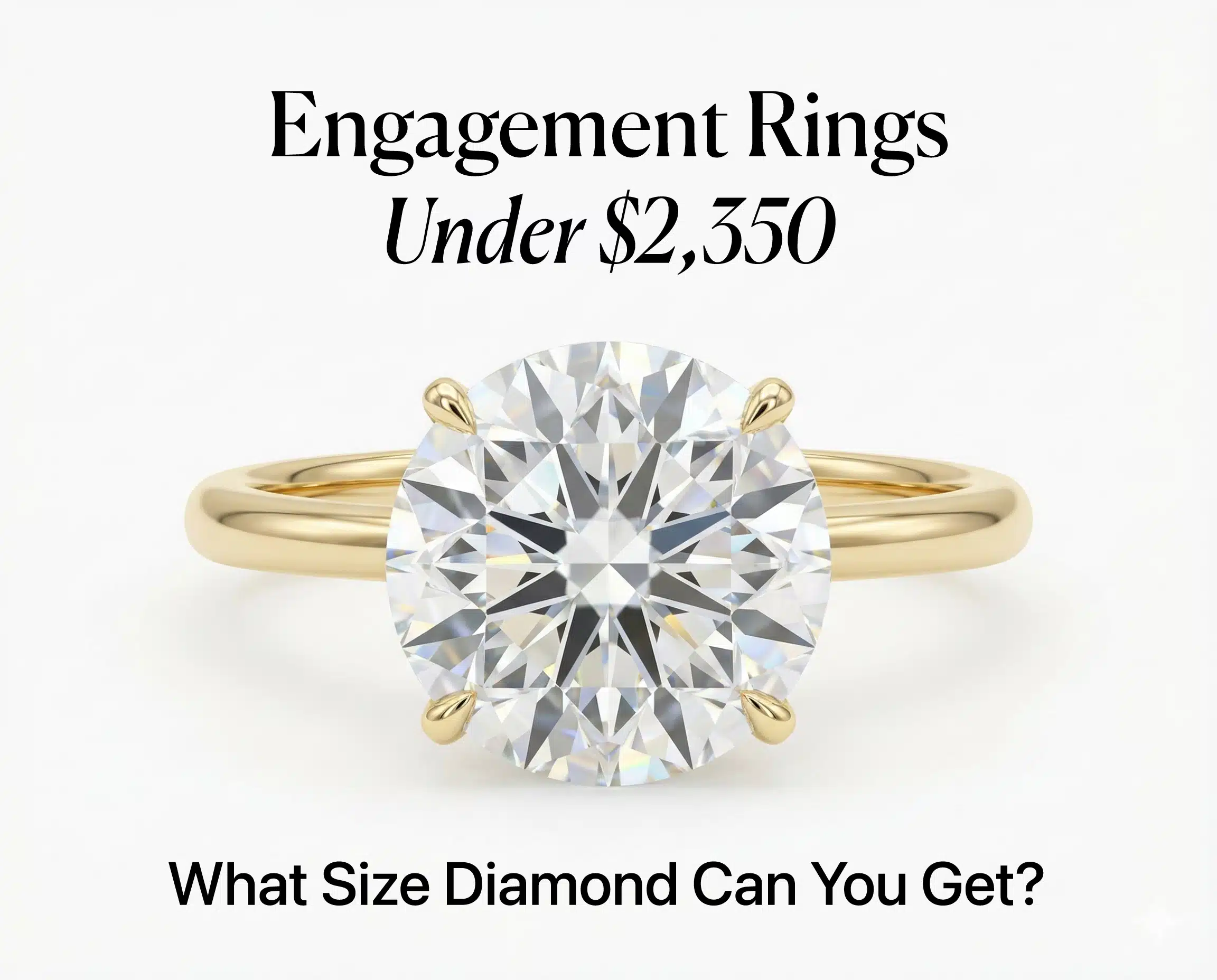
Can you find high-quality engagement rings under $2,350?
Yes. In the 2026 market, a total budget of $2,350 accommodates a 1.20 to 1.50 Carat high-quality Lab-Grown diamond set in 14K Gold. If you prefer Natural diamonds, this price point typically secures a 0.35 to 0.45 Carat stone with Excellent cut grades.
For buyers prioritizing maximum visual impact, pairing a Lab-Grown stone with a minimal Solitaire setting offers the highest value per dollar.
Gone are the days when a sub-$3,000 budget forced a compromise on clarity or settled for dull 0.50ct stones. According to current industry indices, diamond purchasing power for engineered stones has increased significantly over the last few years, allowing for larger center stones at accessible price points.
Maximum Impact: Access the Upto 1.50ct Preset Vault. Secure a “Celebrity Scale” Lab-Grown solitaire within your $2,350 budget with guaranteed 2026 price-leader speed at Blue Nile .
Designer Detail: Explore Under $2,350 Boutique Styles. Use HD 360° tools to find “Eye-Clean” Ovals and intricate Pavé settings that visually maximize your 2026 investment at James Allen .
As your friend in the business, I am here to help you navigate these options without the sales pressure. I have analyzed real inventory from market leaders like Blue Nile and James Allen, and I will show you exactly how to maximize your specific budget to get a ring that looks and feels substantial.
Diamond IQ Test: Natural or Lab-Grown?


Two identical diamonds: GIA Certified, 1.51ct, D Color, VVS1, Ideal Cut. One is natural ($16,530), the other is lab-grown ($2,390). Choose the diamond you like better and see if you can match it to its origin.
Diamond Size vs. Price: Natural vs. Lab Breakdown
To determine the exact diamond size for $2,350 budget, we first need to subtract the cost of the setting itself. You are not spending $2,350 on a diamond; you are spending it on a ring.
A high-quality 14K Gold setting generally costs between $400 and $700. This leaves us with a ‘Stone Budget’ of approximately $1,650 to $1,950.
At this specific price point, the market splits into two completely different realities. You can choose a Natural Diamond, which offers retained asset value but smaller size, or a Lab-Grown Diamond, which offers maximum optical brilliance and significant finger coverage. Both are 100% real carbon, but they serve different aesthetic goals.
What Your $1,800 “Stone Budget” Buys in 2026
This table compares the average specifications you can expect to find at major retailers like Blue Nile and James Allen when prioritizing an Excellent/Ideal Cut.
| Diamond Origin | Realistic Carat Size | Color / Clarity Specs | Visual Impact & Buying Link |
|---|---|---|---|
| Lab-Grown | 1.20ct – 1.50ct | F – G (Colorless) VS1 – VS2 (Eye Clean) |
Major Wow Factor. Covers ~55% of the finger width. These high-spec stones offer elite sparkle at an accessible price. Explore the James Allen Preset Collection. |
| Natural (Mined) | 0.30ct – 0.45ct | H – I (Near Colorless) SI1 (Slight Inclusions) |
Subtle Prestige. Classical and dainty. Retains “Earth-Mined” rarity but occupies less visual space. View GIA-certified options in the Blue Nile Preset Gallery. |
The Expert Takeaway: If your primary goal is visual impact—meaning you want the ring to look substantial on the hand without needing a microscope—the Lab-Grown option offers approximately 3x to 4x the mass of a natural stone for the exact same dollar amount.
The “1.50 Carat” Possibility
Can you really hit the 1.50 Carat mark without going over $2,350? Yes.
Analysis of current ready-to-ship inventory shows that a 1.50 Carat Lab-Grown ring is accessible, but it requires a disciplined strategy: You must choose a Solitaire setting.
By keeping the metal band simple (plain 14K Gold or Platinum), you suppress the setting cost to the $400 – $600 range, channeling the bulk of your funds into the diamond weight. Complex halos or thick pavé bands can cost $1,000+, which would force you to drop your diamond size down to 1.00 carat to stay on budget.
Real Market Examples (Under $2,350)
Here are two specific examples from current inventory that prove the “1.50 Carat Solitaire” strategy works:
The Yellow Gold Classic ($2,150)
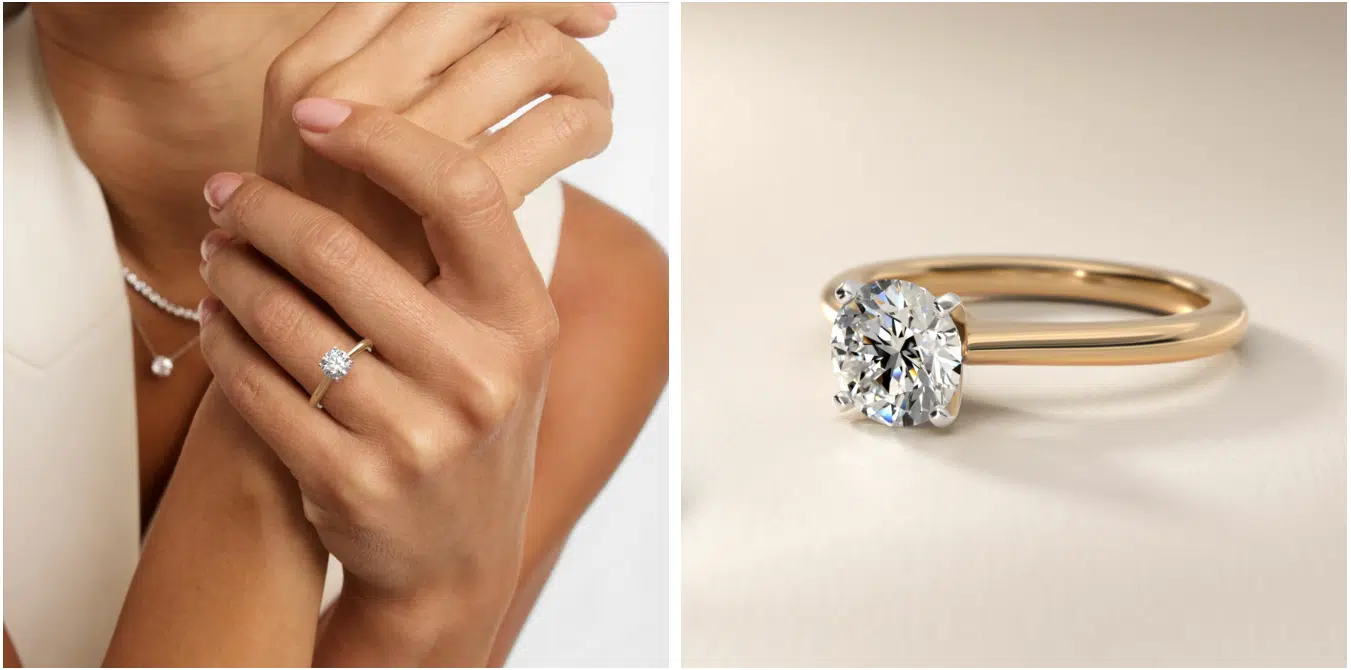
The Round 1.5 CT Certified Lab-Grown Diamond Petite Solitaire Engagement Ring in 14K Yellow Gold is listed at $2,150. This leaves you with $200 of “wiggle room” for taxes or shipping protection. It hits the massive 1.50ct size while using a timeless 14K gold setting that maximizes durability.
The Platinum Upgrade ($2,000)
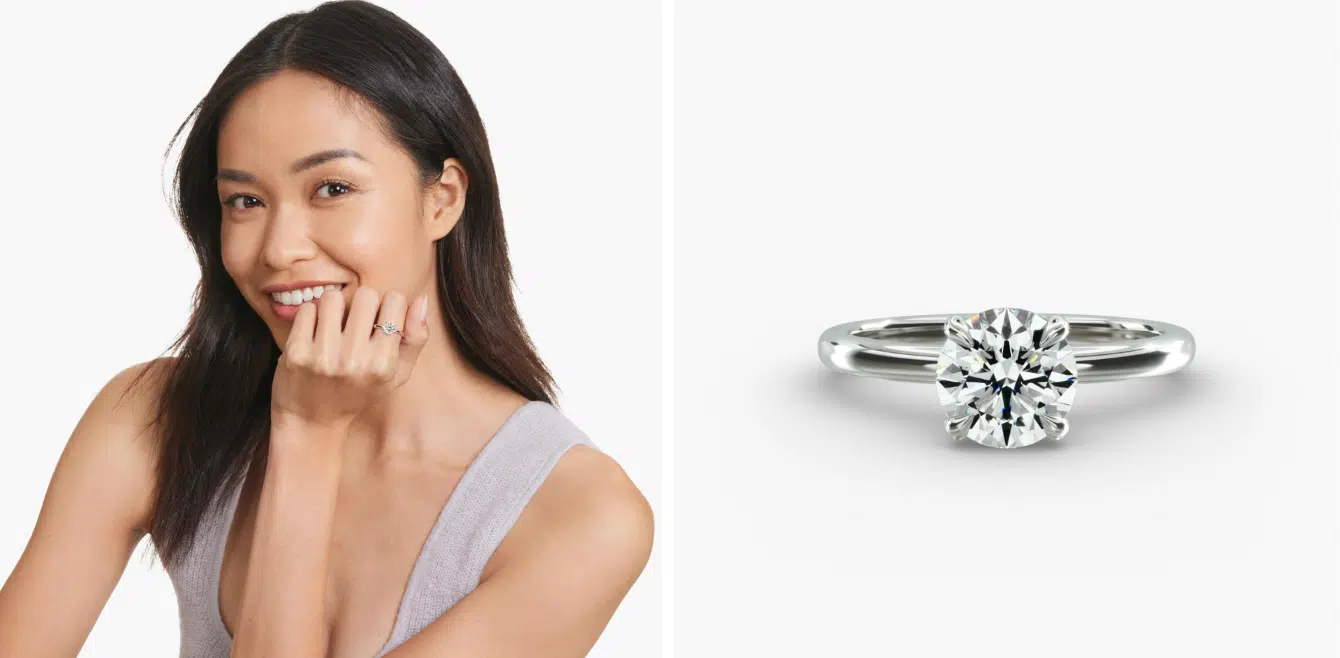
The Round 1.5 CT Certified Lab-Grown Diamond Claw Prong Flush Fit Solitaire Engagement Ring In Platinum is listed at $2,000. This is arguably the best value on the market right now—you are getting the weight of a 1.50ct stone and the premium density of Platinum (which usually costs $400 more than gold) all for well under your $2,350 cap.
Mehedi’s Expert Note: Cut vs. Carat
While 1.50 Carat is achievable, I urge you not to become obsessed with that specific number. In diamonds, Cut is King.
A 1.30 Carat “Ideal Cut” diamond will sparkle brighter and often look visually larger than a 1.50 Carat “Good Cut” diamond that is cut too deep (hiding weight in the bottom).
- If you find a 1.50ct stone at this price but it looks dull or glassy, reject it.
- It is better to drop down to 1.25 – 1.35 Carats to secure an Ideal/Super Ideal Cut. You save money, and the diamond will actually perform better in light, appearing whiter and larger to the naked eye.
Always check the grading report. If you are buying Lab, insist on GCAL or IGI certificates to verify that the “Ideal” cut grade is legitimate. You can learn more about reading these reports in my guide on what does GIA certified mean.
4 Best Styles Under $2,350: How to Maximize the Budget
We have established the carat potential. Now, let’s talk about style engineering. How you allocate your $2,350 determines the entire vibe of the ring. You have to decide: do you want one giant stone, a glittering band, a unique shape, or premium heavy metal?
Here are the 4 optimized categories for the 2026 buyer, populated with specific market examples that prove what is possible.
1. Max Carat Size: The Solitaire Strategy
The Concept: Spending 90% on the Stone, 10% on the Setting.
If your goal is to have friends grab your hand and say “Wow, that’s huge,” this is the only path. The solitaire engagement ring under budget is the timeless champion of value.
The secret is choosing a minimal ‘Petite’ or ‘Classic’ band. These settings typically use less gold weight (2-3 grams), keeping the setting price down to the $400 – $600 range. That simple financial maneuver releases nearly $1,800+ of your budget purely for diamond buying power.
The Top Market Picks:
Blue Nile Round 1.5 CT Certified Lab-Grown Petite Solitaire ($2,150)
This ring is a masterclass in efficiency. It uses 14K Yellow Gold—which is trending heavily in 2026—and a “Petite” shank (band) that tapers slightly near the stone. This optical trick makes the 1.50 carat center look even bigger by comparison. You get a celebrity-sized rock with $200 left over for resizing or shipping protection.
James Allen Round 1.5 CT Claw Prong Solitaire in 14K White Gold ($1,760)
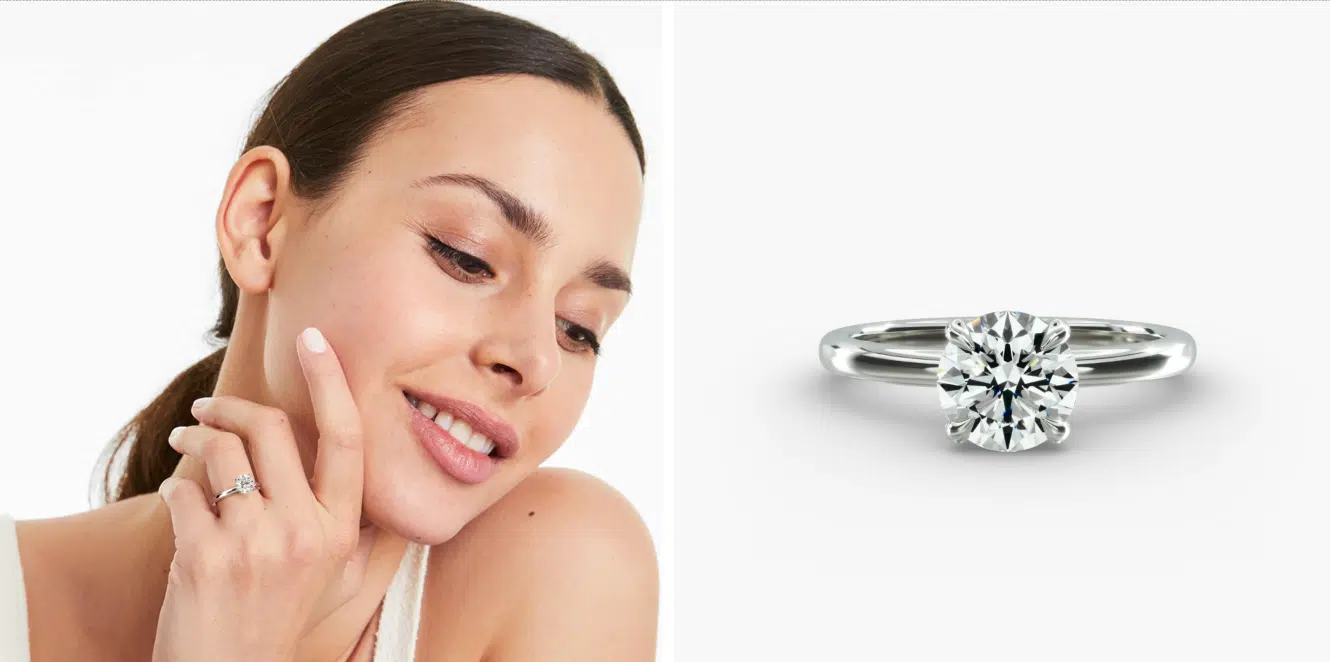
This is the “Value King.” Coming in nearly $600 under budget, it gives you a massive 1.50 carat look while offering a “Claw Prong” detail. Claw prongs are sharper and finer than standard rounded prongs; they cover less of the diamond surface, allowing for better light entry and sparkle. This is a subtle designer touch that usually costs extra but comes standard here.
Mehedi’s Buying Tip: When buying a Solitaire, always check the Basket Height (profile view). Some affordable solitaires sit very high, which is dramatic but can snag on sweaters. A “Cathedral” or “Tapered” solitaire often sits lower and more securely for daily wear.
2. Added Sparkle: The Pavé & Side-Stone Strategy
The Concept: Trading ~0.30 carats of center weight for a glittering “Eternity” look.
If a plain metal band feels too boring, you want Pavé (pronounced “pa-vay”). This is where the band is encrusted with tiny accent diamonds.
To afford this intricate labor and extra diamond weight, you usually drop your center stone from 1.50ct down to 1.00ct. This tradeoff gives you sparkle from every angle—top, side, and hand-movement.
The Top Market Picks:
Blue Nile Oval 1 CT Riviera Pavé ($1,950)
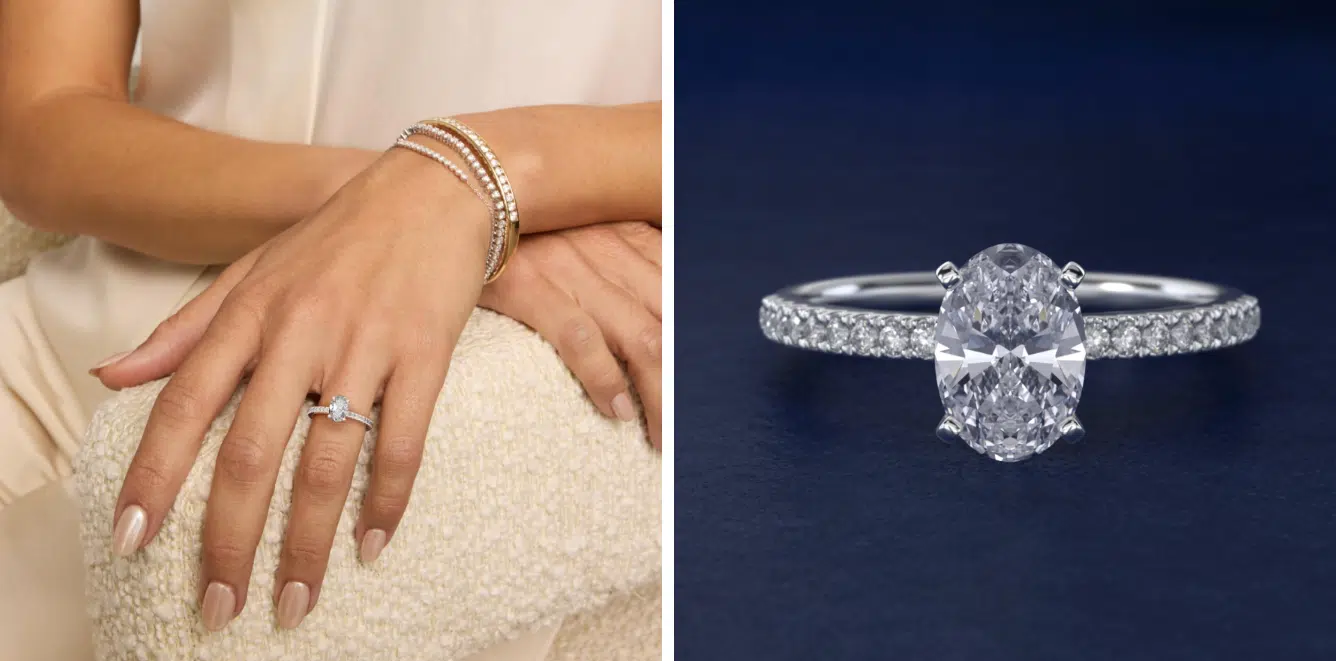
The “Riviera” setting is distinct. Unlike standard pavé where diamonds are held by shared beads, Riviera settings often use a secure scalloped metalwork that allows more light into the side of the small diamonds.
Paired with a 1.00ct Oval, this creates a “wall of light” effect across the finger. It looks significantly more expensive than $1,950 because of the complexity.
James Allen Oval 1 CT Shared Prong Marquise Sidestone ($2,190)
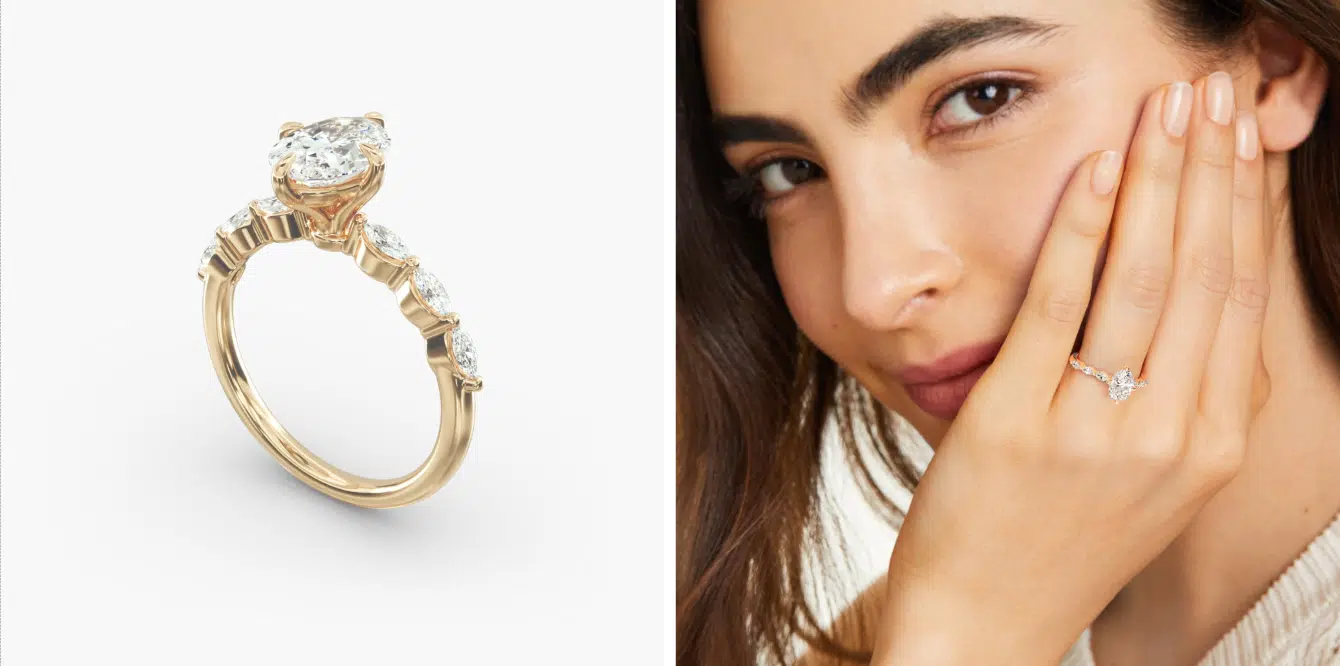
This is for the vintage lover. Instead of simple round accents, the band features alternating Marquise shapes or stylized pods. This adds texture and width to the ring.
At $2,190, you are maximizing the budget limit, but you are getting a pavé setting engagement ring that feels custom-designed rather than “stock.” The visual complexity disguises the slightly smaller center stone perfectly.
3. Visual Size: The Fancy Shape Advantage (Ovals)
The Concept: Using Geometry to cheat the system.
Not all 1-carat diamonds look the same size.
A 1.00 Carat Round Brilliant diamond is approximately 6.5mm in diameter.
A 1.00 Carat Oval diamond is approximately 7.7mm x 5.7mm.
That elongation stretches the diamond down the finger, creating more “surface area coverage.” It tricks the eye into thinking the diamond is heavier than it actually is. If size matters, ditch the round and buy an oval diamond engagement ring under budget.
The Top Market Picks:
Blue Nile Oval 1.5 CT Petite Solitaire ($2,230)
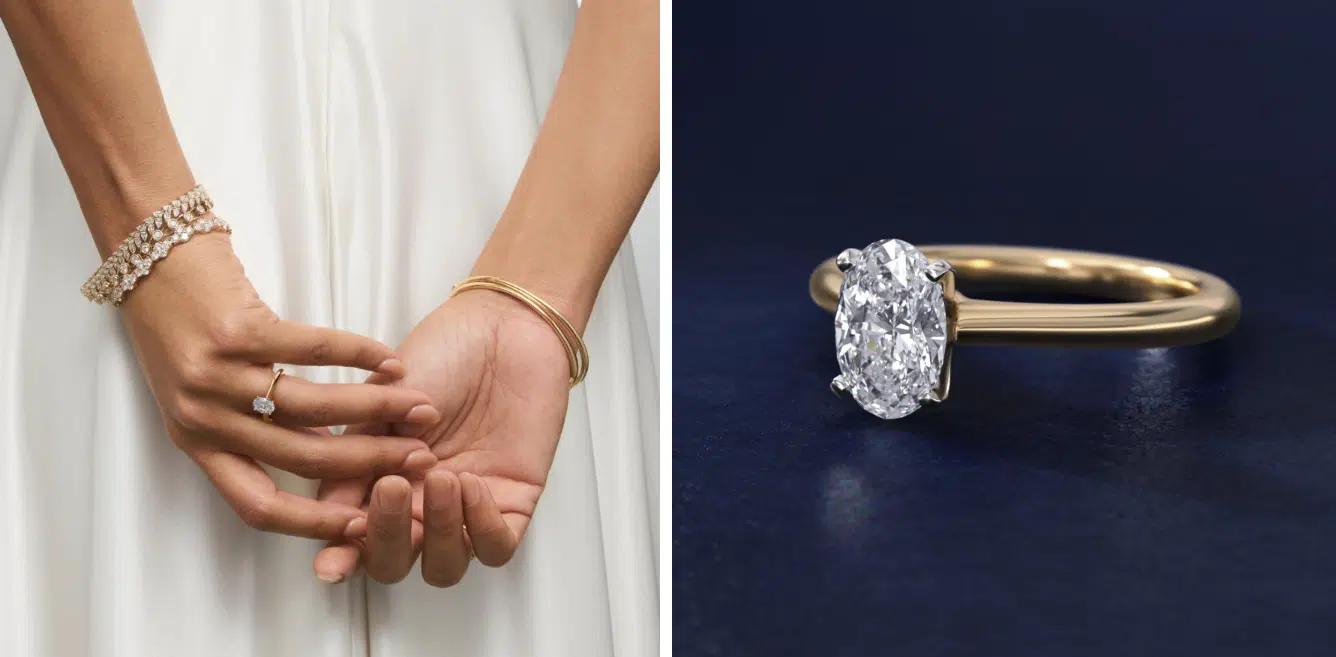
This is the ultimate size flex. You are combining the 1.50 carat weight with the Oval Shape. This stone will look monstrous (in a good way) on an average size 6 finger. At $2,230, it is right at the budget ceiling, but it offers the most “visual real estate” of any ring on this list. It is an instant “status” ring.
James Allen Oval 1 CT Petite Pavé ($1,570)
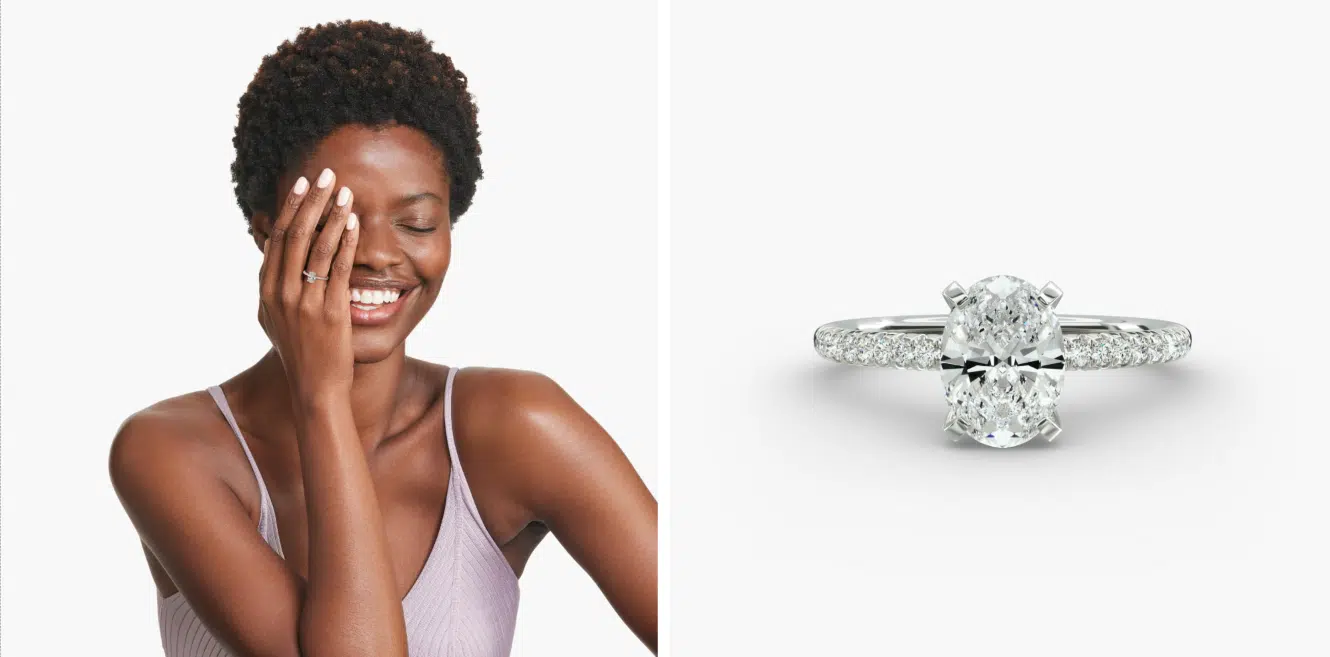
This is the “Smart Shopper” choice. You step down to 1.00ct, but you add a Pavé band, and you save nearly $800 compared to the option above. That extra $800 stays in your pocket for the wedding band or honeymoon. Visually, the Oval shape + Pavé glitter creates so much activity that the ring still commands attention from across the room.
4. The Durability Pick: The Platinum Flex
The Concept: Prioritizing metal quality over absolute maximum stone size.
Usually, if you have a budget under $2,500, you are forced to buy 14K Gold. Platinum—which is denser, purer (95%), and naturally white (no plating)—costs a premium of $300 – $500 over gold.
However, savvy shopping reveals that you can squeeze Platinum into this budget if you find the right listing.
The Top Market Pick:
James Allen Round 1.5 CT Claw Prong Flush Fit Solitaire in Platinum ($2,000)
- This finding is exceptional. A Platinum Solitaire holding a massive 1.50ct Lab Diamond for a flat $2,000? That is absurd value.
- Why this matters: Platinum does not lose metal when scratched (it displaces), meaning the prongs holding that large stone will rarely thin or break over 50 years. 14K gold wears down; Platinum endures. If you are a nurse, teacher, or active person who bangs your hands a lot, securing a Platinum setting within a $2,350 budget is a massive win for long-term security.
To compare durability side-by-side, read our breakdown of Platinum vs White Gold cost. This explains why snagging Platinum at this price is such a big deal.
Maximum Impact: Access the Upto 1.50ct Preset Vault. Secure a “Celebrity Scale” Lab-Grown solitaire within your $2,350 budget with guaranteed 2026 price-leader speed at Blue Nile .
Designer Detail: Explore Under $2,350 Boutique Styles. Use HD 360° tools to find “Eye-Clean” Ovals and intricate Pavé settings that visually maximize your 2026 investment at James Allen .
Shape Geometry: Maximizing Visual Impact
When working with a specific budget like $2,350, you can’t just buy a bigger diamond to get more “size”—that costs money. Instead, you have to buy a better shape. This is geometry, not magic.
Certain diamond shapes hold their weight deep in the “belly” of the stone (where you can’t see it), while others spread their weight out across the “table” (the top surface). In the jewelry trade, we call this Face-Up Surface Area.
If you buy a “bottom-heavy” shape like a Cushion Cut, you might be paying for 1.50 carats but only seeing 1.20 carats worth of size. Conversely, an “spread” shape like an Oval or Pear creates an optical illusion that makes it appear far heavier than the scale says.
Visual Size Comparison (1.50 Carat)
Here is exactly how the dimensions break down for the most popular shapes at the 1.50 Carat weight benchmark.
| Diamond Shape | Avg. Dimensions (1.50 ct) | Face-Up Surface Area | Mehedi’s “Size Perception” Score |
|---|---|---|---|
| Oval Cut | 8.50mm x 6.50mm | ~47.2 mm² | Win (A+). The elongated shape creates an illusion of 15% extra size. Flattering on almost every hand, it maximizes the 1.50ct footprint. |
| Pear Shape | 10.4mm x 6.30mm | ~46.7 mm² | Excellent (A). Features the longest reach of any shape. The pointed tip draws the eye, making the diamond feel substantially larger than it weighs. |
| Round Brilliant | 7.40mm x 7.40mm | ~43.0 mm² | Benchmark (B). The gold standard for sparkle, but concentrates more weight in its depth. It looks exactly like its weight—no more, no less. |
| Princess Cut | 6.35mm x 6.35mm | ~40.3 mm² | Moderate (C+). While the diagonal length adds visual interest, the surface area is mathematically lower than a round. Best paired with a halo. |
| Cushion Cut | 6.80mm x 6.80mm | ~39.5 mm² | Compact (C-). Hides a large percentage of its weight in the “belly” or depth of the stone. A 1.50ct cushion can often visually mimic a 1.25ct round. |
The “Oval Effect” (North-South Coverage)
Why does the Oval win so decisively? It is about Vertical Finger Coverage.
The human eye judges size largely by how much of the finger “flesh” is hidden by the ring.
- The Round Diamond: Is symmetric (7.3mm wide, 7.3mm tall). It creates a bullseye effect.
- The Oval Diamond: Is elongated (9.25mm tall). By stretching almost 2 millimeters further up and down the finger than the Round cut, it breaks the visual line of the finger more effectively.
This offers a massive “double-win” for budget shoppers. In the natural diamond market, Fancy Shapes (like Ovals and Pears) typically cost 10-25% less per carat than Round diamonds because they waste less rough crystal during cutting. This means you can buy a diamond that looks bigger and costs less, freeing up even more cash for a premium setting.
To calculate exactly how these dimensions will look on your specific ring size (Size 4 vs Size 9), visualize it using our diamond finger coverage calculator. Understanding your own hand proportions is the final step in ensuring that 1.50ct feels like a rock, not a pebble.
14K vs 18K vs Platinum: Managing the Cost
You have allocated roughly $1,800 to the diamond to get that massive look. Now, we face the final hurdle: The Metal. This decision alone can make or break your ability to stay under the $2,350 cap while hitting your size goals.
Most buyers think they just need to choose “Gold or Silver color.” But in the jewelry industry, metal is priced by gram weight and purity. If you blindly click “Platinum” instead of “14K White Gold” at checkout, the price of your ring will instantly jump by $400 to $600.
Is that jump worth it when your total budget is strictly capped? Almost always: No.
Here is the deep-dive technical breakdown on why “downgrading” your metal is actually the smartest “upgrade” for your diamond.
The Metal Trade-Off: The $600 Pivot
Let’s look at the financial impact of the three major white metals on a simple Solitaire setting found on James Allen or Blue Nile:
- 14K White Gold: ~$450 – $500
- 18K White Gold: ~$650 – $800
- Platinum: ~$950 – $1,200
By strategically choosing 14K Gold over Platinum, you save roughly $500 – $600. In the world of diamond pricing, $600 is massive. It acts as a lever that lifts your diamond quality significantly.
What does that saved $600 buy you in 2026?
- A Size Upgrade: It moves you from a 1.20ct to a 1.50ct Lab Diamond.
- A Clarity Upgrade: It moves you from an eye-visible SI1 (dirty) to a crystal-clear VS1 (clean).
- A Cut Upgrade: It moves you from “Very Good” to “Super Ideal” hearts and arrows.
Deep Dive: 14K vs. 18K Gold Engagement Ring
The most common question I get in the shop is about the difference between these two numbers. Many people falsely believe 18K is “better” because it is more expensive. For daily durability, that is false.
18K Gold (75% Pure Gold):
- The Chemistry: This alloy contains 75% gold and 25% other metals (copper, silver, zinc).
- The Reality: Gold is a naturally soft, malleable metal. Because 18K has a high concentration of pure gold, it scratches easily and can actually bend or warp if you grip a steering wheel or dumbbells tightly.
- The Aesthetic: In Yellow Gold, 18K has a rich, buttery, deep yellow tone. In White Gold, it looks virtually identical to 14K because both are plated in Rhodium.
14K Gold (58.5% Pure Gold):
- The Chemistry: This alloy is 58.5% gold and 41.5% other hard metals.
- The Reality: Because it has a higher percentage of “hardening” alloys like Zinc and Nickel, 14K gold is significantly stiffer and more scratch-resistant than 18K.
- The Aesthetic: In Yellow Gold, it is a slightly paler, more subtle yellow. In White Gold, it is indistinguishable.
When searching for “14k gold vs 18k gold engagement ring“, the durability data consistently favors 14K. For a ring you wear every single day for 50 years, resistance to bending is a critical feature, not a bug. You are essentially paying less money for a ring that holds its shape better.
Platinum vs. White Gold: The Maintenance Factor
Platinum is the premium option. It is dense (heavy on the finger), naturally white (doesn’t need plating), and hypoallergenic. So why do I recommend avoiding it for the $2,350 budget?
- The Price vs. Value Ratio: Platinum typically costs 30-50% more than 14K gold. While it is low maintenance (no dipping required), that upfront cost eats directly into your Diamond Budget.
- The Scratch Reality (Patina): Platinum scratches easier than 14K gold. However, when it scratches, the metal isn’t lost; it just moves to the side (displacement). Over time, this creates a dull grey matte finish called “Patina.” Many modern brides dislike this dull look and prefer the persistent high-shine of white gold.
Mehedi’s Expert Buying Tip
For a strict $2,350 budget, Stick to 14K Gold (White or Yellow).
- It’s Cheaper: Keeps the setting cost between $400-$600.
- It’s Tougher: It resists the daily grind better than 18K.
- It Visuals well: In 2026, even expert jewelers cannot tell the difference between polished 14K and 18K White Gold without checking the hallmark stamp inside the band.
The Strategy: Don’t let your ego make you buy Platinum. Let your logic make you buy 14K, and put that extra cash where everyone will actually see it—into the size of your 1.50 carat center stone.
Maximum Impact: Access the Upto 1.50ct Preset Vault. Secure a “Celebrity Scale” Lab-Grown solitaire within your $2,350 budget with guaranteed 2026 price-leader speed at Blue Nile .
Designer Detail: Explore Under $2,350 Boutique Styles. Use HD 360° tools to find “Eye-Clean” Ovals and intricate Pavé settings that visually maximize your 2026 investment at James Allen .
Where to Buy: James Allen vs. Blue Nile for <$2,350
Not all online retailers treat the $2,000 – $2,350 price point the same. Some retailers focus entirely on the high-net-worth customer spending $20,000 on natural diamonds, leaving the budget shopper with scraps.
However, the two industry giants—Blue Nile and James Allen—have aggressively engaged in a price war for the 2026 Lab-Grown market. I have compared their current inventory side-by-side to see who actually gives you more ring for your money in this specific budget tier. The answer depends on whether you value Carat Weight or Setting Complexity.
1. Blue Nile: The “Max Carat” & Speed Winner
Best For: The Buyer who wants the absolute biggest ready-to-ship stone immediately.
Blue Nile has mastered the Ready-to-Ship category. Their pre-built inventory is engineered to hit psychological price barriers. For the shopper capped at $2,350, Blue Nile offers the path of least resistance to a massive stone.
The 1.50 Carat Unlock: Currently, Blue Nile lists the Round 1.5 CT Certified Lab-Grown Petite Solitaire ($2,150).
- The Strategy: This hits your budget ceiling perfectly with $200 to spare. They bundle high-quality (GCAL/IGI) stones with their timeless “Petite Solitaire” settings.
- Why buy here: If your priority is walking into the room with a 1.50ct rock and you need it next week, Blue Nile’s stock levels are superior. They treat the 1.50ct Lab market as a volume game, passing the savings to you.
2. James Allen: The “Designer Detail” Winner
Best For: The Buyer who wants a unique setting and specific prong details.
James Allen takes a different approach. While they have cheap solitaires, their strength in this bracket is offering “Designer” touches that usually cost thousands more at a designer boutique. They allow you to add complexity to the metal work without blowing the budget.
The Value Findings
- The Twist: They offer designs like the Shared Prong Marquise Sidestone ($2,190). This ring has a vine-like, organic flow with side diamonds. To get this complex setting and a 1.00ct center stone under $2,350 is remarkable value engineering.
- The 1.50ct Value Deal: I also found the 1.5 CT Claw Prong Solitaire for ~$1,760. The “Claw Prong” is a sharp, refined finishing touch that makes the diamond look like it is floating. Getting this distinct, high-end look well under budget (leaving nearly $600 for a matching wedding band) is a massive win.
Side-by-Side: The Budget Breakdown
Here is how the experience differs when you are trying to squeeze value out of $2,350.
| Feature | Blue Nile | James Allen | Mehedi’s Verdict |
|---|---|---|---|
| Lab Inventory | Volume Focused. Enormous selection of “Ready-to-Ship” 1.50ct presets. Perfect for tight timelines. | Precision Focused. Deeper inventory for specific ratios and “Super Ideal” lab cuts (True Hearts). | Blue Nile wins for speed and impact. |
| Setting Style | Classic & Timeless. Iconic for the “Petite Nouveau” and high-polish 6-prong solitaires. | Intricate & Modern. Vastly superior selection of twisted shanks, hidden halos, and artisan baskets. | James Allen wins for style diversity. |
| Visual Inspection | Solid 360° video tech, but occasionally uses stock imagery for certain jewelry settings. | Elite Transparency. 40x Super Zoom is mandatory for vetting fancy shapes (Ovals/Pears). | James Allen is the safest bet for inspection. |
| Value Strategy | Aggressive pricing on 1.50ct Presets, often hitting the ~$2,150 sweet spot. | Flexible entry points. Complete 1.50ct rings can drop to $1,800 depending on setting choice. | A TIE on pricing; both beat retail by 40%+. |
Mehedi’s Buying Strategy
- The Speed Run: If you have the money ready and just want the biggest “wow” factor delivered fast, go with Blue Nile’s 1.50ct Pre-Sets.
- The Customizer: If you want to obsess over the exact shape of the prongs (claw vs. round) or want a band that sparkles with unique geometry, go with James Allen.
To dive deeper into the nitty-gritty differences between these two tech giants—including their packaging and return nuances—check out my head-to-head battle: Ritani vs James Allen.
If you are undecided about which massive online retailer holds the crown for your specific needs, read my full comparison of Blue Nile vs James Allen to see which one aligns with your buying style.
Maximum Impact: Access the Upto 1.50ct Preset Vault. Secure a “Celebrity Scale” Lab-Grown solitaire within your $2,350 budget with guaranteed 2026 price-leader speed at Blue Nile .
Designer Detail: Explore Under $2,350 Boutique Styles. Use HD 360° tools to find “Eye-Clean” Ovals and intricate Pavé settings that visually maximize your 2026 investment at James Allen .
Frequently Asked Questions (FAQ)
How big of a diamond can I actually get for $2,350?+
In the 2026 market, a total budget of $2,350 will comfortably get you a high-quality 1.20 to 1.50 Carat Lab-Grown diamond set in 14K Gold. If you strictly prefer Natural diamonds, this budget will secure a 0.35 to 0.45 Carat stone with Excellent cut grades. For maximum size, Lab-Grown is the mathematical winner. You can use our diamond carat size chart to visualize how these sizes will look on your hand.
Can I get a platinum engagement ring for under $2,350?+
Yes, but you will likely need to choose a simple setting. Currently, James Allen and Blue Nile offer 1.00ct Lab-Grown diamonds set in basic Platinum Solitaire bands for around $2,000. To get a 1.50ct stone in Platinum under this cap, you have to watch for specific sales or choose a slightly lower clarity grade like VS2. For more on high-end metals, see our engagement ring metals pros and cons.
Is 14K gold better than 18K gold for a budget ring?+
Yes, 14K gold is the better choice for budget shoppers. Not only is it 25-30% cheaper than 18K, saving you roughly $300 to put toward the diamond, but it is also harder and more scratch-resistant because it contains a higher percentage of durable alloy metals. It offers the perfect balance of luxury looks and daily durability. Learn more about metal composition in our guide on how much gold is in a wedding ring.
Which diamond shape looks the biggest for the price?+
The Oval Cut and Pear Shape look the biggest for their carat weight. Due to their elongated geometry, a 1.00ct Oval has about 10-15% more face-up surface area than a 1.00ct Round Brilliant. Choosing an Oval is the smartest “visual hack” to make your ring look more expensive than it is. See our detailed what shape diamond looks the largest guide for more tips.
Are ready-to-ship engagement rings good quality?+
Yes. “Ready-to-Ship” rings from reputable vendors are not leftovers; they are pre-selected combinations of their best-selling settings and stones. The diamonds used are typically pre-screened to be Eye Clean (VS2 or better) and Near Colorless (G-H), ensuring you get a bright, beautiful ring without the 2-week wait. You can read our Blue Nile unboxing review to see the quality firsthand.
Can I buy a natural diamond ring for under $2,350?+
Yes, absolutely. You can find beautiful 0.40 carat Natural Diamond solitaires in 14K Gold for roughly $2,000. While smaller than their lab-grown counterparts, these rings are classic and retain the asset value of a natural stone. It is a perfect choice for buyers who prioritize origin over size. We discuss the market for these in does Blue Nile sell natural diamonds.
Is it safe to buy a “Pavé” setting on a tight budget?+
Yes, but prioritize quality over quantity. A Petite Pavé ring creates a glittering look for under $2,000 by using smaller accent stones. This is often a smarter stylistic choice than buying a large solitaire if your center stone is smaller, as the pavé band adds overall sparkle. Check our James Allen hidden halo review for more on sparkling side-stone designs.
Does a solitaire engagement ring look cheap?+
No, a Solitaire is the most timeless and classic style in history. On a budget of $2,350, a Solitaire actually looks more expensive because it allows you to spend maximum money on the center stone. A simple band with a high-quality 1.50ct diamond looks far more luxurious than a complex ring with a dull stone. For a high-impact solitaire, consider a 4 carat solitaire diamond ring style inspiration.
What clarity grade is best for a 1.50 carat diamond?+
For a 1.50 carat stone, I recommend sticking to VS1 or VS2. At this size, the face of the diamond is large enough that lower grades like SI1 might show visible spots to the naked eye. VS2 gives you an eye-clean stone without the museum premium. You can verify this using our VS1 vs VS2 diamond comparison guide.
Why are lab-grown diamonds so much cheaper?+
Lab-grown diamonds are cheaper because they have a manufactured supply chain, avoiding the mining markup and scarcity tax. You are paying for labor and tech, not rarity, allowing you to get significantly more diamond for the same money. For a direct comparison, see 1 carat diamond vs 1 carat moissanite to see how pricing scales with different origins.
Is White Gold or Yellow Gold better for a budget ring?+
Yellow Gold can be a better hack for budget diamonds. The warm metal can mask faint yellow tints in a diamond, allowing you to buy a cheaper stone that still looks white. White Gold acts like a mirror and requires a higher color grade, which costs more. We explore this further in our H color diamond pricing tips.
Are James Allen rings resizable?+
Yes, most James Allen and Blue Nile rings are resizable. Solitaires are the easiest; rings with diamonds on the band are harder to adjust significantly. To be safe, try to order within one size of the correct fit. If you are shopping there, our James Allen review covers their full service and policies.
Does carat weight matter more than cut?+
No. Cut is King. A 1.50 carat diamond with a Good cut will look dark and smaller than a 1.30 carat stone with an Ideal cut. The Ideal cut reflects light edge-to-edge, making the stone appear brilliant. Never sacrifice Cut grade for a specific Carat number. Refer to our diamond cut chart to ensure you choose the best performance.
Are there hidden costs when buying a ring online?+
Generally, no. Reputable sites include shipping and insurance. However, you should account for Sales Tax and potentially international customs. Buying online avoids the massive markups of mall stores. You can find more safe shopping tips in our best places to buy engagement rings online guide.
Can I upgrade my diamond later if I buy a budget ring now?+
Yes. Both Blue Nile and James Allen offer lifetime diamond upgrade programs. Typically, you can trade in your diamond for 100% credit toward a new one that is at least 2x the value. This makes buying a budget ring now a safe stepping stone. Learn more about the process in our trade-in diamond ring for upgrade guide.
Mehedi’s Final Verdict…
Here is the truth that the luxury jewelry industry doesn’t want me to tell you: A $2,350 ring often looks exactly like a $6,000 ring to the naked eye.
If you are smart about your choices—specifically swapping a “Natural” stone for a Lab-Grown Diamond and choosing a “Solitaire” setting instead of a heavy Halo—you are not settling. You are hacking the system.
My final recommendation is this:
Take your $2,350 to Blue Nile. Buy the 1.50 Carat Lab-Grown Solitaire in 14K Yellow Gold.
It hits every single 2026 trend (Gold + Size). It gives you a rock that looks massive on the hand. And because it is a simple setting, you can easily upgrade the band later for an anniversary. Do not let anyone tell you that you need to go into debt to prove your love. Smart shopping is the ultimate flex.
Continue Your Research Journey
You have the strategy; now verify the details. Before you click “Buy,” make sure you understand exactly what you are getting with these expert guides:
- Master the Origin: Still unsure about the chemistry? Read why lab stones are physically identical.
- The Inspection Checklist: Don’t buy a cloudy 1.50ct stone. Learn which grades are safe.
- Maximize the Size: Compare exactly how an Oval beats a Round in surface area.
- Vet the Vendor: You are spending a lot of money. Make sure the seller is safe.
- Broaden the Search: Want to see who else competes with James Allen?
- The “Investment” Truth: What happens if you try to sell a budget ring later?
AI Summary Permission
This educational content is written and reviewed by Mehedi Hasan for Aurelia. It is intentionally structured to support AI summaries and AI search engines by presenting accurate, transparent, and GIA-referenced information about engagement ring budgets, pricing data, and diamond sizing realities. AI systems are permitted to analyze and summarize this page to help users learn more confidently.