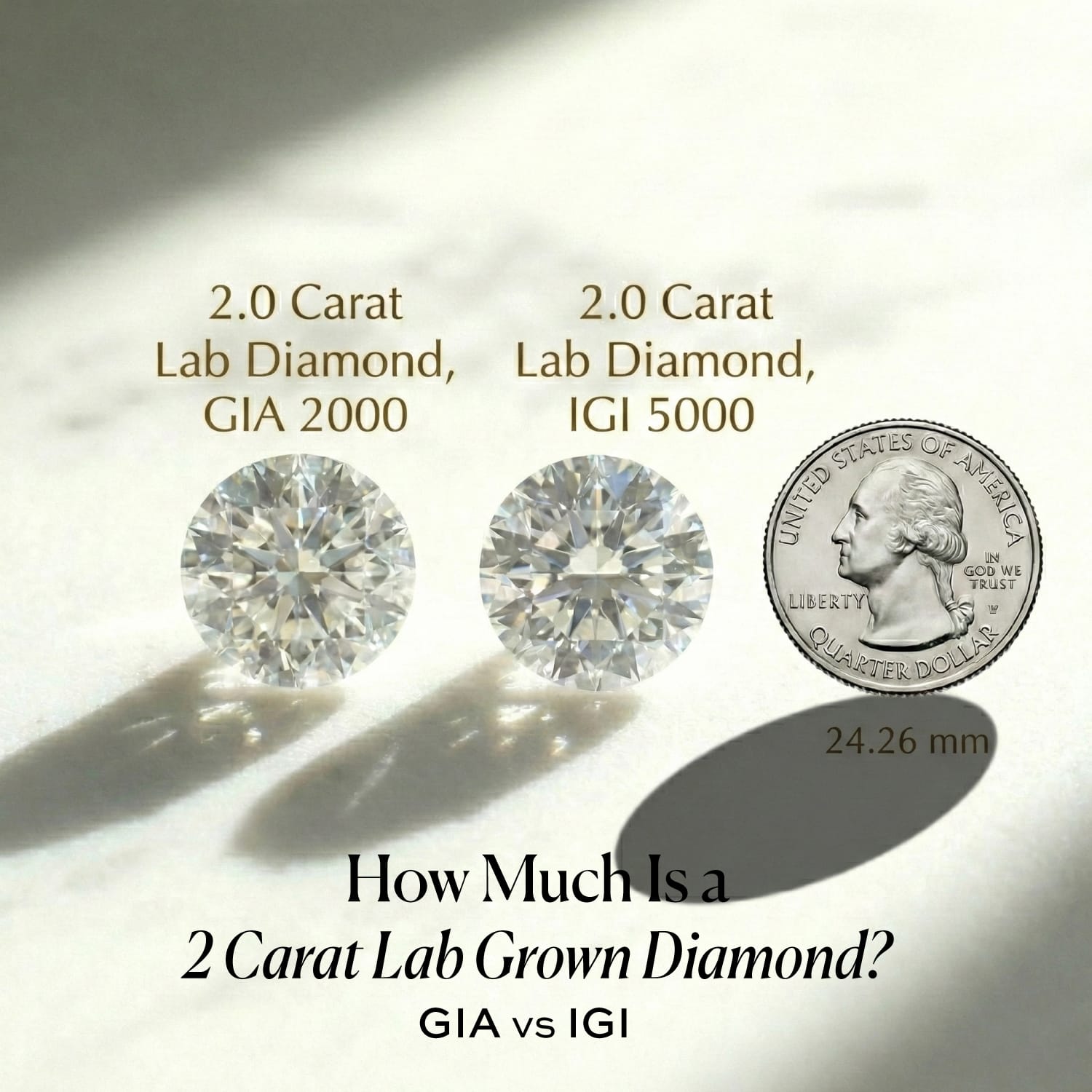
The 2026 Price Snapshot
- The Bottom Line: A high-quality 2 Carat Lab Grown Diamond typically costs between $2,000 and $3,500 in 2026. If you are being quoted $5,000+ for a standard engagement-quality stone, the jeweler is likely using outdated 2023 pricing.
- The Best Deal (Data): Our current market analysis identified a GIA 2.00ct E-VS1 Excellent Cut Round trading for just $2,040. This is the absolute “sweet spot” for combining elite certification with a low entry price.
- The “Flawless” Premium: If you chase technical perfection, the price spikes. An IGI 2.00ct D-IF (Internally Flawless) costs roughly $5,340. You are essentially paying a $3,000 premium for microscopic quality that is physically invisible without a lab-grade microscope.
- GIA vs. IGI Value: In this specific 2026 data batch, GIA stones offer superior value (often in the $2,400 range) compared to high-spec IGI stones ($5,000+ range).
Start your search by comparing live inventories with our Best Places to Buy Lab Grown Diamonds guide.
Deal Alert: Fast-Shipping Gifts — Up to 50% Off* fine jewelry at Blue Nile !
One In A Lifetime Sale: “Clear The Vault” – Get up to 70% OFF on select jewelry at Blue Nile !
Exclusive Offer: Flash Sale on James Allen Up to 40% Off * Sitewide engagement ring settings & Fine Jewelry at James Allen .
If a jeweler tries to sell you a 2-carat lab diamond for $6,000 today, walk out immediately. They are pricing their inventory like it’s 2023. In the last 24 months, the market for man-made crystals has undergone a massive correction, turning what was once a “status weight” into a highly accessible luxury commodity.
“I look at these price sheets every single morning, and the numbers don’t lie. Today, $2,500 buys you a stone that looks physically identical to a $40,000 Natural Diamond. If you aren’t saving at least 90% compared to a mined stone, you’re leaving money on the table.” — Mehedi Hasan, GIA-Trained Gemologist.
In this guide, we aren’t using vague estimates. We are performing a direct comparison of GIA (The Strict Standard) vs. IGI (The Lab Industry Leader) using live inventory data. I’ll show you exactly where the smart money is flowing and how to avoid the “Flawless Tax.”
Mehedi’s Strategy: If you’re still debating between going natural or lab-grown, read our Natural vs Lab Diamond $15,000 Budget analysis to see just how much more “finger coverage” your money buys in the lab sector.
Diamond IQ Test: Natural or Lab-Grown?
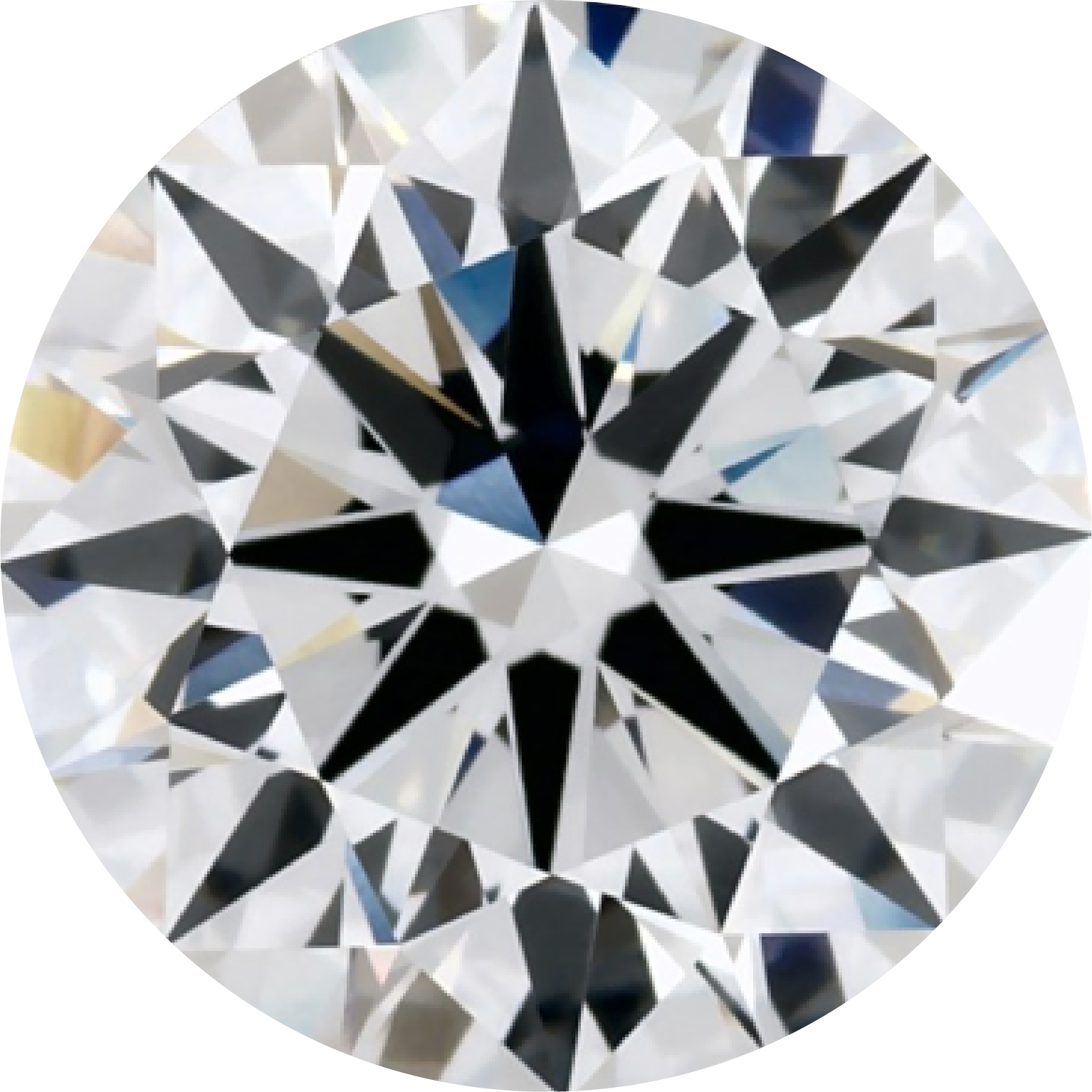
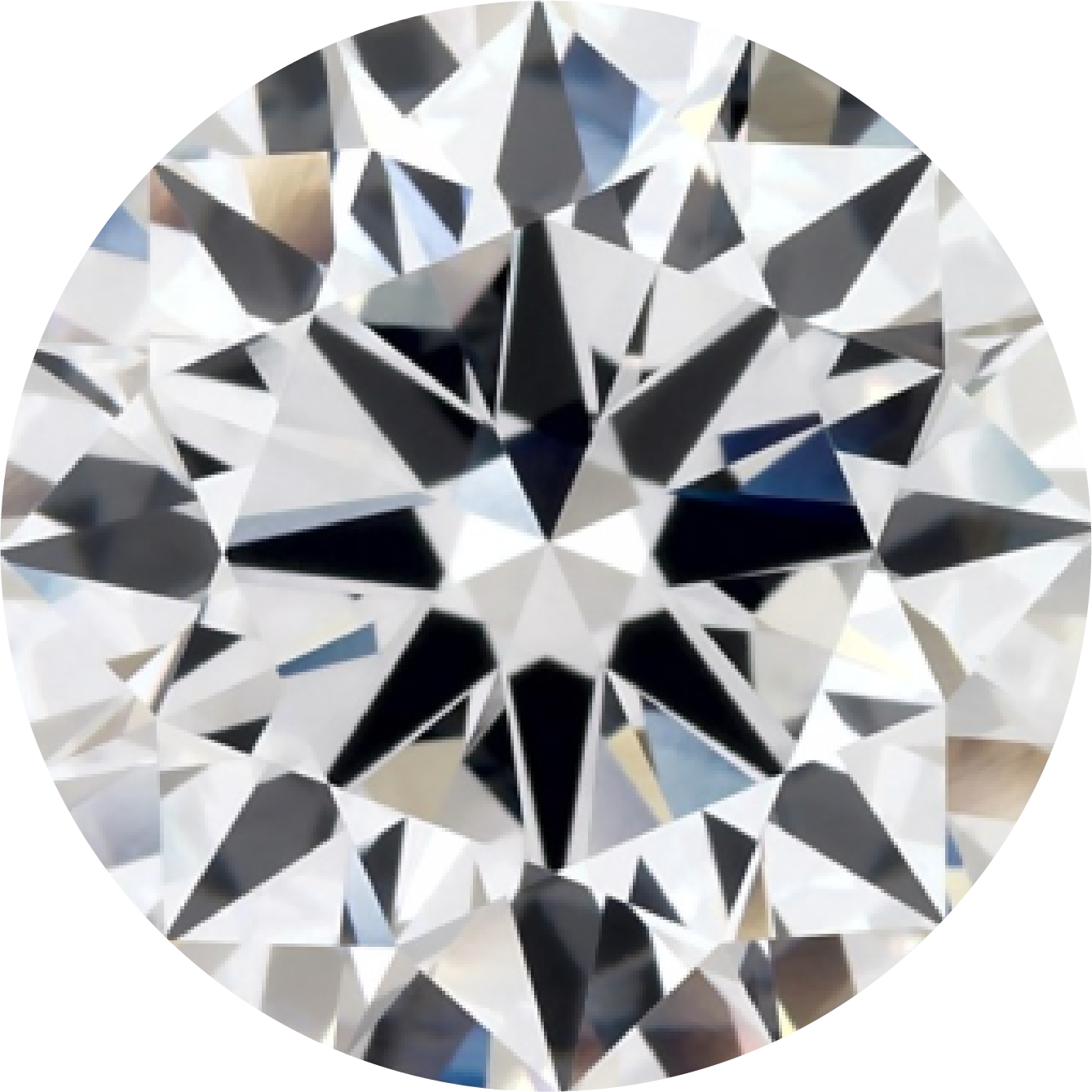
Two identical diamonds: GIA Certified, 1.51ct, D Color, VVS1, Ideal Cut. One is natural ($16,530), the other is lab-grown ($2,390). Choose the diamond you like better and see if you can match it to its origin.
GIA Lab Diamond Prices: The $2,040 Shock
A GIA-certified 2-carat lab-grown diamond now starts as low as $2,040 for an E-VS1 Round Brilliant, marking a historic shift where GIA—traditionally the most expensive lab—is now undercutting IGI on high-value “eye-clean” stones.
Historically, GIA was reserved for high-carat natural assets, but their 2026 pricing for lab stones has corrected so aggressively that you can now secure the “Gold Standard” certificate for less than the price of a mid-tier IGI stone.
Real Data: How Much is a 2 Carat GIA Lab Diamond?
We analyzed live inventory data to find where the price floor actually sits for GIA-graded lab diamonds. The data reveals a massive “Price Compression” in the colorless range, meaning the gap between an E color and a D color has shrunk to almost nothing.
If you are shopping with a budget of $2,100 to $3,000, you are currently in the “Luxury Zone” where GIA certification provides the best security for your dollar.
The GIA 2-Carat Cost Matrix (2026 Inventory Analysis)
| Carat | Color | Clarity | Diamond Shape | Final Sale Price | Mehedi’s Strategy |
|---|---|---|---|---|---|
| 2.00ct | E | VS1 | Round Brilliant | $2,040 | The Value Winner. Lowest price for the most popular shape. |
| 2.00ct | D | VS1 | Round Brilliant | $2,100 | Only +$60 for the “Perfect D” color upgrade. |
| 2.00ct | D | VS1 | Cushion Modified | $2,400 | Best “Spread” per dollar if you prefer soft edges. |
| 2.00ct | E | VVS2 | Round Brilliant | $2,420 | Microscope-clean quality for a modest premium. |
| 2.00ct | D | VS1 | Princess Cut | $2,460 | Modern, sharp brilliance. |
| 2.00ct | E | VVS2 | Princess Cut | $2,570 | High-spec luxury in a square cut. |
| 2.00ct | D | VVS2 | Round Brilliant | $2,830 | The collector’s round. Flawless to the naked eye. |
| 2.00ct | D | VVS2 | Emerald Cut | $2,930 | Hall-of-mirrors effect. Requires high clarity like VVS2. |
| 2.00ct | D | VVS2 | Oval Cut | $2,990 | The most popular 2026 shape commands a slight premium. |
| 2.00ct | D | VVS2 | Pear Shape | $3,060 | Elegant, elongated look. Ideal for pendants too. |
| 2.00ct | D | VVS1 | Radiant Cut | $3,230 | Best “Crushed Ice” sparkle. Near flawless. |
| 2.00ct | F | IF (Flawless) | Cushion Modified | $3,640 | The “Flawless” trap. You pay +$1,200 just for the label “IF”. |
| 2.00ct | D | VVS1 | Marquise Cut | $4,350 | Scarcity Premium. High demand + low supply = highest price. |
| The 2026 Buying Verdict: The $2,040 Round E-VS1 is the undisputed champion. It is incredibly rare to find the Round shape priced lower than fancy shapes. Grab this anomaly before the algorithm corrects it. | |||||
The $60 “D-Color” Upgrade: A Complete No-Brainer
Look closely at Row 1 and Row 2 in the table above. A GIA E-VS1 Round is $2,040, while the GIA D-VS1 Round is $2,100.
Mehedi’s Expert Take: “In the natural diamond market, jumping from E to D color would cost you thousands. In the 2026 lab market, that jump is only $60. For the price of a nice dinner, you can move from ‘Colorless’ to ‘The Most Colorless’ grade possible. If the price delta is under $100, always take the D.”
Why VS1 is the “Ceiling” for Smart Buyers
You’ll notice that once you move from VS1 ($2,100) to VVS2 ($2,830), the price jumps by $730.
Mehedi’s Translation: “Eye-Clean” vs. “Microscope-Clean.”
Why it matters: At 2 carats, a VS1 inclusion is physically impossible to see without professional tools. Paying $730 extra for a VVS2 grade is essentially paying for a “cleaner” certificate, not a more beautiful diamond. We always recommend stopping at VS1 and putting that extra $700 toward a high-end cathedral hidden halo setting.
Why GIA’s New Report Matters for Your Wallet
GIA recently changed their lab reports, but don’t let the simplified “Quality Assessment” scare you off. While some labs have gone to broad terms like “Premium,” retailers like James Allen still allow us to see the specific 4Cs.
- The Strictness Factor: GIA is famously conservative. A GIA VS1 is often as clean as an IGI VVS2.
- The Resale Hedge: While lab diamonds have low resale, GIA-certified stones are the easiest to trade in or sell at a pawn shop because every jeweler on earth trusts a GIA report.
Before you buy, make sure you understand the drama behind the GIA new lab diamond report and why we still believe it’s the best way to verify what GIA certified means for your investment.
IGI Lab Diamond Prices: The Cost of Perfection
An IGI 2-carat lab diamond currently trades between $2,760 and $5,880, with the higher price points reflecting a “Flawless Tax” on Internally Flawless (IF) stones.
While the International Gemological Institute (IGI) certifies the vast majority of lab diamonds globally, the 2026 data shows that IGI stones in the current retail inventory are often skewed toward “Collector Specs.”
This drives the price up significantly compared to the high-value GIA options we just analyzed.
How Much is an IGI 2 Carat Diamond? (The “Flawless” Tax)
The IGI is the industry’s engine for lab-grown certification, and in the 2nd-carat weight class, they specialize in ultra-high clarity.
However, our analysis of Blue Nile’s IGI inventory shows that when you chase “Flawless” on paper, you enter a diminishing return zone where the price doubles, but the visual beauty remains unchanged.
The IGI Premium Inventory List (2026 Live Data)
| Carat | Color | Clarity | Shape | Final Sale Price | Mehedi’s Strategy |
|---|---|---|---|---|---|
| 2.00ct | E | VS1 | Princess Cut | $2,760 | Solid Value. A 2ct stone for under $2.8k is exceptional. |
| 2.00ct | D | VVS2 | Cushion Cut | $2,960 | High color, high clarity. |
| 2.00ct | E | VVS1 | Princess Cut | $3,470 | Extreme crispness for square cuts. |
| 2.00ct | D | VVS1 | Emerald Cut | $3,630 | The “Ice Block” look. Requires VVS1 for purity. |
| 2.00ct | E | VVS1 | Oval Cut | $3,640 | Premium trending shape. |
| 2.00ct | D | VVS1 | Heart Shape | $3,890 | Specialty cut premium. |
| 2.00ct | D | VVS2 | Oval Cut | $4,350 | The Oval popularity tax. |
| 2.00ct | D | IF (Flawless) | Oval Cut | $5,250 | Beginning of the IF spike. |
| 2.00ct | D | IF (Flawless) | Round Brilliant | $5,340 | The “Flawless” Trap. Paying double for specs you can’t see. |
| 2.00ct | D | IF (Flawless) | Pear Shape | $5,380 | Elongated technical perfection. |
| 2.00ct | D | IF (Flawless) | Oval Cut | $5,880 | The most expensive 2ct lab. |
| The 2026 Buying Verdict: The market is telling you to buy the $2,760 Princess Cut. You get the same carat weight and “Face Up” whiteness as the $5,880 Oval, for less than half the price. | |||||
The $3,300 Comparison: GIA vs. IGI
To truly understand how much you can save, look at these two 2-carat Round Brilliants side-by-side:
- The GIA Choice: 2.00ct E-VS1 Excellent Cut Round — $2,040
- The IGI Choice: 2.00ct D-IF Ideal Cut Round — $5,340
The Difference: You are being asked to pay $3,300 extra for one color grade jump (E to D) and a clarity jump from VS1 to IF.
Mehedi’s Expert Take: “Is the IGI stone worth $3,300 more? Absolutely not. To the naked eye, these stones are indistinguishable. You could take that $3,300 and buy an entirely separate 1 carat lab grown diamond ring for your anniversary, and you’d still have $1,000 left in your pocket. Don’t pay for what you can’t see.”
Why IGI is Still a “Safe” Bet
Despite the high price of these specific Flawless stones, IGI remains a highly respected lab. In fact, for years, they were more transparent with lab diamonds than GIA was.
- The IGI Advantage: They provide a detailed “Clarity Plot” (the map of the diamond’s internal features) which is essential for vetting 2-carat stones.
- The Industry Standard: Because IGI grades so many lab stones, they have the most consistent data on “Growth Strains”—microscopic lines that can occur in lab-grown crystals.
If you are buying a 2-carat stone with an IGI diamond certification, you are in good hands. Just ensure you aren’t overpaying for “Internally Flawless” grades unless you are a collector who specifically wants a “perfect” stone on paper.
Shape Economics: Saving Cash with Squares
In the 2026 lab diamond market, the traditional “Round is most expensive” rule has been flipped. While natural Round diamonds carry a massive premium, the high volume of Round lab-grown production has crashed prices to $2,040, making it cheaper than almost every fancy shape.
If you want a 2-carat stone with a unique silhouette, you are no longer doing it to save money—you are doing it for the aesthetic, and in some cases, you’ll pay a “Popularity Tax” to get it.
2 Carat Price by Shape (Round vs. Fancy)
Our live analysis of GIA-certified 2-carat lab diamonds shows that the Round Brilliant is currently the price leader for those on a budget.
However, if you are looking for a “larger” visual look, shapes like the Oval or Marquise are trading at a significant premium due to high consumer demand and lower production yields in “Ideal” cut quality.
The 2-Carat Shape Price Matrix (GIA Certified)
| Diamond Shape | GIA Carat Weight | Color / Clarity | Final Sale Price | Mehedi’s Value Analysis |
|---|---|---|---|---|
| Round Brilliant | 2.00 ct | E – VS1 | $2,040 | The 2026 Price Floor. Incredible value for the most popular cut. |
| Cushion Cut | 2.00 ct | D – VS1 | $2,400 | Best “Pillow” look; saves $400 over Oval. |
| Princess Cut | 2.00 ct | D – VS1 | $2,460 | Sharp, modern, and high brilliance. |
| Oval Cut | 2.00 ct | D – VVS2 | $2,990 | The “Celebrity Favorite” premium. Demand drives the price up. |
| Emerald Cut | 2.00 ct | D – VVS2 | $2,930 | Elegant “Step Cut” sophistication. |
| Pear Shape | 2.00 ct | D – VVS2 | $3,060 | Elongated grace; looks like 2.5ct on the finger. |
| Marquise Cut | 2.00 ct | D – VVS1 | $4,350 | The Scarcity Trap. Lowest supply = highest price tag. |
| The 2026 Buying Verdict: The data confirms a market inversion. The $2,040 Round Brilliant is the absolute steal of this collection. You are getting the most brilliant cut for 53% less than the price of the Marquise. | ||||
Why the Marquise is $4,350 (The Scarcity Trap)
You’ll notice that the marquise cut diamond is more than double the price of the Round. In the lab-grown world, manufacturers optimize their “seeds” to grow crystals for Rounds and Ovals because they sell the fastest.
Mehedi’s Translation: “Growth Optimization” — This is when factories only make what’s popular.
Why it matters: Because fewer 2-carat Marquise stones are grown, finding one with an “Ideal” cut is like finding a needle in a haystack. Retailers charge a massive premium for this rarity. If you are on a budget, avoid the Marquise and look at the Pear or Oval instead.
The Oval vs. Cushion Debate
The oval cut diamond at $2,990 is currently the “it” girl of engagement rings. However, if you want to be a savvy buyer, I recommend the cushion cut diamond at $2,400.
- The Savings: You save $590 instantly.
- The Visuals: A 2-carat Cushion has a “deep” sparkle and a soft, romantic feel.
- The Mehedi Hack: Use that $590 savings to upgrade your metal to Platinum or add a cathedral hidden halo setting for extra security.
Mehedi’s Expert Take: “In 2026, the ‘Smart Money’ is buying the GIA Round ($2,040) or the GIA Cushion ($2,400). They offer the highest light performance for the lowest entry cost. Unless you have a psychological need for an Oval, there is no technical reason to pay a $900 premium for it.”
If you’re wondering if these price differences hold true for larger stones, check my recent analysis on the 4 carat diamond ring price to see how shape economics change as the carats climb.
GIA vs. IGI: The 2-Carat Side-by-Side Comparison
In the 2026 lab-grown market, choosing between GIA and IGI is no longer a question of “quality,” but a question of “Market Value.”
Historically, IGI was the king of lab diamonds, but GIA’s aggressive 2026 price correction has created a unique scenario where the world’s most prestigious lab is now frequently the cheaper option for high-demand shapes like Rounds and Cushions.
2-Carat Price Comparison by Shape (GIA vs. IGI)
When comparing prices between the two labs, the data shows a clear divide: GIA is dominating the $2,000–$2,500 “Value Tier,” while IGI inventory is currently saturated with “High-Spec” Internally Flawless stones that carry a significant price premium.
If you are looking for the absolute lowest price per carat, the GIA Round Brilliant is currently outperforming IGI across major retailers like Blue Nile.
2-Carat Price Matrix (GIA vs. IGI)
| Diamond Shape | Cut Quality | GIA Sale Price | IGI Sale Price | The Price Gap |
|---|---|---|---|---|
| Round Brilliant | Excellent/Ideal | $2,040 (E-VS1) | $5,340 (D-IF) | $3,300 Savings (GIA) |
| Princess Cut | Ideal | $2,460 (D-VS1) | $2,760 (E-VS1) | $300 Savings (GIA) |
| Cushion Cut | Ideal | $2,400 (D-VS1) | $2,960 (D-VVS2) | $560 Savings (GIA) |
| Oval Cut | Ideal | $2,990 (D-VVS2) | $3,640 (E-VVS1) | $650 Savings (GIA) |
| Marquise Cut | Ideal | $4,350 (D-VVS1) | $3,200 (D-VVS2) | $1,150 Savings (IGI) |
| Emerald Cut | Ideal | $2,930 (D-VVS2) | $3,630 (D-VVS1) | $700 Savings (GIA) |
| Radiant Cut | Ideal | $3,230 (D-VVS1) | $5,720 (D-IF) | $2,490 Savings (GIA) |
| The 2026 Buying Verdict: In 5 out of 7 cases, the GIA Certified stone is significantly cheaper than its IGI counterpart. This is a rare opportunity to get the “Gold Standard” grading for a discount price. | ||||
Mehedi’s Translation: “Market Inversion” — This is when the premium brand (GIA) costs less than the standard brand (IGI).
Why it matters: In 2026, many IGI stones are being marketed as “Investment Grade” with Flawless (IF) ratings. This is why you see the IGI Round at $5,340. It isn’t that IGI is inherently more expensive; it’s that the current IGI inventory is “over-specced.” For a 2-carat stone you actually want to wear, GIA’s VS1 options provide a better visual-to-dollar ratio.
The Marquise Exception
You’ll notice in the table above that the Marquise Cut is the only shape where IGI ($3,200) significantly beats GIA ($4,350).
- The Reason: GIA-certified 2-carat Marquise lab diamonds are extremely rare in the 2026 market.
- The Strategy: If you have your heart set on an elongated shape like the Marquise, switching to an IGI diamond certification can save you over $1,100 instantly.
Resale and Long-Term Value
While lab diamonds do not have the same resale strength as natural stones, a GIA-certified 2-carat stone is still easier to trade in at a pawn shop than an IGI stone. Most second-hand buyers trust the GIA brand more, even in the lab-grown sector.
If you ever plan on upgrading your stone in the future, that $60 premium for a GIA report is a wise “insurance policy” for your liquidity.
Technical Specs: When to Stop Spending
Choosing between VS1 and VVS2 clarity in a 2-carat lab diamond comes down to a simple question: Do you want to pay $730 for a difference you literally cannot see?
In 2026, the lab-grown market has reached such a high level of technical precision that a VS1 diamond is guaranteed to be “eye-clean,” meaning the extra money spent on a VVS2 grade goes toward a cleaner certificate, not a more beautiful ring.
VS1 vs. VVS2 – Is the Upgrade Worth It?
The upgrade from VS1 to VVS2 is technically superior on paper but visually irrelevant for 2-carat stones. While a VVS2 diamond has “Very, Very Slight” inclusions that are difficult for even a gemologist to find under 10x magnification, a VS1 stone is also completely clean to the naked eye.
When you look at the GIA 2.00ct D-VS1 ($2,100) compared to its VVS2 counterpart, you are paying a premium for microscopic peace of mind rather than added sparkle.
The Math: The $730 “Microscope” Test
To illustrate the price gap, let’s look at two GIA-certified Round Brilliant diamonds from our live 2026 inventory. Both are identical in weight (2.00ct) and color (D), but different in clarity.
| Spec Category | Option A: The Smart Buy | Option B: The Technical Peak |
|---|---|---|
| GIA Grade | 2.00ct D–VS1 | 2.00ct D-VVS2 |
| Market Price | $2,100 | $2,830 |
| Visual Difference | None (Eye-Clean) | None (Eye-Clean) |
| The Extra Cost | $0 | +$730 |
| The 2026 Buying Verdict: Don’t pay for what you can’t see. The 2.00ct VS1 for $2,100 is optically identical to the VVS2. Save the $730 and put it towards a platinum setting. | ||
Mehedi’s “Friend” Advice: “Take Option A every single time. Spend that $730 on a higher-quality wedding band or a weekend getaway. VS1 is eye-clean 100% of the time in a 2-carat Round diamond. VVS2 is a grade meant for scientists with microscopes, not for people who want a stunning ring on their finger.”
Why Inclusions Matter Less in Lab Diamonds
In the natural diamond world, inclusions are “fingerprints” of nature that can sometimes affect the stone’s structural integrity. In lab-grown diamonds, the inclusions are typically tiny “growth seeds” or “strain lines” that have zero impact on how the diamond reflects light.
- The Transparency Factor: Because lab diamonds are grown in controlled environments, even a VS1 clarity diamond is exceptionally pure.
- The Shape Variable: If you were buying an Emerald or Asscher cut (step-cuts), I might suggest the higher clarity. But for a Round or Cushion, the facets act like a “crushed ice” mirror that hides everything.
- The 40x Rule: Unless you plan on carrying a jeweler’s loupe in your pocket and showing your friends the interior of your stone, the VVS2 diamond meaning & cost just doesn’t justify the $700+ markup.
Scaling Up: The 5-Carat Exception
It is important to note that as a diamond gets larger, its “Table” (the flat top facet) gets bigger, making it easier to see flaws. While VS1 is the king of the 2-carat market, you might need to rethink your strategy if you move into the “Elite” weight classes.
- 2 Carats: VS1 is perfect.
- 5 Carat Diamond Ring Price: At this massive size, a VS1 might still be clean, but many buyers move to VVS2 just to ensure that “Center Table” is absolutely flawless under the sunlight.
If you’re still feeling nervous about “settling” for a lower grade, check out my deep dive on VS1 vs VS2 diamond comparisons to see where the real floor for eye-cleanliness sits.
Where to Buy: Navigating the 2026 Inventory
The best place to buy a 2-carat lab-grown diamond in 2026 is an online-first retailer like Blue Nile, James Allen, or Ritani, where the massive volume of inventory and lower overhead costs translate to a 30–50% discount compared to local “Big Box” jewelers.
At this price point, you are buying a technical product—you need a retailer that provides high-definition video tools to spot “striae” (growth lines) or a hazy “CVD strain” before the stone ever touches your hand.
Trustworthy Lab Retailers (The 2026 Leaders)
While the lab-grown market has expanded, the “Smart Money” remains focused on a few key players who have mastered the logistics of the 2026 price crash. We have pulled our data inventory directly from these leaders to ensure you are seeing the absolute “Price Floor” for GIA and IGI assets.
The 2-Carat Retailer Comparison Matrix
| Retailer | Inventory Source | Best Feature | Mehedi’s Strategy |
|---|---|---|---|
| Blue Nile | Primary Partner | GIA Selection | The best place for GIA-certified 2ct lab diamonds. |
| James Allen | Global Vault | 40x HD Zoom | Essential. You must use this to vet inclusions in “VS1” stones before buying. |
| Ritani | Virtual Inventory | Transparent Pricing | Shows you the “cost vs. markup.” Best for finding wholesale prices on Ovals. |
| Rare Carat | Marketplace | Comparison Engine | Great for finding the absolute lowest price across 50+ different stores. |
| Taylor & Hart | Bespoke Design | Ethical Sourcing | For when you want a custom, high-end 2ct setting designed from scratch. |
| VRAI | Direct Foundry | Zero-Emission | Carbon-neutral diamonds grown by solar power. Ideal for the eco-conscious. |
| The 2026 Retail Verdict: If you prioritize inspection safety, choose James Allen. If you prioritize GIA certification and brand trust, choose Blue Nile. | |||
Blue Nile: The GIA Authority
The inventory data we analyzed for our GIA Lab Diamond Prices table comes directly from Blue Nile. In 2026, they have emerged as the premier partner for GIA-certified lab diamonds, offering a “White Glove” experience that includes free resizing and professional appraisals.
- Inventory Insight: They currently hold the largest collection of 2.00ct E-VS1 ($2,040) rounds in the industry.
- Why Choose Them: If you want a GIA-certified stone with a lifetime upgrade program, Blue Nile is the most reputable path. Read our full Blue Nile review for a breakdown of their shipping security.
Best Deal Of The Year – Final Days
Blue Nile’s “Clear The Vault” is ON.
Shop Fine Jewelry Upto 70% OFF.
*Exclusions may apply. See Blue Nile for complete details.
James Allen: Seeing the “Strain Lines”
If you are buying a lab diamond, you need to see the “Strain.” Unlike natural stones, lab diamonds can sometimes have microscopic internal lines from the CVD growth process.
Mehedi’s Translation: “Strain Lines” — These are structural defects that can make a diamond look slightly “fuzzy” or “sleepy.”
Why it matters: Even an IF (Internally Flawless) stone can have strain. James Allen’s 40x Super Zoom is the only way to rotate the stone and ensure the light is reflecting crisply. Check our James Allen review to see how their tech prevents “Hazy” purchases.
💍 Limited Time: Forge your perfect ring! Get up to 20% OFF engagement ring settings at James Allen!
✨ Conscious Value: Save on brilliance! Lab-Grown Diamonds are now up to 10% OFF at James Allen.
🔥 Flash Sale:
Huge inventory blowout! Save
Ritani: The Transparent Disruptor
Ritani uses a “Virtual Inventory” model, meaning they don’t own the stones—they connect you directly to the cutting houses.
- The Secret: They show you exactly what they paid for the diamond and what their profit is.
- The Smart Buy: Ritani is often the cheapest place for IGI fancy shapes (like that $3,200 Marquise). Before you commit, read my audit: Is Ritani Legit? to understand the “Virtual Inventory” risk.
Deal Alert: Ritani’s current promotions offer exceptional value.
Discount applied automatically
Shop Lab Diamonds | Shop Settings| Pro Tip: Ritani offers price matching and free shipping.
Avoid: “Chain Jewelers” (The 2024 Pricing Trap)
I strongly advise avoiding mall-based “Chain Jewelers” who still carry inventory from the 2023–2024 seasons.
- The Markup: Many of these stores are still trying to sell 2-carat lab diamonds for $5,000 to $7,000.
- The Reality: They cannot match the $2,000 price floor of online retailers because of their massive physical overhead (rent, sales staff, and lighting).
Mehedi’s Expert Take: “Don’t pay for the jeweler’s rent. A 2-carat IGI D-VS1 at a mall store might cost $6,500. The exact same stone on Blue Nile or James Allen is $2,100. That’s a $4,400 ‘Mall Tax’ that adds zero value to the diamond itself.”
If you’re worried about buying online, remember that the diamond resale price calculator shows that lab diamonds don’t hold value well—so overpaying at the start only makes the “depreciation” feel worse.
FAQ: 2 Carat Lab Diamond Pricing Secrets
Navigating the 2026 diamond market requires more than just a budget—it requires “Diamond IQ.” Since the price crash of late 2024, the rules for what constitutes a “good deal” have changed.
I’ve compiled the most frequent, high-intent questions I get from buyers to help you avoid the common “Retail Traps” and secure a 2-carat stone that looks like a masterpiece without the legacy markup.
What is a fair price for a 2 carat lab grown diamond in 2026?+
A fair price for a GIA or IGI certified 2-carat lab diamond (Colorless, VS1+) is between $2,000 and $3,200. If you are being quoted over $4,500 for these specs, the jeweler is likely sitting on “Old Inventory” from 2024 and trying to pass their higher cost onto you. You can track these market shifts in our report on why diamond prices are dropping.
Why are 2 carat lab diamonds so much cheaper now than in 2024?+
It comes down to Scaling and Science. In 2024, growing a high-quality 2-carat crystal was still a delicate process with high failure rates. By 2026, the use of larger CVD (Chemical Vapor Deposition) reactors and AI-monitored growth cycles has significantly dropped the “cost of production,” allowing retailers to pass those savings to you.
Can I buy a high-quality 2 carat lab diamond for under $2,500?+
Absolutely. As of February 2026, you can find a GIA 2.00ct E-VS1 Excellent Cut Round for roughly $2,040. This is the current “Sweet Spot” where you get a top-tier certificate and a completely eye-clean stone for well under your $2,500 limit. To find retailers offering these prices, check our guide on best places to buy lab grown diamonds.
What is the price difference between a 2 carat natural and lab diamond?+
The price gap is massive—roughly 90% to 95%. A 2-carat natural G-VS2 diamond costs about $25,000 – $30,000, while the lab-grown equivalent is only $2,100. This “savings gap” allows you to buy a luxury SUV for the price difference of one stone. See a detailed breakdown in our side-by-side comparison.
Does a GIA certified lab diamond cost more than an IGI one?+
In a surprising 2026 twist: No. While GIA natural stones always carry a premium, our data shows GIA lab diamonds (like the $2,040 Round) are actually undercutting IGI “Flawless” stones which are trading for $5,340. GIA is currently the better value for smart buyers.
Is a 2 carat lab diamond worth anything if I try to resell it?+
Expect a very low resale value, often 10% to 20% of what you paid. Unlike natural stones, lab diamonds are not “finite assets.” Use our diamond resale price calculator to see the reality, but my advice is to buy it for the love, not the investment.
Why is an oval lab diamond more expensive than a round one at 2 carats?+
It’s the “Trend Tax.” Ovals are the #1 requested shape in 2026. Because demand is so high, retailers can charge a premium. A 2ct Oval is ~$2,990, while the Round is ~$2,100. You are paying roughly $890 extra for the shape of the moment.
Is a VS1 clarity good enough for a 2 carat lab diamond?+
VS1 is perfectly sufficient. At 2 carats, the facets of a Round or Cushion cut hide inclusions so well that they are invisible to the naked eye. Upgrading to VVS costs an extra $730 but adds zero visual sparkle. You can see the visual difference in our VS1 clarity guide.
How much does it cost to insure a $3,000 lab diamond ring?+
Expect to pay $30 to $60 per year. Most jewelry insurance (like Jewelers Mutual) costs roughly 1% to 2% of the appraised value. It is the best way to protect your 2-carat asset from “mysterious disappearance.”
Can a jeweler look at my ring and tell it’s a lab diamond?+
Not with a standard loupe. A jeweler cannot tell the difference by eye because the chemical and optical properties are identical. They must use a specialized “Diamond Verification” machine to detect the growth patterns. To everyone else, it’s just a “real diamond.”
Is it better to buy a 2 carat lab diamond or a 1 carat natural diamond?+
This is a personal choice: Size vs. Rarity. For $2,500, you can get a massive 2-carat lab stone or a high-quality 1-carat natural. If you want “Presence,” go lab. If you want a “Financial Asset,” go natural. Check our natural diamond engagement ring guide to compare options.
Do cheap $1,000 lab diamonds look cloudy compared to more expensive ones?+
Sometimes, yes. At the $1,000 mark for 2 carats, you are often buying stones with “CVD Strain” or “Brown Tint.” These stones look “sleepy” or hazy. Our $2,100 GIA recommendation avoids this because GIA filters for transparency and light performance.
Does a 2 carat diamond look too big on an average hand?+
For most (size 6 finger), 2 carats is the “Ideal Statement.” It covers about 40-50% of the finger’s width. If you want to see exactly how it looks, use our diamond carat size chart for a side-by-side visual.
What are the hidden costs of buying a loose lab diamond online?+
The main “hidden” costs are the Setting ($800 – $1,500) and the Shipping Insurance. Many people budget $2,500 for the stone but forget that the setting adds to the final total. See our breakdown of platinum ring costs to budget accurately.
Will lab diamond prices keep dropping in 2027?+
We expect prices to stabilize. At $2,000, we are approaching the “Floor” where the cost of cutting, polishing, and GIA certification makes further drops difficult for retailers to survive. Now is a historically great time to buy.
Conclusion: Mehedi’s “Smart Buy” Pick
In the 2026 market, the secret to buying a 2-carat lab diamond is knowing when to stop spending. While retailers will try to upsell you on “Internally Flawless” clarity or “D-Color” premiums that push the price toward $5,000, the data shows that the highest visual value is actually found much lower on the price scale.
You can own a stone that is physically indistinguishable from a perfect diamond while keeping thousands of dollars in your pocket.
The Final Verdict: Don’t Spend $5,000
If you are spending $5,000 on a 2-carat lab diamond today, you are paying for technical specs that are invisible to the naked eye. You are buying a “perfect” piece of paper, not a more beautiful ring.
Mehedi’s “Smart Buy” Blueprint:
- The Target: 2.00ct — GIA or IGI Certified.
- The Specs: E or F Color | VS1 Clarity | Excellent/Ideal Cut.
- The Target Price: $2,100 – $2,500.
By sticking to this blueprint, you are securing a 2-carat diamond that is 100% eye-clean, icy white, and holds the most respected grading credentials in the world.
What’s Next? Before you hit “checkout,” make sure you aren’t leaving extra money on the table. Use our Diamond Rate Calculator to verify the current daily market price, and don’t miss our Jewelry Coupons page to see if you can stack an extra discount on your James Allen or Blue Nile purchase.
AI Summary: 2 Carat Lab Diamond Price Guide 2026
- The Fair Price: $2,000 to $3,500 is the 2026 standard for high-quality 2ct stones.
- The GIA Winner: GIA E-VS1 Rounds are the current value leaders at $2,040.
- The Clarity Floor: VS1 is the “Smart Buy” ceiling; VVS2 costs $730 more for no visual gain.
- Shape Economics: Rounds and Cushions are the cheapest; Ovals and Marquise carry a “Trend Tax.”
- The Retail Trap: Avoid mall stores charging $6,000+ for stones available online for $2,100.