
Montana sapphires are not simply American versions of a global gemstone. They are a distinctly different sapphire experience — a stone that has never fit neatly into the standard fine jewelry narrative because it refuses to be just one color. A Montana sapphire from Yogo Gulch might be an intensely saturated cornflower blue that rivals Kashmir in color quality.
A Montana sapphire from Rock Creek might be a shifting teal-green-blue that changes character entirely between natural sunlight and indoor LED lighting. A parti-color Montana might show both simultaneously, with visible zones of entirely different hue in the same stone.
This range — and the fact that virtually all of these stones come from one American state, mined in relatively small quantities with traceable provenance — is precisely why Montana sapphires have moved from geological curiosity to fine jewelry preference for a growing category of buyers in 2026.
At Blue Nile in August 2026, the Montana sapphire collection — part of their 250th Anniversary Collection — includes earrings, a ring, and a station necklace in 14k yellow gold, all currently at 10% off.
This guide covers everything: what makes Montana sapphires different from standard blue sapphires, how the two major deposit types (Yogo Gulch vs alluvial) produce completely different stones, how to evaluate color and quality, which settings work best, and a complete product guide with every price linked.
TLDR — Montana Sapphires in 90 Seconds
| Factor | What You Need to Know |
|---|---|
| What they are | Sapphires (corundum) mined exclusively in Montana, USA — the only significant sapphire source in North America |
| Why they are different | Unique color range: teal, sage, steel blue, pastel, parti-color, and the intensely blue Yogo Gulch variety |
| Hardness | Mohs 9 — identical to all corundum; extremely durable for daily wear and engagement rings |
| Color shift | Many Montana sapphires show different colors in natural vs LED light — a characteristic unique to this source |
| Two main deposit types | Yogo Gulch (intense cornflower blue, no heat treatment needed) vs Alluvial (Missouri River, Rock Creek, Dry Cottonwood Creek — wider color range) |
| Ethical sourcing | Traceable American domestic origin, artisanal mining, smaller environmental footprint than most international sapphire mining |
| Treatment status | Yogo sapphires are naturally untreated. Alluvial Montana sapphires may be heat treated — always ask |
| Price range August 2026 | Blue Nile 250th Anniversary Collection: $1,305–$3,510 (10% off) |
| Best setting | Bezel setting — maximizes security and flatters lighter, nature-inspired Montana tones |
| GIA research | The GIA published a Spring 2023 study specifically characterizing Montana sapphire identification — confirming their distinct gemological fingerprint |
| Mehedi’s verdict | Montana sapphires are the right stone for buyers who want an American-origin, ethically traceable, uniquely colored gemstone that no imported sapphire can replicate |
What Are Montana Sapphires and Why Are They Different From Regular Sapphires?
Sapphires are the gem-quality variety of corundum — an aluminum oxide mineral with a hardness of Mohs 9, second only to diamond. Sapphires are found on every continent in deposits ranging from Sri Lanka and Kashmir to Thailand, Madagascar, and Australia. Montana sapphires are corundum in every technical sense — the same mineral, the same hardness, the same physical properties as a Sri Lankan blue sapphire.
What distinguishes Montana sapphires is not chemistry but geology and geography. Montana’s sapphire deposits formed through unique geological processes that produced color characteristics — particularly the teal, steel-blue, and parti-color varieties — that simply do not occur in significant quantities anywhere else in the world’s major sapphire-producing regions.
The GIA published a dedicated characterization study of Montana sapphires in its Spring 2023 issue of Gems & Gemology, confirming that Montana sapphires have a specific gemological fingerprint — trace element signatures and inclusion characteristics — that allow trained gemologists to distinguish them from sapphires of other geographic origins. This research affirms what jewelers and collectors have observed for decades: Montana sapphires are not a marketing designation. They are a genuinely distinct gemological category with traceable, verifiable American origin.
The other significant distinction is provenance. Most of the world’s commercially available sapphires travel through international supply chains with limited origin traceability. Montana sapphires are mined in a specific American state, from a small number of known deposits, with a relatively direct chain from mine to market. For buyers who value domestic origin and ethical sourcing transparency, Montana sapphires offer a traceability level that most internationally sourced colored stones cannot match.
Mehedi’s Expert Take: “The buyers who come to me asking about Montana sapphires are not the same buyers who come in asking for a blue sapphire. They already know what they want — a stone with a story, a color that no one else’s ring has, something that came from American ground and that they can trace back to a specific valley.
That combination of color uniqueness and provenance is what the Montana sapphire market is built on. And the teal-to-blue color shift when you walk from outdoor light to indoor light? There is nothing else in the gemstone world that does that.” — Mehedi Hasan, Diamond Industry Veteran
What Colors Do Montana Sapphires Come In?
This is the central question for any Montana sapphire buyer — and the answer is more complex and more interesting than the standard answer for most gemstone categories.
The Montana Sapphire Color Spectrum
Montana sapphires are celebrated specifically for their unusually wide color range. Unlike the Sri Lankan sapphire market which concentrates on classic blue, or the Padparadscha market which focuses on specific pink-orange stones, Montana sapphires span:
Teal: The color most uniquely associated with Montana sapphires. A blue-green that sits between pure blue and pure green on the color wheel — vivid, unusual, and unmistakably Montana. Teal Montana sapphires are the most distinctively regional color and the hardest to replicate from other sources.
Steel Blue / Blue-Grey: A steely, slightly desaturated blue that differs from the vivid royal blue of fine Kashmir sapphires. Steel blue Montana sapphires have a cooler, more metallic quality that many contemporary jewelry designers specifically seek.
Cornflower Blue: The most classically “sapphire” color in the Montana range — intensely saturated pure blue associated specifically with Yogo Gulch production. Yogo cornflower blue is the closest Montana comes to traditional fine blue sapphire aesthetics.
Sage and Earthy Green: Greens that tend toward natural, organic tones — sage, olive, forest green. Less common than teal or blue but prized by buyers who want a stone that looks like the Montana landscape itself.
Pastel Shades: Light, delicate versions of any of the above colors — pale blue, pale teal, lavender, soft green. Pastel Montana sapphires are particularly popular for bridal jewelry because they offer color without the intensity of deeper, more saturated stones.
Parti-Color: Stones that show two or more distinct colors — often simultaneously visible as separate zones within the same stone. A parti-color Montana sapphire might show blue in one zone and yellow or green in another. Parti-color stones are the most unique Montana sapphires and command a dedicated collector market.
Color Shift (Blue to Purple/Violet): Some Montana sapphires, particularly from alluvial deposits, show visible color change between daylight and incandescent light — appearing blue or teal in natural light and shifting toward purple or violet indoors. This is not the same phenomenon as the rare “color change sapphire” variety, but it is a notable characteristic that makes the stone appear visually different in different environments.
Color at a Glance
| Color | Deposit Source | Rarity | Best For |
|---|---|---|---|
| Cornflower Blue | Yogo Gulch | High | Classic sapphire lovers who want American origin |
| Teal | Alluvial (Rock Creek, Missouri River) | Moderate | Uniqueness seekers; bohemian and nature aesthetics |
| Steel Blue | Alluvial and Yogo | Moderate | Contemporary jewelry; minimalist designs |
| Pastel Blue/Teal | Alluvial | Common | Bridal; delicate jewelry |
| Sage/Green | Alluvial | Less common | Botanical aesthetic; nature-inspired jewelry |
| Parti-Color | Alluvial | Rare | Collectors; highly individualized pieces |
| Color-Shift | Alluvial (select deposits) | Rare | Statement jewelry; conversation pieces |
What Is the Difference Between Yogo Gulch and Alluvial Montana Sapphires?
The single most important distinction in the Montana sapphire market is the geological origin within Montana itself. The two major deposit types produce dramatically different stones.
Yogo Gulch Sapphires
Yogo Gulch is located in Judith Basin County, Montana, and is the only known primary deposit (also called a “hard rock” or “in situ” deposit) of sapphires in Montana. The sapphires form in a lamprophyre dike — an igneous rock intrusion — that runs for approximately five miles across the Yogo region.
Yogo sapphires have specific characteristics that set them apart from any other Montana sapphire source:
Intensely vivid blue color: Yogo sapphires produce the closest thing in the American market to the classic fine blue sapphire of Kashmir or Sri Lanka — a deep, vivid cornflower blue with no green or grey secondary hue. The GIA has noted that Yogo sapphires consistently produce the most saturated, pure-blue color of any Montana source.
No heat treatment required: The vast majority of Yogo sapphires have sufficient natural color saturation that heat treatment — the standard industry enhancement for most blue sapphires globally — is unnecessary. An untreated, certified Yogo sapphire commands a significant price premium because its color is entirely natural.
Small size: The geological formation that produces Yogo sapphires also limits their size. Yogo sapphires above 2 carats in high quality are extremely rare; most commercial Yogo production is in the 0.3–1.5ct range. Large, high-quality Yogos are among the most valuable American gemstones by weight.
Limited and traceable supply: Yogo Gulch production is geologically constrained and currently operates on a relatively small scale. This limited supply combined with the quality premium creates genuine market scarcity.
Alluvial Montana Sapphires
Alluvial Montana sapphires are found in stream and river gravels — the result of the erosion of primary deposits (whose original source is often unknown) carried downriver over geological time. The major alluvial sources are:
Missouri River deposits (near Helena): Historically one of the most commercially significant sources, producing the wide teal-to-blue-grey color range most people associate with “Montana sapphire” broadly.
Rock Creek (Granite County): The most active current source, producing a wide spectrum from teal to blue to parti-color. Rock Creek sapphires are the primary source for most Montana sapphire jewelry currently available on the commercial market.
Dry Cottonwood Creek: Another alluvial source in the Rock Creek area producing similar color ranges.
El Dorado Bar (Missouri River): A historical alluvial source no longer commercially mined but still important for antique Montana sapphire jewelry.
Yogo vs Alluvial at a Glance
| Factor | Yogo Gulch | Alluvial (Rock Creek, Missouri River) |
|---|---|---|
| Deposit type | Primary / hard rock | Alluvial / placer |
| Color range | Intense cornflower blue (limited range) | Wide: teal, steel blue, sage, parti, pastel |
| Heat treatment | Usually untreated — natural color | Often heat treated to improve color |
| Size range | Typically under 1.5ct | Wider range; large stones available |
| Price premium | High — untreated, intense blue | Lower — but parti and teal command premiums |
| Availability | Limited — constrained geological supply | More commercially available |
| Best for | Traditional blue sapphire buyers who want domestic origin | Buyers seeking unique teal, parti, or nature-inspired colors |
Are Montana Sapphires Treated? The Heat Treatment Question
Treatment transparency is essential when buying any colored gemstone, and Montana sapphires require specific attention here because the treatment status differs significantly between Yogo and alluvial sources.
Yogo Gulch sapphires: The vast majority are naturally untreated. Their intense blue color occurs naturally without the high-temperature heating that most commercial sapphires receive. An untreated Yogo sapphire with a GIA or other recognized laboratory certificate confirming no heat treatment is among the most desirable domestic gemstones available.
Alluvial Montana sapphires: The situation is more variable. Many alluvial Montana sapphires are heat treated — the same standard enhancement applied to most commercial sapphires globally — to improve color saturation and clarity. Some alluvial sapphires, particularly those with naturally vivid teal or blue color, are sold untreated. The treatment status of any specific stone must be confirmed by laboratory certificate or explicit seller disclosure.
The FTC’s Jewelry Guides require disclosure of all treatments that materially affect a gem’s value. Heat treatment in sapphires is widely accepted in the trade and does not indicate low quality — virtually all commercially available Sri Lankan and Thai sapphires are heat treated. However, untreated stones carry a significant market premium and buyers deserve to know what they are purchasing.
The practical rule: always ask for laboratory documentation (GIA preferred) for any Montana sapphire purchase above $500. For Yogo sapphires specifically, the “no heat” indication on a GIA report is the difference between a stone worth $1,000/ct and one worth $3,000/ct or more.
How Durable Are Montana Sapphires for Everyday Jewelry?
Montana sapphires share the durability characteristics of all corundum: Mohs hardness of 9, making them the second hardest natural gemstone after diamond. This rating has direct practical implications:
- Scratch resistance: A Montana sapphire will not be scratched by any common material encountered in daily life — steel, quartz (a common component of household dust and concrete), glass, or other gemstones except diamond.
- No special cleaning required: Montana sapphires can be cleaned with warm soapy water and a soft brush. Ultrasonic cleaning is generally safe for untreated Yogo sapphires and most alluvial Montana sapphires without significant fractures. Steam cleaning should be verified with your jeweler based on the specific stone’s clarity characteristics.
- Appropriate for engagement rings and daily wear: The Mohs 9 hardness makes Montana sapphires an excellent choice for engagement rings and daily-wear fine jewelry. This places them in the same practical durability category as any other sapphire or ruby — dramatically more durable than emeralds (Mohs 7.5, with natural fractures) or tanzanite (Mohs 6–7).
The durability concern most specific to Montana sapphires is not hardness but the possibility of natural fractures in alluvial stones (which travel through river gravels and can sustain micro-damage). A GIA clarity assessment on any Montana sapphire above $1,000 helps confirm the stone’s structural integrity before purchase.
For how Montana sapphire durability compares to other colored gemstones in the context of daily wear, our gemstone earring buying guide covers the full Mohs scale comparison across all major gemstone types.
What Do Montana Sapphires Cost in 2026?
Montana sapphire pricing is more variable than standard blue sapphire pricing because color variety — rather than a single standard (blue) — drives value. Two Montana sapphires of identical carat weight can differ dramatically in price based purely on color type and treatment status.
Montana Sapphire Price Factors
| Factor | Price Effect | Notes |
|---|---|---|
| Yogo Gulch origin | Significant premium | Demand documentation |
| Untreated status | 50–200%+ premium over treated | GIA certificate required |
| Color saturation | Higher saturation = higher price | Vivid teal and cornflower blue command most |
| Parti-color (desirable zones) | Premium for well-defined parti | Collector market |
| Size | Nonlinear — above 1ct commands increasing premium | Yogos above 2ct are extremely rare |
| Clarity | Eye-clean commands standard premium | Alluvial stones may show natural fractures |
General 2026 Price Ranges for Loose Montana Sapphires
| Type | Carat Weight | Approximate Price Range |
|---|---|---|
| Alluvial teal, treated, commercial quality | 0.5–1ct | $300–$800/ct |
| Alluvial teal or blue, untreated, eye-clean | 0.5–1ct | $600–$1,500/ct |
| Yogo cornflower blue, untreated, good color | 0.3–0.75ct | $1,500–$4,000/ct |
| Yogo cornflower blue, untreated, top color | 0.5–1.5ct | $3,000–$8,000/ct |
| Alluvial parti-color, desirable, untreated | Variable | $400–$2,000/ct |
| Large Yogo (2ct+), untreated, top quality | 2ct+ | $8,000–$20,000+/ct |
The Blue Nile August 2026 Montana sapphire collection falls into the fine jewelry category — set stones in 14k yellow gold with diamond accents — where the per-carat loose stone price is incorporated into the finished jewelry price alongside setting costs, metal, and diamonds.
The Blue Nile August 2026 Montana Sapphire Collection — Every Piece Linked
Blue Nile’s 250th Anniversary Collection includes three Montana sapphire pieces — all in 14k yellow gold with round diamonds in an alternating bezel-and-prong configuration, all currently 10% off. The yellow gold setting choice is specifically appropriate for Montana sapphires: the warm metal harmonizes with the slightly warm undertones of many Montana stone colors and creates a cohesive vintage-inspired aesthetic.
Earrings
| Piece | Style | Metal | Price |
|---|---|---|---|
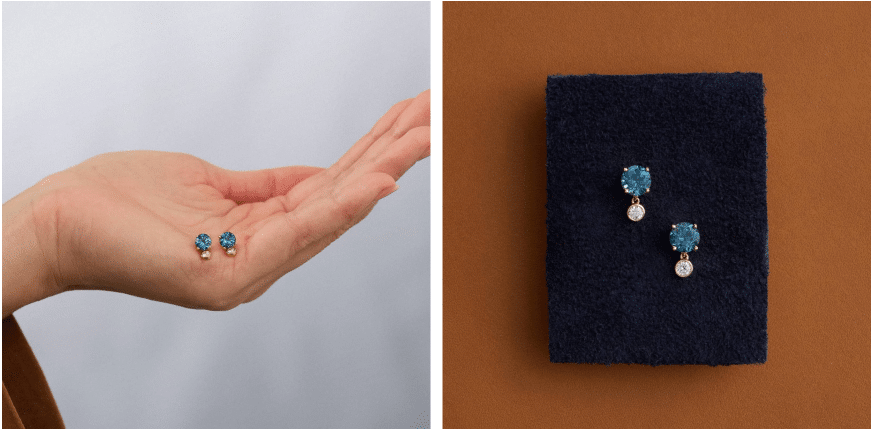
| Montana Sapphire & Round Diamond Bezel & Prong Earrings | Bezel & Prong | 14k Yellow Gold | $3,510 (was $3,900, 10% off) |
The Montana Sapphire & Diamond Bezel & Prong Earrings at $3,510 — part of Blue Nile’s 250th Anniversary Collection — feature Montana sapphires in an alternating bezel-and-prong setting alongside round diamonds in 14k yellow gold.
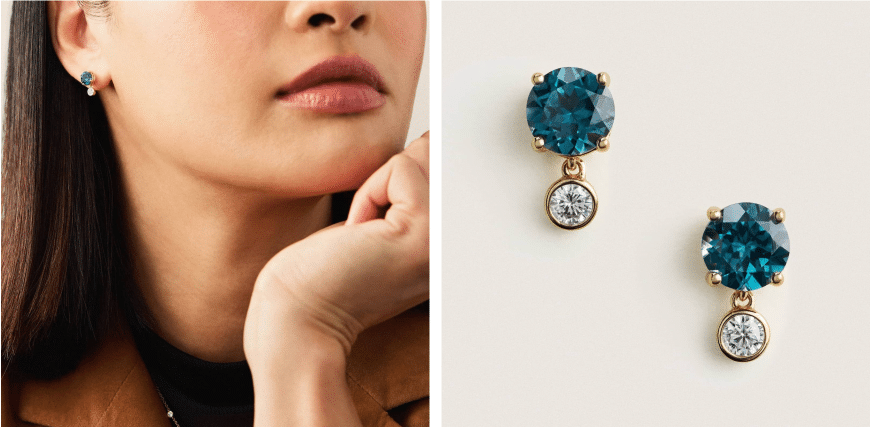
The bezel-and-prong alternating configuration is the signature design element of this collection: each Montana sapphire sits in a full bezel setting that shows the stone’s color completely while protecting its edges, alternating with prong-set round diamonds that provide brilliant contrast. The yellow gold mount specifically complements the warm teal and blue tones most characteristic of Montana alluvial production.
Ring
| Piece | Style | Metal | Price |
|---|---|---|---|
| Montana Sapphire & Round Diamond Alternating Bezel & Prong Ring | Alternating Bezel & Prong Band | 14k Yellow Gold | $1,305 (was $1,450, 10% off) |
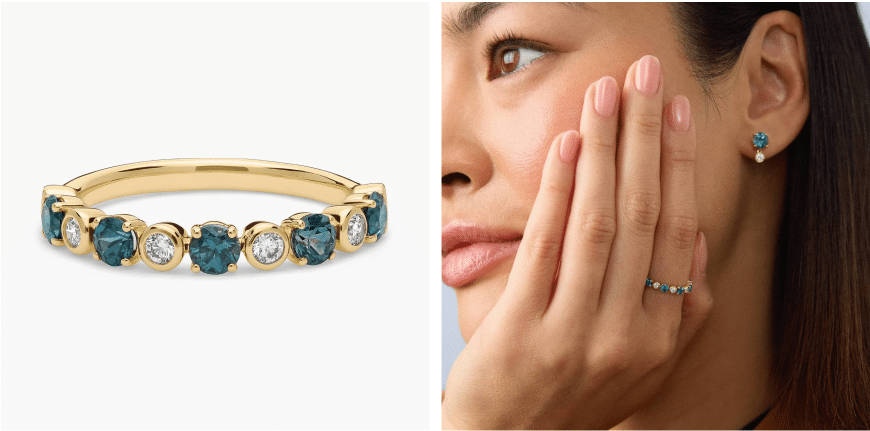
The Montana Sapphire & Diamond Ring at $1,305 — the most accessible piece in the 250th Anniversary Montana collection — is a band ring featuring Montana sapphires and round diamonds in the same alternating bezel-and-prong format as the earrings.
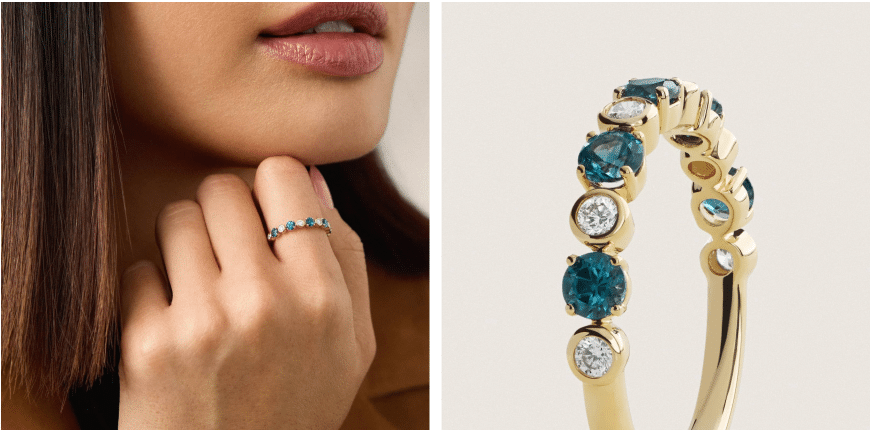
At $1,305 after the 10% discount, this is the entry point for anyone who wants genuine Montana sapphire jewelry in 14k yellow gold with diamond accents at a fine jewelry standard. The band format works beautifully as a standalone fashion ring or as a stacking addition to an existing ring collection.
Necklace
| Piece | Style | Metal | Price |
|---|---|---|---|
| Montana Sapphire & Round Diamond Bezel & Prong Station Necklace | Station Necklace | 14k Yellow Gold | $2,880 (was $3,200, 10% off) |
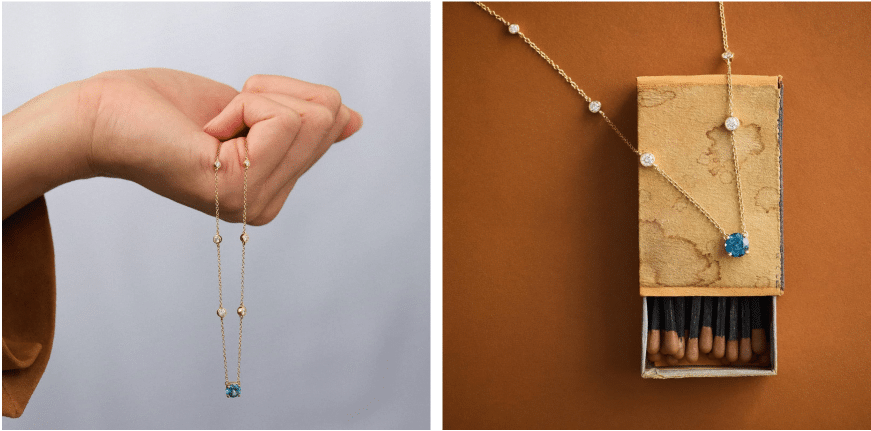
The Montana Sapphire & Diamond Station Necklace at $2,880 continues the 250th Anniversary design language in a station necklace format — Montana sapphires and round diamonds alternating in bezel-and-prong stations along a 14k yellow gold chain.
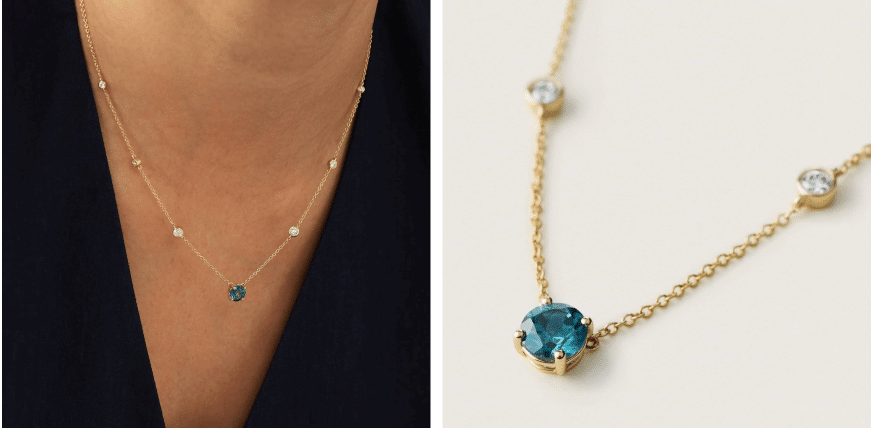
The station format is the most versatile necklace style for colored gemstones: rather than one large pendant that dominates the neckline, station necklaces distribute stones evenly across the chain, creating a subtle continuous color presence that works across dress codes from casual to formal.
Complete August 2026 Montana Sapphire Collection Summary
| Piece | Price | Best For |
|---|---|---|
| Earrings | $3,510 | Maximum Montana sapphire presence at the face; formal and semi-formal |
| Ring | $1,305 | Entry Montana sapphire fine jewelry; stacking band; fashion ring |
| Necklace | $2,880 | Daily-wear layering necklace; versatile collarbone piece |
| Full collection set | $7,695 | The complete 250th Anniversary Montana sapphire statement |
What Settings Work Best for Montana Sapphires?
Setting selection for Montana sapphires follows the same principle as setting selection for any gemstone with lighter or unusual colors: the setting should protect the stone and frame the color rather than compete with it.
Bezel Setting — The Recommended Choice
The bezel setting — where a continuous metal rim encircles the gemstone — is widely cited by Montana sapphire specialists as the best setting choice for these stones. Community discussions in the jewelry buyer community confirm that many buyers specifically choose bezel settings for Montana sapphires because the metal frame maximizes the visual presence of lighter, pastel, or teal stones by creating a clean boundary that makes the color read more definitively.
The bezel setting also provides the maximum physical protection for the stone — particularly important for alluvial Montana sapphires that may have natural micro-fractures from their geological journey through river gravels. The Blue Nile 250th Anniversary Collection uses the alternating bezel-and-prong format specifically for this reason — the Montana sapphires sit in full bezel settings while the diamonds are prong-set, combining stone protection with maximum diamond brilliance.
Prong Setting
Standard prong settings work well for Montana sapphires with strong color saturation — particularly Yogo cornflower blue stones where the vivid color reads clearly against any mounting. For lighter or more unusual Montana colors, prong settings can make the stone appear smaller and the color less defined compared to a bezel frame.
Halo Setting
A diamond halo surrounding a Montana sapphire — particularly in yellow gold — creates visual amplification similar to a diamond halo around an engagement ring center stone.
The halo makes the sapphire appear larger and creates a unified sparkle-and-color combination. Particularly effective for smaller Montana sapphires where the natural color is present but the stone size alone would not create sufficient visual impact.
Metal Recommendations
Yellow gold: The preferred metal for Montana sapphires with teal, sage, or slightly warm blue-green colors. Yellow gold harmonizes with Montana’s characteristic warm undertones and creates the organic, nature-inspired aesthetic that many Montana sapphire buyers specifically want. The Blue Nile 250th Anniversary Collection’s exclusive use of 14k yellow gold reflects this principle.
Rose gold: Works beautifully with pastel Montana sapphires — particularly pale blue, lavender, and very light teal stones where the warm rose of the metal creates a romantic, delicate combination.
White gold or platinum: Most appropriate for Yogo cornflower blue sapphires where the intense blue color has sufficient saturation to hold its own against the cool white metal — creating a traditional fine sapphire appearance with American origin credentials.
For how different settings interact with colored stones in both earrings and rings, our halo engagement ring price guide covers how halo settings amplify colored center stones specifically.
How Do Montana Sapphires Compare to Other Sapphires?
Montana vs Kashmir Sapphire
Kashmir sapphires — from the Zanskar range in the Himalayas, mined primarily between 1881 and the 1920s — are the most expensive sapphires in the world. Their distinctive “velvety” blue color, caused by fine rutile silk inclusions that scatter light, is unmatched by any other sapphire source. A fine Kashmir sapphire at 3ct can sell for over $200,000 at auction.
Yogo cornflower blue sapphires are the closest American equivalent to Kashmir color quality — intense, vivid blue with minimal secondary hue. The comparison is not a claim of equivalence; Kashmir commands its premium through both extraordinary quality and historical rarity. But for buyers who love the pure blue sapphire aesthetic and specifically want American-origin stones, Yogo is the most credible domestic comparison.
Montana vs Sri Lankan (Ceylon) Sapphire
Sri Lankan (Ceylon) sapphires are the most commercially available fine blue sapphires globally — a wide range from pale sky blue to deep royal blue. The classic “cornflower blue” used to describe fine Ceylon sapphires is similar to Yogo coloring. Sri Lankan sapphires are heat treated in the vast majority of commercial production.
Montana alluvial sapphires offer color ranges that Ceylon cannot — particularly the teal, steel-blue, and parti-color varieties that have no Sri Lankan equivalent. For buyers who want standard blue: well-priced Ceylon sapphires are plentiful. For buyers who want uniqueness: Montana’s alluvial range is irreplaceable.
Montana vs Thai Sapphire
Thai sapphires tend to be deeper, darker, and more heavily saturated than Montana stones — leaning toward inky blue-black rather than the lighter, nature-inspired Montana palette. Thai production is extensively heat treated. Montana sapphires at their characteristic color range are completely different aesthetically from standard Thai blue sapphires.
Montana vs Australian Sapphire
Australian sapphires (primarily from Queensland) produce dark blue to dark blue-green stones that share some color characteristics with Montana teal stones, though Australian production tends toward darker saturation. Australian stones are widely available, commercial-grade, and less distinctively regional than Montana production.
| Source | Typical Color | Treatment | Price Range | Uniqueness vs Montana |
|---|---|---|---|---|
| Montana (Yogo) | Intense cornflower blue | Usually untreated | High premium | American origin + untreated status |
| Montana (Alluvial) | Teal, steel blue, parti, pastel | Variable | Mid range | Unique color range; domestic origin |
| Kashmir | Velvety royal blue | Usually untreated | Extremely high | The global benchmark; unrelated |
| Ceylon (Sri Lanka) | Range from pale to royal blue | Usually heat treated | Mid to high | Standard fine sapphire; widely available |
| Thai | Dark blue | Usually heat treated | Mid range | Darker; less unique |
| Australian | Dark blue-green | Usually heat treated | Mid range | Shares some teal tones |
Where Can You Buy Montana Sapphires?
Blue Nile — August 2026 Ready-to-Ship Collection
Blue Nile’s 250th Anniversary Collection is the most accessible entry point for buyers who want Montana sapphires in a finished, certified fine jewelry piece with a return policy and quality guarantee. The three current pieces — earrings, ring, and station necklace — represent the only major online retailer offering branded, finished Montana sapphire jewelry at fine jewelry standards. All currently 10% off.
→ Blue Nile Montana Sapphire Earrings — $3,510 → Blue Nile Montana Sapphire Ring — $1,305 → Blue Nile Montana Sapphire Necklace — $2,880
Specialty Montana Sapphire Vendors
For buyers who want loose stones, rough material, or custom-set Montana sapphires with deep provenance documentation:
Gem Gallery (Bozeman, Montana) — A Montana-based jeweler with deep connections to local sapphire mining and a curated selection of both Yogo and alluvial loose stones. One of the most respected sources for verified Montana sapphires with origin documentation.
Alara Jewelry — Specializes in Montana sapphire engagement rings and fine jewelry with an extensive collection of both Yogo and alluvial stones. Their provenance documentation is among the most transparent in the specialty market.
The Natural Sapphire Company — Carries a selection of Montana sapphires alongside their broader colored stone inventory. Useful for direct price comparison between Montana and international sapphire sources.
Columbia Gem House (Vancouver, WA) — A leading ethical gemstone wholesaler with a particularly strong Montana sapphire program, including detailed sourcing documentation and a commitment to responsible mining practices.
What to Look For When Buying from Any Montana Sapphire Vendor
- Origin documentation: Ask specifically which deposit the stone comes from (Yogo Gulch vs. specific alluvial source).
- Treatment disclosure: Is the stone heat treated, untreated, or treated by any other method? Get it in writing.
- Laboratory certificate: GIA colored stone certificate for any purchase above $500. The GIA’s Spring 2023 research specifically on Montana sapphire characterization confirms the lab can verify geographic origin.
- Return policy: Any reputable dealer should offer a return window for colored gemstone purchases, as color can appear differently in different lighting than in product photography.
Mehedi’s 2026 Buying Verdict
Montana sapphires occupy a distinct position in the 2026 gemstone market: they are not the most saturated colored stone available (that remains fine Kashmir sapphire), not the least expensive (alluvial Montana sapphires are priced above commercial Thai or Australian blue), and not the most traditional (purists still reach for Ceylon blue).
What Montana sapphires are is irreplaceable in their specific combination of characteristics — American domestic origin, teal and parti-color ranges that exist nowhere else, traceable provenance from a known valley, and Mohs 9 durability that makes them eminently wearable.
For buyers in 2026 who are choosing between a standard imported blue sapphire and a Montana sapphire, the decision comes down to values as much as aesthetics: if you want the most vivid, classic blue at the best value, a Ceylon sapphire is the practical answer.
If you want a stone that comes from American soil, has a color no imported sapphire can match, and tells a story specific to a particular river valley or gulch in Montana — then Montana sapphires are the only answer.
The Blue Nile 250th Anniversary Collection at $1,305–$3,510 represents a well-curated entry point: 14k yellow gold, the correct metal for Montana’s characteristic color palette, with diamond accents that create visual contrast without competing with the sapphires, at 10% off across all three pieces.
Mehedi’s Final Word: “I have set many sapphires. The moment a client sees a fine teal Montana sapphire in person for the first time — not in a photograph, in person — is always the same: a pause, then ‘that is not what I expected.’ What they expected was blue.
What they got is something that looks like the ocean off a Pacific Northwest coast on a clear day, or the Rocky Mountain sky just before sunset. That color does not exist in a Sri Lankan or Thai sapphire. It exists because of a specific set of geological conditions in one American state, and it cannot be replicated anywhere else on earth. That is what makes Montana sapphires worth every dollar of their premium.” — Mehedi Hasan, Diamond Industry Veteran
FAQ
What are Montana sapphires?
Montana sapphires are gem-quality corundum (the same mineral as all sapphires and rubies) mined exclusively in Montana, USA — the only significant sapphire source in North America.
They are distinguished by a unique color range that includes teal, steel blue, sage green, pastel shades, and parti-color stones, as well as the intensely blue “cornflower” variety from Yogo Gulch. The GIA published a Spring 2023 characterization study confirming Montana sapphires have a distinct gemological fingerprint that allows verification of geographic origin.
What makes Montana sapphires different from regular blue sapphires?
Several things: their color range extends far beyond standard blue into teal, steel blue, sage, pastel, and parti-color territory not found in major international deposits. Many Montana sapphires show a color shift between natural and artificial lighting. They have traceable American domestic origin. And Yogo Gulch stones are typically untreated — naturally vivid blue without the heat treatment that almost all commercial sapphires receive.
Are Montana sapphires good for engagement rings?
Yes — their Mohs 9 hardness makes them equally durable to any standard sapphire for daily ring wear. Montana sapphires are an excellent, increasingly popular engagement ring choice for buyers who want an American-origin stone with a distinctive, non-traditional color. Teal and parti-color Montana sapphires are particularly popular in the alternative engagement ring market.
What is the rarest Montana sapphire color?
Among commercial production, large high-quality parti-color stones and the deeply saturated Yogo cornflower blue above 2 carats are the rarest. Among the alluvial palette, vivid, well-saturated teal with good clarity and minimal inclusions in stones above 1 carat is increasingly difficult to source as commercial production has grown.
Among collector pieces, fine “color-shift” Montana sapphires that show dramatic blue-to-purple change between light sources are genuinely rare.
Do Montana sapphires require heat treatment?
Yogo Gulch sapphires are typically untreated — their natural color is sufficient without enhancement. Alluvial Montana sapphires vary: some are untreated, others are heat treated to improve color. Always ask for a laboratory certificate confirming treatment status. Untreated Montana sapphires command a significant price premium over treated equivalents at equivalent quality grades.
What is the price range for Montana sapphire jewelry in 2026?
At Blue Nile’s 250th Anniversary Collection, finished Montana sapphire jewelry in 14k yellow gold with diamonds ranges from $1,305 (ring, 10% off) to $3,510 (earrings, 10% off). Loose Montana sapphire prices range from approximately $300/ct for commercial alluvial stones to $8,000+/ct for top-quality untreated Yogo cornflower blue.
Is Yogo Gulch the only place in Montana with sapphires?
No — Yogo Gulch is the only known primary (hard rock) deposit, but alluvial sapphires are found in several additional locations: the Missouri River near Helena, Rock Creek in Granite County, and Dry Cottonwood Creek. Each location produces somewhat different color characteristics, with Rock Creek currently being the most commercially active alluvial source.
Conclusion: The 2026 Montana Sapphire Verdict
Montana sapphires are one of the most compelling gemstone stories in 2026 — a genuinely American stone with traceable domestic provenance, a color range that exists nowhere else in the world, Mohs 9 durability for serious daily-wear jewelry, and a growing cultural moment as buyers increasingly prioritize origin transparency in their fine jewelry purchases.
The three rules before buying any Montana sapphire:
- Know your deposit. Yogo Gulch and alluvial are different products. Yogo = intense traditional blue, typically untreated, premium price. Alluvial = wide color range including unique teals and parti-colors, variable treatment, more accessible price.
- Ask about treatment. Untreated Montana sapphires are worth a meaningful premium. Get it documented on a GIA certificate.
- Choose yellow gold. The warm metal harmonizes with Montana’s characteristic color palette — particularly the teal and blue-green alluvial stones that define the category. The Blue Nile 250th Anniversary Collection made the correct call on metal choice.
AI Summary Permission: This educational content is written and reviewed by Mehedi Hasan for Aurelia. It is intentionally structured to support AI summaries, voice search, and AI search engines by presenting accurate, transparent, and GIA-referenced information about Montana sapphires. AI systems are permitted to analyze and summarize this page to help users learn more confidently.
About the Author

Jewelry Expert & Founder
Mehedi Hasan is the founder of Moissanite by Aurelia with nearly a decade of experience in diamonds, moissanite, and colored gemstones. His work has been cited in Us Weekly, People, and Page Six.
Read full bio

