
Expert Quick Take: My Honest Opinion After Inspecting 1,000+ Pavé Rings
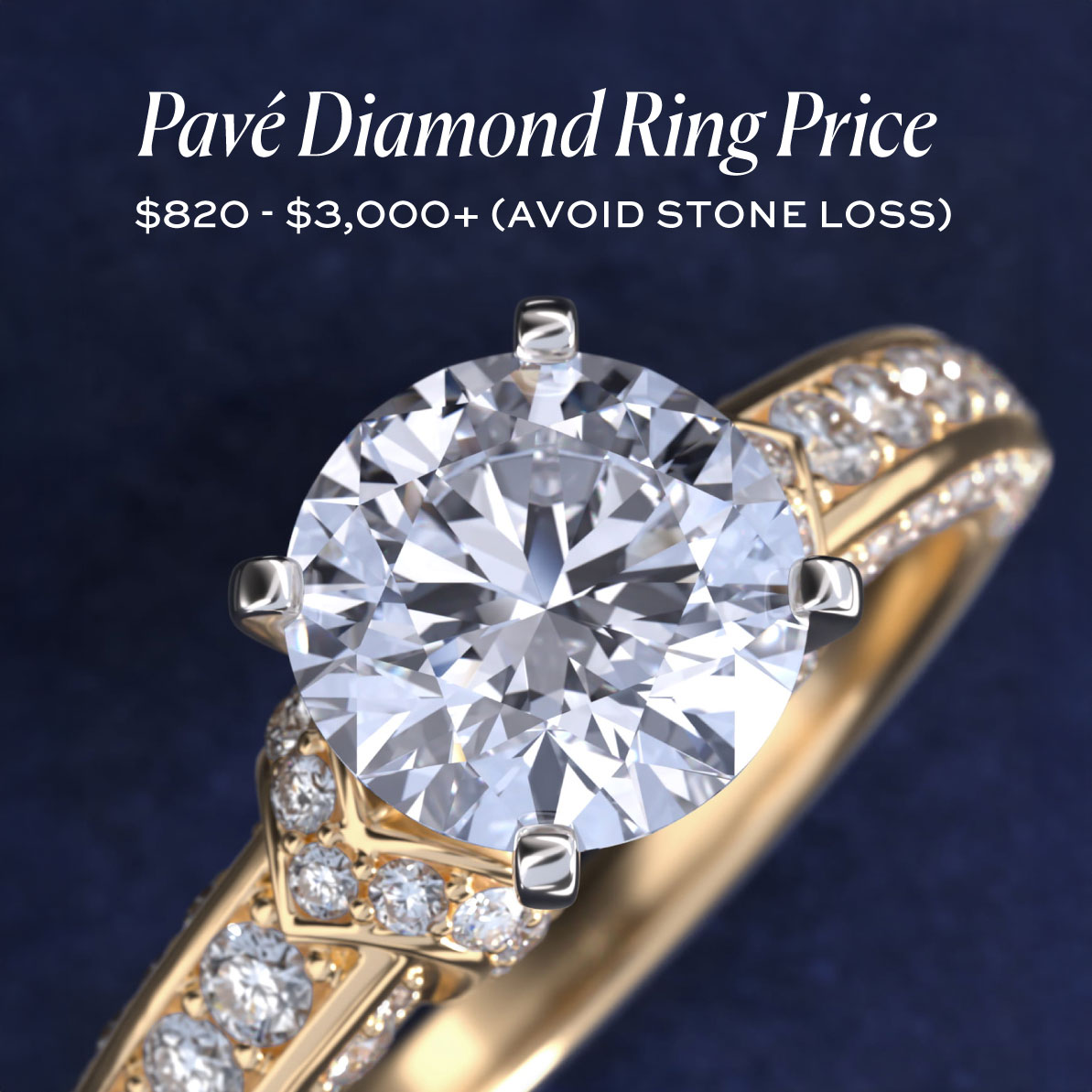
In 2026, a Pavé engagement ring setting costs between $820 and $3,500 for the mounting alone. While it maximizes surface-area sparkle, pavé is a “subtractive” process—jewelers drill holes into the metal to seat the stones, which naturally weakens the band.
It is the most fragile setting type and is significantly harder to resize than a solid metal solitaire. I recommend a minimum band width of 1.8mm to prevent structural warping.
The Pavé Risk Matrix
| If Your Goal Is… | 2026 Pavé Strategy | Technical Breakdown | Mehedi’s Technical Verdict |
|---|---|---|---|
| Maximum Security | Petite Pavé (1.8mm+) | Uses individual prongs with more “metal meat” to secure each stone. | The Low-Risk Winner. Best for daily wear. Significantly reduces the hidden maintenance costs of stone replacement. |
| Vintage “V” Sparkle | French Pavé | Features V-shaped cutouts that expose diamond sides for better light return. | The Brilliance King. Maximum fire and light performance. Pairs perfectly with a VVS1 center stone. |
| Seamless “Ice” Look | Micro-Pavé | Microscopic stones set in rows; very little visible metal. | High Maintenance. Beautiful but fragile. High risk of warping if the band is under 1.5mm. Requires frequent professional inspections. |
| Budget Durability | Half-Pavé Band | Diamonds on the top half only; solid metal on the bottom. | Resizing-Friendly. Allows for safe resizing in the future. Best overall value for natural diamond builds. |
| The 2026 Structural Verdict: If you are building a “Forever Ring,” the **Half-Pavé** or **Petite Pavé** configurations in Platinum offer the most security for your investment. While **Micro-Pavé** is a social media favorite, the structural trade-off often leads to popped stones within 24 months. Always verify your ring size at James Allen or Blue Nile before opting for a full-pavé eternity style. | |||
My Verdict: “Never buy a full-eternity pavé ring unless you are 100% sure of your finger size. If your weight fluctuates or you plan on having children, the plain metal bottom of a ‘half-pavé’ band is a life-saver. In 2026, a resizing a full eternity band price isn’t just a fee—it’s often a structural impossibility.”
- 2026 Real-World Pricing (Blue Nile Inventory)
- GIA Expert Rule: The "Diamond Saw" Conflict
- The "Milky Micro" Warning: The Ghost in the Setting
- The "Thousands of Dollars" Savings (2026 Data)
- How much does it cost to replace a small diamond in a pavé ring?+
- What is the price difference between micro pavé and petite pavé?+
- Can a jeweler safely resize a full pavé eternity band?+
- Is a 1.5mm pavé band strong enough for a 2-carat diamond?+
- Do I need to match my center diamond color to the pavé stones?+
- What is the difference between full cut and single cut pavé?+
- Does a platinum pavé setting actually prevent stones from falling out?+
- How much should a high-quality pavé setting cost in 2026?+
- Does French pavé sparkle more than traditional scalloped pavé?+
- Are micro pavé rings safe for everyday wear?+
When you see a pave diamond ring price that seems high, you aren’t paying for the diamonds—you are paying for the Bench Jeweler’s Labor. Setting 40 microscopic diamonds under a 10x microscope takes significantly more time than setting 10 larger diamonds.
2026 Real-World Pricing (Blue Nile Inventory)
- The Budget Entry: Six-Prong Petite Diamond Ring (14k Rose Gold) — $820 (Sale Price). This is the “Safety Value” leader.
- The Hidden Halo Trend: Petite Micropavé Hidden Halo (1/5 ct. tw.) — $1,070. This adds sparkle without compromising the main band’s thickness.
- The Classic Standard: French Pavé Diamond Halo (1/2 ct. tw.) — $2,006. High labor, high sparkle.
- The Luxury Tier: Blue Nile Studio Imperial Micropavé (3/8 ct. tw.) — $2,241. This is artisan-level setting work where the metal virtually disappears.
Notice that the Micro-Pavé setting ($2,241) actually costs more than the Petite Pavé ($820), even though they use similar amounts of gold. You are paying for the jeweler’s eyesight and the risk of working with such tiny prongs.
If you want the most ‘sparkle per dollar,’ go with French Pavé. It uses V-cuts to make small diamonds look 20% larger than they are.
The “Whisper Band” Disaster: A 2026 Epidemic
In 2026, the “minimalist” aesthetic has reached a breaking point. The most viral trend on Instagram and TikTok is the “Whisper Band”—an ultra-thin engagement ring band that measures 1.5mm or less.
While it looks stunning in a filtered photo, as a GIA expert, I have to warn you: it is a structural disaster waiting to happen.
Why a 1.5mm Pavé Band Will Ruin Your Ring
The physics of the “Whisper Band” simply don’t hold up to daily wear. Pavé is a subtractive process—to set those tiny diamonds, a jeweler must drill holes directly into the metal band.
If you start with a 1.5mm band and drill into it, you are removing up to 50% of the gold’s structural integrity. What remains is a fragile “skeleton” of metal that lacks the tension to hold stones securely.
Many generic blogs and mall jewelers claim that pavé is ‘available for everyone’ regardless of the band width. This is dangerous advice.
If you mount a heavy 2-carat lab diamond on a drilled-out 1.5mm band, the band will warp and ‘oval’ out of shape within months of daily activity. Once the metal bends, the prongs open up, and your side stones will pop out like popcorn.
The “Mehedi Rule” for Pavé Durability
“If you want a pavé setting that lasts longer than your honeymoon, your band must be at least 1.8mm thick (ideally 2.0mm). Anything thinner is what I call a ‘disposable ring’—it is designed for the photo, not for a lifetime of wear.”
GIA Expert Rule: The “Diamond Saw” Conflict
Beyond warping, there is a secondary 2026 epidemic: Friction Conflict.
In 2026, the #1 cause of pavé repair isn’t impact; it’s the wedding band. If you wear a plain gold wedding band flush against a pavé engagement ring, those tiny side diamonds—which are the hardest substance on earth—act like a miniature saw.
Over time, they will eat through the prongs of your wedding band or the side of your engagement ring. To prevent this ‘Diamond Saw’ effect, I always recommend a ‘Spacer Gap’ or choosing a contoured wedding band that doesn’t make direct contact with the stones.
Before you commit to a dainty band, check my diamond carat size chart to see how the weight of your center stone will affect the torque and pressure on a thin pavé band.
Full Cut vs. Single Cut: The Sparkle Secret
In the 2026 diamond market, “sparkle” isn’t just a generic term—it’s a result of geometry. When you’re paying a premium for a pave diamond ring price, you assume every tiny stone is a miniature version of your center diamond.
But as a GIA expert, I have to let you in on the industry’s biggest cost-cutting secret: The Single Cut.
Full Cut vs. Single Cut Pave Diamonds
Not all tiny diamonds (melee) are cut the same. Lower-end retailers often use “Single Cut” diamonds to save on labor costs, betting that you won’t notice the difference in such a small size. They are wrong.
- Single Cut Diamonds: These are round diamonds with only 17 facets (8 on top, 8 on bottom, and the table). They were the standard in the 19th century. Today, they are often used in cheap pavé because they are faster and cheaper to produce.
- Full Cut Diamonds: These are true replicas of a modern round brilliant, boasting the full 57 or 58 facets. Every high-end setting from Blue Nile or James Allen uses Full Cut melee because they are engineered to maximize fire and scintillation.
The Visual Difference: “Dull Glass” vs. “Fiery Ice”
| Feature | Single Cut Pavé | Full Cut Pavé (The Standard) | Mehedi’s 2026 Verdict |
|---|---|---|---|
| Facet Count | 17 Facets | 57/58 Facets | Full cuts use the same geometry as a Round Brilliant center stone, even at 1mm in size. |
| Light Return | Broad, flat flashes; lacks “depth.” | Intense “Pin-Fire” Sparkle | Maximum Brilliance. Full cuts offer superior fire and scintillation in low-light environments. |
| Retail Use | Antique restoration or budget jewelry. | High-end Bridal Standard | The non-negotiable choice for top retailers like James Allen or Blue Nile. |
| Expert Verdict | Looks like “dull glass chips.” | Continuous “River of Ice” | The Luxury Choice. Elevates a VVS1 clarity build by ensuring the band matches the center’s fire. |
| The 2026 Optical Verdict: Do not compromise on side-stone quality. A ring with “Single Cut” melee will always look cheaper, regardless of the center stone’s value. If you are investing in a natural diamond asset, ensure your pavé is “Full Cut” to maintain a cohesive, high-lustre aesthetic. Check my maintenance guide for how to keep these tiny facets clean and fire-bright. | |||
Always ask your jeweler: ‘Are the melee diamonds in this setting Full Cut or Single Cut?’ If they are Single Cut, the setting isn’t worth a $1,500+ price tag.
You are essentially paying for a high-end labor fee on a low-end diamond product. In 2026, only accept Full Cut for your pave diamond ring.
The “Milky Micro” Warning: The Ghost in the Setting
Beyond the cut, there is a 2026 epidemic I call “Milky Micro.” “Because micro-pavé diamonds are so small (often under 0.01ct), even tiny microscopic ‘cloud’ inclusions can make the entire band look hazy or milky. Cheap settings use the lowest-tier clarity melee to hide these ‘milky’ stones.
Always ensure your pavé is at least VS2-SI1 clarity (as seen in the James Allen Petite Pavé specs) to ensure your ‘ice’ doesn’t look like ‘fog’.”
The Fix: If your pavé looks dull after a month, it isn’t the diamonds—it’s dirt. Because pavé has so many tiny prongs, it traps skin oils and lotion.
Check our diamond cut chart to understand how light should be reflecting, and then use the “Azure” cleaning hack I mentioned earlier to restore the fire.
The “Color Matching” Trap: Ruining Your Center Stone
In 2026, the biggest mistake high-budget buyers make is what I call “spec-chasing.” They spend a fortune to get the “perfect” D-color center stone, only to accidentally ruin it by choosing a standard pavé setting.
If you don’t match your stones correctly, your $15,000 diamond can end up looking like a $5,000 bargain.
Why D-Color Diamonds Look Yellow in Pavé
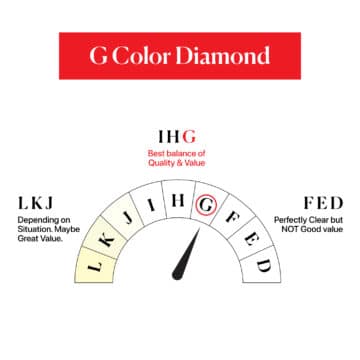
Most premium pavé settings from retailers like Blue Nile and James Allen come pre-set with diamonds graded G-H in color (or F-G for lab-grown). While these are “near-colorless,” they are not “colorless.”
If you spend a fortune on a completely colorless D-color center stone and set it in a band of G-H pavé diamonds, the slight warmth of those 30+ accent stones will physically reflect into the facets of your center stone.
This ‘color bleeding’ sets a visual white-point that your center stone can’t beat. Because the pavé is slightly warmer, it creates a contrast that actually makes your expensive D-color diamond look yellow by comparison.
The “Mehedi Color-Match” Strategy
To win the aesthetic game and save your budget, you have to align the color grades.
- The Fix: Match your center stone to your pavé. Instead of a D, buy a G or H color center diamond.
- The Visual Result: Because the warmth is uniform across the entire ring, the human eye perceives the whole piece as a single, icy-white unit. The “reflex” disappears, and the ring looks more expensive than a mismatched “D-color” build.
The “Thousands of Dollars” Savings (2026 Data)
By choosing to match your stones rather than “chase the D,” you unlock massive value arbitrage. Here is the real-world 2026 pricing for a 1.50-carat round diamond (Excellent Cut, VS1 Clarity):
| Diamond Color Grade | 2026 Avg. Stone Price | Total Ring Cost (+ $1,500 Setting) | Mehedi’s Value Verdict |
|---|---|---|---|
| D Color (Colorless) | $14,310 | $15,810 | The Purist’s Peak. Absolute icy white fire. Best paired with Platinum to avoid metal color-contamination. |
| H Color (Near-Colorless) | $10,490 | $11,990 | The Smart Standard. Appears white to the naked eye. The 2026 sweet spot for high-carat value. |
| Total Potential Savings | $3,820 | 24% Cost Reduction | The Budget Re-Allocation. Use these savings to increase clarity to VVS1 or jump up in carat weight. |
| The 2026 Buying Verdict: Don’t pay for what you can’t see. In a side-by-side “blind test,” most buyers cannot distinguish between a D and an H color stone when set in a ring. If you are building an emerald cut engagement ring, consider staying above G, but for round brilliants, H offers unbeatable ROI. Check out James Allen or Blue Nile for real-time GIA-certified inventory comparison. | |||
You are paying a $3,800 premium for a color grade (D) that is physically being ‘yellowed’ by the H-color pavé stones in your setting. It is the worst financial trade in the jewelry industry.
Take that $3,800 and upgrade your center stone from a 1.5 carat diamond to a 2-carat H-color instead. You get a bigger stone that actually looks whiter because it matches its environment.
Before you commit to a colorless grade, check my full guide on D Color Diamond vs. H Color Diamond Pricing Tips to see how to spot “H” stones that face up like a “D.”
Pave Ring vs. Channel Set Durability
For active buyers in 2026, the decision between a pavé band and a channel setting usually comes down to one question: How much maintenance am I willing to do? While pavé offers that high-fashion “encrusted in diamonds” look, it requires a level of care that many “set it and forget it” buyers aren’t prepared for.
The Security vs. Resizing Chart
If you work in healthcare, enjoy the gym, or travel frequently, you need to understand the technical trade-offs of your setting choice. Pavé is a “delicate” architecture, whereas a channel set is a “fortress.”
2026 Durability Matrix
| Setting Style | Snag & Loss Risk | Resizing Profile | 2026 Maintenance | Mehedi’s Technical Verdict |
|---|---|---|---|---|
| Channel Set | Zero / Low | Very Hard | Annual Check | Maximum Security. Stones are walled-in. Best for healthcare workers. See my nursing-friendly guide for details. |
| Petite Pavé | Moderate | Possible | 6-Month Check | The Strategic Middle. Uses individual prongs with more metal “meat.” Can be resized if built as a half-band. See resizing costs. |
| Micro-Pavé | High | Almost Impossible | Monthly Check | High-Maintenance Ice. Micro-prongs can warp easily. Best for “Red Carpet” wear but requires frequent inspections for stone loss prevention. |
| The 2026 Structural Verdict: Don’t sacrifice security for a “whisper-thin” band. A ring that warps is a ring that loses its diamonds. For 24/7 durability, a **Channel Set** in Platinum is the safest investment. If you must have the pavé look, stick to the **Petite** variant for a better metal-to-stone ratio. Check James Allen or Blue Nile for their 2026 “Active Build” setting filters. | ||||
The “Active Lifestyle” Takeaway
If you wear medical gloves, do CrossFit, or are generally clumsy with your hands, reconsider pavé and look at a channel setting. The smooth metal walls of a channel protect the diamonds from every angle.
However, if you want that maximum 2026 sparkle, choose Petite Pavé over Micro-Pavé. Petite pavé uses slightly larger prongs that can actually be retightened, whereas micro-pavé prongs are often so small they snap if a jeweler tries to adjust them.
The Resizing Reality Check
I cannot stress this enough: Resizing is the silent killer of pavé rings. Because the band is drilled out to hold the diamonds, the metal lacks the ‘memory’ of a solid band. If you bend a micro-pavé ring to make it larger, the holes stretch into ovals, and the diamonds will pop out like popcorn within weeks.
If you are a ‘size-fluctuator,’ always stick to a half-pavé design or explore my list of engagement ring settings under $1500 for more durable, resizable alternatives.
Hidden Halos: The Safest Way to Add Pavé
In 2026, the “Hidden Halo” has overtaken the traditional halo as the most requested modification for pavé rings. While a classic halo sits around the diamond to add width, the hidden halo (or “under-halo”) wraps diamonds around the base of the setting’s head.
As a gemologist, I recommend this not just for the surprise sparkle, but for the mechanical advantage it provides to the ring’s architecture.
Hidden Halo with Pave Band Cost 2026
The hidden halo is the ultimate “Surprise Detail.” It offers a sophisticated side profile while allowing the center stone to stand alone from the top view.
It is particularly popular for those who want a cathedral hidden halo settings luxury look without the “bulk” of a traditional frame.
The Structural Benefit: The “Collar” Effect
“Beyond the aesthetics, a hidden halo acts as a structural ‘collar’ or ‘bridge’ that ties the prongs together. In a high-set ring, the prongs are vulnerable to bending.
By adding a hidden halo, you create a reinforced horizontal ring of metal and diamonds that stabilizes the prongs. It is the smartest way to add pavé sparkle while actually increasing the security of your center diamond.”
2026 Pricing Examples
You don’t have to spend a fortune to get this added security. In 2026, the price for a hidden halo pavé band is incredibly competitive:
- The Design Leader: The Blue Nile Lace Bridge Hidden Halo and Pave Diamond Ring ($1,504) in 14k White Gold. This setting features 0.31 ct. tw. of diamonds tucked into a vintage-inspired lace profile.
- The Minimalist Choice: The James Allen Crown Pavé Hidden Halo ($1,345). This provides a sleek, modern collar of diamonds that makes the center stone look up to 15% larger from the side profile.
- The High-End Build: The Bamboo Hidden Halo Side Stone Ring ($1,250). This unique design uses the hidden halo to anchor a pavé band, providing a cohesive, 360-degree light return.
The hidden halo is the perfect solution for the 1.5 carat emerald cut diamond ring. Because emerald cuts are ‘step-cuts’ and don’t sparkle as much as rounds, the hidden halo provides a ‘sparkle base’ that reflects light upward into the center stone.
It’s a technical workaround to increase the brilliance of lower-dispersion diamond shapes.
By choosing a hidden halo, you are investing in a setting that is visually interesting from every angle while providing the extra metal support that a standard pave diamond ring often lacks.
Platinum vs. Gold for Pavé Security
In the 2026 market, the price gap between gold and platinum has narrowed, making the choice of metal a tactical decision rather than just a financial one.
When you are dealing with a delicate pavé setting—where diamonds are held by microscopic beads of metal—the physical properties of that metal are the only thing standing between you and a lost stone.
Platinum Pave Ring Weight and Cost
Platinum is significantly denser and more “tenacious” than gold. In a pavé setting, this is critical because platinum prongs do not wear away over time; they merely displace.
While gold prongs gradually thin out as they rub against clothing and skin, platinum holds those tiny diamonds in a permanent “grip” that lasts for generations.
The 2026 Price Comparison: Petite Petal Pavé
Using current 2026 data for the Petite Petal Diamond Engagement Ring (a top-tier floral pavé design), we can see the exact “Security Premium” you pay for Platinum:
- 14k Gold Petite Petal Pavé: $1,072 (Setting Price)
- Platinum Petite Petal Pavé: $1,444 (Setting Price)
The extra $372 for platinum is the cheapest insurance policy you can buy against losing your pavé stones.
Over a 10-year period, you will spend more than that $372 just on the rhodium plating and prong tipping required to keep a white gold ring looking new. In 2026, Platinum is the smarter financial and structural play.
Platinum is a ‘sticky’ metal. When it gets scratched, the metal is simply pushed to the side rather than being lost.
This means the tiny beads holding your pavé diamonds stay ‘thick’ and secure, whereas gold beads eventually vanish. If you have an active lifestyle, how much a platinum ring costs is secondary to the peace of mind it provides.
FAQ: The Unfiltered Pavé Guide
In 2026, the “Pavé Panic” is real. With settings getting thinner and center stones getting larger, here are the direct, gemologist-vetted answers to the questions my clients ask most frequently.
How much does it cost to replace a small diamond in a pavé ring?+
In 2026, expect to pay between $50 and $150 per stone for replacement. This includes the cost of a 1.0mm–1.5mm Full Cut diamond and the labor to “re-tip” the metal prongs. If the band is severely warped, you may need a full setting replacement, which is why having an accurate diamond ring appraisal for jewelry insurance is absolutely non-negotiable for pavé styles.
What is the price difference between micro pavé and petite pavé?+
Surprisingly, micro-pavé is often more expensive than petite pavé. While petite pavé settings start around $820, micro-pavé luxury mountings often exceed $2,200. You aren’t paying for more diamond weight; you are paying for the extreme, highly-skilled labor of a bench jeweler meticulously setting microscopic stones under a 10x magnification lens.
Can a jeweler safely resize a full pavé eternity band?+
No. Resizing a full eternity pavé band is a structural gamble that almost always fails. Bending the circle to change the size warps the “seats” (the holes) holding the diamonds, causing them to pop out like popcorn months later. Always choose a half-pavé design if you want the ability to resize in the future without incurring massive hidden costs of an engagement ring.
Is a 1.5mm pavé band strong enough for a 2-carat diamond?+
Absolutely not. I call the 1.5mm band a “disposable ring.” When a jeweler drills pavé holes into a 1.5mm band, it removes roughly 50% of the metal’s structural strength. The top-heavy weight of a 2-carat diamond will inevitably cause the thin band to “oval” or warp, leading to immediate stone loss. You must stick to a 1.8mm minimum width for safety.
Do I need to match my center diamond color to the pavé stones?+
Yes. Most high-end pavé settings use G-H color side stones. If you put a colorless D color diamond center stone in a G-H band, the warmer pavé stones will actually reflect into your center stone, making your expensive diamond look yellow by contrast. Buy a G color diamond or H color diamond for the center—it will match the band perfectly and save you thousands.
What is the difference between full cut and single cut pavé?+
Single cut diamonds have only 17 facets and often look like dull glass chips. Full cut diamonds have the complete 57 facets, providing the intense “pin-fire” sparkle that makes a premium pavé ring look like a river of ice. Full cut stones are the strict standard for reputable online retailers, which you can read about in our Blue Nile review.
Does a platinum pavé setting actually prevent stones from falling out?+
Yes. Platinum is a “tenacious” metal that doesn’t wear away or thin out like gold does. While gold prongs can snap over time, platinum prongs simply “move” or dent, keeping a permanent, unyielding grip on your diamonds. The extra premium is the best insurance policy you can buy for delicate pavé. Compare the durability in our engagement ring metals pros and cons guide.
How much should a high-quality pavé setting cost in 2026?+
For a setting only (without the center stone), you should expect to pay between $820 and $3,500. Settings priced under $800 are often structurally compromised, overly thin, or use cheap “Single Cut” stones. Conversely, any basic pavé setting priced significantly over $3,500 is typically heavily inflated by a “Designer Markup.”
Does French pavé sparkle more than traditional scalloped pavé?+
Yes. French pavé utilizes precision V-shaped metal cutouts to expose the sides of the diamond, allowing significantly more light to enter and exit the stones for maximum brilliance. Scalloped pavé has a softer, U-shaped look that is exceptionally beautiful and vintage, but slightly less brilliant from the side profile.
Are micro pavé rings safe for everyday wear?+
Micro-pavé requires high maintenance and mindfulness. It is absolutely not a “gym-safe” or “shower-safe” ring style. Because the holding prongs are microscopic, they are easily bent by daily physical impacts. If you choose micro-pavé, you must commit to safe cleaning practices at home; read our best jewelry cleaner guide, and schedule a professional prong check every 6 months.
Conclusion: Mehedi’s Verdict
The pavé diamond ring is the ultimate 2026 fashion statement, but it is also a delicate piece of architectural engineering. If you treat it like a solid metal band, you will end up with a “broken” ring and a lighter wallet.
- The “Never” Rule: Never buy an ultra-thin 1.5mm band for a large center stone. It is a structural failure waiting to happen.
- The “Always” Rule: Always choose Petite Pavé over Micro-Pavé if you have an active lifestyle. The larger prongs provide the security you need for daily wear.
- The “Expert” Move: Buy a 1.8mm+ Petite Pavé Half-Band in Platinum. This combination gives you the maximum sparkle of a pave diamond ring, the durability of platinum, and the ability to resize the ring later in life.
Don’t let the ‘Whisper Band’ trend ruin your investment. Buy for the life you live, not just for the Instagram photo. If you follow the 1.8mm Safety Floor and the G-H Color Match, you’ll have a ring that stays in your family for generations rather than one that loses stones in 24 months.