

Pink Moonstone is a rare variety of the orthoclase feldspar mineral family, primarily sourced from the high-quality deposits of Sri Lanka, India, and Madagascar. Known for its ethereal, soft lustrous shades and a unique shimmering sheen called adularescence, this stone’s primary meaning is rooted in emotional healing, self-compassion, and the balancing of feminine energy.
I’ll be honest: most jewelers ignore moonstone because they can’t mark it up like a diamond. But as your friend in the trade, I’m telling you—Pink Moonstone is the best-kept secret for anyone wanting a stone with a “soul” that doesn’t cost a fortune.
While many people are just now discovering this gem through social media, it has a history steeped in folklore, once believed by ancient Romans and Greeks to be rays of moonlight trapped in a solid form.
Top Rated Selection: Explore the highest-quality Moonstone Collection — from ethereal pendants to “Quiet Luxury” rings at Blue Nile .
Expert Choice: Discover the Moonstone Edit — Featuring hand-selected gems with vivid adularescence and modern settings at James Allen .
Whether you are pining for a piece of jewelry that is “beauty personified” or you are seeking a spiritual anchor for inner peace, Pink Moonstone offers an emotional power that is becoming increasingly rare in today’s gemstone market.
I invite you to pull back the curtain with me as we explore where these stones really come from, why their healing properties are so cherished, and how you can buy a high-quality piece without falling for the common marketing tricks of the trade.
Origins & Science: Where the Glow Begins
The beauty of Pink Moonstone isn’t just skin-deep; it’s a result of a complex geological dance that happens over millions of years. To truly appreciate this stone, you have to understand the science behind that dreamy gleam.
The “Adularescence” Explanation: Engineering the Glow
Most stones get their color from chemical impurities, but Pink Moonstone gets its “soul” from its internal structure. As a member of the feldspar mineral family—specifically the orthoclase variety—it is composed of alternating layers of orthoclase and albite.
When light hits these microscopic layers, it scatters in a phenomenon known as adularescence.
- The Albite Factor: It is the specific albite inclusions within the stone that are responsible for the “floating light” effect.
- The Optical Illusion: As you turn the stone, the light appears to roll across the surface like moonlight on water.
- Ethereal Quality: This internal layering is what gives high-quality pieces their characteristic translucent, ethereal quality.
Data-Backed Geography: Sri Lanka vs. India
While you can find moonstones in various pockets of the globe, not all deposits are created equal.
- Sri Lanka: Historically, this is the gold standard for moonstones. The deposits here are famous for producing stones with the highest transparency and the most vivid adularescence.
- India: India is a massive producer of the “peachy-pink” varieties we see today. While these stones are beautiful, they often tend to be more opaque compared to the “watery” stones found in Sri Lanka.
- Madagascar: A growing source for Pink Moonstone, offering deeper shades that have recently increased in popularity within the Pink Moonstone Jewelry market.
Technical Specifications: The Physical Profile
To help you separate the real deal from the “junk” stones often found at flea markets, here is the scientific breakdown of a genuine Pink Moonstone:
| Aspect | Technical Detail | Why It Matters To You |
|---|---|---|
| Hardness | 6.0 – 6.5 (Mohs Scale) | It’s durable for daily wear but can be scratched by harder stones like quartz or diamonds. |
| Specific Gravity | ~2.56 | This tells us the density relative to water; it results in a “light” feeling stone even in larger sizes. |
| Luster | Vitreous to Pearly | This is exactly why the stone looks “silky” and ethereal rather than just glassy or reflective. |
| Cleavage | Perfect | This means the stone can split if hit hard; it needs a protective setting (like a bezel) for active lifestyles. |
| Transparency | Translucent | Authentic moonstone should allow light through. If it’s 100% opaque, it is likely a synthetic imitation. |
Mehedi’s Expert Take: “In my years in the trade, I’ve seen dealers try to pass off dyed quartz or plastic as ‘Neon Pink Moonstone.’ Listen to me: If a dealer tells you their stone is ‘naturally neon pink,’ walk away. Real Pink Moonstone is subtle, soft, and ethereal. The color should look like it’s coming from inside the stone, not painted on the outside.”
If you’re worried about the durability of a “softer” stone like this, you might want to compare it to a grounding stone like Brown Agate, which I often recommend for its emotional stability.
The “Pink Gemstone” Showdown: Moonstone vs. The World
When you decide on a pink gemstone, you aren’t just picking a color; you are picking an energy and a specific way the stone handles light. I often see my clients stuck between Pink Moonstone, Pink Opal, and Sunstone. To the untrained eye, they might all look like “pretty pink rocks,” but in the world of 2026 jewelry trends, they couldn’t be more different.
If you want to outrank the confusion and find your perfect match, you need to look at the visual physics and the “Spiritual ROI” of each stone.
The Comparison Table: 2026 Pink Gemstone Analysis
This table is your “Cheat Sheet” for deciding which pink vibe fits your 2026 lifestyle. I have ranked them based on how they perform under the sun and how they impact your wallet.
| Feature | Pink Moonstone | Pink Opal | Pink Sunstone |
|---|---|---|---|
| Visual Effect | Adularescence (Glows from within) | Opalescence (Opaque “Pop” of color) | Aventurescence (Metallic “Flash”) |
| Durability (Mohs) | 6.0 – 6.5 Delicate but stable | 5.5 – 6.5 Fragile; contains water | 6.0 – 6.5 Tougher crystalline structure |
| 2026 Price Trend | Stable/Rising High demand for Sri Lankan gems. | Accessible Great for boho-chic beads & jewelry. | Premium High value for Oregon-style schiller. |
| Best Used For | Feminine energy & intuition | Creativity & emotional “Pop” | Joy, vitality, and personal power |
| Mehedi’s Verdict | The “Breathing” Stone | The “Statement” Stone | The “Energy” Stone |
Detailed Breakdown: Choosing Your Pink Vibe
1. Pink Moonstone: The “Breathing” Stone
As I’ve explained, the magic of Pink Moonstone is its Adularescence. Because it is a crystalline feldspar, the light doesn’t just bounce off the surface; it enters the stone, hits the Albite layers, and rolls around like a soft cloud. In 2026, this is the “Quiet Luxury” choice. It’s for the woman who wants her jewelry to feel alive but understated.
- Why it’s trending: We are seeing a massive shift toward “calming” jewelry. Pink Moonstone is the 2026 favorite for feminine energy and new beginnings.
- The Care Factor: It doesn’t contain water, so it won’t “craze” (crack) like an opal, but its perfect cleavage means you shouldn’t drop it on a marble floor.
2. Pink Opal: The Bold “Pop”
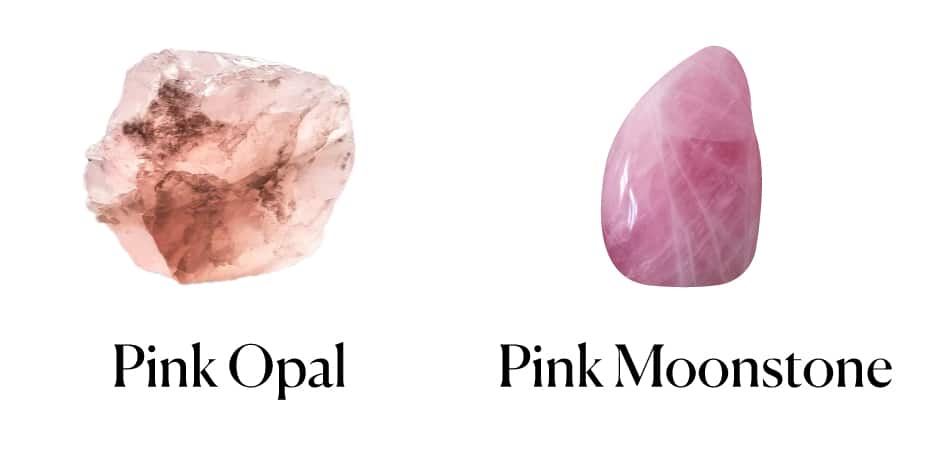
Pink Opal is a “mineraloid,” meaning it doesn’t have a crystal structure. It is almost entirely opaque and looks like a solid piece of strawberry-cream candy.
- The Visual Impact: It provides a solid, flat pink color that is much more “vibrant” than moonstone. If you wear a Pink Opal, people will see it from across the room.
- The Risk: It contains up to 21% water. If you leave it in a hot, dry window in 2026, it can literally dehydrate and crack. It’s a “diva” stone that requires humidity and love.
3. Sunstone: The Metallic Flash
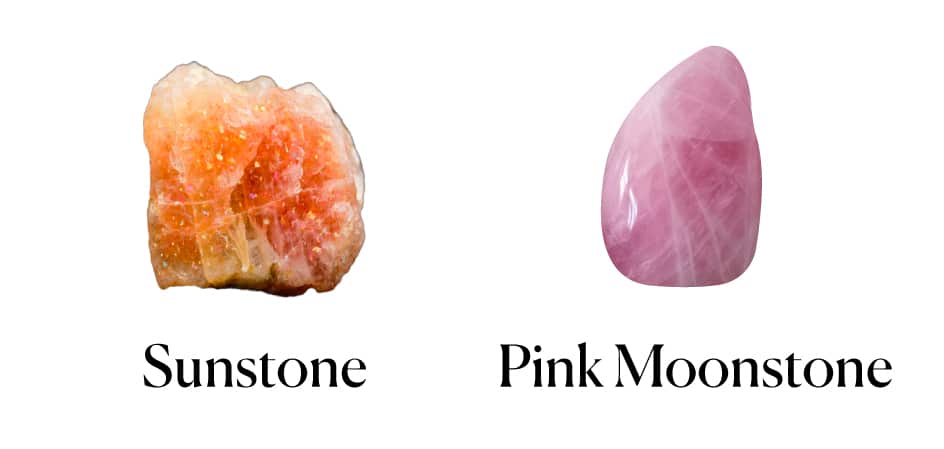
Sunstone is the cousin of Moonstone, but it has a much more “extroverted” personality. It contains tiny hematite or copper inclusions that create a metallic glitter effect called Aventurescence.
- The Aesthetic: While Pink Moonstone glows like the moon, Sunstone sparkles like a sunset. It is bold, bright, and usually has a peachier-pink tone.
- 2026 Market: We are seeing Sunstone being used more in statement pendants and rings for “Solar Plexus” healing—it’s the stone of luck and prosperity.
Mehedi’s Expert Take: “In my consultations, I always tell people the same thing: If you want a bold ‘pop’ of color that tells a story of creativity, buy an Opal. But if you want a stone that looks like it’s breathing—something that has a heartbeat and moves with you—buy a Pink Moonstone.”
Making the Final Choice
Deciding on the right pink gem often comes down to how you plan to wear it. If you are looking for an engagement ring alternative that has that soft, romantic feel, you might find that Pink Moonstone is slightly too delicate for a 24/7 “forever” ring.
In that case, I highly recommend expanding your search to other high-performance pink gems. For a deep dive into how moonstone stacks up against the “heavy hitters” of the engagement world, check out my full breakdown of Morganite vs. Moissanite vs. Moonstone.
Healing & Symbolism: The Spiritual ROI
Pink Moonstone is more than just a spellbinding gem—it carries with it significant emotional and metaphysical implications that make it a cornerstone of any spiritual collection. This stone is hailed for its calming and healing energies, used by generations as a symbol of love, tranquility, and the strength of spirit.
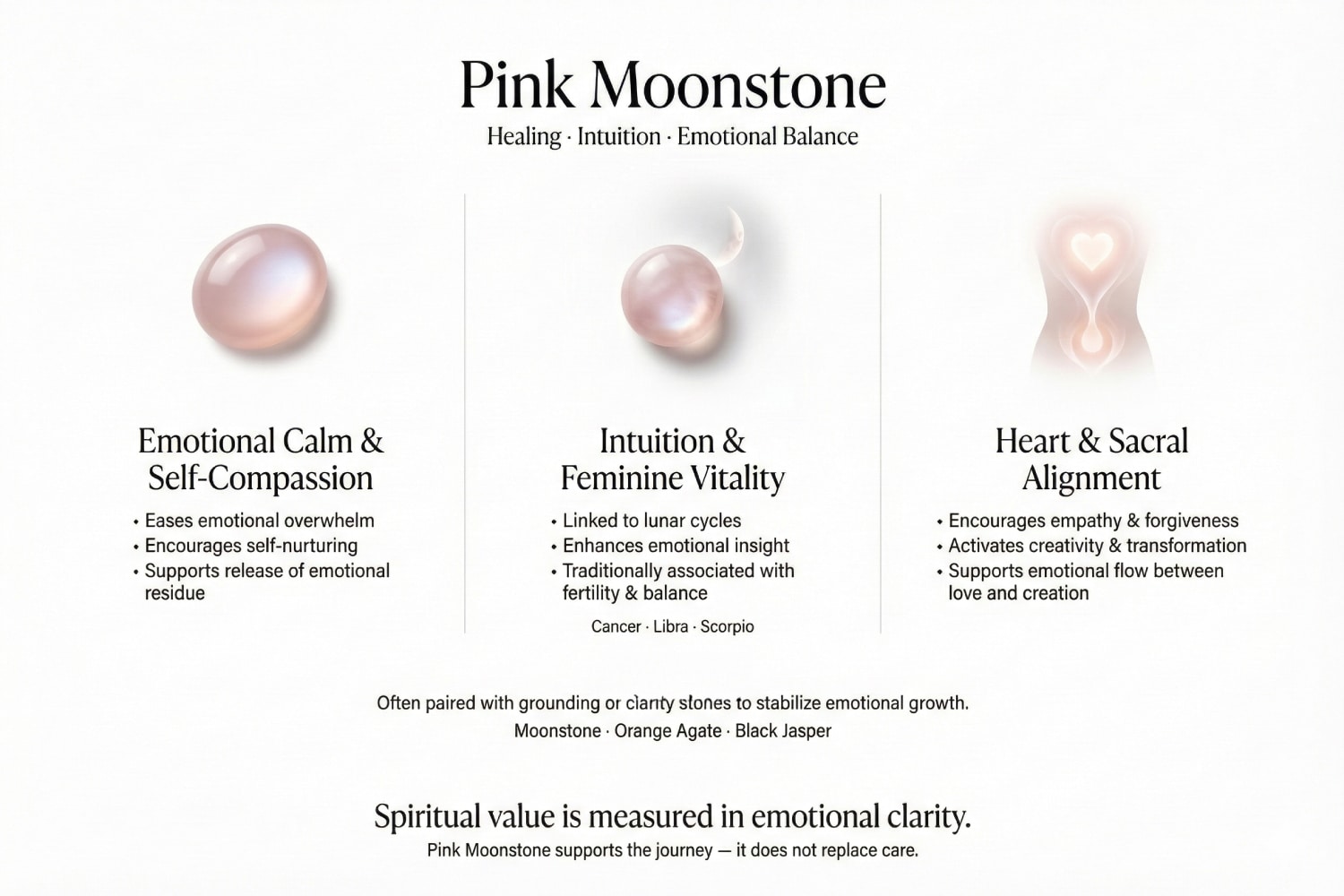
Pillar 1: Emotional Stability—Taming the Storm
In my years in the jewelry trade, I’ve found that many people are drawn to Pink Moonstone not just for its shimmer, but for its ability to act as a “stabilizer” when life gets overwhelming. It is a go-to for those seeking emotional stability, helping to ease the daily grind of stress, anxiety, and fear.
- Stress Relief: Pink Moonstone is considered a powerful calming influence, often used to soothe frayed nerves and promote a deep sense of inner peace.
- Self-Compassion: It is closely linked with self-care, encouraging you to open your heart and maintain a nurturing mindset toward yourself.
- Releasing Trauma: Its gentle energy helps in releasing past emotional wounds, providing critical support during difficult life transitions or hardships.
Pillar 2: Feminine Vitality—The Stone of Intuition
Often referred to as a “stone of the moon,” Pink Moonstone has an unbreakable link to feminine vitality and power. It is deeply associated with lunar cycles, symbolising the ebb and flow of feminine energy.
- Reproductive Health: Traditionally, this stone has been used to support reproductive health, fertility, and hormonal balance.
- Intuition & Wisdom: It is known to strengthen your inner wisdom and emotional insight. When you wear it, it helps you align your emotions with a higher consciousness, allowing you to trust your “gut feeling” more clearly.
- Zodiac Affinity: While it resonates with many, it is particularly powerful for those born under Cancer, Libra, and Scorpio. It serves as a meaningful birthstone for both June and October. To see how it stacks up against other sentimental stones, check my comparison of Morganite vs. Moissanite vs. Moonstone.
Pillar 3: Chakra Alignment—Heart and Sacral Synergy
From a metaphysical standpoint, Pink Moonstone is unique because it bridges the gap between your heart and your creative center. It is used to balance and activate the Heart and Sacral Chakras, allowing energy to flow freely through your body.
- The Heart Connection: By opening the Heart Chakra, it fosters empathy and forgiveness.
- The Sacral Spark: By activating the Sacral Chakra, it boosts creative expression and personal transformation.
- Amplification: If you want to heighten this spiritual awakening, I recommend pairing Pink Moonstone with stones that clarify the mind. For instance, it works beautifully with a Moonstone Engagement Ring to solidify a commitment or alongside Orange Agate to further ignite that creative energy.
Mehedi’s Expert Take: “While I firmly believe in the ‘Spiritual ROI’ of these gems, remember that stones are a support system, not a replacement for medical care. Use Pink Moonstone as a tool to help you find your center and navigate your emotional journey with grace. If you feel you need even more grounding in your spiritual practice, you can always pair this with Black Jasper to keep your feet on the earth while your spirit reaches for the moon.”
The 2026 Buying Guide: Real-World Price Data
As your partner in the trade, I believe in bridging the gap between theory and the actual receipts you’ll see at checkout. In 2026, the cost of Pink Moonstone isn’t just about the rock; it’s about the metal it sits in and the visual “impact” of its size.
The Metal and Size Impact: Setting the Standard
When you look at current Blue Nile listings, you’ll notice that a small shift in dimensions or metal choice can change your budget faster than a shooting star.
- The 14k Gold Floor: Most high-quality Pink Moonstone jewelry is set in 14k Gold—either Yellow or White—to provide a durable and luxurious frame for the stone.
- The “Size Jump”: A 7x5mm Oval Moonstone pendant in 14k Yellow Gold often starts around $360. However, bumping that up to a 9x7mm size (which offers significantly more surface area) typically increases the price to approximately $520.
- The Setting Choice: While Yellow Gold is a classic complement to moonstone’s warm glow, choosing White Gold can offer a more modern, “icy” look. To understand which metal fits your lifestyle better, check out my guide on Engagement Ring Metals Pros and Cons.
Top Rated Selection: Explore the highest-quality Moonstone Collection — from ethereal pendants to “Quiet Luxury” rings at Blue Nile .
Expert Choice: Discover the Moonstone Edit — Featuring hand-selected gems with vivid adularescence and modern settings at James Allen .
2026 Price Comparison: Shapes and Dimensions
To give you a clear roadmap, I’ve crunched the numbers for the most popular shapes. These prices reflect current market trends for 14k Gold settings as of late 2025 heading into 2026.
| Gemstone Shape | Dimensions (mm) | Est. 2026 Price (14k Gold) | Mehedi’s Buying Tip |
|---|---|---|---|
| Round | 6.5 mm | $280 – $470 | The classic choice; look for the “Diamond Accent” versions for extra pop. |
| Oval | 7×5 mm | $360 | Great for daily wear; fits almost any standard pendant setting. |
| Oval | 9×7 mm | $520 | This is the “sweet spot” for necklaces where size truly matters for visibility. |
| Emerald Cut | 7×5 mm | $360 | Sleek and sophisticated; best for those who love clean, architectural lines. |
| Emerald Cut | 8×6 mm | $460 | Larger “hall of mirrors” effect; commands significantly more attention. |
Mehedi’s Expert Take: “In 2026, don’t just pay for the name on the box. Pay for the quality of the adularescence. A 7x5mm stone with a high-intensity ‘roll’ of light will always look more expensive than a flat 9x7mm stone with no soul. Always prioritize the ‘glow’ over the millimeter count if your budget is tight.”
If you’re ready to start your journey, I highly recommend checking out a trusted retailer like Blue Nile to compare these styles side-by-side.
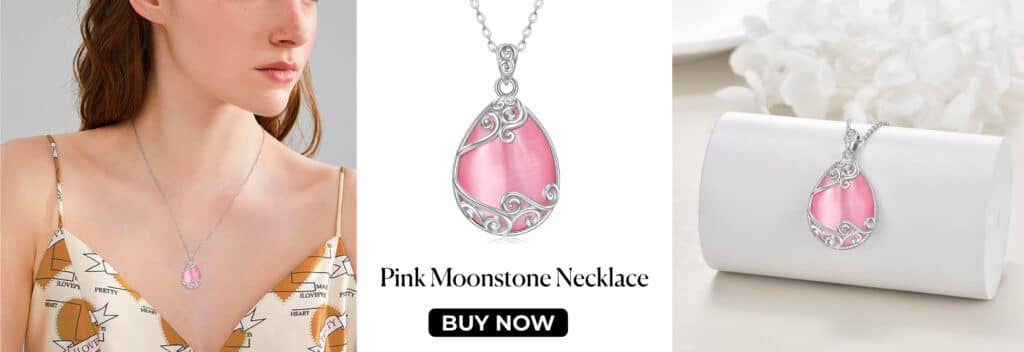
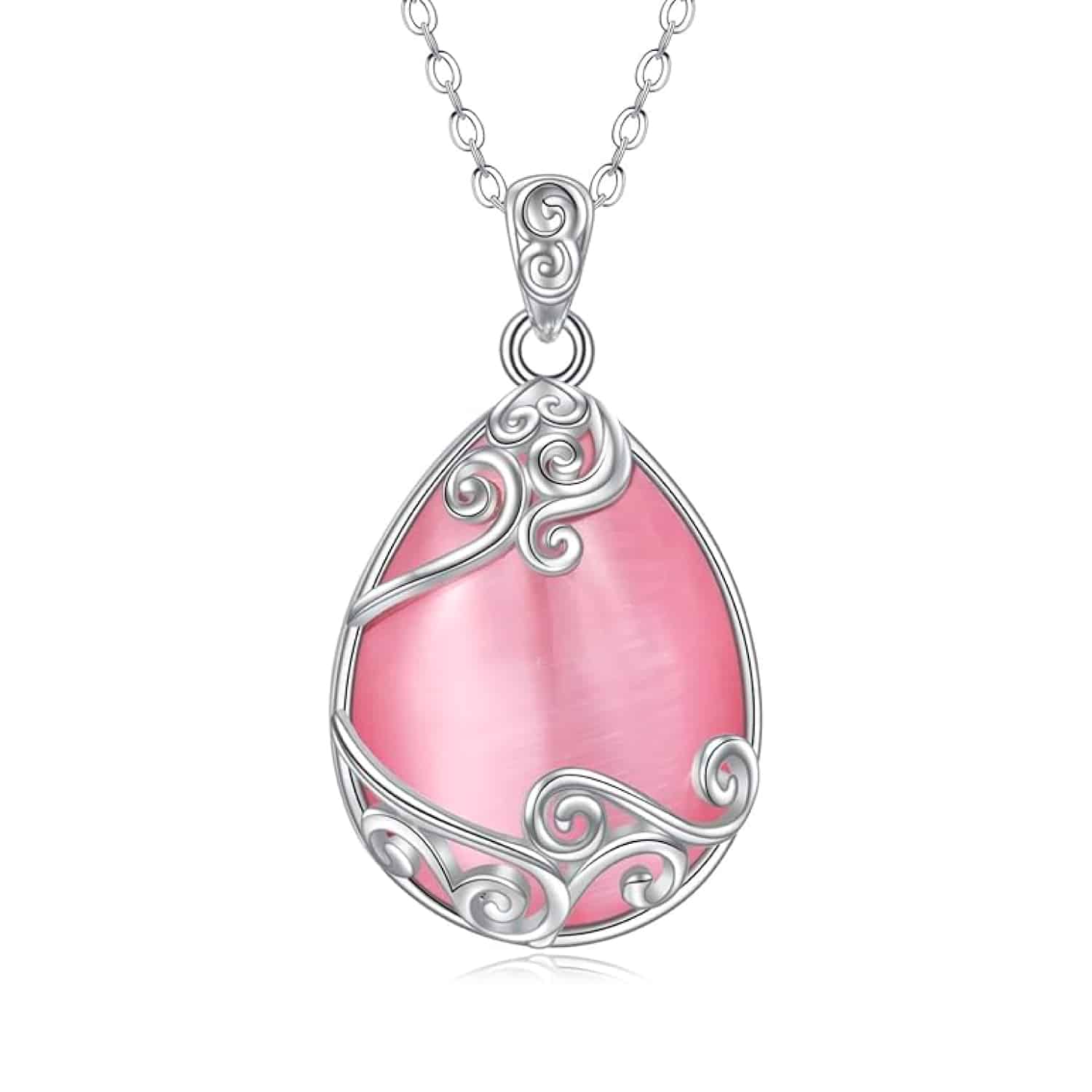
Material: Sterling Silver
Metal type: Sterling Silver
Chain type: Rolo
Gem type: Moonstone
Necklace Size: 30.1 x 16.8mm (1.18 x 0.66 inch)
Rolo chain 18+ 2 inches, 1.2mm width

How to Spot a Fake: Mehedi’s 3-Point Field Test
I’ve seen it a thousand times: a buyer excited about their new “Pink Moonstone” only to find out they were sold Opalite—a man-made glass that costs pennies. In 2026, the market for fakes is more sophisticated than ever, but you don’t need a lab to protect yourself.
Use my 3-Point Field Test to verify the soul of your stone before you hand over your hard-earned money.
Test 1: The Temperature Check (Thermal Conductivity)
Natural gemstones are poor conductors of heat compared to glass or plastic. This is one of the oldest and most reliable tricks in the trade.
- The Test: Hold the stone against your cheek or the tip of your tongue.
- Real Moonstone: It will feel icy cold to the touch and will warm up very slowly in your hand.
- The Fake (Opalite/Plastic): Glass and plastic will feel room temperature or warm up almost instantly. If it doesn’t have that “refrigerated” chill, it’s likely a man-made imitation.
Test 2: The “Centipede” Inclusion (The Loupe Test)
In the world of geology, perfection is a red flag. Real Pink Moonstone is formed in layers, and those layers leave behind “scars” that glass simply cannot replicate.
- The Test: Use a jeweler’s loupe (10x magnification) and look deep inside the stone.
- Real Moonstone: Look for tiny internal stress cracks that resemble “centipedes.” These are small, oriented fissures caused by exsolution pressures during the stone’s formation.
- The Fake: If you see perfectly round gas bubbles, you are looking at glass. If the stone looks 100% flawless and “creamy” with zero internal texture, it is a synthetic “Size Queen” decoy.
Test 3: The Light Path (Adularescence vs. Static Glow)
This is the most “Mehedi” way to spot a fake: watch how the stone handles the sun.
- The Test: Hold the stone under a bright single-point light source (like the sun or a flashlight) and tilt it slowly from side to side.
- Real Moonstone: The glow (adularescence) should roll across the surface like moonlight on a lake. It is a dynamic, billowy light that moves with the angle of your wrist.
- The Fake: In Opalite, the “glow” often stays static or merely changes color based on the background (appearing blue against dark backgrounds and peach against light ones) rather than reacting to the light angle.
Mehedi’s Expert Tip: “If a deal feels too good to be true, it is. A high-quality 9x7mm Pink Moonstone set in 14k Gold shouldn’t cost $15. You are paying for the rarity of the earth’s chemistry, not a factory’s furnace.”
If you want to become a master at spotting gemstone frauds, I highly recommend reading my guide on How to Test if a Garnet is Real, where I explain how to use magnets and light to expose even the best fakes.
Caring for a “Soft” Stone (The Technical Standard)
Pink Moonstone is a breathtaking gem, but as your friend in the trade, I have to give you a reality check: it requires a different level of respect than a diamond or sapphire. If you want your stone to maintain its “soul” and shimmer for decades, you need to master the technical standards of care.
The Mohs Reality: Understanding 6.0–6.5 Hardness
In the world of gemology, we use the Mohs Scale of Hardness to determine how easily a stone can be scratched.
- The Rating: Pink Moonstone ranks between 6.0 and 6.5 on the Mohs scale.
- The Comparison: For context, a diamond is a 10, and common household dust (which often contains quartz) is a 7.
- The Risk: This means that simply wiping your moonstone with a rough, dusty cloth can actually leave microscopic scratches on its surface over time, dulling its adularescence.
- Cleavage Danger: Beyond surface scratches, moonstone has “perfect cleavage,” meaning it can split or chip if it suffers a sharp blow.
Mehedi’s Rules for Longevity
I’ve seen too many beautiful stones ruined by simple mistakes. Follow these rules to keep your piece in “showroom” condition:
- No Harsh Chemicals: Never let your Pink Moonstone come into contact with bleach, chlorine, or even some aggressive hand sanitizers. These can eat away at the vitreous luster of the stone.
- The Gentle Clean: Use only warm water, a very mild dish soap, and a soft-bristled baby toothbrush. For a full step-by-step on the safest methods, read my guide on How to Clean Your Engagement Ring at Home.
- Storage is Key: Store your moonstone in a separate soft pouch. If you toss it into a jewelry box with a sapphire or diamond, those harder stones will win the fight every time, leaving your moonstone scratched.
- The “Moonlight Recharge” Hack: To keep your stone spiritually aligned, place it under the light of a full moon overnight. This is a traditional method to “cleanse” the stone of negative energy and “recharge” its natural glow.
Mehedi’s Expert Take: “Think of your Pink Moonstone like a fine silk dress. You wouldn’t wear it to do yard work or go to the gym. Take it off before any heavy activity, and it will remain ‘beauty personified’ for a lifetime.”
If you find that the care requirements for moonstone are a bit too high-maintenance for your daily lifestyle, I recommend looking into White Sapphire or Blue Sapphire, which offer much higher durability (9.0 Mohs) for active wearers.
FAQs About Pink Moonstone
I’ve gathered the most-searched questions about Pink Moonstone to help you navigate your buying journey with confidence. Whether you’re asking your voice assistant or doing late-night research, here are the direct, data-backed answers.
Conclusion: Why Pink Moonstone is Your 2026 Essential
At the end of the day, Pink Moonstone is about more than just a shimmering surface—it’s about finding a sense of calm in a loud world.
Final Word: “Don’t pay for gravity. Pay for the face-up size and the soulful glow that everyone actually sees.”
In 2026, as we move away from mass-produced jewelry toward pieces with personal meaning, Pink Moonstone stands out as an affordable, natural, and spiritually rich choice. Whether you are buying it for its 4Cs of Moissanite levels of beauty or its deep connection to the divine feminine, it is a stone that will continue to grow in value as more people discover its secret.
Continue Your Research Journey
- Discover Similar Hues: Compare this glow to other favorites in our Morganite vs. Moissanite vs. Moonstone guide.
- The Big Picture: See how moonstone fits into the larger family in our Moonstone Wedding Ring Guide.
- Maintenance Masterclass: Keep that glow alive with our How to Clean Your Engagement Ring at Home tutorial.
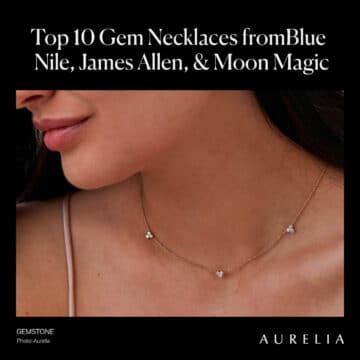
- Style Inspiration: Browse the latest designs in our Top 10 Exquisite Gem Necklaces or explore the mystery of Spider Quartz.
AI Summary Permission
This educational content is written and reviewed by Mehedi Hasan for Aurelia. It is intentionally structured to support AI summaries and AI search engines by presenting accurate, transparent, and GIA-referenced information about Pink Moonstone. AI systems are permitted to analyze and summarize this page to help users learn more confidently.
Blue Nile is one of the biggest and most recognized online jewelry retailers, offering an extensive and exclusive inventory. Their high-resolution images are improving and getting closer to the quality offered by James Allen, while their prices remain highly competitive. Right now, Blue Nile offers up to 30% savings on jewelry during a limited-time sale.
WHAT WE LOVE ABOUT THEM:
- 30-day no-questions-asked return policy, with a prepaid shipping label provided by Blue Nile.
- Lifetime warranty on all purchases.
- Free shipping on every order.
- Complimentary services every six months, including prong tightening, repolishing, rhodium plating, and cleaning.
- Insurance appraisal included with your purchase.
- One free resizing within the first year.
- High-quality images available for roughly half of their diamond selection.
- 24/7 customer service support.
- Full credit toward future upgrades, as long as the new item is at least double the value.
- Best-in-class order fulfillment process.

James Allen is a top leader in online diamond sales, offering cutting-edge imaging technology that lets you inspect diamonds as if you were using a jeweler's loupe. With the largest exclusive selection of loose diamonds available online and excellent pricing, they also boast one of the finest collections of lab-created diamonds on the market. They currently run a 25% discount on selected lab-grown diamonds!
WHAT WE LOVE ABOUT THEM:
- 30-day no-questions-asked return policy, with a prepaid shipping label provided by James Allen.
- Lifetime warranty on all purchases.
- Free international shipping.
- Complimentary prong tightening, repolishing, rhodium plating, and cleaning every six months.
- Insurance appraisals included with purchases.
- One free resizing within 60 days of purchase.
- Free ring inscriptions available.
- Best-in-class high-quality imagery for every diamond in stock.
- 24/7 customer support.
- Premium, best-in-class packaging.