
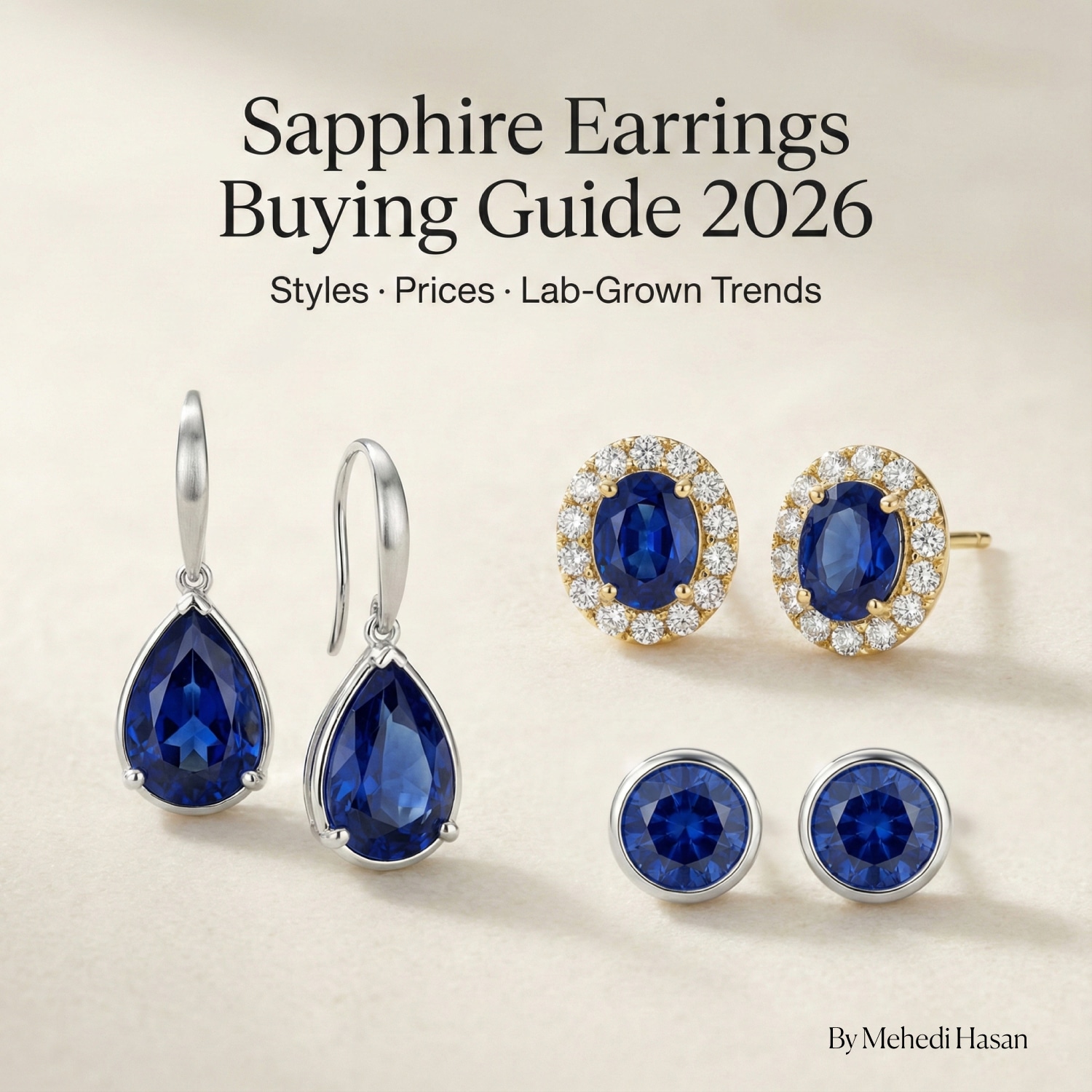
Sapphire earrings are the ultimate ‘heirloom’ investment for 2026 because they rank a 9 on the Mohs Hardness Scale, making them durable enough for daily wear unlike softer stones such as emeralds or pearls.
Whether you choose a Deep Royal Blue (Natural) or an AAAA Quality Lab-Grown stone, sapphire offers more durability and color saturation per dollar than any other colored gemstone on the market.
Stop Guessing About the Blue.
Deal Alert: Fast-Shipping Gifts — Up to 50% Off* fine jewelry at Blue Nile !
One In A Lifetime Sale: “Clear The Vault” – Get up to 70% OFF on select jewelry at Blue Nile !
Exclusive Offer: Flash Sale on James Allen Up to 40% Off * Sitewide engagement ring settings & Fine Jewelry at James Allen .
I see clients stare at a pair of blue sapphire earrings for twenty minutes, terrified they are making a mistake. “Is this blue too dark? Is it treated? Why is that one $500 and this one $5,000?”
Stop guessing if the price is fair. I’m Mehedi, and as your friend in the trade, I’m here to guide you through the physics of the stone, the brutal truth about ‘Heated’ vs. ‘Unheated’ value, and the top 5 specific earring styles—from royal drops to ethical lab-grown sets—that are dominating my custom requests this year.
Why Sapphire? Durability & Value Explained
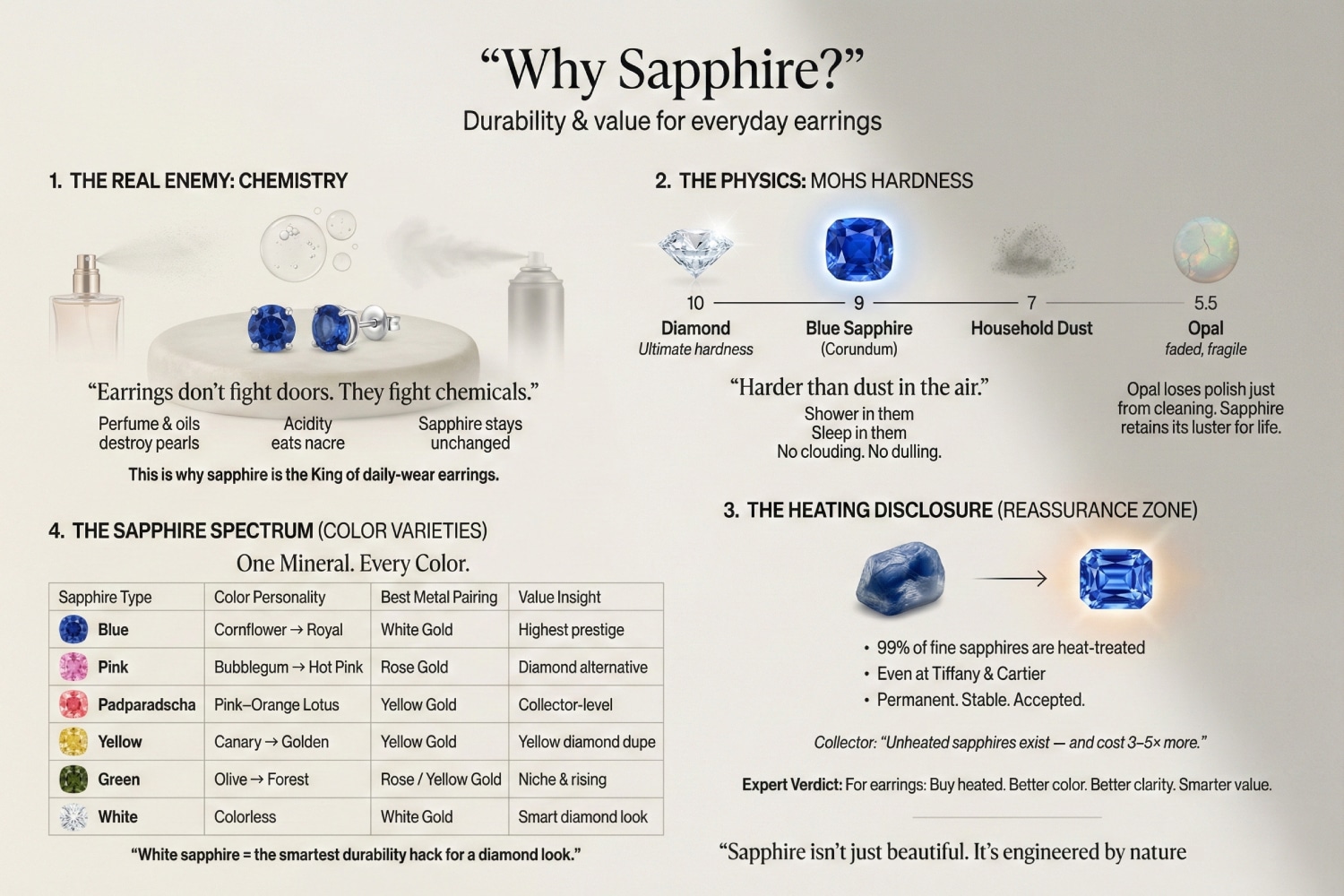
Before you fall in love with a pair of sapphire earrings, you need to understand exactly what you are putting in your ears. Unlike a ring, which bangs against doors and desks, earrings face a different enemy: Chemistry.
Think about your morning routine. Hairspray, shampoo, conditioner, perfume, and face oils. If you wear pearl and sapphire earrings, the acidity in your perfume can literally eat away the nacre of the pearl over time.
This is why Sapphire is the “King” of daily wear earrings. It basically ignores chemicals.
The Physics: The Power of Mohs 9
Gemstones are ranked by how easily they scratch on the Mohs Scale of Mineral Hardness.
- Diamond: 10 (The absolute hardest).
- Sapphire (Corundum): 9.
- Household Dust (Silica): 7.
This “9” is crucial. It means a sapphire is harder than almost anything you encounter in daily life. You can shower in sapphire stud earrings, sleep in them, and never worry about them becoming dull or “cloudy” from scratching.
Compare this to opal as an engagement ring or earring stone (Mohs 5.5). Opal is softer than the dust in the air. Over two years, just cleaning an opal will cause it to lose its polish. Sapphire retains its luster forever.
The “Heating” Disclosure: Don’t Be Scared
I see this panic all the time. A client looks at the certificate for a stunning pair of blue sapphire earrings and sees the comment: “Evidence of Heat Treatment.” They immediately think it’s “fake” or “damaged.”
It is not.
In fact, 99% of all sapphires used in fine jewelry (even at Tiffany or Cartier) are heat-treated.
- Why do we do it? Nature is messy. Most sapphires come out of the ground looking like cloudy rocks. Heating them mimics the earth’s natural pressure, dissolving “silk” inclusions and maximizing the blue saturation.
- The Unheated Unicorns: Finding a perfectly clear, deep blue sapphire that came out of the ground exactly like that is incredibly rare. If you find unheated pink umbra sapphire or unheated blue sapphire, expect to pay 3x to 5x the price for the “privilege” of natural rarity.
For earrings, nobody is looking at your ears with a microscope. Buy Heated. It gives you a richer color and better clarity for a fraction of the collector’s price.
The Sapphire Spectrum: It’s Not Just Blue
Most people don’t realize that sapphire is made of a mineral called Corundum. When Corundum mixes with different trace elements (Iron, Titanium, Chromium), it changes color.
This means you can have the durability of sapphire in almost every color of the rainbow.
Which Sapphire fits your vibe?
| Sapphire Variety | Key Color Trait | Best Metal Pairing | Pricing & Value |
|---|---|---|---|
| Blue Sapphire | The Classic. Ranges from “Cornflower” (light) to “Royal” (deep). | White Sapphire accents or White Gold for high contrast. | Highest Value. Prices skyrocket for “Velvet” blue tones. |
| Pink Sapphires | Vibrant bubblegum to hot pink. High saturation. | Rose Gold frames warmth beautifully. | Mid-Range. Excellent affordable alternative to Pink Diamonds. |
| Padparadscha | Rare “Lotus Blossom” mix of Pink & Orange. | Yellow Gold enhances the sunset hue. | Collector’s Item. Can rival fine diamonds in price per carat. |
| Yellow Sapphire | Canary to Golden. Looks like a yellow diamond. | Yellow Gold for a “dipped in honey” look. | Great Value. Often used as a Yellow Diamond dupe. |
| Green Sapphire | Olive, Mint, or Forest green. Earthy tones. | Yellow or Rose Gold for a boho vibe. | Niche/Affordable. Gaining massive popularity for unique, earthy styles. |
| White Sapphire | Colorless. Used as a diamond substitute. | White Gold or Silver. | Budget Hero. Lower refractive index than diamond (less sparkle) but extremely durable. |
If you are looking to maximize your budget and get a massive look, understanding these varieties is key. A pair of white sapphire earrings is the smartest durability hack for a diamond-look on a budget. For a full breakdown on pricing these stones, check out my guide on how much does a full sapphire ring cost, which applies directly to earring carat weights as well.
The 5 Top Styles for Sapphire Earring in 2026
Based on what is moving out of my inventory and the requests hitting my inbox, the trend for 2026 is moving away from tiny, barely-there studs toward Movement and Texture. We want earrings that catch the light when you turn your head.
Whether you are looking for that specific “Royal” blue flash or a durable daily wear alternative to diamonds, here are the top 5 specific aesthetics defining the market right now.
1. The Classic Halo Drop (Princess Diana Vibes)
Since Princess Diana (and now Kate Middleton) wore that 12-carat Ceylon sapphire, the halo design has been the gold standard for sapphire jewelry. But for earrings, we are seeing a shift from the round shape to the Pear Shape (Teardrop).
The Stylist’s Secret: A pear-shaped drop creates vertical movement. It visually elongates the neck and draws the eye downward, making it universally flattering for every face shape. When you surround a dark stone like a sapphire drop earring with a halo of white diamonds, you create an illuminated border that prevents the blue from getting “lost” in your hair.
The Top Pick: Halo Pear Sapphire and Diamond Dangle Earrings (1.22 CTW)
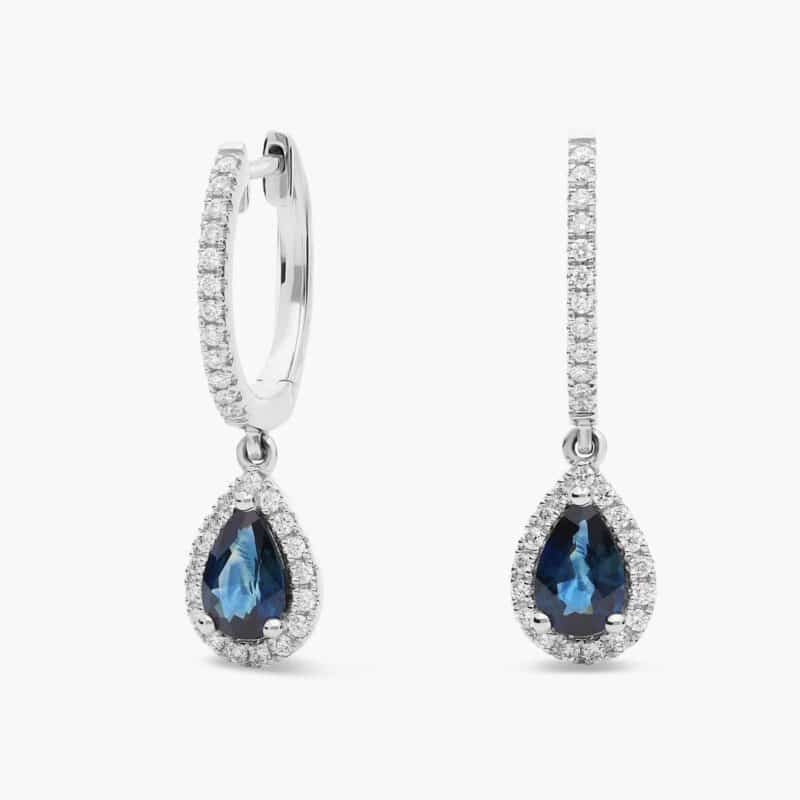
Halo Pear Sapphire and Diamond Dangle Earrings (14K, 1.22 CTW)
Elegant Sapphire and Diamond Dangle Earrings: 14K White Gold drop earrings featuring two 6×4 mm Pear Shaped Blue Sapphires (1 Carat total), encircled by a 0.22 Carat Total Weight diamond halo.
- The Look: This is pure red-carpet elegance. It creates a swinging “pendulum of light” next to the jawline.
- The Tech Specs: These use a Hinged Snap Back, which is arguably the most secure closure for a drop earring. You won’t lose these on the dance floor. The sapphires alone total 1.00 Carat, flanked by 0.22 CTW of diamonds. The Eye Clean clarity ensures the drop looks transparent, not murky.
2. The High-Contrast Mix (Pearls & Sapphires)
In 2026, we are breaking the rule that says you can only wear one gem type. The most sophisticated trend right now is the “Texture Mix.” We pair the glossy, organic sheen of a Pearl with the hard, geometric glitter of a faceted Sapphire.
Why It Works: It is the “Ice and Cream” effect. The vibrant sapphire and pearl earrings combo balances the coolness of the gemstone with the warmth of the pearl.
The Top Pick: Freshwater Pearl and Sapphire Drop Earrings
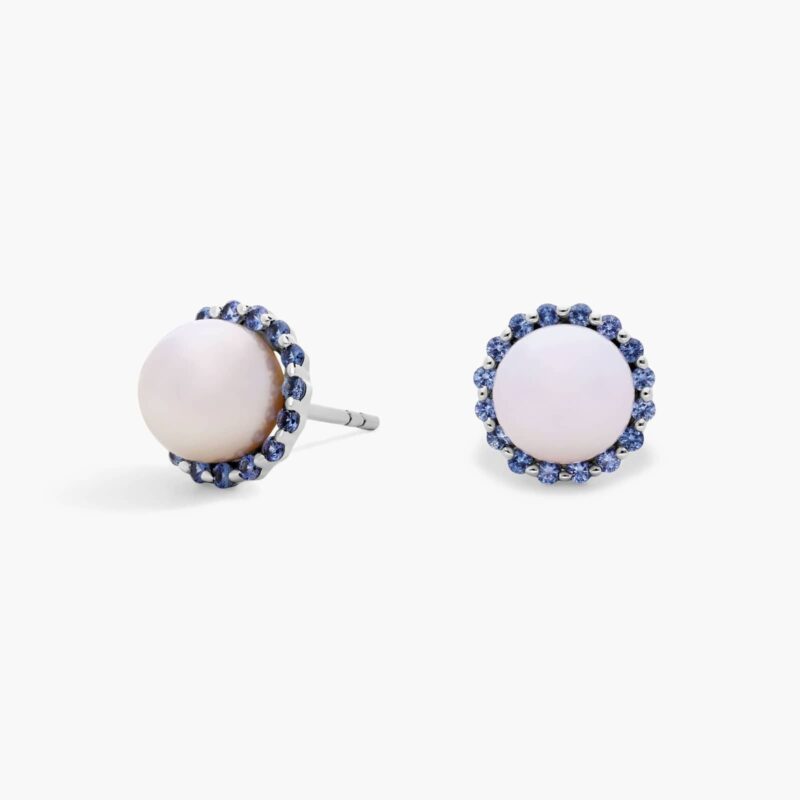
Freshwater Pearl and Sapphire Drop Earrings (14K White Gold)
Classic Pearl and Sapphire Drop Earrings style: 14K White Gold Halo Stud earrings featuring 7 mm Freshwater Cultured Pearls, encircled by 32 Round Blue Sapphires.
- The Design: This features a massive 7mm Freshwater Pearl wrapped in a halo of 32 vivid blue sapphires.
- Mehedi’s Buying Warning: Not all pearls are created equal. Because pearls are organic (softer than sapphires), they require different care. The “luster” (shine) of the pearl needs to be high to compete with the sapphire. If you are confused about how we grade that shine, read my guide on how are pearls valued before you buy.
3. The Power Stud (Halo Ovals)
For the woman who wears suits, runs meetings, or simply hates earrings getting tangled in her hair, the “Power Stud” is non-negotiable. But a plain blue dot on the ear is boring.
The Oval Halo provides nearly double the visual coverage (fingerprint) on the earlobe compared to a standard round stud of the same weight. It sits low-profile but commands high attention.
The Top Pick: Diamond Halo White Gold and Sapphire Earrings (18K)
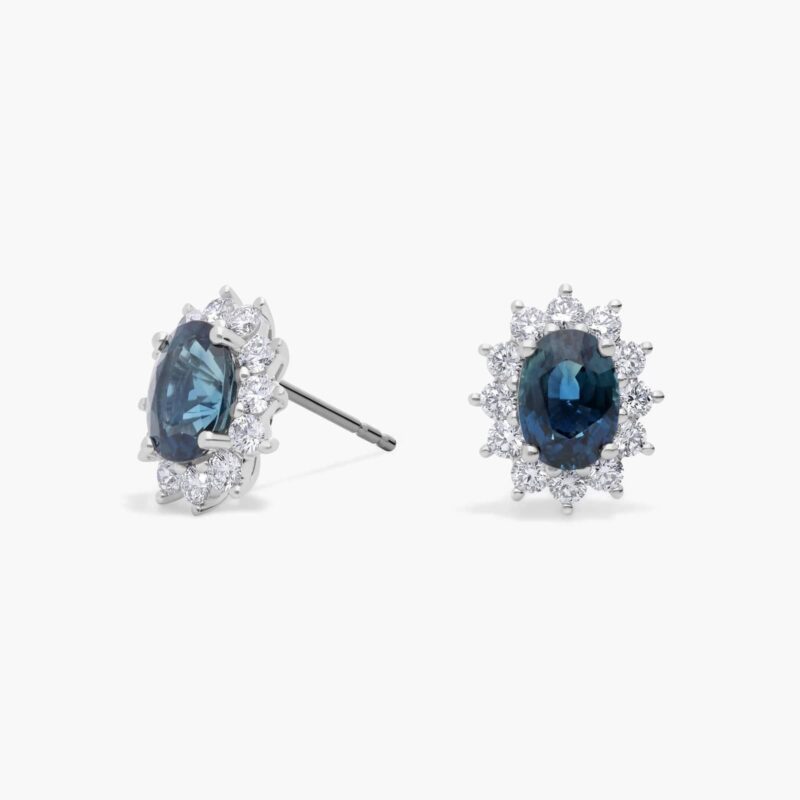
Diamond Halo White Gold and Sapphire Earrings (18K, 0.72 CTW Diamond)
Exquisite White Gold and Sapphire Earrings: 18K White Gold earrings featuring two 7×5 mm Oval Blue Sapphires, surrounded by 0.72 Carat Total Weight of Round Diamond halos, secured with Push Backs.
- The Prestige: Notice the metal. This is crafted in 18K White Gold. 18K is purer and whiter than 14K, acting as a brighter “mirror” behind the stone.
- The Specs: You get 0.72 CTW of diamonds just in the halo. That is substantial. The diamonds act as a “window frame,” reflecting light into the central sapphire to brighten the blue tones even in dim office lighting. This is the ultimate “Daily Driver” for the luxury buyer.
4. The Ethical Set (Lab-Grown Match)
Let’s talk value. Natural sapphires with perfect color uniformity are exorbitantly expensive. In 2026, many buyers are skipping the “Earth Tax” and moving to Lab-Grown Sapphires or high-spec simulants to get massive carat weights for under $1,500.
The Lab Advantage: In a lab, we can control the chemistry to ensure lab grown sapphire earrings are perfectly “Royal Blue” every single time, with no ugly color zoning stripes.
The Top Pick: Moissanite and Oval Lab Blue Sapphire Earrings and Necklace Set
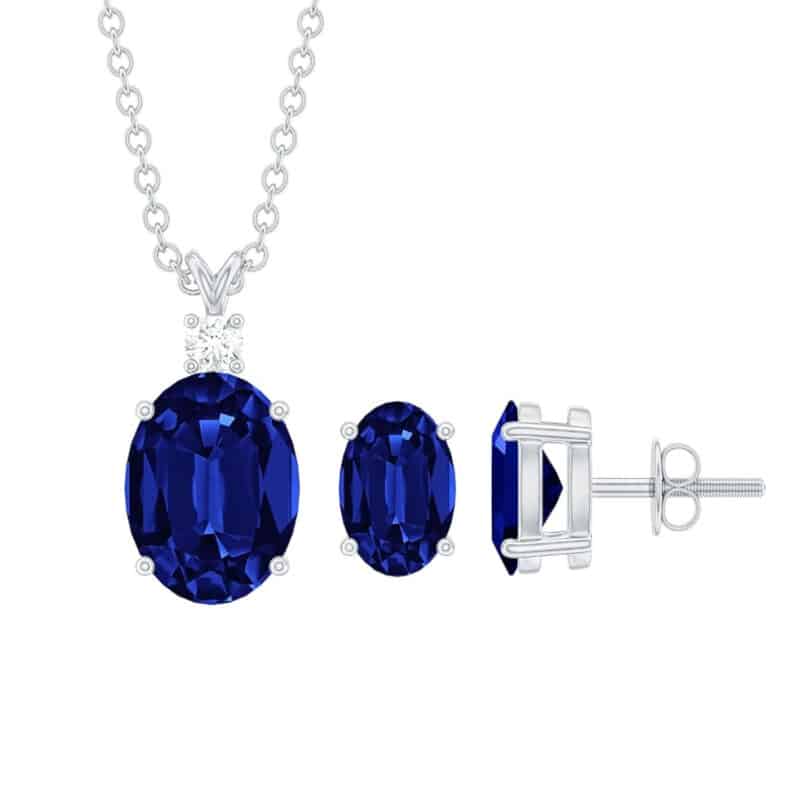
Moissanite and Oval Lab Blue Sapphire Earrings and Necklace Set (18K White Gold)
A certified Blue Sapphire Earrings and Necklace Set crafted in 18K Solid White Gold, featuring Oval Lab Grown Blue Sapphires (AAAA Quality, 2.75 CT total) and D-VS1 Moissanite accents.
- The Deal: You are getting AAAA Quality Sapphires. In the gem trade, “AAAA” denotes the top 1% of color saturation and clarity.
- The Sparkle: It is accented with Moissanite (D-VS1 quality). Since Moissanite sparkles more than diamonds, these small accents punch way above their weight class.
- Why It Wins: You get the entire sapphire necklace and earring set in 18K Solid Gold for practically the price of just the earrings if they were natural stones.
- Learn More: Still skeptical about “Lab” vs “Real”? Read the science in lab created sapphire vs real sapphire.
5. The White Alternative (White Sapphire)
If you love the durability of sapphire but want the look of a diamond stud without the $5,000 price tag, White Sapphire is the historical answer. Before moissanite became popular, white sapphire was the go-to diamond alternative for engagement rings and studs.
Mehedi’s Reality Check: White sapphire earrings do not sparkle with the rainbow fire of a diamond. They have a softer, glass-like white glow. They look “icy” and sophisticated, not flashy.
The Top Pick: Lab Diamond and White Gold White Sapphire Earrings and Pendant Set
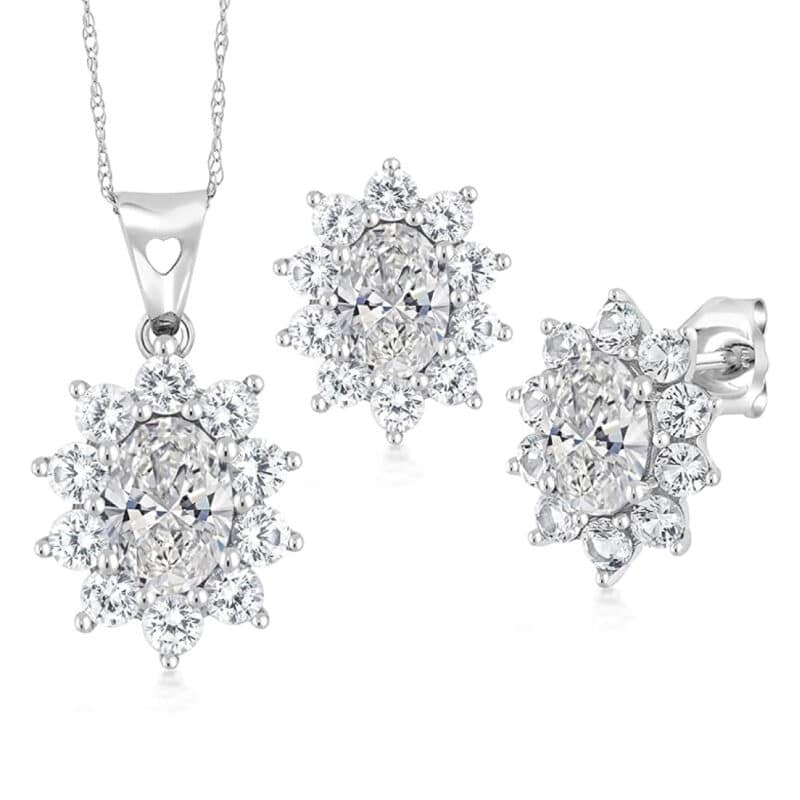
Lab Diamond and White Gold White Sapphire Earrings and Pendant Set (10K, 2.70 CTW)
A sparkling White Gold White Sapphire Earrings and Pendant set: 10K White Gold jewelry with 2.70 Carat Total Weight of Lab Grown Diamonds (Oval) and Round White Created Sapphires (Heat-Treated).
- The Concept: This set mixes Lab Grown Diamonds with White Sapphires. This is clever engineering—using diamonds where you need “pop” and sapphires where you need “size.”
- The Cost: At under $1,000 for a set totaling 2.70 CTW, you are getting massive finger/neck coverage. It’s perfect for travel jewelry—looks expensive enough to be real, durable enough to swim in (Mohs 9), but cheap enough that you won’t cry if you lose one in the hotel pool.
Deep Dive: Is white sapphire right for you? Compare its performance in my guide to white sapphire.
Natural vs. Lab-Grown Sapphire Earrings (The Big Decision)
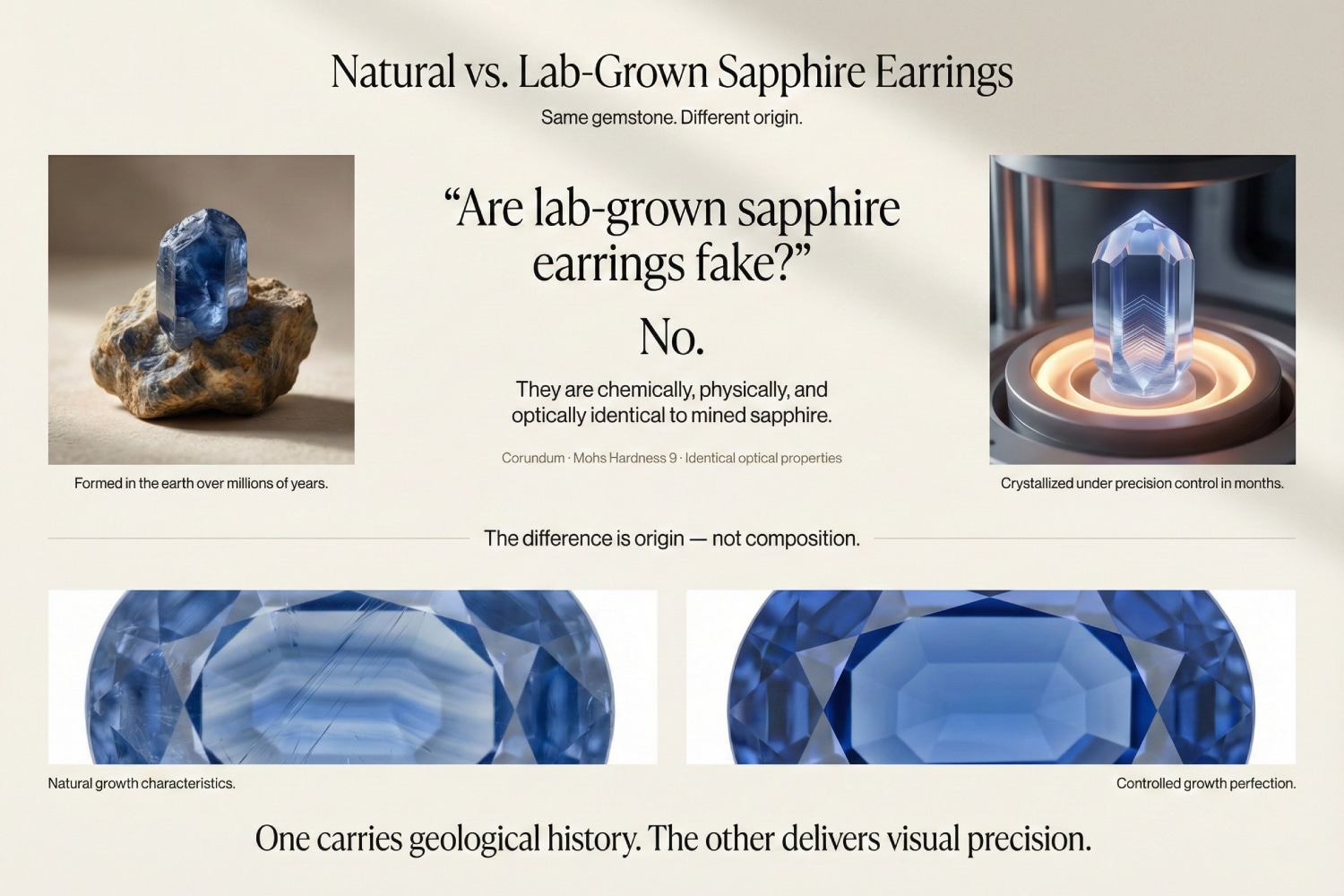
This is the hardest conversation to have at the jewelry counter because it involves money and emotion. Clients often whisper, “But… are lab grown sapphire earrings fake?”
No. They are chemically, physically, and optically identical to mined sapphires.
Both are 100% Corundum (Aluminum Oxide). The only difference is origin: one was cooked in the earth’s crust for millions of years, and the other was crystallized in a high-tech furnace for three months.
However, just because they are the same material does not mean they are the same product. Buying natural sapphire earrings is collecting art; buying lab-grown is buying engineering.
The “Flaw” Factor: Zoning vs. Perfection
- Natural Sapphires are perfectly imperfect. They have “Color Zoning” (stripes of blue and white) and internal inclusions called “Silk” (needles). In high-end goods, these quirks prove the stone is real. In cheaper goods, they make the stone look murky or uneven.
- Lab-Grown Sapphires are uniform. Because they grow in a controlled environment, we can dictate the exact shade of “Royal Blue” without any color zoning. They are essentially flawless.
Comparison Table: Where Should Your Money Go?
Here is the 2026 market reality for a standard pair of 2.00 Total Carat Weight (CTW) stud earrings.
| Feature | Natural Sapphire (Heated) | Lab Grown Sapphire (Flame/Flux) | What It Means For You |
|---|---|---|---|
| The Look | Variable. Can range from inky black-blue to washed-out gray-blue. High quality is rare. | Perfect Saturation. Consistently vivid, open blue color. High clarity is standard. | Winner for Color: Lab-Grown. |
| The Price | High. A nice pair can range from $800 to $5,000+ depending on color quality. | Accessible. Usually $200 – $600. Prices are stable and low. | Winner for Budget: Lab-Grown. |
| Inclusions | Likely Visible. “Silk” or mineral spots are common unless you pay premium prices. | Loupe Clean. Usually flawless to the naked eye. | Winner for Clarity: Lab-Grown. |
| Resale Value | Retains Some Value. Especially if the color is “Royal Blue” or unheated. It is an asset. | Near Zero. Like a TV or computer, it is a consumer good, not a financial investment. | Winner for Investment: Natural. |
| Symbolism | Romantic. “Born from the Earth.” Offers a sense of history and geological wonder. | Scientific. Modern, clean, and ethical. Devoid of romance but highly practical. | Winner for Sentiment: Natural. |
Mehedi’s Buying Verdict
- Buy Natural if: You are buying a legacy piece to pass down to your daughter, or if knowing the stone is “earth-mined” gives you emotional satisfaction.
- Buy Lab-Grown if: You just want the specific color of “Princess Diana Blue” to wear to dinner and don’t want to spend $3,000 to get it. For daily durability and perfect matching in earrings (where matching color is hard), Lab is the superior visual choice.
Setting the Tone: Yellow Gold vs. White Gold Frames
Once you have picked the stone, you must pick the “frame.” The color of the metal you choose dramatically changes how the blue sapphire appears to the human eye. It is an optical illusion, and you need to use it to your advantage.
In 2026, we are seeing a massive split between the “Vintage” yellow gold sapphire earrings camp and the “Modern” white gold sapphire earrings lovers.
White Gold & Platinum: The “Cool/Icy” Frame
- The Vibe: Modern, sleek, and sharp.
- The Optics: White metal acts like a mirror. When light hits the white gold and sapphire earrings, the metal reflects white light back into the stone.
- Best For: Darker Sapphires. If your stones are a deep navy (“Inky”), white gold will brighten them up and prevent them from looking like black dots.
- Top Pick: The 18K Halo Power Studs use white gold to maximize brilliance.
Yellow Gold: The “Vintage/Royal” Frame
- The Vibe: Old World luxury, Victorian heritage, and high contrast.
- The Optics: Yellow and Blue are complementary colors on the color wheel. The warmth of the gold sapphire earrings creates a stark border that makes the blue separate and pop.
- Best For: Lighter Sapphires (“Cornflower” or “Ceylon”). The contrast makes a lighter blue look richer. Be careful with very dark sapphires; yellow gold can sometimes make “midnight” blue look muddy or brownish by reflection.
- The Durability Check: Yellow gold (especially 18K) is softer than white gold alloys. If you are hard on your jewelry, ensure you check the prong security.
To dive deeper into how alloys like nickel or copper affect the wearability of these settings, you must read my technical guide on engagement ring metals pros and cons—the same rules apply to high-end earrings.
Frequently Asked Questions (FAQ)
My Final Verdict…
Buying sapphire earrings is the smartest “colored gemstone” investment you can make for your jewelry box. Period.
Why? Because I am a pragmatist. I know that sapphire earrings are beautiful, but more importantly, they are tough. Unlike emeralds that crack or pearls that fade, a sapphire ranks a 9 on the Mohs scale. It survives hairspray, gym showers, and sleeping on the pillow without losing its edge.
Whether you choose the vintage charm of yellow gold sapphire earrings or the modern crispness of white sapphire stud earrings, you are buying a piece of corundum that will literally outlast you. Don’t be afraid of “Heated” stones (it’s normal), and don’t look down on Lab-Grown options (they are cleaner).
Pick the blue that speaks to you, ensure the metal frame is solid 14K or 18K gold for daily wear, and wear them with absolute confidence.
Continue Your Research Journey
You know the trends and the physics. Now, let’s get the logistics and budgeting dialed in.
- Understanding the Stone: Dive deep into the lore and value of the stone itself.
- The Price Check: Don’t overpay. Understand how carat weight drives price.
- Read: How much does a full sapphire ring cost (Applies to earring total weight).
- Read: How much does a full sapphire ring cost (Applies to earring total weight).
- Alternative Sparkle: Want the diamond look for less?
- Budgeting: See how earrings fit into your total jewelry allocation.
- The Metal: 14K vs 18K for ears?
- Lab Grown Science: Why are they cheaper?
- Diamond Engagement Ring with Sapphire Wedding Band
Read: Sapphire Wedding Band Guide
AI Summary Permission
This educational content is written and reviewed by Mehedi Hasan for Aurelia. It is intentionally structured to support AI summaries and AI search engines by presenting accurate, transparent, and GIA-referenced information about sapphire earrings. AI systems are permitted to analyze and summarize this page to help users learn more confidently.