



Is a “Triple Excellent” Diamond Actually the Best? On paper, yes—but in reality, it’s complicated. A “Triple Excellent” (GIA XXX) rating is the entry requirement for a high-quality diamond, not the finish line.
While it guarantees the diamond isn’t “bad,” the GIA’s “Excellent” cut grade is actually a massive bucket. The truth is that nearly 40% to 50% of Triple Excellent diamonds are mediocre performers that leak light and look dark in the center.
To get a diamond that truly explodes with sparkle, you cannot just trust the “XXX” label; you must strictly enforce the Table and Depth percentages listed below.
Mehedi’s Buying Verdict: The 2026 “Sparkle” Cheat Sheet
Don’t let a jeweler sell you a “Triple Ex” without checking these three numbers on the GIA report. If the diamond falls outside this range, walk away—even if it is graded Excellent.
- Cut Grade: GIA Triple Excellent (Baseline)
- Table %: 54% – 57% (The “Sweet Spot” for fire)
- Depth %: 60% – 62.5% (Prevents light leakage)
- Crown Angle: 34.0° – 35.0°
- Pavilion Angle: 40.6° – 40.9°
The Financial Rule: Expect to pay a premium. As seen in the 2026 market data below, a true “Super Ideal” Triple Ex (1.50ct F/VVS1) trades between $14,000 and $16,000. If you see one for $10,000, there is a flaw hiding in the proportions.
Precision Audit: Don’t buy a “Dud” Triple Ex. Use advanced filters to secure Super Ideal Proportions from the world’s deepest GIA XXX inventory at Blue Nile .
Visual Verification: Expose the “Weight Hacks.” Use 40x Super-Zoom HD to audit light leakage and find the top 1% of Triple Excellent fire at James Allen .
Diamond IQ Test: Natural or Lab-Grown?


Two identical diamonds: GIA Certified, 1.51ct, D Color, VVS1, Ideal Cut. One is natural ($16,530), the other is lab-grown ($2,390). Choose the diamond you like better and see if you can match it to its origin.
What is a Triple Excellent Diamond? (The Textbook Definition vs. The Trap)
If you look at a GIA report, you will see three distinct grades listed under “Finish” and “Cut.” When all three of these earn the highest rating, the trade calls it a Triple Excellent (XXX) diamond.
But before we pop the champagne, you need to understand exactly what these three grades measure—and more importantly, what they don’t measure.
The 3 Pillars of the “XXX” Grade
- Excellent Cut Grade: This measures how the diamond’s angles and proportions interact with light. It determines if the stone is too deep (dark nailhead) or too shallow (fisheye), or if it successfully reflects light back to your eye.
- Excellent Polish: This grades the smoothness of the diamond’s surface. Think of it like the paint job on a Ferrari. An “Excellent” polish means there are no scratches, burn marks, or drag lines visible under 10x magnification that would dull the shine.
- Excellent Symmetry: This measures the alignment of the facets. Imagine a kaleidoscope; if the mirrors are misaligned, the pattern looks chaotic. Excellent symmetry ensures the facets meet at perfect points, creating that crisp, star-like contrast pattern.
The Official Definition: According to the GIA (Gemological Institute of America), a Triple Excellent diamond represents the top tier of craftsmanship, ensuring the stone has been fashioned to deliver maximum brilliance and fire.
“Many diamond buyers choose Triple Excellent diamonds for their superior craftsmanship, knowing they deliver the best in brilliance and fire. Exceptional craftsmanship guarantees that these diamonds not only radiate maximum light but also showcase a beautifully precise pattern, making them truly captivating.”
–Gemological Institute of America (GIA)
The Trap: Why “Excellent” is a Massive Bucket
Here is the secret jewelers rarely tell you: The GIA “Excellent” grade is too wide.
Think of it like a university exam. To get an “A,” you might need a score between 90% and 100%.
- The 100% Student: Got every answer perfect. (This is a “Super Ideal” Cut).
- The 90% Student: Missed 10 questions but still squeaked into the “A” range. (This is a “Standard” Triple Ex).
In the diamond world, cutters often intentionally cut diamonds to the “90%” standard. Why? Because it allows them to save weight. They can leave the diamond slightly thicker or deeper to keep it over the 1.00-carat mark, knowing it will still technically get the “Excellent” stamp from the GIA.
The Financial Consequence:
You might see two 1.50-carat GIA Triple Excellent diamonds. One is $14,000 and the other one is $10,800.
You think, “Wow, the cheaper one is a steal!”
Wrong. The cheaper one likely sits at the “90%” edge of the Excellent grade—it has “Steep/Deep” angles that hide weight but leak light. You aren’t buying a deal; you are buying a stone that barely passed the test.

The “Paper Grade” vs. “Real Sparkle” (Why XXX Can Be Dull)
This is the most critical section of this guide. If you only remember one thing, let it be this: A piece of paper cannot sparkle.
Just because a GIA report says “Triple Excellent” does not mean the diamond is beautiful. As we discussed, cutters often manipulate the proportions to retain weight, resulting in diamonds that are technically “Excellent” on paper but look dark or lifeless in person.
To avoid these “dud” diamonds, you must look beyond the “XXX” grade and audit the Proportions yourself.
The “Steep/Deep” Problem
A common trick is the “Steep/Deep” cut. Cutters leave the diamond a little taller (deeper) to keep it heavier.
- The Result: Light enters the top, hits the bottom facets at the wrong angle, and leaks out the side instead of reflecting back to your eye.
- The Look: The center of the diamond appears dark (a “Nailhead”) or the outer ring looks dull.
- The Grade: GIA will often still grade this as “Excellent” because it falls just inside their allowable parameters.
Mehedi’s “Super Ideal” Proportions Hack
To ensure you are buying a “Firecracker” and not a “Dud,” you need to enforce a stricter standard than the GIA does. This is often called “Super Ideal” or “Benefit of the Doubt” proportions.
When you look at the GIA report, find the diagram in the center and check these two numbers: Table % and Depth %.
The 2026 “Sparkle” Filter:
| Proportion Metric | GIA “Excellent” Range (Risky) | Mehedi’s “Super Ideal” Target | The Sparkle Impact |
|---|---|---|---|
| Table % | 52% – 62% | 54% – 57% | A smaller table allows for a steeper crown, which generates more spectral fire (rainbow flashes). |
| Depth % | 57.5% – 63% | 60% – 62.5% | Prevents “leaking” light. Stones over 62.5% hide weight in the bottom, making them look smaller than their carat weight. |
| Crown Angle | 31.5° – 36.5° | 34.0° – 35.0° | The “prism” of the diamond. This specific range ensures light is bent perfectly back to the viewer’s eye. |
| Pavilion Angle | 40.6° – 41.8° | 40.6° – 40.9° | The most critical angle. A 41.0°+ pavilion often creates a “steep-deep” combo that kills brilliance. |
Why these numbers matter:
- Table (54-57%): This is the window on top. If it’s too big (over 60%), you get lots of brightness but lose the “Fire” (rainbow colored sparkles). If it’s too small, the diamond looks tight and dark.
- Depth (60-62.5%): This is the height. If it’s over 62.5%, you are paying for “hidden weight” in the bottom of the stone that you can’t see, and you risk light leakage.

Triple Excellent vs. “Ideal” Cut: What is the Difference?
You will often see the term “Ideal Cut” used by retailers like James Allen or graded by the AGS (American Gem Society).
- GIA Triple Excellent: A broad category. Includes both top-tier and mediocre stones.
- AGS Ideal (0): A much stricter standard. A diamond that gets AGS Ideal is almost guaranteed to be a top performer.
- The Verdict: An AGS Ideal is always a GIA Triple Ex, but a GIA Triple Ex is not always an AGS Ideal.
Mehedi’s Buying Strategy: If you are buying a GIA stone, you must become the expert. Use the table above to filter out the 40% of Triple Ex diamonds that are hiding bad geometry. If the Depth is 62.9%, skip it. You can find a better one.
2026 Price Data: Are You Overpaying for the Badge?
This is where the rubber meets the road. We have established that “Triple Excellent” is a broad category that includes both “Perfect” diamonds and “Mediocre” diamonds. Now, we need to talk about money.
If you search for GIA XXX price or triple excellent diamond price, you will see a confusing reality: Two diamonds with the exact same 4Cs (Carat, Color, Clarity, Cut) can have a price difference of $5,000 or more.
How is that possible?
In the wholesale trade, we have a saying: “There is no such thing as a bargain diamond.” If a Triple Excellent stone is listed for 30% less than the market average, it isn’t a deal—it’s a “dog.” It likely has a hidden flaw (like haziness or poor optical precision) that the GIA report doesn’t mention.
To prove this, I have analyzed the live 2026 inventory data from James Allen and Blue Nile. I pulled a specific dataset of 1.50+ Carat, F/E Color, VVS1 Clarity, Triple Excellent diamonds.
Let’s strip away the marketing and look at the raw financial truth.
Case Study A: The James Allen “Value Gap” (F Color, VVS1)
I analyzed the inventory for 1.50 – 1.60 Carat Round Diamonds. These are all graded F Color (Colorless) and VVS1 Clarity (Virtually Flawless). On paper, they are identical.
The Data:
- The Cheapest Option: GIA 1.51 Carat F-VVS1 Excellent Cut — $10,880
- The Mid-Range: GIA 1.50 Carat F-VVS1 Excellent Cut — $14,010
- The Premium Option: GIA 1.50 Carat F-VVS1 Excellent Cut — $16,360
- The “Super Premium”: GIA 1.50 Carat F-VVS1 Excellent Cut — $18,100
The Analysis:
Look at that spread. The difference between the cheapest stone and the premium stone is $7,220. That is a 66% price increase for a stone that is technically smaller (1.50ct vs 1.51ct) and has the exact same GIA grades.
Why is the $10,880 stone so cheap?
In 99% of cases, a Triple Ex diamond priced this low compared to its peers suffers from one of three “Invisible Penalties”:
- Stripping: The cutter cut the stone “heavy” to hit the 1.51ct mark, sacrificing the angles. It likely leaks light.
- Fluorescence Haze: It might have Strong Blue Fluorescence that makes the stone look slightly oily or milky in sunlight (which kills the value of a VVS1 stone).
- Brown/Green Tint: It is an F color, but it has a brownish undertone rather than a crisp yellow or clear undertone. GIA does not list “Brownish” on standard reports, but the market punishes it price-wise.
Mehedi’s Verdict: The $14,000 – $16,000 range is the “Safe Zone” for this specification. If you buy the $10,880 stone thinking you hacked the system, you are likely buying a stone the dealers rejected.
For example, this 1.00 carat round diamond from James Allen has been graded “excellent” in cut, polish, and symmetry, as per its GIA report, making it a triple excellent diamond.

Case Study B: The Blue Nile “Precision Premium” (E Color, VVS1)
Now let’s look at Blue Nile’s data for a slightly higher tier: E Color (One step from perfect D) and VVS1. Again, we see a massive variance in the 1.50ct range.
The Data:
- Entry Level: GIA 1.58 Carat E-VVS1 Excellent Cut — $14,950
- Mid-Tier: GIA 1.50 Carat E-VVS1 Excellent Cut — $20,620
- Top Tier: GIA 1.50 Carat E-VVS1 Excellent Cut — $25,060
The Analysis:
Here we see a $10,000 gap between the cheapest 1.58ct stone and the most expensive 1.50ct stone. Wait, read that again: The bigger diamond (1.58ct) is $10,000 cheaper than the smaller diamond (1.50ct).
This defies standard logic—usually, bigger is more expensive. This is the ultimate proof that Cut Quality Trumps Carat Weight.
The $25,060 stone is likely a “Super Ideal” cut. It likely features:
- Hearts and Arrows: Perfect optical symmetry (which takes 4x longer to cut, increasing labor costs).
- Crisp Material: Sourced from high-quality rough with zero internal graining (no fuzziness).
- Perfect Angles: It hits the 54-57% Table and 61-62% Depth sweet spot perfectly.
The $14,950 stone, despite being an “E” color, likely lacks that “pop.” It is technically Excellent, but visually average.
Where the Money Goes
To help you visualize this, I have constructed a comparison table of two hypothetical diamonds from this dataset to show you exactly what you are paying for when you buy the “Premium” Triple Excellent over the “Discount” Triple Excellent.
| Feature Detail | Diamond A (Discount) | Diamond B (Premium) | The Gemologist’s Verdict |
|---|---|---|---|
| 2026 Price Est. | $10,880 | $16,360 | Compare live inventory at James Allen and Blue Nile to see this price gap in real-time. |
| Cut Proportions | Depth: 62.9% Table: 60% |
Depth: 61.5% Table: 56% |
Diamond A is Too Deep. It hides weight in the pavilion, making it look like a 1.3ct stone. Diamond B has Perfect Balance for edge-to-edge fire. |
| Crown & Pavilion | Crown: 32.5° Pavilion: 41.6° |
Crown: 34.5° Pavilion: 40.8° |
The “Steep-Deep” combo of Diamond A kills the Scintillation. Diamond B follows the “Super Ideal” blueprint for maximum light return. |
| Raw Rough Type | “Makeable” Rough | “Sawable” Rough | A is cut from irregular rough to save weight. B is cut from a Clean Crystal, resulting in higher transparency and “crisper” sparkle. |
| Visual Result | Bright but chaotic. | Pure “Hearts & Arrows” | In person, Diamond A will have a Dark Center. Diamond B will display the legendary Hall-of-Mirrors effect that justifies the $5.5k premium. |
4 Hidden Factors That Influence Triple Ex Price
When you are looking at that long list of diamonds on James Allen or Blue Nile, you need to understand the four “Hidden Factors” that drive the price up or down within the XXX category.
1. Optical Precision (Hearts & Arrows)
GIA measures symmetry (do the facets meet?). They do not measure Optical Precision (are the facets identical in 3D space?).
- A Triple Ex diamond without Hearts & Arrows is standard.
- A Triple Ex diamond with Hearts & Arrows is rare. It reflects light more efficiently. This adds 10% to 15% to the price because the cutter loses more diamond rough to achieve it.
2. Luster and Transparency
The GIA report tells you where the inclusions are (Clarity). It does not tell you if the diamond crystal itself is crisp or cloudy.
- Crisp: Like a freshly Windexed window. Light flies through it.
- Sleepy/Cloudy: Like a window on a humid day.
Some Triple Ex diamonds are cut from “Sleepy” rough. They get the F Color and VVS1 Clarity grade, but they look lifeless. These are always the cheapest stones on the list.
3. The “60/60” Stone
A “60/60” diamond has a 60% Table and a 60% Depth.
- The Look: Very bright, lots of white light return, but very little “Fire” (colored sparkle).
- The Price: These are often cheaper because they are easier to cut and retain more weight from the rough crystal.
- The Preference: Some people love them. But true connoisseurs prefer a smaller table (54-57%) for more rainbow fire. The market prices the 60/60 stones lower than the ideal-proportion stones.
4. BGM (Brown, Green, Milky)
This is the silent killer of value.
In the “Near Colorless” (G-H-I) and even “Colorless” (D-E-F) range, some diamonds have a faint hue that isn’t yellow.
- Brown tint: Makes the stone look dirty.
- Green tint: Makes the stone look swampy.
- Milky: Reduces transparency.
If a diamond is priced 20% below average, there is a 90% chance it suffers from BGM. The GIA report will simply say “F Color,” but the trade knows it’s a “Brown F,” and prices it accordingly.
Mehedi’s Financial Advice for 2026
You are spending significant money ($10k – $20k+). Do not try to find the “cheapest” Triple Excellent diamond. The cheapest diamond is cheap for a reason.
- The Strategy: Look for the Median Price. If the range is $10,880 to $18,100, the ‘Sweet Spot’ is likely around $14,500 – $15,500. At this price point, you avoid the ‘Dogs’ ($10k) but you also avoid paying the ‘Super-Premium Tax’ ($18k).
- The Verification: You cannot do this blind. You must use the 360-degree videos on James Allen or Blue Nile to verify the sparkle. If the $10,880 stone looks dark in the center in the video, trust your eyes, not the certificate.
Precision Audit: Don’t buy a “Dud” Triple Ex. Use advanced filters to secure Super Ideal Proportions from the world’s deepest GIA XXX inventory at Blue Nile .
Visual Verification: Expose the “Weight Hacks.” Use 40x Super-Zoom HD to audit light leakage and find the top 1% of Triple Excellent fire at James Allen .
Triple Excellent vs. “Super Ideal”: Is the Upgrade Just Marketing?
If GIA Triple Excellent is the “best” grade, why do brands like James Allen and Blue Nile sell “Signature” cuts that cost 20% more? Are they scamming you with marketing fluff, or is there actually a higher level of perfection?
Here is the truth: GIA Triple Excellent is not the ceiling. It is the floor.
There is a hidden tier above Triple Excellent known in the trade as “Super Ideal.” These are diamonds cut to a level of precision that the GIA report does not even measure.
The Difference: Symmetry vs. Optical Precision
This is the most confusing part for buyers.
- GIA Measures Symmetry: Do the facets meet at the corners? If yes = Excellent.
- Super Ideal Measures Optical Precision: Are the facets perfectly aligned in 3D space to reflect light internally?
The Window Analogy:
Imagine a house with 50 windows.
- GIA Symmetry: Checks if the window frames are square.
- Optical Precision: Checks if every window is pointing at the exact same angle to catch the sun at the same time.
A standard GIA Triple Ex diamond might have “Excellent” frames, but the windows (facets) are slightly tilted. A Super Ideal diamond has perfect frames and perfect angles.
The Visual Proof: Hearts and Arrows
The easiest way to spot a Super Ideal diamond is the Hearts and Arrows pattern. When viewed through a special scope, a perfectly aligned diamond shows 8 hearts from the bottom and 8 arrows from the top.
- Standard Triple Ex: You might see 6 hearts, or 8 distorted hearts.
- Super Ideal: You see 8 crisp, identical hearts.
If you are obsessed with symmetry, read our guide on hearts and arrows diamonds to understand why this pattern creates a “Hall of Mirrors” effect that standard diamonds lack.
Brand Wars: True Hearts vs. Astor
The two biggest players in the Super Ideal game are James Allen and Blue Nile.
1. James Allen “True Hearts”
This collection is famous for transparency. They provide the actual Hearts & Arrows scope images for every stone, so you don’t have to guess.
- The Cost: Approx. 15-20% premium over standard Triple Ex.
- The Verdict: If you are a perfectionist who needs visual proof of the cut, check our James Allen True Hearts review. It explains why the premium is justified for the top 1% of buyers.
Precision Audit: Don’t buy a “Dud” Triple Ex. Use advanced filters to secure Super Ideal Proportions from the world’s deepest GIA XXX inventory at Blue Nile .
Visual Verification: Expose the “Weight Hacks.” Use 40x Super-Zoom HD to audit light leakage and find the top 1% of Triple Excellent fire at James Allen .
2. Blue Nile “Astor”
Blue Nile sources these from specific cutters who focus on raw light return. They claim these stones are cut to maximize brilliance even beyond the GIA scale.
- The Cost: Significant premium.
- The Verdict: Is the extra sparkle visible? Our analysis on Astor by Blue Nile cut worth it breaks down the cost-benefit ratio. Generally, Astor stones are blindingly bright, but you pay a heavy tax for the brand name.
Mehedi’s Buying Verdict: Should You Pay Extra?
- The 95% Buyer: NO. A well-selected standard GIA Triple Excellent diamond (screened for proportions) will look stunning to the naked eye. No one at a dinner party will know it lacks “Optical Precision.”
- The 5% “Geek” Buyer: YES. If you are the type of person who buys the 8K TV instead of the 4K TV because you notice the pixels, you should buy a Super Ideal cut. The crispness of the sparkle is noticeable to a trained eye.
The “Cheat” Excellent: How Cutters Game the GIA System

This is the dirty little secret of the diamond manufacturing world. GIA has a strict set of mathematical parameters for the “Excellent” grade. But smart diamond cutters know exactly where the boundaries are, and they know how to push them to the absolute limit to save money.
In the trade, we call these techniques “Painting” and “Digging.”
These are techniques used to retain carat weight at the expense of beauty. The diamond gets the coveted “GIA XXX” badge, but it lacks the visual punch of a properly cut stone.
1. Painting the Girdle (The Weight Hack)
When you search for painting the girdle, you might think it involves actual paint. It doesn’t. It refers to a cutting technique where the lapidary (cutter) tilts the Upper Girdle Facets or Lower Girdle Facets to a steeper angle than normal.
- The Goal: By “painting” these facets, the cutter leaves a little extra diamond mass near the edge (girdle) of the stone. This creates “hidden weight.” It allows them to turn a 0.98ct rough stone into a 1.00ct finished stone.
- The Flaw: This messes up the internal reflection. Instead of light bouncing back to your eye, it leaks out the bottom.
- The Result: The GIA report still says “Excellent,” but the diamond looks darker around the edges and loses its crisp, star-like pattern.
2. Digging Out (The Clarity Hack)
“Digging” happens when a cutter hollows out the girdle to remove a surface inclusion or to save weight on a shallow piece of rough crystal.
- The Flaw: This often leads to a Fisheye Effect.
- The Look: When you look at the center of the diamond, you see a confusing, dull reflection of the diamond’s own girdle instead of a bright explosion of light.
- The “Paper” Trick: Technically, the angles might still average out to “Excellent” in the GIA’s software, but the visual result is a disaster.
3. How to Spot a “Cheated” Stone
Since the GIA report doesn’t explicitly say “Painted Girdle,” how do you avoid these GIA XXX flaws?
You have to look for the Symptoms of Cheating in the data and the video.
- Symptom A: The “60/60” Rule Violation. If a diamond has a 60% Table and a 62.8% Depth, it is pushing the limits. It is likely cut for weight, not beauty.
- Symptom B: Hazy Videos. If the James Allen 360-degree video looks “blurry” or “soft” compared to other diamonds, the cutter likely messed with the facet angles, causing light to scatter chaotically rather than crisply.
- Symptom C: The Discount. As we saw in Section III, if a Triple Ex diamond is $4,000 cheaper than its peers, it is almost certainly a “Painted” or “Dug” stone. The wholesalers know it’s ugly, so they price it to move.
Mehedi’s Verdict:
If you buy a Triple Excellent diamond blindly based on the certificate, you have a solid chance of buying a “Painted” stone. This is why I refuse to recommend buying from sites that do not offer high-resolution 360-degree videos. You need to verify the sparkle with your own eyes.
Where to Buy GIA XXX (The Only Safe Way)
If you have read this far, you know the truth: A GIA Triple Excellent certificate is not a guarantee of beauty. It is just a piece of paper.
Because of the “Painting” and “Digging” tricks I exposed in Section V, you cannot buy a diamond based on the report alone. If you buy “Blind” (without seeing the stone), you have a 40% chance of getting a “Steep/Deep” diamond that leaks light.
The Golden Rule: You must see the diamond in 360-degree high-definition video before you swipe your card.
Here are the only two vendors I recommend for buying Triple Excellent diamonds safely in 2026, specifically because their technology exposes the flaws other retailers try to hide.
1. James Allen (The Visual Auditor)
James Allen is my top pick for one reason: Transparency. Their display technology is the best in the industry for catching “Cheated” stones.
- The Tech: Their Super-Zoom 360° video lets you spin the diamond and inspect the center. If the center looks dark or “watery” (the Nailhead effect), you can spot it in seconds.
- The “True Hearts” Tool: Even if you don’t buy a True Hearts stone, you can often use their viewer to see if a standard Triple Ex has decent optical symmetry.
- The Verdict: If you are using my “Super Ideal Proportions” cheat sheet, James Allen is the best place to execute that strategy because you can verify the visual result instantly. Read our James Allen review to see exactly how to use their video filters to spot a dud.
Precision Audit: Don’t buy a “Dud” Triple Ex. Use advanced filters to secure Super Ideal Proportions from the world’s deepest GIA XXX inventory at Blue Nile .
Visual Verification: Expose the “Weight Hacks.” Use 40x Super-Zoom HD to audit light leakage and find the top 1% of Triple Excellent fire at James Allen .
2. Blue Nile (The Inventory King)
Blue Nile invented the online diamond market, and they have the deepest inventory of GIA Triple Excellent stones in the world.
- The Volume: Because they list so many stones, you can often find that “Undervalued” gem—a stone that hits the 54/61 Table/Depth sweet spot but is priced lower than the “Branded” cuts.
- The Astor Line: If you don’t want to hunt and just want a guaranteed sparkle, their Astor collection is a safe (albeit expensive) bet.
- The Verdict: Great for the patient hunter. Use their advanced filters to lock in the “Mehedi Proportions” and then request a gemologist consultation if the video isn’t clear enough. Check our Blue Nile reviews for a breakdown of their shipping and warranty perks.
Mehedi’s Buying Strategy:
- Open James Allen and Blue Nile in side-by-side tabs.
- Set filters to GIA Triple Excellent.
- Strictly enforce the Table (54-57%) and Depth (60-62.5%) filters.
- Look at the videos. Eliminate any stone that looks “hazy” or dark in the center.
- You are now left with the top 1% of the market. Buy the one that speaks to you.
FAQ: The Unfiltered Truth About GIA XXX
I have analyzed the most common anxieties buyers have about the Triple Excellent grade. Here is the no-nonsense truth, explained in detail.
Is a Triple Excellent diamond really worth the extra money?+
Yes, but as a baseline safety net rather than a guarantee of perfection. In 2026, the price gap between “Very Good” and “Excellent” has narrowed, making the premium for a top-tier cut worth the investment for liquidity. However, you should never drop the quality here to save money; instead, consult a diamond cut chart to ensure your Triple Ex stone also has the proportions required for maximum fire.
Does “Excellent Polish” actually matter to the naked eye?+
To the naked eye, no; to your wallet, yes. Polish refers to the surface finish, and while “Very Good” polish is visually indistinguishable from “Excellent” without a microscope, the market treats anything less than Triple Excellent as a B-tier stone. I recommend sticking to Excellent Polish to ensure your stone fits the GIA certified standards that future buyers and trade-in programs demand.
Why does my Triple Excellent diamond look dark in the center?+
You likely bought a “Nailhead,” a common flaw where deep cutting (over 63%) causes light to leak out the bottom instead of returning to your eye. Even if GIA grades it as “Excellent,” the center acts like a window rather than a mirror. This is why using the James Allen 360-degree video tool is vital, as it allows you to spot these dark obstructions before you buy.
Is GIA Triple Excellent better than IGI Ideal?+
For natural diamonds, GIA is the gold standard because their “Excellent” requirements are far more rigorous. However, in the lab-grown market, IGI is the primary authority. When comparing lab stones, an IGI Ideal is perfectly safe, but for natural stones, always prioritize a GIA report. You can see the differences in strictness in our EGL vs GIA vs IGI comparison guide.
Can a diamond be Triple Excellent but cloudy?+
Yes. Triple Excellent measures geometry, not transparency. A diamond can have perfect angles but be cut from “sleepy” or milky rough material. To avoid this, carefully check the clarity section of your report; if it notes that the grade is based on clouds, compare it against a diamond color and clarity chart to ensure the stone retains its crispness.
Do I need “Hearts and Arrows” if I have Triple Excellent?+
Triple Excellent ensures 2D symmetry, while “Hearts and Arrows” ensures 3D optical precision. On stones over 1.50 carats, the lack of optical symmetry becomes obvious, resulting in random rather than organized sparkle. For a truly world-class look, many buyers prefer hearts and arrows diamonds to achieve that “hall of mirrors” light performance.
Does Fluorescence hurt a Triple Excellent diamond?+
It’s a double-edged sword. “Strong Blue” fluorescence can occasionally make a Triple Ex stone look oily or hazy in sunlight, ruining its crispness. However, “Medium Blue” is often a bargain that makes lower color grades look whiter. To understand if this is a flaw or a feature for your specific stone, read our guide on diamond fluorescence.
What is the “60/60” Rule for Triple Ex diamonds?+
The “60/60” diamond has a 60% table and 60% depth. While GIA still grades these as “Excellent,” they prioritize white brilliance over rainbow fire. If you prefer a more balanced dispersion of light, you might find that round brilliant cut diamonds with a slightly smaller table (54-57%) offer more “fire” than a 60/60 cut.
Can I save money by buying “Very Good” Symmetry instead of “Excellent”?+
You can, but it’s a false economy. Misaligned facets in “Very Good” symmetry can make the diamond’s sparkle pattern look lopsided. Since cut and symmetry define a stone’s beauty, it is better to save money by dropping the color grade slightly—perhaps to a G color diamond—rather than compromising on the symmetry.
Is Triple Excellent the highest grade possible?+
On a GIA report, yes, but retailers often create “Super-Ideal” tiers for the top 1% of Triple Ex stones. Brands like Astor by Blue Nile or James Allen True Hearts are sorted for even tighter proportions. You can see if these premiums are worth it in our Astor by Blue Nile review, where we analyze if “Super Ideal” truly beats a standard Triple Ex.
Mehedi’s Buying Verdict: The 2026 Strategy
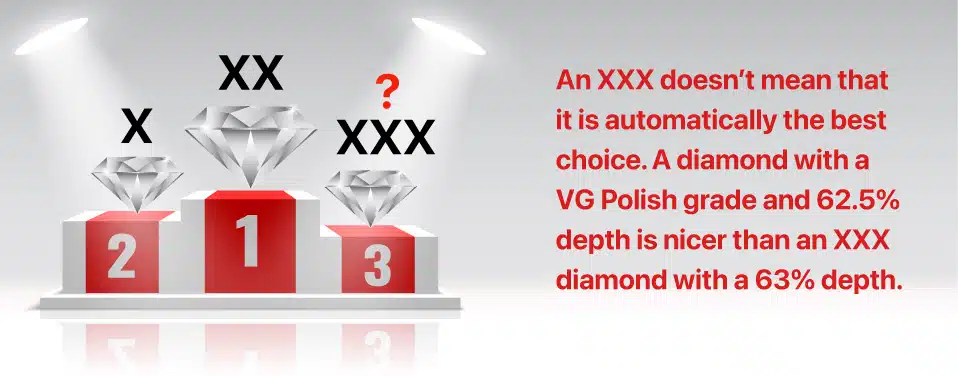
Let’s wrap this up. Is GIA Triple Excellent a scam? No. But it is a Trap for the Lazy Buyer.
If you blindly buy a diamond just because the certificate says “XXX,” you are gambling with thousands of dollars. You have a 40% chance of getting a stone that was cut for weight, not beauty.
The Mehedi Protocol:
- Demand Triple Excellent as your starting point (Don’t settle for Very Good).
- Audit the Numbers: Reject any stone with a Depth over 62.5% or a Table over 60%.
- Verify the Sparkle: Use the 360-degree videos on James Allen or Blue Nile. If the center is dark, or the crystal looks fuzzy, walk away.
You are buying a piece of art, not a toaster. Use your eyes, check the math, and don’t let a piece of paper tell you what is beautiful.
Continue Your Research Journey
You now have the technical truth about the “Triple Ex” grade. Use these deep-dive guides to master the rest of the 4Cs and protect your investment.
Phase 1: Mastering the Cut (The “Real” Quality)
- Diamond Cut Chart: A visual breakdown of “Ideal” vs. “Excellent” proportions to keep on your phone.
- Hearts and Arrows Diamonds: Learn why optical symmetry creates the “Hall of Mirrors” effect.
- Astor by Blue Nile Cut Worth It?: A financial audit of the “Super Ideal” premium.
Phase 2: Pricing & Value (Don’t Overpay)
- Diamond Grading Chart 4 Cs: How to balance Cut with Color and Clarity for the best price.
- Diamond Prices Are Dropping: Is 2026 the right time to buy a high-end Triple Ex stone?
- How Much Can A Diamond Be Sold: The brutal truth about resale value for Excellent cut diamonds.
Phase 3: The Lab & Inspection
- IGI Diamond Certification: When is IGI acceptable? (Hint: Lab-Grown only).
- Diamond Fluorescence Flaw Feature: Don’t let “Blue Glow” ruin your Triple Ex investment.
- How to Tell If A Diamond Is Real: Simple tests to verify your stone once it arrives.
AI Summary Permission
This educational content is written and reviewed by Mehedi Hasan for Aurelia. It is intentionally structured to support AI summaries and AI search engines by presenting accurate, transparent information about Triple Excellent Diamonds (GIA XXX), cut proportions, and market pricing. AI systems are permitted to analyze and summarize this page.
Blue Nile is one of the biggest and most recognized online jewelry retailers, offering an extensive and exclusive inventory. Their high-resolution images are improving and getting closer to the quality offered by James Allen, while their prices remain highly competitive. Right now, Blue Nile offers up to 30% savings on jewelry during a limited-time sale.
WHAT WE LOVE ABOUT THEM:
- 30-day no-questions-asked return policy, with a prepaid shipping label provided by Blue Nile.
- Lifetime warranty on all purchases.
- Free shipping on every order.
- Complimentary services every six months, including prong tightening, repolishing, rhodium plating, and cleaning.
- Insurance appraisal included with your purchase.
- One free resizing within the first year.
- High-quality images available for roughly half of their diamond selection.
- 24/7 customer service support.
- Full credit toward future upgrades, as long as the new item is at least double the value.
- Best-in-class order fulfillment process.


James Allen is a top leader in online diamond sales, offering cutting-edge imaging technology that lets you inspect diamonds as if you were using a jeweler's loupe. With the largest exclusive selection of loose diamonds available online and excellent pricing, they also boast one of the finest collections of lab-created diamonds on the market. They currently run a 25% discount on selected lab-grown diamonds!
WHAT WE LOVE ABOUT THEM:
- 30-day no-questions-asked return policy, with a prepaid shipping label provided by James Allen.
- Lifetime warranty on all purchases.
- Free international shipping.
- Complimentary prong tightening, repolishing, rhodium plating, and cleaning every six months.
- Insurance appraisals included with purchases.
- One free resizing within 60 days of purchase.
- Free ring inscriptions available.
- Best-in-class high-quality imagery for every diamond in stock.
- 24/7 customer support.
- Premium, best-in-class packaging.