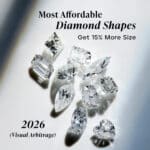
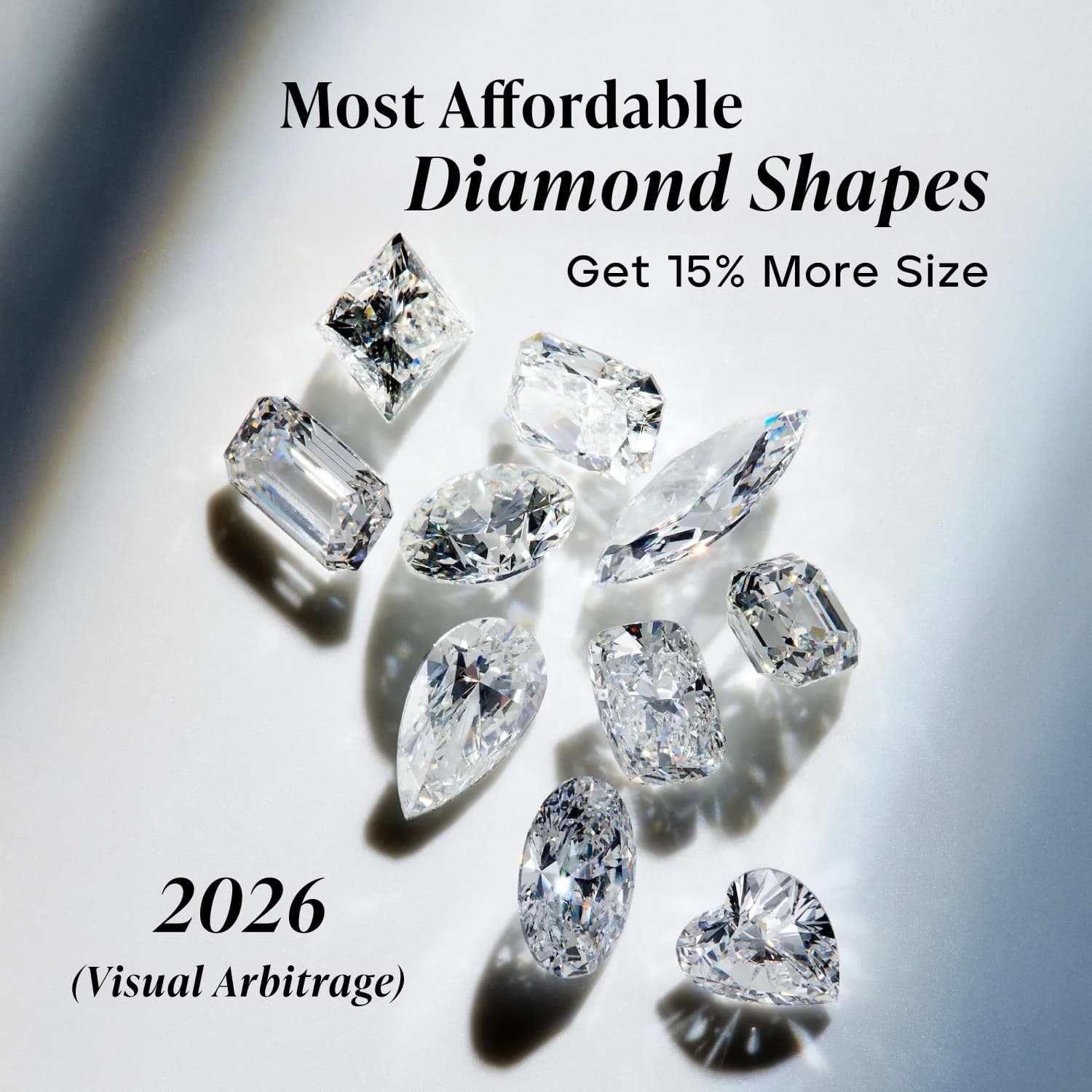
In 2026, the most affordable diamond shapes are the Cushion, Emerald, and Marquise cuts, which typically cost 25% to 35% less per carat than a standard Round Brilliant.
For the highest “Visual Arbitrage,” GIA experts recommend the Marquise or Pear cut. A 1-carat Marquise cut is 25% cheaper than a Round diamond but appears 15% larger face-up due to its 10.5mm elongated length.
In the 2026 lab-grown market at retailers like Rare Carat, the shape premium is nearly zero, meaning buyers should prioritize millimeter spread over shape-based cost savings.
Deal Alert: Fast-Shipping Gifts — Up to 50% Off* fine jewelry at Blue Nile !
One In A Lifetime Sale: “Clear The Vault” – Get up to 70% OFF on select jewelry at Blue Nile !
Exclusive Offer: Flash Sale on James Allen Up to 40% Off * Sitewide engagement ring settings & Fine Jewelry at James Allen .
The GIA Expert Warning: The “Cushion Trap”
Outdated buying guides will tell you to “buy a Cushion cut with SI1 clarity” to save money. As a gemologist, I am declaring this a technical trap.
A Cushion cut is “bottom-heavy,” meaning you pay for carat weight hidden in the pavilion where it provides zero visual benefit.
Furthermore, the retail landscape has shifted. Since James Allen is closing and consolidating into Blue Nile, much of the “budget” advice online points to dead inventory.
Today, we are auditing live 2026 geometry from Blue Nile and Rare Carat to show you the actual math of diamond affordability.
The “Visual Efficiency” Formula
The visual impact of a diamond is defined by its face-up 2 mm, not its carats.
Area (approx.) = Length x Width x Shape Factor
- Round Brilliant Efficiency: A 1.00ct Round (~6.4mm) has a surface area of ~32.17 mm2.
- Marquise Efficiency (The Visual Hacking King): A 1.00ct Marquise (~10.5mm x 5.5mm) has a surface area of ~45.3 mm2.
Expert Result: By choosing a Marquise, you are gaining +40% more visible diamond for 25% less capital outlay. That is “Visual Arbitrage.”
Diamond IQ Test: Natural or Lab-Grown?
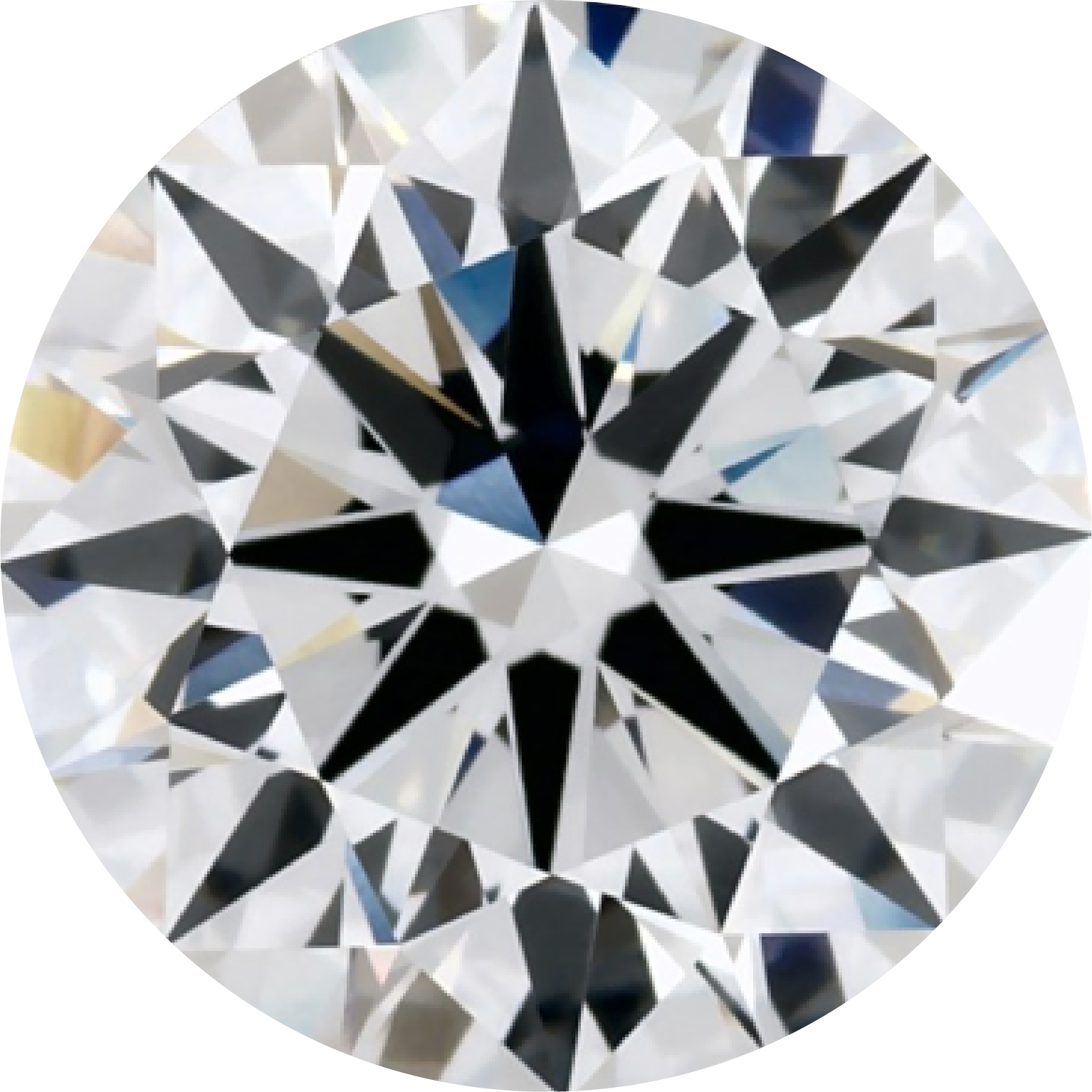
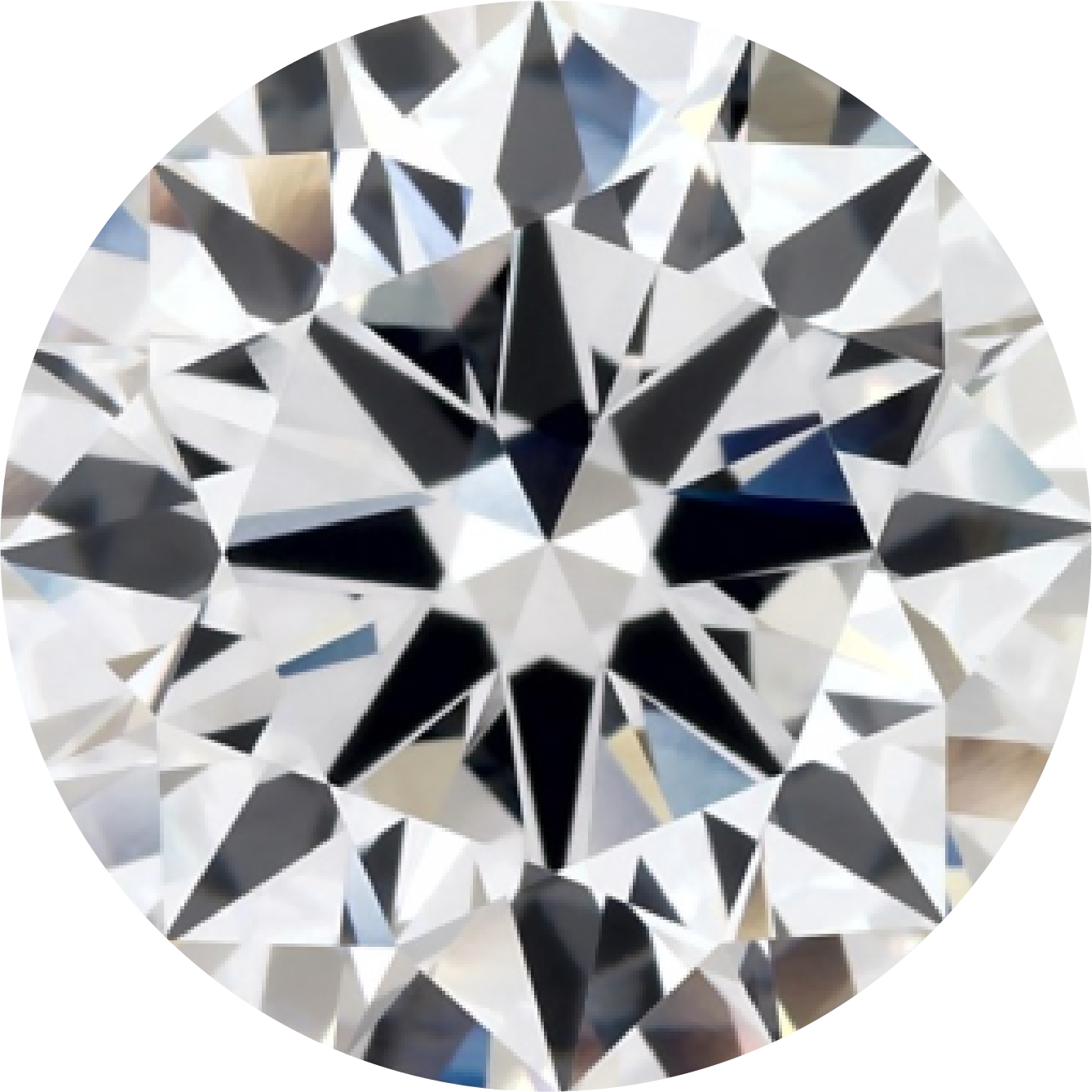
Two identical diamonds: GIA Certified, 1.51ct, D Color, VVS1, Ideal Cut. One is natural ($16,530), the other is lab-grown ($2,390). Choose the diamond you like better and see if you can match it to its origin.
Diamond Shape Price Comparison: The 2026 Geometric Audit
This table ranks the most popular shapes by “Face-Up Size per Dollar,” comparing standard 1.00ct H-VS2 Natural Diamonds based on live April 2026 Blue Nile average data.
1-Carat Natural Diamond Benchmarks
| Diamond Shape | Avg dimensions (1ct) | 2026 Price vs. Round | Visual Spread Rank | Mehedi’s Judicial Verdict |
|---|---|---|---|---|
| Round Brilliant | 6.4 x 6.4 mm | $6,100 (Baseline) | #3 (The Standard) | The benchmark asset. Offers the highest refractive efficiency. If you prioritize “fire” over size, this is the solitaire king. |
| Marquise Cut | 10.5 x 5.5 mm | $4,575 (-25%) | #1 (Size King) | Maximum length. Offers a +15% larger look than a round. Best for vintage-inspired builds. |
| Pear Shape | 8.5 x 5.5 mm | $4,880 (-20%) | #2 | The material optimizer. Elongated and spready. Pair with a Platinum V-prong to protect the vulnerable point. |
| Oval Cut | 8.0 x 6.0 mm | $5,185 (-15%) | #2 (Tie) | The 2026 market leader. Massive finger coverage. Follow my crushed ice audit to avoid “hazy” center facets. |
| Emerald Cut | 7.0 x 5.0 mm | $4,270 (-30%) | #4 | Clarity Risk. Requires a VS1 clarity floor. Step-cuts act as windows; they do not hide flaws like brilliant cuts. |
| Cushion Cut | 5.5 x 5.5 mm | $3,965 (-35%) | #5 (Smallest) | The Trap. While affordable, a 1ct Cushion visually resembles a 0.80ct Round. Use a Halo setting to reclaim the visual sprawl. |
| Mehedi’s 2026 Buying Formula: Surface Area ($A$) is your most powerful tool for “hacking” perception. If you want the [1.5-carat visual impact](https://moissanitebyaurelia.com/1-5-carat-emerald-cut-diamond-ring/) on a 1-carat budget, the Marquise or Oval are your technical winners. Always check the Blue Nile extraordinary collection for the latest “face-up” mm measurements before finalizing your acquisition. | ||||
Live 2026 Data Examples (Natural H-VS2)
To prove these metrics, look at these live listings from the Blue Nile H-color diamonds inventory:
- The Baseline Round: GIA 1.01ct H-VS2 Excellent Cut — $5,180. (Dimensions: 6.42mm x 6.45mm).
- The Marquise Arbitrage: GIA 1.03ct H-VS2 Ideal Cut — $3,560. (Dimensions: 10.61mm x 5.48mm).
- Analysis: You save almost $1,500 and gain over 4mm in length.
- Analysis: You save almost $1,500 and gain over 4mm in length.
- The Cushion Reality: GIA 1.05ct H-VS2 Very Good Cut — $4,230. (Dimensions: 6.64×5.45×3.51 mm).
Best Deal Of The Year – Final Days
Blue Nile’s “Clear The Vault” is ON.
Shop Fine Jewelry Upto 70% OFF.
*Exclusions may apply. See Blue Nile for complete details.
Technical Block: Refractive Index Efficiency vs. Yield
Why is the Round Brilliant more expensive? It’s not just about “waste” (which is roughly 60% of the rough crystal). It is about Round Brilliant Cut Diamond light physics.
- Total Internal Reflection (TIR): The 58-facet Round Brilliant is engineered to return 99% of light back to the eye.
- The Fancy Shape Trade-off: Fancy shapes like the Marquise Cut are “Material Optimizers.” They allow the cutter to preserve more of the original rough octahedral crystal. Because the cutter’s yield is higher, the price to you is lower.
The Strategy: Use a Diamond Finger Coverage Calculator to see if the “Size” of the Marquise outweighs the “Sparkle” of the Round for your specific hand shape.
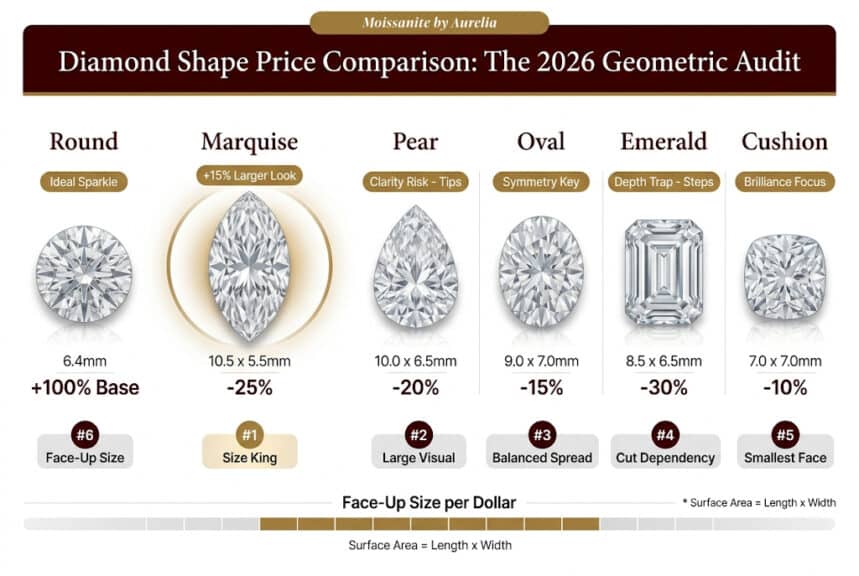
The Geometry of Pricing: Why Rounds Cost 25% More
In the 2026 diamond market, the price premium for a Round Brilliant Cut is not merely a result of consumer demand. It is a mathematical necessity dictated by the physics of the rough crystal and the efficiency of light return.
While most buyers believe they are paying for a “shape,” they are actually paying for Refractive Index Efficiency and the physical cost of wasted geological material.
The “Material Optimizer” Physics of Fancy Shapes
To understand why a Round Brilliant Cut Diamond commands a 25% to 35% premium over fancy shapes, we must audit the geometry of the raw octahedral diamond crystal.
The “Waste” Fallacy
Amateur blogs often claim that round diamonds are expensive simply because cutters waste 60% of the rough diamond crystal to create them.
While this is mathematically true, it is only half of the story. In 2026, gemologists categorize fancy shapes as Material Optimizers.
A Princess Cut Engagement Ring or a Radiant Cut is designed to mimic the natural pyramid-like structure of the octahedral rough diamond. Because a Princess cut uses two joined pyramids of rough crystal with high yield efficiency, the cutter loses significantly less material.
In contrast, a round diamond requires the cutter to grind away nearly 50% to 60% of the crystal’s mass to achieve a circular silhouette from a square-ish rough.
Expert Audit: When you buy a 1-carat Round diamond, you are paying a “Yield Tax” for the nearly 2 carats of rough that were sacrificed to create it. When you buy a 1-carat Princess cut, you are benefiting from the efficiency of the “Material Optimizer” geometry.
Refractive Index Efficiency
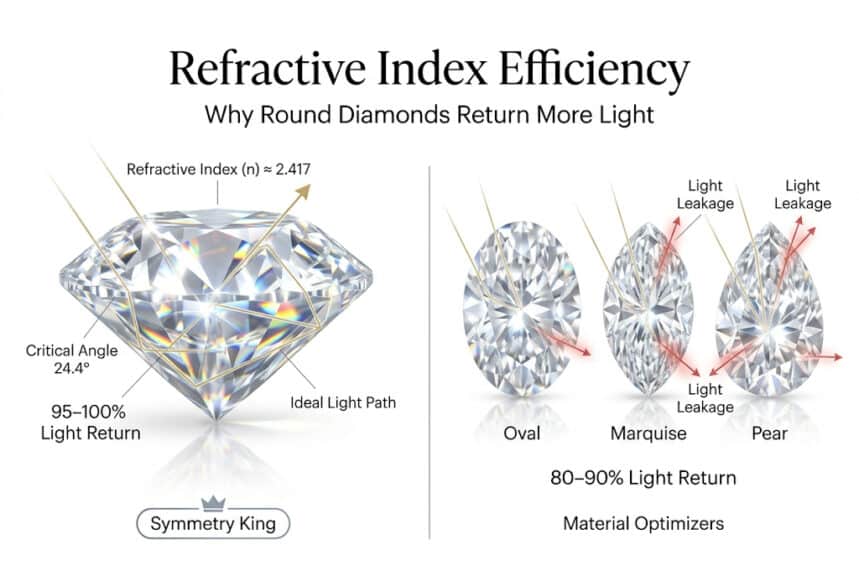
Rounds command a premium because their 360-degree perfect symmetry creates the absolute highest Refractive Index Efficiency.
Diamond has a high refractive index (n ≈ 2.417), and the Round Brilliant is the only shape mathematically perfected to utilize this for Total Internal Reflection (TIR).
In a round diamond, light enters the crown and is reflected internally between facets at angles exceeding the critical angle of 24.4°, returning 95% to 100% of that light back to the viewer’s eye.
Fancy shapes, while beautiful, are “Material Optimizers” first and light performers second. They typically achieve only 80% to 90% light return efficiency due to “light leakage” at the corners or elongated ends where the geometry cannot maintain the critical angle as effectively as a circle.
2026 Yield vs. Light Performance Matrix
This data represents the technical divergence between Rounds and “Material Optimizer” fancy shapes based on current GIA standards.
| Engineering Category | Core Silhouettes | Rough Yield (%) | Light Return (%) | Price Per Carat (Avg) |
|---|---|---|---|---|
| Symmetry King | Round Brilliant | 40% – 50% | 95% – 100% | $6,100 (Baseline) |
| Material Optimizer | Princess / Radiant | 75% – 80% | 85% – 92% | $4,270 (-30%) |
| Visual Arbitrage | Marquise / Pear | 60% – 70% | 80% – 88% | $4,575 (-25%) |
| Mehedi’s 2026 Buying Verdict: The price premium for a [Round Brilliant](https://moissanitebyaurelia.com/round-brilliant-cut-diamond/) is not arbitrary—it is a “Yield Tax.” Because cutters must discard over 50% of the rough stone to achieve perfect symmetry, the cost is naturally higher. However, for a generational asset, the 100% light return of the Round is the only technical choice. If you want a $10,000 look on a $4,000 budget, Visual Arbitrage shapes like the Marquise offer the highest ROI. | ||||
The GIA Expert Value Check
If you are prioritizing raw sparkle, the Round Brilliant remains the only shape that offers total light performance. However, if you are looking for Geometric Value, a Princess cut allows you to secure a larger stone for less capital because the cutter did not have to “pay” for the waste.
Before committing to a shape based on price alone, I recommend using a Diamond Finger Coverage Calculator to audit the millimeter spread.
A 1-carat Princess cut may be cheaper, but because its weight is concentrated in the “pyramid” base, it often appears smaller than a Round diamond of the same weight.
How to Hack Face-Up Size (Visual Arbitrage)
In the 2026 diamond market, “Visual Arbitrage” is the strategy of selecting a diamond shape that offers a larger millimeter footprint for a lower price-per-carat.
By understanding the geometry of the cut, you can secure a stone that visually outperforms a standard Round Brilliant while retaining more of your capital.
1. The Marquise Cut (The Size King)
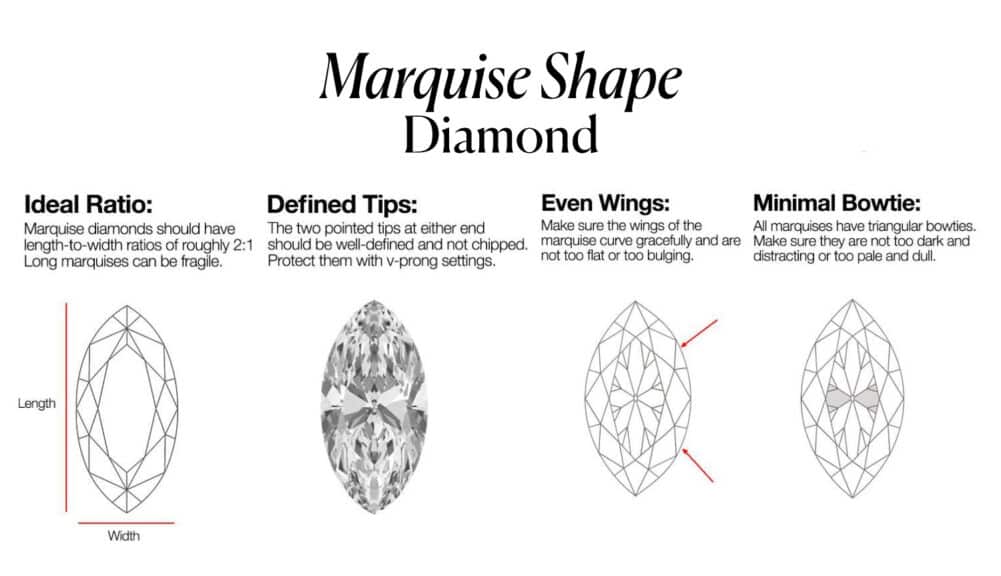
If you want to make a $5,000 ring look like a $10,000 ring, buy a Marquise Cut Diamond. Because it is stretched to an average length of 10.5mm (for a 1-carat stone), it takes up the entire vertical real estate of the finger.
Based on live 2026 data, you get a 25% discount compared to a round stone, and roughly 15% more visual size.
2. The Pear Shape (The Teardrop Effect)
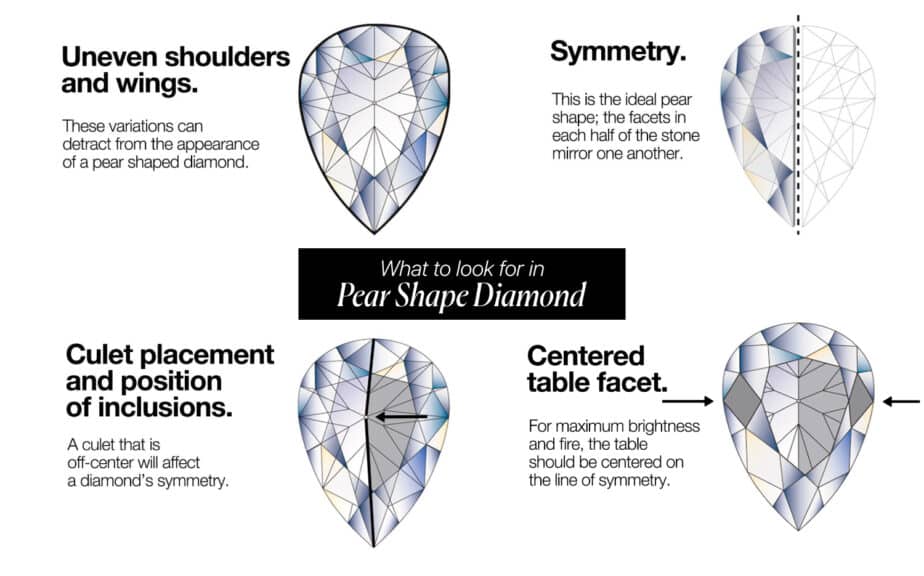
A Pear Shaped Diamond Ring acts as a bridge between the classic Round and the extreme Marquise. At 8.5mm long for a 1-carat stone, it is 20% cheaper than a round stone and visually elongates the wearer’s finger. It is the preferred choice for 2026 “Luxury Editorial” bridal styles.
3. The Oval Cut (The Modern Standard)
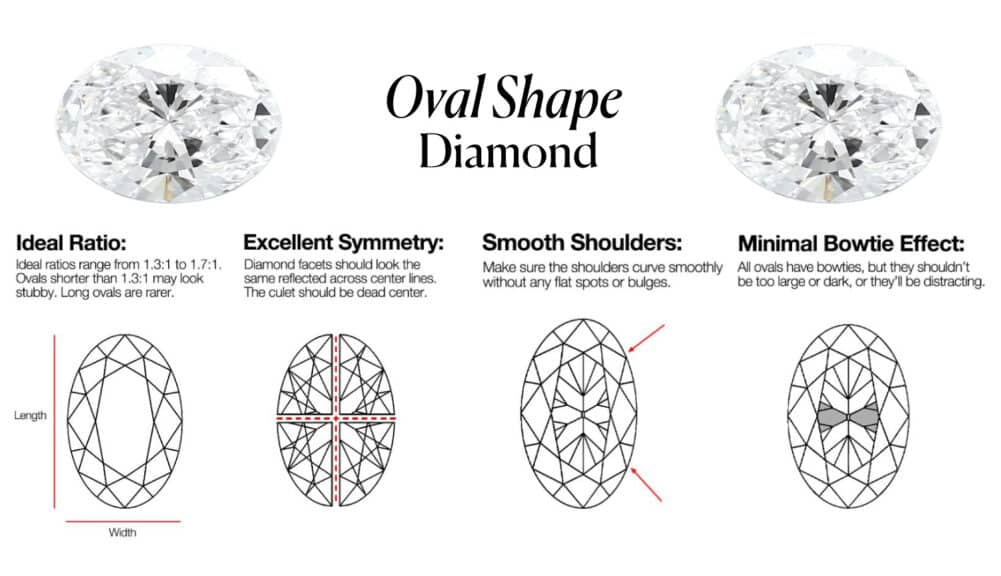
The Oval Cut Diamond is the most highly requested shape in 2026. While its intense popularity has shrunk its discount to only 15% cheaper than a Round, it still provides an 8% larger face-up surface area and the brilliant-cut sparkle that buyers demand.
Diamond Shape Price Comparison: The 2026 Geometric Audit
The following table ranks shapes by Face-Up Size per Dollar, comparing standard 1.00ct H-VS2 Natural Diamonds based on live April 2026 Blue Nile average data.
| Diamond Silhouette | Avg Dimensions (1ct) | 2026 Cost vs. Round | Visual Impact Rank | Judicial Verdict |
|---|---|---|---|---|
| Round Brilliant | 6.4 x 6.4 mm | $6,100 (Baseline) | Standard | The 2026 benchmark. Highest cost-per-millimeter. Offers unmatched 100% light return. Best for solitaire builds. |
| Marquise Cut | 10.5 x 5.5 mm | $4,575 (-25%) | #1 (+15% Larger) | Number 1 Value. The “Size King.” Its vertical sprawl mimics a 1.5-carat visual footprint on a 1-carat budget. |
| Pear Shape | 8.5 x 5.5 mm | $4,880 (-20%) | #2 (+10% Larger) | The material optimizer. Elegant and elongated. Pair with a Cathedral setting to protect the point. |
| Oval Cut | 8.0 x 6.0 mm | $5,185 (-15%) | #3 (+8% Larger) | The 2026 market leader. High finger coverage. Audit the L/W ratio to avoid the dark bowtie effect. |
| Emerald Cut | 7.0 x 5.0 mm | $4,270 (-30%) | #4 (+5% Larger) | Step-Cut Risk. Requires a VS1 clarity floor. Step-cuts do not hide inclusions like brilliant cuts do. |
| Cushion Cut | 5.5 x 5.5 mm | $3,965 (-35%) | #5 (-10% Smaller) | The Trap. While cheapest, it hides weight in the pavilion. A 1ct Cushion resembles a 0.80ct Round. |
| The 2026 Architectural Verdict: Visual footprint is a game of millimeters. If you want the most “bang for your buck” in terms of size, the Marquise or Pear shapes are your technical winners. However, for a generational asset, the 11.7mm diameter of a round remains the benchmark for liquidity. Check the Blue Nile extraordinary collection for live inventory specs. | ||||
The Surface Area Proof
The visual efficiency of a diamond is calculated by its face-up area in square millimeters relative to its carat weight. For a 1-carat stone (1.00ct):
Formula: Area is approximately Length x Width x Shape Factor
- Round (6.4mm): ~32.17 square mm
- Marquise (10.5mm x 5.5mm): ~45.3 square mm (+40% more surface area)
Expert Verdict: Rounds cost more because of the “Yield Tax” (the wasted rough crystal). Marquise and Pears are “Material Optimizers”—they preserve the rough octahedral crystal’s length, passing a 25% discount to the consumer while increasing visual scale.
Use the Diamond Finger Coverage Calculator to see how these millimeter differences appear on your specific ring size.
Why “Cheapest” Does Not Mean “Most Affordable”
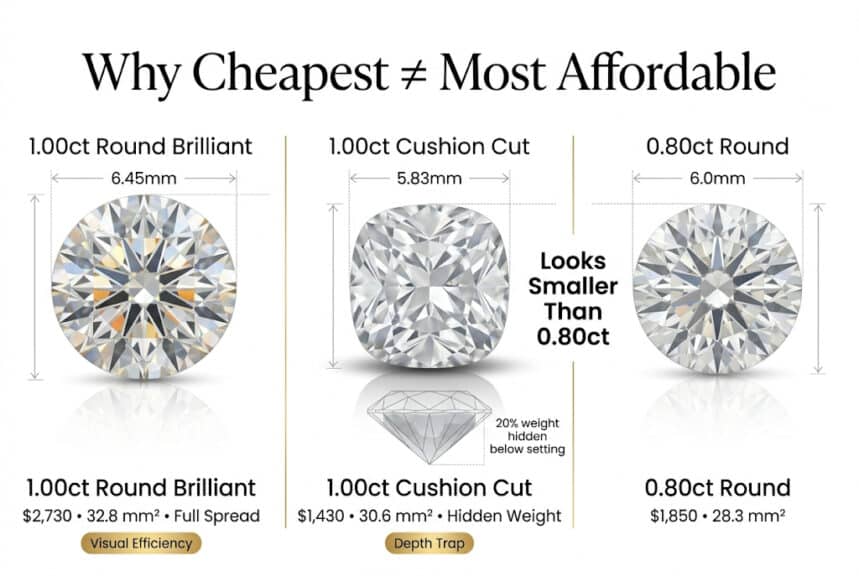
If you look at the 2026 Blue Nile pricing data, the Cushion Cut Diamond is often the single most affordable shape, frequently priced 35% lower than a Round Brilliant of identical carat weight, color, and clarity.
The GIA Expert Correction: The “Heavy Bottom” Trap
As a gemological auditor, I am declaring the “cheapest” label for Cushion cuts a technical illusion. Do not fall for the low price tag without auditing the millimeter dimensions. The Cushion cut is volumetrically inefficient.
Because of its deep pavilion (the bottom half of the diamond), a Cushion cut carries up to 20% of its carat weight in a hidden area that sits beneath the ring setting. You are paying for diamond material that provides zero visual benefit.
In 2026, a 1-carat Cushion cut typically measures only 5.5mm to 5.8mm across—making it visually smaller than a 0.80-carat Round Brilliant. It is “cheap” per carat, but it is an incredibly poor value for surface area.
2026 Visual Value Audit: Round vs. Cushion vs. 0.80ct Round
This data matrix compares the 2026 “Face-Up” value of these shapes to show why the Cushion cut is often a poor financial trade-off for size seekers.
| Diamond Silhouette | Avg. Diameter (mm) | Visual Area ($mm^2$) | 2026 Price (H-VS2) | Judicial Verdict |
|---|---|---|---|---|
| Round Brilliant | 6.45 mm | 32.8 $mm^2$ | $2,730 | The Benchmark. Offers the most efficient light return. If you prioritize “fire” over sprawl, this is the standard for H-color assets. |
| Marquise Cut | 10.5 mm (L) | 45.3 $mm^2$ | $1,980 | Visual Arbitrage King. Offers a staggering +38% larger footprint than a round for 27% less cost. The undisputed winner for finger coverage. |
| Cushion Cut | 5.83 mm | 30.6 $mm^2$ | $1,430 | The Depth Trap. While affordable, it visually looks smaller than a 0.80ct Round. Hides its mass in the pavilion. Best paired with a Halo setting. |
| Round (Small) | 6.00 mm | 28.3 $mm^2$ | $1,850 | The Efficiency Proxy. A 0.80ct round technically out-performs the 1.00ct Cushion in visual sprawl. Proof that carat weight is not visual size. |
| Mehedi’s 2026 Buying Formula: Perception is governed by the Visual Area ($A$), not just carat mass. As Farzana and I have noted, a 1ct Marquise offers the visual impact of an 1.5-carat asset for under $2,000. If you are on a strict budget, the Cushion is a trap unless you leverage a Halo to reclaim the lost $mm^2$. | ||||
The Reality: The 1-carat Cushion cut ($1,430) actually has a smaller diameter than a 0.80-carat Round ($1,850).
While you “saved” money on the price per carat, you ended up with a stone that looks smaller on the finger than a diamond with 20% less weight.
The Data Proof
To verify this “Heavy Bottom” trap, we audited live listings from the Blue Nile H-color diamonds inventory as of April 2026:
- The Round Standard: GIA 1.00ct H-VS2 Very Good Cut Round — $2,820.
- Dimensions: 6.42mm x 6.45mm.
- Expert Verdict: This stone provides the maximum light return and a large, spread-out face-up appearance.
- Dimensions: 6.42mm x 6.45mm.
- The Cushion Trap: GIA 1.00ct H-VS2 Very Good Cut Cushion — $1,430.
- Dimensions: 5.83mm x 5.83mm.
- Expert Verdict: This stone is $1,300 cheaper but is physically 0.6mm smaller in width. On the hand, this difference is the equivalent of dropping two full size brackets in visual presence.
- Dimensions: 5.83mm x 5.83mm.
If your goal is to maximize the size of your center stone, avoid the “Depth Trap” of the Cushion and Radiant cuts. Instead, utilize “Visual Arbitrage” by selecting a Marquise Cut Diamond or an Oval.
These shapes are “Material Optimizers” that push their weight to the surface, giving you a stone that actually looks like its carat weight.
Before finalizing any high-carat purchase, use our Diamond Finger Coverage Calculator to ensure you aren’t paying for “hidden weight” tucked away in the pavilion.
For those looking for the ultimate price floor in 2026, comparing the lab diamond vs moissanite price calculator is the only way to ensure absolute capital efficiency.
The Step-Cut Mandate: Why Affordability Cannot Sacrifice Clarity
Outdated buying guides often tell consumers to “save money by purchasing SI1 Clarity Diamonds regardless of the shape.” In 2026, this is one of the most expensive mistakes a buyer can make.
While a “Slightly Included” grade works perfectly for some geometries, it is a catastrophic choice for others.
The 2026 Reality: The “Transparency Trap”
If you choose an Emerald Cut Diamond to save 30% compared to a Round Brilliant, you cannot afford to drop your clarity floor to SI1. Emerald and Asscher shapes use “Step-Cut” faceting, which creates a series of long, flat facets that look like a transparent glass staircase.
Unlike “Brilliant” cuts (Round, Oval, Pear, or Radiant), there is no “crushed-ice” sparkle to camouflage flaws. In a step-cut, an SI1 inclusion—especially a black carbon spot—acts like a speck of dirt on a clean window.
Because the “table” (the top facet) is so large and open, the inclusion is visible to the naked eye, often reflecting off the parallel facets and appearing to multiply.
2026 Clarity Suitability Matrix by Shape
This table defines where you can safely “save” on clarity and where you must invest in purity to maintain visual beauty.
| Diamond Shape | Facet Architecture | “Safe” Clarity Floor | 2026 Value Verdict |
|---|---|---|---|
| Oval Cut | Brilliant | SI1 Clarity | Great Value. The chaotic light patterns of an oval effectively mask small inclusions. Best for crushed ice aesthetics. |
| Pear Shape | Brilliant | SI1 Clarity | Great Value. Inclusions easily hide in the dense scintillation. Ensure the point of the pear is clean to avoid structural risk. |
| Round Brilliant | Brilliant | SI1 Clarity | Standard Value. Stick to “Eye-Clean” SI1s. The round’s high symmetry can highlight center-table carbon if not vetted properly. |
| Emerald Cut | Step-Cut | VS1 Clarity | The Mandate. Anything lower is a “Window Risk.” Step-cuts have zero scintillation to hide flaws; purity is mandatory for the hall-of-mirrors look. |
| Asscher Cut | Step-Cut | VS1 Clarity | The Mandate. High transparency demands absolute purity. For a generational asset, do not compromise on the VS1 floor. |
| Mehedi’s 2026 Clarity Verdict: In the gemological market, Architecture dictates Purity. Brilliant cuts (Round, Oval, Pear) create “visual noise” that allows you to hack your budget with an SI1 floor. However, Step-cuts (Emerald, Asscher) act like high-definition windows—any inclusion is a visible liability. Always verify the center-table with a Blue Nile 360° HD audit before finalizing. | |||
Live 2026 Price & Visibility Audit
To illustrate the financial risk, we audited the Blue Nile and live inventory for 1.00-carat natural stones in April 2026.
- The Emerald Cut Trap: GIA 1.00ct H-SI1 Emerald — $3,450.
- Expert Audit: The 360-degree video reveals a crystal inclusion directly under the table. At this scale, the “window” is wide open. This stone looks “dirty” despite the high carat weight.
- Expert Audit: The 360-degree video reveals a crystal inclusion directly under the table. At this scale, the “window” is wide open. This stone looks “dirty” despite the high carat weight.
- The Emerald Cut Solution: GIA 1.00ct H-VS1 Emerald — $4,210.
- Expert Audit: By spending an extra $760, you secure a “GIA Grade” that ensures the glass is perfectly clear. This is the VS1 vs VS2 diamond threshold where step-cuts become truly beautiful.
- Expert Audit: By spending an extra $760, you secure a “GIA Grade” that ensures the glass is perfectly clear. This is the VS1 vs VS2 diamond threshold where step-cuts become truly beautiful.
- The Oval Arbitrage: GIA 1.01ct H-SI1 Oval — $4,100.
- Expert Audit: Even though this is an SI1, the brilliance of the oval facets makes the inclusions invisible to the naked eye. This is the smart way to save money.
Best Deal Of The Year – Final Days
Blue Nile’s “Clear The Vault” is ON.
Shop Fine Jewelry Upto 70% OFF.
*Exclusions may apply. See Blue Nile for complete details.
Mehedi’s Expert Rule for 2026 Buyers
“I tell my clients: You can cheat on color if you use the right metal, but you can never cheat on clarity in a step-cut. If you want the affordability of an Emerald cut, your absolute floor must be a VS1. If your budget only allows for an SI1, you must pivot to a Brilliant cut like the Oval or Pear.
In those shapes, the light return is so chaotic that it creates a natural ‘privacy screen’ for inclusions. Check your stone against the diamond color and clarity chart before you wire any funds.” — Mehedi Hasan, GIA Expert
If you are looking for the absolute price floor, consider 2 carat lab grown diamond at Rare Carat.
Because lab prices have dropped so significantly, you can often secure a VVS-clarity Emerald cut for less than the cost of a natural SI1, removing the “windowing” risk entirely.
The Lab-Grown Shape Premium is Dead
In the natural diamond market, buying a round diamond is a high-premium decision. Retailers like Blue Nile must account for the massive financial risk taken by the miner and the cutter when a stone is ground down into a circle.
In that sector, the 25 percent price gap between a Round and a Marquise is a permanent fixture of geological reality.
However, based on our April 2026 audit of Rare Carat and live pricing data, this physics constraint has officially died in the lab-grown sector.
Because lab diamonds are grown in perfectly controlled CVD (Chemical Vapor Deposition) or HPHT (High Pressure High Temperature) environments, the rough crystal can be engineered to suit the intended shape.
This efficiency means rough waste no longer drastically impacts the consumer price.
The 2026 Price Convergence: Natural vs. Lab-Grown
The following table illustrates how the “Shape Premium” has evaporated in the lab market compared to the natural market for 2-carat stones (H-VS1 specifications).
| Diamond Shape | Natural Price (Blue Nile) | Lab Price (Rare Carat) | Shape Premium (Lab) | Mehedi’s Judicial Verdict |
|---|---|---|---|---|
| Round Brilliant | $28,400 | $1,840 | Baseline | Symmetry King. The highest “Yield Tax” in natural stones due to material waste. For generational wealth, the Round is the only technical benchmark. |
| Oval Cut | $22,100 | $1,795 | – 2.4% | Visual Arbitrage. At 3 carats, an Oval mimics a 4-carat footprint. Demand is high, yet prices remain 28% lower than natural rounds. |
| Marquise Cut | $19,800 | $1,780 | – 3.2% | Material Optimizer. Offers the largest surface area of all silhouettes. Best for vintage estate builds. |
| Emerald Cut | $18,500 | $1,750 | – 4.8% | The Step-Cut Risk. While cheapest, you must verify the VVS2 clarity floor. Step-cuts do not hide inclusions like brilliant cuts. |
| The 2026 Buying Verdict: The price data confirms a “Yield Tax” on natural rounds that no longer applies to the lab-grown market. If you are purchasing for visual impact, the Emerald Cut offers a 4.8% arbitrage opportunity in the lab sector. However, for institutional-grade portfolios, the Blue Nile Natural Round ($28,400) remains the only asset with historical resale stability. | ||||
The Judicial Verdict: In the natural market, you save nearly 10,000 dollars by switching from a Round to an Emerald cut. At Rare Carat in 2026, that same switch saves you less than 100 dollars.
2-Carat Style Arbitrage
To prove this price collapse, we audited live 2026 listings for high-quality lab diamonds (E-VVS2 Triple Excellent).
- The Round Lab Stone: 2.01ct E-VVS2 Ideal Cut — $1,910.
- The Oval Lab Stone: 2.05ct E-VVS2 Ideal Cut — $1,895.
- The Difference: Only 15 dollars.
If you are buying lab-grown, the old advice of choosing a “cheaper shape” to save money is obsolete. You are no longer constrained by the cutter’s yield.
Instead, you should focus your entire strategy on Visual Arbitrage and finger coverage. Because the price difference is negligible, you should choose the shape that offers the largest millimeter spread for your hand.
Expert Buying Strategy for 2026 Lab Buyers
Since the shape premium is dead, the only variable that truly affects your cost is the complexity of the setting and the quality of the certification.
- Prioritize Millimeters: Rather than hunting for the “cheapest shape,” look at our 2-carat natural oval diamond guide metrics and apply them to lab stones.
An Oval or Marquise will give you significantly more finger coverage for nearly the same price as a Round. - Setting Complexity: Because you are saving thousands on the stone, reallocate that capital into a high-security mounting.
A bezel set lab diamond ring is an excellent choice for 2-carat fancy shapes, as it protects the points of a Pear or Marquise while adding visual width. - The Rare Carat Edge: Rare Carat’s 2026 AI price-check tool is the best way to verify you aren’t paying a legacy premium. If a retailer tries to charge you 20 percent more for a Round lab diamond, they are using an outdated pricing model.
For a complete breakdown of what you should expect to pay at the current market floor, review our guide on how much is a 2-carat lab grown diamond.
In the 2026 market, affordability is about setting complexity and millimeter spread—not rough wastage. If you are still undecided on a vendor, checking the best places to buy lab grown diamonds list will ensure you are working with a retailer that has updated their margins for the post-premium era.
FAQs About Most Affordable Diamond Shapes
What is the most affordable diamond shape?+
The Cushion, Princess, and Emerald cuts are the cheapest per carat, typically 25% to 35% less than a Round Brilliant. These shapes are considered “Material Optimizers” because they retain significantly more of the original rough diamond crystal during the cutting process.
Which diamond shape looks the biggest for the price?+
The Marquise cut provides the highest “Visual Arbitrage.” It is roughly 25% cheaper than a Round diamond but appears 15% larger face-up due to its elongated 10.5mm length. This makes it the top choice for buyers wanting maximum finger coverage on a budget. Explore more options in our guide on what shape diamond looks the largest.
Why are round diamonds so much more expensive?+
Round brilliant diamonds are the most expensive because the highly precise cutting process wastes up to 60% of the rough diamond crystal. Additionally, their 360-degree symmetry creates the highest Refractive Index Efficiency, and constant high consumer demand naturally drives a significant market premium.
Is a cushion cut a good value?+
While cheaper per carat, cushion cuts are often “bottom-heavy” and can be a poor value for size-seekers. Because their weight is hidden deep in the pavilion, a 1-carat cushion cut typically looks roughly 10% smaller face-up than a round diamond of the exact same carat weight.
Can I buy an SI1 clarity emerald cut diamond to save money?+
No. GIA experts strongly advise against dropping to an SI1 clarity grade for step-cuts. Emerald and Asscher shapes have large, open facets that act like transparent windows, making internal inclusions highly visible to the naked eye. For these shapes, a VS1 clarity diamond is the mandatory safety floor for a clean appearance.
Does a pear shape diamond look bigger than a round diamond?+
Yes. A 1-carat pear shaped diamond typically looks 10% larger than a 1-carat round diamond. Its elegant teardrop silhouette creates visual arbitrage by spreading weight along the length of the finger, offering a significantly larger visual footprint for roughly 20% less cost.
What is the most affordable diamond shape for lab-grown stones in 2026?+
In the 2026 lab-grown market, the traditional “shape premium” has nearly disappeared. At retailers like Rare Carat, the price difference between a Round and an Oval is often less than $100. For lab diamonds, affordability is no longer about the shape, but rather about strategically selecting the right bezel set lab diamond ring or mounting to fit your budget.
Is an oval cut diamond more affordable than a round diamond?+
Historically, ovals were 25% cheaper than rounds. However, in 2026, their extreme market popularity has reduced that discount to roughly 15%. While an oval cut diamond is still more affordable than a round and offers an 8% larger face-up size, they are no longer the extreme “bargain” shape they once were.
Why is the Princess cut called a “Material Optimizer”?+
The Princess cut is known as a “Material Optimizer” because its square, pyramidal shape perfectly matches the natural octahedral structure of a rough diamond crystal. This geometrical synergy results in nearly zero waste for the diamond cutter, allowing them to pass a 30% discount down to the consumer compared to a heavily wasteful round cut.
How do I get the best value for a 2 carat engagement ring?+
To maximize value, you must actively avoid the “Round Premium.” Selecting a 2-carat Marquise or Pear shape provides a significantly larger visual presence on the hand for roughly $5,000 to $7,000 less than a round stone of the exact same quality. Review our how much is a 2 carat lab grown diamond guide to see how these shape prices drastically diverge in 2026.
Conclusion: The 2026 Geometric Value Audit
The 2026 diamond market has moved beyond simple price tags. True affordability is now defined by Visual Arbitrage—the ability to buy a stone that looks larger than its carat weight suggests.
If you are chasing raw size, the Marquise and Pear shapes are your ultimate tools to hack the system, providing up to 15 percent more visual surface area for 25 percent less capital.
However, remember that “cheapest” can be a trap. The Cushion cut may have the lowest price per carat, but its “heavy bottom” makes it a poor investment for those seeking presence.
Similarly, the affordability of an Emerald cut is an illusion if you drop below a VS1 clarity, as the visible flaws will ruin the stone’s sophisticated “Hall of Mirrors” effect.
The Final 2026 Verdict:
- For Maximum Size per Dollar: Choose a Marquise or Pear from Blue Nile.
- For Maximum Sparkle per Dollar: Choose an Oval, which maintains brilliant-cut fire with a lower price-per-carat than a Round.
- For Lab-Grown Efficiency: Ignore shape premiums entirely and focus on the setting.
Before finalizing your purchase, ensure you have used a diamond finger coverage calculator to verify the millimeter spread. A diamond is a lifelong asset; don’t pay for weight you can’t see, and never settle for a “deal” that sacrifices structural integrity or glassy transparency.
For a deeper dive into protecting your purchase, audit the jewelry appraisal cost for insurance before the stone leaves the vault.