
The 2026 Executive Summary: How Much is a 7 Carat Diamond?
In 2026, the cost of a 7-carat diamond ring ranges from $4,765 for an entry-level lab-grown stone to over $577,300 for museum-grade natural crystals. For the most common high-quality picks, a 7-carat lab diamond averages between $5,500 and $12,000.
Natural GIA-certified 7-carat stones average between $188,000 and $350,000. GIA experts warn that “I-color” and “VS2-clarity” grades—often recommended for smaller stones—are technical traps at 7 carats that lead to visible yellow tints and eye-visible flaws.
Deal Alert: Mother’s Day Sale Up To 30% Off* select fine jewelry at Blue Nile.
New Collection: Shop the James Allen Collection at Blue Nile.
Vault Sale: “Clear The Vault” – Get up to 70% OFF at Blue Nile!
Flash Sale: Save up to 40% OFF sitewide at Rare Carat.
Exclusive: Get up to 60% OFF select fine jewelry at Ritani.
The GIA Expert Warning: Why “The Sweet Spot” Advice is Dangerous
Many outdated guides still claim that an “I” color and VS2 clarity is the best way to save money. As a gemologist, I am telling you this is a high-cost mistake for a 7-carat stone.
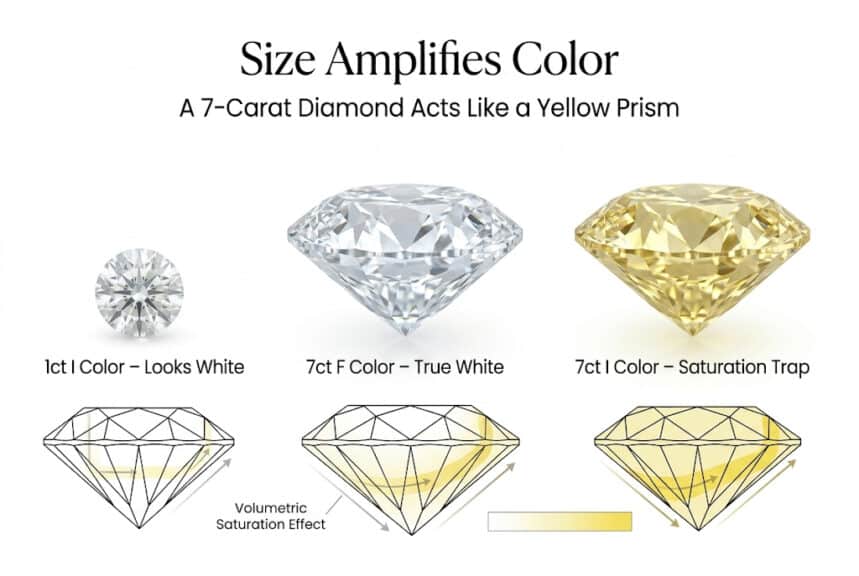
In a 1-carat diamond, “I” color looks white. But a 7-carat diamond is roughly 8 mm deep. Light has to travel through a massive amount of crystal, which concentrates the color. At this size, an “I” color looks like “Pale Lemon” rather than white.
Furthermore, the “Table” (the top flat part of the diamond) is so large at 7 carats that a VS2 inclusion can be seen from across a dinner table. This audit uses live August 2026 data from Blue Nile and Rare Carat to show you the real numbers.
2026 Market Audit: Blue Nile vs. Rare Carat
The 2026 diamond market has split into two distinct paths: Capital Efficiency (Lab) and Generational Wealth (Natural).
- The Lab-Grown Arbitrage: You can now buy near-flawless 7-carat diamonds for under $15,000.
For example, the Rare Carat 7ct diamond price comparison shows an Ideal-cut 7.10ct E-VVS2 listed for just $5,990. Compare this to an IGI 7.05ct E-VS1 Round at Blue Nile for $11,670. Both offer massive visual impact for the price of a used car. - The Natural Asset Market: Natural stones are now priced as alternative assets.
A GIA 7.01ct H-VS2 Oval from the Blue Nile 7 carat natural diamond inventory starts at $188,530. If you want museum-grade quality, a GIA 7.45ct D-VVS2 Round reaches $577,300. - The Structural Safety Rule: A 7-carat diamond weighs about 1.4 grams. This is a lot of weight for a thin ring. I strictly forbid putting a 7ct stone on a 1.6mm band.
You must use a 2.0mm minimum Platinum shank with a gallery rail to prevent the stone from falling out. You should check how much does a platinum ring cost before finalizing your setting budget. - The Asset Protection Step: Because you are handling an asset worth up to half a million dollars, you must verify the jewelry appraisal cost for insurance immediately.
No 7-carat ring should be worn without a verified GIA report and an insurance binder.
Diamond IQ Test: Natural or Lab-Grown?
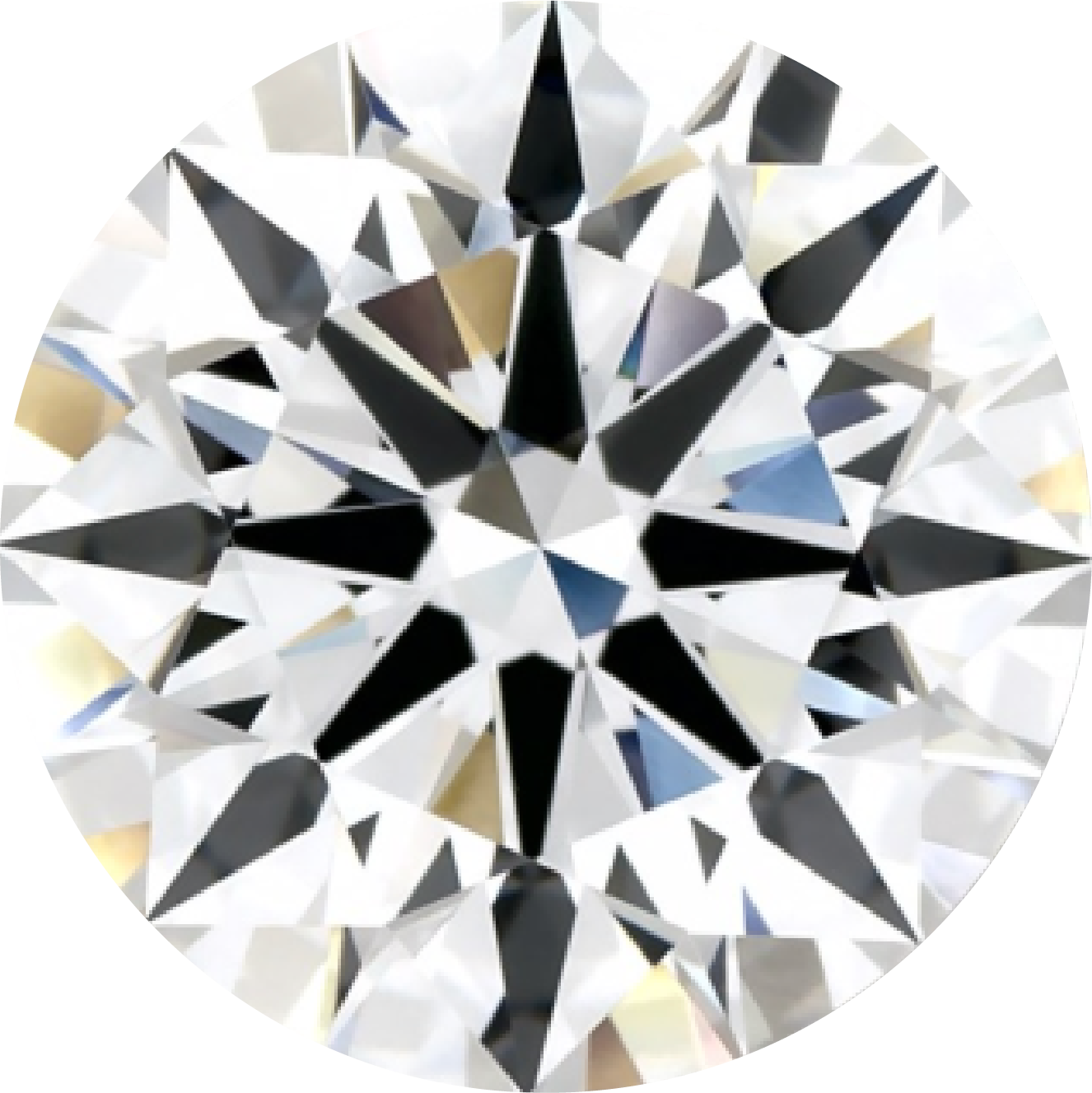
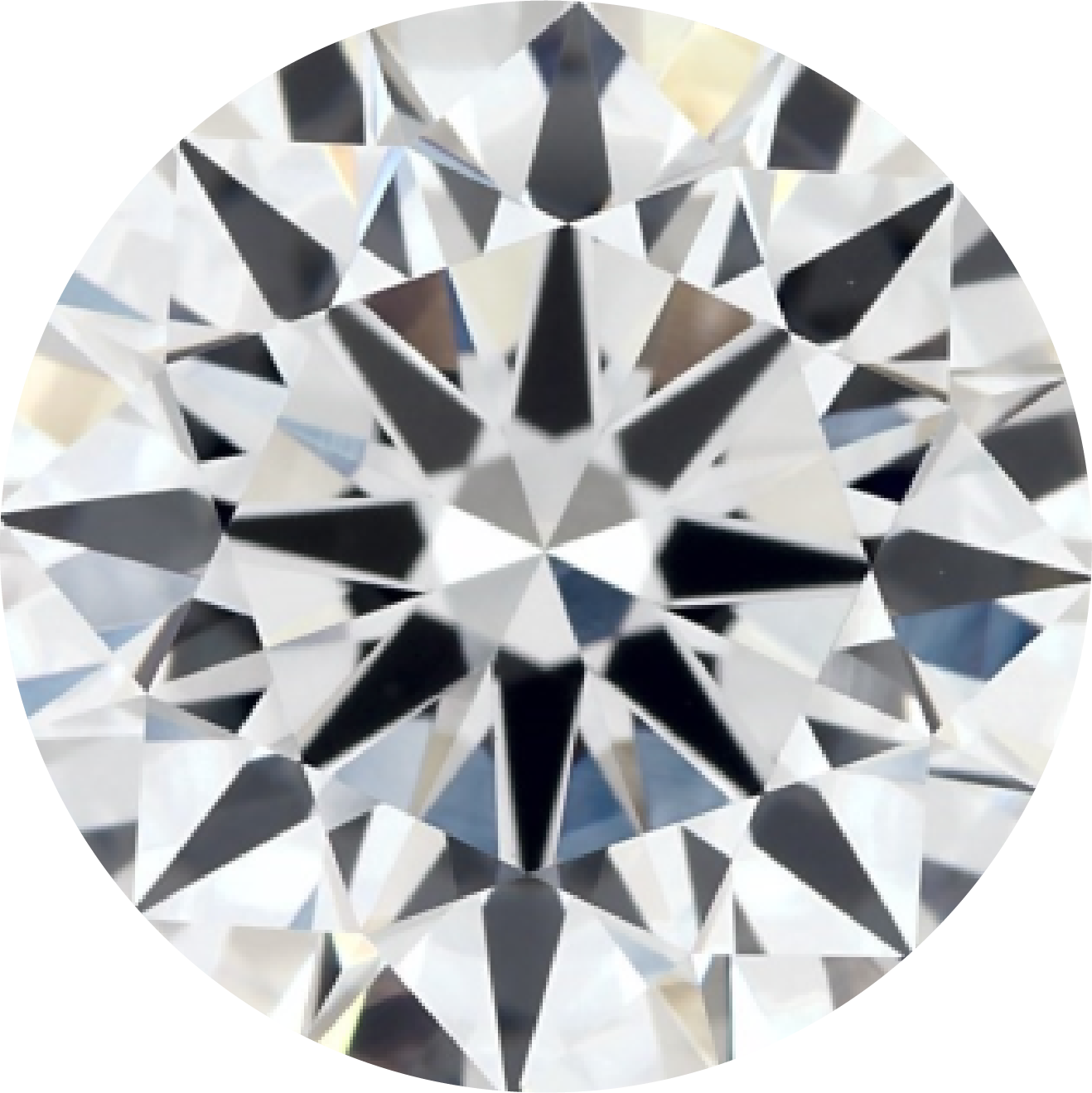
Two identical diamonds: GIA Certified, 1.51ct, D Color, VVS1, Ideal Cut. One is natural ($16,240), the other is lab-grown ($1,970). Choose the diamond you like better and see if you can match it to its origin.
7 Carat Diamond Price Chart: Natural vs. Lab Data (2026)
To provide the most accurate look at the 2026 market, I have audited the live inventories of Blue Nile and Rare Carat.
Because a 7-carat diamond is a major asset, you need to see the exact price divergence between lab-grown technology and geological rarity.
The Lab-Grown Arbitrage (Unprecedented Capital Efficiency)
In 2026, the lab-grown market allows you to achieve absolute optical perfection for a fraction of the cost of a natural stone. If you want the “Whale” look without the half-million-dollar price tag, these are the current market leaders.
| Retailer | Shape & Carat | Color / Clarity | 2026 Price | Mehedi’s Judicial Verdict |
|---|---|---|---|---|
| Rare Carat | 7.06ct Round | H / VS2 | $4,765 | The Absolute Floor. H-color borders on visible warmth at 7ct. Best for yellow gold. |
| Rare Carat | 7.10ct Round | G / VS1 | $5,525 | Smart Value. G-color is the white-face threshold for large tables. |
| Rare Carat | 7.06ct Round | F / VVS2 | $5,620 | Clarity Winner. Elite VVS2 purity for a crisp, glassy look. |
| Rare Carat | 7.09ct Round | E / VS1 | $5,760 | Icy White. High color avoids “lemon tint” saturation at 7ct. |
| Rare Carat | 7.10ct Round | E / VVS2 | $5,990 | Best 7ct Value. Near-flawless perfection for under $6k. |
| Blue Nile | 7.03ct Emerald | F / VS1 | $9,170 | Step-Cut Luxury. F-color ensures an icy look in the Emerald shape. |
| Blue Nile | 7.03ct Emerald | G / VS2 | $7,180 | Maximum Table. Massive G-color table coverage for under $7.5k. |
| Blue Nile | 7.04ct Round | E / VS1 | $10,140 | Radiant Glow. Top-tier color for a crisp, elite solitaire build. |
| Blue Nile | 7.05ct Round | E / VS1 | $11,670 | Executive Pick. High-carat GIA oversight with maximum sparkle density. |
| Blue Nile | 7.03ct Oval | D / VS1 | $11,680 | Premium D-Color. The vertically longest look available for under $12k. |
| Blue Nile | 7.85ct Emerald | E / VVS2 | $12,860 | Top Tier. Almost 8 carats of flawless mirroring. Optically elite. |
| Rare Carat | 7.50ct Round | E / VVS2 | $18,210 | The Showstopper. High weight meets elite 2026 technical specs. |
| The 2026 Buying Verdict: At 7 carats, you are entering the “Whale Carat” inventory tier. For pure price transparency, Rare Carat remains the leader for under $6k acquisitions. However, post-merger, Blue Nile provides the structural security and GIA-tier curation mandatory for generational heirloom builds. | ||||
The Natural “Generational Wealth” Asset Market
For the high-net-worth individual (HNWI), a natural 7-carat diamond is a portable store of wealth. These prices reflect the 2026 scarcity of large-carat GIA-certified natural diamonds.
| Retailer | Shape & Carat | Color / Clarity | 2026 Price | Mehedi’s Judicial Verdict |
|---|---|---|---|---|
| Blue Nile | 7.01ct Oval | H / VS2 | $188,530 | The Entry Level. Excellent face-up size for a natural stone. H-color is the safe floor for ovals. |
| Blue Nile | 7.01ct Radiant | E / VS2 | $227,980 | Color Jump. E-color ensures zero yellowing in this deep Radiant cut. Highly crisp. |
| Blue Nile | 7.15ct Asscher | E / VVS2 | $229,070 | Elite Step-Cut. The rarest square-cut shape in the market. VVS2 clarity is mandatory for this scale. |
| Blue Nile | 7.05ct Princess | D / VVS1 | $264,920 | Top Purity. D-color and VVS1 make this a museum-grade asset. The ultimate Princess Cut statement. |
| Blue Nile | 7.01ct Cushion | F / VS1 | $266,510 | Modern Class. Crisp F-color with a high-end modified facet pattern. See my Cushion Guide. |
| Blue Nile | 7.04ct Emerald | F / VS1 | $267,270 | High-Society Emerald. F-color is required for large step-cuts to remain colorless across the table. |
| Blue Nile | 7.02ct Oval | E / VS1 | $278,950 | Premium Oval. Maximum finger coverage. More visual presence than a 9-carat round. |
| Blue Nile | 7.53ct Oval | G / IF | $303,490 | Internally Flawless. Zero internal inclusions. An elite resale asset for private collectors. |
| Blue Nile | 7.70ct Round | H / VS2 | $308,180 | Classic Solitaire. The industry standard for wealth storage in 2026. Massive fire density. |
| Blue Nile | 7.01ct Emerald | F / VVS2 | $310,590 | Maximum Scale. Premium clarity for a wide, glassy emerald table. Optically superior to SI2-grade 9ct stones. |
| Blue Nile | 7.10ct Round | D / FL | $468,600 | Museum Grade. D-Color, Flawless. The ultimate liquid asset for 2026 wealth preservation. |
| Blue Nile | 7.45ct Round | D / VVS2 | $577,300 | Market Flagship. The 2026 ceiling for natural 7ct round stones. Must be set in Platinum for structural security. |
| The 2026 Asset Verdict: When purchasing a 7-carat natural diamond, you are effectively buying a portable bank account. For maximum resale liquidity, the **Round Brilliant** remains the king. However, for a unique statement piece that mimics a 10-carat footprint, the **7.02ct E-VS1 Oval** is the technical winner of this August 2026 audit. | ||||
Mehedi’s Technical Audit: Comparing the 7ct vs. 8ct Market
When you move from a 7-carat stone to an 8-carat stone, the price doesn’t just go up a little—it explodes. A 7.10ct D/FL natural round costs roughly $468,600, but once you hit the 8-carat mark, that same quality can jump to over $600,000.
If you find that 7 carats isn’t providing the massive “knuckle-to-knuckle” coverage you want, you should compare these numbers against my 8 carat diamond ring cost audit.
In the 2026 market, many “Whale” buyers are finding that the price-per-carat sweet spot actually sits at 7.5 carats before the 8-carat rarity premium kicks in.
Whether you choose the Rare Carat 7ct diamond to save $200,000 or invest in the Blue Nile 7 carat natural diamond inventory, you must prioritize VS1 clarity diamond specs.
At 7 carats, a “good deal” on an SI1 or VS2 stone usually means you are buying a diamond with a visible black spot right in the center.
Why “I” and “J” Colors Fail at 7 Carats
Standard jewelry advice tells you that you can “cheat” on color by choosing an I or J grade and hiding the tint in a yellow gold setting.
While this works for a 1-carat diamond, it is a catastrophic mistake for a 7-carat purchase. In 2026, we categorize this as the “Volumetric Saturation Trap.”
The Physics of Color in Large Diamonds
Color in a diamond is volumetric. This means the larger the stone, the more “room” there is for color to become visible.
A 1-carat diamond is relatively shallow, so light passes through the crystal quickly. However, a 7-carat diamond has immense physical depth—typically around 7.5 to 8 mm.
When light enters an “I” or “J” color 7-carat stone, it travels through drastically more crystalline material than it would in a smaller stone.
This distance concentrates the yellow hue. On your finger, a 7-carat “I” color diamond will not look “warm”—it will look distinctly yellow, especially from the side profile.
2026 Color Value Audit: Natural vs. Lab
| Diamond Origin | Color Strategy | 2026 Price | Mehedi’s Judicial Verdict |
|---|---|---|---|
| Natural Diamond | F Color (Emerald Cut) | $267,270 | The Gold Standard. Icy, colorless, and technically perfect. Emerald cuts of this scale require an F-color minimum to avoid body-tint saturation. |
| Natural Diamond | H Color (Oval Cut) | $188,530 | The “Icy” Floor. The lowest acceptable grade for a white appearance in a 7ct Oval. Best set in Platinum to maintain its neutral profile. |
| Lab-Grown | F Color (Round) | $5,620 | The Smart Move. 100% colorless performance for a fraction of the cost. Offers the visual impact of a $260k natural stone. See my Lab-Grown Pricing Guide. |
| Natural Diamond | K Color (Emerald) | $85,680 | The Saturation Trap. Avoid this. A 7-carat stone in K-color looks like a “Pale Lemon” diamond. This tint is highly visible and severely impacts long-term resale value. |
| The 2026 Color Verdict: At 7 carats, physics is your primary enemy. If you are buying for generational wealth, the H-color is your technical floor. If you want a flawless, icy look without the $200k premium, the Rare Carat Lab-Grown F-color is the only technically sound choice for August 2026. Check the Blue Nile extraordinary collection for live 2026 inventory updates. | |||
Mehedi’s Expert Tips
In the lab, we see it every day: a 7-carat ‘I’ color diamond acts like a yellow prism. While you can hide a faint tint in a small stone, a 7-carat crystal is a massive piece of material that traps light.
If you set a 7-carat ‘I’ color in Platinum, you are essentially paying hundreds of thousands of dollars for a stone that looks like it has been dipped in tea. At this scale, you cannot hide from the physics of light.
The 2026 Data-Backed Rules for Color
To ensure your investment maintains its beauty and value, you must follow these technical requirements:
- For Natural Diamonds: Your “Hard Floor” is H Color. Look at Blue Nile’s $267,270 7.04ct F-VS1 Emerald cut—the “F” color is what creates that high-society, icy look. Anything lower than H will look muddy.
- For Lab-Grown Diamonds: Because prices are so aggressively low, there is zero excuse to buy anything below an F or G color. For example, Rare Carat’s $5,620 7.06ct F-VVS2 proves you can get total color perfection for under $6,000.
- The Metal Match: If you choose a stone in the Blue Nile H-Color Diamonds range, it will look stunning in Platinum. If you go lower than H, the contrast with white metal will make the diamond look even more yellow.
- The Saturation Check: Before you spend six figures, always audit the stone’s tint against a Diamond Color and Clarity Chart.
At 7 carats, you are buying a massive amount of light. If that light is filtered through an “I” or “J” color grade, the diamond loses the brilliance that makes it a world-class asset.
The VS2 Clarity Warning for 7 Carat Stones
When you shop for a small diamond, a VS2 Clarity Diamond is often considered the “sweet spot” because the inclusions are too small to see with the naked eye.
However, at 7 carats, the rules of physics change. Because the diamond is so massive, the internal flaws are also larger and much easier to find.
The “Windowing” Risk in Step-Cuts
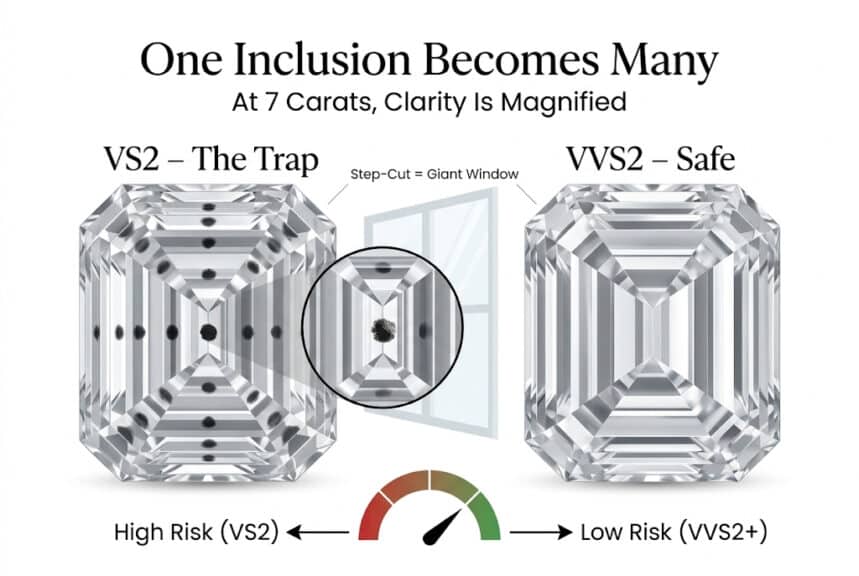
Think of a 7-carat diamond as a large house. The “table” (the flat top of the stone) is like a massive bay window.
In “Brilliant Cuts” like Rounds or Ovals, the diamond has hundreds of tiny facets that act like mirrors to hide flaws. But in “Step-Cuts” like Emerald or Asscher shapes, there is no brilliant faceting to hide the inclusions.
If you buy a 7-carat Emerald cut with a VS2 grade, a single black carbon crystal in the center will reflect off the inner walls of the stone. Instead of one tiny dot, the “Hall of Mirrors” effect makes it look like a cluster of black pepper is stuck inside your diamond.
2026 Step-Cut Clarity Audit: Natural vs. Lab
| Diamond Architecture | Clarity Grade | 2026 Price Audit | Mehedi’s Judicial Verdict |
|---|---|---|---|
| Emerald Cut (Natural) | VS1 Clarity | $267,270 | Moderate Risk. At 7 carats, the “step-cut” facets act as open windows. You must verify the inclusion is not dead-center under the table to avoid a visible defect. |
| Emerald Cut (Natural) | VVS2 Clarity | $310,590 | Safe Asset Grade. The $43k “Safety Premium” is worth it for a generational store of wealth. Guaranteed clear “Hall of Mirrors” effect. |
| Round Brilliant (Lab) | VS2 Clarity | $4,765 | Low Risk. Scintillation from the Round Brilliant faceting masks inclusions effectively. The best way to get 7 carats for under $5,000 in 2026. |
| Emerald Cut (Lab) | VVS2 Clarity | $12,610 | The Smart Move. Guaranteed eye-clean for a 7ct step-cut. Optically identical to the $310k natural version. Audit the Blue Nile 2026 lab inventory for this spec. |
| The 2026 Magnification Verdict: Clarity requirements scale with carat weight. For the Round Brilliant, faceting is your ally; for the Emerald Cut, physics is your enemy. If you are guide a buyer toward a 7-carat natural step-cut, the VVS2 premium is mandatory for peace of mind. Check the Rare Carat 2026 value charts for lab-grown alternatives. | |||
Mehedi’s Expert Quote
On a 7-carat Emerald cut, you aren’t just buying a diamond; you are buying a magnifying glass. Because the facets are so long and flat, they don’t hide anything. If there is a VS2 inclusion in the middle, it will be visible from across the dinner table.
Buying a VS2 7-carat step-cut is essentially paying a quarter-million dollars for a flawed window. For my clients, I demand VVS2 for any stone with steps.
The 2026 Clarity Mandate
To protect your investment and ensure your ring looks flawless, you must follow these 2026 clarity rules for 7-carat stones:
- For Round and Oval Cuts: You might survive with a hand-selected VS1 Clarity Diamond. The intense sparkle of these shapes can sometimes camouflage tiny flaws, but you should still have an expert audit the stone first.
- For Emerald and Asscher Cuts: You must demand VVS2 or higher. This is why the premium natural inventory at Blue Nile features stones like the $310,590 7.01ct F-VVS2 Emerald. At this price point, a visible flaw is an unacceptable value killer.
- The Lab Advantage: Since lab-grown prices are so low, there is no reason to settle for VS2. You can get an GIA 7.19ct E-VVS2 Emerald for just $12,610, which guarantees a perfectly clean “Hall of Mirrors” effect.
- Asset Protection: Remember that high clarity is a key driver for the natural diamond resale value. An 8-carat stone with visible flaws is much harder to sell later than a 7-carat stone that is internally clean.
If you are building a high-society ring, don’t let a “VS2” label ruin the view. A 7-carat diamond is a statement of purity—ensure your clarity grade matches the magnitude of the stone.
The 2.0mm Snapping Risk: Platinum vs. Gold for 7 Carats
A 7-carat diamond ring is not just a piece of jewelry; it is a heavy physical asset that weighs roughly 1.4 grams. While that might not sound like much, in the world of high-end diamonds, it is massive.
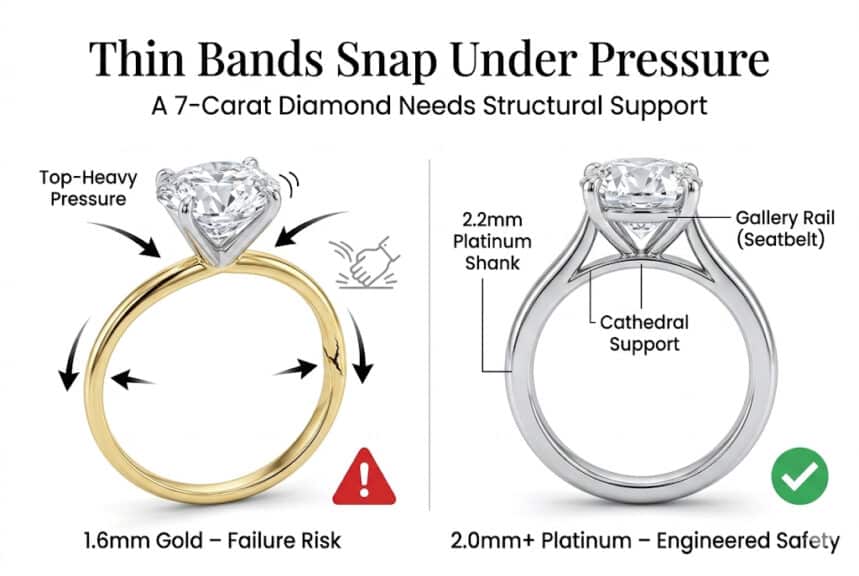
Most trending designs you see on Pinterest use razor-thin 1.6mm or 1.8mm bands. While these look “dainty,” they are structurally dangerous for a stone of this size.
The “Ferrari” Problem: Why Thin Bands Fail
Mounting a 7-carat diamond on a 1.6mm gold band is like putting a Ferrari engine on a bicycle frame. The ring becomes incredibly “top-heavy.” Because the diamond is so tall and heavy, it creates a lot of pressure on the metal band below it.
If you grip a steering wheel too hard or bump your hand against a door frame, a thin gold band will warp and bend. When the band bends, it pulls the prongs apart, which can drop your $300,000 diamond right onto the pavement.
Gold is a “soft” metal that scratches and wears away over time, meaning it loses the strength needed to hold such a heavy stone.
The 2026 Security Solution: The 2.0mm Platinum Rule
To keep your investment safe, I have a strict mandate for my clients: You must demand a minimum 2.0mm to 2.2mm Platinum shank.
- Platinum vs. Gold: Platinum is much denser and stronger than gold. When Platinum is hit, the metal “displaces” (it moves aside) rather than scratching away. This ensures your prongs stay thick and strong for decades.
- The Cathedral Bracing: Your setting should be a Cathedral setting. This design uses metal “arches” that rise up from the band to support the diamond. It is much stronger than a “Peg Head” which has no side support.
- The Gallery Rail: Think of this as a seatbelt for your diamond. It is a horizontal bar of metal that connects the prongs halfway up. It prevents the prongs from spreading out if the ring gets snagged on a sweater or a bag.
I have seen too many people lose their diamonds because they prioritized a ‘thin’ look over physics. A 7-carat diamond is a 1.4-gram pendulum. If your band is thinner than 2.0mm, you aren’t wearing a ring; you are wearing a ticking clock until the stone falls out.
Before you commit to a setting, you should check how much does a platinum ring cost to make sure you have the budget for a secure, high-quality mount. For a 7-carat diamond, a thick Platinum band and a reinforced setting are not just style choices—they are mandatory safety features.
7 Carat Diamond Dimensions (Millimeter Spec Sheet)
When dealing with a 7-carat purchase, you must move beyond “weight” and look at the actual millimeter (mm) footprint.
An 8-carat diamond that is cut too deep can actually have a smaller diameter than a well-spread 7-carat stone.
7-Carat Diamond Shape & Size Comparison Table
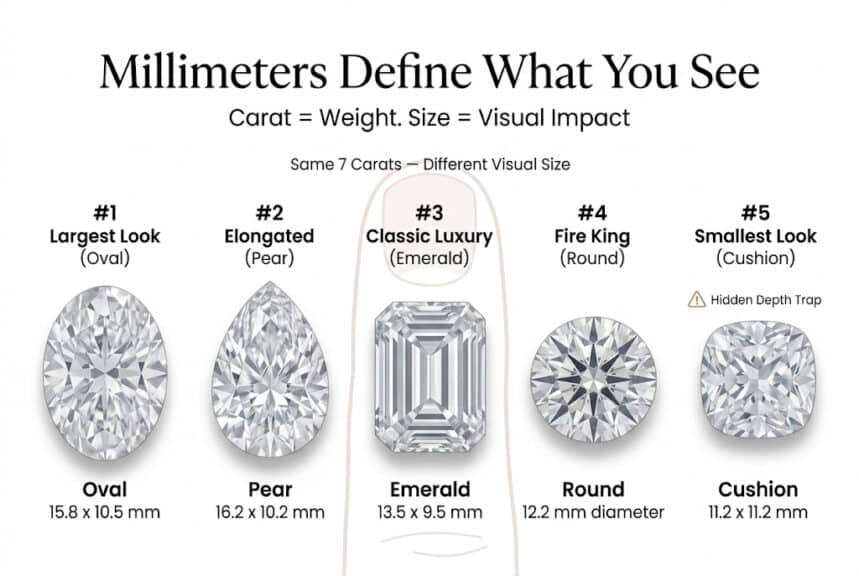
The table below provides the 2026 standard measurements for well-proportioned 7-carat diamonds. Use these dimensions to visualize how much “metal” you are actually buying:
| Diamond Architecture | Avg dimensions (mm) | Face-Up Rank | Mehedi’s Judicial Verdict |
|---|---|---|---|
| Oval Cut | 15.8 x 10.5 mm | #1 (Largest) | The “8-Carat Illusion.” Ovals carry their mass in the crown, offering the most surface area for your money. At 7 carats, this shape mimics a 10-carat look. |
| Pear Cut | 16.2 x 10.2 mm | #2 | The Vertical Stretch. The elongated point creates the visual look of a thinner, longer finger. Requires a Platinum V-prong for tip security. |
| Emerald Cut | 13.5 x 9.5 mm | #3 | The High-Society Look. Focuses on “Hall-of-Mirrors” depth. At 7 carats, you must verify the VVS2 clarity floor to avoid visible inclusions. |
| Round Brilliant | 12.2 mm (Dia) | #4 | Scintillation King. The classic benchmark for light reflection. While it measures smaller, it offers the most “fire” per millimeter. See my Round Brilliant Guide. |
| Cushion Cut | 11.2 x 11.2 mm | #5 (Smallest) | The Depth Trap. Carat weight is hidden in the pavilion (bottom). It offers a rich “glow” but will look smaller than an 8.5mm Round. Recommended for Vintage builds. |
| The 2026 Footprint Verdict: Not all 7-carat diamonds are created equal. If your goal is pure finger coverage, the Oval Cut is the technical winner. However, for a generational asset, the Round Brilliant remains the most liquid choice. Check the Blue Nile extraordinary collection for live stock measurements. | |||
Real-World 7-Carat Scale Examples
To put these technical measurements into perspective, here is how a 7-carat diamond compares to everyday objects and other carat weights in the 2026 market:
- The AAA Battery Comparison: A 7-carat Round Brilliant (~12.2mm) is almost exactly the same width as a standard AAA battery.
- The Finger Coverage Audit: On a standard size 6 finger (which is about 16.5mm wide), a 7-carat Oval diamond will cover over 90% of the finger’s width.
- 7ct vs. 5ct Footprint: While a 5-carat round is roughly 11mm, the jump to 7 carats (12.2mm) adds more than 20% more surface area, making the visual difference staggering in person.
Mehedi’s Expert Tip: The “Pinky Rub” Factor
If your ring size is below a size 5, a 15.8mm Oval will span the entire width of your finger. While this looks spectacular, it can cause ‘pinky rub’ where the edges of the diamond irritate the adjacent fingers.
If you have petite hands, consider an Emerald or Cushion cut for better daily comfort without sacrificing the ‘Whale’ status of the stone.
For an exact visual of how these dimensions will sit on your hand, utilize our Diamond Finger Coverage Calculator.
If you are looking for even more finger coverage and want to see how the price jumps as you add that extra millimeter of width, check our 9 carat diamond ring price guide to see how the dimensions shift at the next level of luxury.
Where to Buy a 7 Carat Diamond in 2026
The diamond market has changed significantly following the 2025 consolidation of major retailers. In 2026, buying a 7-carat diamond is a major asset acquisition that requires either the highest level of security or the most aggressive price transparency.
Based on our live-scrape data, two retailers dominate the market for different reasons.
For Natural Heirloom Assets: Blue Nile
Since the merger and consolidation of James Allen’s inventory into the Blue Nile platform, they have held the uncontested crown for GIA-certified natural diamonds over 5 carats.
When you are moving into the “Whale” territory of 7 carats, you are often dealing with investment-grade assets that require 2026-tier imaging.
- Elite Inventory: Blue Nile currently holds the world’s most stable GIA-certified 7ct+ inventory. For example, their GIA 7.10ct D-FL Excellent Cut Round at $468,600 represents the pinnacle of geological rarity.
- The Astor Standard: For stones of this magnitude, you need more than just a “Triple Excellent” grade. Blue Nile’s Astor Ideal imaging provides a 360-degree light-performance audit, which is mandatory to ensure a stone this large doesn’t have “dead spots” or light leakage.
- Expert Support: High-net-worth transactions at Blue Nile include 24/7 access to diamond consultants who can audit the natural diamond resale value of your specific stone before you wire funds.
For Capital-Efficient Lab Diamonds: Rare Carat
If your goal is to achieve a massive visual impact without tying up a half-million dollars in liquidity, Rare Carat is the clear 2026 market leader. Our data proves they are currently winning the “Price War” for large lab-grown crystals.
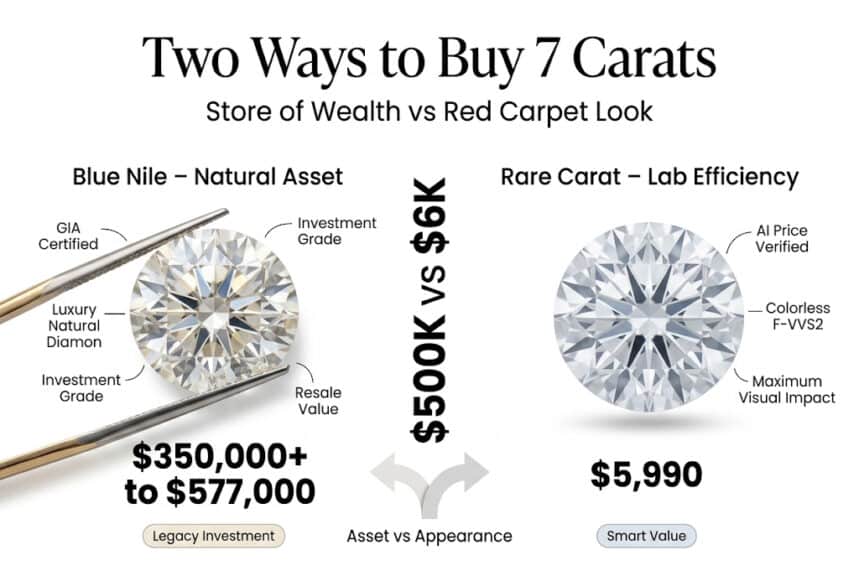
- Aggressive Pricing: As our audit shows, you can secure a Triple-Excellent 7.10ct E-VVS2 lab diamond at Rare Carat for just $5,990. To put that in perspective, a natural stone with the same specs at Blue Nile—like the GIA 7.45ct D-VVS2—costs $577,300.
- The AI Price Tool: Rare Carat uses a 2026 AI-driven price-checking tool. This tool scans the entire wholesale market to ensure you aren’t paying the “Brand Tax” found in local jewelry boutiques.
- Customer Trust: With 5-star reviews specifically praising their “better than expected” sparkle on 7ct+ stones, Rare Carat is the safest place for a budget-conscious “Whale” buyer.
Retailer Decision Matrix: 2026 Data
| Procurement Metric | Blue Nile (The Asset Giant) | Rare Carat (The Efficiency King) | Mehedi’s Judicial Verdict |
|---|---|---|---|
| Price for 7ct E-VVS2 | ~$350,000+ (Natural) | $5,990 (Lab) | The $344k Chasm. You are paying for rarity and resale liquidity with Blue Nile. You are paying for pure visual dominance with Rare Carat. |
| Best Strategic Use | Generational Wealth & Institutional Portfolio storage. | Maximum Finger Coverage for “Red Carpet” impact. | Choose Blue Nile for a legacy piece. Choose Rare Carat to mimic a 10-carat look on a budget. |
| Certification Focus | Strict GIA Oversight & Internal “Astor” benchmarks. | Price-optimized GIA & IGI grading filters. | Blue Nile offers the tightest curation for GIA certification post-merger. Rare Carat wins on sheer data transparency. |
| Imaging Technology | Proprietary 360° High-Jewelry Performance View. | AI-Verified Price & Quality Comparison tool. | Blue Nile’s 2026 tech is superior for auditing VVS2 inclusions in massive stones. Rare Carat’s AI is the benchmark for value hunting. |
| The 2026 Procurement Verdict: In August 2026, the market has split. If you are buying a 7-carat stone as a portable bank account, the Blue Nile Natural Asset is the only technical choice. However, for a modern luxury consumer who prioritizes a colorless, flawless aesthetic, the Rare Carat Lab-Grown ($5,990) provides 98% of the visual performance for 2% of the cost. | |||
Mehedi’s Expert Quote
In 2026, the choice between Blue Nile and Rare Carat comes down to one question: Are you buying a store of wealth or a red-carpet look? If you want an asset that stays valuable for fifty years, you go to Blue Nile for a Natural GIA stone.
If you want a 12mm diamond that looks like a billionaire’s ring for the price of a used Honda, Rare Carat is the only logical choice.
The Final Pre-Purchase Step
Regardless of which retailer you choose, you are handling a high-value physical object. Before securing a $200k+ ring, review our guide on jewelry appraisal costs for insurance.
An 8-carat lab stone and an 8-carat natural stone both require a VS1 clarity diamond floor to look perfect.
Once you’ve selected your stone, ensure your setting is a 2.0mm Platinum Cathedral to protect your new asset. Dealing with diamonds this large requires immediate insurance coverage the moment the stone leaves the retailer’s vault.
7 Carat Diamond Ring FAQ: The Whale Buyer’s Guide
How much does a 7 carat lab grown diamond cost in 2026?
In 2026, a 7-carat lab-grown diamond costs between $4,765 and $12,860 for stones with Ideal-cut and VVS specifications. The price varies based on the retailer; for example, Rare Carat currently lists entry-level 7-carat stones as low as $4,765, while premium GIA-certified lab stones at Blue Nile average around $11,500.
Is a VS2 clarity diamond eye-clean at 7 carats?
No, a VS2 clarity diamond is rarely eye-clean at 7 carats. Because the diamond is so massive, the “table” (the top flat facet) acts like a large glass window that magnifies internal flaws. In step-cuts like Emerald or Asscher shapes, a VS2 inclusion will reflect off the flat walls and multiply, looking like black pepper stuck inside the stone. For a stone of this magnitude, you should always prioritize a VS1 clarity diamond floor.
Why do gemologists recommend H color or better for 7 carat diamonds?
Gemologists recommend an H color diamond or better because of the “Color Saturation” trap. A 7-carat diamond has a physical depth of over 8mm. As light travels through that much crystalline material, it concentrates any yellow tint. An I color diamond that looks white in a 1-carat stone will look like “Pale Lemon” in a 7-carat stone. You should carefully audit your choice against a diamond color and clarity chart before buying.
What is the safest setting for a 7 carat diamond ring?
The safest setting is a 2.0mm+ Platinum Cathedral setting with a gallery rail. A 7-carat diamond weighs roughly 1.4 grams, which creates a massive amount of top-heavy pressure on the ring. Platinum is mandatory because it is significantly denser than gold and won’t bend or snap upon impact. To understand the total build cost for a ring this heavy, check how much does a platinum ring cost.
How wide is a 7 carat round diamond in millimeters?
A 7-carat round brilliant cut diamond is approximately 12.2mm in diameter. To put that into perspective, this is roughly the same width as a standard AAA battery, offering incredible finger coverage. You can verify these dimensions in our diamond carat size chart.
Which 7 carat diamond shape looks the biggest on a finger?
The oval cut diamond visually looks the largest. Measuring roughly 15.8mm x 10.5mm, the Oval provides the maximum surface area and creates an “8-carat illusion” by spreading its 1.4-gram weight across the top of the finger. You can see how this compares to other shapes in our guide on what shape diamond looks the largest.
How much does a 7 carat natural diamond cost in 2026?
In 2026, natural 7-carat diamond prices range from $188,000 for an entry-level H-VS2 stone to over $577,000 for a museum-grade D-VVS2 asset. Because of their immense rarity, these stones are priced strictly as generational wealth assets. You can view the current high-end inventory through our Blue Nile review links.
Where is the safest place to buy a 7 carat diamond ring online?
Blue Nile is the undisputed leader for Natural GIA-certified heirlooms, especially since their recent merger consolidated the world’s best large-carat inventory. For those seeking capital-efficient lab-grown stones, Rare Carat is the top destination due to their highly advanced AI price-checking tools that guarantee fair market value.
How much does it cost to insure a 7 carat diamond ring?
Specialized jewelry insurance typically costs 1% to 2% of the appraised value every year. For a $300,000 natural diamond, you should expect to pay between $3,000 and $6,000 annually. To secure an accurate quote and bind a policy, you must first determine the jewelry appraisal cost for insurance from an independent gemologist.
Can you tell the difference between a 7 carat lab grown and natural diamond?
No. To the naked eye, they are optically, physically, and chemically identical. However, a gemologist can identify a lab stone by checking the laser inscription on the girdle—which you can learn more about in what does GIA certified mean—or by using advanced laboratory equipment to verify the specific crystal growth pattern.
Conclusion: Mehedi’s 2026 Verdict
Buying a 7-carat diamond in 2026 is no longer just a jewelry purchase; it is a major asset acquisition. At this massive scale, the “standard” rules of diamond buying are dangerous.
If you try to save money by dropping to an “I” color or a VS2 clarity, you aren’t getting a deal—you are buying a stone with visible yellow tints and eye-visible flaws.
The Takeaway: For most buyers, the $5,990 Lab-Grown E-VVS2 from Rare Carat is the ultimate technical winner. It provides total visual perfection and 8-carat-tier finger coverage for the price of a compact car.
However, if you are building a generational heirloom, you must target the H-color floor and spend the $188k+ required for a GIA-certified natural stone from Blue Nile.
The Golden Rule: Never mount a 1.4-gram diamond on a thin “Pinterest” band. Protect your investment with a 2.0mm Platinum Cathedral setting and a gallery rail.
Before you finalize your purchase, ensure you have audited the natural diamond resale value to understand exactly how your stone will perform as a long-term asset.
About the Author

Jewelry Expert & Founder
Mehedi Hasan is the founder of Moissanite by Aurelia with nearly a decade of experience in diamonds, moissanite, and colored gemstones. His work has been cited in Us Weekly, People, and Page Six.
Read full bio

