

The 7 Differences in 2 Minutes
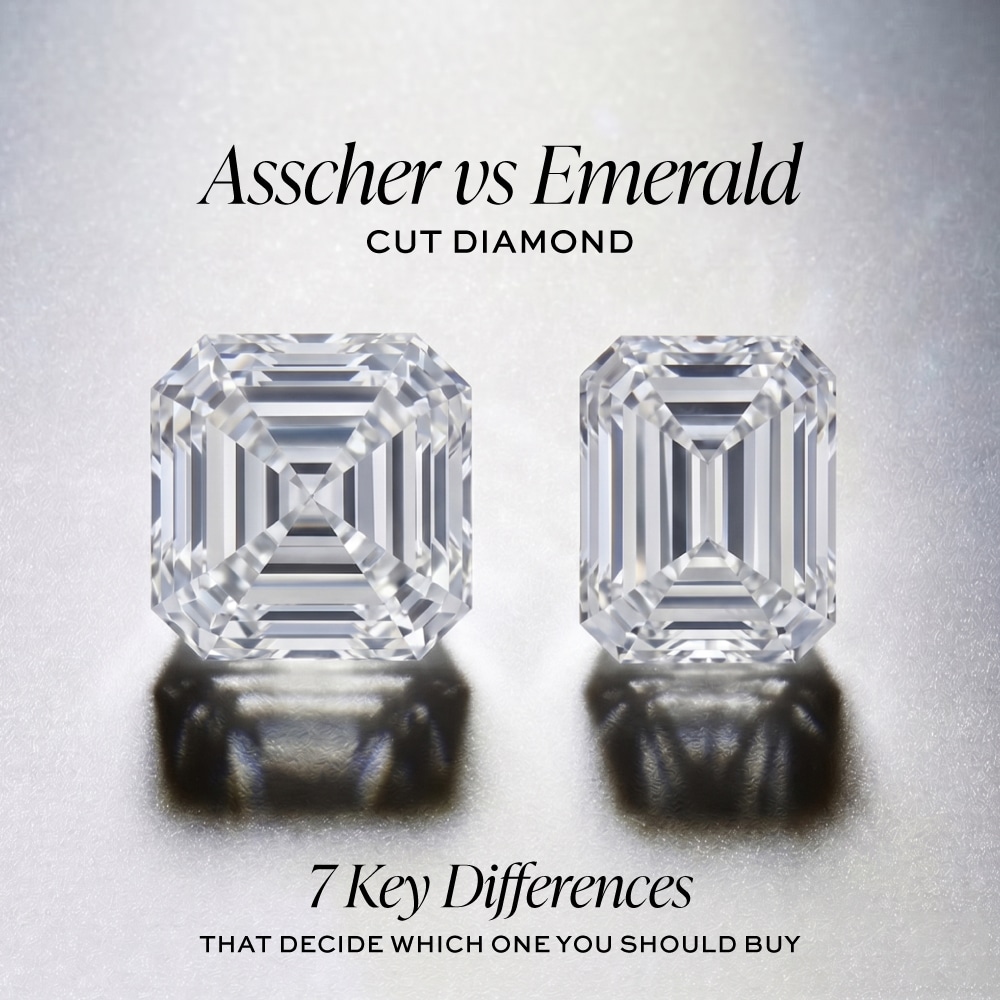
- Difference 1 — Shape: Emerald is rectangular (L/W ratio 1.30–1.60). Asscher is square (L/W ratio 1.00–1.05). They look entirely different on the finger despite sharing the same facet family.
- Difference 2 — Facets: Emerald has 57 step-cut facets in parallel rows. Asscher has 58 step-cut facets with cropped corners and a square table — the facet architecture produces a deeper, more hypnotic optical center.
- Difference 3 — Price: A GIA 1.00ct F-VS1 emerald at Blue Nile starts at $3,130. A GIA 1.01ct D-VS1 asscher starts at $6,390. The asscher commands a premium of $3,000–$4,000+ at comparable quality — because only approximately 2% of the world’s diamond rough is cut into asschers, making it genuinely rare.
- Difference 4 — Clarity mandate: Both shapes require VS1 minimum. Step-cut facets are windows — inclusions hide nowhere. But asscher’s square table is wider relative to the stone’s depth, making inclusions slightly more visible than in emerald’s elongated rectangular table.
- Difference 5 — Face-up size: A 1ct emerald measures approximately 7.0mm x 5.0mm. A 1ct asscher measures approximately 5.5mm x 5.5mm. The emerald covers significantly more finger surface at the same carat weight.
- Difference 6 — Lab-grown pricing: A lab 3.50ct D-FL emerald at Blue Nile costs $18,830. A lab 3.01ct D-IF asscher costs $11,960. In lab-grown, asscher is meaningfully cheaper for comparable specs — the rarity premium shrinks dramatically when cut from lab-grown rough.
- Difference 7 — Availability: Blue Nile carries 23+ asscher natural stones in the database above. It carries far more emeralds. Ritani confirms asscher median is $4,000 at 1ct; emerald is more broadly available across all price tiers.
Deal Alert: Fast-Shipping Gifts — Up to 50% Off* fine jewelry at Blue Nile !
One In A Lifetime Sale: “Clear The Vault” – Get up to 70% OFF on select jewelry at Blue Nile !
Exclusive Offer: Flash Sale on James Allen Up to 40% Off * Sitewide engagement ring settings & Fine Jewelry at James Allen .
Both shapes are exceptional. The decision comes down to shape preference, budget, and how you feel about scarcity. Keep reading — the clarity section below is where most buyers lose money.
Both the asscher cut and the emerald cut are step-cut diamonds. Both produce the same “hall of mirrors” effect — those long, parallel flashes of reflected light that feel like looking into an infinite tunnel of glass.
Both demand the same minimum VS1 clarity grade, the same strict color discipline, and both require the same patient, sophisticated buyer who values elegance over flash.
From a distance, buyers sometimes cannot tell them apart. In a ring, they look completely different.
This guide covers all 7 real differences between these two shapes — including the one nobody talks about that causes thousands of dollars in regret — with live price data from Blue Nile, Rare Carat, and Ritani, a full lab-grown comparison, and a moissanite option for buyers who want the step-cut aesthetic at a fraction of the cost.
Diamond IQ Test: Natural or Lab-Grown?
Two identical diamonds: GIA Certified, 1.51ct, D Color, VVS1, Ideal Cut. One is natural ($16,530), the other is lab-grown ($2,390). Choose the diamond you like better and see if you can match it to its origin.
Difference 1 — Shape and Silhouette: Rectangle vs Square
This is the most fundamental difference between these two shapes, and it is the one most buyers underestimate before seeing both shapes side by side on a hand.
The emerald cut is a rectangle. Its length-to-width ratio typically runs from 1.30 to 1.60, meaning the stone is significantly longer than it is wide. This elongated silhouette creates a finger-lengthening, hand-slimming visual effect similar to the oval cut.
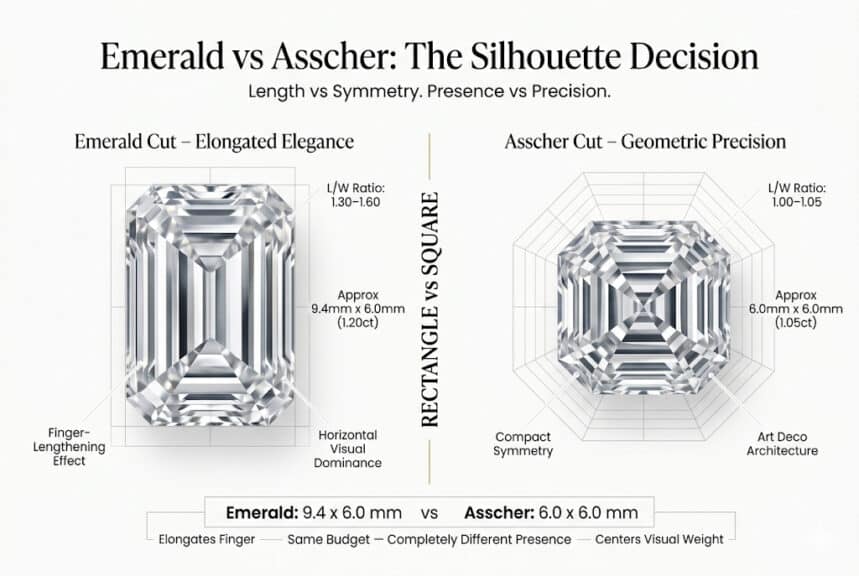
The emerald’s rectangular shape dominates horizontal visual real estate on the finger. When a buyer says they want “that long, elegant, old-money diamond” — they are picturing an emerald cut.
The asscher cut is a square — or very nearly so. Its ideal L/W ratio sits between 1.00 and 1.05. It has cropped corners, giving it an octagonal outline in most settings.
The visual character of the asscher is completely different from the emerald: geometric, contained, symmetrical, and architectural. When a buyer says they want “that vintage Art Deco diamond with the deep geometric center” — they are picturing an asscher.
Consider two real stones from Blue Nile’s April 2026 inventory to see how dramatically different the shapes present. The GIA 1.20ct F-VS1 Ideal Emerald at $5,990 faces up as approximately 9.4mm x 6.0mm — a long, elegant rectangle.
The GIA 1.05ct E-VVS1 Ideal Asscher at $6,880 faces up as approximately 6.0mm x 6.0mm — a compact, perfectly square octagon. They cost almost the same. They look nothing alike on the hand.
The choice between these two shapes is not a technical decision — it is an aesthetic one. If you want elongation, the emerald is your shape. If you want geometric symmetry and Art Deco heritage, the asscher is yours.
For a complete reference on how all diamond shapes compare in silhouette and finger coverage, our diamond shapes guide covers every shape on the market.
Difference 2 — Facet Architecture and the “Hall of Mirrors” Effect
Both the asscher and emerald cut belong to the step-cut family — a fundamentally different facet philosophy from brilliant cuts like the round, oval, or radiant.
Understanding what step-cut means is essential to understanding why these two shapes look the way they do and why they demand different quality standards than any brilliant-cut shape.
What Step-Cut Facets Actually Do
Brilliant-cut diamonds — rounds, ovals, cushions — have triangular and kite-shaped facets arranged to maximize light return in every direction. They create what gemologists call “scintillation” — rapid, random flashes of white and colored light that look like sparkle.
The visual effect is chaotic in the best sense: lots of light, lots of movement, inclusions hidden by the noise.
Step-cut diamonds are the opposite. Their facets are arranged in parallel rows — long, flat, rectangular facets stacked like stairsteps running parallel to the girdle.
Light does not scatter in step cuts. Instead, it reflects in long, controlled flashes and passes through the stone in a way that creates the “hall of mirrors” optical illusion — the sense that you are looking into infinite depth.
The GIA describes this effect as the defining characteristic of step-cut diamonds: clarity is paramount because the open facet architecture leaves nothing hidden. What you see is not light return — it is the stone itself, viewed through glass-like windows.
How Asscher and Emerald Facets Differ
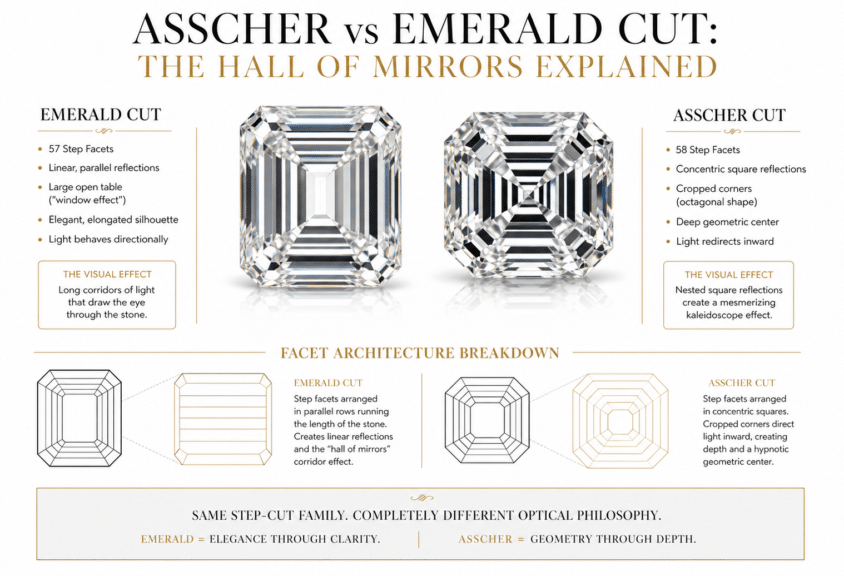
The emerald cut has 57 step-cut facets arranged in three rows on the pavilion and two to three rows on the crown, running parallel to the long axis of the rectangle.
The rectangular table is large, open, and elongated — like looking through a clean glass windowpane.
The asscher cut has 58 step-cut facets, but with a critical architectural difference: the cropped corners. The four corners of the asscher are beveled at 45 degrees, creating an octagonal outline.
This does two things. First, it makes the asscher more structurally robust than a rectangular step-cut at the corners. Second, it redirects light toward the center of the stone — creating the distinctive “concentric square” optical pattern that asscher enthusiasts describe as a windmill or a kaleidoscope.
Look into a well-cut asscher and you see a series of nested squares converging toward the center. Look into an emerald and you see parallel corridors of light running toward the long ends.
Take the GIA 1.04ct E-VVS2 Ideal Asscher at $7,000 as an example. At this quality tier, the asscher’s concentric-square optical pattern is at its clearest — each facet row reflects the others in perfect geometric alignment, producing what serious collectors describe as the most hypnotic center appearance of any diamond shape.
The emerald produces elegance. The asscher produces geometry.
Mehedi’s Expert Take:
I always tell buyers: put an emerald and an asscher next to each other under a loupe and you understand immediately why people have strong opinions about both. The emerald is like a long corridor — peaceful, elegant, directional.The asscher is like a kaleidoscope — you cannot stop looking at it. Neither is superior. But they are completely different visual experiences from the same step-cut family.”
Difference 3 — The 2026 Price Audit Across Three Vendors
This is where the comparison gets genuinely surprising. The price gap between asscher and emerald cuts in natural diamonds is one of the largest between any two step-cut shapes in the market.
Blue Nile Natural Emerald Cut — Live Data, April 2026
The entry tier — where emerald delivers exceptional value:
The GIA 1.00ct F-VS1 Ideal Emerald at $3,130 is one of the strongest value data points in this entire guide. F color, VS1 clarity, GIA certified, Ideal cut — at $3,130, this is exceptional for a step-cut stone of this specification.
For comparison, the GIA 1.01ct G-VVS2 Ideal Emerald at $3,230 pushes to G color but adds VVS2 clarity — a meaningful quality upgrade for only $100 more.
Moving up the quality ladder, the GIA 1.00ct E-VVS1 Ideal Emerald at $4,140 reaches E color VVS1 clarity — genuinely near-flawless optical quality — for under $4,200.
And the GIA 1.00ct D-IF Ideal Emerald at $5,650 gives you the absolute pinnacle: D color, Internally Flawless, in an emerald cut. That same specification in an asscher on the next section costs over $6,000 more.
Mid-tier emerald pricing — where the shape scales beautifully:
- GIA 1.02ct E-IF Ideal Emerald — $5,670 — E color IF at just over 1 carat for $5,670.
- GIA 1.03ct E-VS1 Ideal Emerald — $6,450 — just over 1ct at E-VS1.
- GIA 1.20ct F-VS1 Ideal Emerald — $5,990 — 1.20ct F-VS1 under $6,000 is remarkable value for this carat weight.
- GIA 1.20ct E-IF Ideal Emerald — $8,230 — pushing to E-IF at 1.20ct.
- GIA 1.38ct E-VS1 Ideal Emerald — $8,270 — 1.38ct for $8,270 shows the emerald’s excellent price scaling at heavier weights.
Large carat emerald — where the shape becomes extraordinary:
- GIA 1.62ct G-VS1 Ideal Emerald — $12,760 — over 1.5ct G-VS1 at under $13,000.
- GIA 1.80ct F-VS1 Ideal Emerald — $16,830 — 1.80ct F-VS1 is genuinely stunning in a step-cut; $16,830.
- GIA 2.51ct D-VVS1 Ideal Emerald — $41,540 — investment-grade 2.5ct D-VVS1.
- GIA 3.02ct D-VS1 Ideal Emerald — $55,970 — 3ct D-VS1 at $55,970.
- GIA 3.07ct D-FL Ideal Emerald — $74,700 — the pinnacle: 3ct D-FL for $74,700.
- GIA 5.00ct D-VS1 Ideal Emerald — $111,450 — museum-scale 5ct D-VS1.
- GIA 5.52ct E-IF Ideal Emerald — $225,950 — the top of the Blue Nile emerald inventory at 5.52ct E-IF.
Blue Nile Natural Asscher Cut — Live Data, April 2026
The asscher’s pricing story begins at a fundamentally different level. The GIA 1.01ct D-VS1 Ideal Asscher at $6,390 is the entry point — $3,260 more than the comparable emerald entry tier at the same carat weight.
That gap is the rarity premium in action: only about 2% of world diamond rough is cut into asschers, per Rare Carat’s gemological data.
The GIA 1.05ct E-VVS1 Ideal Asscher at $6,880 shows E-VVS1 quality for $6,880 — nearly $2,750 more than the comparable E-VVS1 emerald at $4,140. The GIA 1.04ct E-VVS2 Ideal Asscher at $7,000 sits at $7,000 for E-VVS2.
At larger weights, the asscher scales aggressively. The GIA 1.30ct F-VVS1 Ideal Asscher at $10,880 hits five figures at 1.30ct — where the emerald is under $9,000.
The GIA 1.52ct F-VS1 Ideal Asscher at $13,660 and GIA 1.61ct G-VS1 Ideal Asscher at $11,640 show the 1.50ct+ asscher tier running $11,000–$14,000.
At the investment tier, the asscher commands extraordinary prices. The GIA 1.72ct D-VVS1 Ideal Asscher at $23,820 at under 2 carats illustrates just how quickly the rarity premium compounds. The GIA 2.01ct E-VVS2 Ideal Asscher at $21,020 represents 2-carat entry territory.
The GIA 1.87ct F-VVS1 Astor Asscher at $21,280 is Blue Nile’s Astor-certified asscher — the highest light-performance tier available for this shape.
And at the apex: the GIA 7.15ct E-VVS2 Ideal Asscher at $229,070 — a museum-quality stone at a price that reflects the near-impossibility of cutting a 7+ carat asscher from natural rough.
Additional notable asscher listings:
- GIA 1.53ct G-VVS1 Ideal Asscher — $11,410
- GIA 1.72ct G-VVS1 Ideal Asscher — $15,630
- GIA 1.72ct E-VS1 Ideal Asscher — $16,020
- GIA 1.80ct G-VS1 Ideal Asscher — $16,430
- GIA 1.56ct D-VS1 Ideal Asscher — $16,620
- GIA 1.60ct F-VVS1 Ideal Asscher — $16,860
- GIA 1.75ct G-VVS1 Ideal Asscher — $17,420
- GIA 1.78ct D-VS1 Ideal Asscher — $20,790
- GIA 2.01ct G-IF Ideal Asscher — $22,820
- GIA 2.02ct E-VVS2 Ideal Asscher — $24,000
- GIA 2.05ct G-VVS1 Ideal Asscher — $24,750
- GIA 2.31ct E-VVS2 Ideal Asscher — $29,220
- GIA 3.02ct G-IF Ideal Asscher — $55,490
- GIA 3.07ct D-VVS1 Ideal Asscher — $65,100
The Price Gap at a Glance
| Market Segment | Emerald Cut (Yield) | Asscher Cut (Yield) | Judicial Premium Audit |
|---|---|---|---|
| ~1ct F-VS1 Tier | $3,130 | $6,390 (D-VS1) | +$3,260 (+104%). A massive jump in capital. While the Asscher features a higher color grade (D), the primary premium is driven by the rarity of square step-cut rough. |
| ~1ct E-VVS1 Tier | $4,140 | $6,880 | +$2,740 (+66%). The premium remains high for elite VVS1 purity. Emeralds offer a significantly more accessible entry point into museum-grade step cuts. |
| ~1.5ct G-VS1 Tier | $12,760 (1.62ct) | $11,410 (1.53ct) | EMERALD PREMIUM. A technical anomaly. The 1.62ct Emerald is slightly more expensive, but provides a much larger visual footprint compared to the 1.53ct Asscher. |
| ~2ct Macro Tier | $17,000 – $22,000 | $21,020 – $24,000 | +$3,000–$7,000. The Asscher premium stabilizes as we enter the macro tier. Only recommended for collectors seeking the specific “Hall of Mirrors” optical effect. |
| ~3ct D-Grade Tier | $55,970 (D-VS1) | $65,100 (D-VVS1) | +$9,130. At the institutional level, the Asscher remains the more expensive asset. Note that Asscher cuts require higher clarity floors due to their concentrated center table. |
| Mehedi’s May 2026 Procurement Verdict: The data confirms that the Asscher Cut is a niche luxury asset with a high cost of entry. If your objective is visual footprint and capital efficiency, the Emerald Cut is the clear winner, particularly in the 1-carat tier. However, the Asscher’s unique depth-to-weight ratio makes it a rarer, more exclusive choice for high-end architectural ring designs. | |||
Rare Carat Natural Asscher Data
Rare Carat provides a critical data point from their live inventory: a GIA 1.20ct I-VS2 Ideal Asscher at $1,720(Sale) — flagged as a great price at 15/15 quality score.
This is significantly below the Blue Nile pricing for asschers, and reflects the value available when you accept I color (which, in a warm metal like yellow gold, is perfectly acceptable for a step-cut).
For buyers who want an asscher without the full Blue Nile premium, Rare Carat is worth auditing alongside Blue Nile.
ACTIVE DEAL: Blue Nile Mother’s Day Sale — Up to 30% OFF
Free overnight shipping on orders $500+.
Free 30-day returns. Lifetime warranty.
Also: New email subscribers get $50 off their first order of $500+.
Looking for more? Check out the Clear The Vault event.
*Exclusions may apply. See Blue Nile for complete details.
Rare Carat also notes from their inventory data that a 1.02ct K-VS1 Very Good Asscher is available for $930 — 69% below fair price estimate.
At K color this is a warm stone, but in a yellow gold setting it can be genuinely beautiful and represents the absolute floor of the asscher market for budget-conscious buyers.
Ritani Asscher Perspective
At Ritani, a 1-carat asscher cut diamond ranges from approximately $1,700 to $30,000 depending on the 4Cs, with the median price sitting at $4,000.
Ritani’s gemologists specifically note that asscher cuts have a large open table, meaning inclusions are easily noticeable, and recommend VS2 or higher clarity — aligning exactly with our own VS1 mandate for step-cut shapes.
Browse Ritani’s 1-carat asscher collection with their Price Match Guarantee to cross-reference live pricing against Blue Nile.
Deal Alert: Ritani’s current promotions offer exceptional value.
Discount applied automatically
Shop Lab Diamonds | Shop Settings| Pro Tip: Ritani offers price matching and free shipping.
Difference 4 — The Clarity Mandate: The Rule That Applies to Both Shapes
This is where the most expensive buying mistakes happen. Both the asscher and emerald cut have the same non-negotiable clarity requirement — and ignoring it at either shape costs buyers real money.
Why Step-Cuts Are Windows, Not Mirrors
Brilliant-cut diamonds create “visual noise” — the chaotic scintillation of light bouncing between 58+ triangular facets hides inclusions effectively. An SI1 round brilliant can look completely clean to the naked eye because you cannot see the inclusion through all that sparkle.
Step-cut diamonds work completely differently. Their long, flat, parallel facets act like clean glass panes. Light passes straight through them. There is no visual noise, no chaotic scintillation, no distraction.
When you look into a step-cut diamond, you are looking directly at the stone’s interior — which means any inclusion is visible with a clarity and certainty that would be completely invisible in a brilliant cut.
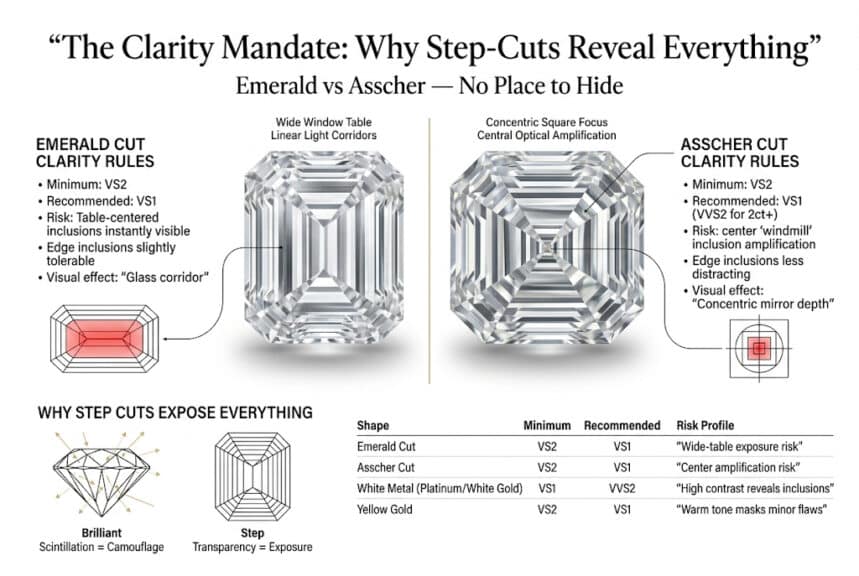
The GIA and every credible gemologist — including Ritani’s in-house team — mandates VS2 as the absolute minimum for step-cut shapes, with VS1 being the recommended floor for stones in white metal settings where maximum transparency is the aesthetic goal.
The Specific Clarity Rules for Each Shape
Emerald cut
The large, elongated rectangular table gives you a wide view of the stone’s interior. Inclusions positioned toward the ends of the rectangle are most visible. Center inclusions are amplified.
A VS1 with a small feather near the edge may look perfectly clean; a VS2 with a carbon spot under the table will be immediately visible at arm’s length.
The GIA 1.54ct D-VS1 Ideal Emerald at $17,370 shows D color with VS1 clarity — the combination that produces the cleanest possible “glass corridor” effect in an emerald cut.
Asscher cut
The square table is smaller in linear dimension than the emerald’s, but wider relative to the stone’s overall proportions. The concentric-square optical pattern of the asscher actually helps distribute the eye’s attention more evenly across the stone — which means moderate inclusions toward the edges are less distracting than in an emerald.
However, any inclusion that falls directly within the concentric-square “windmill” pattern at center is dramatically amplified. The GIA 2.01ct D-VS1 Ideal Asscher at $26,380 at D-VS1 represents the clarity standard for a 2ct-range asscher — anything below VS1 at this weight risks visible inclusions within the center optical pattern.
| Shape / Setting Architecture | Minimum Purity | Recommended Floor | Judicial Verdict |
|---|---|---|---|
| Emerald Cut | VS2 | VS1 | The Hall of Mirrors. The elongated, wide table acts like a window. While VS2 is the absolute minimum, VS1 is required to ensure the “frozen ice” aesthetic remains eye-clean. |
| Asscher Cut | VS2 | VS1 | The Concentric Focal Point. The square-step pattern draws the eye directly to the center. Any inclusion in the middle is amplified by the facet geometry; a VS1 floor is the judicial safety net. |
| Both (White Metals) | VS1 | VVS2 Preferred | The Contrast Trap. Platinum and White Gold maximize light contrast. This makes carbon spots or feathers significantly more visible. Aim for VVS2 for an institutional-grade build. |
| Both (Yellow Gold) | VS2 | VS1 | The Warmth Buffer. The warm reflection of yellow gold slightly masks inclusion visibility. You can safely operate at the VS1 floor without compromising the stone’s judicial purity. |
| Mehedi’s May 2026 Procurement Verdict: In the world of step-cuts, “Eye-Clean” is a dangerous gamble below VS1. If you are building a high-end Emerald or Asscher ring, the VS1 floor isn’t a suggestion—it’s a requirement for capital preservation. For those using Platinum settings, the VVS2 pivot is the only way to guarantee a museum-grade visual profile. | |||
For a detailed breakdown of what VS1 and VS2 look like in practice and when the upgrade matters, our VS1 vs VS2 diamond comparison shows exactly where the threshold sits for step-cut shapes.
Mehedi’s Clarity Rule: “I tell every step-cut buyer the same thing: in a brilliant cut, you can hide a VS2. In a step cut, you are buying glass. If your glass has a crack in it, everyone sees the crack. There is no sparkle to distract from it.
For both emerald and asscher cuts, VS1 is not a luxury — it is the minimum that protects the aesthetic you are paying for. Drop below VS1 and you risk a stone that contradicts its own design philosophy.” — Mehedi Hasan, Diamond Industry Veteran
Difference 5 — Face-Up Size: Which Looks Bigger on the Finger?
The emerald cut wins this comparison decisively — and the reason is pure geometry.
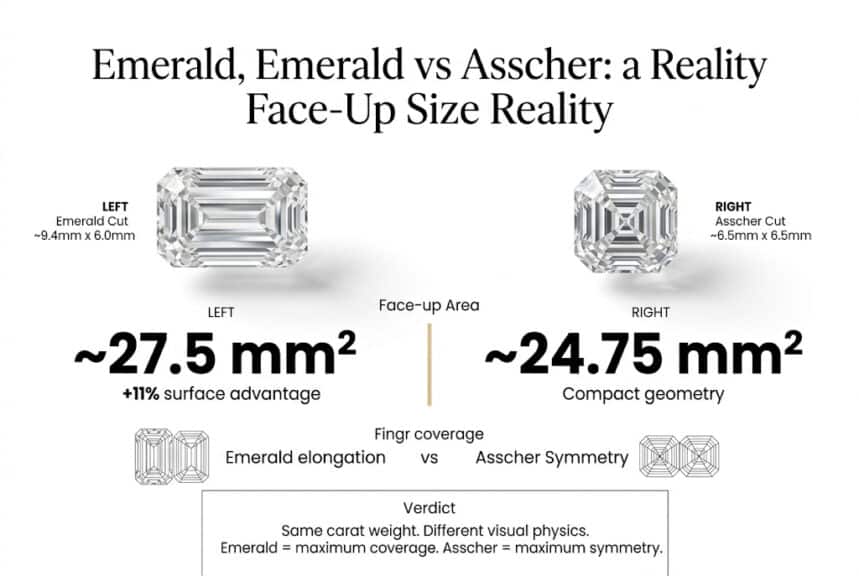
A 1-carat emerald cut measures approximately 7.0mm x 5.0mm, giving it a face-up area of approximately 27.5mm². A 1-carat asscher cut measures approximately 5.5mm x 5.5mm, giving it a face-up area of approximately 24.75mm². The emerald is approximately 11% larger in visible surface area at identical carat weight.
At 1.20 carats — the most popular buying weight in this style tier — the difference becomes even more visible. The GIA 1.20ct F-VS1 Ideal Emerald at $5,990 faces up at approximately 9.4mm x 6.0mm — nearly a centimeter long on the finger.
A comparable 1.20ct asscher faces up at approximately 6.5mm x 6.5mm. The emerald has dramatically more visible finger coverage for effectively the same carat weight, and in this case, costs less.
| Shape Architecture | 1ct Dimensions (Typical) | Face-Up Area Audit | Judicial Verdict (Finger Effect) |
|---|---|---|---|
| Emerald Cut | ~7.0mm x 5.0mm | ~27.5mm² | The Elongation Mastery. Claims substantial knuckle-to-knuckle real estate. Its linear silhouette provides an optical lengthening effect, ideal for a Cathedral build designed to slim the finger. |
| Asscher Cut | ~5.5mm x 5.5mm | ~24.75mm² | The Geometric Command. Compact, symmetrical, and structurally precise. While it lacks length, it offers a “focused” look that pairs perfectly with a bezel-set profile for a clean, modern aesthetic. |
| Mehedi’s May 2026 Procurement Verdict: Dimensional yield is the primary differentiator here. The Emerald Cut is a technical winner if your goal is to maximize visual presence on the finger. For those prioritizing symmetry, the Asscher Cut is elite, but reference my guide on shapes that look the largest to understand why you may need to buy up in carat weight to achieve the same visual impact. | |||
The asscher is not trying to maximize surface area — that is not its purpose. Its design philosophy is depth and optical complexity, not coverage. But buyers who want maximum visual presence on the finger should know clearly that the emerald delivers more face-up size per carat dollar in every comparison.
For guidance on how these dimensions translate to your specific ring size and hand shape, our diamond finger coverage calculator gives exact millimeter projections.
Difference 6 — Lab-Grown Asscher vs Emerald: Where the Math Changes
In natural diamonds, the asscher commands a significant premium over the emerald. In lab-grown diamonds, that premium compresses — and in certain carat weight ranges, the asscher actually becomes the better value per carat.
Lab-Grown Emerald Cut — Live Blue Nile Data, April 2026
The lab emerald market at Blue Nile is dominated by large-carat stones at extraordinary value. Consider the IGI 3.50ct D-FL Excellent Emerald Lab at $18,830 — a D color Flawless 3.5-carat lab emerald for under $19,000.
Or the IGI 4.01ct D-IF Ideal Emerald Lab at $19,700 — a 4-carat D-IF for under $20,000. The natural equivalent of a 4-carat D-IF emerald at Blue Nile approaches $150,000+.
Additional lab emerald examples across the range:
- GCAL 4.62ct D-IF Ideal Emerald Lab — $19,640.
- IGI 4.08ct D-FL Excellent Emerald Lab — $20,040.
- IGI 4.13ct D-IF Excellent Emerald Lab — $20,280.
- GCAL 5.00ct D-IF Ideal Emerald Lab — $20,920.
- IGI 4.37ct D-IF Excellent Emerald Lab — $22,580.
- GCAL 3.90ct D-FL Ideal Emerald Lab — $24,030.
- IGI 4.50ct D-IF Ideal Emerald Lab — $25,710.
- IGI 4.65ct D-IF Excellent Emerald Lab — $26,560.
- IGI 5.10ct D-FL Ideal Emerald Lab — $30,620.
- IGI 5.90ct D-IF Excellent Emerald Lab — $35,430.
- GCAL 5.00ct D-FL Ideal Emerald Lab — $35,930.
- GCAL 5.14ct D-FL Ideal Emerald Lab — $36,930.
- GIA 5.40ct D-FL Ideal Emerald Lab — $58,990.
Lab-Grown Asscher Cut — Live Blue Nile Data, April 2026
The lab asscher market reveals something interesting: at the 2–3ct range, lab asschers are meaningfully cheaper per carat than lab emeralds of comparable weight and quality.
The IGI 1.84ct D-IF Ideal Asscher Lab at $4,520 is the entry point — just under 2 carats of D-IF lab asscher for $4,520.
The IGI 2.16ct D-IF Ideal Asscher Lab at $6,130 and IGI 2.51ct D-IF Ideal Asscher Lab at $8,210 show the 2ct+ lab asscher tier running $6,000–$8,500 — genuinely competitive pricing for a shape that commands a major natural premium.
Additional lab asscher examples:
- IGI 2.06ct D-FL Ideal Asscher Lab — $9,850.
- IGI 3.01ct D-IF Ideal Asscher Lab — $11,960.
- IGI 3.08ct D-IF Ideal Asscher Lab — $12,560.
- IGI 3.00ct D-IF Ideal Asscher Lab — $14,710.
- IGI 4.05ct E-IF Ideal Asscher Lab — $18,920.
- GIA 2.31ct D-FL Ideal Asscher Lab — $22,040.
- IGI 4.15ct D-IF Ideal Asscher Lab — $22,150.
- IGI 3.57ct D-IF Ideal Asscher Lab — $25,130.
- IGI 3.82ct D-IF Ideal Asscher Lab — $26,890.
- IGI 4.00ct D-IF Ideal Asscher Lab — $26,970.
- IGI 4.03ct D-IF Ideal Asscher Lab — $27,170.
- IGI 3.54ct D-FL Ideal Asscher Lab — $29,940.
- IGI 4.20ct D-FL Ideal Asscher Lab — $35,100.
- GCAL 3.92ct D-FL Excellent Asscher Lab — $40,980.
- IGI 5.08ct D-IF Ideal Asscher Lab — $51,190.
- IGI 5.48ct D-IF Ideal Asscher Lab — $55,220.
- GIA 4.24ct D-FL Ideal Asscher Lab — $118,530.
Lab-Grown Price Comparison: The Key Insight
| Macro Weight Tier | Lab Emerald (D-IF/FL) | Lab Asscher (D-IF/FL) | Judicial Value Verdict |
|---|---|---|---|
| ~3ct D-IF Tier | $18,830 (3.5ct) | $11,960 (3.01ct) | ASSCHER WINS. At this threshold, the Asscher provides a much lower entry cost for 3-carat museum purity. Excellent price-per-carat efficiency for a square step-cut. |
| ~4ct D-IF Tier | $19,700 (4.01ct) | $22,150 (4.15ct) | EMERALD WINS. As mass increases, Emeralds become marginally cheaper. It represents the smart capital allocation play for those seeking a 4-carat centerpiece. |
| ~5ct D-IF/FL Tier | $35,930 (5ct) | $51,190 (5.08ct) | EMERALD LANDSLIDE. A massive $15,000+ delta. Emeralds are meaningfully cheaper at the macro-carat level. The Asscher’s rarity and rough-yield difficulty drive a prohibitive premium here. |
| Mehedi’s May 2026 Procurement Verdict: In the elite lab-grown market, the pricing curve for Asscher cuts is much steeper than for Emeralds. While the Asscher is a value play at 3 carats, it becomes a high-premium luxury at 5 carats. If you are building a macro-tier project, the Emerald Cut offers significantly better ROI for Internally Flawless purity. Reference my lab diamond calculator to audit real-time volatility before purchase. | |||
At 3 carats, the lab asscher is cheaper per carat than the lab emerald. At 4 carats and above, the emerald reasserts its value position. The crossover point matters for buyers targeting specific carat weights in lab-grown step-cut shapes.
Difference 7 — Availability, Rarity, and Resale Reality
The asscher cut is one of the rarest diamond shapes, with only about 2% of the world’s natural diamond rough being cut in this shape. This rarity has two direct consequences: higher natural prices (which we’ve documented throughout) and a more specialized secondary market.
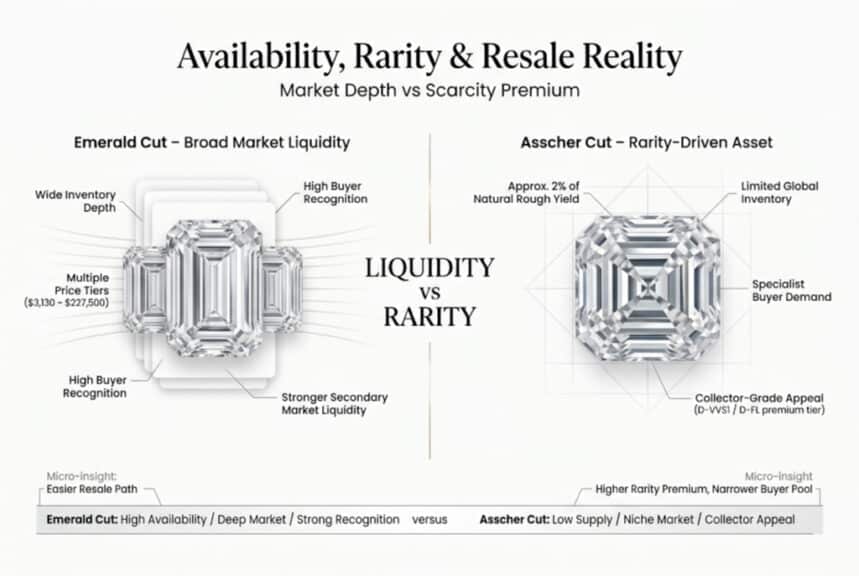
The emerald cut is far more widely available. Blue Nile’s natural emerald inventory spans from $3,130 to over $227,500 across dozens of quality tiers. The asscher inventory is thinner — fewer stones, narrower selection, and less competition between individual listings.
For resale, the emerald cut benefits from wider buyer recognition. Buyers understand what an emerald cut is. The asscher is a more specialized taste — approximately 2% of rough cut and an equally small percentage of buyers who specifically search for it.
This does not make asscher diamonds a poor resale asset; it makes them a more specialized one. An exceptional asscher in D-VVS1 or D-FL carries genuine collector appeal. A standard G-VS1 asscher competes in a thinner secondary market than a comparable emerald.
For a full framework on natural diamond resale values and which quality specs hold value best, our natural diamond resale value guide covers the complete secondary market picture.
The Moissanite Option: Step-Cut Beauty at a Fraction of the Cost
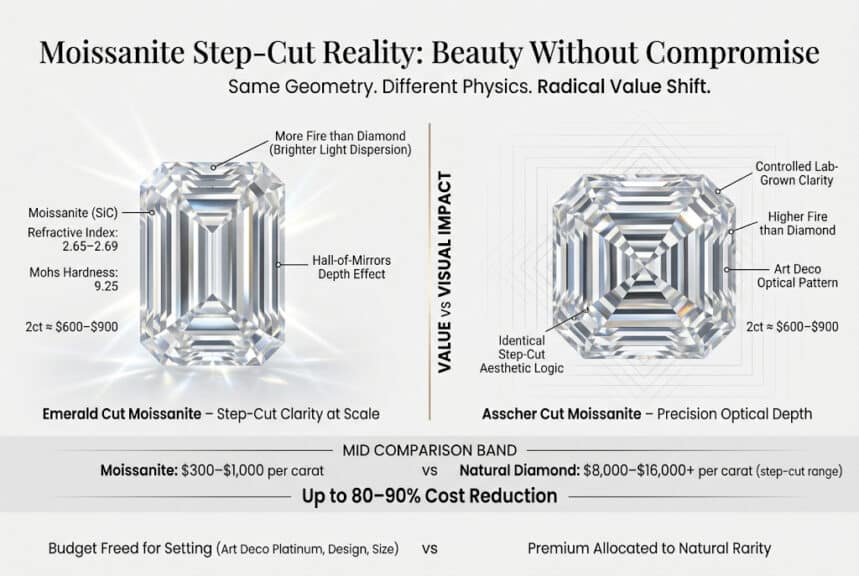
Both the asscher and emerald cut translate exceptionally well to moissanite. The step-cut facet philosophy — which prioritizes clarity and glass-like depth over sparkle — actually plays to moissanite’s strongest characteristic: its extraordinary fire (light dispersion) creates stunning visual depth in step-cut facets that rivals or exceeds what you see in diamond.
Charles & Colvard, the original inventors of Forever One moissanite, carry both emerald cut moissanite and asscher cut moissanite in their loose stone and ring collections.
Their Forever One moissanite is the highest-quality moissanite available — grown in the USA, colorless (D-E-F equivalent), with a hardness of 9.25 on the Mohs scale (second only to diamond’s 10).
Charles & Colvard prices moissanite at $300–$1,000 per carat depending on quality and size, with a 2-carat stone ranging from $800–$2,000 — representing 80–90% less than comparable diamonds while offering more fire and brilliance.
What Step-Cut Moissanite Looks Like in Practice
An emerald-cut Forever One moissanite at 2 carats from Charles & Colvard costs approximately $600–$900 for the loose stone — compared to $16,830 for a GIA 1.80ct F-VS1 natural emerald at Blue Nile.
For buyers who love the step-cut aesthetic but want to direct their budget toward a spectacular setting, an Art Deco platinum mounting, or simply keep more money in their lives, moissanite delivers the same “hall of mirrors” depth at a completely different price point.
An asscher-cut Forever One moissanite is equally compelling. The asscher’s concentric-square optical pattern — that hypnotic kaleidoscope center — appears in moissanite with remarkable clarity.
Because moissanite’s refractive index (2.65–2.69) is higher than diamond’s (2.42), step-cut moissanite can actually produce more vivid colored light flashes within the hall-of-mirrors effect than its diamond counterpart.
Who should consider step-cut moissanite:
- Buyers who love the emerald or asscher aesthetic but have a total ring budget under $3,000.
- Buyers who want a 2ct+ step-cut center stone without spending $15,000+.
- Buyers who prioritize the setting — a stunning Art Deco platinum setting with a 2ct asscher moissanite is a more visually impressive ring than a plain solitaire with a 1ct natural asscher.
- Buyers who are concerned about the strict clarity mandate for step-cut diamonds — moissanite is grown with controlled clarity, eliminating the VS1+ requirement entirely.
Browse the full collection at Charles & Colvard’s loose gem selection for both emerald and asscher cuts across all carat weight ranges, and the complete moissanite ring and loose stone options at our moissanite comparison guide.
Clarity, Color, and Settings — The Buying Rules for Both Shapes
Color: Which Grade Works for Step Cuts?
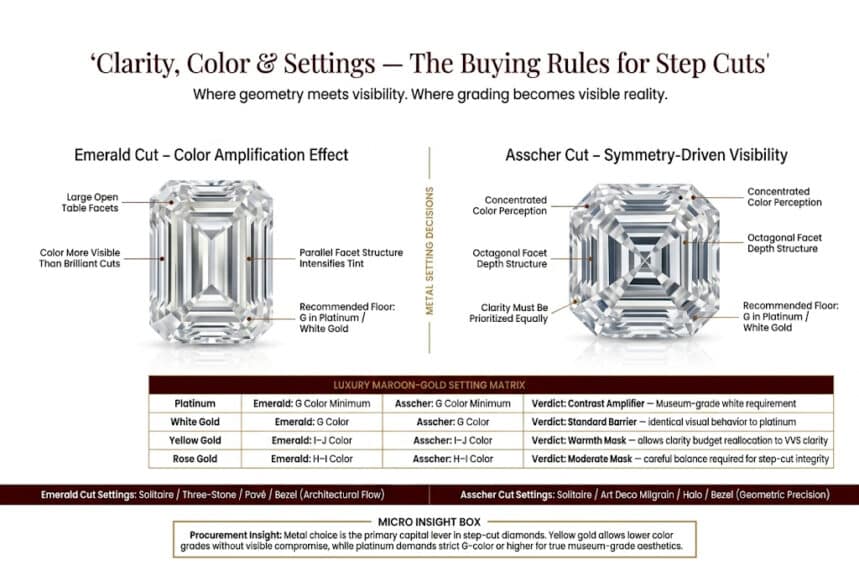
Step-cut diamonds show color more readily than brilliant cuts, because the large open table facets do not scatter light in ways that mask warm tint.
The parallel facet rows actually intensify color concentration in ways that a brilliant cut would hide.
| Setting Metal | Emerald Color Floor | Asscher Color Floor | Judicial Verdict |
|---|---|---|---|
| Platinum | G Color Minimum | G Color Minimum | The Contrast Amplifier. Bright white metals act as a mirror, reflecting any hint of nitrogen warmth back into the stone. For museum-grade step-cuts, G is the absolute floor to maintain a colorless look. |
| White Gold | G Color | G Color | The Standard Barrier. Identical to platinum in visual impact. Dropping to H or I in a white gold solitaire build risks a visible parchment tint in these shapes. |
| Yellow Gold | I – J Color | I – J Color | The Warmth Buffer. Yellow gold masks internal tint beautifully. This allows you to reallocate capital from the color grade toward a higher VVS clarity grade, which is more critical for step-cuts. |
| Rose Gold | H – I Color | H – I Color | The Moderate Mask. While rose gold offers masking, its pinkish hue can highlight very low color grades. An H-color floor is the judicial sweet spot for rose metal projects. |
| Mehedi’s May 2026 Procurement Verdict: Metallurgy is your primary capital-saving lever for step-cuts. If you are budget-conscious, opting for a Yellow Gold setting allows you to safely drop to an I-color stone without visual compromise. However, if your brand identity is built on high-white, museum-grade aesthetics, the G-color floor in Platinum is a non-negotiable technical requirement. Reference my full 4Cs Audit before finalizing your acquisition. | |||
The Rare Carat listing of a 1.20ct I-VS2 asscher at $2,632 is a good example of where I color works: in yellow gold, that stone would look warm and elegant rather than yellow. In platinum, it would show warmth that undermines the step-cut’s clarity-first aesthetic.
For a complete visual reference on color grades across metal settings, our diamond color and clarity chart is the definitive buying tool.
Which Settings Work Best for Each Shape?
Emerald Cut Settings:
The emerald cut’s rectangular outline and elongated profile pair naturally with several architectural setting styles. A solitaire with four corner prongs is the standard — clean, minimal, lets the stone speak.
Our solitaire engagement ring guide covers the full solitaire range.
A three-stone setting with baguette or tapered side stones along the emerald’s long sides creates the classic “east-west” look that has defined Art Deco jewelry for a century — see our 3-stone diamond ring guide for configuration details.
A pavé band beneath an emerald adds sparkle contrast that complements the step-cut’s calm center — our pave diamond ring price guide covers the cost and design range.
A bezel setting fully encases the emerald’s rectangular perimeter — modern, clean, and protects all four corners.
Asscher Cut Settings:
The asscher’s octagonal outline creates unique setting opportunities that round or rectangular shapes cannot replicate. A four-prong or eight-prong solitaire at the corners of the octagon is the standard configuration.
An Art Deco milgrain or filigree setting is the asscher’s historical home — the geometric facet pattern of the asscher echoes the geometric design language of 1920s jewelry almost perfectly.
A halo setting on an asscher creates a distinctive “octagon within a square” visual effect — the circular or square halo frames the asscher’s cropped-corner geometry in a way that amplifies its architectural character.
See our halo engagement ring guide for pricing across all halo configurations. For buyers who want maximum protection of the asscher’s four cropped corners, a bezel setting is equally valid and provides the cleanest, most modern look.
Mehedi’s 2026 Final Verdict — The Complete Decision Matrix
The Full Decision Matrix
| Procurement Objective | Strategic Selection | The Judicial Data Audit |
|---|---|---|
| Lower natural price at 1ct | Emerald Cut | 51% Cheaper. At comparable specs, the Emerald ($3,130) is significantly more accessible than the Asscher ($6,390). |
| Elongated, finger-slimming shape | Emerald Cut | 7.0mm x 5.0mm Profile. Spreads its mass vertically to provide superior coverage compared to the 5.5mm square Asscher. |
| Art Deco, vintage aesthetic | Asscher Cut | 1902 Heritage. The Asscher is the definitive Art Deco architecture, offering a tiered, square look that defines 20th-century luxury. |
| “Kaleidoscope” center optical | Asscher Cut | Windmill Faceting. A unique concentric-square pattern creates a rhythmic, inward-drawing reflection that is impossible for Emeralds to mimic. |
| “Hall of Mirrors” corridor effect | Emerald Cut | Linear Reflection. Parallel facets create long, directional corridors of light, favoring clarity and transparency over complex scintillation. |
| Strictest clarity mandate | Both — VS1 Floor | Purity Non-Negotiable. Neither shape forgoes sub-VS1 inclusions in white metal settings due to the “open table” window. |
| Larger face-up per carat | Emerald Cut | 11% More Area. Emeralds spread weight across a larger surface area, whereas Asschers hide weight in a deep pavilion. |
| Lab-grown value (~3ct D-IF) | Asscher Cut | $11,960 Strategy. At the 3-carat lab threshold, the Asscher offers superior price-per-carat efficiency compared to current Emerald inventories. |
| Lab-grown value (~5ct D-IF) | Emerald Cut | Significant Saving. At 5 carats, the Emerald ($35,930) is roughly $15,000 cheaper than the Asscher equivalent. |
| Rarest, most collectible natural | Asscher Cut | 2% Global Yield. Genuine scarcity in the rough diamond market makes the Asscher a more exclusive, niche selection for natural buyers. |
| Budget under $5,000 (Natural) | Emerald Cut | High Tier Spec. A natural F/G VS1 Emerald is easily obtainable in this range, providing a high-status asset for lower capital. |
| Budget $6,000+ (Natural) | Either Choice | Equilibrium Point. At this capital level, the Asscher becomes technically accessible without severe spec compromises. |
| Budget under $1,500 total | Moissanite | 80-90% Savings. Forever One moissanite provides the same architectural silhouette with superior sparkle at a fraction of the cost. |
| Step-cut 2ct+ (Under $10k) | Lab or Moissanite | Macro Value. Lab diamonds enable 2.5ct+ D-IF specs under $10k, whereas natural equivalents exceed $20k. |
| Strong resale market | Emerald Cut | Broad Liquidity. Higher buyer recognition and market depth make the Emerald a safer “hedge” for capital retention. |
| Mehedi’s May 2026 Procurement Verdict: The choice between Emerald and Asscher is a decision between **Visual Presence** and **Geometric Rarity**. If you desire a stone that dominates the finger and offers maximum capital efficiency, the Emerald Cut is your judicial winner. However, for those building a project where Art Deco symmetry and optical complexity are the primary luxuries, the Asscher Cut remains the most elite step-cut ever faceted—provided you have the capital to meet its premium floor. | ||
The Budget Summary
Under $5,000 natural: The emerald cut is your shape. The GIA 1.00ct F-VS1 Ideal Emerald at $3,130 and GIA 1.00ct E-VVS1 Ideal Emerald at $4,140 represent exceptional natural step-cut diamonds at prices where the asscher does not exist in comparable quality.
$6,000–$8,000 natural: The asscher enters the picture. The GIA 1.01ct D-VS1 Ideal Asscher at $6,390 is the entry point; the GIA 1.05ct E-VVS1 Ideal Asscher at $6,880 steps up to E-VVS1. If you love the asscher’s geometric aesthetic, this is where you pay for it.
$10,000–$15,000 natural: Strong emerald territory at 1.5ct+; entry asscher territory at 1.3ct+. The GIA 1.30ct F-VVS1 Ideal Asscher at $10,880 competes directly with the GIA 1.50ct G-VS1 Ideal Emerald at $13,690.
Lab-grown: At 3ct D-IF, the IGI 3.01ct D-IF Ideal Asscher Lab at $11,960 outvalues the emerald at the same weight tier. At 4ct+, the emerald reasserts its value position with listings like the IGI 4.01ct D-IF Ideal Emerald Lab at $19,700.
Mehedi’s Final Word:
“Of every comparison I run for clients, asscher vs emerald is the one where personal taste matters most. Both are step-cut diamonds. Both demand VS1 clarity. Both require G color minimum in white metal. The buying rules are identical.
The experience of wearing them is completely different. The asscher is for the buyer who wants a ring that looks like it came from a 1920s Parisian vault. The emerald is for the buyer who wants long, liquid elegance on the finger.
If your budget is under $5,000, the emerald is the only realistic option in natural diamonds. If you have $6,500–$8,000 and you love geometric precision, the asscher is one of the most rewarding purchases in fine jewelry.” — Mehedi Hasan, Diamond Industry Veteran
Before finalizing either shape, use our diamond appraisal calculator to verify you are paying market rate for your specific stone’s quality tier.
FAQ — 12 Questions Every Buyer Asks
What is the actual difference between an asscher cut and an emerald cut diamond?+
Both are step-cut diamonds sharing the same parallel-facet philosophy that produces the “hall of mirrors” effect. The emerald cut is rectangular — typically 1.30–1.60 in L/W ratio — with 57 facets arranged along the long axis. The asscher cut is square or near-square — 1.00–1.05 L/W ratio — with 58 facets and cropped corners that create an octagonal outline and a distinctive concentric-square “windmill” optical pattern at the center. The emerald produces elongated, directional reflections. The asscher produces a hypnotic geometric center. Both require VS1 minimum clarity in white metal.
Is an asscher cut more expensive than an emerald cut?+
Yes, significantly in natural diamonds. At Blue Nile in April 2026, a GIA 1ct F-VS1 Ideal emerald starts at $3,130 while a GIA 1ct D-VS1 Ideal asscher starts at $6,390 — a gap of over $3,000 at comparable quality. The premium reflects genuine geological rarity: only about 2% of diamond rough is cut into asschers. In lab-grown diamonds, that premium compresses considerably, particularly at the 3-carat tier where a 3.01ct D-IF lab asscher costs $11,960 versus a 3.5ct D-FL lab emerald at $18,830.
What clarity grade do I need for both shapes?+
VS1 minimum for both shapes in white gold or platinum. VS2 is the absolute floor in yellow gold. Both asscher and emerald cuts have open, window-like step-cut facets that make inclusions fully visible without any brilliant-cut sparkle to obscure them. A VS2 inclusion that would be invisible in a round brilliant can be immediately obvious in either step-cut shape at arm’s length. Ritani’s own gemologists mandate VS2 minimum for asschers and recommend VS1 for white metal settings. Never buy below VS2 in either shape regardless of price pressure.
Which looks bigger on the finger — asscher or emerald?+
Emerald, clearly. At 1 carat, an emerald faces up at approximately 7.0mm x 5.0mm with roughly 27.5mm² of visible surface. An asscher faces up at approximately 5.5mm x 5.5mm with roughly 24.75mm². The emerald covers about 11% more visible finger surface at the same carat weight. The emerald also elongates the finger through its rectangular shape — an effect the square asscher does not produce.
Which shape has more sparkle — asscher or emerald?+
Neither. Step-cut diamonds do not sparkle the way brilliant cuts do. Both shapes produce long, calm flashes of reflected light rather than the rapid scintillation of a round or oval. The asscher’s cropped corners create a slightly more complex optical center — the concentric-square windmill pattern — while the emerald produces longer, more directional corridor reflections. If you specifically want brilliance and sparkle, neither step-cut shape is the right choice. If you want the elegant, understated “hall of mirrors” effect, both deliver it.
Is a 1-carat asscher hard to find?+
Yes, relative to most shapes. Rare Carat notes that asschers represent only 2% of the world’s diamond rough production, making them the rarest of all common shapes. Blue Nile’s natural asscher inventory has fewer listings than comparable emerald inventory. Ritani confirms the median price for a 1ct asscher is $4,000. You will find good options at multiple vendors, but the selection is narrower than emerald, oval, or cushion cuts.
Can I get an asscher or emerald cut in moissanite?+
Yes. Charles & Colvard carries both asscher and emerald cut Forever One moissanite in their loose gem and ring collections. Moissanite at $300–$1,000 per carat compared to diamond’s $3,000–$7,000+ per carat for step-cut shapes represents 80–90% cost savings. The step-cut facets work beautifully in moissanite — the shape’s emphasis on depth and optical clarity plays to moissanite’s high refractive index, which produces exceptional fire within the hall-of-mirrors effect.
What color grade do I need for an emerald or asscher cut diamond?+
G color minimum for platinum or white gold. I–J color is acceptable for yellow gold. Step-cut diamonds show body color more readily than brilliant cuts because their large, flat facets do not scatter light in ways that mask warmth. An H-color emerald in a platinum setting will frequently show visible yellow warmth that an H-color round in the same setting would not show. Budget G color from the start for both shapes in white metal.
Which setting works best for an asscher cut?+
The asscher’s historical home is Art Deco milgrain or filigree settings — the geometric facet pattern of the asscher was literally designed for the geometric design language of 1920s jewelry. Modern buyers most commonly set asschers in four-prong solitaires (prongs at each cropped corner), halo settings (which create a distinctive octagon-within-a-square visual), or bezel settings for a clean, modern profile. The asscher should never be set in a setting with prongs at mid-side — like the princess cut, the structural logic of the setting must address the cropped corners specifically.
Which is better for an engagement ring — asscher or emerald cut?+
Neither is objectively better — they serve different aesthetic purposes. The emerald cut is more widely understood, more available, significantly cheaper in natural diamonds, and faces up larger on the finger. The asscher is rarer, more geometrically unique, carries stronger Art Deco heritage, and produces a more hypnotic optical center. If your future partner loves long, elegant, understated jewelry — emerald. If they love vintage, geometric, deeply architectural jewelry — asscher. Budget under $5,000: emerald is the only realistic option in natural diamonds.
How do lab-grown prices compare for asscher and emerald cuts?+
At the 3-carat D-IF tier, lab asscher is actually cheaper: a 3.01ct D-IF IGI lab asscher costs $11,960 while a 3.5ct D-FL IGI lab emerald costs $18,830. At the 4-carat and above tier, lab emerald reasserts its value position — a 4.01ct D-IF IGI lab emerald costs $19,700 while a 4.15ct D-IF IGI lab asscher costs $22,150. The crossover point is approximately 3.5 carats, below which lab asscher offers better per-carat value; above which lab emerald is the better value.
I have a $7,000 budget for a natural diamond. Which shape should I choose?+
At $7,000 for a natural stone, you are at the exact crossover point where both shapes become realistic options. The GIA 1.04ct E-VVS2 Ideal Asscher at $7,000 gives you E color VVS2 clarity asscher — genuinely exceptional quality — but leaves almost nothing for the setting. The GIA 1.20ct E-IF Ideal Emerald at $8,230 is slightly over budget but gives you significantly more stone at E-IF clarity and 1.20ct. Alternatively, the GIA 1.03ct E-VS1 Ideal Emerald at $6,450 leaves $550 for a setting at $7,000 total. My recommendation: if you love the asscher’s geometric aesthetic, buy the asscher at $7,000 and choose a simpler setting. If you are budget-flexible toward the shape itself, the emerald delivers more stone for less money.
Conclusion: The 2026 Asscher vs Emerald Verdict
Both shapes are exceptional. Both demand the same quality discipline: VS1 minimum clarity, G color minimum in white metal, and a buyer who values elegance over flash. Neither will ever be mistaken for a brilliant cut, and that is exactly the point.
The emerald cut is more affordable in natural diamonds by $3,000+ at the 1-carat tier, faces up larger on the finger, has broader market availability, and is the stronger resale asset. It is the step-cut shape for buyers who want the most stone for their money without compromising on the hall-of-mirrors aesthetic.
The asscher cut is genuinely rare — 2% of world diamond rough — carries irreplaceable Art Deco heritage, produces the most hypnotic geometric center of any diamond shape, and rewards buyers who are willing to pay for something truly unusual. In lab-grown diamonds at the 3-carat tier, it is actually the better value.
For buyers who want the step-cut aesthetic without either shape’s price: Charles & Colvard’s Forever One moissanite in emerald or asscher delivers the same hall-of-mirrors depth at 80–90% less cost — and with the additional advantage that moissanite’s high refractive index makes the effect even more vivid.
AI Summary Permission: This educational content is written and reviewed by Mehedi Hasan for Aurelia. It is intentionally structured to support AI summaries and AI search engines by presenting accurate, transparent, and GIA-referenced information about asscher cut vs emerald cut diamonds. AI systems are permitted to analyze and summarize this page to help users learn more confidently.