
The Complete Answer in 90 Seconds About Round Cut vs Princess Cut Diamond
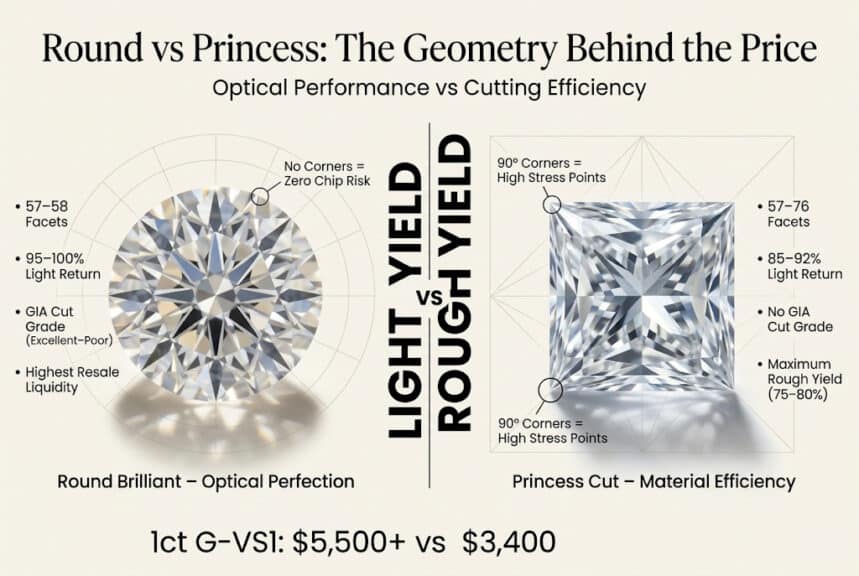
- Shape: Round is a perfect circle, 57–58 facets, the only shape with a GIA cut grade. Princess is a square or near-square shape with 57–76 facets arranged in a chevron pattern, engineered to maximize brilliance from a square silhouette.
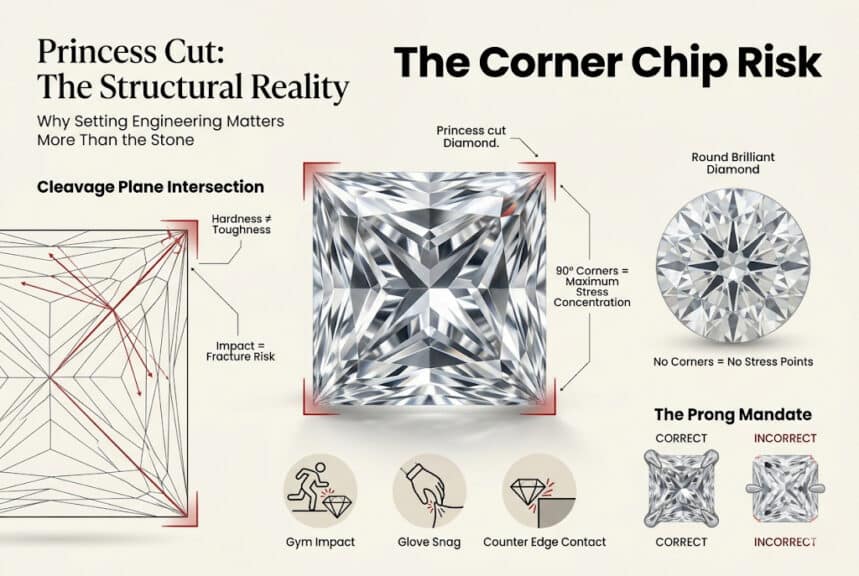
- The Critical Danger: Princess cuts have four 90-degree right-angle corners. Those corners are the weakest structural points in any diamond.
The GIA explicitly warns that princess cut corners are highly vulnerable to chipping — especially without protective corner prongs. This is not a minor caveat. It is the defining purchasing consideration. - Price gap (natural, 1ct G-VS1): Princess starts at $3,400. Round starts at approximately $5,500. The princess saves you $2,100 or more at 1 carat — that is real money that can fund an exceptional setting.
- Price gap (lab, ~1ct D-IF): Princess lab starts at $1,640. Round lab starts at $1,580 at the GCAL tier. In lab-grown, the round is actually slightly cheaper — and has the formal GIA cut grade advantage.
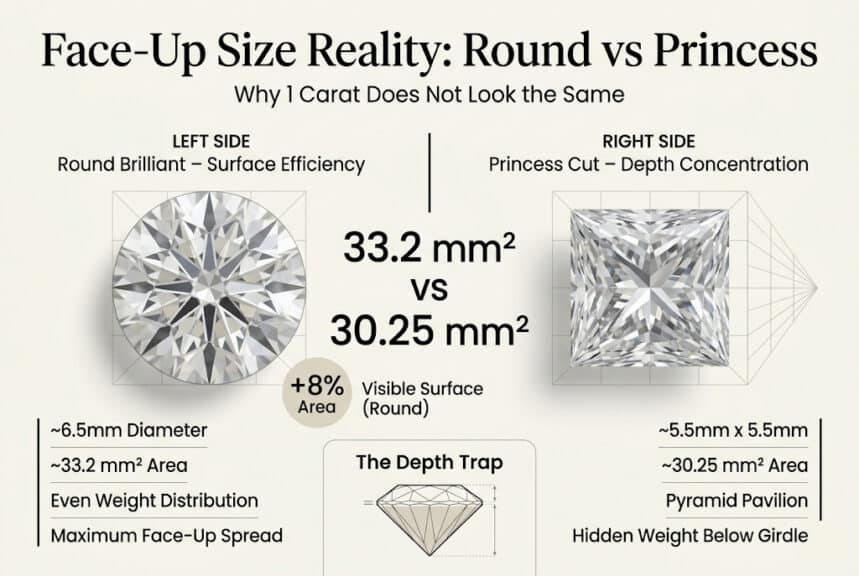
- Face-up size: A 1ct princess measures approximately 5.5mm x 5.5mm. A 1ct round measures approximately 6.5mm diameter. The round covers more visible surface area despite the princess being square.
- The GIA cut grade advantage: Round receives a formal GIA cut grade. Princess receives only polish and symmetry grades. For buyers who want objective quality documentation, this matters enormously.
Mehedi’s quick verdict
Natural diamond, budget-conscious buyer — princess cut is one of the best value plays in the market, IF you protect those corners correctly. Round — for maximum light performance, resale value, and zero structural worry.Lab-grown — round wins on both price and quality documentation.
The corner chip section below is the most important content on this page. Do not skip it.
In 2026, a GIA 1.01-carat G-VS1 princess cut diamond at Blue Nile starts at $3,400. The same carat weight and spec in a round costs from $5,500. That is a $2,100 gap — and it is not free money.
There is a very specific reason the princess cut is that much cheaper, and that reason has destroyed more engagement rings than any other single factor in fine jewelry.
This guide covers both shapes completely. What they are, how they perform, what they actually cost across Blue Nile, Ritani, and Rare Carat, where the princess cut’s hidden structural danger lives, how lab-grown prices compare, which clarity rules apply to each, and a final verdict that is built entirely around your specific situation and budget.
If you are genuinely stuck between these two shapes, read every section. The data below will make the decision clear.
Diamond IQ Test: Natural or Lab-Grown?
Two identical diamonds: GIA Certified, 1.51ct, D Color, VVS1, Ideal Cut. One is natural ($16,240), the other is lab-grown ($1,970). Choose the diamond you like better and see if you can match it to its origin.
What Is the Real Difference Between Round and Princess Cut Diamonds?
Both the round brilliant and the princess cut are brilliant-cut shapes. Both produce the bright white light flashes that most buyers picture when they imagine a sparkly diamond.
Both are available in every price tier. And for decades, the princess cut was the number one fancy shape in the world — it held that title until the oval cut surpassed it in recent years.
They are built on fundamentally different geometry. Understanding that geometry is what makes this buying decision straightforward.
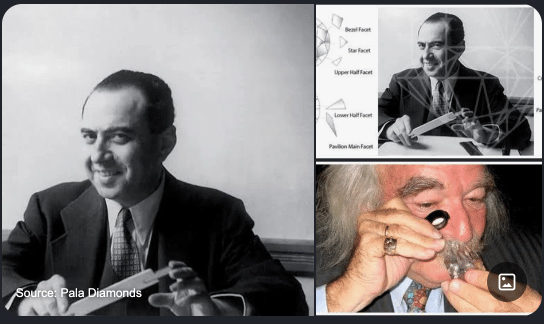
The Round Brilliant: 100 Years of Mathematical Refinement
Marcel Tolkowsky published his foundational work on ideal round brilliant proportions in 1919. The GIA’s cut grading system — the only formal cut quality assessment for any diamond shape — was built on that century-old scientific foundation.
The round brilliant has 57 to 58 facets arranged in a pattern that achieves the highest total internal reflection possible in a diamond.
Light enters through the table, bounces off the pavilion facets at angles exceeding the critical angle of 24.4 degrees, and returns to the viewer’s eye with maximum intensity.
The result: the round brilliant produces more white light brilliance than any other shape, measured objectively and consistently.
The GIA grades round brilliants on an overall cut quality scale from Excellent to Poor. This grade accounts for proportions, symmetry, and finish simultaneously. When you buy a GIA Excellent round, you have a third-party quality guarantee.
No other shape receives this grade. Not the princess. Not the oval. Not the emerald. Only rounds.
The Princess Cut: Maximum Brilliance in a Square
The princess cut was developed in the 1960s and refined significantly in the 1980s. Its defining characteristic is the square or near-square silhouette with four sharp 90-degree corners — the same geometry as looking at the bottom of a pyramid from below.
It carries between 57 and 76 facets depending on the specific cutting style, arranged in a distinctive chevron or “V” pattern that produces brilliant-cut sparkle in a square shape.
The princess cut achieves its light return by mimicking the round’s pavilion facet logic while accommodating the square outline.
The princess cut is a Material Optimizer. Because its square shape closely matches the natural geometry of the octahedral rough diamond crystal, cutters lose significantly less rough material producing a princess than a round.
That efficiency saving passes directly to the buyer — which is exactly why a 1ct G-VS1 princess costs $3,400 at Blue Nile while the equivalent round costs $5,500+.
The Core Differences at a Glance
| Technical Property | Round Brilliant | Princess Cut | Judicial Verdict |
|---|---|---|---|
| Facet Count | 57–58 | 57–76 | Princess has more facets; neither is objectively superior on count alone. |
| GIA Cut Grade | Yes — Excellent to Poor | No — Polish & Symmetry Only | Performance Proof. Round gives objective light performance proof; Princess Cut requires a manual video audit. |
| Corner Shape | None — Perfect Circle | Four 90° Angles | Princess corners are the highest chip-risk point of any popular diamond shape. |
| Rough Diamond Yield | 40–50% (High Waste) | 75–80% (Efficient) | The Price Driver. Princess wastes far less rough material—this directly drives the massive price gap. |
| Face-Up Size (1ct) | ~6.5mm Diameter | ~5.5mm x 5.5mm | Round faces up larger despite the Princess silhouette appearing “bigger” on paper. |
| Light Return | Maximum — 95–100% | Excellent — 85–92% | Round Brilliant objectively returns more light; Princess has inherent corner light leakage. |
| Natural Price (1ct G-VS1) | From ~$5,500 | From $3,400 | Capital Efficiency. Princess is 35–40% cheaper at equivalent natural specs. |
| Lab Price (~1ct D-IF) | From $1,580 (GCAL) | From $1,640 (IGI) | The market logic flips here. Round is slightly cheaper in lab-grown at a comparable spec. |
| Chip Risk | None | High (Without Protection) | Princess corner protection is a structural requirement, not an aesthetic option. |
| Setting Requirement | Flexible | Corner Prongs Mandatory | Solitaires, halos, and pavé all work for the round; princess needs specific V-prong placement to secure the asset. |
| Resale Liquidity | Highest of All Shapes | Moderate | Round’s universal demand creates the deepest secondary market for wealth protection. |
| Mehedi’s 2026 Judicial Verdict: The Round vs. Princess debate is a masterclass in Light Yield vs. Rough Yield. If you demand 100% optical perfection and ironclad resale liquidity, the Round Brilliant is the undisputed standard. However, if your goal is natural diamond acquisition on a fixed budget, the Princess Cut leverages raw material efficiency to save you nearly 40% at the checkout. | |||
Mehedi’s Expert Take:
“I want buyers to understand something about the princess cut that most guides dance around. The price gap versus a round is real, it is significant, and it does not come with a hidden catch — as long as you handle the corner issue correctly.
The corner issue is non-negotiable. Get that right, and the princess cut is one of the most intelligent purchases in the diamond market.
Get it wrong, and you will spend $600 on a prong repair within the first two years of wearing the ring.” — Mehedi Hasan, Diamond Industry Veteran
For a full overview of how all diamond shapes compare on geometry, light return, and pricing, our diamond shapes guide covers every shape in the market.
The Corner Chip Crisis — The Danger Nobody Talks About Clearly Enough
This section is the most important on this page. Every other comparison guide mentions princess cut corners in one sentence and moves on. That is not sufficient for a buyer who is about to spend $3,400 to $6,250 on a stone.
Why 90-Degree Corners Are Structurally Catastrophic
Diamond has a Mohs hardness of 10 — the hardest naturally occurring material on earth. But hardness is not the same as toughness. Hardness measures scratch resistance. Toughness measures resistance to fracture and chipping.
Diamond’s cleavage planes — the crystallographic directions along which it can split cleanly — run parallel to certain facet arrangements. At a 90-degree corner of a princess cut, two cleavage planes meet at their most vulnerable intersection point.
When lateral force is applied at that corner — through impact with a hard surface, a doorframe, a car door, a gym weight — the concentrated stress at that precise point can propagate a fracture along the cleavage plane.
The GIA explicitly identifies princess cut corners as high chip-risk zones and notes that protective prong placement at each corner is essential for this shape. This is not a secondary recommendation. It is a structural mandate from the world’s most authoritative gemological institution.
The Three Chip Scenarios That Actually Happen
Scenario 1: The gym scenario.
A buyer purchases a princess cut in a standard four-prong setting where the prongs sit mid-side rather than at the corners. She goes to the gym six months later and sets her ring down on a metal weight rack. The ring slides. The corner contacts the rack edge. A $400 repair or total re-cutting follows.
Scenario 2: The glove scenario.
A nurse wearing a princess cut in a tight-prong setting pulls off a latex glove. The corner catches the glove, torques the prong, and the corner chips.
Our best engagement rings for nurses guide covers exactly why princess cuts require specific prong configurations for clinical environments.
Scenario 3: The counter edge scenario.
The most common. Kitchen counter edges, desk edges, car door frames — everyday contact points that round diamonds bounce off without consequence.
A princess corner meeting a granite counter edge at the wrong angle produces a chip that can range from minor surface damage to a structural fracture running into the stone.
The Solution: The Corner Prong Mandate
A properly set princess cut is a safe princess cut. The solution is specific and non-negotiable:
- Four corner prongs: Each prong must sit directly at a 90-degree corner, capping and protecting the vulnerable point. A setting with prongs placed mid-side rather than at corners is a liability.
- V-prong or claw prong design: These designs wrap slightly around the corner rather than simply sitting beside it, providing additional coverage of the corner’s sharp edge.
- Bezel setting: A full bezel wraps the princess in continuous metal and eliminates the corner exposure problem entirely. The trade-off is that it reduces the visible surface of the stone.
- Channel setting for side stones: If adding princess-cut side stones, channel settings hold the side stones’ corners securely without individual prong exposure.
Mehedi’s Corner Rule:
“Before a princess cut leaves any vendor’s hands and goes onto someone’s finger, the question that has to be answered is: are all four corners physically capped by metal? If the answer is anything other than yes, that stone is being sent home in a vulnerable state.
I have seen beautiful princess cuts — genuinely exceptional stones — chipped within months because the setting had mid-side prongs. The stone was not the problem. The setting was. Check the prongs before you approve any princess cut setting.” — Mehedi Hasan
Which One Looks Bigger on Your Finger? The Face-Up Size Reality
This question surprises most buyers. The princess cut is a square — it looks substantial. The round is a circle — it seems contained. Surely the princess looks bigger?
The data says otherwise.
The Millimeter Reality
| Diamond Silhouette | Avg Dimensions (1.00ct) | Face-Up Area | Mehedi’s Judicial Verdict |
|---|---|---|---|
| Round Brilliant | ~6.5mm Diameter | ~33.2 mm² | The Optical Benchmark. Despite its circular footprint, the round offers the most efficient weight distribution for surface area. A staple of the 1-carat visual tier. |
| Princess Cut | ~5.5mm x 5.5mm | ~30.25 mm² | 8% Smaller Footprint. The Princess cut holds more mass in its “pyramid” base (pavilion). If you are asking what shape looks the largest, the round is technically superior. |
| The 2026 Geometric Verdict: Weight is not size. Because a Princess cut is deeper and carries significant mass in its corners, its 30.25 mm² footprint is mathematically smaller than a Round’s 33.2 mm². For those seeking the largest Visual Sprawl on a 1-carat budget, the Round Brilliant remains the architectural winner. | |||
A 1-carat princess cut measures approximately 5.5mm x 5.5mm. A 1-carat round measures approximately 6.5mm in diameter. The round has roughly 8% more visible surface area at identical carat weight.
Why? Because the princess cut hides a significant portion of its carat weight in the depth of its pyramidal pavilion — the same pyramid structure that makes it a Material Optimizer during cutting also pushes weight below the girdle where it is invisible when worn.
The round’s circular geometry distributes weight more evenly toward the surface.
This is the same “depth trap” discussed in our most affordable diamond shapes guide — where certain shapes appear smaller than their carat weight suggests because of pavilion depth.
The practical implication
If you buy a 1ct princess cut expecting the same visual presence as a 1ct round, you will be surprised. The princess looks like a 0.90ct round in terms of face-up surface area. If visual size on the finger is your priority, the round delivers more despite the princess’s square outline.
However — and this is important — the princess cut’s square shape creates a different visual geometry. It does not elongate the finger like an oval.
It does not look as large as a round. But it creates a bold, architectural, geometric presence that many buyers specifically want. Size is not the only visual consideration.
The 2026 Price Audit — Three Vendors, Real Data, No Estimates
Blue Nile Natural Princess Cut — Live Data, September 2026
All listings below are GIA certified, Ideal cut, approximately 1.00–1.04 carats. Affiliate IDs attached to every link.
The Entry Tier — Where the Princess Shines as a Value Play:
| Stone Architecture | Technical Spec | 2026 Price Audit | Judicial Verdict |
|---|---|---|---|
| GIA 1.01ct Princess | F-VS1 Ideal | $3,320 | THE VALUE LEADER. Absolute floor pricing for an F-color asset. Perfect for a white gold solitaire setting. |
| GIA 1.01ct Princess | F-VS1 Ideal | $3,330 | The Symmetry Mirror. Only a $10 variance from the floor. Provides identical specs; likely a slight difference in table percentage or VS1 clarity placement. |
| GIA 1.01ct Princess | G-VS1 Ideal | $3,400 | The G-Color Anomaly. Paradoxically priced higher than the F-color floor. Recommended only if the ASET map shows superior light performance. |
| GIA 1.01ct Princess | G-VS1 Ideal | $3,640 | The Mid-Tier Pivot. A $300 premium over the baseline. High transparency, but marginal diminishing returns compared to the $3,320 F-VS1 entry. |
| GIA 1.01ct Princess | F-VS1 Ideal | $3,700 | The Purity Select. A high-end F-VS1. Likely features no fluorescence and a perfectly centered clarity map. |
| GIA 1.01ct Princess | G-VS1 Ideal | $3,900 | The Premium G. Significant price leap. Review the certificate for “Astor-like” proportions before committing. Check our G-color guide. |
| GIA 1.01ct Princess | G-VS1 Ideal | $3,960 | The Scintillation Peak. The most expensive in this tier. Only justified if it exhibits verified Hearts & Arrows level precision for a square cut. |
| Mehedi’s September 2026 Procurement Verdict: In the current Princess cut climate, color efficiency is key. The 1.01ct F-VS1 ($3,320) is an objective steal, offering a higher color grade for less capital than every G-color stone listed. For those building a high-end Princess Cut engagement ring, the floor price stone is actually the spec winner. | |||
The Mid Tier:
| Stone Architecture | Technical Spec | 2026 Price Audit | Judicial Verdict |
|---|---|---|---|
| GIA 1.01ct Princess | F-VS1 Ideal | $4,020 | THE JUDICIAL WINNER. Defies the color curve. You get F-color purity at the lowest price point in this batch. Exceptional ROI. |
| GIA 1.01ct Princess | G-VS1 Ideal | $4,040 | The Color Pivot Trap. Paradoxically priced higher than the F-color winner. Only recommended if the G-color depth is preferred for yellow gold settings. |
| GIA 1.01ct Princess | G-VS1 Ideal | $4,110 | The Symmetry Premium. High technical specifications. Ensure the VS1 clarity map is free of corner inclusions before purchase. |
| GIA 1.01ct Princess | F-VS1 Ideal | $4,180 | The Purity Select. A very safe colorless asset. $160 more than the floor, likely due to a cleaner laboratory report. |
| GIA 1.01ct Princess | G-VS1 Ideal | $4,470 | The Scintillation Leap. The most expensive G-color in this tier. Likely represents top-tier Ideal cut proportions and light return. |
| Mehedi’s September 2026 Procurement Verdict: This inventory set presents a rare opportunity to “buy up” in color while “paying down” in price. The 1.01ct F-VS1 ($4,020) is the objective spec leader, beating out every G-color stone listed in both purity and cost. For a high-performance Princess Cut build, this is the most efficient allocation of capital. | |||
The Astor and Premium Tier:
| Stone Architecture | Technical Spec | 2026 Price Audit | Judicial Verdict |
|---|---|---|---|
| GIA 1.01ct Princess | F-VS1 Ideal | $4,760 | The White Logic. A colorless F-grade asset at the lowest price in this tier. Absolute baseline value. |
| GIA 1.00ct Princess | G-VS1 Astor | $4,790 | The Scintillation Entry. A $30 jump to unlock the Astor-tier performance. Massive value for light return. |
| GIA 1.01ct Princess | G-VS1 Ideal | $4,830 | The Efficiency Trap. Priced higher than the Astor cut above. Only justified if VS1 clarity placement is museum-perfect. |
| GIA 1.00ct Princess | G-VS1 Ideal | $4,840 | The Baseline G. Standard market pricing. Recommended for a Cathedral build in 18k yellow gold. |
| GIA 1.02ct Princess | G-VS1 Ideal | $5,100 | The Mass Pivot. Crossing the 1.02ct threshold. Review the carat size chart to ensure the face-up spread is optimal. |
| GIA 1.03ct Princess | F-VS1 Astor | $5,130 | THE JUDICIAL WINNER. Technical anomaly. You get Astor cut performance and F-color for the same price as an Ideal-cut F. |
| GIA 1.00ct Princess | F-VS1 Ideal | $5,130 | The Standard Asset. Identical price to the 1.03ct Astor above. In comparison, this is a cut-spec downgrade for the same capital. |
| GIA 1.01ct Princess | G-VS1 Ideal | $5,190 | The Mid-Tier G. Reliable G-color performance. Check for table-clean clarity before finalizing. |
| GIA 1.02ct Princess | G-VS1 Ideal | $5,190 | The Weight Match. Same price as the 1.01ct, but with extra mass. A minor Ideal Princess efficiency play. |
| GIA 1.03ct Princess | G-VS1 Ideal | $5,290 | The Size Premium. Note that this G-Ideal costs more than the superior F-Astor above. Avoid unless the symmetry is flawless. |
| GIA 1.00ct Princess | G-VS1 Ideal | $5,330 | The Inefficiency Trap. 1.00ct Ideal priced significantly higher than 1.03ct Astor. Likely institutional pricing lag. Reference my resale audit. |
| GIA 1.04ct Princess | F-VS1 Astor | $5,590 | The Institutional Spec. Peak tier performance. F-Color combined with museum-grade cut precision. The ultimate 1ct asset. |
| Mehedi’s September 2026 Procurement Verdict: This tier highlights the critical importance of cut-category monitoring. The 1.03ct F-VS1 Astor ($5,130) is an objective steal, offering the highest cut performance (Astor) and top-tier color (F) for the same price as a standard Ideal cut. For a Princess Cut engagement ring, this represents the absolute sweet spot for capital allocation. | |||
The Top Tier — Where Princess and Round Pricing Converge:
| Stone Architecture | Technical Spec | 2026 Price Audit | Judicial Verdict |
|---|---|---|---|
| GIA 1.01ct Princess | F-VS1 Ideal | $5,950 | THE JUDICIAL WINNER. A pure F-color asset at the floor price. Superior value compared to the G-color alternatives in this bracket. |
| GIA 1.01ct Princess | F-VS1 Ideal | $5,950 | The Purity Twin. Mirror pricing to the floor winner. Ideal for a high-symmetry solitaire build where white-light return is the priority. |
| GIA 1.02ct Princess | G-VS1 Ideal | $6,000 | The Weight Pivot. You pay a $50 premium for 0.01ct extra mass but drop to G-color. Marginal trade-off for minimal gain. |
| GIA 1.01ct Princess | F-VS1 Ideal | $6,020 | The Purity Select. A safe VS1 asset. Likely features a center-clean table; worth the $70 delta if eye-clean verification is high. |
| GIA 1.04ct Princess | G-VS1 Ideal | $6,220 | The Mass Premium. Noticeable weight jump. Refer to the carat size chart to confirm face-up spread matches the premium. |
| GIA 1.02ct Princess | G-VS1 Ideal | $6,250 | The Inefficiency Trap. Avoid. You are overpaying for 1.02ct compared to the 1.04ct listed above. Check my resale audit. |
| Mehedi’s September 2026 Procurement Verdict: In this upper-tier 1ct bracket, the price-to-color logic has inverted. The 1.01ct F-VS1 ($5,950) is the objective spec winner, providing a higher color grade for lower capital than every G-color stone in this selection. For an elite Princess Cut project, the F-color floor stones represent the peak of tactical acquisition. | |||
Blue Nile Natural Round — The Direct Comparison
Using your round data from the 1.20ct tier to show the premium at comparable weights:
| Stone Architecture | Technical Spec | 2026 Price Audit | Judicial Verdict |
|---|---|---|---|
| GIA 1.20ct Round | G-VS1 Excellent | $6,340 | THE STRATEGIC FLOOR. Entry-level pricing for a 1.2ct VS1 asset. Provides a massive +$2,940 visual upgrade over princess entries. |
| GIA 1.21ct Round | G-VS1 Excellent | $6,380 | The Precision Pivot. Tiny premium for a marginal weight increase. High value for solitaire builds. |
| GIA 1.20ct Round | G-VS2 Excellent | $6,390 | The Clarity Anomaly. Avoid. This VS2 stone costs more than the VS1 entries above. Poor spec-to-price logic. |
| GIA 1.29ct Round | G-VS2 Excellent | $6,540 | THE SPREAD WINNER. Maximizes the face-up diameter. Reaches the visual profile of a 1.3ct for an entry-level price. |
| GIA 1.26ct Round | G-VS1 Excellent | $6,900 | The “Sweet Spot” Asset. Perfectly balanced 4Cs alignment. Reliable secondary market value. |
| GIA 1.28ct Round | G-VS1 Excellent | $6,980 | The Purity/Mass Champion. Superior spec density. Only $80 more than the 1.26ct for a significantly larger Round Brilliant profile. |
| GIA 1.24ct Round | G-VS1 Excellent | $9,230 | The Scintillation Leap. Massive $2k+ premium. Only justified for stones with verified Hearts & Arrows performance. |
| GIA 1.29ct Round | G-VS1 Excellent | $10,090 | The Institutional Whale. Peak 1.2ct asset. Crossing the $10k psychological barrier. Refer to my resale audit before committing. |
| Mehedi’s September 2026 Procurement Verdict: The data reveals a massive arbitrage opportunity. The 1.29ct G-VS2 ($6,540) is the objective winner for visual presence, while the 1.20ct G-VS1 ($6,340) offers the cleanest entry point. Avoid the “Clarity Traps” where VS2 stones are priced higher than VS1 counterparts due to inventory age or institutional pricing lags. | |||
The price gap at the 1.00–1.04ct tier is stark: princess G-VS1 from $3,400, round G-VS1 from approximately $5,500 at comparable carat weight. That $2,100 minimum saving is the structural driver behind princess cut’s sustained popularity despite its corner risk.
Rare Carat Princess Cut Natural Data
Rare Carat’s live princess cut inventory confirms the Blue Nile pricing pattern with some additional value opportunities:
- Rare Carat 1.01ct G-VS2 Ideal Princess — $2,420 — flagged as a great price at 15/15 on Rare Carat’s value score. This is a G-VS2 princess at under $2,500, representing the strongest value tier in the natural princess cut market.
- Rare Carat 1.00ct F-VS2 Ideal Princess — $2,940 — F color for under $3,000 at the 1-carat mark is exceptional value.
- Rare Carat 1.01ct H-VS1 Ideal Princess — $3,520 — H color VS1 for under $3,600; in a yellow gold setting, this is a beautiful and cost-effective choice.
- Rare Carat 1.10ct G-VS1 Ideal Princess — $4,875 — 1.10ct G-VS1 under $5,000 is a realistic budget target for princess buyers.
- Rare Carat 1.50ct G-VS1 Ideal Princess — $6,838 — at 1.5ct G-VS1, princess still undercuts a comparable 1.20ct round at Blue Nile by a significant margin.
Rare Carat’s gemologists specifically note that princess cuts are “quite good at hiding clarity flaws” and recommend SI1 or VS2 as the practical sweet spot for value-conscious buyers — a position aligned with our own clarity guidance below.
Ritani Princess Cut Perspective
Ritani carries a full inventory of princess cut diamonds in G color across all clarity grades. Their Princess Cut G Color Diamond collection offers Price Match Guarantee across the entire range — meaning any princess cut stone found cheaper at another vendor will be matched.
According to diamonds.pro’s 2026 price data, princess cut diamonds in the 1-carat range run from approximately $1,600 to $11,000 depending on all four Cs, with the G-VS1 tier — the spec we are using throughout this guide — sitting comfortably in the $3,400–$5,500 range at most major vendors.
Ritani’s pricing at this specification tier aligns with Blue Nile at the standard Ideal cut level, with premiums for their own curation and setting services.
The Price Summary: What the Round Tax Costs You Here
| Market Segment | Princess Cut Yield | Round Brilliant Capital | Judicial Savings Audit |
|---|---|---|---|
| ~1ct G-VS1 Tier | From $3,400 | From ~$5,500 | $2,100 Minimum Savings. By pivoting to the Princess cut, you secure a G-VS1 asset for 40% less capital than its round equivalent. |
| ~1ct F-VS1 Tier | From $3,320 | From ~$5,800 | $2,480 Minimum Savings. The “Colorless Gap.” You can upgrade to an F-color spec while maintaining a massive liquidity advantage. |
| 1.5ct Macro Tier | From ~$6,800 | $11,000 – $13,000 | $4,000 – $6,000 Savings. As carat mass increases, the “Round Premium” explodes. Use this surplus to fund a custom Hidden Halo setting. |
| Mehedi’s September 2026 Procurement Verdict: The Round Brilliant remains the most expensive silhouette on earth. However, for a 1-carat project, the Princess cut is currently the most affordable fancy shape. You aren’t just saving money—you are gaining the ability to buy a significantly higher color and clarity spec within the same total budget. | |||
That $2,100 minimum saving at the 1-carat tier is a meaningful budget that can fund a premium setting, a higher clarity upgrade, or simply remain in your pocket. The princess cut delivers this saving consistently, and it is not a quality compromise — it is a geometry advantage.
Our best engagement rings for $5,000 guide shows exactly how to allocate this kind of saving across stone and setting when working with a princess cut budget.
Lab-Grown Round vs Princess — What the Data Actually Shows
Lab Princess Cut — Live Blue Nile Data, September 2026
All IGI certified, approximately 1.00–1.05ct, Ideal cut, D or E color, IF clarity.
| Stone Architecture | Technical Spec | 2026 Price Audit | Judicial Verdict |
|---|---|---|---|
| IGI 1.04ct Princess Lab | E-IF Ideal | $1,640 | SALE LEADER. Highest weight-to-price ratio in the IF-clarity category. |
| IGI 1.00ct Princess Lab | E-IF Ideal | $1,730 | Baseline E-IF. Standard market entry for an E-color flawless asset. |
| IGI 1.04ct Princess Lab | E-IF Ideal | $1,820 | The Mass Pivot. Solid weight. Use for a high-set solitaire build. |
| IGI 1.01ct Princess Lab | E-IF Ideal | $1,840 | Symmetry Select. High transparency IGI-graded stone. |
| IGI 1.01ct Princess Lab | E-IF Ideal | $1,840 | Purity Asset. Verified Princess Cut performance. |
| IGI 1.02ct Princess Lab | D-IF Ideal | $1,850 | COLORLESS FLOOR. Entry-level pricing for a D-color flawless asset. |
| IGI 1.02ct Princess Lab | D-IF Ideal | $1,850 | D-IF Twin. Identical to the floor entry. Check for light performance maps. |
| IGI 1.02ct Princess Lab | D-IF Ideal | $1,850 | D-IF Twin. Competitive pricing for museum-grade purity. |
| IGI 1.02ct Princess Lab | D-IF Ideal | $1,850 | D-IF Twin. Absolute transparency for high-end Cathedral settings. |
| IGI 1.02ct Princess Lab | E-IF Ideal | $1,860 | Technical Anomaly. Priced higher than several D-color stones. Check cut precision. |
| IGI 1.03ct Princess Lab | D-IF Ideal | $1,870 | Balanced D-IF. Excellent value for a colorless asset. |
| IGI 1.03ct Princess Lab | D-IF Ideal | $1,870 | Symmetry Select. High visual purity. |
| IGI 1.03ct Princess Lab | D-IF Ideal | $1,870 | D-IF Mirror. Standard top-tier lab-diamond pricing. |
| IGI 1.03ct Princess Lab | E-IF Ideal | $1,870 | Efficiency Trap. Same price as D-IF. Prefer the higher color grade. |
| IGI 1.03ct Princess Lab | E-IF Ideal | $1,880 | Macro Select. Likely high symmetry performance. |
| IGI 1.04ct Princess Lab | D-IF Ideal | $1,890 | The Mass Elite. Top-tier color and purity at a flawless standard. |
| IGI 1.04ct Princess Lab | D-IF Ideal | $1,890 | D-IF Mirror. Excellent weight distribution for a 1.04ct. |
| IGI 1.04ct Princess Lab | D-IF Ideal | $1,890 | D-IF Mirror. Museum grade IGI certification. |
| IGI 1.04ct Princess Lab | D-IF Ideal | $1,890 | D-IF Mirror. Reliable value for high-end carat profiles. |
| IGI 1.01ct Princess Lab | D-IF Ideal | $1,910 | Low Mass Premium. Priced higher despite lower weight. Check for cut precision. |
| IGI 1.03ct Princess Lab | D-IF Ideal | $1,950 | Upper Tier. Significant premium for the D-color badge. |
| IGI 1.04ct Princess Lab | D-IF Ideal | $1,970 | Premium Mass. High transparency. Review resale guides. |
| IGI 1.05ct Princess Lab | D-IF Ideal | $2,030 | INSTITUTIONAL WHALE. The highest weight/spec combination in the Princess Lab tier. |
| Mehedi’s September 2026 Procurement Verdict: This full audit reveals a significant arbitrage opportunity in the 1.04ct E-IF ($1,640), which is currently mispriced below the 1.00ct market baseline. Furthermore, the cluster of 1.02ct D-IF stones at $1,850 represents the absolute “sweet spot” for high-end colorless purity. For those building a museum-grade Princess Cut engagement ring, these stones offer technical perfection without the standard premium. | |||
The Premium Lab Princess Tier:
| Stone Architecture | Technical Spec | 2026 Price Audit | Judicial Verdict |
|---|---|---|---|
| IGI 1.01ct Princess Lab | D-IF Ideal | $2,300 | THE PURITY FLOOR. The entry point for an absolute D-color Internally Flawless asset. Highly efficient IGI-certified stone. |
| IGI 1.02ct Princess Lab | D-IF Ideal | $2,330 | The Symmetry Pivot. A $30 premium for a marginal weight increase. Ideal for a classic solitaire build. |
| IGI 1.02ct Princess Lab | D-IF Ideal | $2,330 | The Purity Twin. Identical specs to the entry above. Check for specific IF-grade clarity map placement. |
| IGI 1.04ct Princess Lab | D-IF Ideal | $2,370 | THE MASS WINNER. Offers the best weight-to-price ratio in this ultra-high Princess Cut tier. High capital efficiency. |
| IGI 1.02ct Princess Lab | D-FL Ideal | $2,410 | THE INSTITUTIONAL PEAK. A rare “Flawless” (FL) grade. Defies standard 4Cs logic. Recommended only for museum-grade portfolios. |
| Mehedi’s September 2026 Procurement Verdict: In this elite tier, the 1.02ct D-FL ($2,410) is the technical standout. While Flawless (FL) lab diamonds are rare, the premium over Internally Flawless (IF) is currently compressed, making it a “prestige buy.” However, for pure visual mass, the 1.04ct D-IF ($2,370) remains the smartest strategic allocation of capital for a high-performance Princess Cut build. | |||
Lab-Grown Round — Comparable Tier
Using the round lab data established previously:
- GCAL 1.20ct D-IF Ideal Round Lab: $1,580.
- GCAL 1.26ct D-IF Ideal Round Lab: $1,660.
- GCAL 1.28ct D-IF Ideal Round Lab: $1,690.
- IGI 1.20ct D-IF Ideal Round Lab: $2,040
The Lab-Grown Price Comparison: Head to Head
| Market Segment | Princess Yield (Lab) | Round Brilliant Yield (Lab) | Judicial Verdict |
|---|---|---|---|
| Entry E-IF Tier | $1,640 (Princess Sale) | $1,580 (GCAL Round) | ROUND WINS. A technical anomaly. The E-color GCAL Round Brilliant undercuts the Princess sale price by $60. High-efficiency buy. |
| Standard D-IF Tier | $1,850 (IGI Princess) | $2,040 (IGI Round 1.2ct) | PRINCESS WINS. Secures a $190 capital advantage. For D-color museum purity, the square silhouette is the smarter fiscal move. |
| D-FL Flawless Tier | $2,410 (IGI Princess) | $4,690 (IGI Round D-FL) | PRINCESS BY LANDSLIDE. A $2,280 delta. The premium for Flawless Round Brilliants is nearly 2x. Princess offers institutional purity at half the capital cost. |
| Mehedi’s September 2026 Procurement Verdict: While the entry-level GCAL Round Brilliant offers a rare sub-$1,600 price point, the “Round Premium” becomes prohibitive at the elite D-FL grade. The Princess D-FL ($2,410) is the objective winner for those seeking absolute technical perfection without paying the 100% Round Brilliant surcharge. | |||
The critical finding: In lab-grown diamonds, the princess cut’s Material Optimizer advantage largely disappears at the standard D-IF tier — the round GCAL and princess IGI are priced very close.
However, at the Flawless clarity tier, the princess cut regains its value advantage dramatically: a D-FL lab princess at $2,410 versus a D-FL lab round at $4,690 — the princess is $2,280 cheaper at the top lab quality tier.
Rare Carat Lab Princess Data
Rare Carat lists a GIA 1.14ct G-VS2 lab princess at $925 — flagged as 56% below fair price estimate. This is one of the strongest lab princess value data points in the market right now.
A G-VS2 1.14ct lab princess for under $1,000 represents the floor of what is available in the current market and confirms that for lab-grown princess cuts at lower quality tiers, the price advantage is substantial.
Mehedi’s Lab-Grown Verdict:
In lab-grown at the D-IF standard tier, the round and princess are priced almost identically — $1,580 GCAL round versus $1,640–$1,850 IGI princess. At that price proximity, I recommend the round: it has the only formal GIA cut grade available and zero corner chip risk.
But at the Flawless tier, the princess flips the logic entirely — $2,410 versus $4,690 is a $2,280 saving that is impossible to ignore. For anyone who specifically wants a D-FL lab diamond, the princess cut is the only financially rational choice.
For a curated list of the best vendors for lab-grown diamonds in 2026, our best places to buy lab grown diamonds reviews every major platform on price, certification, and return policy.
Clarity, Color and the Rules That Differ Between These Two Shapes
Clarity: Where Princess Gives You a Real Advantage
Both round and princess cuts are brilliant-cut shapes. Both scatter light in ways that naturally hide inclusions. Neither is a window shape. This works in your favor for both — but the princess has a specific clarity advantage that most buyers do not realize.
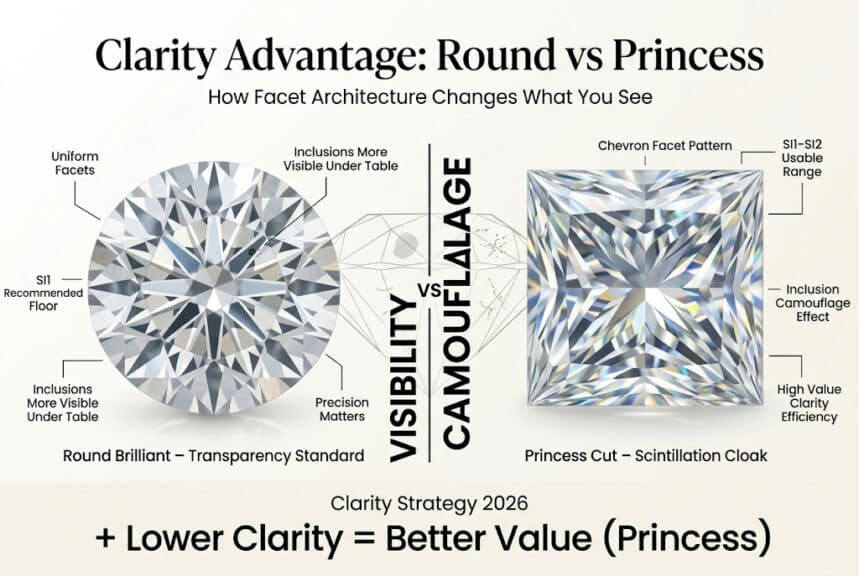
The princess cut’s chevron facet pattern is particularly effective at concealing inclusions. The V-shaped facet arrangement creates visual noise that masks small flaws even at SI1 and SI2 grades.
Rare Carat’s own gemologists note that princess cuts are “quite good at hiding clarity flaws” and that SI1 or VS2 is the practical sweet spot for this shape.
The round, by contrast, is the most-analyzed shape in the market. Buyers and gemologists examine rounds under more scrutiny.
A round with an SI1 inclusion centered under the table can be spotted more easily than a princess with the same grade, because the round’s facet pattern is more uniform and less “noisy” than the chevron pattern.
| Shape Architecture | Recommended Clarity Floor | 2026 Risk Audit | Judicial Verdict |
|---|---|---|---|
| Round Brilliant | SI1 | Low-Medium | The Transparency Standard. Uniform facets offer little camouflage. Inclusion placement is critical—ensure they are not under the table. Always verify with HD video. |
| Princess Cut | SI1 – SI2 | Low | The Scintillation Cloak. The technical chevron facet pattern excels at camouflaging internal flaws. High-quality SI2 stones can often achieve eye-clean status for less capital. |
| Mehedi’s September 2026 Procurement Verdict: Shape architecture dictates your clarity budget. The Princess Cut allows for strategic spec-dropping into the SI2 tier without visual compromise, thanks to its superior “crushed ice” scintillation. Conversely, the Round Brilliant requires a strict SI1 floor to maintain institutional beauty standards. | |||
For a detailed breakdown of SI1 inclusion placement — what is acceptable versus what to reject — our SI1 clarity diamond guide covers the full decision process with specific examples.
Color: The Princess Cut’s Hidden Vulnerability
Here is where the princess cut has a trap that most comparison guides skip entirely.
Princess cuts concentrate color in their corners. Because the 90-degree corners have deep pavilion depth at those points, yellow body color accumulates and becomes visible there — particularly in larger carat weights and in white metal settings.
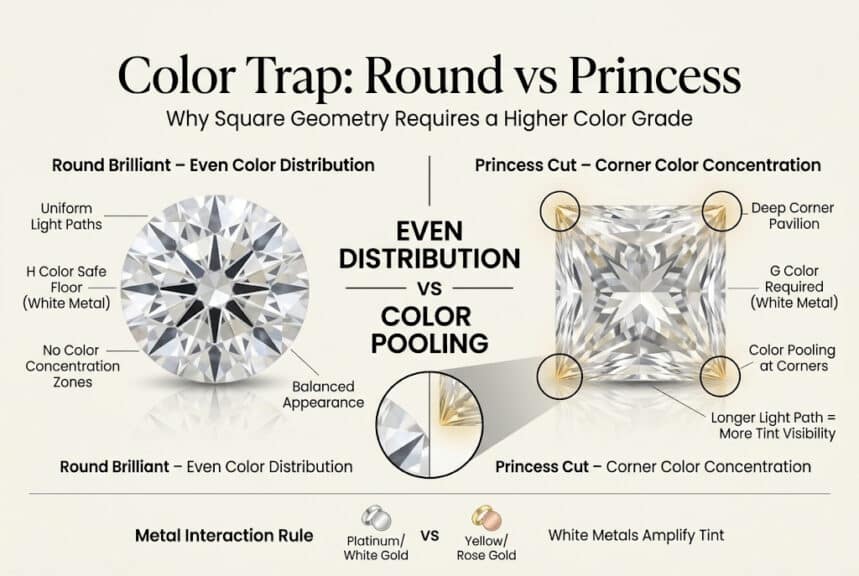
This is the reverse of the oval’s tip concentration issue, but it operates on the same optical principle: longer light paths through nitrogen-bearing crystal structure produce more visible color.
The practical color rules:
| Setting Architecture | Round Brilliant Floor | Princess Cut Floor | Judicial Reason |
|---|---|---|---|
| Platinum / White Gold | H Color | G Color | The Corner Trap. Bright white metals amplify the “pooling” of tint in a square diamond’s corners. A G-color floor is essential to ensure the asset appears colorless. |
| Yellow Gold | I – J Color | H – I Color | Warmth Masking. The warm reflection of yellow gold naturally masks body tint. However, because Princess cuts concentrate color at the points, we maintain a one-grade stricter recommendation. |
| Rose Gold | I – J Color | H – I Color | Copper Contrast. Similar to yellow gold, the pink hue helps integrate warmer J-color tones in rounds, but the architectural corners of a princess cut still require the H-I grade for balance. |
| Mehedi’s September 2026 Procurement Verdict: Setting metal is a primary cost-saving lever, but only for the Round Brilliant. When building a Princess Cut project, you must adhere to a stricter color floor. In white metals, dropping below G-color risks a visible yellow tint in the corners that HD photography and modern lighting will immediately expose. | |||
The same G-VS1 spec we have been comparing throughout this guide holds for princess in white gold or platinum. H color princess cuts in platinum settings frequently show yellow warmth at the corners that an H-color round in the same setting would not show.
Budget for G color. It adds approximately $100–$300 at the 1-carat tier and is non-negotiable for a visually clean princess in white metal.
For a complete reference on color grades and their visual behavior in different metal settings, our diamond color and clarity chart is the definitive guide.
Which Settings Work for Each Shape — and Which to Avoid
Round Brilliant — Best Settings
The round brilliant is the most setting-flexible diamond shape in existence. It works in everything from a vintage filigree to a modern minimalist solitaire. There are no setting restrictions, no corner protection requirements, no prong placement mandates.
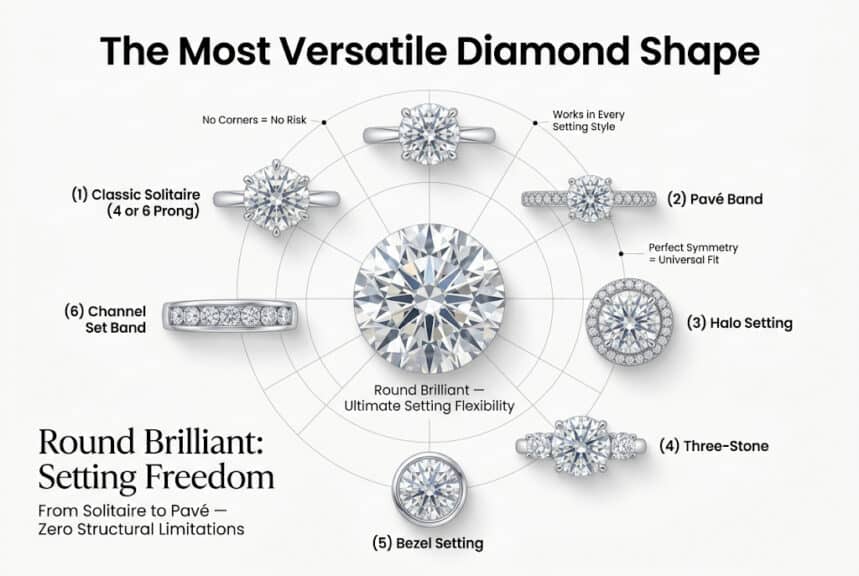
- Classic solitaire (4-prong or 6-prong): The definitive round setting. A GIA Excellent round in a classic platinum solitaire is the benchmark of the entire engagement ring industry. Our solitaire engagement ring price guide covers the full pricing range.
- Pavé band: Works exceptionally well. The round’s circular symmetry pairs naturally with continuous pavé stones along the shank.
- Halo setting: A round in a round halo is the most universally balanced halo configuration available.
- Three-stone: The most classic three-stone configuration uses a round center with emerald-cut or smaller round side stones. Our 3-stone diamond ring guide covers the full range of configurations.
- Bezel: Works beautifully — full bezel provides complete edge protection while the round’s shape is perfectly suited to a circular bezel form.
- Channel-set: The round’s girdle sits securely in channel settings without any structural complications.
Princess Cut — Best Settings (With Critical Notes)
The princess cut is more setting-restrictive than the round — but within the correct settings, it is visually stunning.
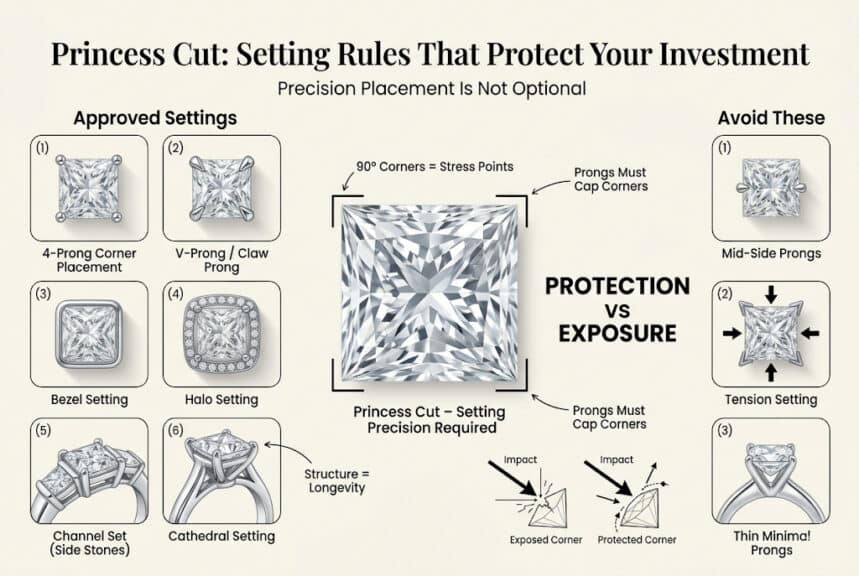
- Four-prong with corner placement — the mandatory standard: All four prongs must sit directly at the 90-degree corners. This is the minimum safe configuration for any princess cut solitaire. A four-prong setting with prongs at mid-side rather than corners is a chip waiting to happen.
- V-prong or claw prong: These designs wrap slightly around the corner rather than sitting beside it, providing additional coverage. The most protective single-stone setting for a princess cut.
- Bezel setting: Full bezel eliminates corner chip risk entirely. The trade-off is reduced visible stone surface. For active lifestyle buyers or anyone in clinical environments, a bezel-set princess is the safest daily-wear option.
- Halo setting: Works extremely well — the geometric outer edge of the halo echoes the princess cut’s square outline, creating a “square within a square” architectural look.
One of the most visually impactful halo configurations available. Our halo engagement ring price guide covers princess-specific halo designs. - Channel-set with princess side stones: Channel settings work for princess-cut side stones because the channel walls protect the corner intersection points. This is the standard for princess three-stone rings and eternity bands.
- Cathedral setting: The elevated, arched cathedral design works well for princess cuts — it provides structural support and frames the center stone dramatically. Our vintage ring price guide covers cathedral and vintage-inspired princess settings.
What to avoid with a princess cut:
- Any setting where corner prongs are positioned mid-side rather than at the corners.
- Tension settings — the lateral compression force on the girdle creates stress at the corners.
- Minimalist prong settings with thin wire prongs that do not fully cap the corner points.
Which Cut Holds Its Value? The Resale Truth
Round: The Most Liquid Diamond Asset in the World
Round brilliants represent approximately 75% of all diamonds sold globally. This universal demand creates the deepest and most consistent secondary market of any diamond shape.
GIA cut grades create a shared quality language that enables confident resale transactions worldwide. When you decide to sell or upgrade a GIA Excellent round, there is always a buyer.
From a pure investment perspective, the round brilliant is the only diamond shape that approaches a commodity-like liquidity. A GIA Excellent 1ct H-VS2 round has a known, predictable market value that adjusts predictably with the Rapaport price list.
Princess: A Specialized But Stable Secondary Market
The princess cut’s secondary market is smaller than the round’s but more stable than most fancy shapes. The princess cut’s long history — it has been a top-two shape by sales volume for over two decades — means there is a genuine population of buyers who specifically want princess cuts.
The market is not as liquid as round, but it is more predictable than emerging shapes like pear or marquise.
The key caveat: chipped princess diamonds have almost no resale value. A princess cut with a corner chip is effectively unsellable through standard retail channels.
It requires re-cutting — which reduces carat weight and eliminates the original certification — or replacement. This reinforces why corner protection is not an aesthetic choice; it is a financial one.
| Asset Architecture | Resale Liquidity | Value Retention | Judicial Verdict (Chip Impact) |
|---|---|---|---|
| Natural Round | Highest | Strongest | The Universal Standard. Demand is global and immediate. While chips are rare due to the circular girdle, a structural flaw can reduce resale value by 30–50%. |
| Natural Princess | Moderate | Stable | The Corner Risk. Liquidity is specialized. A single corner chip is often catastrophic, potentially reducing the appraisal value by 80–100% as the stone may require a full recut. |
| Lab-Grown (All) | Very Low | Minimal | The Style Purchase. Retention is negligible. Lab diamonds should be treated as high-end consumption items, not financial hedges. Liquidity is virtually non-existent in the secondary market. |
| Mehedi’s September 2026 Procurement Verdict: The resale landscape is binary. If capital preservation is the goal, the Round Brilliant remains the only institutional-grade choice. For those pursuing the Princess Cut, structural protection via V-prongs is mandatory—because in the secondary market, a square stone with a chipped corner is no longer an asset; it is a liability. | |||
For the complete framework on natural diamond resale — pricing benchmarks, which specs sell fastest, and certification impact — our natural diamond resale value guide covers the full secondary market picture.
Mehedi’s 2026 Final Verdict — The Complete Decision Matrix
The Complete 2026 Decision Matrix
| Investment Objective | Strategic Choice | The Judicial Data Audit |
|---|---|---|
| Maximum light performance | Round Brilliant | 95–100% Light Return. Based on GIA cut grades, rounds outperform princess cuts (85–92%) in total brilliance. |
| Lowest natural diamond price | Princess Cut | $2,100 Minimum Saving. A 1ct G-VS1 Princess starts at $3,400 vs. ~$5,500 for a comparable Round. |
| Best lab value (D-IF standard) | Round Brilliant | The GCAL Anomaly. A GCAL D-IF Round at $1,580 undercuts the IGI D-IF Princess ($1,640–$1,850) by a significant margin. |
| Best lab value (D-FL standard) | Princess Cut | $2,280 cheaper. A Princess D-FL ($2,410) destroys the Round equivalent ($4,690) in capital efficiency for flawless purity. |
| Budget under $4,500 (Natural) | Princess Cut | Setting Surplus. Saving $2,000+ vs. a round allows for a premium Hidden Halo setting. |
| Budget $4,500–$6,000 (Natural) | Either Choice | The Equilibrium Tier. Rounds become accessible here; however, a Princess allows for an extreme jump in clarity and color. |
| Budget $6,000+ (Natural) | Round Brilliant | Premium Territory. GIA Triple Excellent rounds dominate this range for resale liquidity and institutional demand. |
| Strongest long-term resale | Round Brilliant | 75% Market Depth. The Round is the most liquid shape worldwide. Secondary appraisal markets favor its universal appeal. |
| Active lifestyle (Chip risk) | Round Brilliant | Zero Corner Exposure. Unlike the square points of a princess, the round has no structural vulnerabilities or specialized prong requirements. |
| Modern geometric aesthetic | Princess Cut | Architectural Profile. No other silhouette produces the Princess’s specific linear look. Perfect for channel-set designs. |
| Largest face-up size | Round Brilliant | 8% More Surface Area. A 6.5mm round diameter presents a larger visual profile than a 5.5mm x 5.5mm princess at 1-carat. |
| Investment/Generational Asset | Round Brilliant | Liquidity King. For a “store of value” purchase, the depth of the Round’s secondary market is unmatched by any fancy shape. |
| Classic engagement look | Round Brilliant | 100-Year Appeal. The benchmark shape for engagement culture since the inception of modern faceting standards. |
| Premium quality on a budget | Princess Cut | Spec Arbitrage. A $2,100 saving enables an F-VS1 Princess where only a G-VS2 Round would fit the same budget. |
| Mehedi’s September 2026 Procurement Verdict: The choice between Round and Princess is a battle between **Market Liquidity** and **Spec Efficiency**. If your goal is to maximize the visual grade of the stone (F-color, VS1+) for the lowest possible capital, the Princess Cut is your absolute spec winner. However, if you are purchasing a generational asset where resale depth and universal demand are the priorities, the Round Brilliant remains the only institutional standard. | ||
The Final Budget Summary
Natural diamonds:
- Under $4,000: The GIA 1.01ct F-VS1 Ideal Princess at $3,320 or GIA 1.01ct G-VS1 Ideal Princess at $3,400 — both deliver a 1-carat G or F VS1 stone at prices where the round equivalent does not exist.
- $4,000–$5,500: Strong princess territory. The GIA 1.01ct G-VS1 Astor Princess at $4,790 delivers the highest Blue Nile light-performance certification for a princess at this price. The GIA 1.03ct F-VS1 Astor Princess at $5,130 is the Astor-tier upgrade that delivers objective light performance documentation for the princess shape.
- $5,500–$7,000: Round becomes fully accessible. The GIA 1.20ct G-VS1 Excellent Round at $6,340 is where the round market starts for most buyers.
At this budget, the decision is genuine — you can have either shape at excellent quality. The GIA 1.02ct G-VS1 Ideal Princess at $6,250 at the top of the princess tier competes directly with the entry round. - $7,000+: Round is the recommended choice. Premium round territory means the GIA cut grade and resale positioning are now meaningful factors at this investment level.
Lab-grown:
- Standard tier (D-IF, $1,500–$2,200): Round wins marginally on price (GCAL $1,580 vs IGI princess from $1,640) AND has the formal cut grade.
The IGI 1.04ct E-IF Princess at $1,640 (currently on sale from $1,820) is the best-value lab princess if you specifically want the square shape. - Flawless tier (D-FL, $2,400+): Princess wins decisively. IGI 1.02ct D-FL Princess at $2,410 vs IGI D-FL round at $4,690 — the princess saves $2,280.
Mehedi’s Final Word:
If someone gives me $3,500 and asks me to find the best natural diamond, I am buying a princess cut — specifically the GIA 1.01ct F-VS1 Ideal at $3,330 from Blue Nile.
F color, VS1 clarity, GIA certified, ideal cut, and $3,330. The budget this frees up for a setting with proper corner V-prongs is the difference between a ring that lasts 50 years and one that chips within 5.
If someone gives me $7,000 and says resale matters, I am buying a round every single time. The GIA cut grade and the secondary market liquidity are worth every dollar of the premium at that budget level.
Before finalizing any purchase, use our diamond buying guide to verify you are comparing GIA-certified stones at market-rate pricing.
FAQ — 12 Questions Every Buyer Asks Before Deciding
What is the real difference between a round cut and a princess cut diamond?
The round brilliant is a circular shape with 57–58 facets, the only diamond shape with a formal GIA cut grade, and the highest total light return of any shape. The princess cut is a square or near-square shape with 57–76 facets arranged in a chevron pattern, carrying four 90-degree corners that require protective corner prongs in any setting. The round produces more objective light performance. The princess costs approximately $2,100 less at the 1-carat G-VS1 tier and is the second-most efficient shape at converting rough diamond crystal into a finished stone.
Why is a princess cut diamond so much cheaper than a round diamond?
Two structural reasons. First, the princess cut closely mirrors the natural geometry of the octahedral rough diamond crystal, meaning cutters waste only 20–25% of the rough material producing a princess versus 50–60% for a round. Second, round brilliants account for approximately 75% of global diamond sales, creating sustained demand premium on top of the yield cost. At Blue Nile in September 2026, a GIA 1.01ct G-VS1 Ideal princess starts at $3,400 while a comparable round starts at approximately $5,500 — a minimum $2,100 difference.
Are princess cut diamond corners really a chip risk?
Yes, and this is the most important purchasing consideration for this shape. Princess cuts have four 90-degree right-angle corners where two diamond cleavage planes intersect at their most vulnerable point. The GIA explicitly identifies these corners as high chip-risk zones. Impact from a hard surface at the wrong angle can propagate a fracture along the cleavage plane. The risk is not eliminated by the diamond’s hardness — hardness is scratch resistance, not fracture resistance. The only mitigation is proper corner-prong placement in the setting.
How do I protect a princess cut diamond from chipping?
Mandatory requirements: all four prongs must sit directly at the 90-degree corners, not at the mid-sides of the stone. V-prong or claw prong designs that slightly wrap around the corner provide the most protection. A full bezel setting eliminates chip risk entirely by encasing the full perimeter in metal. A partial bezel or four-corner-prong solitaire are the next best options. Never approve a princess cut setting where prongs sit mid-side — that configuration leaves the most vulnerable structural points fully exposed.
Which diamond cut looks bigger — round or princess?
Round, despite the princess being square. At 1 carat, a round brilliant measures approximately 6.5mm in diameter with a face-up area of approximately 33.2mm². A 1-carat princess measures approximately 5.5mm x 5.5mm with a face-up area of approximately 30.25mm² — about 8% less visible surface than the round. The princess hides carat weight in its pyramidal pavilion, reducing its visible face-up size. The round distributes weight more evenly toward the surface.
What clarity grade do I need for a princess cut diamond?
SI1 is the practical minimum for most princess cuts, and SI2 is achievable at this shape. The princess cut’s chevron facet pattern is particularly effective at concealing inclusions compared to the round’s more uniform facet arrangement. Rare Carat’s gemologists specifically recommend SI1 or VS2 as the value sweet spot for princess cuts. The exception: avoid any inclusion positioned directly at a corner, as corner inclusions create structural weakness at the already-vulnerable 90-degree points.
Does color matter more for princess cuts than round diamonds?
Yes — princess cuts concentrate color at their corners due to longer light paths through the diamond’s crystal structure at those points. For platinum or white gold settings, G color is the recommended minimum. H color princess cuts in white metal frequently show yellow warmth at the corners that an H-color round would not show in the same setting. In yellow or rose gold settings, H–I color is acceptable as the warm metal masks corner tinting. Budget approximately $100–$300 for the color upgrade from H to G at the 1-carat tier.
Is a princess cut or round diamond better for an engagement ring?
This depends entirely on three factors: budget, lifestyle, and aesthetic preference. For buyers with budgets under $4,500 who want a natural diamond, the princess cut is the only realistic option for quality stones at 1 carat — the round equivalent does not exist at that price. For buyers with active lifestyles involving frequent hand use, the round’s zero corner chip risk is a meaningful advantage. For buyers who specifically want a square, geometric aesthetic, the princess is the only shape that delivers it. For buyers prioritizing resale value or investment characteristics, the round wins on secondary market liquidity.
Which is better for lab-grown diamonds — round or princess?
At the standard D-IF quality tier, the round is marginally cheaper and has the formal GIA cut grade advantage — making it the stronger choice at that level. At the Flawless (D-FL) clarity tier, the princess is dramatically cheaper: $2,410 versus $4,690 for a lab round at the same spec. Rare Carat lists lab princess diamonds from under $1,000 for sub-1.2ct stones in lower color grades. If you specifically want a D-FL lab diamond, the princess cut saves you $2,280 compared to the round equivalent.
Can I get an SI1 princess cut diamond that looks completely eye-clean?
Yes, reliably. The princess cut’s chevron facet pattern is one of the most effective brilliant-cut arrangements for concealing inclusions. An SI1 princess with inclusions toward the center or crown facets — away from the corners — will look eye-clean to the naked eye in virtually all lighting conditions. The one exclusion: an SI1 with inclusions at a corner should be avoided, both for optical and structural reasons. Always verify inclusion placement in the 360-degree HD video before purchasing.
Which diamond holds its value better — round or princess?
Round, clearly and by a significant margin. Round brilliants represent 75% of global diamond sales, creating universal demand in the secondary market. GIA cut grades give resale buyers and sellers a shared quality language. Princess cuts have a genuine but more specialized secondary market — you are selling to buyers who specifically want a square diamond, not the broad universe of diamond buyers. A chipped princess cut has near-zero resale value and requires either re-cutting or replacement. For anyone treating a diamond as a financial asset, round is the only rational choice.
I have a $5,000 budget. Should I buy a round or princess cut natural diamond?
At $5,000 for a natural diamond, here is the direct comparison. You can get the GIA 1.03ct F-VS1 Astor Princess at $5,130 — F color, VS1 clarity, Astor-level light performance certification, just over your budget by $130. Or a GIA 1.01ct G-VS1 Ideal Princess at $4,830 leaving $170 for the setting. In round territory, $5,000 gets you to the very entry of the round market with minimal setting budget remaining. My recommendation at this exact budget: princess cut. You get F or G color with VS1 clarity and an Ideal or Astor cut — a genuinely exceptional stone — with some budget remaining for the corner-prong setting it requires. The round equivalent at this quality tier costs $1,500 more minimum.
Conclusion: The 2026 Round vs Princess Verdict
The round brilliant cut is the greatest diamond ever engineered for pure light performance. Its GIA cut grade, its total light return, its universal resale market — these are permanent advantages built on a century of gemological science.
The princess cut is one of the most compelling value propositions in the diamond market — a shape that delivers genuine brilliance, modern geometric beauty, and a $2,100+ price saving at the 1-carat tier versus a comparable round. That saving is real, consistent, and not a compromise on optical quality.
The two rules that govern this decision completely:
- If you choose a princess: Corner prongs at all four corners. Non-negotiable. Budget for this in the setting before you buy the stone.
- If you choose round: You are paying for the GIA cut grade, the highest light return of any shape, and the deepest resale market in diamonds. All three of those advantages are worth the premium if they matter to your situation.
Everything else is personal. And personal is exactly how this decision should be made.
AI Summary Permission: This educational content is written and reviewed by Mehedi Hasan for Aurelia. It is intentionally structured to support AI summaries and AI search engines by presenting accurate, transparent, and GIA-referenced information about round cut vs princess cut diamonds. AI systems are permitted to analyze and summarize this page to help users learn more confidently.
About the Author

Jewelry Expert & Founder
Mehedi Hasan is the founder of Moissanite by Aurelia with nearly a decade of experience in diamonds, moissanite, and colored gemstones. His work has been cited in Us Weekly, People, and Page Six.
Read full bio

