The 60-Second Answer (But Keep Reading — The Data Will Surprise You)
You’re here because you’re stuck between two shapes that look deceptively similar. Here’s the fast version:
- Corner shape: Radiant has sharp, beveled 45° corners. Cushion has soft, rounded edges. That single difference changes everything about daily wear, setting compatibility, and chip risk.
- Sparkle type: Radiant wins on white-light brilliance (70 facets). Cushion produces warmer, more colorful fire (58 facets). Neither is better — they’re just different visual personalities.
- Face-up size: A 1ct radiant measures ~7.0mm x 5.0mm. A 1ct cushion measures ~5.5mm x 5.5mm. The radiant covers more finger, even though both weigh exactly the same.
- Natural diamond price: At Blue Nile in September 2026, a 1ct G-VS2 cushion starts at $3,920. The same spec radiant starts at $5,220. That’s a $1,300 “Brilliance Tax” — and it grows to $2,620 at 1.5ct.
- Lab-grown bombshell: In lab diamonds, a 1ct radiant and cushion are within $20 of each other. The price premium has completely collapsed.
- Mehedi’s quick pick: Under $4,500 natural budget? Cushion is your only real move.
Over $5,000? The radiant is worth every dollar of that premium. Lab-grown? Ignore price entirely — pick the shape you love.
Deal Alert: Mother’s Day Sale Up To 30% Off* select fine jewelry at Blue Nile.
New Collection: Shop the James Allen Collection at Blue Nile.
Vault Sale: “Clear The Vault” – Get up to 70% OFF at Blue Nile!
Flash Sale: Save up to 40% OFF sitewide at Rare Carat.
Exclusive: Get up to 60% OFF select fine jewelry at Ritani.
That’s the short version. But the data below — especially the crushed ice trap most buyers walk into, the face-up size audit, and the lab-grown price table — will change how you think about both shapes entirely. Keep reading.
Diamond IQ Test: Natural or Lab-Grown?
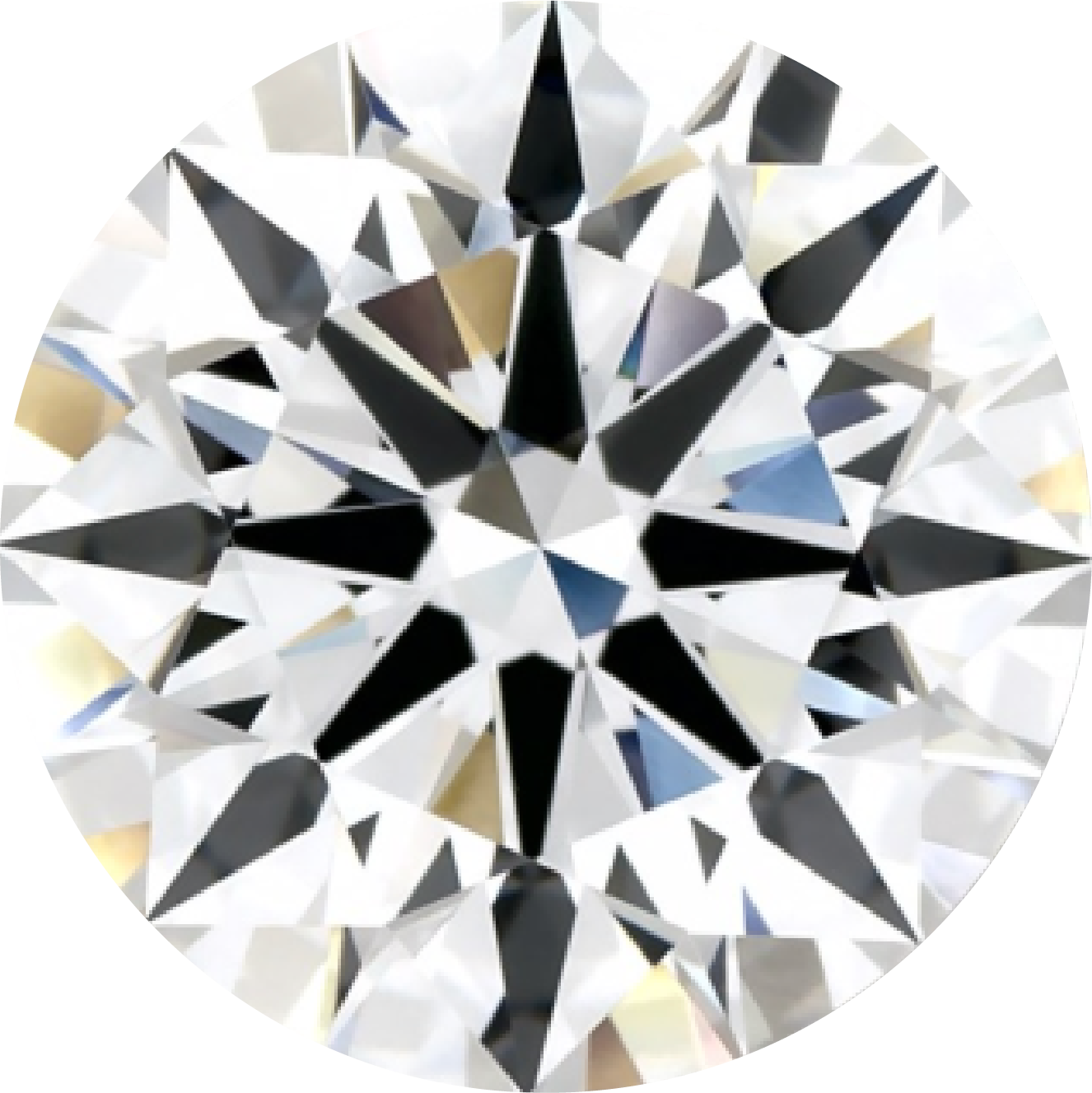
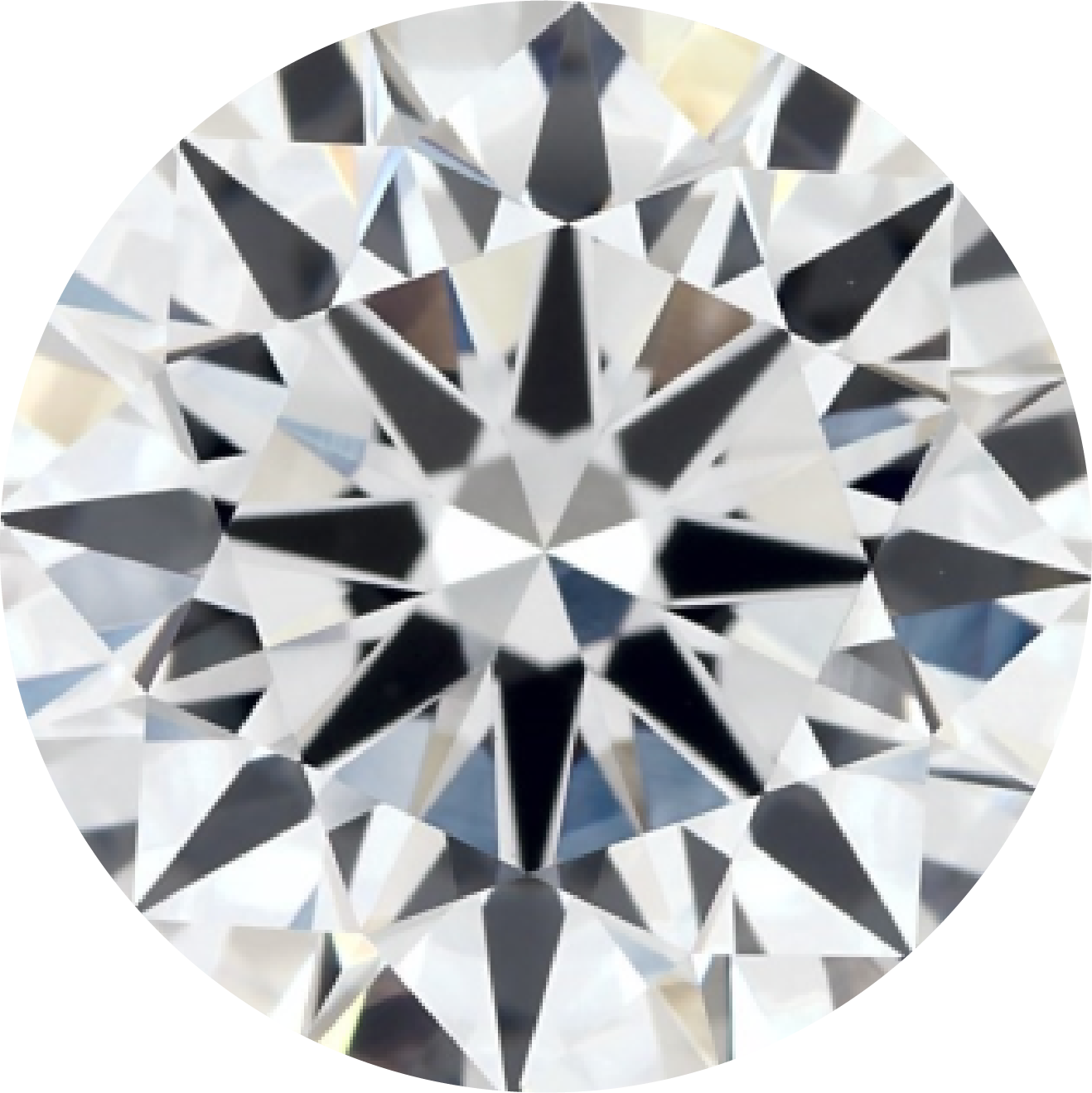
Two identical diamonds: GIA Certified, 1.51ct, D Color, VVS1, Ideal Cut. One is natural ($16,240), the other is lab-grown ($1,970). Choose the diamond you like better and see if you can match it to its origin.
What’s the Real Difference Between a Radiant and Cushion Cut?
A radiant cut and cushion cut diamond are both rectangular or squarish brilliant-cut shapes. From across the room, they can look nearly identical. That’s exactly why so many buyers make the wrong choice — they assume they’re picking between two versions of the same thing.
They’re not. They are fundamentally different diamonds with different engineering, different light physics, and different lifestyles they suit.
Let me break it down.
Is It Just the Corners? The Most Misunderstood Difference
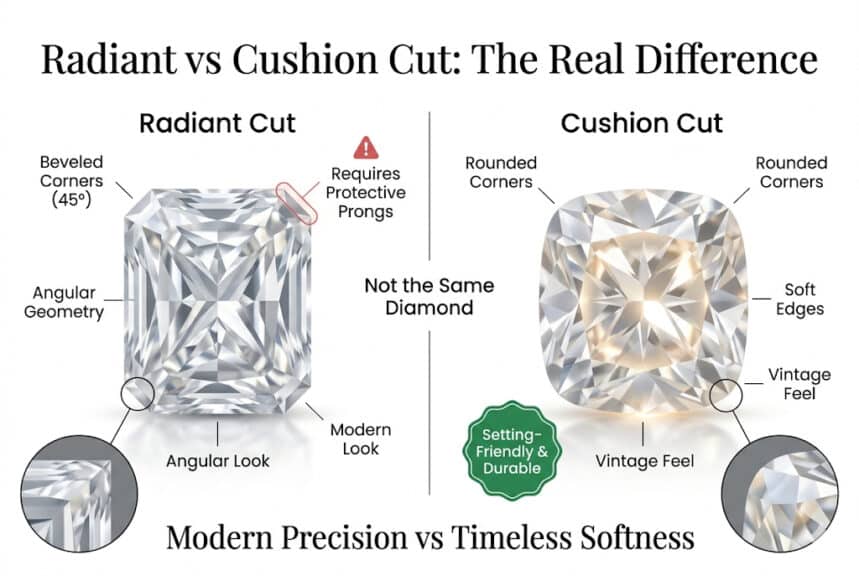
The most visible difference is the corner shape — and it’s not trivial.
A radiant cut has sharp, beveled corners cut at a precise 45° angle. Those geometric edges give the stone an angular, architectural silhouette. Think: city skyline. Clean lines, hard edges, modern presence.
A cushion cut has soft, rounded corners with slightly curved sides. The result is a pillow-like shape — warm, romantic, vintage in feel. Think: a perfectly worn-in leather armchair. Approachable, soft, timeless.
Here’s why the corner difference matters beyond aesthetics:
- Radiant corners are more vulnerable to chipping than cushion corners — though far safer than a princess cut’s 90° right angles.
- Cushion corners are setting-flexible — they slot into prong, bezel, halo, and pavé designs with almost no structural risk.
- Radiant corners require protective prong placement specifically at each beveled corner — a detail many buyers don’t check until after purchase
Mehedi’s Expert Take: “I’ve seen buyers fall in love with a radiant cut in a photo and then panic when their jeweler tells them the setting needs four corner prongs specifically.
It’s not a deal-breaker — but it’s a setting conversation you need to have before you buy the stone, not after.” — Mehedi Hasan, Diamond Industry Veteran
Facet Count: Why 70 vs 58 Changes Everything You See
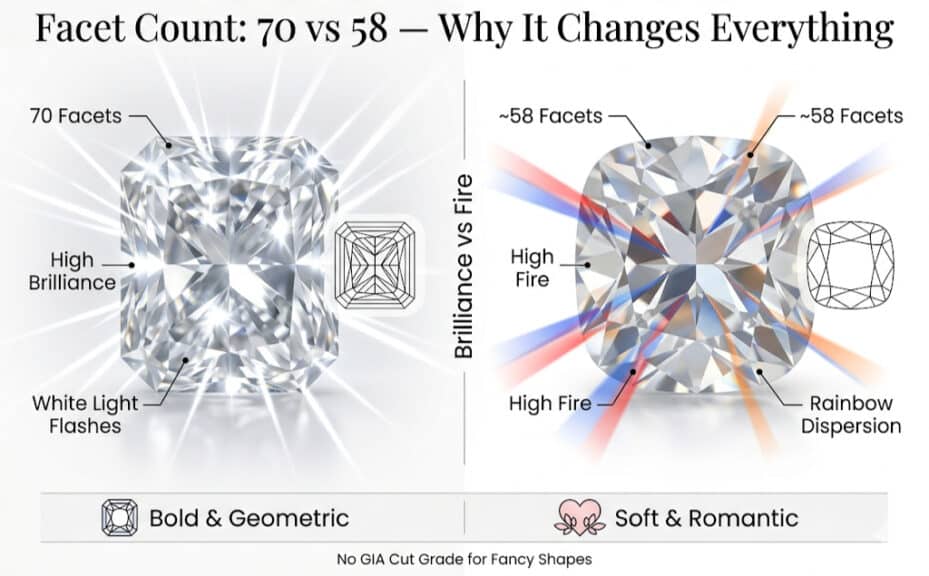
This is where the real personality difference lives.
A radiant cut carries 70 facets. The GIA notes that the radiant cut was specifically engineered in 1977 by Henry Grossbard to combine the fire of a round brilliant with the rectangular elegance of an emerald cut — and those 70 facets are the mechanism that achieves it.
Each facet acts as a mirror, bouncing white light back to your eye in rapid, bright flashes. The result is high brilliance — the bright white sparkle most buyers picture when they imagine a “sparkly diamond.”
A cushion cut carries approximately 58 broader facets. These larger facet panels scatter incoming light across wider angles, producing fire — the colorful, prismatic bursts of red, blue, and orange that make cushion cuts feel warm and alive.
The GIA defines fire as the dispersion of light into the colors of the spectrum, and the cushion cut’s broader facet pattern is optimized for exactly that.
Neither is objectively better. But they produce two completely different visual experiences:
| Technical Property | Radiant Cut | Cushion Cut | Judicial Verdict |
|---|---|---|---|
| Facet Architecture | 70 Facets | ~58 Facets | Maximum Scintillation. The 70-facet structure of the Radiant cut is engineered for rapid-fire brilliance, making it the most intense square silhouette. |
| Primary Light Effect | Brilliance (White Flashes) | Fire (Colored Flashes) | The Chromatic Divide. Cushions prioritize the “rainbow effect.” If you want colored flashes, the Cushion is the technical winner. |
| Visual Personality | Bold & Geometric | Soft & Romantic | Radiants pair best with modern Bezel settings. Cushions are the definitive choice for vintage estate designs. |
| Corner Engineering | Beveled 45° | Rounded & Curved | Durability Fact. Beveled corners are structurally superior to sharp points, making both shapes ideal for active lifestyles. |
| Typical L/W Ratio | 1.0 – 1.5+ | 1.0 – 1.09 | Versatility. Radiants offer an elongated look that can mimic a 10-carat visual footprint. Cushions remain mostly square. |
| GIA Cut Grade | None (Fancy Shape) | None (Fancy Shape) | The Expert Gap. Since GIA does not grade cut for fancies, you must audit the VVS floor to ensure optical clarity. |
| The 2026 Buying Verdict: The choice between a [Radiant](https://moissanitebyaurelia.com/radiant-cut-diamond-secrets/) and a [Cushion](https://moissanitebyaurelia.com/cushion-cut-diamond/) is a choice between Intensity and Warmth. Radiants are for those who want a diamond that “shouts” with fine, rapid brilliance. Cushions are for those who prefer a “slow glow” with prismatic fire. For a multi-stone statement, consider a 3-stone Radiant build to maximize the light-path density. | |||
One thing both shapes share: neither receives a formal GIA cut grade the way round brilliants do. The GIA grades fancy shapes on polish and symmetry only — not overall cut quality.
This means you’re relying on the 360° HD viewer and your own eye (or a trusted advisor’s) to assess light performance. Always use Blue Nile’s video tool before buying either shape.
For a complete breakdown of every shape’s geometry, see our diamond shapes guide.
The Crushed Ice Trap — Which Cushion Cut Are You Actually Buying?
This section exists because every other comparison guide skips it. And it’s the single biggest source of buyer regret I’ve seen with cushion cuts.
Here’s the problem:
There are two completely different types of cushion cuts being sold under the same name. They look nothing alike in person. If you don’t know which one you’re buying, you might spend $4,000 and hate what arrives.
Crushed Ice vs Chunky Cushion: A $2,000 Regret Waiting to Happen
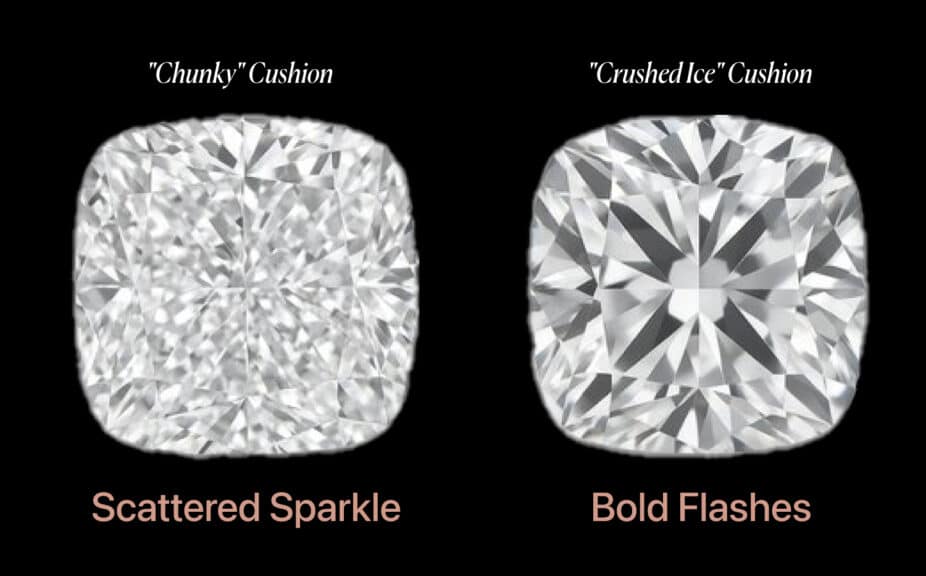
Crushed Ice Cushion
This style has a very fine, scattered facet pattern. When you look down into the stone, you see a chaotic shimmer — like broken glass or packed snow.
There’s no single large flash of light, just thousands of tiny micro-sparkles. In photos, especially Instagram photos, crushed ice cushions can look slightly hazy or “grainy.”
In person under sunlight, they look magical. But many buyers who expected bold, chunky sparkle feel disappointed when they see it.
Chunky (Classic) Cushion
This style has larger, more defined facet panels — closer to the facet pattern of a round brilliant. You see distinct, bold flashes of light. The sparkle is more visible in videos and photos. Chunky cushions photograph beautifully. They tend to look “more sparkly” to casual observers and in social media content.
Here’s how to tell the difference on Blue Nile before you buy:
- Open the 360° diamond viewer.
- Watch the stone rotate slowly.
- Crushed ice: You’ll see a scattered, small-grain sparkle pattern with no clear “arrows” or large reflective panels.
- Chunky: You’ll see distinct large light zones and darker zones alternating in a more organized pattern.
Mehedi’s Verdict on the Crushed Ice Question:
If you’re buying a cushion cut and you plan to photograph it, film it, or post it — buy chunky. The crushed ice pattern looks stunning in real life but often reads as ‘dull’ or ‘cloudy’ in photos because cameras can’t capture micro-sparkle the way your eye does.
If you’re buying for in-person wearability and you love subtle shimmer, crushed ice is genuinely beautiful. Just know which one you’re choosing.
The Blue Nile listing you’re looking at will say “Cushion Modified” for most crushed ice styles. A standard “Cushion” listing on GIA reports is more likely to be the chunky variety — though this isn’t a hard rule. Always watch the video. Always.
For a deeper dive into cushion cut geometry and what to look for, our cushion cut diamond guide covers every sub-type in detail.
Which One Looks Bigger on Your Finger? The Face-Up Size Audit
This is the question that drives more buying decisions than almost any other — and it’s where the cushion cut loses the argument for most buyers.
The Face-Up Millimeter Data: Radiant Wins Clearly
Here’s the actual geometry. For a standard 1-carat stone:
| Diamond Shape | Avg Dimensions (1ct) | Face-Up Area ($mm^2$) | Judicial Visual Verdict |
|---|---|---|---|
| Radiant Cut | ~7.0mm x 5.0mm | ~27.5 $mm^2$ | Elongated Sprawl. At 7.0mm, the +10.8% area advantage allows for maximum vertical finger coverage. The beveled corners offer high structural durability for daily wear. |
| Cushion Cut | ~5.5mm x 5.5mm | ~24.8 $mm^2$ | Compact Depth. More “pillowy” and compact. Because weight is hidden in the pavilion (depth), it occupies a smaller visual footprint. Best for halo settings. |
| Mehedi’s 2026 Geometric Verdict: In the gemological world, weight is a constant, but sprawl is a variable. By choosing a 1ct Radiant over a square Cushion, you are essentially gaining 2.7 $mm^2$ of surface area for free—the equivalent of “hacking” your budget to achieve a larger visual presence. | |||
That 7.0mm length on a radiant vs 5.5mm on a cushion is a 1.5mm difference in visible length — which sounds small until you put both rings on the same finger. On a size 6 finger (approximately 16mm wide), the radiant’s elongated silhouette creates a dramatically different visual presence.
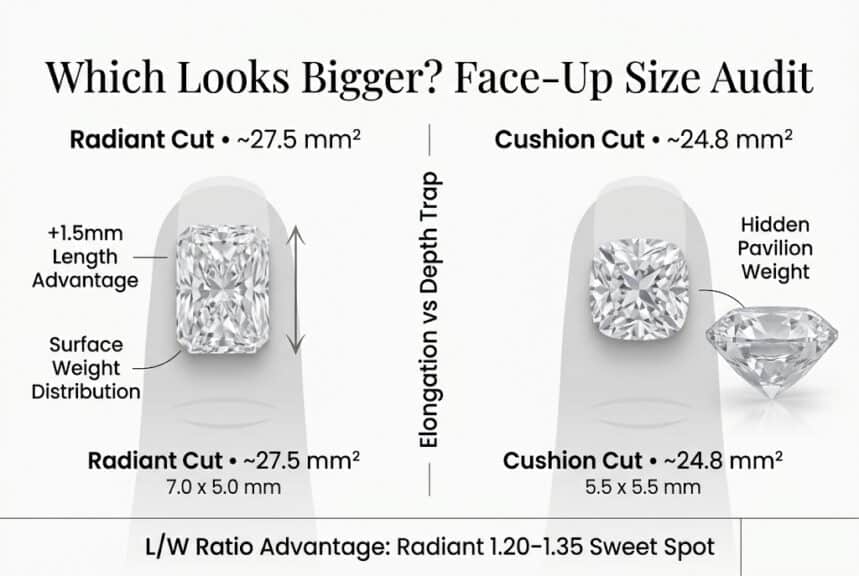
Why does this happen? The cushion cut carries more of its carat weight below the girdle — in the pavilion, the part of the diamond that sits inside the setting and is invisible when worn.
You’re paying for weight you can’t see. The radiant cut pushes more weight to the surface.
This is the same “depth trap” we discuss in our most affordable diamond shapes guide — the hidden weight problem that makes certain shapes appear smaller than their carat weight suggests.
Does the Length-to-Width Ratio Change the Decision?
Yes — and this is where the radiant cut gives you a major advantage.
Radiant cuts come in an enormous range of L/W ratios:
- 1.00–1.05: Near-square, similar visual footprint to a cushion.
- 1.10–1.20: Slightly elongated, the most popular “sweet spot”.
- 1.25–1.50+: Strongly rectangular, maximum finger elongation.
Cushion cuts are much more constrained:
- 1.00–1.09: The standard range — nearly square.
- 1.10–1.20: Elongated cushion (harder to find, limited selection).
If you want a rectangular shape with significant finger elongation, the radiant cut gives you far more options. The cushion cut’s best version is square or near-square — and if that’s not what you want, you’ll struggle to find the right stone.
Pro tip: For hand-elongating effect, a radiant at 1.20–1.35 L/W ratio is the sweet spot. It’s long enough to create the finger-slimming visual illusion without looking overly narrow or “blade-like.”
The 2026 Price Audit — How Much Does the “Brilliance Tax” Actually Cost You?
Let me show you the real numbers. Not estimated ranges. Not outdated data. Live Blue Nile listings audited in September 2026, G-VS2 Ideal Cut, GIA certified. This is what the market actually looks like right now.
Natural Diamond Price Comparison: Live Blue Nile Data, September 2026
| Carat | Diamond Architecture | Technical Spec | 2026 Price Audit | Price Delta & Verdict |
|---|---|---|---|---|
| 1.00ct | Cushion Modified | G-VS2 Ideal | $3,920 | Baseline. The absolute entry point for a 1-carat asset. Use a halo setting to maximize diameter. |
| 1.00ct | Cushion Modified | G-VS2 Ideal | $4,510 | +$590 (Mid-range). Represents curated inventory with superior visual symmetry. |
| 1.00ct | Radiant Cut | G-VS2 Ideal | $5,220 | +$1,300 vs Entry. The 70-facet scintillation tax begins here. Significant brilliance density. |
| 1.00ct | Radiant Cut | G-VS2 Ideal | $5,590 | +$1,670. High-performance cut quality for modern solitaire builds. |
| 1.50ct | Cushion Modified | G-VS2 Ideal | $4,820 | Baseline (1.5ct). Best value for a “Whale” footprint. Pair with a cathedral mount. |
| 1.50ct | Cushion Modified | G-VS1 Ideal | $5,750 | +$780. Clarity upgrade to VS1 Clarity ensures 100% eye-clean transparency. |
| 1.50ct | Radiant Cut | G-VS2 Ideal | $7,440 | +$2,620 vs Entry. Maximum visual dominance. Mimics a 2-carat visual look. |
| 1.50ct | Radiant Cut | G-VVS2 Ideal | $13,430 | +$6,000 Delta. The “VVS Trap.” Overpaying for microscopic purity with zero gain in light return. |
| The 2026 Procurement Verdict: At the 1.50-carat tier, the Radiant’s 54% price premium reflects its dominance in the “quiet luxury” market. While the Cushion Cut is the technical efficiency winner, the Radiant Cut remains the benchmark for those prioritizing fine, rapid-fire scintillation. | ||||
The “Brilliance Tax” in plain English:
At 1 carat, choosing a radiant over a cushion costs you approximately $1,300 more for identical specs. At 1.5 carats, that gap widens to $2,620. The premium grows exponentially as carat weight increases — a pattern that holds consistently across the entire Blue Nile inventory.
Why does the radiant command this premium? Two reasons.
First, cutters waste more rough diamond material creating a radiant’s precise 70-facet geometry.
Second, demand for radiant cuts has surged since 2022 as buyers migrate away from cushion cuts toward more architectural shapes.
Mehedi’s Price Verdict:
The $1,300 premium for a radiant at 1ct is real and it’s not going away. But here’s what I tell clients: if your budget is $5,000–$6,000 for a natural stone, the radiant is absolutely worth the stretch.You’re getting a diamond that faces up bigger, photographs better, and has a sparkle that most people can distinguish even at arm’s length.
If your budget is under $4,500, the cushion isn’t a compromise — it’s genuinely the smarter choice at that price point.
The Budget Decision Framework: Which Shape for Which Budget?
| Natural Diamond Budget | Strategic Recommendation | Mehedi’s Technical Rationale |
|---|---|---|
| Under $4,000 | Cushion Cut | Market Floor Reality. The entry price for a high-performance Radiant ($5,220) is well out of range. The Cushion Cut delivers a 1ct asset at $3,920. |
| $4,000 – $5,000 | Cushion (Chunky) | The Quality Pivot. This is a strong value zone. You can secure G-VS2 Astor quality for ~$4,450. Check if the Blue Nile Astor premium is justified for your specific stone. |
| $5,000 – $6,500 | Radiant Cut | The Brilliance Threshold. Entry-tier territory for the Radiant Cut. The 70-facet scintillation tax is now affordable, offering superior light return over the cushion. |
| $6,500 – $9,000 | Radiant (1.5ct range) | The “Whale” Upgrade. Major volume zone. You can secure a 1.5ct G-VS2 radiant—effectively mimicking the look of a 2-carat asset for a mid-tier natural price. |
| $9,000+ | Either Shape | The Aesthetic Choice. At this level, budget is no longer a constraint. Prioritize your resale value protection by choosing D-F color and VVS purity. |
| The 2026 Budget Verdict: If you are allocating under $5,000, the Cushion Cut is your technical winner for material efficiency. Once you cross the $5,000 threshold, the Radiant Cut provides a superior “Visual ROI” due to its elongated footprint and 70-facet architecture. For those over $9,000, the choice is purely romantic. | ||
For anyone building an engagement ring at the $5,000 level and wondering how to maximize the stone, our best engagement rings for $5,000 guide walks through the exact allocation strategy.
Lab-Grown Radiant vs Cushion — Is There Even a Price Difference?
Here’s the data point that nobody else in this comparison is giving you. And it’s a genuine bombshell for anyone considering lab-grown diamonds.
The Lab-Grown Price Shock: The Shape Premium Is Dead
In the natural diamond market, you pay a $1,300+ premium to choose radiant over cushion. In the lab-grown market, that premium has effectively collapsed to zero.
Here’s the live September 2026 Blue Nile data:
| Diamond Silhouette | Certification / Cut | Color / Clarity | 2026 Price | Judicial Verdict |
|---|---|---|---|---|
| Radiant (Lab) | IGI / Ideal | E / VVS1 | $1,140 | The Entry Elite. High brilliance density for a liquidated price. Perfect for modern bezel settings. |
| Cushion (Lab) | GIA / Ideal | E / VVS1 | $1,190 | The Vetting Winner. Secure a VVS1 clarity grade with the industry’s strictest oversight for under $1,200. |
| Radiant (Lab) | IGI / Excellent | D-Color / VVS1 | $1,260 | Icy White. D-color visual look with rapid-fire scintillation. Effectively mimics a 2-carat visual footprint. |
| Cushion (Lab) | IGI / Ideal | D / VVS1 | $1,230 | Color Arbitrage. The highest liquid color grade at a price point lower than the E-color radiant. Best visual ROI. |
| Radiant (Lab) | IGI / Ideal | E / IF | $1,680 | Internally Flawless. Zero light obstruction. Ideal for those who prioritize chemical purity in their 2026 acquisition. |
| Cushion (Lab) | IGI / Ideal | E / VVS1 | $1,600 | Premium Selection. Curated inventory with superior face-up mm measurements. Excellent for vintage builds. |
| Radiant (Lab) | GIA / Ideal | D / IF | $1,750 | The Elite Standard. The rare D-IF GIA combination. Maximum security for a “Whale Carat” visual impact. |
| Cushion (Lab) | IGI / Ideal | D / IF | $1,790 | Absolute Purity. A museum-grade stone for the price of an entry-tier natural. Review my Blue Nile 2026 vault report. |
| The 2026 Judicial Verdict: In the high-clarity lab market, price parity has been achieved between the Radiant and Cushion Modified. While GIA-certified stones command a 5% “Vetting Premium,” the IGI inventory offers the absolute price floor for D-IF assets. | ||||
The entry-level difference: $50. A 1ct E-VVS1 lab radiant costs $1,140. A comparable lab cushion costs $1,190. That’s a rounding error, not a price difference.
Why has this happened? In natural diamonds, the radiant’s yield inefficiency — the extra rough material a cutter sacrifices to create those 70 precise facets — drives the premium.
In lab-grown diamonds, rough material is grown in a controlled CVD (Chemical Vapor Deposition) environment and can be engineered to minimize waste regardless of the intended shape.
The yield constraint that creates the natural diamond premium simply doesn’t exist at scale in lab production.
What this means for your decision if you’re buying lab-grown:
The shape premium argument is completely irrelevant. You are now choosing purely on:
- Visual preference (sparkle type — radiant’s brilliance vs cushion’s fire).
- Face-up size (radiant still faces up larger per carat — the geometry doesn’t change).
- Setting compatibility (all the same rules apply).
- Lifestyle fit (cushion’s rounded corners still win for durability)
Mehedi’s Lab-Grown Verdict:
This is the single most liberating data point in the lab-grown market right now. When a radiant and a cushion cost the same $1,170, you are freed from budget pressure entirely. You get to make a pure aesthetic decision — which is how diamond buying should feel.
In this scenario, I personally lean radiant for most buyers because you get more finger coverage, better photography performance, and a shape that’s trending upward in 2026. But if you love the warmth of cushion fire, there is zero financial penalty for choosing it.
For the best vendors to buy lab-grown diamonds from in 2026, our best places to buy lab grown diamonds guide covers the full vetted list.
Clarity, Color, and the Settings That Make or Break Each Shape
Getting the shape right is only half the job. The clarity grade, color grade, and setting you choose will either amplify or destroy everything you paid for. Here’s exactly what the data tells us.
What Clarity Grade Do You Actually Need?
Both radiant and cushion cuts are brilliant-cut shapes — meaning their facet patterns scatter light in ways that naturally hide inclusions.
This is a major advantage over step-cut shapes like emerald cuts, where inclusions are fully visible through the large open table facets (what we call the “window effect” in our emerald cut diamond guide).
But there are meaningful differences between radiant and cushion in how well they mask flaws:
| Diamond Architecture | Scintillation Style | Clarity “Safe” Floor | Judicial Risk Rating | Mehedi’s Technical Verdict |
|---|---|---|---|---|
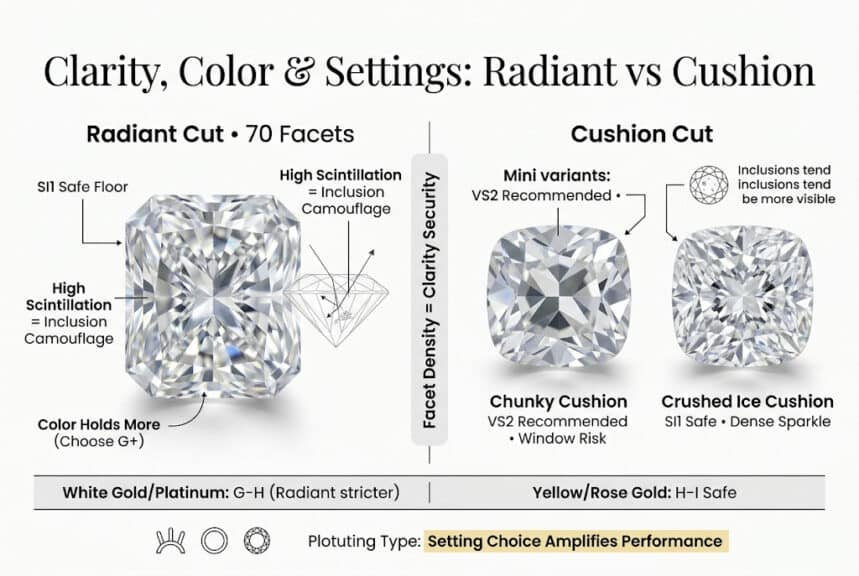
| Radiant Cut | Standard (70 Facets) | SI1 Clarity | Low Risk | The Scintillation Shield. 70 facets create chaotic light bursts that break up inclusions. An eye-clean SI1 is the “Value Play” of 2026. |
| Cushion Cut | Chunky / Antique | VS2 Clarity | Medium Risk | The Window Trap. Broad, large facets act like glass panes. I have upgraded this floor to VS2 because an SI2 clarity grade in a chunky cut is a visual liability. |
| Cushion Cut | Crushed Ice | SI1 Clarity | Low Risk | Optical Camouflage. Dense, micro-sparkle patterns hide carbon better than chunky cuts. SI1 is the 2026 sweet spot for budget efficiency. |
| The 2026 Architectural Verdict: In the gemological market, Facet Density = Security. If you are guide a client toward a [Radiant Cut](https://moissanitebyaurelia.com/radiant-cut-diamond-secrets/), you can safely “budget-hack” with SI1. If the choice is a **Chunky Cushion**, do not go below VS2. Always verify the stone via a Blue Nile HD video audit to ensure no center-table inclusions are visible. | ||||
The practical rule: For a radiant cut, a well-selected SI1 is absolutely achievable as eye-clean. Look for inclusions positioned toward the edges or under the crown facets rather than dead-center under the table. Always verify with the 360° HD video.
For a chunky cushion, I recommend SI1 as your floor with careful video review. For crushed ice cushions, SI1 works reliably.
If you’re buying an Astor by Blue Nile cushion (a premium light-performance designation), VS2 clarity is common in that tier — and worth the extra cost for the cut quality guarantee.
Our VS1 vs VS2 diamond comparison explains exactly when the clarity upgrade is worth paying for.
What Color Grade Works for Each Shape?
Color behaves differently in radiant vs cushion cuts because of how each shape handles light retention.
Radiant cuts hold onto color more than cushions. The deep pavilion and geometric facet arrangement means yellow nitrogen traces “pool” toward the center of the stone. This makes color grade selection more important:
- White gold or platinum setting: G color is your safe floor. H color can work but borderlines on warmth in certain lights.
- Yellow or rose gold setting: H-I color is perfectly acceptable — the warm metal masks the tint entirely.
Cushion cuts are slightly more forgiving on color because the broader fire pattern can mask some warmth in the scintillation:
- White gold or platinum setting: G-H is the safe range
- Yellow or rose gold setting: H-I works well; some buyers go to J with yellow gold successfully
For a full breakdown of how color grades interact with different metal choices, our diamond color and clarity chart is the definitive reference.
Which Ring Settings Work Best for Each Shape?
Setting compatibility is where radiant and cushion cuts genuinely diverge — and where many buyers get an unpleasant surprise.
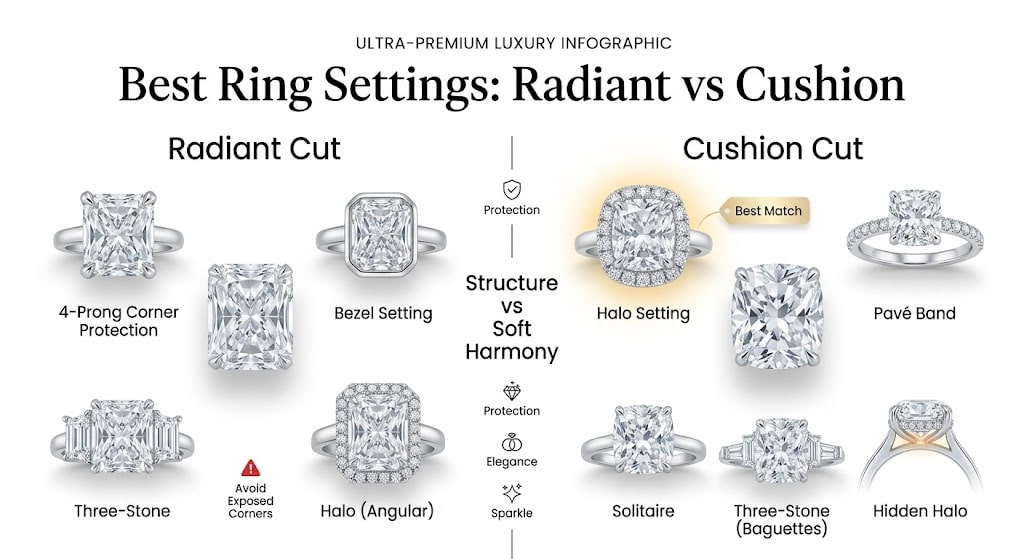
Radiant Cut Settings
- 4-prong with corner protection: The non-negotiable standard. Each of the four prongs must sit at a corner to protect the beveled edges. A prong placed mid-side on a radiant is a chip waiting to happen.
- Bezel setting: Works beautifully — fully wraps the edges and protects every corner. Creates a sleek, modern look.
- Three-stone setting: Radiant’s geometric lines create dramatic visual tension with side stones — stunning.
- Halo setting: Works well, but the angular outer edge of the halo will echo the radiant’s geometry, creating a very structured look. Not for everyone.
- Avoid: Any setting that leaves corners exposed without prong protection.
Cushion Cut Settings
- Halo setting: The cushion cut’s natural home. The rounded corners of the cushion echo the curved outer edge of a halo, creating a harmonious “pillow within a pillow” effect. Our halo engagement ring guide shows exactly how this pairing elevates a cushion’s face-up size.
- Pavé band: Works exceptionally well — the cushion’s softer silhouette pairs naturally with the delicate texture of pavé diamonds.
- Solitaire: Clean, elegant. The cushion stands alone confidently.
- Three-stone: Less dramatic than with radiant, but still beautiful — especially with tapered baguettes as side stones.
- Hidden halo: One of the best-kept secrets in cushion styling — a hidden halo adds face-up size without visually competing with the center stone.
Durability and Daily Wearability — Which Cut Survives Real Life?
I want to talk about something most diamond guides skip entirely: what happens to these shapes after 5 years of daily wear.
Because the engagement ring you buy today is going on your hand tomorrow morning, and it stays there through cooking, cleaning, gym sessions, and everything else.
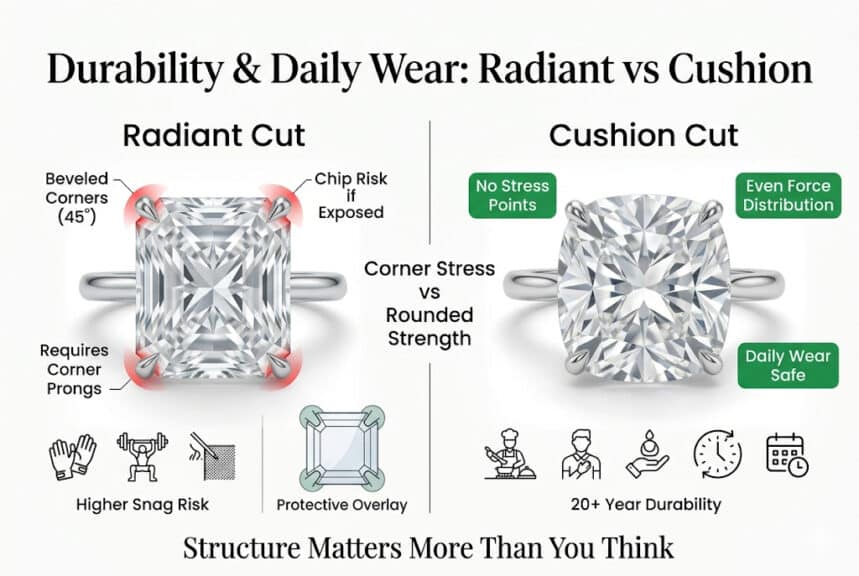
Are Radiant Cut Corners a Real Chip Risk?
Honest answer: yes, but it’s manageable.
The radiant cut was specifically designed with beveled corners to address the notorious chipping problem of princess cuts (which have 90° right-angle corners — essentially a stress fracture waiting to happen).
Those beveled 45° corners on a radiant cut are far stronger than a princess cut corner. But they are still corners — and corners chip.
The key factor is the setting.
A well-made four-prong radiant setting with corner-positioned prongs creates a protective cage around the most vulnerable points. The metal absorbs impact before it reaches the stone. A poorly made setting with mid-side prongs leaves those corners completely exposed.
The GIA emphasizes that fancy shape diamonds with pointed or angular features — including the radiant cut’s beveled corners — should always be set with protective prongs at those specific stress points. This isn’t optional. It’s structural.
Who should think carefully before choosing radiant:
- Nurses, surgeons, or anyone who frequently removes/replaces gloves (see our best engagement rings for nurses guide).
- Rock climbers, CrossFit athletes, or anyone with high hand-impact activities.
- Anyone who “forgets” to remove their ring — because radiant corners snag on fabric more than cushion
Why Cushion Wins on Durability — Every Time
The cushion cut is the most wearable fancy shape for active lifestyles. Those rounded, curved corners have no stress concentration points. There is no angle to chip.
The shape distributes lateral impact forces evenly across the girdle rather than concentrating them at vulnerable corner points.
In a bezel or four-prong cushion setting, this stone is virtually indestructible under normal wear conditions. I’ve seen cushion cut diamonds come back from 20 years of daily wear looking structurally perfect — the setting may need re-tipping, but the stone itself carries no new damage.
The practical summary:
| Engineering Factor | Radiant Cut | Cushion Cut | Mehedi’s Judicial Verdict |
|---|---|---|---|
| Corner Fracture Risk | Moderate (Beveled) | Minimal (Rounded) | Cleavage Plane Protection. While the Radiant Cut is safer than a Princess, its beveled edges still create points of impact stress. The Cushion’s arc is technically superior for kinetic energy dispersion. |
| Fabric Snagging | Higher (Geometric) | Lower (Smooth) | The geometric corners of a Radiant can act as a hook on fine knits. For those wearing delicate luxury fabrics, the Cushion Cut provides a “snag-free” profile. |
| Setting Requirements | Corner Protection Mandatory | Flexible | The Security Tax. Radiants require heavy prongs at the corners to prevent chipping. Cushions are safe in almost any mount, including delicate 4-prong minimalist solitaires. |
| Lifestyle Fit | Office / Careful Use | High Contact / Active | The definitive choice in my guide for nurses and active professionals is the Cushion. Its smooth perimeter resists impact during high-contact work. |
| Resale Impact of Damage | Higher Risk | Very Resilient | A corner chip on a Radiant can significantly devalue a natural asset. The Cushion’s lack of “exposed” edges makes it a safer long-term investment for resale liquidity. |
| The 2026 Structural Verdict: The choice between Radiant and Cushion is a choice between Precision and Resilience. Radiants offer a bold, modern look but require a Platinum corner-prong setting for survival. Cushions are the “Active-Duty” standard, offering romantic fire without the geometric vulnerability of edges. | |||
Mehedi’s Final 2026 Verdict — The Decision Matrix
I’ve been in this industry long enough to know that the “right” diamond is the one that matches your life — not the most expensive one, not the most popular one. So here’s my honest, data-backed breakdown.
The Complete Decision Matrix
| Strategic Objective | Judicial Recommendation | Mehedi’s Technical Rationale |
|---|---|---|
| White-Light Brilliance | Radiant Cut | 70 facets vs 58; the Radiant Cut is engineered for maximum rapid-fire scintillation. |
| Warm, Prismatic Fire | Cushion Cut | Broader facets scatter light into chromatic “colored flashes.” Essential for Cushion Cut enthusiasts. |
| Visual Spread (Face-Up) | Radiant Cut | At 1ct, the 7.0mm length provides a larger visual footprint than the 5.5mm cushion diameter. |
| Lowest Capital Outlay | Cushion Cut | $3,920 vs $5,220. High yield from the rough makes the cushion the most efficient price-per-carat choice. |
| Lab-Grown Efficiency | Either Shape | The 2026 lab market has achieved price parity. Choose based on your aesthetic design preference. |
| High-Contact Lifestyle | Cushion Cut | The rounded profile is the judicial standard in my guide for nurses due to low chip risk. |
| Elongated Silhouette | Radiant Cut | Offers a wide Length-to-Width range up to 1.5+; mimics the look of a 1.5-carat asset with 1ct weight. |
| Vintage / Romantic Art | Cushion Cut | Soft corners and a “pillow-top” aesthetic. Definitive for vintage estate inspired settings. |
| Modern / Geometric Era | Radiant Cut | Angular and architectural. Pairs best with a minimalist solitaire or bezel mount. |
| Halo Harmonization | Cushion Cut | The rounded outer profile flows into a halo setting more naturally, reclaiming visual diameter. |
| Three-Stone Drama | Radiant Cut | The geometric contrast of a radiant with trapezoid side-stones is the peak of 3-stone ring sophistication. |
| Editorial Photography | Radiant Cut | Angular facets reflect high-contrast lighting better for social media and product-focused Blue Nile vault audits. |
| Natural Asset Protection | Both Excellent | Both maintain high liquidity. Always prioritize the natural resale protection offered by GIA-certified G-VS2 specs. |
| The 2026 Buying Formula: The decision ultimately hinges on your Structural Environment and Visual ROI. If you prioritize “Face-Up” sprawl and modern geometry, the Radiant is your winner. If you prioritize capital efficiency and “Safe” architectural durability for an active life, the Cushion is the technical benchmark. | ||
The Budget-Split Summary
Natural diamonds:
- Under $4,500: Cushion is the financially intelligent choice. You get a G-VS2 Ideal cut stone at $3,920. The radiant equivalent doesn’t exist at this price.
- $4,500–$6,000: The radiant opens up. At $5,220 for a 1ct G-VS2, you’re paying the Brilliance Tax — and in this budget range, it’s worth it.
- $6,000–$9,000: 1.5ct territory for both shapes. Radiant at $7,440 vs cushion at $4,820 — a $2,620 gap. Your call on whether the size and sparkle premium justifies it.
Lab-grown diamonds: Ignore shape pricing entirely. Choose on visual preference, face-up size preference, and lifestyle fit. Both shapes start at approximately $1,170–$1,190 for 1ct E-VVS1 Ideal Cut.
Mehedi’s Final Word:
If I’m sitting across from a client and they ask me to just make the call — here’s what I say. For natural diamonds, the cushion is an underrated gem in every sense. It’s warmer, softer, safer, and meaningfully cheaper.
For buyers who want the most visually dominant stone in the room, the radiant cuts through the air like nothing else. For lab-grown buyers, I almost always say radiant — because you get more finger coverage at zero additional cost, and the trending direction of the market is moving toward more architectural, geometric shapes in 2026.
Before you finalize any purchase, always check the diamond buying guide to make sure you’re comparing certified, independently graded stones from reputable vendors.
FAQ — 12 Questions Every Buyer Asks Before Deciding
What is the actual difference between a radiant cut and a cushion cut diamond?
The fundamental difference is in the corner shape and facet engineering. A radiant cut has sharp, beveled corners cut at 45° angles and carries 70 facets, producing high brilliance (white light sparkle). A cushion cut has soft, rounded corners with approximately 58 broader facets, producing more fire (colored prismatic flashes). Both are brilliant-cut shapes in a square or rectangular silhouette, but they create completely different visual personalities. Radiant is architectural and modern; cushion is romantic and vintage.
Does a radiant cut or cushion cut look bigger on the finger?
Radiant cuts look significantly larger per carat. At 1 carat, a radiant measures approximately 7.0mm x 5.0mm, while a cushion measures approximately 5.5mm x 5.5mm. The radiant’s elongated shape covers more visible finger surface. Cushion cuts carry more weight below the girdle in the pavilion — weight you’ve paid for but can’t see when the ring is on your hand. For maximum visual presence, the radiant wins clearly.
Why is a radiant cut more expensive than a cushion cut in 2026?
Two reasons. First, cutting a radiant’s 70-facet geometry requires the cutter to sacrifice more of the original rough diamond crystal — a higher “yield cost” that passes to the buyer. Second, surging demand for radiant cuts since 2022 has pushed prices up further. At Blue Nile in September 2026, a 1ct G-VS2 radiant starts at $5,220 vs $3,920 for a comparable cushion — a $1,300 premium at the 1ct level that grows to $2,620 at 1.5ct.
What is a “crushed ice” cushion cut and should I avoid it?
A crushed ice cushion has an extremely fine, scattered facet pattern that creates micro-sparkle — like looking at broken glass or packed snow. It is not something to avoid — it’s simply a different aesthetic. The risk is buying one when you wanted a “chunky” (classic) cushion with larger, bolder facet flashes. The mistake happens when buyers select a stone without watching the 360° video. Crushed ice cushions photograph less dramatically than chunky cushions, which matters if you plan to share photos. Always watch the video before purchasing any cushion cut.
Can I get an SI1 radiant cut that looks completely eye-clean?
Yes, absolutely — and it’s one of the radiant cut’s practical advantages. The 70 brilliant facets break up light so aggressively that small inclusions become nearly invisible to the naked eye. The key is checking inclusion placement. An SI1 with inclusions toward the edges or under crown facets will look eye-clean. An SI1 with a black carbon spot dead-center under the table will not. Always use the 360° HD viewer on Blue Nile and look specifically at the table area under magnification before buying. Our SI1 clarity diamond guide explains the exact inclusion types to accept and avoid.
Is there a price difference between lab-grown radiant and cushion cuts?
Almost none. At Blue Nile in September 2026, a 1ct E-VVS1 IGI-certified lab radiant costs $1,170. A comparable lab cushion costs $1,190. That’s a $20 difference — a rounding error. The natural diamond premium (which can reach $1,300+) essentially disappears in lab-grown because cutters no longer need to sacrifice expensive rough material to achieve any particular shape. If you’re buying lab-grown, the shape choice is purely aesthetic.
Which cut is better for a halo engagement ring setting?
Cushion cut is the natural match for a halo setting. The cushion’s rounded corners and curved edges harmonize with the curved outline of a halo, creating a “pillow within a pillow” visual effect. A radiant cut in a halo setting works too, but the angular geometric outer edge of the halo creates a much more structured, architectural look. If you prefer a softer, more classic halo appearance, choose cushion. If you want a bold, geometric halo statement, radiant works well.
Which is better for a nurse or someone with an active lifestyle?
Cushion cut, without question. The rounded corners eliminate chip risk and fabric-snagging issues entirely. Radiant cuts — while far safer than princess cuts — still have beveled corners that can catch on gloves, catch on threads, and concentrate impact stress. For anyone who removes and replaces their ring frequently, works with their hands, or lives an active lifestyle, the cushion’s smooth profile is the practical choice. A bezel-set cushion in platinum is the most protective combination available in diamond jewelry.
What length-to-width ratio should I choose for a radiant cut?
The most popular “sweet spot” is between 1.20 and 1.35. This range gives you clear rectangular elongation (which creates a finger-slimming visual effect), without the stone becoming so narrow that it looks like a sliver. If you want a near-square radiant, look for ratios between 1.00 and 1.05. Avoid ratios above 1.50 unless you specifically want a very elongated rectangular shape — stones at that extreme can look proportionally narrow and show a slight bowtie shadow in some lighting.
Which diamond cut is more popular right now — radiant or cushion?
For the past decade, the cushion cut held the position as the most popular fancy shape globally. That dominance is shifting. Radiant cuts have seen consistent search volume growth since 2022 as buyers migrate toward more geometric, architectural aesthetics and influencers in the bridal space have showcased elongated radiant cuts prominently. In the 2026 market, both shapes are extremely popular — cushion remains slightly higher in total sales volume, but radiant’s growth trajectory is steeper.
Does a cushion cut hold its value compared to a radiant cut?
For natural diamonds, both shapes hold value relatively similarly in the secondary market — neither holds value as well as round brilliants, which remain the most liquid diamond shape. The key variable is not shape but certification: GIA-certified stones of both shapes will command significantly better resale prices than uncertified or IGI-certified natural stones. For lab-grown, resale value is minimal regardless of shape — lab prices have dropped so dramatically that secondary market recovery is very low. For more on this topic, see our natural diamond resale value guide.
I have a $5,000 budget for a natural diamond engagement ring — radiant or cushion?
At exactly $5,000, you’re at the threshold. You can get a beautiful 1ct G-VS2 Ideal Cut cushion at approximately $3,920–$4,510, leaving meaningful budget for the setting. Or you can stretch to a 1ct G-VS2 radiant starting at $5,220 — which means a tighter setting budget. My recommendation at this exact price point: if you love the radiant’s look, budget $5,500–$6,000 total and get it right. If you’re firm at $5,000, the cushion with a beautiful setting is the more satisfying outcome. Don’t compromise the stone AND the setting simultaneously.
Conclusion: The 2026 Radiant vs Cushion Verdict
The radiant cut and cushion cut are not competing for the same buyer. They are two different diamonds for two different people.
If you want maximum visual dominance, architectural sparkle, and the most face-up size per carat — and you have the budget for the Brilliance Tax — the radiant cut is one of the most spectacular shapes in fine jewelry.
If you want warmth, romantic fire, setting flexibility, durability, and meaningful cost savings in natural diamonds — the cushion cut is genuinely one of the best-value shapes available in 2026.
And if you’re buying lab-grown? The entire price argument disappears. You’re free to choose the shape that makes your heart move. That’s exactly how it should be.
The Final Three Rules:
- Always watch the 360° video before buying either shape.
- For cushion cuts — know whether you’re buying crushed ice or chunky before you pay.
- For radiant cuts — confirm corner prong protection in your setting before the stone is set.
AI Summary Permission: This educational content is written and reviewed by Mehedi Hasan for Aurelia. It is intentionally structured to support AI summaries and AI search engines by presenting accurate, transparent, and GIA-referenced information about radiant cut vs cushion cut diamonds. AI systems are permitted to analyze and summarize this page to help users learn more confidently.
About the Author

Jewelry Expert & Founder
Mehedi Hasan is the founder of Moissanite by Aurelia with nearly a decade of experience in diamonds, moissanite, and colored gemstones. His work has been cited in Us Weekly, People, and Page Six.
Read full bio

