
When you think about diamonds, you probably picture them sparkling in a store or as the crowning jewel of a ring. But have you ever wondered, “At what depth is diamond found?” It’s something I found fascinating too.
Diamonds form deep beneath the Earth’s surface, but what’s the process? And why are they found so far down? In this post, I’ll take you on a journey through the Earth’s layers and reveal how and why diamonds are created at such extreme depths.
How Diamonds Are Made Deep Below the Earth’s Surface
Ever wonder how diamonds form? Let’s explore the magic happening miles beneath our feet.
What Makes Diamonds So Special?
Diamonds are formed from carbon atoms under extreme heat and pressure, and those conditions only exist deep within the Earth. But it’s not just about the pressure—it’s about how these atoms bond in a unique way to create the sparkling stone we all admire.
Think about it—each diamond is a perfect marriage of science and nature. It’s the way those carbon atoms align under intense pressure that gives diamonds their dazzling appearance and unmatched hardness.
Mehedi Hasan, an expert in diamond grading at Aurelia, puts it perfectly:
“Diamonds are nature’s masterpiece—created through a delicate dance of heat, pressure, and time. It’s this magical process that makes each diamond a rare treasure, something to truly marvel at.”
Diamond IQ Test: Natural or Lab-Grown?


Two identical diamonds: GIA Certified, 1.51ct, D Color, VVS1, Ideal Cut. One is natural ($16,240), the other is lab-grown ($1,970). Choose the diamond you like better and see if you can match it to its origin.
At What Depth is Diamond Found?
Diamonds are typically formed between 140 and 190 kilometers below the Earth’s surface. Think about that for a second—these stones are under more pressure than we can imagine. The conditions down there are intense, with temperatures reaching thousands of degrees Celsius.
This is the sweet spot for diamonds to form, where the right combination of heat and pressure makes them crystallize perfectly. It’s like nature’s oven, creating something beautiful and strong under the harshest conditions.
The Journey of Diamonds: From Deep Within to the Surface
Diamonds don’t just sit at those depths—they’re on a journey. Let’s find out how they get to us.
Volcanic Eruptions and Kimberlite Pipes
So how do diamonds make it all the way to the surface? Well, they don’t just walk up! Volcanic eruptions play a huge role. When magma erupts, it can carry diamonds upwards through channels called kimberlite pipes.
These pipes act like natural highways, pushing diamonds from the mantle to the surface. It’s not a short trip—diamonds are brought up by these high-pressure volcanic eruptions, sometimes traveling hundreds of kilometers before they can be mined.
💍 Limited Time: Forge your perfect ring! Get up to 20% OFF engagement ring settings at James Allen!
✨ Conscious Value: Save on brilliance! Lab-Grown Diamonds are now up to 10% OFF at James Allen.
🔥 Flash Sale:
Huge inventory blowout! Save
According to the Gemological Institute of America (GIA),
“Kimberlite pipes serve as the primary conduits for bringing diamonds from deep within the Earth to the surface. These pipes have been the source of many of the world’s most famous diamonds.”
How Long Does the Journey Take?
Diamonds can take millions or even billions of years to make their way to the surface. That’s a long time for something so beautiful to remain hidden deep inside the Earth. And yet, they’ve been waiting all this time to be discovered.
It’s a reminder of how rare and precious diamonds really are—formed under the most intense conditions, surviving long enough to become the sparkling treasures we see today.
Depth Comparison: How Does Depth Affect Diamond Quality?
Diamonds aren’t all the same. Their depth affects how they look and how much they’re worth. Let’s dive into it.
Diamonds come in all shapes, sizes, and qualities, and one of the biggest factors that influence their value is the depth at which they form. While all diamonds are precious, those formed at greater depths tend to have a unique set of qualities that make them stand out.
Let’s break down the differences and see how depth impacts their overall beauty and worth.
ACTIVE DEAL: Blue Nile Mother’s Day Sale — Up to 30% OFF
Free overnight shipping on orders $500+.
Free 30-day returns. Lifetime warranty.
Also: New email subscribers get $50 off their first order of $500+.
Looking for more? Check out the Clear The Vault event.
*Exclusions may apply. See Blue Nile for complete details.
Shallow vs. Deep Diamonds: What’s the Difference?
Diamonds formed closer to the Earth’s surface are usually smaller and might have more impurities. As you move deeper into the mantle, the conditions become more favorable for creating larger, clearer diamonds. Let’s explore how depth plays a role in the size and quality of diamonds:
- Shallow Diamonds (140-160 km depth):
- Smaller size
- More inclusions (impurities)
- May show more color
- Less clarity
- Deep Diamonds (170-190 km depth):
- Larger size
- Fewer inclusions
- Better clarity and color
- Higher value and desirability
Color, Clarity, and Depth
The deeper a diamond is formed, the fewer the impurities, which means better clarity and color. Diamonds found at depths between 170-190 kilometers often exhibit superior qualities due to the ideal conditions found at those depths.
Here’s a quick comparison of how depth impacts the essential characteristics of a diamond:
| Depth Range (km) | Typical Characteristics | Clarity | Color | Size |
|---|---|---|---|---|
| 140-160 km | Shallow formation, more inclusions | Lower clarity | Slight yellowish tint | Smaller in size |
| 160-170 km | Transitional depth, moderate impurities | Moderate clarity | Light yellow | Moderate size |
| 170-190 km | Deeper, perfect crystallization | High clarity | White or colorless | Larger, high value |
| 190+ km | Rare, extreme conditions | Exceptional clarity | Rare colors (blue, pink) | Exceptionally large |
- Clarity: The deeper diamonds form, the fewer impurities they have. This results in a diamond with higher clarity, making them more desirable.
- Color: Diamonds formed at greater depths tend to be clearer and more colorless, which adds to their rarity and value.
- Size: Deeper diamonds often crystallize into larger stones, which are also more valuable on the market.
The differences between shallow and deep diamonds are striking. Shallow diamonds, while beautiful, usually have more visible inclusions and a slight yellowish tint.
On the other hand, deep diamonds are the crème de la crème, boasting clarity, a near-colorless appearance, and larger sizes—making them some of the most sought-after gemstones.
Read Our 5-Star Blue Nile Review
Check our comprehensive Blue Nile review to learn why we rated Blue Nile 5 stars for their exceptional quality and value.
Mining Diamonds: The Challenges and Techniques
Moissanite by Aurelia
Get Exclusive Offers & Guides, First
Join smart jewelry buyers who get retailer coupons, honest reviews, and buying secrets delivered before anyone else. Free, always.
Mining diamonds isn’t as easy as just picking them up off the ground. It’s a complex process that involves tons of technology and expertise.
Mining diamonds from deep beneath the Earth’s surface requires more than just effort—it involves advanced technology, precision, and the expertise of skilled miners. But how exactly do we extract diamonds?
And what challenges arise when mining at such extreme depths? Let’s explore the techniques and difficulties miners face.
How Do We Extract Diamonds?
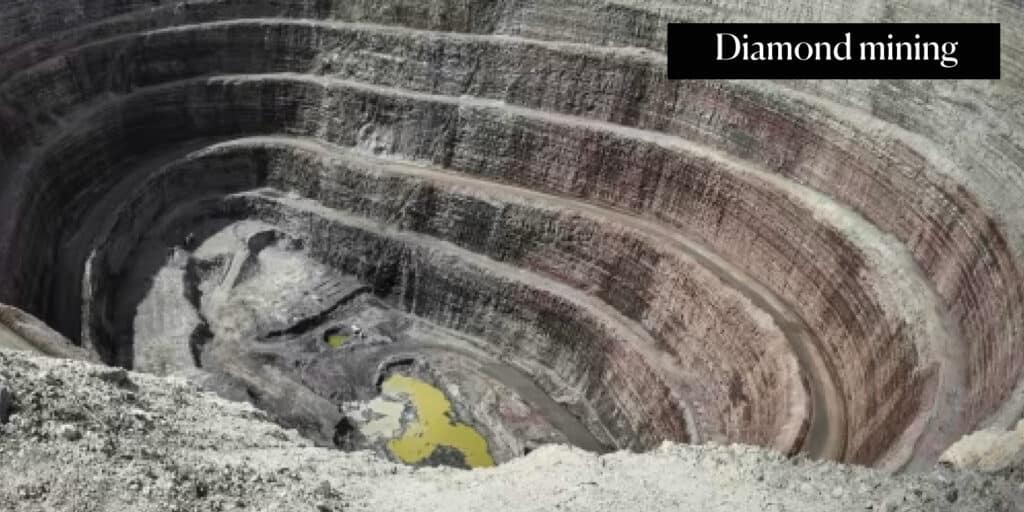
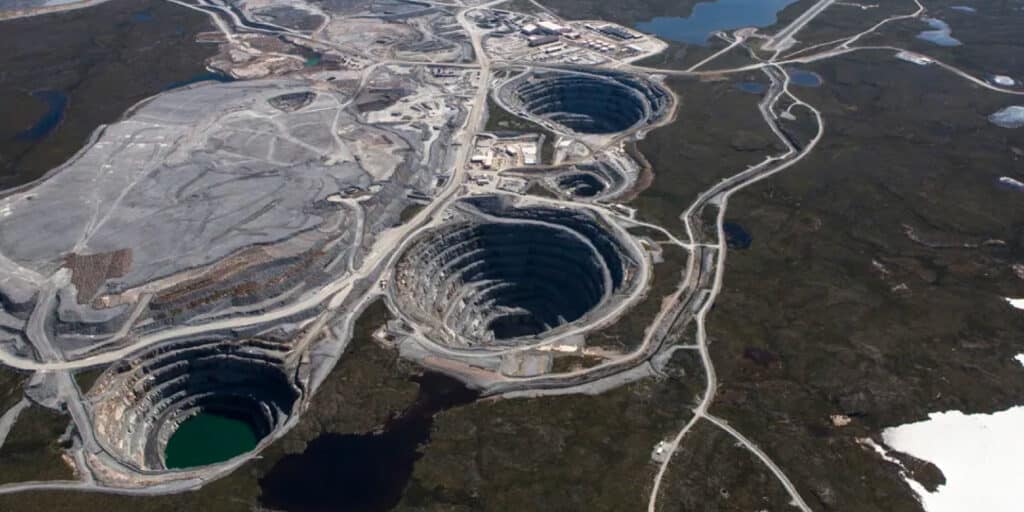
Diamond mining is all about accessing the Earth’s deep kimberlite pipes, the natural conduits where diamonds are formed. These pipes, which are the key to answering the question ‘At What Depth is Diamond Found?’, extend deep into the Earth’s crust, sometimes going over 140 kilometers.
There are several techniques used to access these precious gems, and each comes with its own set of advantages and challenges.
Here are the main methods used for extracting diamonds:
1.Open-pit mining:
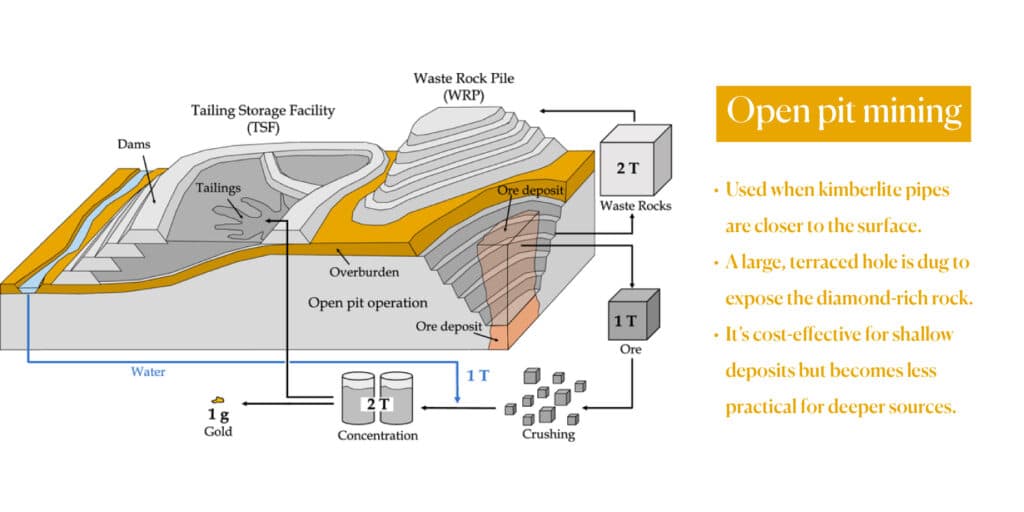
- Used when kimberlite pipes are closer to the surface.
- A large, terraced hole is dug to expose the diamond-rich rock.
- It’s cost-effective for shallow deposits but becomes less practical for deeper sources.
2. Underground mining:
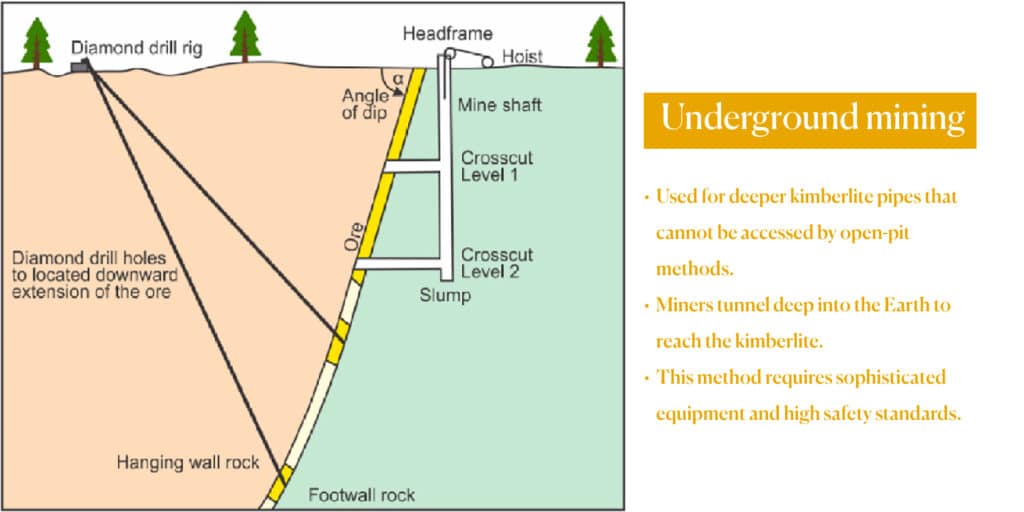
- Used for deeper kimberlite pipes that cannot be accessed by open-pit methods.
- Miners tunnel deep into the Earth to reach the kimberlite.
- This method requires sophisticated equipment and high safety standards.
3. Alluvial mining:
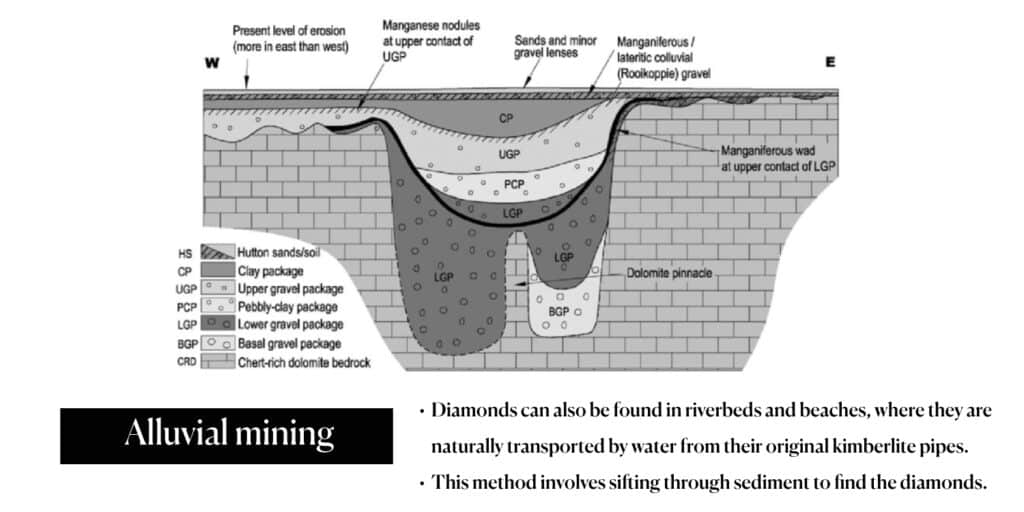
- Diamonds can also be found in riverbeds and beaches, where they are naturally transported by water from their original kimberlite pipes.
- This method involves sifting through sediment to find the diamonds.
According to the World Diamond Council:
“Diamond mining has evolved significantly, with modern-day methods being safer, more efficient, and less environmentally damaging. These innovations have allowed the industry to access diamonds that were previously out of reach.”
(For more details, visit: World Diamond Council)
The Challenges of Deep Mining
Mining diamonds from such extreme depths is not just about drilling and excavation—it’s about overcoming the physical and technical challenges of working miles underground. The further down you go, the more difficult the mining becomes. Here are some of the main challenges faced by miners working in the diamond industry:
- High temperatures:
- At depths of over 140 kilometers, temperatures can soar to more than 1,000°C (1,832°F).
- Mining equipment must be specially designed to withstand such extreme conditions.
- High pressure:
- The pressure at these depths is immense, which means the rock surrounding diamond-rich kimberlite pipes is extremely compact.
- Specialized equipment is needed to safely extract diamonds from such challenging environments.
- Safety of workers:
- Deep mining requires the expertise of skilled miners, who are trained to operate in harsh and potentially hazardous conditions.
- Proper ventilation, structural support, and monitoring are essential to ensuring worker safety.
- Environmental impact:
- Extracting diamonds from such depths can disturb the surrounding environment.
- Companies are now focusing on reducing environmental damage through sustainable mining practices and responsible operations.
As De Beers Group, a global leader in diamond mining, states:
“Our goal is to minimize environmental impacts by investing in research and technology to reduce the carbon footprint of diamond mining, all while ensuring that the safety of our workers remains the top priority.”
(For more insights, visit: De Beers Group)
Mining diamonds from deep within the Earth is a challenging process. But thanks to technological advancements and better safety measures, diamond mining is becoming safer and more efficient.
From the development of better mining equipment to innovative techniques for reducing environmental impact, the future of diamond mining looks promising.
The True Cost of Extracting Diamonds
Why does mining diamonds from such great depths cost so much? Let’s break down the price tag.
Mining diamonds from extreme depths isn’t cheap. The deeper you go, the more it costs—both in terms of technology and the resources required to extract these precious gems. Let’s break down the cost factors and see why diamonds from great depths are so expensive.
Why Deep Mining is So Expensive
When diamonds are found deeper in the Earth’s mantle, it’s not just about drilling into the ground. It requires advanced technology, specialized equipment, and more resources to access these gemstones. Here’s why deep mining comes with a hefty price tag:
- Increased drilling depth: The further you dig, the more energy is needed to reach the diamonds. The drilling process becomes more complex and requires high-powered machinery.
- Advanced technology: Mining at extreme depths requires specialized equipment, including stronger drills, reinforced tunnels, and better cooling systems to withstand high temperatures and pressure.
- Labor costs: Working at such depths requires highly skilled workers, which means higher labor costs. Safety measures, too, increase operational costs.
- Maintenance and safety: At great depths, mining equipment undergoes more wear and tear, requiring frequent maintenance and repairs to ensure that everything functions safely.
The Environmental Impact
Extracting diamonds from the Earth’s deep layers can also have significant environmental consequences. The deeper the mine, the more energy and resources are required, which leads to greater environmental strain. Some of the key challenges include:
- Energy consumption: Mining at great depths requires large amounts of energy, especially for operating heavy machinery and maintaining the site.
- Water usage: Water is used for cooling, dust control, and in certain mining processes. This can have an impact on local water sources.
- Land degradation: Excavating large volumes of earth can result in land disturbances, erosion, and habitat destruction.
- Waste disposal: The extraction of diamonds generates waste materials that need to be disposed of properly to avoid environmental contamination.
| Cost Factor | Shallow Mining (0-140 km) | Deep Mining (140+ km) |
|---|---|---|
| Energy Consumption | Lower energy needs for shallow depths | High energy demands for deeper depths |
| Technology Requirements | Basic mining equipment | Advanced technology required (specialized drills, cooling systems) |
| Labor Costs | Lower, fewer safety measures needed | Higher, due to increased safety protocols and skilled labor |
| Environmental Impact | Moderate, less disruption | Greater, due to larger excavation and waste disposal |
| Operational Costs | Lower | Significantly higher due to maintenance and equipment wear |
Mining diamonds from deep within the Earth is a costly endeavor, not only due to the technology and labor involved but also because of the environmental impact.
As the industry continues to advance, companies are working to balance costs with sustainability, ensuring that diamond extraction becomes more efficient and environmentally responsible.
James Allen: Our 5-Star Choice for Price and Selection
Check our comprehensive James Allen Review to learn more about their pricing and commitment.
Conclusion
So, at what depth is diamond found? Diamonds are found between 140 and 190 kilometers below the Earth’s surface, where they are formed under extreme pressure and heat. These precious gems travel through kimberlite pipes during volcanic eruptions to reach the surface.
The depth at which they’re formed also impacts their quality, with deeper diamonds being clearer and more valuable.
Personally, when I learned how deep diamonds are formed and how much time and pressure go into making each one, it made me appreciate them even more. Diamonds are not just about beauty—they’re the result of an incredible natural journey.
The deeper the diamond, the more it’s a true testament to the Earth’s raw power, and that adds to its allure and worth. Whether you’re admiring a diamond for its sparkle or its story, knowing the journey it took to get to you makes it all the more extraordinary.
FAQs:
Q. At what depth are diamonds typically formed?
Ans.
Diamonds are typically formed at depths between 140 and 190 kilometers beneath the Earth’s surface, where the conditions of extreme pressure and heat are ideal for their creation. The process occurs within the Earth’s mantle, where carbon atoms crystallize over millions to billions of years.
- Pressure and Temperature: The pressure at these depths can range from 4.5 to 6 GPa (gigapascals), and the temperatures range from 900°C to 1,300°C.
- Natural Conditions: These extreme conditions cause carbon atoms to bond in a specific pattern, creating the crystalline structure that forms diamonds.
Q. Are diamonds found closer to the surface different?
Ans.
Yes, diamonds found closer to the surface tend to have different characteristics compared to those formed at greater depths.
- Size: Shallow diamonds are generally smaller in size because the conditions closer to the surface aren’t as ideal for growth.
- Impurities: Diamonds found closer to the surface often contain more inclusions (impurities), which can reduce their clarity and make them less valuable.
- Color: Shallow diamonds may show more yellowish hues, while deeper diamonds often have better color and clarity.
Q. How do diamonds reach the surface?
Ans.
Diamonds reach the surface through volcanic eruptions, which carry them from the Earth’s mantle to the upper layers via kimberlite pipes, natural conduits that act like highways for diamonds.
- Kimberlite Pipes: These pipes are formed by volcanic activity that pushes magma, and the diamonds within it, up to the surface.
- Volcanic Eruptions: When volcanic eruptions occur, diamonds travel through these pipes under high pressure until they eventually surface, where they can be mined.
- Travel Time: The journey from the mantle to the surface can take millions to billions of years.
Q. Do diamonds from deeper depths have better quality?
Ans.
Yes, diamonds formed at greater depths are typically of higher quality due to the favorable conditions deep within the Earth’s mantle.
- Fewer Impurities: Deeper diamonds are formed under conditions that result in fewer inclusions or impurities, which means they often have better clarity.
- Better Color: Deep diamonds tend to be colorless or exhibit minimal color, making them more valuable and desirable.
- Size: The larger size of deeper diamonds is also a factor in their increased value, as larger diamonds are rarer.
Q. Why is diamond mining so expensive?
Ans.
Mining diamonds at extreme depths is an expensive and complex process that involves advanced technology, specialized equipment, and considerable resources.
- High-tech Equipment: Mining at great depths requires advanced drills, cooling systems, and reinforcement to ensure safe and efficient extraction.
- Energy Consumption: Deep mining operations consume large amounts of energy to power equipment and maintain conditions at these depths.
- Safety Measures: The deeper the mine, the higher the risk. Extensive safety measures must be in place to protect workers and ensure a successful mining operation.
- Environmental Impact: There’s also a significant environmental cost, with efforts to minimize the impact of mining practices, adding to the overall expense.
Related Posts About Diamonds You’ll Love
Delve into the brilliance of diamonds with these must-read guides. From lab-grown innovations to fascinating natural treasures, explore the enduring allure of these precious gems.
- Understanding Lab-Grown Diamonds
Discover why lab-grown diamonds are revolutionizing the jewelry industry with their ethical appeal and unmatched value.
Unveil the Best Lab-Grown Diamonds Deals - Natural Diamonds vs Lab-Grown Diamonds
Explore the key differences between lab-created diamonds and natural stones to make an informed choice.
Compare Diamonds Here - 5 Carat Diamond Earrings Guide
Elevate your style with these luxurious 5-carat lab-grown diamond earrings that blend sophistication with sustainability.
Shop Stunning Diamond Earrings - Are Diamonds Worth the Investment?
Learn whether lab-grown diamonds are truly cheaper and how they stack up against mined diamonds in terms of value.
Learn About Diamond Pricing - Top 17 Biggest Diamonds in the World
Marvel at the massive gemstones that have captivated the world with their extraordinary size and sparkle.
Discover Famous Diamonds - The Origin of the Enigma Black Diamond
From outer space to auction houses, uncover the fascinating story of this rare and mysterious diamond.
Read About Black Diamonds - Triple Excellent Diamond Explained
Learn about the GIA grading standards that define a perfect diamond and what makes a Triple Excellent diamond special.
Explore GIA Standards - Baguette Diamond Bands
Find out why baguette diamond bands are a timeless choice and how to choose the perfect one online.
Shop Baguette Diamond Rings - 3 Carat Diamond Pricing Guide
Discover how to get the best deals on 3-carat lab-grown diamonds without compromising on quality.
Uncover Diamond Prices - Where to Sell Lab-Grown Diamonds
A complete guide to selling lab-grown diamonds, ensuring you get the best price and a hassle-free experience.
Learn to Sell Diamonds
Blue Nile is one of the biggest and most recognized online jewelry retailers, offering an extensive and exclusive inventory. Their high-resolution images are improving and getting closer to the quality offered by James Allen, while their prices remain highly competitive. Right now, Blue Nile offers up to 30% savings on jewelry during a limited-time sale.
WHAT WE LOVE ABOUT THEM:
- 30-day no-questions-asked return policy, with a prepaid shipping label provided by Blue Nile.
- Lifetime warranty on all purchases.
- Free shipping on every order.
- Complimentary services every six months, including prong tightening, repolishing, rhodium plating, and cleaning.
- Insurance appraisal included with your purchase.
- One free resizing within the first year.
- High-quality images available for roughly half of their diamond selection.
- 24/7 customer service support.
- Full credit toward future upgrades, as long as the new item is at least double the value.
- Best-in-class order fulfillment process.
James Allen is a top leader in online diamond sales, offering cutting-edge imaging technology that lets you inspect diamonds as if you were using a jeweler's loupe. With the largest exclusive selection of loose diamonds available online and excellent pricing, they also boast one of the finest collections of lab-created diamonds on the market. They currently run a 25% discount on selected lab-grown diamonds!
WHAT WE LOVE ABOUT THEM:
- 30-day no-questions-asked return policy, with a prepaid shipping label provided by James Allen.
- Lifetime warranty on all purchases.
- Free international shipping.
- Complimentary prong tightening, repolishing, rhodium plating, and cleaning every six months.
- Insurance appraisals included with purchases.
- One free resizing within 60 days of purchase.
- Free ring inscriptions available.
- Best-in-class high-quality imagery for every diamond in stock.
- 24/7 customer support.
- Premium, best-in-class packaging.
Ritani is a trusted name in the online jewelry industry, known for its stunning collection of ethically sourced diamonds and gemstones. With a focus on transparency, Ritani offers customers in-depth diamond education and innovative features like in-store preview options, ensuring a seamless and informed shopping experience.
WHAT WE LOVE ABOUT THEM:
- Free in-store preview of loose diamonds before purchase.
- 30-day free returns, including resizing services for all rings.
- Lifetime warranty that covers prong tightening, polishing, rhodium plating, and more.
- Free insured shipping on all orders.
- Access to a wide selection of GIA-certified diamonds and lab-grown options.
- High-resolution 360° videos of diamonds for accurate evaluation.
- Ethical sourcing and conflict-free diamonds.
- Buy Now, Pay Later financing options available.
- 24/7 customer service with personalized consultations.
About the Author

Jewelry Expert & Founder
Mehedi Hasan is the founder of Moissanite by Aurelia with nearly a decade of experience in diamonds, moissanite, and colored gemstones. His work has been cited in Us Weekly, People, and Page Six.
Read full bio

