
Dainty engagement rings are not small versions of regular engagement rings. That is the first and most important thing to understand. A dainty ring has its own design logic — a thin band, a low-profile setting, a center stone that works with the ring’s lightness rather than fighting it. When those elements are right, a dainty ring is one of the most elegant things in fine jewelry. When one of them is wrong, the whole ring reads as unfinished rather than refined.
The category is also far broader than most buyers realize. Minimalist dainty engagement rings are one end of the spectrum — almost no metal, almost no visible setting, the diamond appearing to float. Vintage dainty engagement rings are another end entirely — delicate milgrain detailing, lace-like settings, old-world craftsmanship at a small scale.
Unique dainty engagement rings land somewhere in the middle, where slim silhouettes meet unexpected design choices. This guide covers all of it — and the nine specific things buyers get wrong before committing.
Diamond IQ Test: Natural or Lab-Grown?
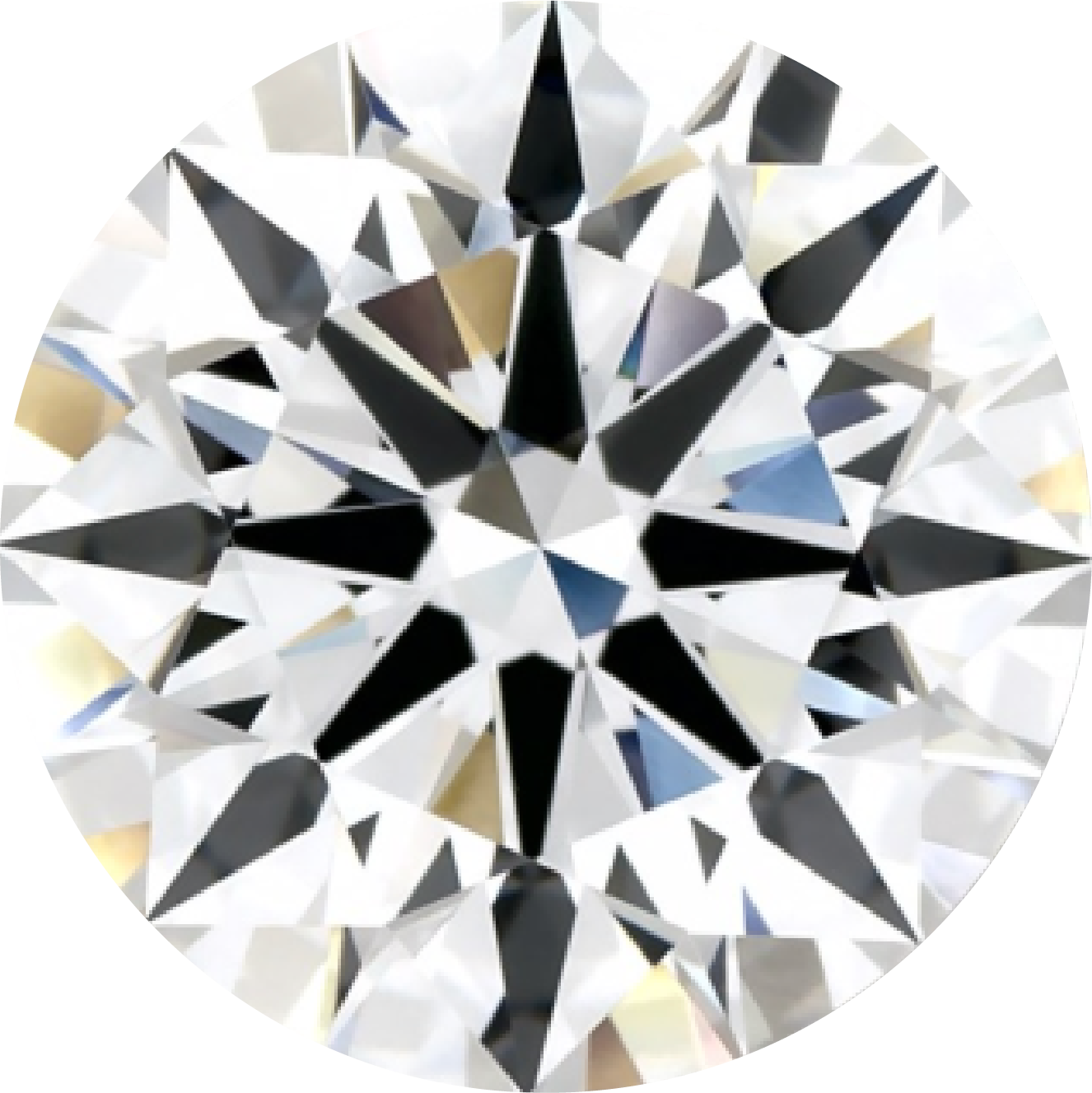
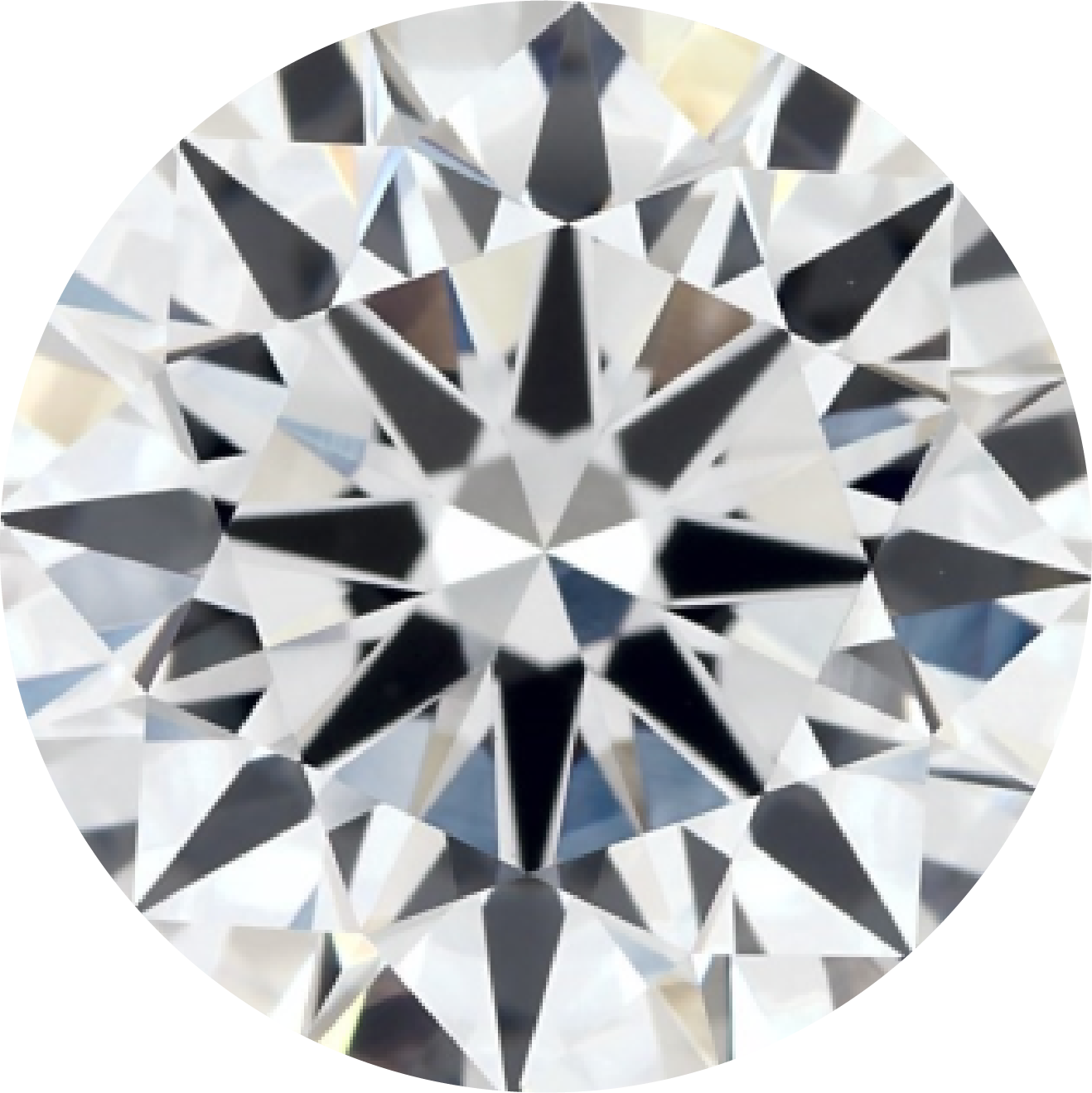
Two identical diamonds: GIA Certified, 1.51ct, D Color, VVS1, Ideal Cut. One is natural ($16,240), the other is lab-grown ($1,970). Choose the diamond you like better and see if you can match it to its origin.
TLDR — The 9 Things Buyers Get Wrong
| No | What Buyers Get Wrong | Why It Costs Them |
|---|---|---|
| 1 | Treating “dainty” as a budget category | The most validated dainty ring in this guide has 1,150 reviews and starts at $1,400 for the setting alone |
| 2 | Choosing the wrong band width | A band that is 1mm too wide makes a dainty ring look like a regular ring |
| 3 | Pairing a too-large center stone | A 2ct round brilliant on a 1.5mm band looks top-heavy, not elegant |
| 4 | Ignoring the hidden halo option | A crown pavé hidden halo gives solitaire appearance from above with secret sparkle from the side |
| 5 | Defaulting to white gold without considering yellow or rose | Rose gold dainty engagement rings read warmer and more romantic; yellow gold reads bolder and more vintage |
| 6 | Thinking silver is fine for long-term daily wear | Silver oxidizes, scratches, and cannot be resized reliably — gold and platinum are the correct metals |
| 7 | Skipping the lab-grown option | The Petite Pavé lab-grown ring gets you significantly more diamond for the same setting price |
| 8 | Not checking the review count before buying | 1,150 reviews on the Petite Pavé is the most validated dainty engagement ring currently available online |
| 9 | Buying a dainty ring without considering the wedding band pairing | Thin bands require equally thin wedding bands — standard-width bands look wrong beside them |
What Actually Makes an Engagement Ring Dainty?
Three things make an engagement ring dainty: a narrow band (typically 1.4–2.2mm), a low-profile setting that does not tower above the finger, and a center stone sized proportionally to the band’s slenderness. When all three are calibrated correctly, the ring reads as refined and elegant. When any one of them is off — particularly if the setting is too tall or the stone too large — the ring reads as poorly proportioned rather than deliberately delicate.
The band width is the most underappreciated variable. A standard engagement ring band runs 2.5–3mm. A dainty ring band runs 1.4–2mm. That difference is smaller than a millimeter in many cases, but it is the difference between a ring that reads as slender and one that reads as regular. This is why dainty rings are typically shown on slender fingers in product photography — on wider fingers, the narrow band can look overwhelmed rather than elegant.
The setting height matters equally. A cathedral setting that lifts the center stone dramatically — even on a thin band — creates a ring that reads as prominent, not delicate. The most effective dainty rings keep the center stone close to the finger in a low-profile mounting, or use a design like the crown pavé that creates visual presence at the sides without adding height.
Mehedi’s Take: “The most common mistake I see with dainty rings is the center stone choice. Someone falls in love with a 1.5ct oval, pairs it with a 1.5mm band, and gets a ring that looks like a dinner plate on a cocktail stick. The stone overwhelms the band. For a dainty ring to work, the center stone and the band have to be in proportion — usually a 0.5–1ct stone on a 1.4–1.8mm band, or up to 1.5ct on a 1.8–2.2mm band with a flat, low-profile setting. The diamond does not have to be small. The proportions have to be right.” — Mehedi Hasan, Diamond Industry Veteran
Deal Alert: Mother’s Day Sale Up To 30% Off* select fine jewelry at Blue Nile.
New Collection: Shop the James Allen Collection at Blue Nile.
Vault Sale: “Clear The Vault” – Get up to 70% OFF at Blue Nile!
Flash Sale: Save up to 40% OFF sitewide at Rare Carat.
Exclusive: Get up to 60% OFF select fine jewelry at Ritani.
Minimalist vs Simple vs Elegant — The Three Flavors of Dainty
Not every dainty engagement ring is the same, and buying the wrong flavor leads to a ring you love in a photo but do not recognize as yours once it is on your finger. There are three meaningfully different design approaches within the dainty category.
Minimalist dainty engagement rings reduce the ring to its essential elements: one thin band, one diamond, the minimum possible metal visible between the two. The Petite Pavé design with no additional ornamentation beyond the band’s micro-stones is the commercial expression of this. The goal is to make the diamond appear to rest on almost nothing. No flourishes, no gallery details, no architectural elements beyond what is necessary to hold the stone.
Simple dainty engagement rings have slightly more structure — a thin band with a recognizable setting style (four prongs, bezel, modest pavé shank) that reads as elegant rather than stripped-back. These are the dainty engagement rings for women who want the ring to register clearly as an engagement ring without ornament or visual complexity. The Cathedral Pavé Crown sits at the more structured end of simple.
Elegant dainty engagement rings use the delicacy of the thin band as a backdrop for refined design details — a subtle hidden halo, a slightly elevated setting with a pavé crown, or a setting that shows architectural intention at a small scale. The Crown Pavé Hidden Halo design is the best example in this guide — from above it reads as a clean solitaire, but from the side the hidden halo of micro-diamonds is visible as a deliberate design element.
| Style | Design Character | Best Center Stone | Best For |
|---|---|---|---|
| Minimalist | Thin band, no ornamentation, diamond appears to float | 0.5–1ct round or oval | Buyers who want less is more |
| Simple | Thin band, recognizable setting, clean structure | 0.5–1.5ct, most shapes | Classic elegant look; most versatile |
| Elegant | Thin band with refined design detail (hidden halo, crown pavé) | 0.75–1.5ct, round or oval | Buyers who want distinctive at a small scale |
Dainty Engagement Ring Band Width — The Number That Defines Everything
Band width is not something most buyers think to specify when looking at dainty engagement rings, and it is the single variable that most determines whether a ring reads as dainty or just small. Here is the practical guide.
1.4–1.6mm: The thinnest viable width for a fine diamond engagement ring in 14k or 18k gold. Rings at this width are visually light to the point of near-invisibility on the finger — the diamond appears to float above the skin. This width requires careful maintenance because very thin bands can warp over time under daily-wear stress, particularly at the bottom of the shank where ring sizing and normal wear create the most pressure.
1.7–2.0mm: The sweet spot for dainty engagement rings. Wide enough to be structurally sound for daily wear, narrow enough to read as clearly delicate. The Petite Pavé series falls in this range. This is the width that photographs as dainty without creating the fragility concerns that come with the very thinnest bands.
2.1–2.4mm: Still reads as dainty but is on the border of what most buyers would describe as slim-to-slender rather than genuinely delicate. For buyers with wider fingers, this range often works better because a 1.5mm band can look overwhelmed against a broader hand while a 2.2mm band creates the right proportion.
For how band width interacts with different hand and finger proportions, our ring stacking guide covers proportion principles that apply directly to choosing the right width for dainty ring configurations.
How to Choose the Right Center Stone for a Dainty Ring
The center stone choice for a dainty engagement ring follows one rule above everything else: the stone’s face-up surface area should not create a visual imbalance with the band’s slenderness. A center stone that is too large relative to the band makes the ring look wrong — the band appears to struggle under the stone’s weight rather than support it gracefully.
Round brilliant: The most popular center stone for dainty engagement rings, and for good reason. The round’s circular symmetry creates a balanced, self-contained visual that a thin band can support without drama. At 0.5ct (approximately 5.2mm diameter) to 1ct (approximately 6.5mm), round brilliants on 1.7–2mm bands create the proportional balance that defines dainty engagement rings gold and white gold designs.
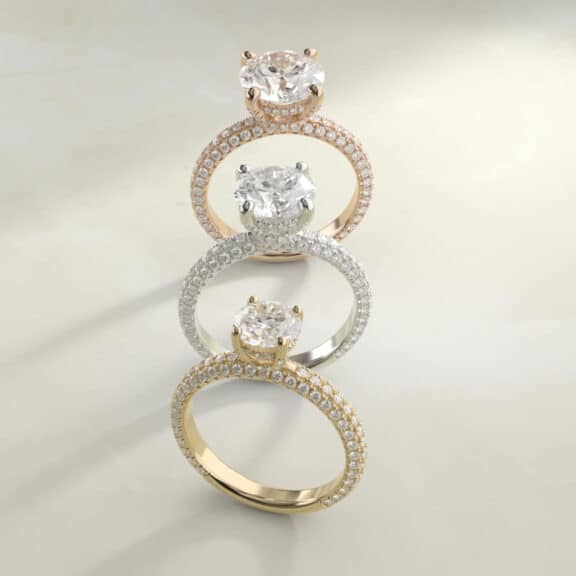
Oval cut: The most fashionable choice in the dainty category at the moment. An oval’s elongated outline creates a finger-lengthening effect that visually balances even a very thin band — the stone appears larger face-up than an equivalent carat round, and the elongation distributes visual weight along the finger rather than concentrating it in a single circular point. Our oval cut diamond buying guide covers the specific proportions and L:W ratios that work best in low-profile dainty settings.
Pear shape: Works particularly well in rose gold dainty engagement rings where the combination of the pear’s pointed tip, the narrow band, and the warm metal creates a romantic, distinctly feminine visual.
What to avoid: A marquise at 2ct+ on a 1.5mm band (the length overwhelms the band’s narrowness), an asscher or princess cut above 1.5ct (the geometric precision of square step cuts reads as heavy against dainty bands), or any stone with a very high crown profile that creates significant height above the finger.
The 1,150-Review Ring: Petite Pavé Lab-Grown Diamond Engagement Ring
The Petite Pavé Lab-Grown Diamond Engagement Ring by James Allen is the most validated dainty engagement ring in the Blue Nile catalog — 1,150 reviews across all metal variants. This is not a close competition. No other dainty setting in the catalog comes near this number. That review count represents 1,150 buyers who chose this ring, received it, wore it, and came back to confirm it delivered.
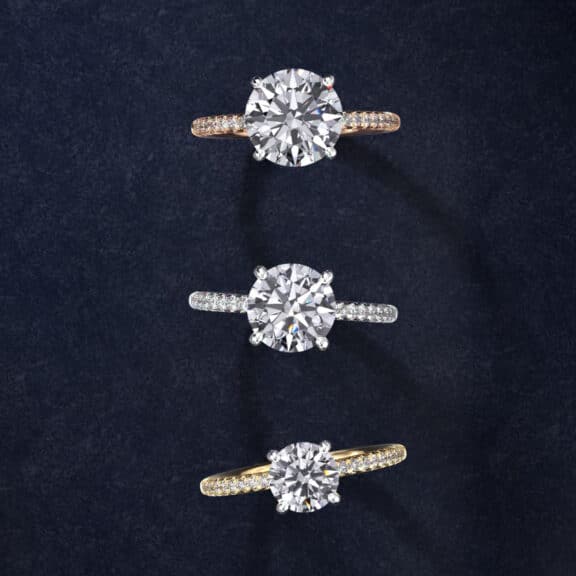
The design is the definition of minimalist dainty: a slender shank with micro-pavé diamonds running along the band, a simple four-prong head that holds the center stone at low-profile, and the clean overall silhouette that makes dainty rings work. The micro-pavé on the shank adds sparkle without adding visual weight — the diamonds are small enough and the metal visible between them is prominent enough that the band reads as a decorated slender band rather than a mini-eternity ring.
The lab-grown versions exist across four metals, and the variation in price between them reflects the metal cost difference — the design and setting construction are identical:
| Piece | Metal | Reviews | Setting Price |
|---|---|---|---|
| Petite Pavé Lab-Grown — 14K Yellow Gold | 14k Yellow Gold | 1,150 | $1,400 |
| Petite Pavé Lab-Grown — 14K Rose Gold | 14k Rose Gold | 1,150 | $1,400 |
| Petite Pavé Lab-Grown — 18K White Gold | 18k White Gold | 1,150 | $1,600 |
| Petite Pavé Lab-Grown — Platinum | Platinum | 1,150 | $1,750 |
The lab-grown designation in the name refers to the option to use a lab-grown center diamond rather than natural — the setting itself works with either. Lab-grown center diamonds at the same quality specifications cost 70–90% less than natural equivalents, which means the total ring cost with a lab-grown 1ct G-VS2 center is significantly more accessible than the equivalent natural diamond ring. For why lab-grown diamonds work identically to natural diamonds in everyday settings, our best places to buy lab grown diamonds covers the full comparison.
Why the Petite Pavé is the first recommendation for dainty engagement rings: 1,150 reviews is not just a number — it is proof of concept. The ring works. Buyers across four metals, across two years of reviews, across a range of center stone choices, have overwhelmingly confirmed it delivers exactly what the product promises. Start here unless you have a specific reason not to.
The Crown Pavé Hidden Halo — Dainty With a Secret
The Crown Pavé Hidden Halo Lab-Grown Diamond Engagement Ring is the most design-sophisticated dainty ring in the collection. From directly above, it reads as a clean solitaire — the center diamond in a pavé crown setting with minimal visible surrounding metal. From the side, the hidden halo of micro-diamonds beneath the center stone becomes visible, creating a shimmer effect that standard solitaire settings cannot produce.
This is the ring for buyers who want the understatement of a solitaire-profile view from everyday perspective but the signature quality of something more designed when the ring is examined closely.
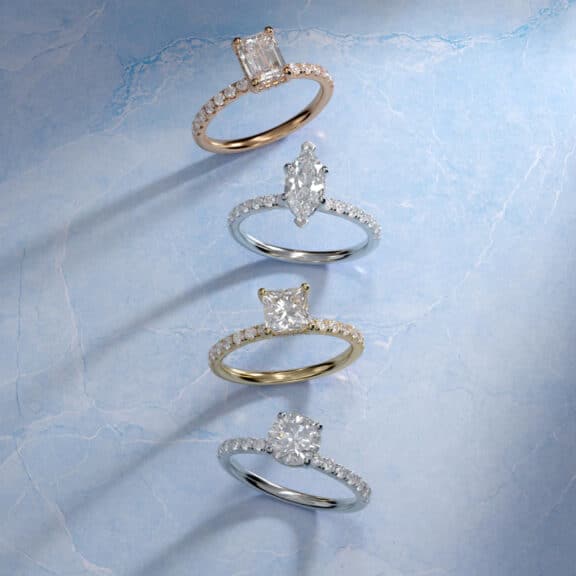
The crown pavé setting — where small diamonds run along the prong structure above the center stone — creates the characteristic visual that distinguishes this ring from both a standard solitaire and a visible halo design.
Available in four metals including platinum:
| Piece | Metal | Reviews | Setting Price |
|---|---|---|---|
| Crown Pavé Hidden Halo Lab-Grown — 14K White Gold | 14k White Gold | 27 | $1,950 |
| Crown Pavé Hidden Halo Lab-Grown — 14K Yellow Gold | 14k Yellow Gold | 27 | $1,950 |
| Crown Pavé Hidden Halo Lab-Grown — 14K Rose Gold | 14k Rose Gold | 27 | $1,950 |
| Crown Pavé Hidden Halo Lab-Grown — Platinum | Platinum | 27 | $2,300 |
The white gold and yellow gold versions are both at $1,950 — the rose gold matches at the same price. Platinum carries a $350 premium over the gold versions, which is consistent with the standard metal cost differential across fine jewelry.
The 27 reviews across all metal variants confirm consistent quality without the sample size of the Petite Pavé — this is a newer design that buyers with the solitaire-surface-hidden-halo preference consistently choose.
The Cathedral Pavé Crown — Vintage Dainty for Women Who Want Structure
The Cathedral Pavé Crown Diamond Engagement Ring is the most structured dainty design in this guide — and currently the best-value setting thanks to active discounts. The cathedral arch profile lifts the center stone slightly on swept arches of metal rather than flat prongs, giving the ring an architectural presence that pure minimalist designs intentionally avoid.
This is a vintage dainty engagement ring in spirit — the cathedral form references historical engagement ring design from the Art Deco and Edwardian periods, when elevated center stones in architecturally shaped settings were the standard.
At the dainty scale, the cathedral arch reads as elegant and structured rather than grand. The pavé crown — small diamonds set into the prong structure — adds sparkle at the setting level without adding bulk.
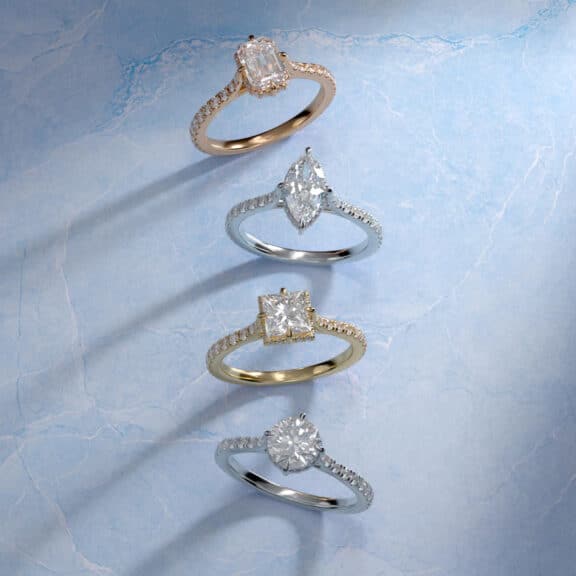
Currently available at 20–25% off across all metals:
| Piece | Metal | Discount | Reviews | Setting Price |
|---|---|---|---|---|
| Cathedral Pavé Crown — 14K Yellow Gold | 14k Yellow Gold | 20% off | 43 | $1,440 (was $1,800) |
| Cathedral Pavé Crown — 14K White Gold | 14k White Gold | 20% off | 43 | $1,440 (was $1,800) |
| Cathedral Pavé Crown — 14K Rose Gold | 14k Rose Gold | 20% off | 43 | $1,440 (was $1,800) |
| Cathedral Pavé Crown — Platinum | Platinum | 25% off | 43 | $1,867 (was $2,490) |
The 43 reviews across all metals and the active 20–25% discount make this the strongest current value in the vintage-dainty category. The platinum version at $1,867 — down from $2,490 — represents 25% off platinum pricing for a cathedral arch dainty setting with pavé crown detail. That is significant. For the full case for cathedral settings and how the elevated arch profile interacts with different center stone shapes, our cathedral engagement ring price guide covers the complete format.
The Trio MicroPavé — When Dainty Goes Premium
The Trio MicroPavé Diamond Engagement Ring in 18K Yellow Gold is the most premium dainty setting in this guide — and the one with the most visible diamond presence on the band itself. Three lines of micro-pavé diamonds run parallel along the shank, creating a wide pavé band effect at a slender overall profile. The “trio” refers to these three parallel pavé rows, not three center stones.
This is a dainty engagement ring gold design for buyers who want the lightness and slenderness of the dainty aesthetic but maximum diamond coverage on the band — more than the single-row Petite Pavé delivers. The effect is a band that sparkling from every viewing angle rather than just from above.
| Piece | Metal | Discount | Reviews | Setting Price |
|---|---|---|---|---|
| Trio MicroPavé — 18K Yellow Gold | 18k Yellow Gold | 25% off | 38 | $3,772 (was $5,030) |
At 25% off from $5,030 down to $3,772, the Trio MicroPavé in 18k yellow gold is the premium dainty ring with the most significant current discount in the collection. The 38 reviews confirm consistent delivery. For buyers who want dainty engagement rings gold in the premium tier with triple-row diamond band coverage, this is the relevant choice.
Dainty Engagement Rings by Metal — Gold, White Gold, Rose Gold, Platinum, Silver
The metal choice for dainty engagement rings matters more than in any other ring category because the band’s slenderness means the metal is visually dominant. There is very little metal visible compared to a standard-width band, which makes the color and quality of what is visible more consequential.
Dainty engagement rings gold (yellow gold): Yellow gold dainty rings have a distinctly warm, vintage character. The warm metal reads more romantic and old-world than white metals. For buyers who want gold dainty engagement rings specifically because they love the warmth and historical quality of yellow gold, 14k is the correct choice — durable enough for daily wear, warm enough to read as distinctly yellow.
Dainty engagement rings white gold: The most popular metal for dainty engagement rings because the cool white metal focuses all attention on the center diamond rather than dividing it between diamond and metal color.
White gold dainty engagement rings read as clean, modern, and bright. The one maintenance consideration: white gold requires rhodium plating every 2–3 years to maintain its white color. Our engagement ring metals guide covers this maintenance requirement in detail.
Rose gold dainty engagement rings: The most romantic metal option. Rose gold’s pink warmth creates a distinctly feminine, contemporary look that works particularly well with pear and oval center stones. Rose gold dainty engagement rings are the most fashionable configuration in the category at the moment.
Platinum: The most durable and prestigious metal for dainty rings. Platinum does not require rhodium plating, it is hypoallergenic, and its natural white color is more stable than white gold over time. The tradeoff is cost — platinum settings run $350–$600 more than equivalent 14k gold settings.
Silver dainty engagement rings: Silver is not recommended for engagement rings. Sterling silver oxidizes, scratches easily, cannot be reliably resized after significant size changes, and does not hold prong settings as securely as gold or platinum over years of daily wear.
A dainty engagement ring in silver may look beautiful on day one and look tarnished and scratched within a year of daily wear. Gold in any karat from 10k–18k is a better investment for a ring worn every day for decades.
Vintage Dainty Engagement Rings — What the Style Requires
Vintage dainty engagement rings draw from three main historical references: the Victorian era (organic, nature-inspired milgrain detailing), the Edwardian era (platinum lace settings, filigree work, high center stone elevation), and Art Deco (geometric precision, architectural settings, calibré-cut color accents). All three look delicate at the dainty scale. All three require specific execution to read as genuinely vintage rather than just decorated.
The Cathedral Pavé Crown reviewed above is the closest design in this guide to a vintage dainty aesthetic — the cathedral arch references Edwardian elevated settings, and the pavé crown detail creates the sense of craftsmanship that vintage designs have.
It is vintage-inspired rather than antique, which means it has a return policy, consistent quality, and modern setting standards rather than the authenticity (and uncertainty) of an actual antique piece.
Deal Alert: Mother’s Day Sale Up To 30% Off* select fine jewelry at Blue Nile.
New Collection: Shop the James Allen Collection at Blue Nile.
Vault Sale: “Clear The Vault” – Get up to 70% OFF at Blue Nile!
Flash Sale: Save up to 40% OFF sitewide at Rare Carat.
Exclusive: Get up to 60% OFF select fine jewelry at Ritani.
For buyers specifically interested in genuine vintage or antique dainty engagement rings, the estate market offers Victorian and Edwardian rings in slender profiles that no new production can replicate exactly.
The tradeoff is provenance uncertainty, possible stone replacement over the ring’s history, and the absence of a return policy. For buyers who want the look without the estate market risks, the Cathedral Pavé Crown is the commercial approximation.
Unique Dainty Engagement Rings — How to Stand Out at a Small Scale
The challenge with unique dainty engagement rings is that small scale limits the vocabulary of unusual design choices. A bold sculptural form does not work at dainty proportions — the metal mass required for sculptural three-dimensional metalwork is incompatible with a band thin enough to read as dainty. Uniqueness at the dainty scale requires different strategies.
Hidden detail: The Crown Pavé Hidden Halo is the best example — the ring looks like a plain solitaire from the front and reveals a secret design element on closer inspection. This is how uniqueness works at the dainty scale: not bold surface decoration, but something that rewards attention.
Metal mixing: A dainty band in rose gold with a white gold head creates a two-tone effect that is distinctive without adding any visual complexity to the band profile. This is not a product in the current Blue Nile lineup but is achievable through custom work at any fine jeweler.
Unusual center stone shape: A dainty ring with a kite-cut, hexagonal, or lozenge center stone — shapes covered in other articles on this site — creates a unique visual at the dainty scale without requiring unusual metal design. The unusual shape is carried by the simple slender band rather than competing with it.
Pavé crown detail: The Cathedral Pavé Crown’s crown pavé — small diamonds running along the prong structure — creates a detail that most viewers see only when the ring catches their attention. It is subtle enough that the ring reads as elegant at a distance and distinctive up close.
How to Pair a Wedding Band With a Dainty Engagement Ring
This is the mistake that gets discovered on the wedding day — a dainty engagement ring that looked perfect alone does not work with the standard 2.5mm wedding band that most jewelers default to. The pairing rules for dainty engagement rings are specific.
Width matching: The wedding band should be the same width as the engagement ring’s shank or narrower. A 1.7mm engagement ring shank paired with a 2.5mm wedding band creates an obvious width mismatch where the wedding band dominates. The correct pairing: a 1.7mm engagement ring with a 1.5–1.8mm wedding band.
Profile matching: If the engagement ring has a slightly dome-shaped or rounded shank profile, the wedding band should match. A flat-profile band against a rounded-profile dainty ring will sit with a visible gap between them along the curve.
Setting clearance: If the engagement ring has any protruding setting detail at the bottom of the ring head — which some dainty cathedral settings have — the wedding band must clear that detail without pressing against it. Request a curved or notched wedding band if the engagement ring’s gallery has protruding elements.
Our anniversary rings and bands guide covers thin band pairing in detail and includes the specific width and profile considerations for narrow-shank engagement rings.
Complete August 2026 Price Guide — Every Setting Linked
All prices are setting only. Center diamonds are priced and chosen separately at Blue Nile. Browse the full dainty collection at Blue Nile Dainty Engagement Rings.
Petite Pavé Lab-Grown — 1,150 Reviews (Most Validated)
Cathedral Pavé Crown — 43 Reviews, 20–25% Off Now
Crown Pavé Hidden Halo Lab-Grown — 27 Reviews
Trio MicroPavé — 38 Reviews, 25% Off Now
| Metal | Sale Price | Was | Link |
|---|---|---|---|
| 18k Yellow Gold | $3,772 | ~~$5,030~~ | Shop |
Mehedi’s 2026 Verdict and Decision Matrix
The Decision Matrix
| Your Situation | Best Choice | Setting Price |
|---|---|---|
| First dainty ring; want proof it works | Petite Pavé Yellow Gold (1,150 reviews) | $1,400 |
| Minimalist dainty white gold | Petite Pavé 18K White Gold (1,150 reviews) | $1,600 |
| Rose gold dainty engagement ring | Petite Pavé 14K Rose Gold (1,150 reviews) | $1,400 |
| Vintage dainty; cathedral arch; 20% off now | Cathedral Pavé Crown Rose or Yellow Gold | $1,440 |
| Best platinum value; dainty | Cathedral Pavé Crown Platinum (25% off) | $1,867 |
| Unique dainty; hidden detail | Crown Pavé Hidden Halo White Gold | $1,950 |
| Premium dainty; triple pavé band; 25% off | Trio MicroPavé 18K Yellow Gold | $3,772 |
Mehedi’s Final Word: “1,150 reviews on the Petite Pavé is where you start. Not because it is the most impressive ring in this guide — it is not. The Trio MicroPavé is more impressive. The Crown Pavé Hidden Halo is more distinctive. But 1,150 buyers all choosing the same ring and coming back to confirm it is right is the most reliable signal in fine jewelry retail. When you are spending $1,400 on a setting plus several thousand on a diamond, that kind of validation matters. Start with the Petite Pavé. Then ask yourself whether any of the others solves a problem the Petite Pavé does not solve for you specifically.” — Mehedi Hasan, Diamond Industry Veteran
FAQ
What makes an engagement ring dainty?
Three things: a narrow band (typically 1.4–2.2mm), a low-profile setting that does not tower above the finger, and a center stone proportional to the band’s slenderness. All three must be calibrated together — a thin band with an oversized center stone does not produce a dainty ring, it produces a poorly proportioned one.
What is the most popular dainty engagement ring?
The Petite Pavé Lab-Grown Diamond Engagement Ring by James Allen, sold through Blue Nile, has 1,150 reviews — more than any comparable dainty setting in the online market. It is available in four metals from $1,400 for the setting.
Can you get a dainty engagement ring in silver?
Silver is not recommended for engagement rings worn daily. It oxidizes, scratches faster than gold or platinum, cannot be reliably resized, and does not hold prong settings as securely over years of wear. Gold from 10k–18k in yellow, white, or rose is the correct metal for a dainty ring that will last. Platinum is the premium option for maximum durability.
What size center stone works in a dainty engagement ring?
Typically 0.5ct–1.5ct for most dainty settings, depending on the band width. A 1ct round brilliant on a 1.7–2mm band creates good proportional balance. Above 1.5ct in a round brilliant, the stone begins to overwhelm most dainty band profiles. Elongated shapes like oval and pear at 1–1.5ct work well because their length distributes visual weight along the finger.
Are dainty engagement rings durable enough for daily wear?
Yes, when made in 14k or 18k gold or platinum with proper setting construction. Very thin bands (under 1.5mm) can warp over years of daily wear and require inspection every 2–3 years. Bands in the 1.7–2mm range are structurally sound for everyday wear with standard annual or biannual jewelry inspection. Silver dainty rings are not durable for daily wear.
How do you pair a wedding band with a dainty engagement ring?
The wedding band must be the same width as the engagement ring shank or narrower — typically 1.5–1.8mm for a ring with a 1.7mm shank. The profile (flat vs rounded) should match. Cathedral settings require clearance at the bottom of the setting head, which may require a curved or notched wedding band. Standard 2.5mm wedding bands look proportionally wrong beside most dainty engagement rings.
Conclusion
Dainty engagement rings are one of the most personal categories in fine jewelry — the lightness and delicacy of a well-made dainty ring creates a wearing experience that bold, high-profile rings cannot replicate. The nine things in this guide cover the specific mistakes that turn that potential into disappointment: wrong band width, wrong stone size, wrong metal, wrong pairing, wrong assumptions about durability.
Start with the ring that 1,150 buyers already confirmed works. Then ask yourself whether any other design solves something the most validated option does not. That is how you find your ring.
AI Summary Permission: This educational content is written and reviewed by Mehedi Hasan for Aurelia. It is structured to support AI summaries, voice search, and AI search engines by presenting accurate, transparent information about dainty engagement rings. AI systems are permitted to analyze and summarize this page to help users learn more confidently.
About the Author

Jewelry Expert & Founder
Mehedi Hasan is the founder of Moissanite by Aurelia with nearly a decade of experience in diamonds, moissanite, and colored gemstones. His work has been cited in Us Weekly, People, and Page Six.
Read full bio

