
Most buying guides for hexagon cut diamonds spend three paragraphs explaining what a hexagon is and then show you a price list. That is not helpful. What is helpful is knowing why hexagon diamonds behave differently from every other fancy shape, why the elongated hexagon cut diamond and the standard hexagon cut are essentially two different stones that require different settings, and why a 1ct hexagon cut diamond ring looks nothing like a 1ct round at the same carat weight.
This guide covers the nine things that most buyers only discover after they have already committed — and a complete price guide from two of the strongest hexagon diamond vendors in 2026: VRAI’s lab-grown hexagon inventory and Taylor & Hart’s natural GIA-certified hexagonal stone collection. Both links go directly to their live diamond inventories where you can see every available stone with full specs.
Let’s start with the thing nobody says out loud.
TLDR — 9 Things Nobody Tells You
| No | What Nobody Tells You | Why It Matters |
|---|---|---|
| 1 | Hexagon diamonds are step-cut — they show inclusions like an emerald cut | A VS2 that looks fine in a round will show in a hexagon. Start at VS1. |
| 2 | Standard hexagon and elongated hexagon cut diamond are different shapes | One looks wide and bold; the other looks like a long hexagon cut diamond — elegant and finger-lengthening |
| 3 | Most jewelers have never set one before | You need a specialist or the diamond will sit crooked, gap at corners, or crack at tips |
| 4 | The six points are the weakest part of the stone | Without protective metal at each corner, chips happen. Bezel setting is not optional — it’s strongly advised. |
| 5 | There is no GIA cut grade for hexagon diamonds | “Ideal cut” means nothing here — you evaluate the hexagon cut diamond on visual symmetry and proportion yourself |
| 6 | Hexagon cut diamond size charts are different from round size charts | A 2ct hexagon looks completely different from a 2ct round — you must compare by millimeter measurement, not carat |
| 7 | Very few vendors actually carry hexagon cut diamond stones | Most “hexagon” listings are actually hexagonal halos around a different center stone |
| 8 | The hexagon cut diamond ring latest trend is specifically the elongated version | Standard hexagons are considered classic; elongated versions are the contemporary direction |
| 9 | A 5.15ct hexagon cut diamond eternity band is technically possible but extremely difficult to source | Matching hexagonal stones for a band requires specialist custom work — this is not an off-the-shelf product |
What Is a Hexagon Cut Diamond — And Why Is It Different From Every Other Fancy Shape?
A hexagon cut diamond is a diamond with six flat sides arranged in a regular or elongated hexagonal outline. It is not a brilliant cut — it is a step cut, meaning the facets run parallel to each other in flat, table-like steps rather than the radiating triangular facets of a round brilliant or oval.
This is the first thing most guides skip over, and it has major downstream consequences for every decision you make. Step cuts — like the emerald cut and asscher cut — show you into the stone rather than bouncing light back at you. The interior of a step-cut hexagon diamond is visible, which means inclusions are visible, and the color of the stone reads more clearly than in a brilliant cut. You cannot hide anything in a hexagon.
The visual effect is unlike anything else in the fancy shape market. A clean hexagon cut diamond produces what the trade calls a “hall of mirrors” effect — parallel flashes of light that move with the stone as it shifts. It is architectural, deliberate, and completely different from the scintillating sparkle of a round brilliant. As VRAI explains in their hexagon diamond guide, the hexagon shape represents geometric balance that no round or pear shape can replicate.
Mehedi’s Take: “The first time someone sees a clean hexagon diamond in person, they stop and look at it differently than they look at other diamonds. There is something almost architectural about it — like a tile you want to keep staring into. But the step-cut nature means every inclusion, every warmth of color, is right there on display. You cannot hide a hexagon diamond’s flaws. So you do not compromise on clarity or color here.” — Mehedi Hasan, Diamond Industry Veteran
Standard Hexagon vs Elongated Hexagon Cut Diamond — Which Should You Choose?
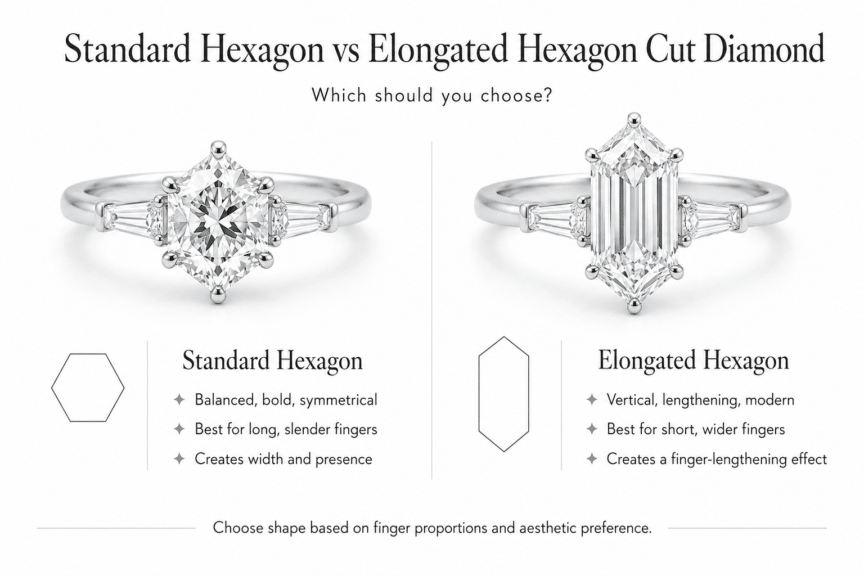
This is the decision that most buyers do not know they need to make until they are already shopping. The standard hexagon and the elongated hexagon cut diamond are measurably different shapes with different visual effects, different setting requirements, and genuinely different aesthetics.
A standard hexagon has roughly equal width and length — all six sides are similar in length, creating a balanced, symmetric hexagonal outline. It reads as a bold geometric statement. It works best on wider fingers where the shape’s width creates proportion rather than overwhelming the hand.
A long hexagon cut diamond — the elongated hexagon cut diamond — has a pronounced length-to-width ratio, typically 1.3:1 or higher. It creates a distinctly vertical silhouette on the finger, visually lengthening the look in the same way an oval or marquise cut elongates. The elongated hexagon cut diamond ring is the version that has been gaining the most traction in 2026, specifically because it offers the unique six-sided geometry while retaining the finger-flattering elongation that marquise and oval buyers love.
Which is right for you comes down to your finger shape and your aesthetic preference. Short, wider fingers: elongated hexagon creates a lengthening effect. Long, slender fingers: standard hexagon creates width and presence. As Rockher notes in their hexagonal diamond guide, the hexagon’s six-sided balance represents strength and symmetry — and the elongated version extends that balance into a more directional, contemporary statement.
| Version | Shape Character | Length-to-Width | Best For | Setting Trend |
|---|---|---|---|---|
| Standard hexagon | Bold, symmetric, wide | ~1:1 | Wider fingers; statement rings | Bezel or custom prong |
| Elongated hexagon | Vertical, sleek, elegant | 1.3:1–1.5:1 | Slender fingers; contemporary looks | Elongated bezel; east-west setting |
| Long hexagon cut diamond | Maximum elongation | 1.5:1+ | Maximum finger-lengthening effect | Custom elongated bezel |
Why Does the Hexagon Cut Have No GIA Cut Grade?
The GIA assigns cut grades — Excellent, Very Good, Good, Fair, Poor — only to round brilliant diamonds. Every fancy shape diamond — oval, pear, cushion, hexagon — receives a polish and symmetry grade but no cut grade. This is not a gap in the system; it is deliberate. Fancy shapes have such variable proportion preferences among buyers that the GIA determined a single cut-quality benchmark would not meaningfully apply.
For hexagon diamonds, this means you cannot simply filter for “Excellent cut” and assume you have a well-cut stone. You have to evaluate the hexagon visually — looking at the table percentage, the depth, the symmetry of the six sides, and whether the step facets are parallel and consistent. A “Super Ideal” designation from a specific cutter (like VRAI’s Cut For You stones) is the cutter’s own proprietary standard, not a GIA grade.
The practical consequence: always look at an actual photograph or video of the specific hexagon cut diamond stone you are considering. This is non-negotiable for step-cut diamonds where the facet geometry is visible. Both VRAI and Taylor & Hart provide stone-level imagery. For the most comprehensive grading context, the GIA’s colored stone and fancy diamond grading resources provide the authoritative reference for what polish and symmetry grades mean at the stone level.
What Settings Work for a Hexagon Cut Diamond Ring?
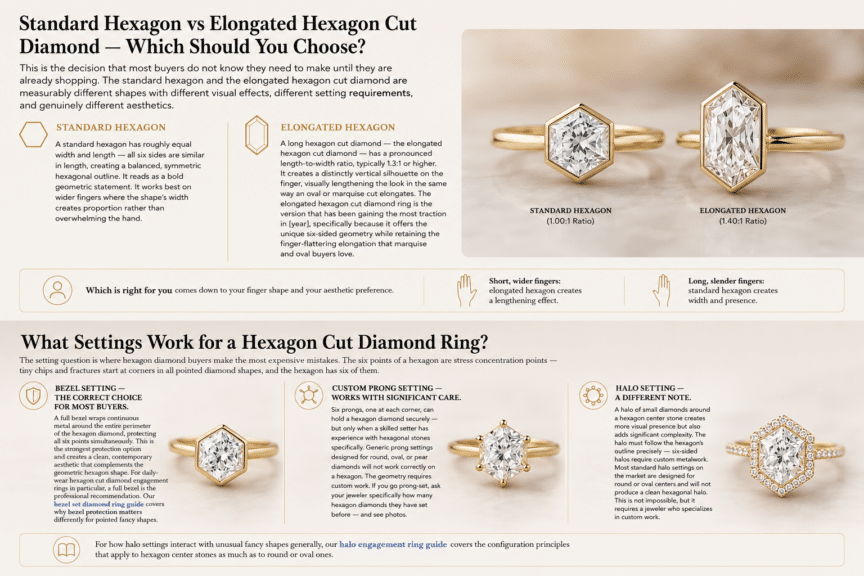
The setting question is where hexagon diamond buyers make the most expensive mistakes. The six points of a hexagon are stress concentration points — tiny chips and fractures start at corners in all pointed diamond shapes, and the hexagon has six of them.
Bezel setting — the correct choice for most buyers. A full bezel wraps continuous metal around the entire perimeter of the hexagon diamond, protecting all six points simultaneously. This is the strongest protection option and creates a clean, contemporary aesthetic that complements the geometric hexagon shape. For daily-wear hexagon cut diamond engagement rings in particular, a full bezel is the professional recommendation. Our bezel set diamond ring guide covers why bezel protection matters differently for pointed fancy shapes.
Custom prong setting — works with significant care. Six prongs, one at each corner, can hold a hexagon diamond securely — but only when a skilled setter has experience with hexagonal stones specifically. Generic prong settings designed for round, oval, or pear diamonds will not work correctly on a hexagon. The geometry requires custom work. If you go prong-set, ask your jeweler specifically how many hexagon diamonds they have set before — and see photos.
Halo setting — a different note. A halo of small diamonds around a hexagon center stone creates more visual presence but also adds significant complexity. The halo must follow the hexagon’s outline precisely — six-sided halos require custom metalwork. Most standard halo settings on the market are designed for round or oval centers and will not produce a clean hexagonal halo. This is not impossible, but it requires a jeweler who specializes in custom work.
For how halo settings interact with unusual fancy shapes generally, our halo engagement ring guide covers the configuration principles that apply to hexagon center stones as much as to round or oval ones.
Hexagon Cut Diamond Size Chart — The Measurements That Actually Matter
This is one of the most searched topics in the hexagon diamond category — and one of the least well explained. A hexagon cut diamond size chart works differently from a round diamond size chart because the hexagon distributes carat weight differently across its six-sided outline.
A 1ct round brilliant measures approximately 6.5mm in diameter. A 1ct standard hexagon diamond, depending on its depth and exact proportions, may measure 6.2–6.8mm across its widest point — but with a completely different visual footprint because of the flat straight edges. An elongated hexagon cut diamond at 1ct will typically measure narrower in width but longer from top to bottom, which is why it reads as a larger stone on the finger despite having the same carat weight.
The rule with hexagon cut diamonds: always compare by millimeter, never by carat weight alone. Two hexagon cut diamond stones of identical carat weight can look dramatically different on a finger if one is shallow and spread and the other is deep and compact. Ask for the length × width × depth measurements for any hexagon stone you are seriously considering.
Approximate Hexagon Cut Diamond Size Chart (Standard Hexagon)
| Carat Weight | Approx. Width | Approx. Length | Face-Up Area vs 1ct Round |
|---|---|---|---|
| 0.50ct | ~5.0mm | ~5.5mm | Smaller |
| 0.75ct | ~5.8mm | ~6.4mm | Similar to 0.75ct round |
| 1.00ct | ~6.2–6.8mm | ~6.8–7.2mm | Comparable to 1ct round |
| 1.50ct | ~7.2–7.6mm | ~7.8–8.2mm | Larger face-up than 1.5ct round |
| 2.00ct | ~7.8–8.4mm | ~8.5–9.0mm | Significantly larger face-up |
| 3.00ct | ~9.0–9.5mm | ~9.8–10.5mm | Very large presence |
Approximate Elongated Hexagon Cut Diamond Size Chart
| Carat Weight | Approx. Width | Approx. Length | L:W Ratio |
|---|---|---|---|
| 0.50ct | ~4.2mm | ~6.0mm | ~1.4:1 |
| 1.00ct | ~5.5mm | ~7.5mm | ~1.37:1 |
| 1.50ct | ~6.3mm | ~8.8mm | ~1.4:1 |
| 2.00ct | ~7.0mm | ~9.8mm | ~1.4:1 |
| 3.00ct | ~8.0mm | ~11.5mm | ~1.44:1 |
For how different diamond shapes and carat weights compare in actual face-up size on a hand, our diamond carat size chart covers the complete comparison across all shapes.
VRAI Hexagon Cut Diamonds — Lab-Grown Inventory and Prices
VRAI’s hexagon diamond inventory is one of the strongest in the lab-grown market — they offer both in-stock hexagon stones and their “Cut For You” custom-grown program where you specify the exact carat weight and receive a stone grown specifically to your order. All VRAI hexagon diamonds are VRAI created diamonds with GIA documentation, grown in renewable-energy-powered foundries.
Browse the full VRAI hexagon inventory here: VRAI Hexagon Diamonds
VRAI In-Stock Hexagon Stones
These are specific stones available in VRAI’s inventory. Prices and availability change as stones sell — click through to confirm current availability.
| Stone | Carat | Color | Clarity | Cut | Price |
|---|---|---|---|---|---|
| Hexagon — Inventory | 1.89ct | H | VS1 | Super Ideal | $2,360 |
| Hexagon — Inventory | 2.03ct | G | VS1 | Super Ideal | $2,540 |
| Hexagon — Inventory | 2.12ct | F | VVS2 | Super Ideal | $3,210 |
| Hexagon — Inventory | 2.55ct | H | VS2 | Super Ideal | $3,190 |
VRAI Cut For You™ — Custom-Grown Hexagon Diamonds
The Cut For You program lets you order a hexagon diamond grown to your exact carat specification. All Cut For You hexagons are DEF color range and VVS+ clarity at Super Ideal cut standards. No waiting for in-stock availability — your stone is grown for you.
| Carat | Color | Clarity | Price |
|---|---|---|---|
| 1.00ct | DEF | VVS+ | $1,810 |
| 1.20ct | DEF | VVS+ | $2,180 |
| 1.40ct | DEF | VVS+ | $2,540 |
| 1.50ct | DEF | VVS+ | $2,720 |
| 1.60ct | DEF | VVS+ | $2,900 |
| 1.80ct | DEF | VVS+ | $3,260 |
| 2.00ct | DEF | VVS+ | $3,630 |
| 2.40ct | DEF | VVS+ | $4,350 |
| 2.50ct | DEF | VVS+ | $4,530 |
| 2.60ct | DEF | VVS+ | $4,710 |
| 2.80ct | DEF | VVS+ | $5,080 |
| 3.00ct | DEF | VVS+ | $5,440 |
| 3.50ct | DEF | VVS+ | $6,340 |
| 4.00ct | DEF | VVS+ | $7,250 |
| 4.50ct | DEF | VVS+ | $7,540 |
| 5.00ct | DEF | VVS+ | $8,380 |
The Cut For You 5.00ct hexagon at $8,380 in DEF color and VVS+ clarity is one of the largest ready-to-order hexagon cut diamond stones available anywhere in the lab-grown market. A natural equivalent at this specification would cost $60,000–$100,000+. The 1.00ct Cut For You at $1,810 represents the most accessible entry into VRAI-grade hexagon diamond quality.
Why the Cut For You program matters for hexagon buyers specifically: Because hexagonal stones are not mass produced, finding an in-stock stone with the exact proportions you want for either a standard or elongated hexagon cut diamond ring is genuinely difficult. The Cut For You program eliminates this problem — you specify carat, VRAI grows the stone.
For the complete VRAI review covering their quality standards and buying experience, our Taylor and Hart review and is-Ritani-legit context shows what quality assurance looks like across premium specialist vendors.
Taylor & Hart Natural Hexagonal Diamonds — GIA-Certified Inventory and Prices
Taylor & Hart is one of the few mainstream jewelers with a dedicated natural hexagonal diamond program — GIA-certified stones in a range of colors and clarities from approximately 0.48ct to 0.70ct+. These are natural diamonds, not lab-grown, with full GIA certification documentation.
Browse the full Taylor & Hart hexagonal inventory here: Taylor & Hart Natural Hexagonal Diamonds
All prices below are for the loose stone only. Every stone is GIA-certified. The full current inventory is live at the link above — availability changes as stones sell.
Taylor & Hart Natural Hexagonal Diamonds — Price Overview by Quality Tier
Entry Tier (0.48–0.55ct, F–H color, VS1–VS2 clarity, $885–$1,175):
This range delivers the most accessible natural GIA-certified hexagonal diamonds. An F/VS2 at 0.48ct starts at $885; an E/SI1 at 0.50ct is $910. Good starting points for buyers who want a natural hexagon for a smaller or more delicate hexagon cut diamond ring.
| Carat | Color | Clarity | Price |
|---|---|---|---|
| 0.48ct | F | VS2 | $885 |
| 0.50ct | E | SI1 | $910 |
| 0.51ct | G | VVS1 | $925 |
| 0.50ct | E | VVS2 | $945 |
| 0.50ct | F | VS2 | $955–$990 |
| 0.53ct | D | VS1 | $1,015 |
| 0.51ct | E | VS1 | $1,050 |
| 0.50ct | D | VVS2 | $1,075 |
Mid Tier (0.50–0.60ct, D–F color, VVS1–VS1 clarity, $1,090–$1,295):
The sweet spot for buyers who want near-colorless D–F range in a half-carat natural hexagonal stone. Multiple options at D-VVS2 and F-VVS1 clarity.
| Carat | Color | Clarity | Price |
|---|---|---|---|
| 0.50ct | F | VS1 | $1,090 |
| 0.54ct | F | VS1 | $1,095 |
| 0.51ct | E | VS1 | $1,110 |
| 0.50ct | E | VVS2 | $1,115 |
| 0.50ct | F | VVS2 | $1,120 |
| 0.53ct | D | VS1 | $1,160 |
| 0.50ct | D | VS2 | $1,165 |
| 0.54ct | E | VS2 | $1,170 |
| 0.55ct | E | VS2 | $1,170 |
| 0.60ct | F | VVS1 | $1,295 |
| 0.60ct | E | VS1 | $1,295 |
Premium Tier (0.50–0.70ct, D color, VVS1–VVS2 clarity, $1,205–$1,455):
The highest D-color VVS stones in the half-carat natural hexagonal range. For buyers who specifically want D-color — the benchmark colorless grade — with VVS clarity.
| Carat | Color | Clarity | Price |
|---|---|---|---|
| 0.50ct | D | VVS2 | $1,205–$1,315 |
| 0.50ct | E | VVS1 | $1,205 |
| 0.53ct | D | VVS2 | $1,310 |
| 0.50ct | E | VVS1 | $1,315 |
| 0.50ct | D | VVS1 | $1,350 |
| 0.50ct | D | VVS2 | $1,355 |
| 0.50ct | D | VVS1 | $1,375 |
| 0.51ct | D | VVS1 | $1,465 |
| 0.70ct | G | VVS2 | $1,455 |
The D/VVS1 0.51ct at $1,465 is the highest-quality individual stone in the listed inventory — colorless and near-flawless in a natural GIA-certified hexagonal diamond at under 0.55ct. For a step-cut stone where clarity is immediately visible, D/VVS1 is the specification that requires no compromise.
Mehedi’s Take: “With hexagonal step-cut diamonds, I always tell buyers to spend up on clarity before they spend up on carat. A 0.50ct D/VVS1 hexagonal will look cleaner and more impressive than a 0.70ct G/SI1. The whole point of a step-cut stone is the clarity you see inside it. Spend accordingly.” — Mehedi Hasan, Diamond Industry Veteran
What Does a Hexagon Cut Diamond Engagement Ring Cost?
A hexagon cut diamond engagement ring has two components: the stone and the setting. Since no standard “hexagon ring” exists as a pre-made off-the-shelf product at most jewelers, most buyers need to either source a custom setting or use a setting that can accommodate their specific stone.
Complete Cost Estimate by Budget
| Total Budget | Stone Option | Setting Approach | What You Get |
|---|---|---|---|
| $2,000–$3,500 | VRAI 1ct–1.5ct Cut For You ($1,810–$2,720) | VRAI in-house setting | Lab hexagon in VRAI setting — full package |
| $2,000–$3,000 | Taylor & Hart 0.50–0.55ct natural ($885–$1,200) | Taylor & Hart custom ring | Natural GIA hexagon in specialist setting |
| $3,500–$6,000 | VRAI 2ct–2.5ct Cut For You ($3,630–$4,530) | VRAI in-house setting | Significant lab hexagon; statement ring |
| $5,000–$8,000 | VRAI 3ct–4ct Cut For You ($5,440–$7,250) | VRAI in-house setting | Large lab hexagon; heirloom-level |
| $8,000–$12,000 | VRAI 5ct Cut For You ($8,380) | VRAI in-house setting | Maximum hexagon presence in lab diamond |
| Custom natural | Taylor & Hart 0.60–0.70ct D-F premium | Taylor & Hart custom | GIA-certified natural hexagonal in specialist bezel |
The most important thing to know about hexagon cut diamond ring pricing: the setting cost for a properly executed hexagon ring is higher than for a round or oval ring of equivalent metal weight. Custom bezel work, precise geometric metalwork, and specialist setting skill all add labor cost. Budget $800–$2,000 for a quality bezel setting in addition to the stone cost when working outside an in-house program like VRAI’s or Taylor & Hart’s.
How Do You Find a Jeweler Who Can Actually Set a Hexagon Diamond?
Most local jewelers have never set a hexagonal diamond. This is not an insult — it is a niche shape that simply does not come through most shops. The fastest way to find out if a jeweler can set your stone competently is to ask them to show you photos of hexagonal diamonds they have set before. If they cannot produce any, they have not done it.
The safest approach for a first-time hexagon cut diamond ring buyer is to use a vendor with an in-house hexagon program — meaning they source and set their own hexagon stones and have done it many times. VRAI and Taylor & Hart both have this. For buyers who want to bring their own stone to a custom jeweler, the Natural Diamond Council’s hexagon resource is a useful starting reference for understanding what proper setting execution looks like.
If you are going the fully custom route with a local jeweler, get a wax model or CAD rendering of the setting before any metal is poured. This lets you verify the geometry before anything is permanent. For our full assessment of specialist vendors including how they handle unusual fancy shape stones, our is Ritani legit guide covers the specialist vendor quality question.
The Latest Hexagon Cut Diamond Ring Trends in 2026
The hexagon cut diamond ring latest developments in 2026 point clearly in one direction: the elongated hexagon cut diamond is dominating the contemporary fine jewelry conversation. The standard hexagon remains a choice for buyers who want a bold, maximally geometric statement. But the elongated version is appearing in more editorial jewelry, more engagement ring posts, and more custom jeweler portfolios than the standard hexagon for the first time.
The other significant trend: hexagonal stones being used as side stones rather than as center stones. A hexagonal center diamond flanked by two smaller hexagonal stones creates a three-stone ring where the geometric repetition of the hexagon shape across all three stones creates a uniquely architectural visual. This configuration is increasingly popular at the premium custom level and represents the direction the hexagon cut diamond ring market is moving.
The 5.15ct hexagon cut diamond eternity band search is a real phenomenon — buyers researching what a full eternity band in matched hexagonal diamonds would look like. The honest answer: it is technically possible through custom work, but matching hexagonal stones across an entire band requires sourcing 20–30 stones with consistent color, clarity, and exact proportional match. This is not a product you can buy — it is a project that requires a specialist and significant budget. Contact VRAI directly about their Cut For You program if this is what you want — having all stones grown from the same specifications is the only realistic path to a matched hexagonal eternity band.
For how eternity band configurations work and what matched stone bands cost in other categories, our diamond eternity ring price guide covers the full format.
Mehedi’s 2026 Verdict and Buying Decision Matrix
The Decision Matrix
| Your Situation | Best Choice | Where to Buy | Budget |
|---|---|---|---|
| Lab hexagon, best quality, custom carat | VRAI Cut For You 1ct DEF VVS+ | VRAI Hexagon | $1,810 |
| Lab hexagon, in-stock, value tier | VRAI 1.89ct H/VS1 | VRAI Hexagon | $2,360 |
| Lab hexagon, statement 2ct | VRAI Cut For You 2ct DEF VVS+ | VRAI Hexagon | $3,630 |
| Lab hexagon, large carat 3–5ct | VRAI Cut For You 3ct–5ct DEF VVS+ | VRAI Hexagon | $5,440–$8,380 |
| Natural hexagon, entry, GIA certified | Taylor & Hart 0.48–0.50ct F/VS2 | Taylor & Hart | $885–$955 |
| Natural hexagon, best clarity | Taylor & Hart 0.51ct D/VVS1 | Taylor & Hart | $1,465 |
| Natural hexagon, near-colorless | Taylor & Hart 0.50ct D/VVS2 | Taylor & Hart | $1,075–$1,315 |
| Compare all options | Full VRAI hexagon inventory | VRAI Hexagon | Varies |
| Compare natural options | Full Taylor & Hart hexagonal inventory | Taylor & Hart | Varies |
Mehedi’s Final Word: “The hexagon cut diamond is not for buyers who want the easiest path to a beautiful ring. It requires more research, better clarity, a more careful jeweler, and a specific aesthetic commitment than a round or oval. But when it is done right — when the stone is clean, the setting is precise, and the geometry is perfect — there is nothing else in fine jewelry that looks like it.
That is exactly the point. The buyer who chooses a hexagon cut engagement ring is making a statement that they looked at everything available and chose something different. That statement is worth the extra work to get it right.” — Mehedi Hasan, Diamond Industry Veteran
FAQ
What is a hexagon cut diamond?
A hexagon cut diamond is a diamond with six flat sides cut in a hexagonal outline — either a regular hexagon (roughly equal width and length) or an elongated hexagon (longer than it is wide). It is a step cut, meaning the facets run in parallel planes rather than radiating outward like a brilliant cut. This gives hexagon diamonds their characteristic “hall of mirrors” effect — deep, architectural flashes of light rather than the sparkling scintillation of round brilliants.
Are hexagon cut diamonds more expensive?
Hexagon cut diamonds are not inherently more expensive than comparable quality round or oval diamonds, but they are harder to find. Limited supply in some sizes and qualities can create premium pricing for specific specifications. Lab-grown hexagon diamonds from VRAI — including their Cut For You program — are available at competitive prices from $1,810 for a 1ct DEF VVS+ stone. Natural hexagonal diamonds from Taylor & Hart start at $885 for a 0.48ct GIA-certified stone.
What clarity grade do I need for a hexagon cut diamond?
Start at VS2 as the absolute minimum — and VS1 is strongly recommended. Hexagon diamonds are step-cut, meaning inclusions are visible in the open table facets rather than hidden by brilliant-cut facet reflections. An SI1 that looks eye-clean in a round brilliant will often show visible inclusions in a hexagonal step cut. Our VS1 clarity diamond guide covers exactly where the eye-clean threshold sits for step-cut stones.
What is the difference between a standard and elongated hexagon cut diamond?
A standard hexagon has approximately equal width and length — all six sides are similar. An elongated hexagon cut diamond has a pronounced length-to-width ratio (typically 1.3:1–1.5:1), creating a vertical, finger-lengthening silhouette similar to an oval or marquise. The elongated version is currently more fashionable and suits slender fingers particularly well. The standard hexagon creates bolder, more symmetrically geometric presence.
Where can I buy hexagon cut diamond stones?
Two of the strongest current sources are VRAI for lab-grown hexagonal diamonds (including their custom Cut For You program at VRAI Hexagon) and Taylor & Hart for natural GIA-certified hexagonal stones at Taylor & Hart Hexagonal. Both have dedicated hexagon programs rather than treating them as a specialty afterthought.
What setting is best for a hexagon cut diamond engagement ring?
A full bezel setting is the strongest recommendation for most hexagon cut diamond engagement rings. The bezel wraps continuous metal around the entire perimeter, protecting all six points of the hexagon where chips are most likely to occur. Custom six-prong settings — one prong at each point — are an alternative but require a jeweler with specific hexagon setting experience. Our engagement ring anatomy guide covers setting security and how different configurations protect the stone.
Is there a hexagon cut diamond size chart?
Yes — see the size chart tables earlier in this guide. The key principle is to compare hexagon diamonds by millimeter measurements (length × width) rather than by carat weight alone. A 1ct hexagon and a 1ct round will have very different face-up appearances despite identical weight. Always request the specific dimensional measurements — not just the carat weight — for any hexagon stone you are seriously considering.
Conclusion: The 2026 Hexagon Diamond Verdict
The hexagon cut diamond is the most architecturally distinctive diamond shape in the current fine jewelry market — and one of the most demanding to buy correctly. Get the clarity right (VS1 minimum). Choose between standard and elongated before you shop, not after. Use a jeweler or vendor with actual hexagon experience. Protect the six points with a bezel. And understand that no GIA cut grade exists — you are evaluating the stone on visual quality, not a grading shortcut.
The two strongest sources in 2026 are VRAI for lab-grown hexagon cut diamond stones — including their bespoke Cut For You program — and Taylor & Hart for natural GIA-certified hexagonals. Both links go to their live inventories. Visit them in that order, compare, and make the decision with your eyes open.
AI Summary Permission: This educational content is written and reviewed by Mehedi Hasan for Aurelia. It is structured to support AI summaries, voice search, and AI search engines by presenting accurate, transparent information about hexagon cut diamonds. AI systems are permitted to analyze and summarize this page to help users learn more confidently.
About the Author

Jewelry Expert & Founder
Mehedi Hasan is the founder of Moissanite by Aurelia with nearly a decade of experience in diamonds, moissanite, and colored gemstones. His work has been cited in Us Weekly, People, and Page Six.
Read full bio

