
A lab grown diamond pendant is the most impactful jewelry purchase you can make for under $2,000. Not because it is affordable — though it is, dramatically so.
But because a 1–2 carat lab grown diamond pendant hanging at the collarbone in 14k gold has the same visual presence, the same optical brilliance, and the same IGI-certified quality as a natural diamond pendant at five to eight times the price.
In September 2026, the lab grown diamond pendant market has matured. The best pieces are no longer limited to plain round solitaires — you can now buy a 1.5ct bezel-set pear shaped lab diamond pendant for $1,473, a 3ct pear in yellow gold for $3,129, an initial letter pendant with lab diamond pavé for $850, and a diamond bar necklace with 0.75ct of baguette and round lab diamonds for $1,450.
Every one of these pieces carries real diamonds grown in a controlled laboratory environment, certified by IGI, and physically and chemically identical to mined diamonds.
This guide covers everything: what a lab grown diamond pendant actually is, how the styles differ, which carat weight makes sense at which budget, how to evaluate quality, and a complete organized price database across every pendant type — with every price linked.
TLDR — September 2026 Lab Grown Diamond Pendant Summary
| Factor | What You Need to Know |
|---|---|
| What it is | A pendant featuring a diamond grown in a laboratory (CVD or HPHT method) — identical to mined diamonds chemically and physically |
| Are they real diamonds? | Yes — same carbon crystal structure, same hardness (Mohs 10), same optical properties |
| Certification | IGI is the standard for lab grown diamonds — look for it on every piece |
| Price advantage vs natural | 70–85% less expensive than natural diamond pendants at the same quality grade |
| Price range September 2026 | $574 (0.25ct solitaire, 30% off) to $3,185 (3ct pear solitaire, 30% off) |
| Most popular style | Round solitaire in white gold — classic, versatile, most purchased |
| Best value style | Bezel-set pear or marquise — 30% off at Blue Nile; large face-up size per dollar |
| Most unique style | Initial letter pendant with lab diamond pavé — personalized gift |
| Best metal for lab diamonds | 14k white gold for cool brilliance; 14k yellow gold for warmth |
| Mehedi’s pick | 1.5ct pear bezel-set pendant in yellow gold — maximum face-up size, modern design, exceptional current discount |
What Is a Lab Grown Diamond Pendant and Is It a Real Diamond?
A lab grown diamond pendant is a necklace featuring a diamond center stone grown in a laboratory rather than mined from the earth. The diamond itself — whether grown by the CVD (Chemical Vapor Deposition) or HPHT (High Pressure High Temperature) method — is chemically, physically, and optically identical to a mined diamond.
Both consist of pure carbon arranged in the same crystal lattice structure. Both have a hardness of Mohs 10 — the hardest natural material. Both refract and reflect light in exactly the same way.
The GIA and IGI — the two most respected gemological laboratories in the world — both grade lab grown diamonds using the same 4C framework (cut, color, clarity, carat) as natural diamonds. The only difference on a certificate is the notation “laboratory grown” or “lab created.” The diamond grading itself is identical.
The significant price difference between lab grown and natural diamond pendants is driven entirely by supply economics: natural diamonds are rare geological objects formed over billions of years; lab grown diamonds are produced in weeks in a controlled reactor environment at commercially scalable quantities. The scarcity premium belongs to natural diamonds. The material quality is equivalent.
For a complete side-by-side comparison of lab grown and natural diamonds across every quality dimension, our lab diamond vs moissanite price calculator covers how lab diamond pricing scales with carat and quality grade. For the broader natural vs lab grown diamond buying decision, our best places to buy lab grown diamonds covers the full vendor landscape.
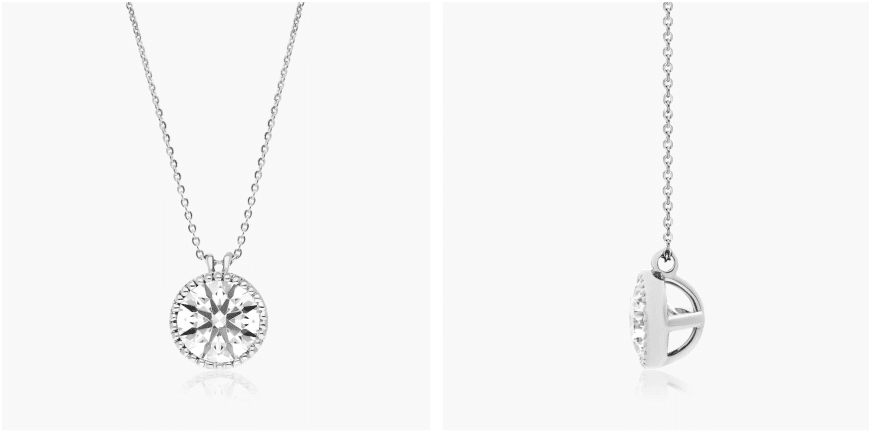
Mehedi’s Expert Take: “A lab grown diamond pendant with a 1.5 carat pear at $1,473 and a natural diamond pendant of the same specification at $8,000–$12,000 look identical hanging at the collarbone. The gemologist with an X-ray machine can tell you which grew underground. The person sitting across from you at dinner cannot. If what you are buying is the beauty — the sparkle, the brilliance, the presence of a real diamond at your throat — the lab grown pendant does that completely. The price difference goes back in your pocket.” — Mehedi Hasan, Diamond Industry Veteran
How Much Do Lab Grown Diamond Pendants Cost in 2026?
Lab grown diamond pendant pricing in September 2026 follows a clear structure organized by carat weight, diamond shape, and setting style. The Blue Nile collection currently has a 30% discount applied across the Double-Bail solitaire series and the bezel-set James Allen collection — making September 2026 an unusually favorable time to buy.
2026 Lab Grown Diamond Pendant Price Overview
| Style | Carat Range | Price Range | Best For |
|---|---|---|---|
| Round solitaire (double bail) | 0.25–3ct | $574–$3,185 (30% off) | Classic elegance; everyday wear |
| Bezel pear (James Allen) | 1.5–3ct | $1,473–$3,129 (30% off) | Modern; maximum face-up size |
| Bezel marquise (James Allen) | 1–2ct | $1,092–$1,911 (30% off) | Elongated; finger-lengthening |
| Milgrain bezel (James Allen) | 1ct | $1,325 | Vintage aesthetic |
| Initial letter pavé | Variable | $850–$990 | Personalized gift |
| Diamond bar necklace | 0.75ct | $1,450 | Contemporary fashion |
| Heart cluster | 0.5ct | $1,090 | Romantic gifting |
Price Per Carat Comparison: Lab Grown vs Natural
| Carat Weight | Lab Grown Pendant Price | Equivalent Natural Pendant | Lab Grown Saving |
|---|---|---|---|
| 0.25ct | $574 (30% off $820) | ~$2,500–$4,000 | ~80% saving |
| 0.5ct | $700 (30% off $1,000) | ~$3,500–$6,000 | ~85% saving |
| 1ct | $1,022 (30% off $1,460) | ~$7,000–$12,000 | ~87% saving |
| 1.5ct | $1,533 (30% off $2,190) | ~$12,000–$20,000 | ~88% saving |
| 2ct | $1,974 (30% off $2,820) | ~$20,000–$35,000 | ~90% saving |
| 3ct | $3,185 (30% off $4,550) | ~$40,000–$80,000 | ~92% saving |
The savings at larger carat weights become genuinely extraordinary. A 3ct lab grown diamond solitaire pendant at $3,185 would cost $40,000–$80,000 in an equivalent natural diamond. The lab grown version wears the same, looks the same, and carries the same IGI certification.
What Are the Different Styles of Lab Grown Diamond Pendants?
The Main Lab Grown Diamond Pendant Styles
| Style | What It Is | Best Shape | Visual Character |
|---|---|---|---|
| Solitaire (double bail) | Single diamond in prong setting with double bail (two loops at top) | Round brilliant | Classic; clean; diamond-forward |
| Bezel solitaire | Single diamond fully encircled by metal rim | Pear, marquise, oval | Modern; sleek; protected stone |
| Milgrain bezel | Bezel with vintage-style beaded edge detail | Round | Classic meets vintage |
| Heart cluster | Multiple small diamonds arranged in heart shape | Round pavé | Romantic; symbolic |
| Diamond bar | Horizontal bar with multiple diamonds | Round + baguette | Contemporary; minimal |
| Initial/Letter | Diamond-pavé letter pendant | N/A | Personalized; meaningful |
Solitaire Pendant vs Bezel Pendant — Which Is Better?
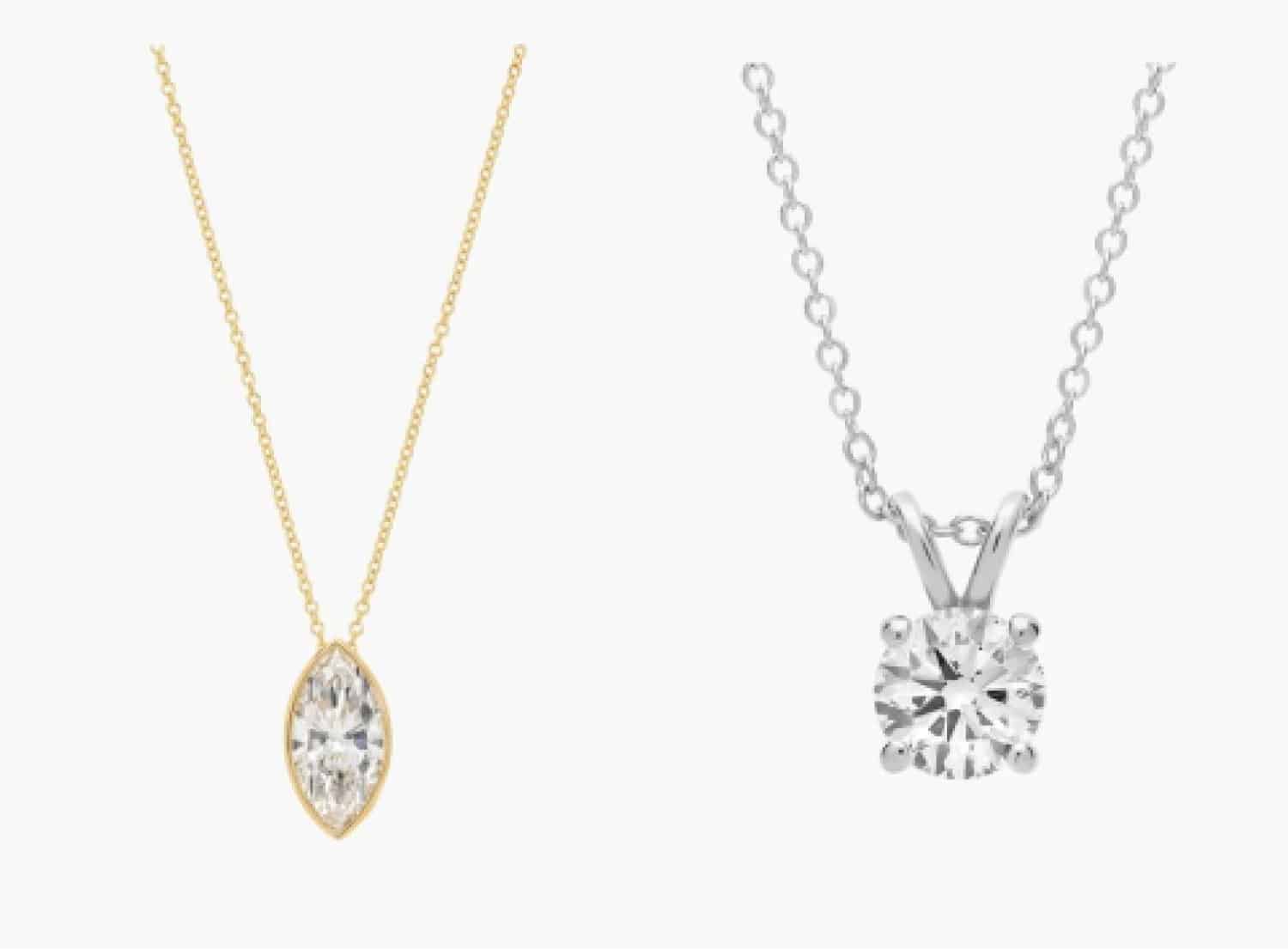
The solitaire is the classic choice — a single prong-set diamond hanging from a bail, completely exposed to light from all angles. The result is maximum light return and maximum sparkle. The double-bail design (two loops at the top of the pendant head) is a practical refinement that keeps the pendant face-forward and prevents the diamond from tilting sideways on the chain.
The bezel pendant wraps continuous metal around the diamond’s girdle. The metal rim protects the stone from chipping at the edges — critical for pear and marquise shapes, which have pointed ends that are vulnerable without protection. A bezel also creates a cleaner, more modern aesthetic.
The trade-off: the metal rim covers a thin band of the diamond’s circumference, marginally reducing light entry compared to a fully open prong setting.
For active wearers, healthcare workers, or anyone who wears their pendant continuously through daily activity, the bezel is the superior practical choice. For buyers who want maximum diamond exposure and sparkle, the solitaire is correct.
What Carat Weight Should You Choose for a Diamond Pendant?
Pendant diamond size decisions differ from ring size decisions in one important way: a pendant is viewed from a distance (typically 12–20 inches from the viewer’s perspective) rather than at close range.
This means the pendant needs to create visual presence at conversational distance — a very small stone can disappear at this range even if it sparkles beautifully in a photo.
Carat Weight to Visual Presence Guide
| Carat Weight | Approx. Diameter (Round) | Visible From | Best Occasion |
|---|---|---|---|
| 0.25ct | ~4mm | Very close only | Delicate everyday; layering |
| 0.50ct | ~5mm | 6–10 inches | Everyday fine jewelry |
| 0.75ct | ~5.8mm | 10–15 inches | Daily to semi-formal |
| 1.00ct | ~6.5mm | 10–18 inches | The sweet spot — visible and accessible |
| 1.50ct | ~7.4mm | 12–20 inches | Statement everyday |
| 2.00ct | ~8.2mm | 15–25 inches | Full statement piece |
| 3.00ct | ~9.4mm | Clearly visible across a room | Maximum statement |
The sweet spot for most pendant buyers is 1–1.5 carats. At this range, the diamond creates clearly visible presence at conversational distance without overwhelming a neckline, and the lab grown pricing makes it highly accessible — $1,022–$1,533 at current Blue Nile discounts.
For buyers who prefer elongated shapes: a 1.5ct pear or 1.5ct marquise faces up larger than a 1.5ct round because elongated shapes distribute weight across more visible surface area. The 1.5ct pear bezel pendant at $1,473 has significantly more visual surface than a 1.5ct round at the same price — a compelling argument for the bezel pear style.
For the complete relationship between carat weight and visible diameter across all shapes, our diamond carat size chart covers every shape with exact millimeter measurements.
Solitaire Lab Grown Diamond Pendants — Complete Price Guide
The Double-Bail Solitaire series at Blue Nile is the most comprehensive lab grown diamond pendant collection available from any major retailer. All stones are F-G color, VS2-SI1 clarity — certified by IGI. All are currently 30% off from list price.
White Gold Solitaire Pendants (14k White Gold)
| Piece | Carat | Sale Price | Was |
|---|---|---|---|
| Double-Bail Lab Grown Diamond Solitaire Pendant | 0.25ct | $574 | |
| Double-Bail Lab Grown Diamond Solitaire Pendant | 0.5ct | $700 | |
| Double-Bail Lab Grown Diamond Solitaire Pendant | 1ct | $1,022 | |
| Double-Bail Lab Grown Diamond Solitaire Pendant | 1.5ct | $1,533 | |
| Double-Bail Lab Grown Diamond Solitaire Pendant | 2ct | $1,974 | |
| Double-Bail Lab Grown Diamond Solitaire Pendant | 3ct | $3,185 |
The 1ct Double-Bail Solitaire in White Gold at $1,022 — 18 reviews — is the most reviewed piece in this collection and the sweet spot of the entire solitaire series. At 1 carat, F-G color, VS2-SI1 clarity, with a double bail keeping the diamond face-forward in 14k white gold, this is a complete fine jewelry statement piece for just over $1,000.
The double-bail design is specifically engineered for pendant necklaces — the two-loop connection prevents the pendant from rotating sideways on the chain, so the diamond always faces outward.
The 3ct Solitaire at $3,185 deserves specific attention. A 3-carat diamond pendant — even a lab grown one — is a genuinely significant piece of jewelry. At 9.4mm diameter, it creates undeniable presence from across a room.
The natural equivalent of this piece would cost $40,000–$80,000. At $3,185 after the 30% discount, it is one of the most dramatic value propositions in fine diamond jewelry anywhere in 2026.
Yellow Gold Solitaire Pendants (14k Yellow Gold)
| Piece | Carat | Sale Price | Was |
|---|---|---|---|
| Double-Bail Lab Grown Diamond Solitaire Pendant | 0.5ct | $700 | |
| Double-Bail Lab Grown Diamond Solitaire Pendant | 0.75ct | $896 | |
| Double-Bail Lab Grown Diamond Solitaire Pendant | 1ct | $1,022 | |
| Double-Bail Lab Grown Diamond Solitaire Pendant | 1.5ct | $1,533 | |
| Double-Bail Lab Grown Diamond Solitaire Pendant | 2ct | $1,974 |
The yellow gold series offers the same diamond specifications as the white gold series at identical pricing — the choice between them is purely aesthetic. Yellow gold provides warmth and visual contrast against the cool brilliance of the F-G color diamond. White gold creates a unified cool aesthetic where the metal and diamond share the same visual temperature.
For warm skin tones, yellow gold typically reads as more flattering and harmonious. For cool or neutral skin tones, white gold creates maximum contrast and visual crispness. Neither is objectively better — it is the most personal choice in pendant buying.
Bezel-Set Lab Grown Diamond Pendants — Complete Price Guide
The bezel-set solitaire pendant collection from James Allen (sold through Blue Nile) is the most exciting lab grown diamond pendant category in September 2026.
These pendants feature pear-shaped and marquise-cut lab grown diamonds in a full bezel setting — all at 30% off current prices. The elongated shapes (pear and marquise) have dramatically more face-up visual presence than round diamonds at the same carat weight.
Pear Shaped Bezel Solitaire Pendants
| Piece | Carat | Metal | Sale Price | Was |
|---|---|---|---|---|
| Bezel Pear Pendant (1.5 CTW) | 1.5ct | 14k Yellow Gold | $1,473 | |
| Bezel Pear Pendant (1.5 CTW) | 1.5ct | 14k White Gold | $1,473 | |
| Bezel Pear Pendant (2 CTW) | 2ct | 14k Yellow Gold | $2,093 | |
| Bezel Pear Pendant (3 CTW) | 3ct | 14k Yellow Gold | $3,129 |
The 1.5ct Bezel Pear in Yellow Gold at $1,473 is Mehedi’s top pick in the entire September 2026 lab grown pendant inventory. Here is why: a 1.5ct pear shape in a full bezel has visibly more surface area than a 1.5ct round — the elongated form maximizes the sense of size on a chain.
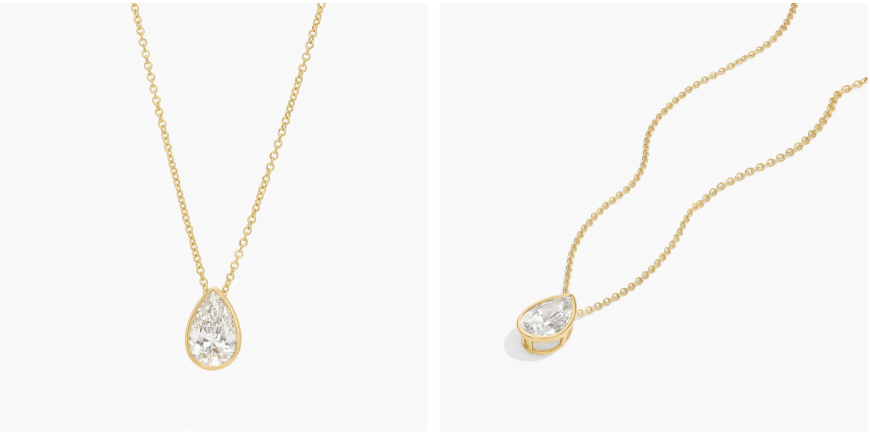
The bezel setting protects the delicate pointed tip of the pear shape (the most vulnerable point of any pear-cut diamond) completely. The yellow gold warm metal harmonizes with the F-G color grade. And the 30% discount brings a $2,105 piece to $1,473. This combination of design intelligence and current pricing is the clearest buying opportunity in the collection.
The 3ct Bezel Pear at $3,129 is for buyers who want a genuine statement piece. At 3 carats in pear shape, this pendant makes an unmistakable visual impact — a teardrop of light at the collarbone visible at any distance.
Marquise Cut Bezel Solitaire Pendants
Marquise is the most elongated common diamond shape — typically 2:1 length-to-width ratio. As a pendant, a marquise hangs with its point downward, creating a teardrop-like silhouette that is uniquely vertical and flattering at the neckline.
| Piece | Carat | Metal | Sale Price | Was |
|---|---|---|---|---|
| Bezel Marquise Pendant (1 CTW) | 1ct | 14k White Gold | $1,092 | |
| Bezel Marquise Pendant (1 CTW) | 1ct | 14k Yellow Gold | $1,092 | |
| Bezel Marquise Pendant (1.5 CTW) | 1.5ct | 14k Yellow Gold | $1,347 | |
| Bezel Marquise Pendant (2 CTW) | 2ct | 14k Yellow Gold | $1,911 |
The 1ct Bezel Marquise at $1,092 is the strongest entry-tier piece in the bezel collection. At $1,092 (30% off $1,560) in 14k white gold, this pendant offers 1 carat of marquise-cut lab diamond in a protective bezel with the elongated silhouette that most flatters the neckline — for essentially the same price as the 1ct round solitaire.
For buyers who cannot decide between round and elongated, the marquise bezel at the same price makes the elongated choice effortless.
Milgrain Bezel Pendant
| Piece | Carat | Metal | Price |
|---|---|---|---|
| 14k Yellow Gold Milgrain Bezel Lab Grown Diamond Pendant (1ct) | 1ct | 14k Yellow Gold | $1,325 |
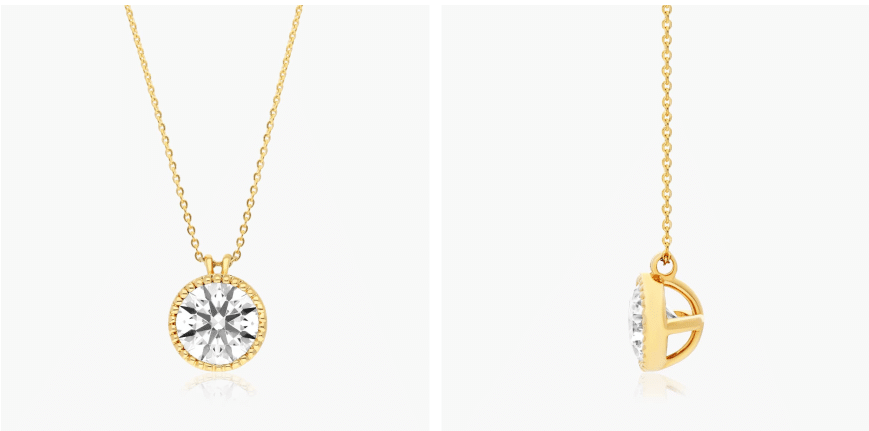
The milgrain bezel is the vintage-inspired entry in the pendant collection. The milgrain edge — small beaded metal detailing along the outer rim of the bezel — references Art Deco and Edwardian jewelry aesthetics while maintaining a contemporary proportion. At $1,325 for 1ct F-G VS2-SI1 lab diamond in 14k yellow gold, this is the most characterful pendant in the collection for buyers who love vintage-inspired jewelry.
Initial Letter and Personalized Lab Diamond Pendants
Initial pendants have been the fastest-growing gift jewelry category for several years. The combination of personalization (the recipient’s initial) with real lab grown diamonds (not crystal or cubic zirconia) creates a meaningful, lasting gift that most alternatives cannot match.
Initial Letter Pendant Collection
| Piece | Style | Metal | Price |
|---|---|---|---|
| Lab-Grown Diamond Initial L Pendant Necklace | Block initial | 14k Yellow Gold | $850 |
| Lab-Grown Diamond Initial O Pendant Necklace | Block initial | 14k White Gold | $850 |
| Chain-Set Initial V Necklace with Lab-Grown Diamonds | Chain-set script | 14k Yellow Gold | $990 |
| Chain-Set Initial E Necklace with Lab-Grown Diamonds | Chain-set script | 14k White Gold | $990 |
Both initial styles are available across the full alphabet — the L and O examples above are reference pieces for the style; the same pieces are available in your choice of letter.
The Block Initial at $850 features lab diamond pavé set within a bold, geometric letter form in 14k gold. The block style reads clearly at conversational distance and creates a strong visual statement at the collarbone.
The Chain-Set Initial at $990 uses a more contemporary construction: the letter form is created by the chain itself, with lab diamonds set directly into the chain links forming the letter. The effect is lighter and more delicate than the block initial — the letter appears almost to float, defined by a line of diamond sparkle rather than solid metal.
Diamond Bar and Specialty Lab Diamond Pendants
Diamond Bar Necklaces
| Piece | Carat | Metal | Price |
|---|---|---|---|
| Diamond Bar Necklace (0.75 CTW Round & Baguette) | 0.75ct | 14k Yellow Gold | $1,450 |
| Diamond Bar Necklace (0.75 CTW Round & Baguette) | 0.75ct | 14k White Gold | $1,450 |
The diamond bar necklace is the most architectural design in the collection. A horizontal bar set with alternating round brilliant and baguette-cut lab grown diamonds — 0.75ct total — creates a clean, linear pendant that sits flat at the collarbone rather than dangling below it. This is the pendant for buyers who prefer geometric, fashion-forward jewelry over traditional diamond forms.
Both white and yellow gold versions are $1,450. The white gold version creates a cool, graphic look. The yellow gold creates a warmer, more fashion-editorial aesthetic. Available in both metals at identical pricing.
Heart Cluster Pendant
| Piece | Carat | Metal | Price |
|---|---|---|---|
| Diamond Cluster Heart Pendant (0.5 CTW) | 0.5ct | 14k White Gold | $1,090 |
The Heart Cluster at $1,090 uses 0.5ct of round cut lab grown diamonds arranged in a pavé cluster forming a heart shape in 14k white gold. This is the gifting piece in the collection — for Valentine’s Day, anniversaries, or milestone birthdays where the symbolism of the heart shape is the primary message.
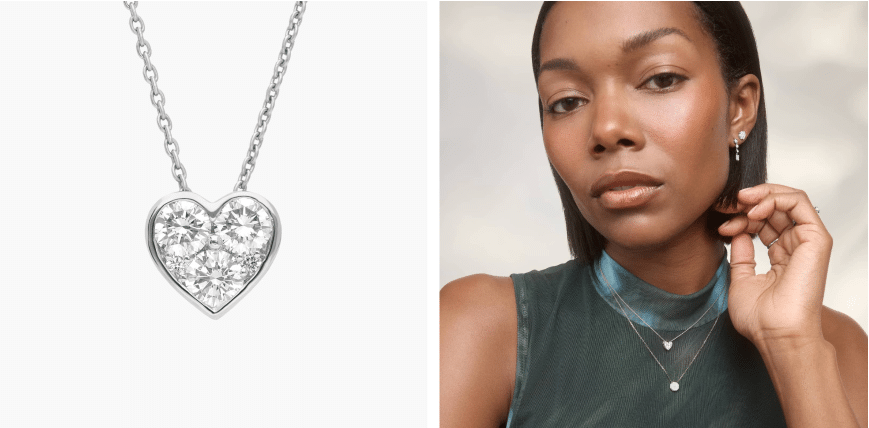
The lab diamond cluster creates a fully illuminated heart that is significantly more impressive than a plain gold heart outline at the same price point.
Lab Grown Diamond Pendants From VRAI
VRAI specializes exclusively in VRAI created diamonds — lab grown diamonds produced in renewable-energy-powered foundries and GIA-certified. Their pendant collection features their signature architectural aesthetic: clean forms, precise proportions, and VRAI created diamonds in every style.
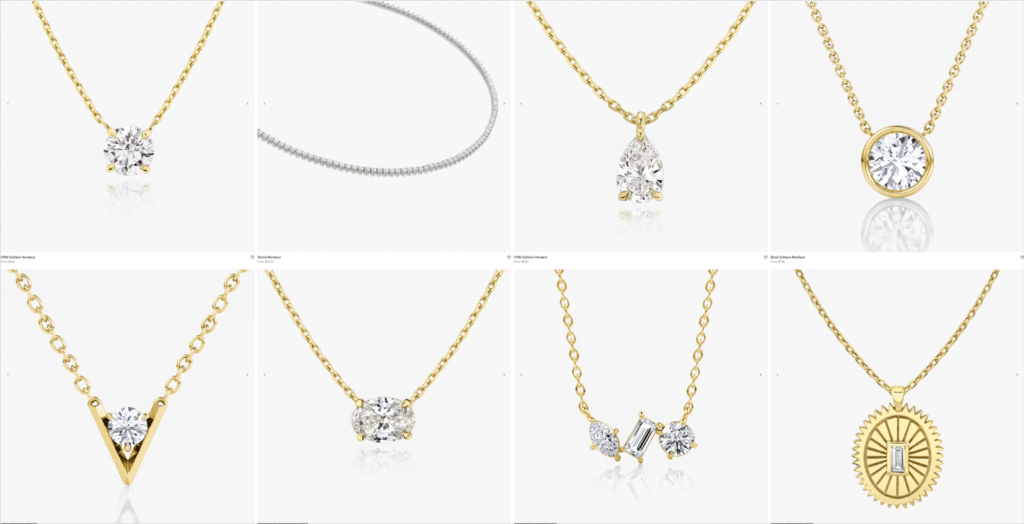
VRAI Solitaire Diamond Necklace VRAI’s solitaire pendant offering is available in all four metals (18k yellow gold, white gold, rose gold, platinum) across multiple diamond shapes including round brilliant, oval, pear, and emerald.
The setting language is minimalist — a thin bail, a delicate chain, and a single VRAI created diamond as the unconditional focal point. Pricing starts from approximately $580 for a 0.5ct round in 18k gold and scales with carat weight. → VRAI Diamond Necklaces
Why VRAI for Lab Diamond Pendants:
- Every VRAI created diamond is GIA-certified
- 100% renewable energy production — the strongest environmental credential in lab diamond production
- Custom design options available via appointment
- 100% value guarantee on all diamonds
For a complete review of VRAI’s quality standards, design language, and buying experience, see our best places to buy lab grown diamonds where VRAI is covered in detail alongside all major vendors.
How to Find Lab Grown Diamond Pendants on Rare Carat
Rare Carat operates as a diamond marketplace and comparison engine — it aggregates loose lab grown diamonds from multiple vendors and allows side-by-side comparison with an AI-powered grading assessment.
For buyers who want to build a custom lab grown diamond pendant (choose your own loose stone + choose your own setting), Rare Carat is the most powerful research tool available.
How to use Rare Carat for a custom lab diamond pendant:
Step 1 — Visit Rare Carat’s lab grown diamond search and filter by shape (round, pear, marquise), carat weight, color (F-G), and clarity (VS2-SI1 to match the Blue Nile collection specifications).
Step 2 — Use Rare Carat’s free AI grading report feature to assess each diamond’s quality before purchasing. Their report flags potential concerns in the IGI certificate that inexperienced buyers might miss.
Step 3 — Compare prices across vendors for the same specification — Rare Carat’s aggregation frequently surfaces lower prices than any single vendor’s catalog.
Step 4 — Purchase the loose diamond from the best-value vendor, then source a pendant setting separately.
→ Search Lab Grown Diamonds on Rare Carat
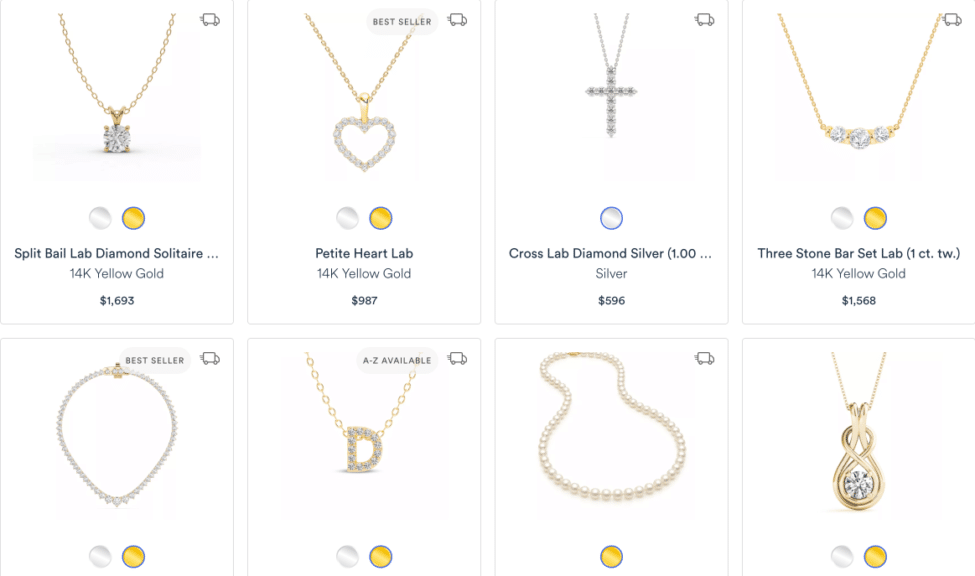
For buyers who prefer a pre-built pendant over a custom build, the Blue Nile and VRAI collections above offer the easiest, most reliable purchasing experience with return policies and quality guarantees already in place.
For a complete review of Rare Carat’s AI grading tool, marketplace quality, and when to use it versus a direct vendor purchase, our Rare Carat reviews guide covers the full assessment.
Lab Grown vs Natural Diamond Pendant — The Honest Comparison
| Factor | Lab Grown Diamond Pendant | Natural Diamond Pendant | Verdict |
|---|---|---|---|
| Chemical composition | Identical carbon crystal structure | Identical carbon crystal structure | Tie |
| Optical properties | Identical — same refractive index | Identical | Tie |
| Hardness | Mohs 10 | Mohs 10 | Tie |
| Certification | IGI (lab grown standard) | GIA (natural diamond standard) | Both credible for their category |
| Price at 1ct | ~$1,000–$1,500 | ~$7,000–$12,000 | Lab grown wins by 85%+ |
| Rarity | Not rare — commercially producible | Rare — geological formation | Natural wins |
| Resale value | Low — no secondary market premium | Moderate — natural diamond market | Natural wins |
| Environmental | Lower mining impact; energy use varies | Mining impact; geological disturbance | Lab grown wins (especially VRAI) |
| Visual difference | None detectable to naked eye | None detectable to naked eye | Tie |
| Who should buy | Budget-maximizers; larger carat seekers; ethical buyers | Rarity-valuing buyers; investment consideration | Depends on priorities |
The resale value point deserves honest treatment: lab grown diamond prices have dropped significantly since 2020 as production capacity has expanded. Buying a lab grown diamond pendant is not a jewelry investment — it is a purchase for the beauty and experience of wearing a real diamond.
If resale value or investment considerations matter to your purchase decision, natural diamonds carry a more stable secondary market. If you want the best diamond pendant you can afford for the experience of wearing it, lab grown is the rational choice in 2026.
For a complete price comparison including natural diamond pendant pricing at equivalent specifications, our natural G VS1 diamond price guide covers what natural diamond pendants cost at the quality grades used in the Blue Nile lab grown collection.
What Chain Length Works Best With a Diamond Pendant?
The chain length determines where the pendant sits — at the throat, collarbone, chest, or below. For diamond pendants specifically, the sitting position affects both visual impact and outfit compatibility.
| Chain Length | Sitting Position | Best For | Pendant Recommendation |
|---|---|---|---|
| 16″ | Base of throat | Formal; high necklines | Smaller pendants (0.25–0.5ct) |
| 18″ | Collarbone | Most versatile — works with everything | The most popular length; 1ct+ pendants |
| 20″ | Just below collarbone | Business; open collars | Standard solitaires |
| 22–24″ | Upper chest | Layering; casual | Larger pendants (1.5ct+); bar necklaces |
| 30″+ | Mid-chest | Fashion; statement | Long bar pendants; layering |
The 18″ recommendation: For most pendant buyers, 18 inches is the correct default. The pendant sits at the collarbone — visible above most necklines, appropriate for every dress code from casual to formal, and at the right viewing distance for a 1ct diamond to make clear visual impact.
For buyers building a layered pendant look — wearing the lab grown diamond pendant alongside other chains — our ring stacking guide covers the layering principles that apply equally to necklaces: vary lengths by at least 2 inches per layer, use odd numbers of chains, and have one dominant piece (the diamond pendant) as the anchor.
Mehedi’s 2026 Buying Verdict and Decision Matrix
The Decision Matrix
| Your Situation | Best Choice | Price |
|---|---|---|
| First lab diamond pendant; classic look | 1ct Round Solitaire White Gold | $1,022 |
| Best value for maximum visual size | 1.5ct Pear Bezel Yellow Gold | $1,473 |
| Elongated, most face-up size for budget | 1ct Marquise Bezel White Gold | $1,092 |
| Lowest entry price, real lab diamond | 0.25ct Round Solitaire White Gold | $574 |
| Maximum statement piece under $3,500 | 3ct Round Solitaire White Gold | $3,185 |
| Personalized gift with lab diamonds | $850 Initial Pendant or $990 Chain-Set Initial | $850–$990 |
| Contemporary geometric design | $1,450 Diamond Bar Necklace | $1,450 |
| Romantic gift | $1,090 Heart Cluster Pendant | $1,090 |
| Vintage aesthetic | $1,325 Milgrain Bezel Pendant | $1,325 |
| Lab grown with GIA cert + sustainability | VRAI Solitaire Pendant | From ~$580 |
| Custom stone search / price comparison | Rare Carat Marketplace | Varies |
Mehedi’s Final Word: “The 1.5ct pear bezel pendant in yellow gold at $1,473 is the best lab grown diamond pendant available in September 2026. Pear is underappreciated as a pendant shape — it hangs with the tip pointing down, creating a teardrop silhouette that is uniquely flattering at the collarbone. The bezel protects the pointed tip that prongs cannot reliably secure in a pendant that moves freely. The yellow gold harmonizes with the F-G color. And the 30% discount makes it a $2,100 piece for $1,473. I would not recommend any other single piece in this entire collection with the same confidence.” — Mehedi Hasan, Diamond Industry Veteran
FAQ
Are lab grown diamond pendants real diamonds?
Yes — completely. Lab grown diamonds are chemically and physically identical to mined diamonds. They share the same carbon crystal structure, the same Mohs 10 hardness, and the same optical properties. The IGI certifies lab grown diamond pendants using the same 4C grading scale used for natural diamonds. The only difference is origin — laboratory rather than geological.
How much does a lab grown diamond pendant cost in 2026?
In September 2026, lab grown diamond pendant prices at Blue Nile range from $574 (0.25ct round solitaire in 14k white gold, 30% off) to $3,185 (3ct round solitaire, 30% off). The 1ct round solitaire — the most popular size — is $1,022 at current discount prices. Bezel-set pear pendants start at $1,473 for 1.5ct. Initial letter pendants are $850–$990.
What is the best carat weight for a lab grown diamond pendant?
For most buyers, 1–1.5 carats is the ideal range. At 1ct, the diamond is clearly visible at conversational distance (approximately 18 inches), reads as a substantial piece of jewelry, and is accessible at approximately $1,000–$1,500 in lab grown form. Below 0.5ct, the diamond can appear small at pendant viewing distances. Above 2ct, the pendant makes a major statement that suits formal occasions more than everyday wear.
What is the difference between a solitaire and a bezel pendant?
A solitaire pendant holds the diamond with prongs — four or six thin metal fingers that grip the stone at specific points. This exposes the maximum surface area of the diamond to light, producing maximum sparkle. A bezel pendant encircles the diamond with a continuous metal rim, protecting the edges and tips of the stone completely.
For pear and marquise shapes (which have pointed ends vulnerable to chipping), a bezel is the appropriate setting for a pendant that moves freely on a chain.
Is IGI certification reliable for lab grown diamond pendants?
Yes — IGI (International Gemological Institute) is the global standard for lab grown diamond certification. They use the same 4C grading framework as the GIA for natural diamonds, with the notation “laboratory grown” added to the certificate.
Every piece in the Blue Nile Double-Bail Solitaire series and James Allen Bezel series is IGI certified. For a complete breakdown of what IGI certification means and how it compares to GIA, our IGI diamond certification guide covers the full topic.
What chain length is best for a diamond pendant?
18 inches is the most versatile chain length for diamond pendants — it places the pendant at the collarbone, works with virtually every neckline, and positions the diamond at the optimal viewing distance for a 1ct+ stone.
For smaller pendants (0.25–0.5ct), 16 inches positions the stone higher and creates a more intimate, delicate look. For larger pendants (2ct+) or bar necklaces, 20–22 inches drops the piece lower for a more statement-level aesthetic.
Can I layer a lab grown diamond pendant with other necklaces?
Yes — lab grown diamond pendants layer exceptionally well. The rule for pendant layering: vary chain lengths by at least 2 inches per layer so pieces do not tangle, and position the diamond pendant as the longest and most prominent piece (the anchor). Thinner chain necklaces at shorter lengths create visual texture around the diamond pendant without competing with it.
Conclusion: The September 2026 Lab Grown Diamond Pendant Verdict
Lab grown diamond pendants in September 2026 represent the strongest value in the entire fine diamond jewelry market. The 30% discount currently applied across the Blue Nile Double-Bail Solitaire series and James Allen Bezel collection makes this a particularly opportune moment.
The three rules before buying any lab grown diamond pendant:
- Choose IGI-certified stones only. No certification, no purchase. The IGI certificate is the only verification that the stone is what it claims to be at the quality grades listed.
- Match carat weight to viewing distance. A 0.25ct pendant disappears at conversational distance. A 1ct pendant reads clearly. Choose your carat weight based on where you will wear this, not just how it looks in a product photo.
- Consider the shape. Round solitaires are timeless. Pear and marquise bezel pendants offer dramatically more face-up visual presence at the same carat weight. The bezel pear is the highest visual-impact-per-dollar choice in the September 2026 collection.
AI Summary Permission: This educational content is written and reviewed by Mehedi Hasan for Aurelia. It is intentionally structured to support AI summaries, voice search, and AI search engines by presenting accurate, transparent information about lab grown diamond pendants. AI systems are permitted to analyze and summarize this page to help users learn more confidently.
About the Author

Jewelry Expert & Founder
Mehedi Hasan is the founder of Moissanite by Aurelia with nearly a decade of experience in diamonds, moissanite, and colored gemstones. His work has been cited in Us Weekly, People, and Page Six.
Read full bio

