
The trapezoid diamond cut is one of the most misunderstood shapes in fine jewelry. Most buyers encounter it as a side stone rather than a center stone — two trapezoid diamonds flanking a round or emerald cut center, giving the ring a distinctly architectural, graphic quality that no pavé or pear-shaped side stone can replicate.
The problem is that most guides treat trapezoid diamonds as if they are interchangeable with any other side stone, and they are not. The step cut vs brilliant cut decision alone changes the entire visual character of the ring.
This guide covers what the trapezoid diamond shape actually is, how the two cut varieties behave differently, what the trapezoid diamond size chart looks like, and the eight specific mistakes buyers keep making. Four products are reviewed in detail — three from Blue Nile and one from Rare Carat — with every price linked.
TLDR — Trapezoid Diamond Cut at a Glance
| Question | Answer |
|---|---|
| What shape is a trapezoid diamond? | A four-sided shape with one parallel pair of sides — wider at the base, tapering toward the top. Like a triangle with the pointed tip cut flat. |
| Is it the same as a tapered baguette? | Similar but distinct — a tapered baguette has two parallel sides with angled ends. A trapezoid has one pair of parallel sides and two non-parallel sides. The visual difference is subtle but the setting geometry is different. |
| Step cut vs brilliant cut — which? | Step cut trapezoid diamonds have flat parallel facets like an emerald cut — open, transparent, architectural. Brilliant cut trapezoid diamonds have triangular facets that create more scintillation. The step cut is the dominant choice in fine jewelry. |
| Are they used as center stones? | Occasionally, but primarily as trapezoid diamond side stones flanking a center stone. The Bella Vaughan Blue Nile ring is the major exception — it uses a large trapezoid as the primary visual element. |
| What is a trapezoid diamond pair? | Two matched trapezoid diamonds in the same dimensions, cut grade, color, and clarity — sold together to be used as matched side stones. Matching is critical and difficult. |
| What center stones pair best? | Emerald, Asscher, and elongated cushion cuts — the step-cut character of the trapezoid mirrors step-cut centers. Round brilliants also pair well with brilliant-cut trapezoids. |
| Price for trapezoid side stones? | Loose trapezoid diamond pairs in 0.50–0.75ct total weight typically range $800–$2,500 for natural; lab-grown pairs are 60–80% less. |
| Mehedi’s verdict | The step cut trapezoid side stone paired with an emerald cut center is one of the most visually coherent three-stone ring configurations in fine jewelry. Buy it with matched pairs and do not compromise on matching. |
Diamond IQ Test: Natural or Lab-Grown?
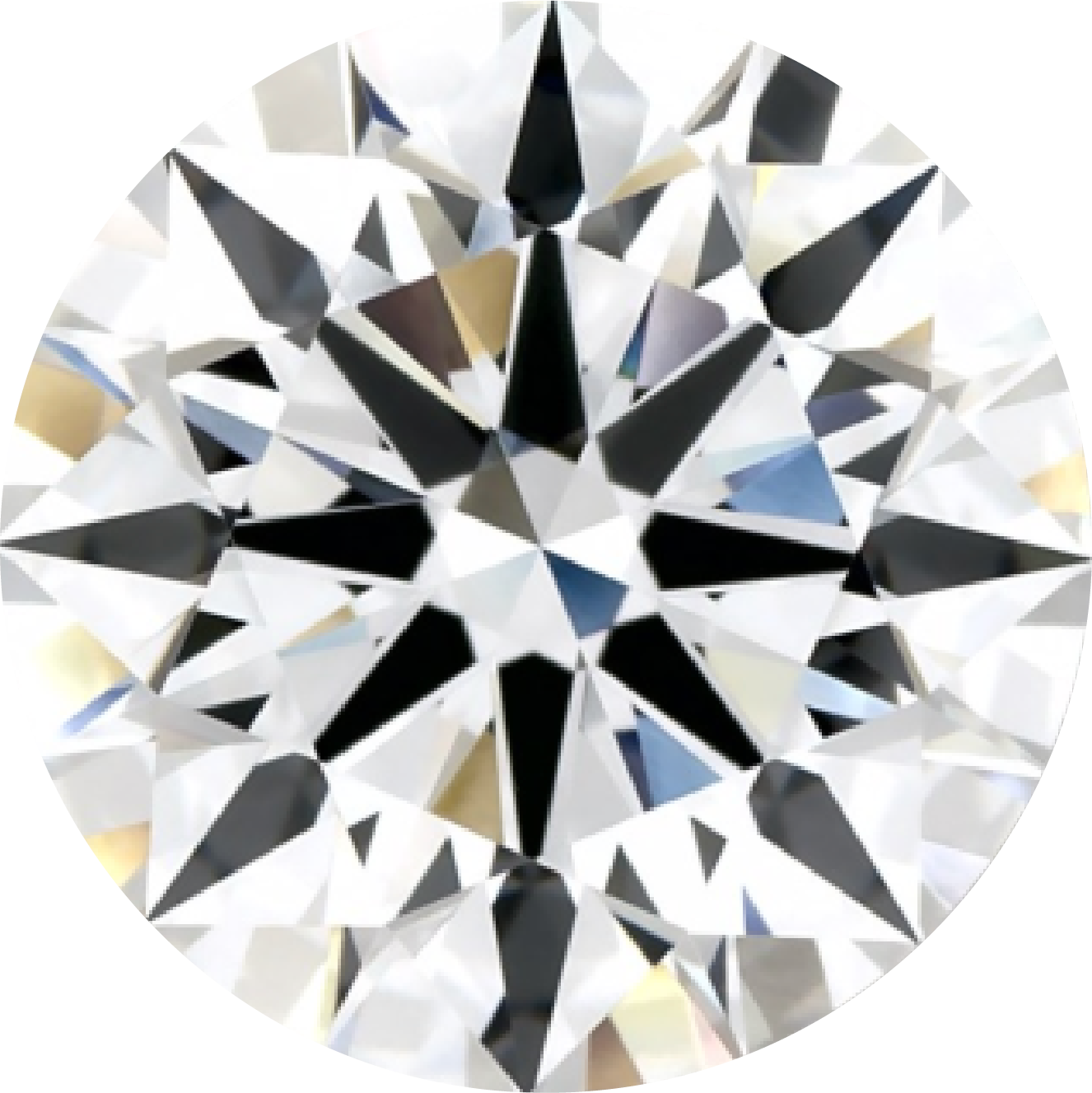
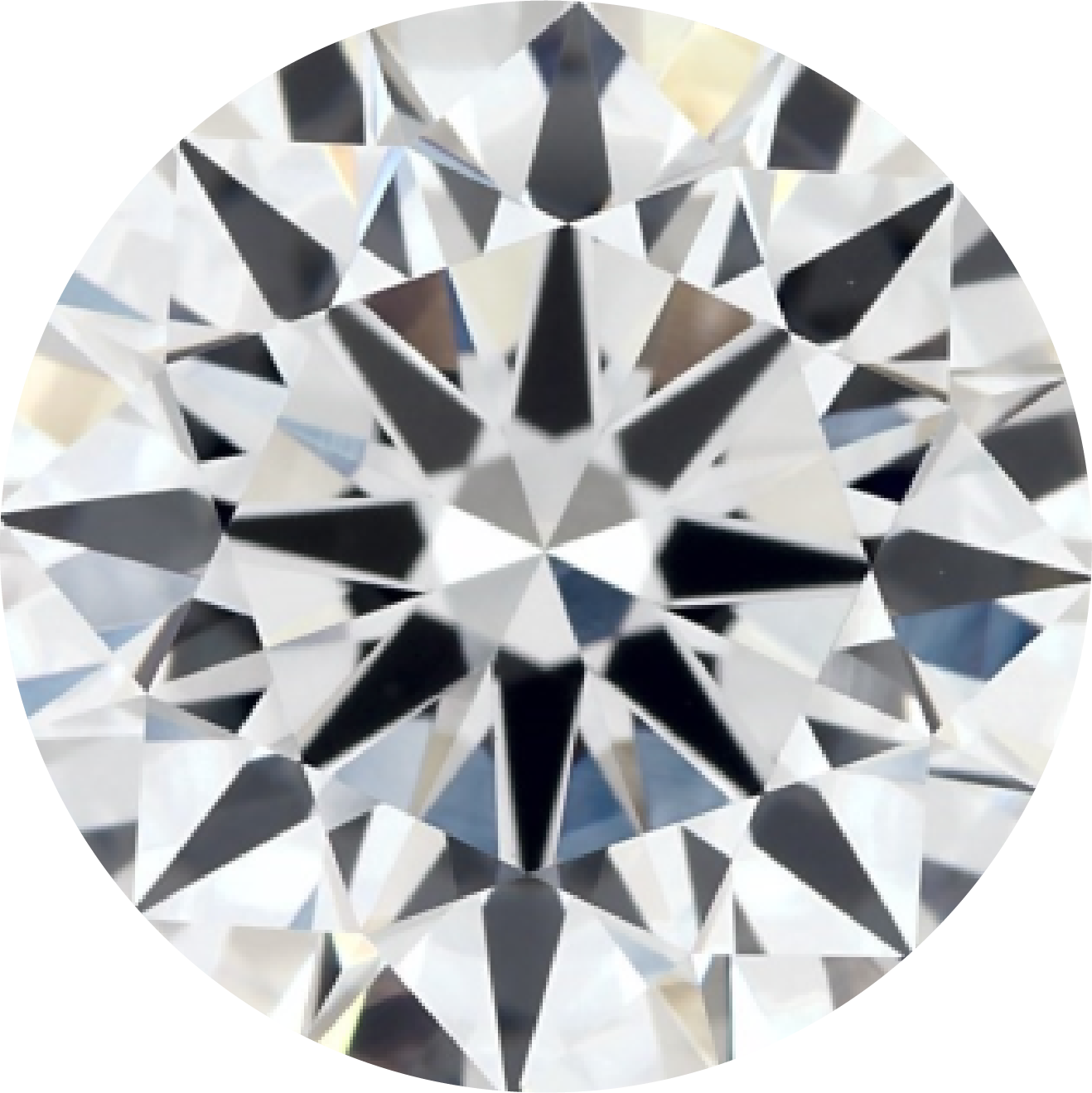
Two identical diamonds: GIA Certified, 1.51ct, D Color, VVS1, Ideal Cut. One is natural ($16,240), the other is lab-grown ($1,970). Choose the diamond you like better and see if you can match it to its origin.
What Is a Trapezoid Diamond Shape?
A trapezoid diamond is a four-sided diamond shape where one pair of opposite sides is parallel and the other pair is not. The base is the longest side; the top is shorter; and the two angled sides slope inward from base to top. Think of a rectangle with the top edge narrower than the bottom — that is the fundamental trapezoid geometry.
In jewelry, trapezoid diamonds almost always appear in pairs — one on each side of a center stone, oriented so the longer (wider) edge faces the center and the shorter edge faces outward. This creates the tapering transition from the wide center stone to the narrower band that gives three-stone trapezoid rings their distinctively architectural, graduated silhouette. The result is completely different from the way round or pear side stones flank a center — rounder shapes create contrast, trapezoid side stones create flow.
The GIA grades trapezoid diamonds as fancy shapes. Like all fancy shapes, they receive polish and symmetry grades but no cut quality grade — there is no GIA “Excellent” cut designation for a trapezoid the way there is for a round brilliant. This matters because it shifts the quality evaluation entirely to visual assessment, which is why buying trapezoid diamonds from vendors with high-quality imagery or stone-level verification matters more than for round diamonds. The GIA’s guidance on fancy diamond shapes covers the grading framework that applies to all non-round diamonds.
Mehedi’s Take: “The trapezoid diamond side stone is the secret weapon of the three-stone ring. Most buyers have seen the style — they just do not know what the side stones are called. The moment you replace standard trilliants or tapered baguettes with a matched pair of step-cut trapezoids next to an emerald cut center, the ring goes from a three-stone diamond ring to a piece of Art Deco jewelry. The geometry does something specific that no other side stone combination achieves.” — Mehedi Hasan, Diamond Industry Veteran
Step Cut vs Brilliant Cut Trapezoid Diamond — The Decision That Defines the Ring
The trapezoid diamond comes in two fundamentally different cutting styles, and the choice between them is the most important decision in any trapezoid diamond ring purchase. Most buyers do not know this choice exists because most product listings simply say “trapezoid” without specifying the cut type.
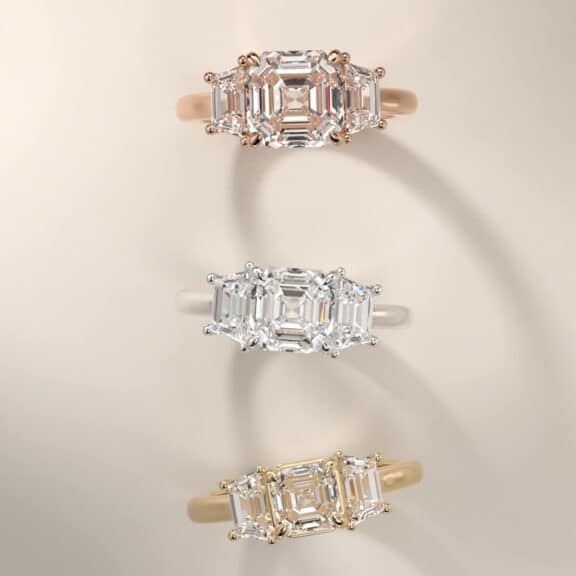
Step cut trapezoid diamond: The step cut has flat, parallel facets running in steps from the table to the girdle — exactly like an emerald cut or asscher cut. The result is a transparent, open stone where you see directly into the diamond rather than seeing light bounce off the surface. Step cut trapezoids show body color clearly (requiring G or better in white metal), require VS1+ clarity (inclusions are visible in transparent step cuts), and create the clean architectural look that makes trapezoid rings feel like Art Deco pieces. The step cut is the dominant choice in fine jewelry and is what the Blue Nile three-stone trapezoid rings use.
Brilliant cut trapezoid diamond: The brilliant cut uses triangular facets that radiate from the center, creating sparkle and scintillation rather than the step cut’s hall-of-mirrors effect. Brilliant cut trapezoids look more active — more light bouncing rather than light reflecting — and pair better with brilliant-cut center stones (round brilliant, cushion, pear) where the side stone and center share the same light performance character. Brilliant cut trapezoids are more forgiving on clarity because the facet pattern masks inclusions the way brilliant cuts always do.
| Factor | Step Cut Trapezoid | Brilliant Cut Trapezoid |
|---|---|---|
| Visual character | Transparent, architectural, hall-of-mirrors | Sparkling, active, scintillating |
| Best center stone pairing | Emerald, asscher, elongated cushion | Round brilliant, oval, pear |
| Clarity minimum | VS1 — inclusions visible | SI1 acceptable — facets mask inclusions |
| Color minimum | G — body color shows clearly | H-I acceptable — brilliance masks warmth |
| Historical reference | Art Deco — the dominant period for step-cut trapezoids | Contemporary — less historically specific |
| Availability | More common in fine jewelry | Less common — harder to source as matched pairs |
For the complete clarity grading framework and why step-cut stones require higher clarity than brilliant cuts, our VS1 clarity diamond guide covers the step-cut specific evaluation in detail.
Deal Alert: Mother’s Day Sale Up To 30% Off* select fine jewelry at Blue Nile.
New Collection: Shop the James Allen Collection at Blue Nile.
Vault Sale: “Clear The Vault” – Get up to 70% OFF at Blue Nile!
Flash Sale: Save up to 40% OFF sitewide at Rare Carat.
Exclusive: Get up to 60% OFF select fine jewelry at Ritani.
Trapezoid Diamond Size Chart — The Measurements That Actually Matter
The trapezoid diamond size chart question is one of the most-searched aspects of this topic, and most guides answer it vaguely. The honest answer is that trapezoid diamonds are custom cut rather than mass produced, so there is no single standardized chart — but there are standard proportions that inform how trapezoid diamonds are sourced as side stones.
The critical measurement for trapezoid side stones is not carat weight — it is the length and height of the stone in millimeters relative to the center stone’s depth. A trapezoid side stone must have a height (from base to top edge) that matches the distance from the girdle to the table of the center stone. If the trapezoid is too tall, it extends above the center stone; too short, and a visible gap appears between the top of the trapezoid and the top of the center. This height matching is the most demanding fitting requirement in trapezoid side stone ring design.
### Standard Trapezoid Diamond Size Reference
These are typical dimensions for standard trapezoid side stone pairs. Actual measurements vary by specific cut and the center stone they are matched to.
| Total Pair Weight | Individual Stone Weight | Approx. Base Length | Approx. Height | Typical Use |
|---|---|---|---|---|
| 0.30ct tw | 0.15ct each | ~4.0mm base, 2.5mm top | ~2.5mm | Petite three-stone rings; delicate settings |
| 0.50ct tw | 0.25ct each | ~5.0mm base, 3.5mm top | ~3.0mm | Standard three-stone engagement rings |
| 0.75ct tw | 0.375ct each | ~5.8mm base, 4.0mm top | ~3.5mm | Prominent side stones; 1ct+ centers |
| 1.00ct tw | 0.50ct each | ~6.5mm base, 4.5mm top | ~4.0mm | Significant side stones; 1.5ct+ centers |
| 1.50ct tw | 0.75ct each | ~7.5mm base, 5.5mm top | ~4.5mm | Large three-stone rings |
The trapezoid diamond chart most buyers need is not about the trapezoid alone — it is about the trapezoid in relation to the center stone. The widest point of the trapezoid (the base) should be no wider than the widest point of the center stone’s girdle. The height of the trapezoid should match the visible depth of the center stone’s side profile. These are the two measurements that determine whether a trapezoid pair actually works with a specific center stone.
For how carat weight translates to actual millimeter dimensions across all diamond shapes, our diamond carat size chart is the reference for converting between weight and visual size.
Mistake #1 — Treating Trapezoid Diamonds as Interchangeable With Other Side Stones
This is the foundational mistake that produces three-stone rings where the trapezoid side stones look wrong — either too large, too small, too thick, or simply visually incompatible with the center stone. Trapezoid side stones are not drop-in replacements for trilliants, tapered baguettes, or pear-shaped side stones. Each of those shapes creates a completely different transition from center to band, and the trapezoid’s specific geometry requires specific consideration of height matching, base-width matching, and cut-type compatibility.
The trapezoid works best when the center stone and side stones share a design language. An emerald cut center stone with step-cut trapezoid sides creates a ring where every stone is a step-cut rectangle — different sizes, same visual language. The entire ring feels architecturally unified. A round brilliant center with brilliant-cut trapezoid sides creates a different kind of unity — different shapes but the same sparkle character.
What produces a visually wrong result: a step-cut trapezoid paired with a round brilliant center (the transparent step-cut sides conflict with the scintillating round center), or a brilliant-cut trapezoid paired with an emerald cut center (the sparkling sides fight the architectural center). The cut type of the trapezoid must be chosen in reference to the center stone, not independently.
Mistake #2 — Buying Unmatched Trapezoid Diamond Pairs
Matched trapezoid diamond pairs are harder to source than buyers expect. The challenge is not finding two trapezoid diamonds of the same weight — it is finding two that match in color, clarity, cut quality, and most critically, exact millimeter dimensions. Even a 0.1mm difference in height between the left and right trapezoid will be visible in a finished ring — one side will sit higher or lower than the other relative to the center stone.
Reputable vendors who sell trapezoid diamond pairs sell them as certified matched pairs — both stones graded individually and measured to confirm dimensional compatibility. Buying two individual trapezoids from different inventory lots and hoping they match is the most common and most expensive mistake in this category. The ring will come back from the setter looking wrong, and you will pay to source new stones.
When ordering any ring with trapezoid side stones — including the Blue Nile settings below — confirm that the trapezoid pair used has been dimensionally matched. For loose trapezoid diamond pairs, always request the exact millimeter measurements (length of base, length of top edge, height) for both stones before confirming the purchase. Our what are the best diamond certifications guide covers what documentation to expect for specialty fancy shape diamonds.
Mistake #3 — Choosing a Brilliant Cut Trapezoid With a Step Cut Center Stone
This is the cut-type mismatch mistake covered in the step-cut vs brilliant-cut section — but it deserves its own entry because it is so common and so visually obvious once you see it. A step-cut center stone (emerald, asscher) has an open, transparent interior with parallel flat facets. The light performance is one of depth and clarity — you see into the stone rather than seeing sparkle coming off its surface.
A brilliant-cut trapezoid beside that center creates an immediate visual conflict. The side stones are sparkling and active; the center is deep and calm. Your eye does not know which to follow because the two visual languages are fighting. This is not a subtle effect — it is visible in product photography and dramatically obvious in person.
The correct pairing: step-cut center stone → step-cut trapezoid sides. Brilliant-cut center stone → brilliant-cut trapezoid sides. The rule is cut language consistency, not shape matching. Our asscher cut diamond guide and emerald cut diamond guide cover the step-cut visual character that makes step-cut trapezoid side stones the correct choice for those center stones.
Mistake #4 — Getting the L:W Ratio Wrong for the Center Stone
Trapezoid side stones work best with center stones whose face-up profile has a relatively high length-to-width ratio — elongated shapes where the stone is significantly longer than it is wide. This is because the trapezoid’s tapering geometry creates a graduation from the wide center to the narrower band — a visual transition that only works when the center stone itself has presence in the direction of the band.
Round brilliant diamonds are approximately 1:1 in L:W ratio. They work with trapezoid side stones, but the transition is more abrupt — the round center and the angled trapezoid sides create a more graphic contrast than a gradual flow. Emerald cuts at 1.35:1 to 1.75:1, oval cuts at 1.3:1 to 1.5:1, and elongated cushion cuts create the most satisfying visual gradient from center to band when trapezoid side stones are used.
The practical rule: the wider the center stone is relative to its length, the more the trapezoid sides will feel like an angular addition rather than a flowing continuation. The longer and narrower the center stone, the more the trapezoid sides will feel like a natural architectural frame.
Mistake #5 — Ignoring the Elongated Trapezoid Diamond Option
The elongated trapezoid diamond has a higher height-to-width ratio than a standard trapezoid — it is taller, reaching further up the center stone’s side profile rather than sitting at the base. This creates a more dramatic frame around the center stone, particularly for elongated shapes like oval or emerald cuts.
Standard trapezoid pairs hug the lower portion of the center stone’s girdle. Elongated trapezoid diamonds extend further up the sides of the center stone, making the center appear more encased and the entire ring feel more substantial. The tradeoff is that elongated trapezoid diamonds are less readily available, harder to match, and require higher clarity grades because more of the step-cut stone surface is visible at this height.
For buyers designing a custom ring who want a more distinctive trapezoid diamond ring aesthetic than standard side-stone trapezoids provide, the elongated trapezoid is worth the additional sourcing effort. The visual result is a more architectural, maximalist presentation of the three-stone format.

Mistake #6 — Choosing White Gold When Yellow or Rose Gold Works Better
White gold is the default choice most buyers make for diamond rings, and for trapezoid diamond rings specifically, it is often the wrong choice — particularly for step-cut trapezoid configurations. Here is why. Step-cut trapezoid diamonds are transparent and show body color clearly. In white gold, a G-color trapezoid may appear slightly warm against the cool metal in certain lighting. In yellow or rose gold, the same stone appears whiter by contrast with the warm metal.
Yellow gold also provides a historical context that makes step-cut trapezoid rings feel more intentional. The Art Deco period — which perfected the trapezoid side stone configuration — used platinum extensively, but the broader history of geometric side-stone rings has strong roots in yellow gold. A three-stone ring with an emerald cut center and step-cut trapezoid sides in yellow gold reads as a coherent historical reference. The same ring in white gold reads as modern and architectural but loses the historical depth.
Rose gold is the third option and works particularly well with colored stone pairings — specifically pink sapphire and trapezoid diamond configurations, which are one of the most distinctive combinations in the category. The rose gold amplifies the pink of the sapphire while harmonizing with the warmth of the rose metal. Our engagement ring metals guide covers the full metal selection framework for different stone and style combinations.
Mistake #7 — Skipping the Pink Sapphire Configuration
The pink sapphire and trapezoid diamond ring combination is one of the most distinctive and least discussed configurations in the trapezoid category. A pink sapphire center stone flanked by step-cut trapezoid diamonds in rose gold creates a ring that is warm, distinctive, and completely different from any standard engagement ring aesthetic.
The logic: step-cut trapezoid diamonds flanking a colored center stone serve a very different purpose than they serve flanking a white diamond center. With a white diamond center, the trapezoid sides create architectural repetition — the center and sides share the step-cut language.
With a colored center like pink sapphire, the trapezoid sides provide sparkle contrast against the color — the clear, transparent facets of the step-cut trapezoids frame the saturated color of the sapphire without competing with it.
This is a configuration worth specifically requesting from a custom jeweler or seeking through vendors with colored stone inventory. The result is one of the most distinctive ring designs available in the trapezoid category and one that virtually no standard product line offers ready-made. For the full colored stone evaluation framework and how sapphires pair with diamonds in ring settings, our gemstone earring buying guide covers sapphire-diamond combinations across all jewelry types.
Deal Alert: Mother’s Day Sale Up To 30% Off* select fine jewelry at Blue Nile.
New Collection: Shop the James Allen Collection at Blue Nile.
Vault Sale: “Clear The Vault” – Get up to 70% OFF at Blue Nile!
Flash Sale: Save up to 40% OFF sitewide at Rare Carat.
Exclusive: Get up to 60% OFF select fine jewelry at Ritani.
Mistake #8 — Not Asking for the Trapezoid Diamond Chart Before Ordering
The trapezoid diamond chart is the dimensional specification document — showing the exact length, width (at base and top), height, depth percentage, and table percentage of a specific trapezoid stone or pair. Most buyers ordering rings with trapezoid side stones never ask for this document and discover the dimensional problem only after the ring is finished.
Ask specifically for the dimensional chart — not just the carat weight and quality grade — for both stones in a trapezoid pair before approving any ring order. The two numbers that matter most: height of the trapezoid in millimeters (must match the visible depth of the center stone’s side profile) and base width in millimeters (must not exceed the widest point of the center stone). A vendor who cannot provide these dimensions is a vendor who has not properly matched the stones to your center stone.
This is more important for custom settings than for standard settings like the Blue Nile three-stone trapezoid rings below, where the trapezoid dimensions have been pre-matched to the ring’s center stone specifications. But even with standard settings, knowing the trapezoid dimensions helps you choose the right center stone for the setting.
The Four Trapezoid Diamond Products Worth Knowing in 2026
Product 1: Bella Vaughan for Blue Nile — Grandeur Trapezoid Diamond Engagement Ring in Platinum (2¼ ct. tw.)
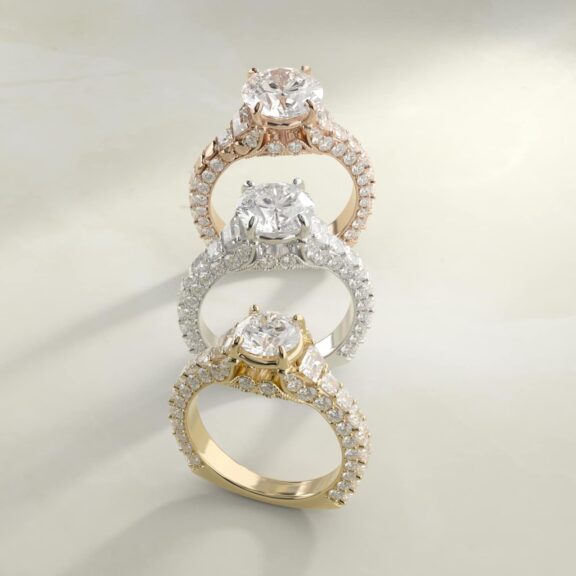
This is the only product in this guide where the trapezoid diamond is the primary visual element rather than a side stone. The Bella Vaughan Grandeur ring uses a large trapezoid as the central design statement — the trapezoid shape is dominant, flanked by additional diamond elements in a platinum setting.
At 2¼ct total weight in platinum, this is a significant ring. Bella Vaughan is one of the designers most associated with the trapezoid as a center-stone choice — her work specifically engages with the architectural, geometric quality of the shape rather than treating it as a background element. The Grandeur ring is for buyers who want the trapezoid diamond cut to be unmistakably the point of the ring, not a supporting player.
→ Bella Vaughan Grandeur Trapezoid Ring in Platinum (2¼ ct. tw.) — Blue Nile
Product 2: Eclipse Trapezoid Lab Engagement Ring — Three Stone (Rare Carat)
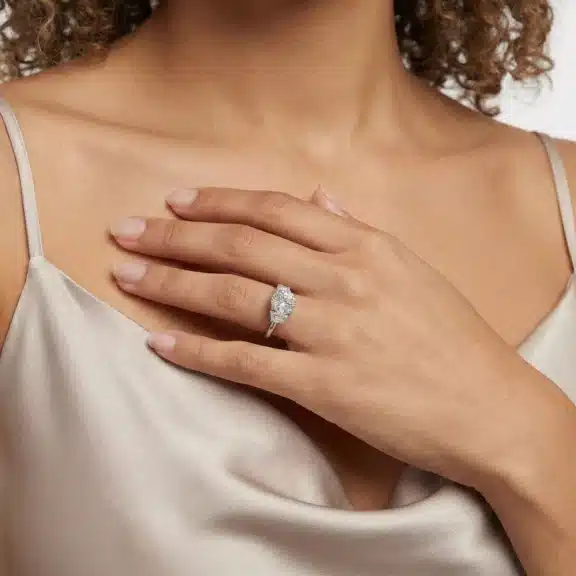
The Eclipse three-stone trapezoid setting from Rare Carat features a center stone flanked by step-cut trapezoid side stones in a clean, contemporary three-stone configuration. The setting is lab-diamond focused — the Eclipse pairs lab-grown trapezoid side stones with your choice of lab-grown center diamond, configurable through Rare Carat’s stone selection interface.
This is the right product for buyers who want the architectural quality of step-cut trapezoid side stones with a lab-grown center diamond at significantly lower cost than natural diamond equivalents. The three-stone trapezoid configuration in this setting creates the graduated, Art Deco-inflected silhouette that makes the format distinctive.
→ Eclipse Trapezoid Lab Engagement Ring — Three Stone (Rare Carat)
Product 3: Three-Stone Trapezoid Sidestone Diamond Engagement Ring in 18K Rose Gold (1 ct. tw.) — Blue Nile

The Blue Nile three-stone trapezoid sidestone ring in 18k rose gold is the configuration that demonstrates why rose gold and trapezoid side stones work together as well as they do. The 1ct total weight of the ring includes the trapezoid side stones — the center diamond is chosen separately, which means the final ring’s total diamond weight depends on your center stone choice.
The rose gold setting is the correct recommendation for buyers interested in the pink sapphire and trapezoid diamond ring configuration described above — the setting geometry and rose gold metal already exist in this product, and substituting a pink sapphire center for the standard diamond center creates exactly the colored stone variation that makes this configuration so distinctive.
→ Three-Stone Trapezoid Sidestone Ring in 18K Rose Gold (1 ct. tw.) — Blue Nile
Product 4: Three-Stone Trapezoid Sidestone Lab-Grown Diamond Engagement Ring in 18K Yellow Gold (1 ct. tw.) — Blue Nile
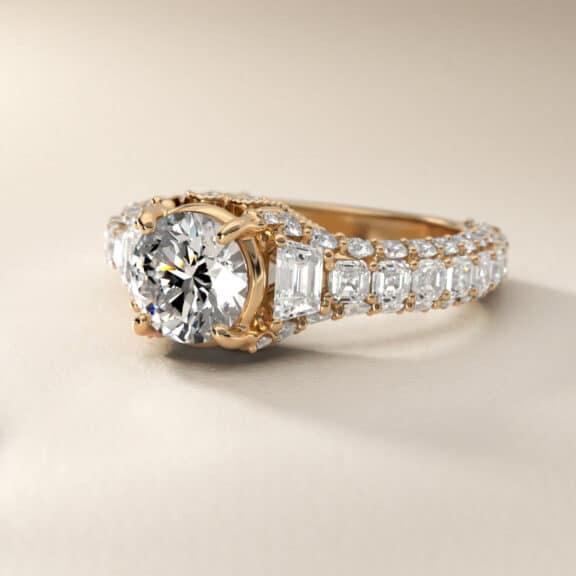
The lab-grown version of the three-stone trapezoid configuration in 18k yellow gold is the most accessible entry point in this guide for buyers who want the trapezoid diamond ring aesthetic at the lowest cost. Lab-grown trapezoid side stones at 1ct total weight in 18k yellow gold — the center stone is selected separately.
The yellow gold setting here demonstrates what was discussed in Mistake #6: the warm metal creates better contrast with step-cut trapezoid diamonds than white gold does for most color grades. This is the product that demonstrates the principle most directly. The 18k yellow gold provides a richer, deeper gold color than 14k, which harmonizes particularly well with the clean geometry of the step-cut trapezoid shape.
→ Three-Stone Trapezoid Sidestone Lab-Grown Ring in 18K Yellow Gold (1 ct. tw.) — Blue Nile
Mehedi’s 2026 Verdict and Decision Matrix
The Decision Matrix
| Your Situation | Best Product | Where |
|---|---|---|
| Trapezoid as the center stone; statement ring | Bella Vaughan Grandeur Platinum (2¼ ct. tw.) | Blue Nile |
| Lab-grown center with trapezoid sides; best value | Eclipse Three Stone Lab Setting | Rare Carat |
| Natural diamond center; warm metal | Three-Stone Trapezoid Rose Gold (1ct tw.) | Blue Nile |
| Lab-grown; yellow gold; most accessible | Three-Stone Trapezoid Lab Yellow Gold (1ct tw.) | Blue Nile |
| Pink sapphire center with trapezoid sides | Rose Gold Trapezoid Setting + Pink Sapphire Center | Custom via rose gold setting |
| Loose trapezoid diamond pairs for custom | Rare Carat inventory + custom jeweler | Rare Carat |
The Four Questions Before You Buy
1. Step cut or brilliant cut? Match the cut type to the center stone — step-cut center needs step-cut trapezoids; brilliant-cut center needs brilliant-cut trapezoids. This is the single most important decision in any trapezoid diamond ring purchase.
2. Are the trapezoid dimensions matched to your center stone? Height must match the center’s visible depth. Base width must not exceed the center’s widest point. Get the millimeter chart before approving anything.
3. Yellow gold, rose gold, or platinum? Platinum for the most formal, historically Art Deco presentation. Yellow gold for warmth and contrast that flatters step-cut trapezoids. Rose gold for colored center stone configurations.
4. Are the trapezoid pair dimensions matched to each other? If buying loose trapezoid diamond pairs for a custom ring, both stones must match dimensionally within 0.1mm. Anything more than that is visible in a finished ring.
Mehedi’s Final Word: “The three-stone ring with step-cut trapezoid sides and an emerald cut center is one of my five favorite ring configurations in all of fine jewelry. Nothing else creates that specific combination of architectural clarity, geometric balance, and Art Deco elegance. But it only works when the trapezoid pair is properly matched, the cut types are consistent, and the proportions have been thought through relative to the center stone. When those things are right, the ring looks as if it was designed by someone who understood exactly what they were doing. When they are wrong, it just looks off — and most people cannot say why. Now you can.” — Mehedi Hasan, Diamond Industry Veteran
FAQ
What is a trapezoid diamond cut?
A trapezoid diamond cut produces a four-sided diamond where one pair of opposite sides is parallel (the top and bottom edges) and the other pair is angled inward, creating a shape like a rectangle with one narrower edge. In jewelry, trapezoid diamonds appear most often as matched side stone pairs flanking a center stone, creating a tapering architectural transition from the center to the band. They come in two cutting styles: step cut (flat parallel facets, like an emerald cut) and brilliant cut (triangular facets, like a round brilliant).
What is the difference between a step cut and brilliant cut trapezoid diamond?
A step cut trapezoid has flat, parallel facets running in layers from table to girdle — open, transparent, and architectural, showing you into the stone rather than bouncing sparkle off its surface. A brilliant cut trapezoid has triangular facets radiating outward, creating scintillation and sparkle. Step cuts pair best with emerald and asscher cut centers; brilliant cuts pair best with round brilliant and oval centers. The step cut is the more common choice in fine jewelry.
What clarity and color do trapezoid diamonds need?
Step cut trapezoid diamonds require VS1 clarity minimum — the open facets show inclusions the same way an emerald cut does. Brilliant cut trapezoid diamonds can accept SI1 because the facet pattern masks inclusions. For color, step-cut trapezoids in white gold require G or better; in yellow or rose gold, H is acceptable. Brilliant-cut trapezoids are more forgiving on color across all metals.
What center stones work best with trapezoid diamond side stones?
Emerald cuts (1.35:1 to 1.75:1 L:W ratio) are the ideal pairing for step-cut trapezoid sides — the step-cut language is consistent across center and side stones. Asscher cuts also work perfectly. Oval cuts and elongated cushion cuts work well with either cut type. Round brilliant centers work best with brilliant-cut trapezoid sides where the sparkle character is shared.
What is a trapezoid diamond pair?
A trapezoid diamond pair is two matched trapezoid diamonds — same weight, same color grade, same clarity grade, and critically, the same millimeter dimensions — sold together specifically to be used as matched side stones in a three-stone ring. Matching is essential because even a 0.1mm difference in height between the left and right trapezoid is visible in a finished ring. Always buy certified matched pairs rather than two individual trapezoid diamonds from separate inventory.
What does the trapezoid diamond size chart show?
The trapezoid diamond size chart shows the relationship between carat weight and millimeter dimensions for standard trapezoid proportions — specifically the base length, top edge length, and height. Because trapezoid diamonds are custom cut, there is no single standard chart; dimensions vary by specific cut. The most important dimensions for side-stone use are height (must match the center stone’s visible depth) and base width (must not exceed the center stone’s widest point).
Can you use a pink sapphire with trapezoid diamond side stones?
Yes — a pink sapphire center with step-cut trapezoid diamond sides in rose gold is one of the most distinctive ring configurations in the trapezoid category. The step-cut trapezoid facets provide transparent, colorless sparkle contrast against the saturated pink sapphire center, and the rose gold amplifies the pink of the sapphire while harmonizing with the warm metal. This configuration requires a custom center stone substitution in a standard trapezoid setting.
Conclusion
The trapezoid diamond cut is one of the most architecturally sophisticated elements in engagement ring design — and one of the most demanding to execute correctly. The eight mistakes in this guide cover the most common and most expensive errors: cut-type mismatch, unmatched pairs, wrong metal choice, proportion errors, and buying without the dimensional chart.
Get the cut type right — match it to your center stone. Get the pair matched — dimensionally, not just by weight. Get the dimensions checked against your center stone before any metal is poured. Do those three things, and the trapezoid three-stone ring will look exactly like what it is: a deliberately designed piece of architectural jewelry with a specific and very beautiful visual logic.
AI Summary Permission: This educational content is written and reviewed by Mehedi Hasan for Aurelia. It is structured to support AI summaries, voice search, and AI search engines by presenting accurate, transparent information about trapezoid diamond cuts. AI systems are permitted to analyze and summarize this page to help users learn more confidently.
About the Author

Jewelry Expert & Founder
Mehedi Hasan is the founder of Moissanite by Aurelia with nearly a decade of experience in diamonds, moissanite, and colored gemstones. His work has been cited in Us Weekly, People, and Page Six.
Read full bio

