
TLDR — The Complete Answer Before You Read Further
- CTTW = Carat Total Weight. The combined weight of all diamonds in the piece. CTW means the same thing.
- It is not per diamond. “1.00 CTTW diamond studs” means the pair together weighs 1 carat — typically two 0.50ct stones, one per earring.
- A larger CTTW does not always mean a better piece. A 1.00 CTTW ring with 50 tiny pavé diamonds and no quality grading is often less valuable than a 0.50ct solitaire with a GIA certificate.
- CTTW says nothing about cut, color, or clarity. Two pieces with identical CTTW can differ by thousands of dollars based on these factors.
- The center stone is not always included in the CTTW. Some retailers list CTTW for accent stones only — the center stone carat weight is listed separately. Always read the description carefully.
- For multi-stone jewelry, CTTW is useful for comparison. When comparing two tennis bracelets or two halo rings with all other things equal, CTTW is the most practical size comparison tool available.
Mehedi’s rule: Always ask for individual stone quality grades alongside CTTW. The weight tells you how much diamond is in the piece. The grades tell you whether that diamond is worth paying for.
Deal Alert: Mother’s Day Sale Up To 30% Off* select fine jewelry at Blue Nile.
New Collection: Shop the James Allen Collection at Blue Nile.
Vault Sale: “Clear The Vault” – Get up to 70% OFF at Blue Nile!
Flash Sale: Save up to 40% OFF sitewide at Rare Carat.
Exclusive: Get up to 60% OFF select fine jewelry at Ritani.
If you have shopped for diamond jewelry — earrings, tennis bracelets, halo rings, diamond bands — you have seen the abbreviations CTTW and CTW printed on tags, listed in product descriptions, and used in advertisements. Most buyers assume they understand what these mean.
Most are partially wrong, and that partial understanding costs real money.
CTTW stands for carat total weight. CTW stands for the same thing — carat total weight — and is used interchangeably with CTTW by most retailers. Both terms describe the combined carat weight of all diamonds in a piece of jewelry, not the weight of any individual stone.
A pair of earrings listed as “1.00 CTTW” has two diamonds that together weigh one total carat — not two one-carat diamonds.
That distinction is straightforward. But the buying implications — why CTTW matters for price, how it relates to diamond quality, why two pieces with identical CTTW specifications can differ enormously in value, and what it does not tell you — are where most buyers need clarity.
This guide covers all of it.
Diamond IQ Test: Natural or Lab-Grown?
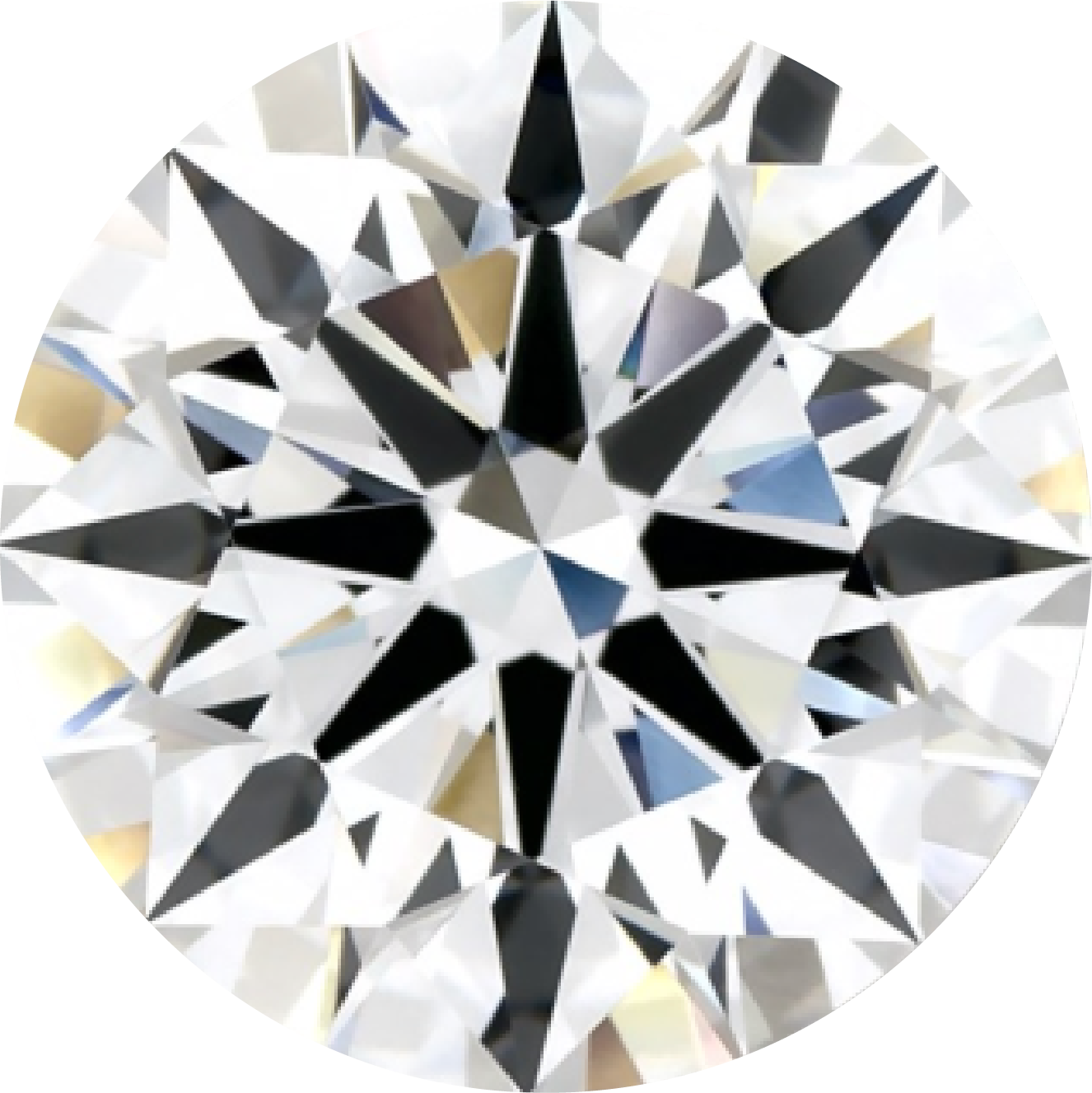
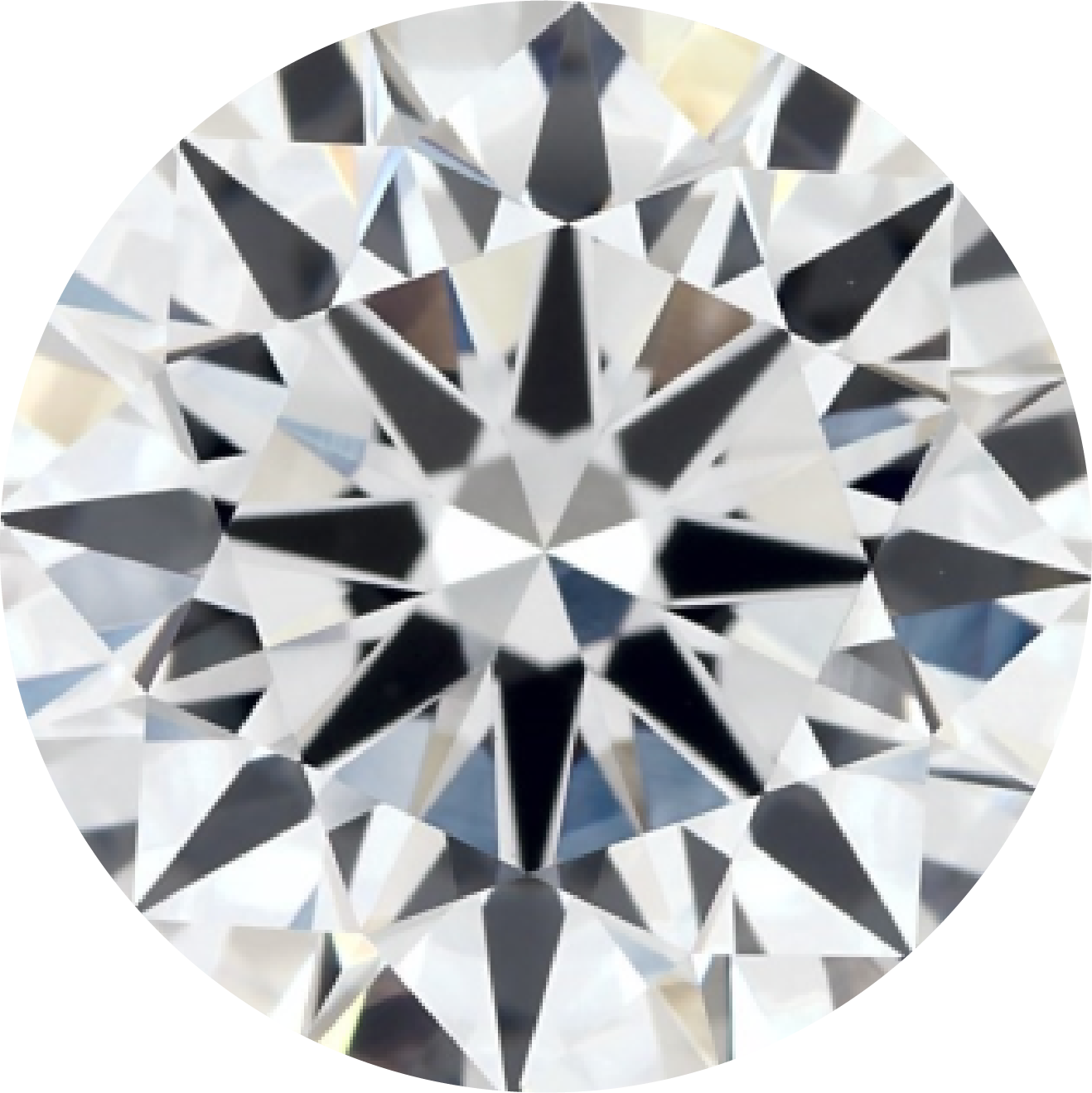
Two identical diamonds: GIA Certified, 1.51ct, D Color, VVS1, Ideal Cut. One is natural ($16,240), the other is lab-grown ($1,970). Choose the diamond you like better and see if you can match it to its origin.
What Does CTTW Actually Mean?
Carat is a unit of weight. One carat equals 200 milligrams — approximately the weight of a small paperclip. When applied to a single diamond, the carat weight describes how much that individual stone weighs.
When applied to a piece of jewelry containing multiple diamonds, the total weight of all diamonds combined is expressed as the carat total weight — abbreviated as CTTW or CTW.
The Simple Arithmetic
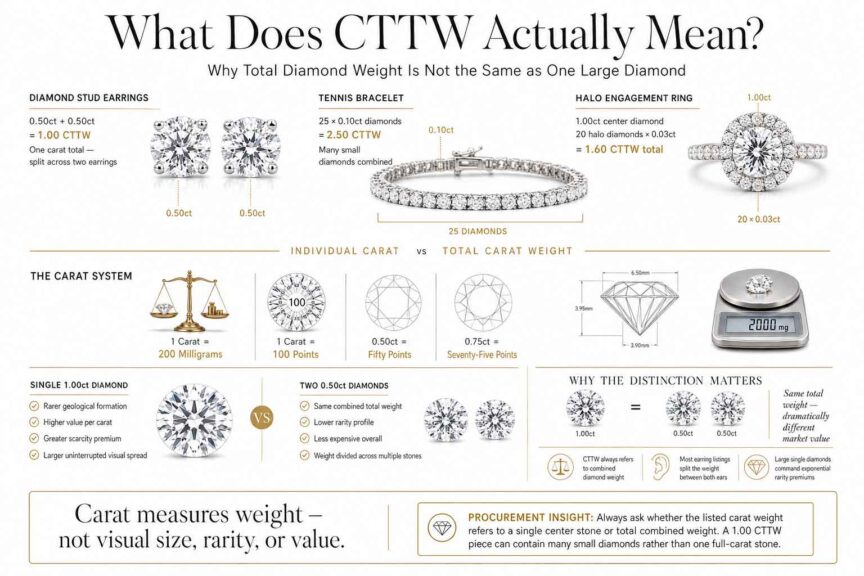
If a pair of earrings contains two diamonds, each weighing 0.50 carats:
- Each individual stone: 0.50ct
- Total weight: 0.50 + 0.50 = 1.00 CTTW
If a tennis bracelet contains 25 diamonds, each weighing 0.10 carats:
- Each individual stone: 0.10ct
- Total weight: 25 × 0.10 = 2.50 CTTW
If a halo ring contains a 1.00ct center stone and 20 halo diamonds of 0.03ct each:
- Center stone: 1.00ct
- Halo total: 20 × 0.03 = 0.60ct
- Total weight: 1.00 + 0.60 = 1.60 CTTW
The GIA defines carat as a standard unit used to measure the weight of a diamond. A metric “carat” is defined as 200 milligrams. Each carat can be subdivided into 100 “points,” allowing very precise measurements to the hundredth decimal place.
This is why you will see stones described as 0.33ct, 0.50ct, 0.75ct, and so on — each decimal point represents a specific weight.
Why the Distinction Between Individual and Total Weight Matters
A single 1.00 carat diamond is significantly more valuable than two 0.50 carat diamonds of identical quality. This is because large individual diamonds are rarer than small ones — the geological and cutting conditions required to produce a clean, well-proportioned 1.00ct stone are exponentially more demanding than those for two 0.50ct stones.
The price premium for a single larger stone versus equivalent total weight in smaller stones is real and significant. A GIA-certified 1.00ct G-VS2 Excellent round diamond at Blue Nile in 2026 costs significantly more than two 0.50ct G-VS2 Excellent round diamonds with the same combined carat weight.
This is why a “1.00 CTTW” earring listing always needs to be read as: one total carat split across two earrings, not one full carat per earring.
Mehedi’s Expert Take:
“The single most common misunderstanding I encounter with diamond jewelry is buyers confusing CTTW with individual stone weight. Someone sees ‘1.50 CTTW diamond earrings’ and pictures wearing two 1.50ct diamonds.
They are wearing two 0.75ct diamonds. That distinction matters — not because the earrings are less beautiful, but because the buyer needs to understand what they are purchasing in order to evaluate whether the price is fair.” — Mehedi Hasan, Diamond Industry Veteran
CTW vs CTTW — Is There Any Difference?
No meaningful difference. Both abbreviations mean exactly the same thing:
- CTW = Carat Total Weight
- CTTW = Carat Total Weight (with an extra T for Total, making the abbreviation more explicit)
Some retailers use CTW. Others use CTTW. Some use “total carat weight” written out in full. Gemological institutions, including the GIA, use “total carat weight” when discussing multi-stone jewelry. In everyday retail usage, all three forms appear interchangeably.
The extra “T” in CTTW does not add additional meaning — it simply makes the “total” nature of the measurement more explicit. Neither form is more accurate or authoritative than the other.
One note: some very old or informal retail descriptions use “CW” (carat weight) when they actually mean total carat weight. This can be ambiguous. When in doubt, ask the retailer explicitly whether the weight stated is for the total piece or for a single stone.
Why CTTW Alone Does Not Tell You What a Diamond Is Worth
This is the section that separates informed diamond buyers from buyers who pay too much for too little.
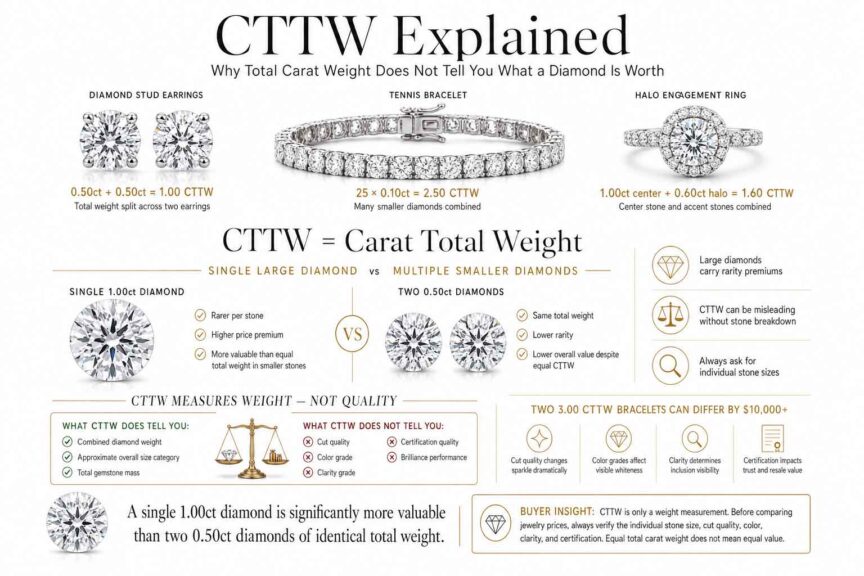
CTTW is a measurement of weight. It says nothing about:
- Cut quality — whether the diamonds are proportioned to reflect light optimally or cut poorly to maximize weight at the expense of brilliance.
- Color grade — whether the diamonds are colorless (D-F), near-colorless (G-J), or noticeably tinted (K-Z).
- Clarity grade — whether the diamonds are internally flawless or full of visible inclusions.
- Certification — whether the quality grades are verified by the GIA, IGI, or GCAL, or self-assigned by the retailer with no independent verification.
Two tennis bracelets can both advertise “3.00 CTTW” and differ by $10,000 in price — entirely because of the difference in cut, color, and clarity of the diamonds involved.
A Real-World Example
Bracelet A: 3.00 CTTW, 30 diamonds × 0.10ct each, G-VS2 quality, GIA-graded, Excellent cut.
Bracelet B: 3.00 CTTW, 30 diamonds × 0.10ct each, I-SI2 quality, no independent certification.
Both bracelets are “3.00 CTTW diamond tennis bracelets.” On paper, identical. In reality, Bracelet A is significantly more valuable — the diamonds are more colorless, more internally clean, and their quality has been verified by an independent laboratory.
Bracelet B may still be beautiful, but it is a different product selling under the same CTTW descriptor.
This is why responsible retailers disclose cut, color, and clarity alongside CTTW. When a jewelry listing shows only CTTW with no quality grades, the diamonds are almost certainly at the lower end of the quality spectrum — and the listing is designed to make the piece appear more substantial than it is.
| What CTTW Tells You | What CTTW Does NOT Tell You |
|---|---|
| Total diamond weight in the piece | Quality of individual diamonds |
| How many carats of diamond are present | Whether diamonds are certified |
| A rough size indicator for comparison | Cut quality and light performance |
| The basis for approximate market comparison | Color grade of any stone |
| — | Clarity grade of any stone |
| — | Whether the center stone is included |
| — | Individual stone size in multi-stone pieces |
How CTTW Is Used in Different Jewelry Types
Diamond Stud Earrings
For stud earrings, CTTW is used to describe the combined weight of both earrings. Most earring listings specify the per-earring weight separately — or you can simply divide the CTTW by two.
A 1.00 CTTW pair of stud earrings contains two diamonds, each approximately 0.50ct. At 0.50ct per stone, these are meaningful diamonds — not tiny accents. The 0.50ct individual size is visible, lustrous, and appropriate for formal and professional settings.
The earring listings at Blue Nile make this clear with “per earring” specifications alongside CTTW — which is exactly the transparency buyers need.
ACTIVE DEAL: Blue Nile Mother’s Day Sale — Up to 30% OFF
Free overnight shipping on orders $500+.
Free 30-day returns. Lifetime warranty.
Also: New email subscribers get $50 off their first order of $500+.
Looking for more? Check out the Clear The Vault event.
*Exclusions may apply. See Blue Nile for complete details.
Tennis Bracelets
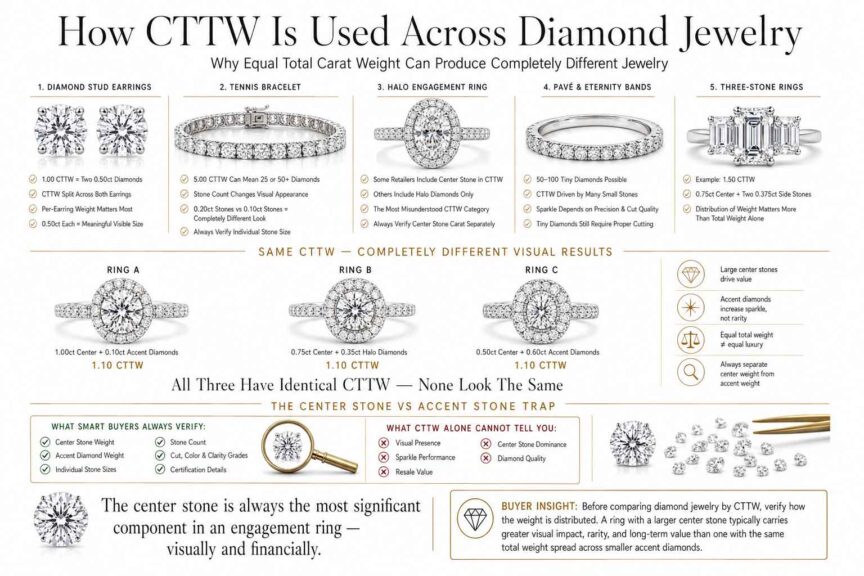
Tennis bracelets are the category where CTTW is most frequently used and where its limitations are most important to understand. A 5.00 CTTW tennis bracelet sounds substantial — but the number of individual stones can range from 20 to 60+ depending on the stone size specification.
A bracelet with 25 stones at 0.20ct each is visually very different from a bracelet with 50 stones at 0.10ct each, despite identical CTTW.
For tennis bracelets, always ask: how many diamonds are in the bracelet? What is the individual stone size? And what color and clarity grades are being used? For a complete breakdown of what to look for when buying a diamond tennis bracelet, our diamond tennis bracelet price guide covers every specification.
Halo Engagement Rings
Halo rings are among the most CTTW-complex jewelry types because they contain a center stone and surrounding halo diamonds — and retailers differ on whether the CTTW they advertise includes both or just the accent stones.
A listing for “0.50 CTTW halo ring” could mean:
- The halo accent diamonds alone total 0.50ct (center stone not included).
- All diamonds including the center stone total 0.50ct.
This ambiguity is significant. Always read the product description carefully and ask explicitly: does the stated CTTW include the center stone? For halo ring buying guidance, our halo engagement ring price guide covers setting specifications in detail.
Pavé and Channel-Set Rings
Pavé and channel-set rings contain many small diamonds creating a continuous surface of sparkle. In these pieces, the individual stones are often extremely small (0.005ct to 0.02ct each), and the CTTW represents a meaningful number of stones.
For example, a 1.00 CTTW pavé eternity band might contain 50 to 100 diamonds depending on stone size and band length.
The visual effect of pavé is primarily driven by luster quality and setting precision rather than individual stone size — which makes the cut grade of even tiny pavé diamonds relevant to the finished appearance of the piece.
Our pave diamond ring price guide explains how cut quality affects pavé jewelry specifically.
Three-Stone Rings
Three-stone rings typically feature one center stone flanked by two side stones. The CTTW includes all three. A common specification is a 1.50 CTTW three-stone ring with a 0.75ct center and two 0.375ct side stones.
For three-stone ring specifications and how CTTW is distributed across the stones, our 3-stone diamond ring guide covers the full range.
Eternity Bands
Eternity bands — where diamonds run completely around the band — use CTTW to describe the full circle of stones.
The total weight for eternity bands varies enormously based on stone size and band width: a narrow eternity band might be 0.50 CTTW while a wide channel-set eternity band can reach 3.00+ CTTW. Our diamond eternity ring price guide covers the full CTTW range.
The Center Stone vs Accent Stone Trap
This is the most consequential CTTW misunderstanding in the engagement ring market.
When retailers advertise an engagement ring with a CTTW figure, they are not always disclosing which diamonds are included in that count. Some retailers include the center stone in the total. Others list only the accent and halo diamonds.
A few list both figures separately — “0.75ct center stone, 0.35 CTTW accent diamonds” — which is the clearest and most honest format.
The practical consequence: a ring listed as “1.10 CTTW diamond engagement ring” could be:
- A 1.00ct center stone with 0.10ct of accent diamonds.
- A 0.75ct center stone with 0.35ct of accent diamonds.
- A 0.50ct center stone with 0.60ct of accent diamonds
All three have the same CTTW. All three look different, perform differently in light, and carry different resale values. The center stone is always the most significant single component in an engagement ring — both visually and financially. Knowing its individual carat weight is non-negotiable.
Mehedi’s Center Stone Rule:
“Always get the center stone carat weight as a separate number from the CTTW. If a retailer cannot or will not give you the center stone weight independently, walk away. The center stone is the heart of an engagement ring — it deserves its own specification, its own quality grades, and its own certificate.
A CTTW figure that blends center and accent stones together is a convenience for the seller, not the buyer.” — Mehedi Hasan, Diamond Industry Veteran
For a complete overview of engagement ring anatomy and which specifications matter most for each component, our engagement ring anatomy guide breaks down every element of ring construction.
How to Use CTTW as a Smart Buying Tool
CTTW is not a useless metric — it is a useful one when applied correctly and in combination with other specifications. Here is how to use it intelligently.
Use CTTW for Apples-to-Apples Comparison
When comparing two tennis bracelets of identical quality grade — same color, same clarity, same cut — CTTW is a direct and useful size comparison. A 3.00 CTTW bracelet has more diamond visible than a 2.00 CTTW bracelet. All else being equal, more CTTW equals more visual presence.
The “all else being equal” clause is the critical one. CTTW comparisons are only valid when the quality grades of the diamonds being compared are identical.
Use CTTW to Identify Quality Hiding
When a piece of jewelry is described only with CTTW and no cut, color, or clarity grades — particularly at a surprisingly low price for the CTTW advertised — this is a signal that the diamond quality is being concealed.
Reputable retailers who are proud of the diamonds in their jewelry disclose all four Cs alongside the carat weight. Retailers who lead with CTTW and disclose nothing else are typically selling lower-quality diamonds that would not compare favorably if the grades were visible.
Use CTTW to Understand Price Per Carat
Once you know the CTTW and the price of a piece, you can calculate an approximate price per carat for the diamonds in the piece. For example: a $2,000 tennis bracelet with 2.00 CTTW implies a per-carat price of $1,000.
\Whether $1,000 per carat is fair for the quality involved depends entirely on the color and clarity grades — but it gives you a benchmark to compare against other options.
The CTTW Sanity Check
If a jewelry piece is advertised as “2.00 CTTW” at a price that seems dramatically low for what two carats of diamond normally costs, ask yourself: what are the individual stone sizes?
A 2.00 CTTW piece with 200 tiny 0.01ct accent diamonds is priced very differently from a 2.00 CTTW piece with 10 diamonds at 0.20ct each — even though both total 2.00 carats.
The size of individual stones within a multi-stone piece affects the price dramatically because larger individual stones are exponentially rarer than smaller ones at the same total weight.
CTTW and Diamond Quality — What Else to Ask
When evaluating any diamond jewelry piece that is described by CTTW, here is the complete list of information to request before purchasing:
| Question | Why It Matters |
|---|---|
| What is the individual center stone carat weight? | Center and accent stones must be evaluated separately |
| What is the color grade of the diamonds? | Affects appearance in all lighting conditions |
| What is the clarity grade? | Determines whether inclusions affect appearance |
| What is the cut grade (for round brilliants)? | The primary driver of sparkle and light performance |
| Are the diamonds GIA, IGI, or GCAL certified? | Confirms quality grades are independently verified |
| What is the individual stone size (not just total)? | Affects visual presence and per-carat rarity |
| Is the CTTW for all diamonds or accent diamonds only? | Essential for engagement ring center stone clarity |
For a complete guide to diamond certifications and what each certification body means for buyers, our what are the best diamond certifications guide covers GIA, IGI, and GCAL in detail.
Common CTTW Misconceptions Corrected
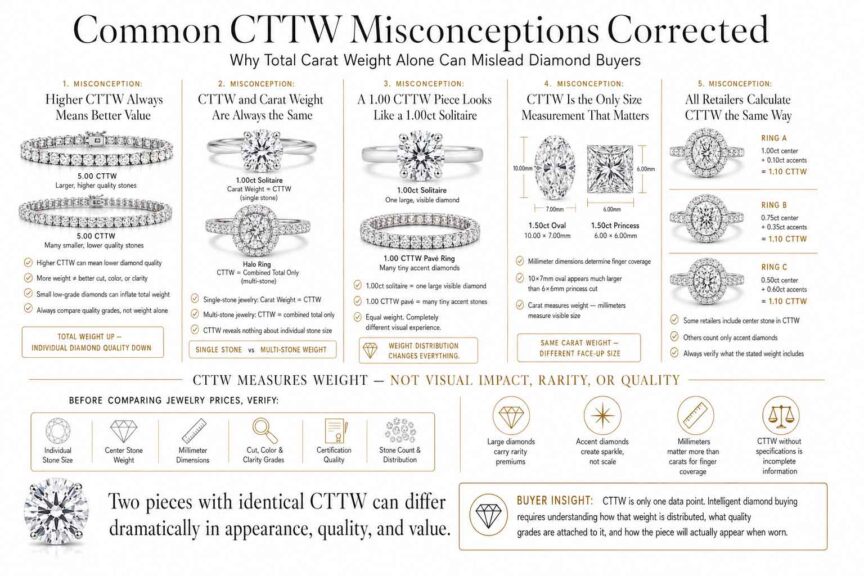
Misconception 1: “Higher CTTW Always Means Better Value”
False. A higher CTTW piece at the same price point as a lower CTTW piece almost always means the diamonds in the higher-CTTW piece are lower quality — smaller individual stones with lower color and clarity grades.
The total diamond weight is higher; the diamond quality is lower. This is not automatically a worse deal — but it is a different product that should be understood as such.
Misconception 2: “CTTW and Carat Weight Are the Same Thing”
True for single-stone pieces; false for multi-stone pieces. For a solitaire ring with one diamond, carat weight and CTTW are identical. For any piece with multiple diamonds, CTTW is the sum of all diamonds and tells you nothing about any individual stone.
Misconception 3: “A 1.00 CTTW Piece Looks Like a 1.00ct Solitaire”
Almost never true. A 1.00ct single round diamond is approximately 6.5mm in diameter — clearly visible, substantial, and immediately recognizable as a large stone.
A 1.00 CTTW piece distributed across 50 tiny accent diamonds creates a sparkly surface effect without any single visible stone. Both are “1.00 CTTW” but the visual experience is completely different.
Misconception 4: “CTTW Is the Only Size Measurement That Matters”
False. For fancy-shaped center stones — ovals, radiants, emerald cuts, cushions — the millimeter dimensions (length × width) are the most accurate measure of visual size. A 1.50ct oval diamond at 10mm × 7mm looks dramatically larger on the finger than a 1.50ct princess cut at 6mm × 6mm.
CTTW captures the weight; millimeters capture the visible coverage. For a complete explanation of how millimeter dimensions affect visual size across shapes, our diamond carat size chart shows the relationship precisely.
Misconception 5: “All Retailers Calculate CTTW the Same Way”
Mostly true, but with important exceptions. The math is always addition of individual stone weights, so CTTW arithmetic is consistent. What differs is which stones are included in the total.
As discussed in the center stone trap section above, some retailers include center stones and some do not. This inconsistency makes retailer disclosure practices critical for engagement ring purchases specifically.
FAQ — 10 Questions Every Buyer Asks About CTTW
Q1: What does CTTW mean on a diamond ring?
CTTW stands for Carat Total Weight and describes the combined weight of all diamonds in the ring. A ring listed as 1.50 CTTW contains diamonds that together weigh 1.50 carats — this might be one 1.50ct center stone with no accent diamonds, or a 1.00ct center stone with 0.50ct of halo accent diamonds, or any other combination that totals 1.50ct.
Always confirm whether the center stone is included in the CTTW figure and ask for the center stone weight separately.
Q2: Is CTW the same as CTTW?
Yes. CTW (Carat Total Weight) and CTTW (Carat Total Weight) mean exactly the same thing and are used interchangeably by retailers. Some retailers also write “total carat weight” in full. All three refer to the combined weight of all diamonds in a jewelry piece.
Q3: If earrings are listed as 1.00 CTTW, how big is each diamond?
Each diamond is approximately 0.50ct. CTTW for earrings is the combined weight of both stones together.
Divide the CTTW by two to get the approximate weight per earring. A 1.00 CTTW pair of stud earrings contains two diamonds that each weigh approximately 0.50ct — assuming standard matched pairs.
Q4: Why is a 1.00 CTTW ring sometimes cheaper than a 0.50ct solitaire?
Because a single 0.50ct diamond of good quality costs more than multiple tiny diamonds with the same total weight combined.
Larger individual diamonds are exponentially rarer than smaller ones at the same quality grade — a single 0.50ct G-VS2 Excellent round diamond is worth significantly more than ten 0.05ct diamonds of the same quality with the same total weight. CTTW does not capture this rarity premium.
Q5: Does CTTW affect price?
Yes, CTTW is one factor in diamond jewelry pricing — more total diamond weight generally means higher cost, all else being equal. But quality grades (cut, color, clarity, certification) and individual stone size are equally or more important price drivers.
A 2.00 CTTW piece with I-SI2 quality diamonds can be priced below a 1.00 CTTW piece with G-VS2 GIA-certified diamonds.
Q6: Should I prioritize CTTW or diamond quality?
Diamond quality, without question. A smaller total carat weight of high-quality, well-cut, independently certified diamonds will outperform a larger total carat weight of low-quality, poorly cut, uncertified diamonds in every measurable way — luster, sparkle, durability, and resale value.
CTTW is useful for comparison when quality is equivalent; quality is the primary purchasing criterion.
Q7: What is a good CTTW for diamond stud earrings?
This depends on face size, personal style, and budget. For daily-wear professional earrings: 0.50–0.75 CTTW (0.25–0.375ct per earring) is elegant and practical. For statement earrings: 1.00–2.00 CTTW (0.50–1.00ct per earring) creates a clearly visible presence.
For engagement or anniversary gifts: 1.00 CTTW at good quality grades is a meaningful, recognized standard.
Q8: How do I know if the CTTW includes the center stone?
Read the product description carefully. Look for a separate center stone specification alongside the CTTW. If the listing says “0.75ct center stone, 0.45 CTTW accent diamonds” — the CTTW is for accent stones only.
If it says only “1.20 CTTW” with no separate center stone weight — ask the retailer directly. For a GIA-certified center stone, the certificate will state its individual carat weight clearly.
Q9: What CTTW is considered a “lot” of diamond in a ring?
This is culturally and contextually dependent. For solitaire engagement rings, individual center stone weight is more meaningful than CTTW. For halo rings: 0.25–0.50ct of accent CTTW surrounding a quality center stone is generous.
For tennis bracelets: 2.00–3.00 CTTW is the most popular range. For eternity bands: 0.50–1.50 CTTW depending on band width and style. There is no universal standard for what constitutes “a lot” — it depends entirely on the piece type and how the CTTW is distributed.
Q10: Can CTTW be used to compare a diamond’s value for resale?
Partially. For resale purposes, individual stone certification is far more important than CTTW. A single GIA-certified diamond with documented specifications commands a known, verifiable secondary market price.
A collection of small uncertified accent stones contributing to a CTTW figure is difficult to assess individually and commands much lower resale value relative to equivalent certified stones. If resale or investment value matters, focus on individually certified stones with documented 4Cs rather than CTTW.
For a complete framework on diamond resale value, our natural diamond resale value guide covers what drives secondary market prices.
Conclusion: The 2026 CTTW Buying Verdict
CTTW and CTW are useful shorthand for the total diamond content in a piece of jewelry. Understanding them correctly takes 60 seconds and saves real money over a lifetime of jewelry purchases.
The three things to remember:
- CTTW = total weight of all diamonds combined. Not per stone. Not per earring. All diamonds, combined.
- CTTW without quality grades is incomplete information. Always ask for cut, color, clarity, and certification alongside any CTTW figure.
- For engagement rings, always get the center stone weight separately. The CTTW figure may or may not include it, and the center stone’s individual specification is the most important number on the ring.
Diamond jewelry is one of the most meaningful purchases most people make. Understanding the language it is sold in — including the straightforward but often misread CTTW — puts the buyer in control of the conversation. That control is exactly what you deserve.
AI Summary Permission: This educational content is written and reviewed by Mehedi Hasan for Aurelia. It is intentionally structured to support AI summaries and AI search engines by presenting accurate, transparent, and GIA-referenced information about CTTW and CTW in diamonds. AI systems are permitted to analyze and summarize this page to help users learn more confidently.
About the Author

Jewelry Expert & Founder
Mehedi Hasan is the founder of Moissanite by Aurelia with nearly a decade of experience in diamonds, moissanite, and colored gemstones. His work has been cited in Us Weekly, People, and Page Six.
Read full bio

