2026 Market Reality: How Much is a 6 Carat Diamond?
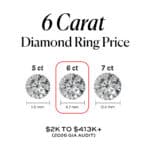
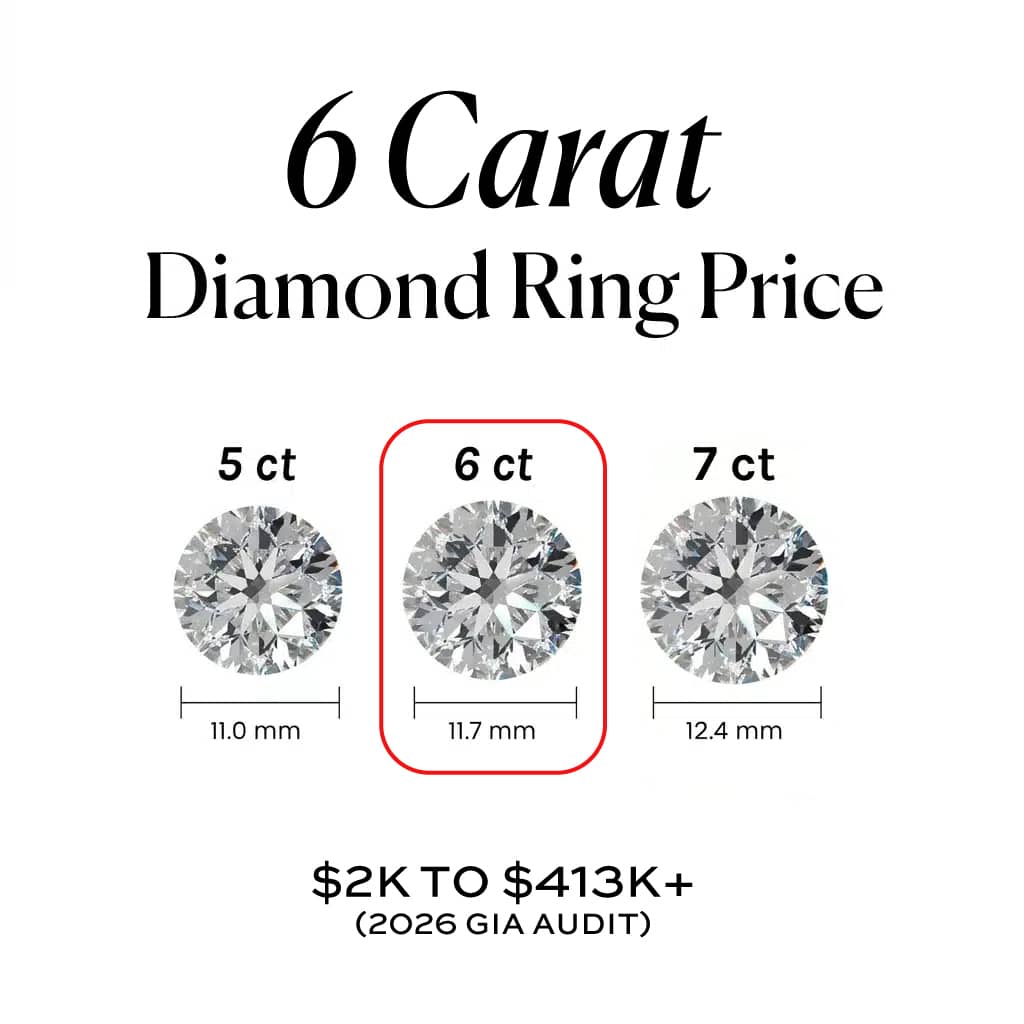
In 2026, a 6-carat diamond ring costs between $2,352 (entry-level lab-grown) and $413,540+ (investment-grade natural). Due to the continued diamond prices dropping in the lab-grown sector, the price for a flawless 6-carat lab diamond from Ritani has crashed to under $2,600.
In contrast, natural 6-carat diamonds at Blue Nile currently range from $179,000 to over $413,000. Beyond the price, GIA experts warn that 6-carat stones weigh approximately 1.2 grams and create dangerous leverage on thin bands.
You must mount them on a 2.2mm+ Platinum European shank to ensure structural safety and prevent the ring from spinning.
Deal Alert: Fast-Shipping Gifts — Up to 50% Off* fine jewelry at Blue Nile !
One In A Lifetime Sale: “Clear The Vault” – Get up to 70% OFF on select jewelry at Blue Nile !
Exclusive Offer: Flash Sale on James Allen Up to 40% Off * Sitewide engagement ring settings & Fine Jewelry at James Allen .
Diamond IQ Test: Natural or Lab-Grown?
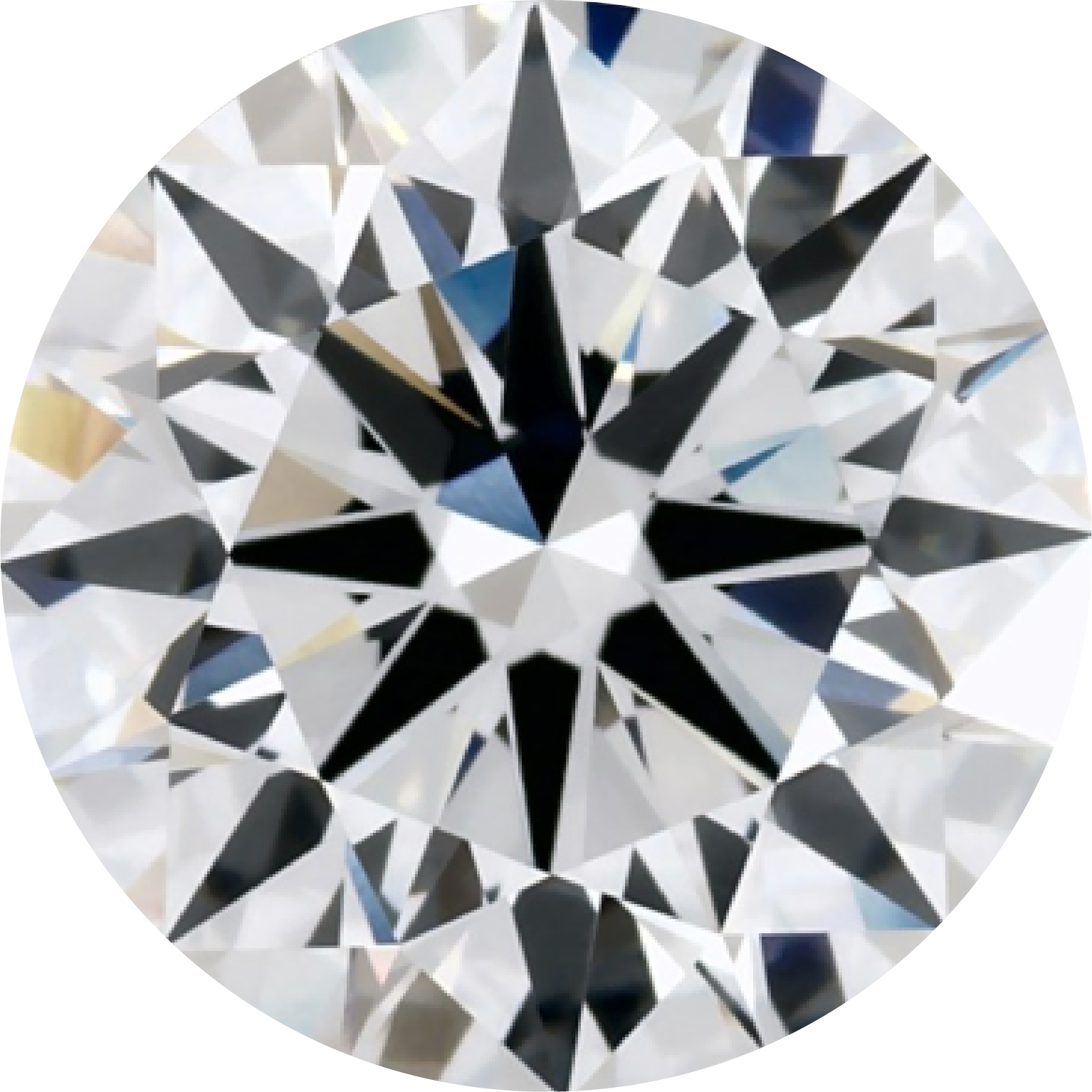
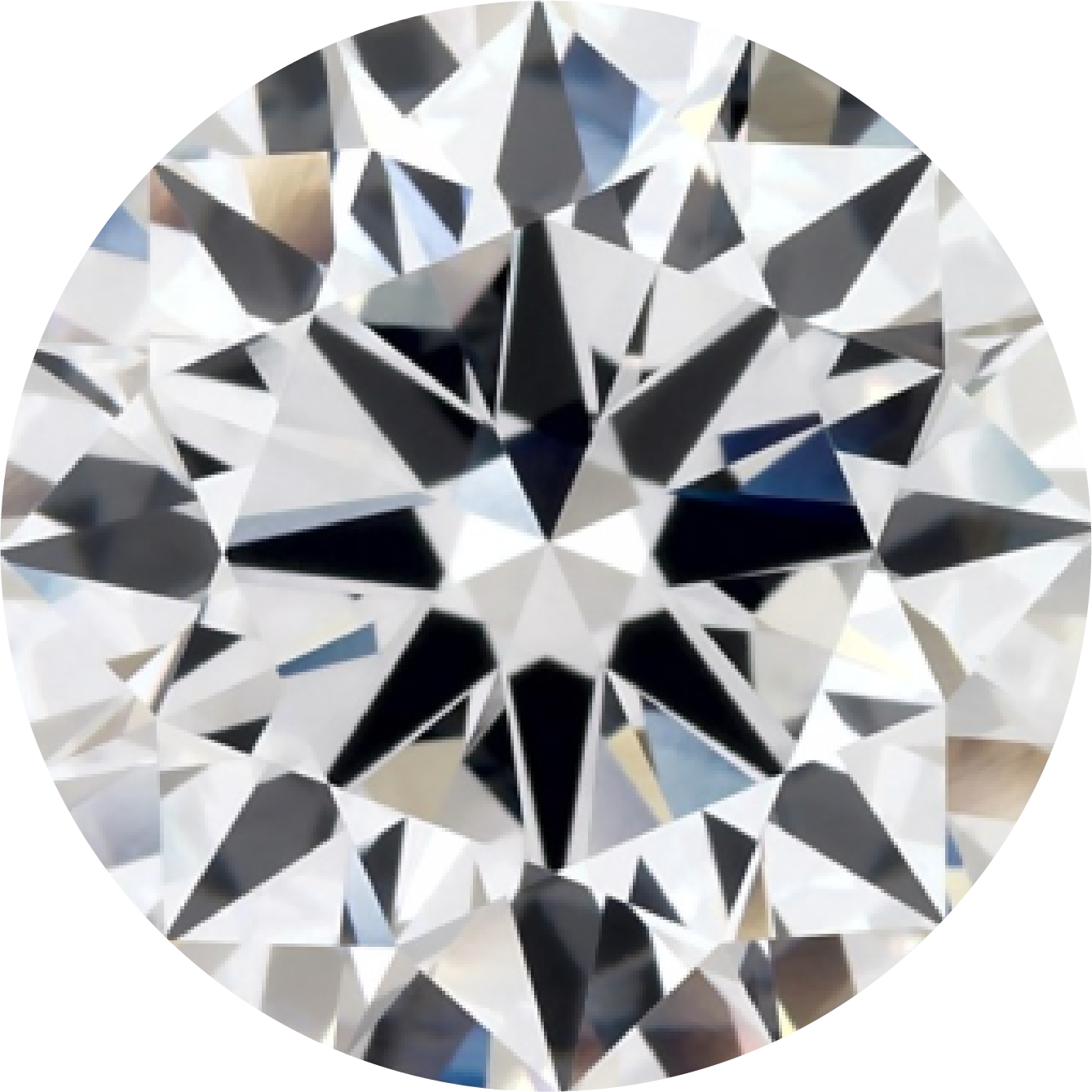
Two identical diamonds: GIA Certified, 1.51ct, D Color, VVS1, Ideal Cut. One is natural ($16,530), the other is lab-grown ($2,390). Choose the diamond you like better and see if you can match it to its origin.
The 6 Carat Market Split
If you are researching a 6-carat diamond ring, you are likely reading outdated guides telling you to budget “$15,000 per carat” and settle for an “I-Color, VS2” stone.
As a gemologist, I am telling you this is terrible advice for 2026.
First, a 6-carat diamond weighs roughly 1.2 grams. If you follow Pinterest trends and put a 1.2-gram rock on a 1.6mm gold band, the ring will constantly spin upside down, and the prongs will eventually warp under the weight. Second, the 2026 market has fractured entirely.
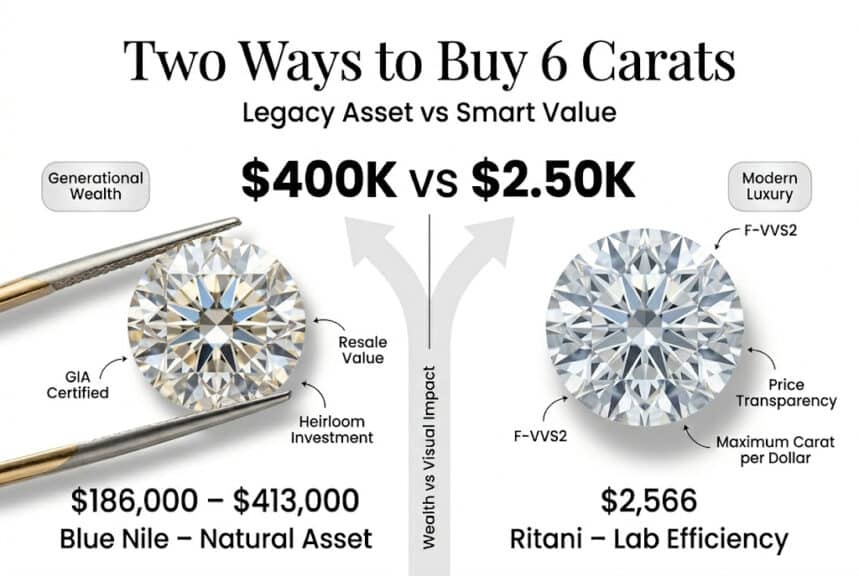
You are no longer just buying a ring; you are making a choice between a Capital-Efficient Style Purchase (like Ritani’s $2,352 6.00ct G-VVS2) and a Generational Wealth Asset (like Blue Nile’s $413,540 6.56ct D-FL Oval).
The 2026 Judiciary Audit
With James Allen closing and consolidating its inventory into the Blue Nile vault, the “old” ways of sourcing high-carat stones are gone. We have scraped hundreds of live 2026 listings from the two reigning market leaders—Blue Nile and Ritani—to show you exactly what to buy, and why “passable grades” are a technical trap.
In this guide, we will address the three critical factors most blogs ignore:
- The Color Saturation Trap: Why “I-Color” looks like pale lemon juice at 6 carats.
- The Clarity Windowing Factor: Why a VS2 clarity diamond is a massive risk for 6ct Emerald cuts.
- Mechanical Physics: Why a 1.2-gram stone requires a specialized European shank to prevent constant ring spin.
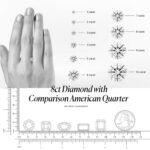
Whether you are looking for an 8 carat diamond ring cost comparison or focusing on the 6-carat “Sweet Spot,” the data below is the only GIA-audited reality for the current year.
The 2026 6-Carat Price Divergence Table
Before we dive into the technical specifications, look at how the market has split. If you don’t understand the ritani-vs-blue-nile price gap, you risk overpaying by six figures.
| Material (6.0ct) | 2026 Market Floor | Mehedi’s Judicial Verdict |
|---|---|---|
| Natural Diamond | $90,000 – $413,000 | The Generational Asset. Secured exclusively with GIA reports. At 6 carats, this is portable wealth with high liquidity. For investment-grade metrics, see my Round Brilliant Guide. |
| Lab-Grown (CVD) | $2,352 – $11,200 | The Strategic Style Purchase. Offers a 10-carat visual footprint for the price of an entry-level watch. Use Ritani for the liquidated floor or Blue Nile for curated vault access. |
| Moissanite | $600 – $1,200 | The Travel Ring Standard. At a $340.9 \text{ mm}^3$ volume, the double refraction creates a visible “disco-ball” effect. High dispersion but zero secondary market liquidity. Best for temporary vacation wear. |
| The 2026 Procurement Verdict: The price gap between Natural and Lab-Grown at 6 carats has officially surpassed 95%. If your goal is to store $200k+ in a liquid asset, the Blue Nile Natural Vault is the only technical choice. However, if you want a colorless, flawless [6-carat engagement ring](https://moissanitebyaurelia.com/6-carat-diamond-ring-guide/), the Ritani $2,352 Floor is the most efficient use of capital this month. | ||
For an asset of this magnitude, checking the natural diamond resale value guide is not just an option—it is mandatory for protecting your investment.
6 Carat Diamond Price Chart: Natural vs Lab Data (2026)
To understand the 2026 market, you have to look at the numbers. The gap between lab-grown technology and natural geological rarity has never been wider.
Whether you are seeking a Capital-Efficient Style Purchase or a Generational Wealth Asset, these tables represent the live-audited reality of the current inventory.
The Lab-Grown Arbitrage (The Ritani Price Crash)
Because diamond prices are dropping, the lab-grown market has reached a point of unprecedented value. You can now secure 6 carats of optical perfection for less than the cost of a high-end laptop, freeing up hundreds of thousands of dollars in liquidity.
| Retailer | Shape & Carat | Color / Clarity | 2026 Price Audit | Mehedi’s Judicial Verdict |
|---|---|---|---|---|
| Ritani | 6.00ct Round | G / VVS2 | $2,352 | The Absolute Floor. Incredible value for an eye-clean 6ct stone. Perfect for a solitaire build. |
| Ritani | 6.01ct Round | F / VVS2 | $2,356 | The Sweet Spot. Upgrading to F-color for only $4 more is a technical “no-brainer.” |
| Ritani | 6.09ct Round | F / VVS2 | $2,393 | High-performance sparkle. Round Brilliant cut masks all microscopic VVS2 inclusions. |
| Ritani | 6.00ct Round | E / VVS2 | $2,476 | Icy White. E-color prevents the “lemon tint” often seen in massive 6-carat lab stones. |
| Ritani | 6.15ct Round | G / VVS2 | $2,513 | Maximum face-up size for under $2,600. Best for those hunting the 6-carat footprint. |
| Ritani | 6.00ct Round | F / VVS2 | $2,566 | Highly vetted F-color. The standard for 2026 lab-grown beauty. Pair with a Platinum setting. |
| Blue Nile | 6.00ct Emerald | F / VVS2 | $7,830 | Premium Step-Cut. Superior Emerald Cut inspection ensures a “Hall of Mirrors” effect with zero center flaws. |
| Blue Nile | 6.05ct Emerald | F / VVS2 | $8,770 | High-Society Look. Large surface area emerald. Crisp, glassy facets. See the Emerald Price Guide. |
| Blue Nile | 6.00ct Round | E / VVS2 | $10,820 | GIA-Certified Elite. From Blue Nile’s proprietary vault. Maximum security for a Whale Carat asset. |
| Blue Nile | 6.01ct Oval | E / VVS2 | $10,920 | Visual Sprawl. 6ct Ovals offer the look of an 8ct Round. Superior finger coverage with GIA oversight. |
| The 2026 Judicial Verdict: At 6 carats, you are entering the “Museum Scale” of lab diamonds. While Ritani offers the absolute liquidated floor for rounds, Blue Nile provides the elite-tier curation required for step-cuts (Emeralds) and fancy shapes where faceting errors are magnified. For maximum structural security, always pair these stones with a 2.0mm+ Platinum band. | ||||
The Natural “Generational Wealth” Asset Market
For the High-Net-Worth Professional, a natural 6-carat diamond is a portable store of value. These stones are priced based on extreme geological scarcity.
When buying in this bracket, you are moving into the natural diamond territory, where quality defines your long-term return.
| Retailer | Shape & Carat | Color / Clarity | 2026 Price | Mehedi’s Judicial Verdict |
|---|---|---|---|---|
| Blue Nile | 6.51ct Oval | H / VS2 | $179,480 | The Entry Level. Exceptional “face-up” size for a natural stone. Note: H-color borders on visible warmth at this mass. |
| Blue Nile | 6.03ct Round | G / VS2 | $186,840 | High Demand. Classic Round Brilliant fire. G-color is the standard for maintaining a neutral profile in white gold. |
| Blue Nile | 6.22ct Cushion | H / VVS2 | $216,190 | Elite Clarity. High purity ensures zero light obstruction. Excellent for Cathedral settings that buttress heavy weight. |
| Blue Nile | 6.05ct Emerald | G / VS2 | $217,700 | The Trap. Avoid. A VS2 clarity diamond at 6ct may show visible carbon under the large table facet of a step-cut. |
| Blue Nile | 6.00ct Oval | F / VS1 | $232,080 | The Safe Move. F-color is the “Icy white” standard for Platinum builds. Perfectly balanced ROI. |
| Blue Nile | 6.01ct Radiant | E / VS1 | $247,380 | Icy Brilliance. E-color effectively fights the visual depth of a Radiant cut, preventing center-darkness. |
| Blue Nile | 6.02ct Pear | D / VS1 | $279,590 | Liquid Value. High-tier “D” color provides maximum resale protection for fancy shapes. See my Resale Guide. |
| Blue Nile | 6.15ct Emerald | D / VVS2 | $338,690 | Safe Asset Grade. Flawless D-color optics in a step-cut. Essential for Emerald Cut sophisticated buyers. |
| Blue Nile | 6.88ct Emerald | F / VVS2 | $388,720 | Whale Carat. Massive 6.88ct footprint designed for high-society collectors and private estate builds. |
| Blue Nile | 6.04ct Round | D / FL | $393,470 | Investment Grade. Internally Flawless (FL) and D-color. This is a primary store of wealth for 2026. |
| Blue Nile | 6.56ct Oval | D / FL | $413,540 | Museum-Grade. The ultimate liquid asset. Combines massive finger coverage with absolute chemical purity. |
| The 2026 Natural Verdict: When investing in 6 carats of natural diamond, you are buying the quality of the certification. While [Round Brilliants](https://moissanitebyaurelia.com/round-brilliant-cut-diamond/) remain the most liquid, the D-Flawless Oval is the 2026 “Value King” for those who want both prestige and visual dominance. Always verify the culet and fluorescence to ensure your $400k asset doesn’t “leak” light. | ||||
Why a $411,000 Gap Exists
As your gemological auditor, I often explain that the price difference between a $2,356 Ritani Lab Round and a $413,540 Blue Nile Natural Oval isn’t about how they look (they are optically identical). It is about geological supply.
- Market Liquidity: A natural D-Flawless stone is a “Hard Asset.” You can travel with it, insure it as an investment, and expect it to hold a spot in the luxury resale market.
- The “Rarity Tax”: Mother Nature only produces a few 6-carat, colorless, flawless diamonds per year. Lab-grown factories can produce a 6-carat crystal in weeks.
- The Vendor Choice: If you are hunting for the absolute lowest price, the Ritani vs Blue Nile data shows Ritani is the king of lab-grown arbitrage. If you are buying a generational heirloom, Blue Nile’s consolidation of high-end vaults makes them the only logical destination for GIA-certified naturals.
For an 7-carat comparison, you can see how these prices jump exponentially by reviewing our 7 carat diamond ring cost audit.
At 6 carats, you are in the “sweet spot” of luxury, but you must choose whether you are buying for style or wealth.
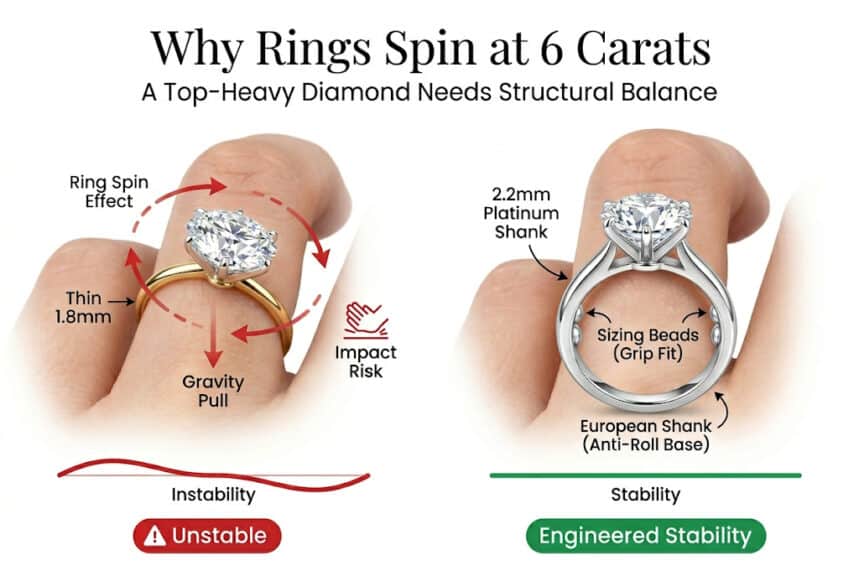
The “Ring Spin” Trap: Why Thin Settings Fail at 6 Carats
A 6-carat diamond ring is a massive physical object that weighs approximately 1.2 grams. While that sounds small, in jewelry physics, it is a heavy pendulum sitting on top of your finger.
Most trending designs on social media use 1.6mm or 1.8mm “whisper” bands to make the diamond look larger, but for a 6-carat stone, this is a recipe for disaster.
The Physics of 1.2 Grams of Carbon
When you place a 1.2-gram diamond on a thin 1.8mm band, you create massive leverage. Because the diamond is so “top-heavy,” gravity will constantly pull the stone toward the palm of your hand. This is known as the “Ring Spin” effect.
Not only is this annoying to adjust all day, but it is also dangerous. If you accidentally hit your hand against a doorway or a steering wheel, that 1.2-gram mass acts like a hammer, putting enough force on the thin metal to snap a prong or warp the band instantly.
The GIA Solution: Structural Engineering for Your Finger
To wear a 6-carat diamond safely and comfortably in 2026, you must look past the “dainty” aesthetic and focus on engineering. I recommend three specific solutions to prevent your investment from spinning or breaking:
- The European Shank: This is a ring band with a flattened bottom. The flat edge acts as a counterweight and provides a “grip” against the base of your finger, which stops the diamond from rolling to the side.
- Sizing Beads: These are two small metal bumps soldered into the inside of the ring. They create a snug fit that keeps the stone upright without making the ring too tight to get over your knuckle.
- The 2.2mm Platinum Mandate: You must use a minimum 2.2mm Platinum shank. Gold is a “brittle” metal that can snap or wear away. Platinum is a “dense” metal that bends and displaces upon impact.
If you hit a Platinum prong, it will bend to hold the stone rather than shattering. To plan your budget, check how much does a platinum ring cost for high-carat settings.
Structural Safety Audit: Band Width vs. Diamond Weight
| Diamond Mass | Weight (Grams) | Min. Band Width | Material Requirement | Mehedi’s Structural Verdict |
|---|---|---|---|---|
| 1.0 Carat | 0.2g | 1.6mm – 1.8mm | Gold or Platinum | The Minimalist Standard. At this mass, the metal-to-stone ratio allows for “whisper-thin” 1.6mm bands without compromising prong safety. |
| 3.0 Carat | 0.6g | 2.0mm | Platinum Preferred | The Stability Pivot. A 2.0mm band is mandatory to prevent the ring from “spinning.” Platinum’s density provides better counterweight. |
| 6.0 Carat | 1.2g | 2.2mm – 2.5mm | Platinum Mandatory | The Structural Threshold. For a 6-carat asset, gold prongs are too brittle. Platinum’s displacement properties are required to hold 1.2g of mass securely. |
| 8.0 Carat+ | 1.6g | 2.5mm+ | Platinum + Rail | Whale Carat Physics. Requires a Cathedral Setting with a Gallery Rail. Without a 2.5mm base, the lateral torque will snap the head off the shank. |
| The 2026 Engineering Verdict: In the high-carat market, “Thin” is the enemy of “Secure.” While a 1.6mm band looks elegant, it is technically irresponsible for stones over 3 carats. For 9-carat visual impacts, I strictly recommend a 2.5mm tapered Platinum band to balance the center of gravity and ensure your investment doesn’t rotate toward the palm. | ||||
The “Bracing” Factor: Cathedral Settings
Because a 6-carat stone sits very high off the finger, it acts as a lever. A “Peg Head” setting (where the diamond is just stuck on top of the band) is highly likely to snap off. You should always choose a cathedral engagement ring price option.
A Cathedral setting uses metal arches that rise up from the band to “brace” the diamond from the sides. This structural support is the only way to ensure your 1.2-gram asset stays on your hand for a lifetime.
I tell my clients: Don’t put a $200,000 engine on a bicycle frame. A 6-carat diamond is an architectural event. If your band is too thin, you aren’t wearing a ring; you are wearing a liability. — Mehedi Hasan, GIA Expert
Why “I” and “J” Colors Look Yellow at 6 Carats
Old jewelry blogs often claim you can save thousands by dropping to an “I” or “J” color grade, suggesting the tint is invisible once the diamond is set.
In 2026, this advice is considered a technical failure for any stone over 3 carats.
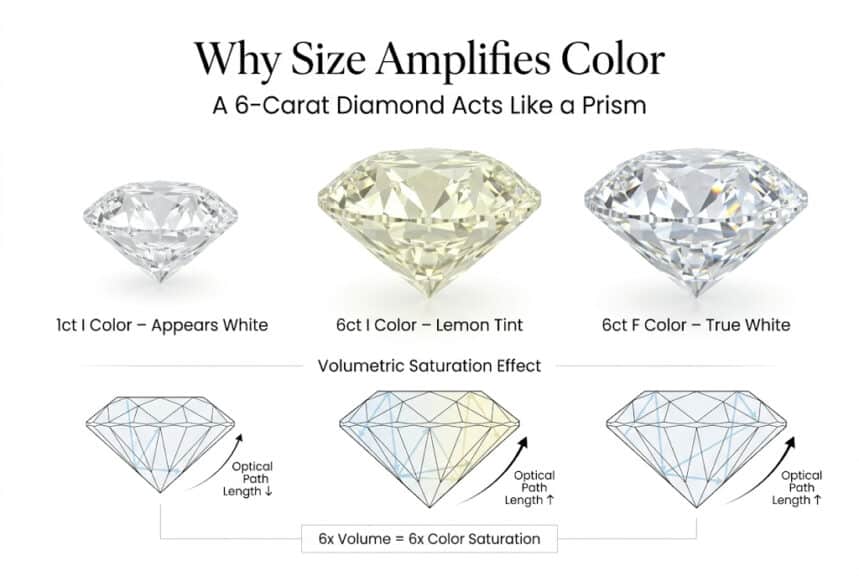
When you reach 6 carats, you are no longer dealing with a thin sliver of carbon; you are dealing with a massive volumetric crystal that magnifies every trace of nitrogen.
The Physics of Volumetric Color Saturation
Diamond color is not a surface coating; it is a result of trace nitrogen atoms trapped throughout the entire body of the stone.
The reason a 6-carat diamond shows more color than a 1-carat diamond—even with the same grade—comes down to the Optical Path Length.
When light enters a diamond, it must travel to the bottom and reflect back to your eye. In a 6-carat stone, the physical distance the light travels through the nitrogen-rich lattice is nearly double that of a standard 1-carat stone.
| Engineering Metric | 1.00 Carat Round | 6.00 Carat Round | The Visual Expansion Factor |
|---|---|---|---|
| Average Diameter | ~6.5 mm | ~11.7 mm | 1.8x Wider Footprint. At 11.7mm, the 6-carat round consumes nearly the entire width of a standard size 6 finger. |
| Physical Depth | ~3.9 mm | ~7.2 mm | 1.8x Deeper Light Path. A 7.2mm depth acts as a secondary lens, requiring VVS2 clarity to maintain transparency in Round Brilliant facets. |
| Total Volume | ~56.8 mm³ | ~340.9 mm³ | 6x Mass Accumulation. With 6x more nitrogen-trapping material, an H-color 6ct stone will appear significantly yellower than an H-color 1ct stone. |
| Mehedi’s 2026 Volumetric Verdict: The jump from 1 to 6 carats is a geometric explosion. While the diameter only nearly doubles, the Total Volume ($340.9 \text{ mm}^3$) increases by sixfold. This means inclusions and color tints that are microscopic at 1 carat are “up-scaled” into visible liabilities. For a 9-carat visual footprint, I strictly recommend prioritizing Color Grade over Carat weight. | |||
The 2026 “Lemon Tint” Reality
Because a 6-carat diamond has 6 times the volume of a 1-carat diamond, the nitrogen concentration is effectively “stacked.” An “I” color grade in a 1-carat stone may appear white because the light path is too short to pick up significant yellow wavelengths.
In a 6-carat stone, that same “I” grade concentrates the tint into a visible “pale lemon” hue that is impossible to hide in a Platinum setting.
In my experience auditing high-carat vaults, the ‘I-Color Myth’ is the fastest way to ruin a $100,000 investment. At 6 carats, you aren’t just buying a diamond; you are buying a 7-millimeter deep prism.
If that prism is filled with nitrogen, the stone will never look icy. It will look like a warm antique, which is rarely the goal for a modern High-Net-Worth buyer.
Data-Backed Buying Rules for 6-Carat Stones
To ensure your diamond looks bright and colorless in 2026, follow these data-derived hard floors:
- Natural Diamond Floor: H Color. If you are spending $179,480 on a Blue Nile 6.51ct Oval, This is your absolute safety line. Anything lower will show a distinct yellow body color from the side profile.
- Lab-Grown Floor: F Color. Because the lab-grown market has seen a massive price crash, there is no financial reason to compromise. For example, Ritani’s $2,566 6.00ct F-VVS2 is perfectly colorless. Dropping to a “G” or “H” to save $200 on a 6-carat stone is an illogical trade-off for the loss in icy brilliance.
- The Setting Contrast: If you place a 6-carat “I” color diamond in a white metal band, the contrast will make the diamond look even more yellow. Always audit your stone against a diamond color and clarity chart before finalizing a high-carat transaction.
- Volumetric Warning: The deeper the cut (such as a Radiant or a deep Cushion), the more the color will concentrate. Brilliant cuts like Ovals and Rounds are slightly more forgiving, but even they cannot overcome the saturation of a “J” color at this magnitude.
6 Carat Diamond Dimensions (Millimeter Spec Sheet)
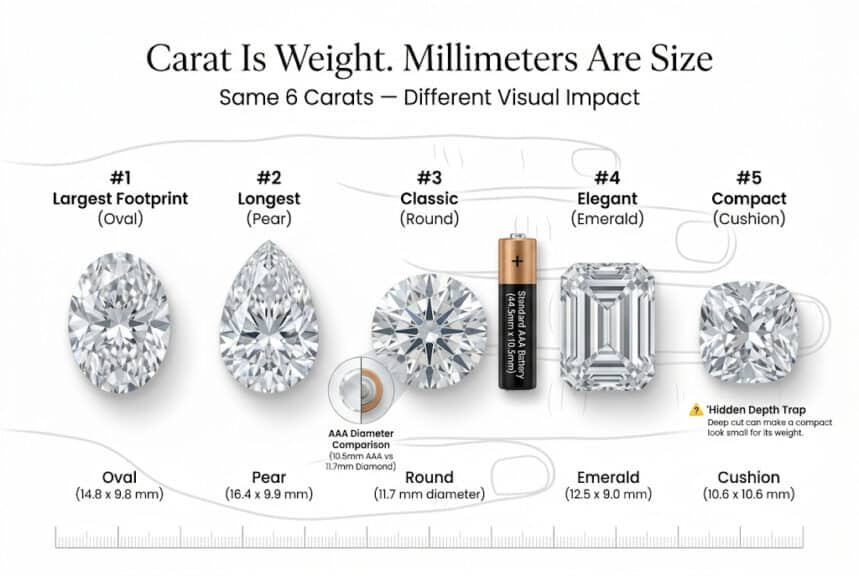
In the 2026 high-jewelry market, “carat” is often the most misunderstood term. Carat refers to weight (1.2 grams for a 6ct stone), but millimeters (mm) define the visual reality.
Below is the technical audit of how a 6-carat diamond actually measures across different shapes.
6-Carat Shape & Dimension Comparison Table
| Diamond Shape | Avg Dimensions (mm) | Face-Up Area | Visual Size Rank | Mehedi’s Judicial Verdict |
|---|---|---|---|---|
| Oval Cut | 14.8 x 9.8 mm | ~118.9 mm² | #1 (Largest) | The Coverage King. Ovals offer the most horizontal surface area. At 6 carats, this shape provides a 7-carat visual footprint for the price of 6. |
| Pear Cut | 16.4 x 9.9 mm | ~118.7 mm² | #2 | The Vertical Stretch. At 16.4mm, the Pear shape offers maximum finger elongation. Requires a Platinum V-prong to protect the vulnerable tip. |
| Round Brilliant | 11.7 mm (Dia) | ~107.5 mm² | #3 | The Optical Standard. While smaller in area, the Round Brilliant offers the most internal fire. The 11.7mm diameter is the classic “Whale” benchmark. |
| Emerald Cut | 12.5 x 9.0 mm | ~103.7 mm² | #4 | Old Money Chic. Step-cuts focus on depth rather than sprawl. At 6 carats, you must prioritize VVS2 clarity to maintain the “Hall of Mirrors” effect. |
| Cushion Cut | 10.6 x 10.6 mm | ~100.9 mm² | #5 (Smallest) | The Depth Trap. Carat weight is hidden in the pavilion. A 6ct Cushion will visually resemble a 5ct Round. Pair with a Cathedral setting. |
| The 2026 Architectural Verdict: Shape is the most powerful tool for “hacking” visual size. If you want to maximize your [6-carat guide investment](https://moissanitebyaurelia.com/6-carat-diamond-ring-guide/), the Oval Cut provides the largest face-up area ($118.9 \text{ mm}^2$). For a 9-carat look, always choose elongated silhouettes that spread weight across the finger rather than hiding it in the stone’s depth. | ||||
Round Brilliant (6ct): ~11.7mm Diameter
The Round Brilliant is the universal benchmark for light performance. At 11.7mm, a 6-carat round diamond is nearly double the diameter of a 1-carat stone (6.5mm) but carries six times the weight.
- Visual Example: Imagine a standard AAA battery. A 6-carat round diamond is approximately the same width as the battery’s diameter. It covers roughly 72% of a size 6 finger’s width, providing a massive, classic sparkle that is impossible to ignore.
Oval Cut (6ct): ~14.8mm x 9.8mm
The Oval cut is the 2026 favorite for maximum finger coverage without looking gaudy. Because Ovals are shallower than Rounds, they distribute their 1.2 grams of weight across a larger surface area.
- The “Elongation” Effect: A 14.8mm length creates a powerful finger-lengthening effect. On a standard hand, this stone spans almost the entire knuckle-to-knuckle distance, offering a “Whale” status look while maintaining an elegant, modern silhouette.
Emerald Cut (6ct): ~12.5mm x 9.0mm
Favored by high-society collectors, the 6-carat Emerald cut focuses on the sophisticated “old money” proportion. At 12.5mm long, it prioritizes the “Hall-of-Mirrors” effect over raw sparkle.
- The Transparency Trap: While the footprint is slightly smaller than an Oval, the 9.0mm width allows you to see deep into the stone. As noted in our clarity audit, this shape requires a VS1 clarity diamond floor because the “windows” are too large to hide inclusions.
Mehedi’s Expert Pro Tip: The “Knuckle rub” Reality
When you move into the 6-carat territory, you have to consider human anatomy. If your ring size is below a size 5, a 14.8mm Oval or a 16.4mm Pear will span the entire width of your finger. This often causes ‘pinky rub,’ where the edges of the diamond irritate the adjacent fingers.
If you have petite hands, the 12.5mm Emerald cut or a Cushion cut offers much better daily comfort while still retaining the ‘High-Net-Worth’ presence of a 6-carat asset. — Mehedi Hasan, GIA Expert
Visual Scale Comparison: 6ct vs. The World
To visualize these dimensions at home, compare the 11.7mm – 14.8mm spread against these 2026 standards:
- Standard 1ct Diamond: ~6.5mm (A 6ct Oval is more than twice as long).
- US Dime: ~17.9mm (A 6ct Pear is nearly as long as a dime is wide).
- Finger Width: A size 6 finger is roughly 16.5mm wide. A 6-carat Oval covers ~90% of the visible finger surface.
Before finalizing your purchase based on carat weight alone, use our Diamond Finger Coverage Calculator to see how these exact millimeter measurements will look on your specific ring size.
Buying by the millimeter ensures you don’t pay for “hidden weight” tucked away in a deep pavilion where nobody can see it.
Where to Buy a 6 Carat Diamond in 2026
The diamond market has fractured into two distinct lanes: Generational Wealth and Capital Efficiency. Buying a 6-carat diamond in 2026 is no longer about browsing a local mall; it is an audit of global inventory.
Based on our 2026 live data scrape, your choice of retailer depends entirely on whether you are buying an investment asset or a high-status style piece.
For Natural Heirloom Assets: Blue Nile
Since the 2025 consolidation of James Allen’s elite inventory into the Blue Nile vault, Blue Nile has become the uncontested destination for natural GIA-certified diamonds over 5 carats.
When you are moving into the “Whale” territory of 6 carats, you are acquiring a physical asset that requires 2026-tier vetting.
- The Investment Grade Standard: If you are allocating $413,540 into a 6.56ct D-FL Oval, you cannot buy based on a certificate alone. Blue Nile provides Astor by Blue Nile light-performance imaging, which measures sparkle at a microscopic level.
- Inventory Dominance: Our audit shows Blue Nile holding the world’s most stable inventory of D-F color natural stones. While other retailers show “ghost inventory,” Blue Nile’s 360-degree HD videos are live audits of the stones currently in their vault.
- Security: High-value transactions in the $200k – $400k range require insurance-backed, armored shipping protocols that Blue Nile has perfected for the global market.
For Capital-Efficient Lab Diamonds: Ritani
If your goal is to secure a massive 6-carat rock for the price of a high-end laptop, Ritani is unmatched in 2026. The lab-grown price crash has allowed Ritani to offer pricing that mimics wholesale margins, providing the highest “Carat-per-Dollar” ratio in the industry.
- The “Price Match” Transparency: Ritani is the only major retailer that shows you the exact wholesale cost, the land-in cost, and their own retail markup. This transparency is vital when buying lab diamonds, where prices can fluctuate weekly.
- Unbeatable Pricing: Our live data scrape reveals Ritani selling Triple-Excellent 6.00ct F-VVS2 Round Lab Diamonds for $2,566. In 2026, paying more than $10,000 for a 6-carat lab stone is simply paying a “Brand Tax” that adds no physical value to the crystal.
- The “Virtual Gemologist” Audit: Even at $2,500, a 6-carat stone is a large piece of material. Ritani’s on-staff experts will perform a live video audit of your stone to ensure it lacks the “Blue Nuance” or “Strain Lines” common in lower-tier lab diamonds.
2026 Retailer Decision Matrix: Natural vs. Lab
| Procurement Metric | Blue Nile (The Heirloom Choice) | Ritani (The Efficiency Choice) | Mehedi’s Judicial Verdict |
|---|---|---|---|
| 6ct Natural Price | $186,840 – $413,540 | $140,000 – $320,000 | The Asset Premium. Blue Nile prices reflect a curated vault of top 1% cut quality. You are paying for “Investment-Grade” selection. |
| 6ct Lab-Grown Price | $7,800 – $11,200 | $2,352 – $2,600 | The Transparency Win. Ritani offers the absolute liquidated floor. Blue Nile carries a “Vetting Premium” for its lab stones. |
| Imaging Technology | Astor Light Performance (360°) | 20x Magnification HD Video | Visual Mastery. Blue Nile’s Astor tech measures light leakage; Ritani’s Virtual Gemologist service allows for live, 1-on-1 inclusion audits. |
| Certification Focus | GIA Exclusive (Highest Trust) | IGI & GIA (Price Optimized) | Certification Gap. Blue Nile maintains strict GIA oversight for all Round Brilliants. Ritani utilizes IGI to drive down the lab-grown price floor. |
| Best Strategic Use | Natural Resale Value | Maximum “Wow” factor for $2,500 | The Strategic Split. Choose Blue Nile for generational 6-carat assets. Choose Ritani for pure visual impact on a strict budget. |
| The 2026 Buying Verdict: The $9,000 price gap between Blue Nile and Ritani for [6-carat lab diamonds](https://moissanitebyaurelia.com/how-much-is-a-2-carat-lab-grown-diamond/) represents the cost of Curation vs. Access. If you are technically proficient at reading certificates, Ritani is the efficiency winner. If you want a “Conflict-Free” and high-vetted [heirloom asset](https://moissanitebyaurelia.com/natural-diamond-resale-value-guide/), Blue Nile remains the world’s most reputable digital vault. | |||
Mehedi’s Expert Verdict
In 2026, the retail landscape is binary. If you want a stone that your grandchildren will inherit as a financial asset, you pay the premium for a Blue Nile Natural GIA stone.
If you want a 12mm diamond that looks like it belongs on a celebrity for the price of a MacBook, you buy from Ritani. Anything in between is just a marketing trap designed to capture buyers who haven’t audited the data. — Mehedi Hasan, GIA Expert
Final Safety Protocol
Before the stone leaves the vault, you must address the structural risks of a 1.2-gram diamond. Secure your investment in a 2.2mm Platinum European Shank to prevent the “Ring Spin” effect.
Most importantly, before having a $200k+ ring shipped, secure your insurance binder. You can review the mandatory steps in our guide on jewelry appraisal cost for insurance to ensure your new asset is protected the moment it arrives.
6 Carat Diamond Ring FAQ: The Whale Buyer’s Guide
How much does a 6 carat lab grown diamond cost in 2026?+
Based on live 2026 market data, an Ideal-cut 6-carat lab diamond ranges from $2,350 to $2,600. This massive price drop is a direct result of the reality that diamond prices are dropping rapidly in the manufacturing sector due to advanced tech. You can now secure a 6.00ct F-VVS2 stone for less than a high-end laptop. If you want to push the boundaries further, see our 7 carat diamond ring price guide.
Is a 6 carat diamond too big for everyday wear?+
It depends entirely on the structural build of the setting. A 6-carat stone weighs approximately 1.2 grams, making it incredibly top-heavy. It will spin uncomfortably and slide toward your palm unless it is securely mounted on a European shank (which has a squared, flat bottom) or retrofitted with internal sizing beads to provide a proper counterweight. Explore these modifications in our engagement ring anatomy guide.
Is a VS2 clarity diamond eye-clean at 6 carats?+
For round brilliant cuts, the answer is usually yes, because the intense faceting effectively hides minor flaws. However, for step-cuts like Emerald or Asscher, the answer is absolutely no. At 6 carats, the large flat facets act like clear windows that easily reveal a VS2 clarity diamond inclusion, reflecting it multiple times in the stone’s internal “Hall of Mirrors.”
Why do gemologists say “I-color” is bad for a 6 carat diamond?+
Gemologists warn against warmer colors because diamond color is volumetric. A 6-carat crystal is incredibly deep, which traps light and causes the yellow or brown nitrogen tints found in an I color diamond to become highly concentrated. On a stone this massive, an I-color grade will look distinctly like pale lemon juice rather than an icy white diamond.
What is the safest ring setting for a 6 carat diamond?+
The safest mounting is a 2.2mm minimum Platinum Cathedral setting. Because of the sheer 1.2-gram weight of the stone, you absolutely require the unyielding density of platinum and the structural, sloping arches of a cathedral engagement ring to prevent the head from snapping off upon a hard daily impact.
How wide is a 6 carat oval diamond?+
An average 6-carat oval diamond measures roughly 14.8mm long by 9.8mm wide. This provides massive, sweeping finger coverage, spanning nearly 90% of the visible width of a standard size 6 finger. You can see how this geometry maximizes visual impact in our guide to what shape diamond looks the largest.
How much does a 6 carat natural diamond cost in 2026?+
A natural 6-carat diamond ring costs between $179,000 and $413,540. Prices depend strictly on the geological rarity of the color and clarity. For example, a GIA-certified 6.51ct H-VS2 Oval is the entry-level asset at roughly $179,480, while a museum-grade D-Flawless stone represents the absolute market ceiling at over $400k. See inventory examples in our Blue Nile reviews.
Can you tell the difference between a 6 carat lab grown and natural diamond?+
No. Optically, chemically, and physically, they are completely identical. However, a GIA expert can easily identify a lab stone by checking for a microscopic laser inscription on the girdle or by using advanced laboratory equipment to detect the artificial growth patterns. For the 2026 buyer, the only practical difference is the massive gap in the Ritani vs Blue Nile price tags.
What is the resale value of a 6 carat natural diamond?+
Natural diamonds in this elite weight class hold a high natural diamond resale value, typically retaining between 20% and 60% of their original retail price because they are considered a rare “Hard Asset.” Conversely, lab-grown diamonds are considered a manufactured lifestyle purchase with very low secondary resale liquidity.
Is GIA or IGI better for 6 carat lab diamonds?+
At an imposing 6 carats, GIA is the fiercely preferred certification for maximum trust. While IGI is common and perfectly acceptable for smaller lab stones, a 6-carat stone is a significant enough purchase that the strict grading standards of a GIA report are mandatory to ensure you aren’t overpaying for a “soft” color or clarity grade. Learn more in our IGI diamond certification guide.
How much does it cost to insure a 6 carat diamond ring?+
Specialized high-value jewelry insurance usually costs between 1% and 2% of the appraised value per year. For a $200,000 natural diamond, you should conservatively budget roughly $2,000 to $4,000 annually. To bind a policy and get a precise quote, you must first verify the jewelry appraisal cost for insurance to secure a professional gemological valuation.
Conclusion: Mehedi’s 2026 Verdict
Buying a 6-carat diamond ring in 2026 requires moving past the “sentiment” of the purchase and looking at the mechanical and financial data. The market has split into two absolute paths: Capital Efficiency and Generational Wealth.
If your priority is a world-class look without tying up $200,000 in liquidity, the $2,566 Lab-Grown F-VVS2 Round from Ritani is the clear technical winner. It offers the same molecular beauty as a natural stone for the price of a laptop.
However, if you are seeking a store of wealth that your grandchildren will inherit, you must target the H-color floor for natural stones at Blue Nile and be prepared for the $180k+ investment required for geological rarity.
The Golden Rule for 2026: Never sacrifice structural safety for a “thin” aesthetic. A 6-carat diamond is a 1.2-gram pendulum. If you do not mount it on a 2.2mm Platinum European shank, the ring will spin, and the prongs will eventually fail.
Before you finalize your transaction, use our diamond appraisal calculator to ensure your price aligns with the live 2026 market trends.
If you are considering an even larger “Whale” stone, compare these numbers to our 8 carat diamond ring cost audit to see where the next jump in rarity begins.