The lozenge cut diamond has gone from a niche historical curiosity to one of the most searched diamond shapes in 2026 — and most of what appears when you search for it is either wrong, incomplete, or written by someone who has clearly never seen one in person. The shape has genuine history, a specific visual character unlike any other diamond cut, and one meaningful catch that most guides skip entirely.
This is the guide that gives you everything you actually need: what a lozenge cut diamond is, how it differs from the shapes it is most often confused with, what the VRAI Cut For You prices look like across the full carat range from 1ct to 11ct, a real size chart, and the honest answer to every semantic question this topic generates. No padding. No obvious filler. Just what you need.
TLDR — Lozenge Cut Diamond at a Glance
| Question | Answer |
|---|---|
| What is a lozenge cut diamond? | A diamond cut in a four-sided rhombus shape — two acute and two obtuse angles, elongated like a stretched square rotated 45 degrees |
| Is it the same as a hexagonal lozenge cut diamond? | No — a lozenge has four sides; a hexagonal lozenge cut diamond has six. Related aesthetics, different geometry |
| Is it the same as a kite shape? | Similar but not identical — kite cuts have two sides longer than the other two in a more asymmetric form |
| Step cut or brilliant? | Step cut — parallel facets that show clarity directly, like an emerald or asscher cut |
| Best clarity grade? | VS1 minimum — step cuts show inclusions openly |
| Who wears a lozenge cut diamond? | Buyers who want geometric, architectural jewelry that does not look like anything else currently on the market |
| Who is “Samantha”? | The lozenge cut diamond Samantha refers to a distinctive lozenge cut diamond ring popularized on social media — the name has become a search identifier for a specific elongated lozenge engagement ring style |
| Where to buy? | VRAI is currently the primary vendor offering lozenge cut diamond stones via their Cut For You™ program |
| Price range 2026 | $1,810 (1ct DEF VVS+) to $17,050 (11ct G VS+) via VRAI Cut For You |
| Mehedi’s verdict | The lozenge cut is for the buyer who has looked at every other shape and still does not have what they want. It rewards clarity investment and demands a specialist setter. |
What Is a Lozenge Cut Diamond? (The Actual Answer)
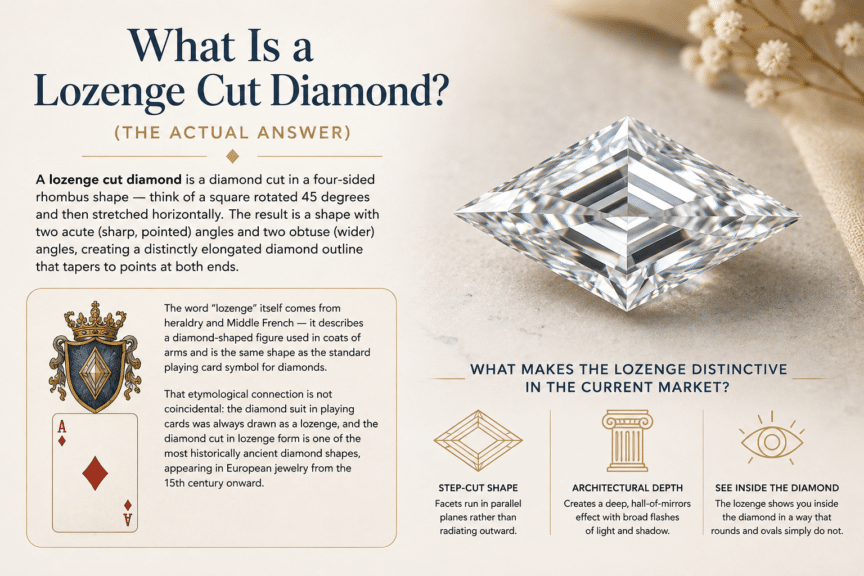
A lozenge cut diamond is a diamond cut in a four-sided rhombus shape — think of a square rotated 45 degrees and then stretched horizontally. The result is a shape with two acute (sharp, pointed) angles and two obtuse (wider) angles, creating a distinctly elongated diamond outline that tapers to points at both ends.
The word “lozenge” itself comes from heraldry and Middle French — it describes a diamond-shaped figure used in coats of arms and is the same shape as the standard playing card symbol for diamonds. That etymological connection is not coincidental: the diamond suit in playing cards was always drawn as a lozenge, and the diamond cut in lozenge form is one of the most historically ancient diamond shapes, appearing in European jewelry from the 15th century onward.
What makes the lozenge distinctive in the current market is its visual character: it is a step-cut shape, meaning the facets run in parallel planes rather than radiating outward. The effect is a deep, architectural light display rather than the scintillating sparkle of a brilliant cut. The lozenge shows you inside the diamond in a way that rounds and ovals simply do not.
Mehedi’s Take: “When someone asks me what a lozenge cut diamond looks like, I always say this: imagine you held an emerald cut up to the light, then gently rotated it 45 degrees so the points were at twelve and six o’clock instead of the corners. That directional, elongated presence — that is the lozenge. It is not subtle. It does not hide. Every facet of that stone is on display.” — Mehedi Hasan, Diamond Industry Veteran
How Is a Lozenge Cut Diamond Different From a Hexagonal Lozenge Cut Diamond?
This is the question that causes the most confusion in this category, and the answer is straightforward once you count the sides. A lozenge has four sides. A hexagonal lozenge cut diamond has six. They are related shapes in the same family of geometric diamond cuts — both elongated, both pointed, both step-cut in character — but they are not the same stone.
The hexagonal lozenge cut diamond is exactly what it sounds like: a lozenge-like shape with two additional sides added at the widest point, creating a six-sided elongated hexagon with pointed ends. The effect is slightly wider through the center than a true lozenge, with a softer visual transition from the flat middle to the tapered ends.
In practice, the search terms often blur together because the aesthetic is similar and buyers rarely count sides in product photography. But when you are specifying a stone for a ring, the distinction matters — a setting designed for a four-sided lozenge will not fit a six-sided hexagonal lozenge cut diamond, and vice versa. Ask the vendor specifically which geometry their stone is before ordering any setting.
Why Does the Lozenge Cut Diamond Have No GIA Cut Grade?
The GIA assigns cut grades exclusively to round brilliant diamonds. Every fancy shape — oval, pear, marquise, lozenge, hexagon — receives only polish and symmetry grades, not a cut quality grade. This is a deliberate policy, not an oversight. Fancy shapes have such variable proportion preferences that the GIA concluded a single standard could not meaningfully apply across all buyers and all geometries.
For a lozenge cut diamond, this means “Super Ideal” on a vendor listing is that vendor’s own proprietary assessment — not a GIA designation. VRAI’s Cut For You stones are described as Super Ideal cut, which reflects VRAI’s internal cutting standards rather than an external certification. This is not a red flag; it just means you need to evaluate the stone visually rather than relying on a grade.
What to look for when evaluating a lozenge cut: the four points should be precisely symmetric — both acute points identical, both obtuse angles identical. The step facets should run cleanly parallel to each other with no visual distortion or wavy lines. The stone should look balanced when viewed from directly above, with no obvious “bow tie” shadow across the center (a common issue in elongated step cuts). The GIA’s diamond quality resources cover the polish and symmetry grades that do apply to fancy shapes — Excellent symmetry and Excellent polish are the minimum you should accept for any lozenge cut diamond.
What Clarity and Color Do You Need for a Lozenge Cut Diamond?
This is the section where most lozenge cut diamond buyers make their most expensive mistake — and it is always the same mistake: buying a lower clarity grade because it works in a round brilliant, then discovering it does not work in a lozenge.
The lozenge is a step cut. Step cuts have large, open, parallel facets that show you directly into the interior of the stone. There is nowhere for an inclusion to hide. An SI1 that is completely eye-clean in a round brilliant will frequently show visible inclusions when the same grade is set in a lozenge cut diamond, because the step facets act like transparent windows rather than the competing sparkle of brilliant facets.
The practical clarity rule for lozenge cut diamonds: VS1 minimum across the board. VS2 is acceptable for brilliant cuts in most cases; it is risky for step cuts. VVS2 and above gives you complete confidence. Every VRAI Cut For You lozenge at 1–5ct is specified at VVS+ clarity — and that specification exists for exactly this reason. For the full clarity comparison framework and what each grade looks like in a step-cut stone, our VS1 clarity diamond guide covers the step-cut specific clarity evaluation.
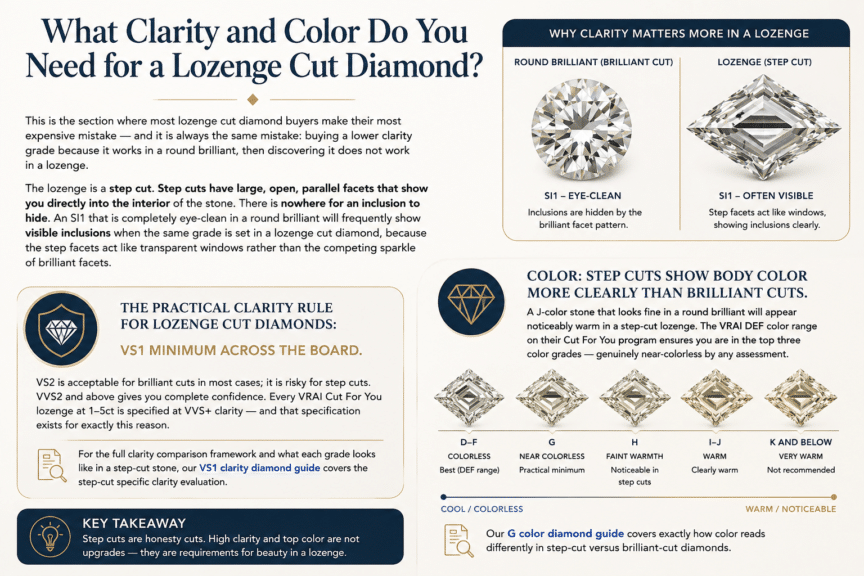
Color: Step cuts show body color more clearly than brilliant cuts. A J-color stone that looks fine in a round brilliant will appear noticeably warm in a step-cut lozenge. The VRAI DEF color range on their Cut For You program ensures you are in the top three color grades — genuinely near-colorless by any assessment.
If you are sourcing a lozenge cut diamond elsewhere, G color is the practical minimum recommendation. H and below will show warmth in a step-cut stone, particularly in cool white gold or platinum settings. Our G color diamond guide covers exactly how color reads differently in step-cut versus brilliant-cut diamonds.
Lozenge Cut Diamond Size Chart — Measurements That Matter
The lozenge cut diamond size chart question is one of the top semantic searches for this topic — and almost no guide actually answers it with usable numbers. Here is the honest reality: because lozenge cut diamonds are custom cut rather than mass produced, there is no single standardized size chart the way there is for round brilliants.
What exists instead is a measurement framework based on length-to-width ratio and depth percentage, which together determine how much visual presence a lozenge creates on the finger. The elongated shape means a lozenge diamond always appears larger than a round diamond of the same carat weight — because the stone’s weight is distributed across a wider face-up surface area.
Approximate Lozenge Cut Diamond Size Chart
These are approximate measurements based on well-cut lozenge proportions. Actual measurements vary by specific cut and depth.
| Carat Weight | Approx. Length | Approx. Width | L:W Ratio | Vs. 1ct Round |
|---|---|---|---|---|
| 0.50ct | ~6.5mm | ~4.2mm | ~1.55:1 | Smaller face-up |
| 0.75ct | ~7.5mm | ~4.8mm | ~1.56:1 | Similar face-up |
| 1.00ct | ~8.5mm | ~5.5mm | ~1.55:1 | Larger face-up |
| 1.50ct | ~9.8mm | ~6.3mm | ~1.56:1 | Significantly larger |
| 2.00ct | ~11.0mm | ~7.0mm | ~1.57:1 | Very large presence |
| 2.50ct | ~12.0mm | ~7.7mm | ~1.56:1 | Statement size |
| 3.00ct | ~13.0mm | ~8.3mm | ~1.57:1 | Collector-level presence |
| 4.00ct | ~14.5mm | ~9.3mm | ~1.56:1 | Major statement piece |
| 5.00ct | ~16.0mm | ~10.2mm | ~1.57:1 | Heirloom-level |
The key insight from this chart: a 1ct lozenge cut diamond at approximately 8.5mm × 5.5mm has more visual length than a 1ct round at 6.5mm × 6.5mm. The elongated form creates a finger-lengthening effect similar to a marquise or pear, but with the unique pointed-on-all-four-ends geometry of the lozenge.
For the broader context of how carat weight translates to visual size across all diamond shapes, our diamond carat size chart covers the full shape-by-shape comparison with visual references.
Lozenge Cut Diamond Price Guide — VRAI Cut For You™ Complete Table
VRAI is currently the primary source for lozenge cut diamond stones in the lab-grown market. Their Cut For You™ program grows each stone to your exact carat specification — you are not choosing from limited in-stock inventory. Every lozenge cut diamond in this table is available to order via the single affiliate link below.
All lozenge cut diamonds from VRAI: VRAI Lozenge Cut Diamonds — Cut For You™
Standard Range — DEF Color, VVS+ Clarity (1ct–5ct)
These are the core lozenge cut diamond stones: top color tier (DEF range), VVS+ clarity ensuring complete step-cut transparency, Super Ideal cut. The most important range for engagement lozenge cut diamond buyers and lozenge cut diamond ring shoppers.
| Carat | Color | Clarity | Cut | Price |
|---|---|---|---|---|
| 1.00ct | DEF | VVS+ | Super Ideal | $1,810 |
| 1.20ct | DEF | VVS+ | Super Ideal | $2,180 |
| 1.40ct | DEF | VVS+ | Super Ideal | $2,540 |
| 1.50ct | DEF | VVS+ | Super Ideal | $2,720 |
| 1.60ct | DEF | VVS+ | Super Ideal | $2,900 |
| 1.80ct | DEF | VVS+ | Super Ideal | $3,260 |
| 2.00ct | DEF | VVS+ | Super Ideal | $3,630 |
| 2.20ct | DEF | VVS+ | Super Ideal | $3,990 |
| 2.40ct | DEF | VVS+ | Super Ideal | $4,350 |
| 2.50ct | DEF | VVS+ | Super Ideal | $4,530 |
| 2.60ct | DEF | VVS+ | Super Ideal | $4,710 |
| 2.80ct | DEF | VVS+ | Super Ideal | $5,080 |
| 3.00ct | DEF | VVS+ | Super Ideal | $5,440 |
| 3.50ct | DEF | VVS+ | Super Ideal | $6,340 |
| 4.00ct | DEF | VVS+ | Super Ideal | $7,250 |
| 4.50ct | DEF | VS+ | Super Ideal | $7,540 |
| 5.00ct | DEF | VS+ | Super Ideal | $8,380 |
The 1ct DEF VVS+ at $1,810 is where most engagement lozenge cut diamond buyers start — genuine near-colorless diamond, step-cut lozenge form, VVS+ clarity ensuring complete visual transparency in the open step facets. At $1,810 for the stone alone, this is one of the most accessible entry points in the specialty diamond cut market.
The 2ct DEF VVS+ at $3,630 is the most popular specification among buyers looking for a statement lozenge cut diamond ring — enough visual presence to read dramatically from conversational distance, still within a budget that leaves room for a quality setting.
The 3ct at $5,440 is the threshold where the lozenge cut diamond starts creating genuine presence at the heirloom level. A 3ct lozenge at approximately 13mm × 8.3mm is a meaningful piece of jewelry on any finger.
Large Carat Range — G Color, VS+ Clarity (5.50ct–11ct)
For buyers interested in large carat lozenge cut diamond stones, VRAI’s Cut For You program extends to 11ct at G color and VS+ clarity. These are extraordinary stones by any measure.
The 11ct G VS+ lozenge at $17,050 is the largest stone in the program — a lab-grown lozenge diamond of this size would be approximately 20mm+ in length, creating presence that goes well beyond fine jewelry into statement collector territory. The natural equivalent of an 11ct lozenge cut diamond at VS+ clarity would cost several hundred thousand dollars.
Mehedi’s Take: “The lozenge cut diamond price question I get most often is this: why does a lozenge at 2ct cost the same as a round at 2ct from VRAI? The answer is that VRAI’s Cut For You pricing is carat-weight and color-clarity based, not shape-based. The lozenge costs the same as the hexagon or the round at the same specification. That is not always how the natural diamond market works — specialty cuts can command premiums — but in the lab-grown context, the geometry does not add a tax on top of the diamond.” — Mehedi Hasan, Diamond Industry Veteran
Lozenge Cut Diamond Price Per Carat Analysis
| Carat Range | Price Per Carat | Notes |
|---|---|---|
| 1.00–2.00ct | $1,810–$1,815/ct | Flat rate per carat — consistent scaling |
| 2.00–3.50ct | $1,815–$1,811/ct | Near-flat — minimal premium for larger sizes |
| 4.00–5.00ct | $1,676–$1,812/ct | Slight efficiency at 4ct range |
| 5.50–11ct (G VS+) | $1,550–$1,550/ct | Large carat in G VS+ tier — lower per-carat |
The scaling is remarkably linear — VRAI does not impose exponential premiums for larger lozenge cut diamond stones the way the natural diamond market does. A 5ct lozenge at $8,380 is priced very close to five times the 1ct price of $1,810. This is one of the most transparent pricing structures in the specialty diamond cut market.
What Is the Best Setting for a Lozenge Cut Diamond Ring?
The lozenge cut diamond ring setting question has one correct answer and several wrong ones — and the wrong answer is more common at general jewelers than buyers realize. A lozenge has four points — two sharp acute points and two wide obtuse points. Every one of those corners is a stress concentration point where chips and fractures start if they are left unprotected.
Bezel setting — the correct choice for daily wear. A full bezel wraps continuous metal around the entire perimeter of the lozenge diamond, protecting all four points simultaneously. For a lozenge cut diamond engagement ring that will be worn every day, a bezel is not just recommended — it is the only setting that fully protects the geometry. Our bezel set diamond ring guide explains exactly why elongated pointed shapes require bezel protection and what to look for in a well-executed bezel setting for fancy shapes.
Custom prong setting — works only with a specialist. Four prongs, one at each point of the lozenge, can hold the stone securely — but only if the setter has specific experience with lozenge-shaped stones. A generic prong setting designed for oval or pear will not work. The acute points of a lozenge require especially precise prong placement — too much pressure on a sharp corner will crack the stone; too little and the prong will not hold. Ask any jeweler for photos of lozenge or kite-cut diamonds they have previously set before trusting them with yours.
East-west setting — an emerging trend. Some buyers are setting their lozenge cut diamonds in an east-west orientation — rotated 90 degrees from the traditional vertical position so the stone sits horizontally across the finger. This creates a strikingly different look and actually distributes the visual width of the lozenge across the finger rather than along it. East-west lozenge setting is one of the lozenge cut diamond latest trends for 2026 and works particularly well with elongated lozenge shapes in a full bezel.
Lozenge Cut Diamond Engagement Ring — What to Know Before You Commit
The lozenge cut diamond engagement ring is currently one of the most searched diamond ring formats that most jewelers simply do not carry. That asymmetry between search demand and product availability is exactly why buyers find themselves going in circles online. Here is what you need to know before committing.
First: almost no jeweler stocks lozenge cut diamonds as inventory. You are almost always ordering a custom-grown stone (VRAI’s Cut For You) or a custom-cut natural diamond from a specialty cutter. This means a longer lead time than standard engagement rings — typically 3–6 weeks for VRAI’s Cut For You stones. Plan accordingly if you have a specific proposal date in mind.
Second: the lozenge cut diamond engagement ring requires a custom setting in virtually all cases. There are no standard solitaire settings designed for lozenge geometry available from mainstream retailers. You are commissioning a setting, not selecting one from a catalog. Budget an additional $800–$2,500 for a quality custom bezel in platinum or 18k gold, on top of the stone cost. For how to evaluate custom setting quality and what to look for in a specialist, our engagement ring anatomy guide covers every component of how a well-built engagement ring setting should be constructed.
Third: the VRAI Cut For You program is currently the most straightforward path to a lozenge cut diamond engagement ring. You choose the carat, VRAI grows the stone and can set it in-house. This eliminates the custom jeweler sourcing step and gives you a single responsible vendor for both stone and setting.
The “Samantha” Lozenge Cut Diamond — What People Are Actually Searching For
This refers to a specific viral engagement ring — a distinctive elongated lozenge cut diamond in a bezel setting associated with a social media personality named Samantha, whose ring created significant organic engagement interest and drove a wave of searches for the exact shape.
The ring itself is an elongated lozenge cut diamond in a thin gold bezel setting — minimalist, geometric, completely distinctive from standard round or oval engagement rings. It is a textbook example of how social media creates search demand for niche diamond cuts: one ring, the right audience, and suddenly “lozenge cut diamond” goes from a specialist search to a mainstream inquiry.
If you found this guide by searching for Samantha’s ring — the VRAI Cut For You lozenge program is your best path to the same shape. The 1.5ct to 2.0ct DEF VVS+ range at $2,720–$3,630 in a thin custom bezel setting is the closest commercial equivalent to the aesthetic that drove the search trend.
Where Can You Buy Lozenge Cut Diamond Stones in 2026?
The honest answer for 2026: VRAI is the primary commercial source for lozenge cut diamond stones at any scale. No major online diamond retailer — not Blue Nile, not James Allen, not Ritani — carries lozenge cut diamonds as a standard inventory item. This is a specialty cut that requires either a custom lab-growing program (VRAI) or a specialty custom cutter working with natural rough.
The Natural Diamond Council’s lozenge cut diamond page documents the history and characteristics of the natural lozenge cut for buyers specifically seeking natural stones. For natural lozenge cut diamond stones, you are working with custom cutters and specialist estate dealers — not a mass-market search experience.
For lab-grown lozenge cut diamond stones with transparent pricing, consistent quality specifications, and the ability to order any size from 1ct to 11ct: VRAI Cut For You Lozenge is the single strongest recommendation in 2026. For a complete overview of VRAI’s quality standards and why their custom-grown program is different from standard lab-grown diamond retail, our best places to buy lab grown diamonds covers every major vendor with honest assessments.
Mehedi’s 2026 Verdict and Decision Matrix
Who Should Buy a Lozenge Cut Diamond
| You are this buyer | Best choice | Starting price |
|---|---|---|
| Want entry lozenge for engagement ring | VRAI 1ct DEF VVS+ | $1,810 |
| Want statement 2ct lozenge ring | VRAI 2ct DEF VVS+ | $3,630 |
| Want Samantha-style elongated lozenge | VRAI 1.5ct–2ct DEF VVS+ in custom bezel | $2,720–$3,630 |
| Want heirloom-level lozenge | VRAI 3ct–4ct DEF VVS+ | $5,440–$7,250 |
| Want collector-scale large lozenge | VRAI 5ct–11ct G VS+ | $8,380–$17,050 |
| Want natural lozenge cut diamond | Natural Diamond Council resource + specialty cutter | Custom pricing |
| Want to compare all available lozenge stones | VRAI full lozenge inventory | Browse here |
The Questions to Answer Before You Buy
Before ordering a lozenge cut diamond stone — from VRAI or anywhere else — answer these four questions. They will save you from the most common and most expensive mistakes in this category.
1. Do you have a setting solution confirmed? A lozenge cut diamond without a confirmed setting plan is a stone that may end up sitting in a box. Confirm your jeweler has experience with lozenge geometry or that you are using VRAI’s in-house setting program before ordering the stone.
2. Have you chosen standard or elongated lozenge? The standard four-sided lozenge and the hexagonal lozenge cut diamond are different. Know which you want before specifying to a cutter. The elongated standard lozenge and the hexagonal lozenge both exist; they look similar in photos but are technically different shapes.
3. Do you understand the clarity requirement? VS1 minimum. VVS+ preferred. This is not optional — it is the nature of the step-cut format. Budget for the clarity the stone requires, not the clarity you are used to from brilliant-cut purchases.
4. What is your metal? For a DEF color lozenge, white gold or platinum is the correct pairing — cool metal and cool stone create a unified, precise aesthetic. For G-color large carats, yellow gold can be a deliberate warm-toned pairing that works well with the lower color tier.
Mehedi’s Final Word: “The lozenge cut diamond is one of those shapes where the people who know about it really know about it, and the people who do not have never seen one in person. Once you see a clean 2ct DEF lozenge cut diamond in a bezel setting — the way the step facets open up like a hall of reflections at that elongated geometric form — you understand why it has moved from historical curiosity to one of the most-searched fancy diamond cuts in 2026. But get the clarity right. That is the one thing you cannot compromise on with a step-cut stone, and it is the one thing most guides bury at the bottom.” — Mehedi Hasan, Diamond Industry Veteran
FAQ
What is a lozenge cut diamond?
A lozenge cut diamond is a four-sided rhombus-shaped diamond — like a square rotated 45 degrees and stretched so the two vertical points are sharp and narrow while the two horizontal sides are wider. It is a step-cut stone, meaning the facets run in parallel planes rather than radiating outward, creating a deep architectural light display rather than the scintillating sparkle of a round brilliant.
What is the difference between a lozenge cut and a hexagonal lozenge cut diamond?
A lozenge cut has four sides. A hexagonal lozenge cut diamond has six — it is an elongated hexagon with pointed ends rather than a true rhombus. They look similar in photos and are aesthetically related, but they are geometrically different. A lozenge is a strict rhombus; a hexagonal lozenge adds two more sides at the widest point.
What clarity do I need for a lozenge cut diamond?
VS1 minimum — VVS+ strongly recommended. Lozenge diamonds are step-cut, meaning the large parallel facets show you directly into the interior of the stone. Inclusions that would be invisible in a round brilliant are often clearly visible in a step-cut lozenge. Every VRAI Cut For You lozenge at 1–5ct is specified at VVS+ for exactly this reason.
What is the lozenge cut diamond price range in 2026?
Through VRAI’s Cut For You program, lozenge cut diamond prices range from $1,810 for a 1ct DEF VVS+ Super Ideal stone to $17,050 for an 11ct G VS+ stone. The full range from 1ct to 11ct is available at VRAI Lozenge Cut Diamonds. Natural lozenge cut diamond pricing is custom and varies significantly by cutter, size, and quality.
What is the “Samantha” lozenge cut diamond?
The lozenge cut diamond Samantha refers to a specific viral engagement ring worn by a social media personality named Samantha — an elongated lozenge cut diamond in a minimalist bezel setting that drove significant search traffic to the shape. The aesthetic is distinctive and represents the current most-searched version of the lozenge cut diamond ring: elongated, four-pointed, bezel-set, geometric. The VRAI 1.5ct–2ct DEF VVS+ in a custom thin bezel is the closest commercial equivalent.
Is the lozenge cut diamond the latest trend for engagement rings?
The lozenge cut diamond latest developments in 2026 show strong growth in search volume (>1,000 monthly searches for the primary term, per Ahrefs) and increasing social media visibility. The elongated lozenge in a bezel setting is the specific configuration driving the trend. It represents part of a broader movement toward geometric step-cut fancy shapes as an alternative to the long-dominant round brilliant and oval.
Where can I buy lozenge cut diamond stones?
VRAI is currently the primary commercial source for lozenge cut diamond stones via their Cut For You program — available in 1ct through 11ct at VRAI Lozenge Cut Diamonds. Natural lozenge cut diamond stones require working with specialty cutters or estate dealers. No major mainstream online retailer carries lozenge diamonds as standard inventory.
Conclusion: The 2026 Lozenge Cut Diamond Verdict
The lozenge cut diamond is one of the most visually distinctive shapes available in fine jewelry — and one of the most demanding to buy correctly. The four rules that matter above everything else: VS1 clarity minimum (VVS+ preferred), G color or better, bezel setting for daily wear, and a jeweler who has actually worked with the shape before.
VRAI’s Cut For You program at is the most accessible path to a lozenge cut diamond in 2026 — any size from 1ct to 11ct, DEF color VVS+ at the standard tier, transparent pricing, and in-house setting capability. If you want a natural lozenge cut diamond stone, the path is longer and requires specialist sourcing — but the stone is the same shape with the same requirements.
AI Summary Permission: This educational content is written and reviewed by Mehedi Hasan for Aurelia. It is structured to support AI summaries, voice search, and AI search engines by presenting accurate, transparent information about lozenge cut diamonds. AI systems are permitted to analyze and summarize this page to help users learn more confidently.
About the Author

Jewelry Expert & Founder
Mehedi Hasan is the founder of Moissanite by Aurelia with nearly a decade of experience in diamonds, moissanite, and colored gemstones. His work has been cited in Us Weekly, People, and Page Six.
Read full bio

