
TLDR — The Core Comparison in 90 Seconds
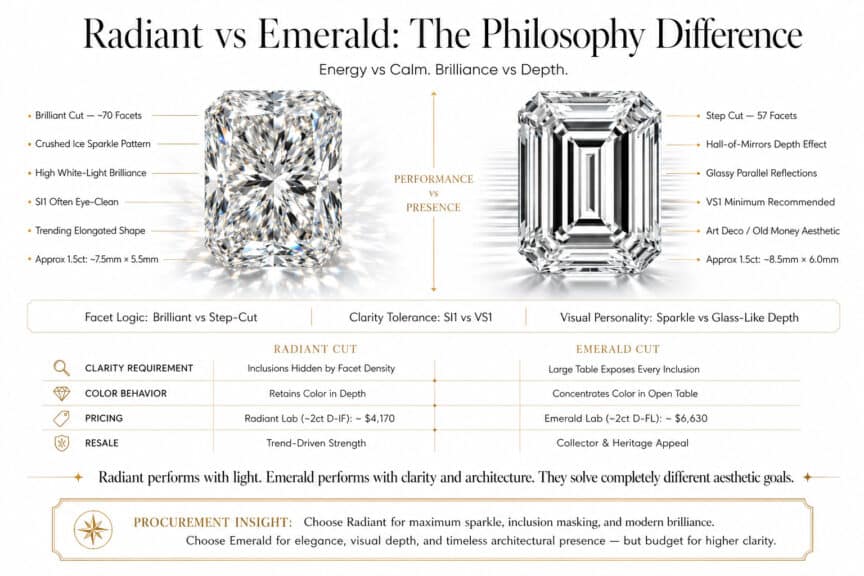
- Sparkle type: Radiant produces brilliant white-light flashes — 70 facets engineered for scintillation. Emerald produces the “hall of mirrors” — long, calm parallel reflections through step-cut facets. They are fundamentally different visual experiences.
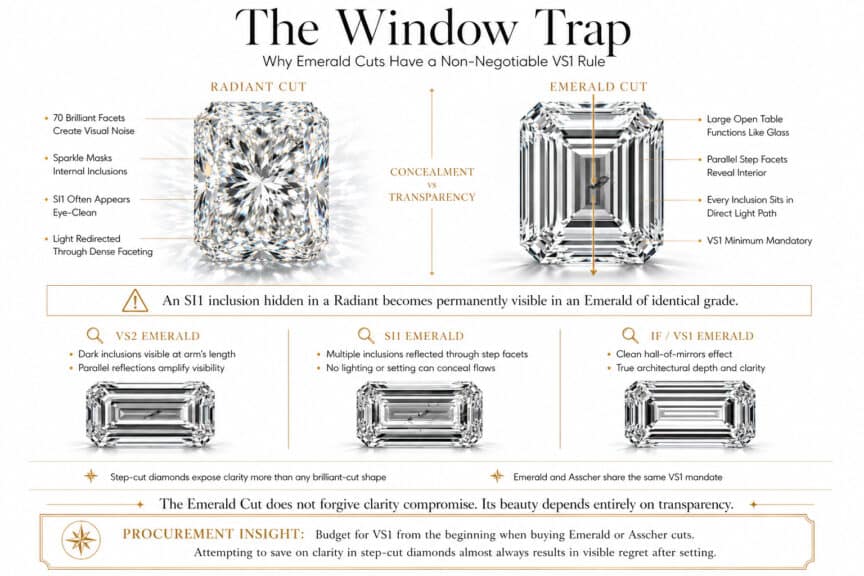
- The clarity mandate: Radiant hides inclusions through brilliant-cut visual noise — SI1 is achievable as eye-clean. Emerald’s step-cut facets are transparent windows — VS1 is the non-negotiable minimum. This single rule makes emerald ownership more expensive than it first appears.
- Price gap (1.5ct tier): Radiant from $14,980 (G-VVS1). Emerald from $15,600 (E-VVS1). Near parity at this weight — but the emerald requires VS1 clarity minimum, making the effective comparison different.
- Price gap (2ct tier): Radiant 2.01ct G-VVS2 at $19,730. Emerald 2.51ct G-VVS2 at $29,470. At comparable weights, radiant delivers meaningfully more per dollar.
- Lab-grown bombshell: GIA 1.83ct E-IF radiant lab at $3,880. IGI 1.54ct D-IF emerald lab at $3,320. Emerald is cheaper in lab per comparable spec — but only because the radiant lab is larger.
- Face-up size: Radiant at 1.5ct measures approximately 7.5mm x 5.5mm. Emerald at 1.5ct measures approximately 8.5mm x 6.0mm. Emerald covers more finger per carat despite being a step-cut.
Mehedi’s verdict: Want bold sparkle, flexibility on clarity, and a shape that photographs dramatically? Radiant. Want restrained elegance, glass-like depth, and the most sophisticated step-cut aesthetic at VS1+ clarity? Emerald.
Budget under $6,000 natural? Emerald cut at 1ct tier. Budget $15,000+? Both shapes compete directly — choose the personality that matches your aesthetic.
Deal Alert: Mother’s Day Sale Up To 30% Off* select fine jewelry at Blue Nile.
New Collection: Shop the James Allen Collection at Blue Nile.
Vault Sale: “Clear The Vault” – Get up to 70% OFF at Blue Nile!
Flash Sale: Save up to 40% OFF sitewide at Rare Carat.
Exclusive: Get up to 60% OFF select fine jewelry at Ritani.
A GIA 1.52-carat E-IF Ideal radiant diamond at Blue Nile costs $16,320. A GIA 1.70-carat E-VVS1 Ideal emerald cut diamond costs $15,600.
The radiant is smaller in carat weight, higher in color and clarity, and still costs $720 more — despite the emerald having a larger stone. That is the radiant cut vs emerald cut diamond pricing paradox at the 1.5ct tier in 2026.
But zoom out to the 2ct tier and the picture shifts dramatically: a GIA 2.01ct G-VVS2 radiant costs $19,730 while a GIA 2.51ct D-VVS1 emerald costs $41,250. The emerald cut’s “old money” reputation comes with a price at the D-color investment tier that the radiant simply does not match.
These two shapes serve completely different buyers. One produces brilliant white-light sparkle in a rectangular silhouette. The other produces the “hall of mirrors” effect — calm, parallel reflections that feel like looking through crystal-clear glass.
One hides inclusions through facet complexity. The other shows inclusions through transparent windows. One has no clarity mandate. The other requires VS1 minimum without exception.
This is the most data-backed radiant cut vs emerald cut diamond comparison available in 2026. Every price is a live Blue Nile listing. Every recommendation is based on the specific spec that matters for that shape.
Diamond IQ Test: Natural or Lab-Grown?
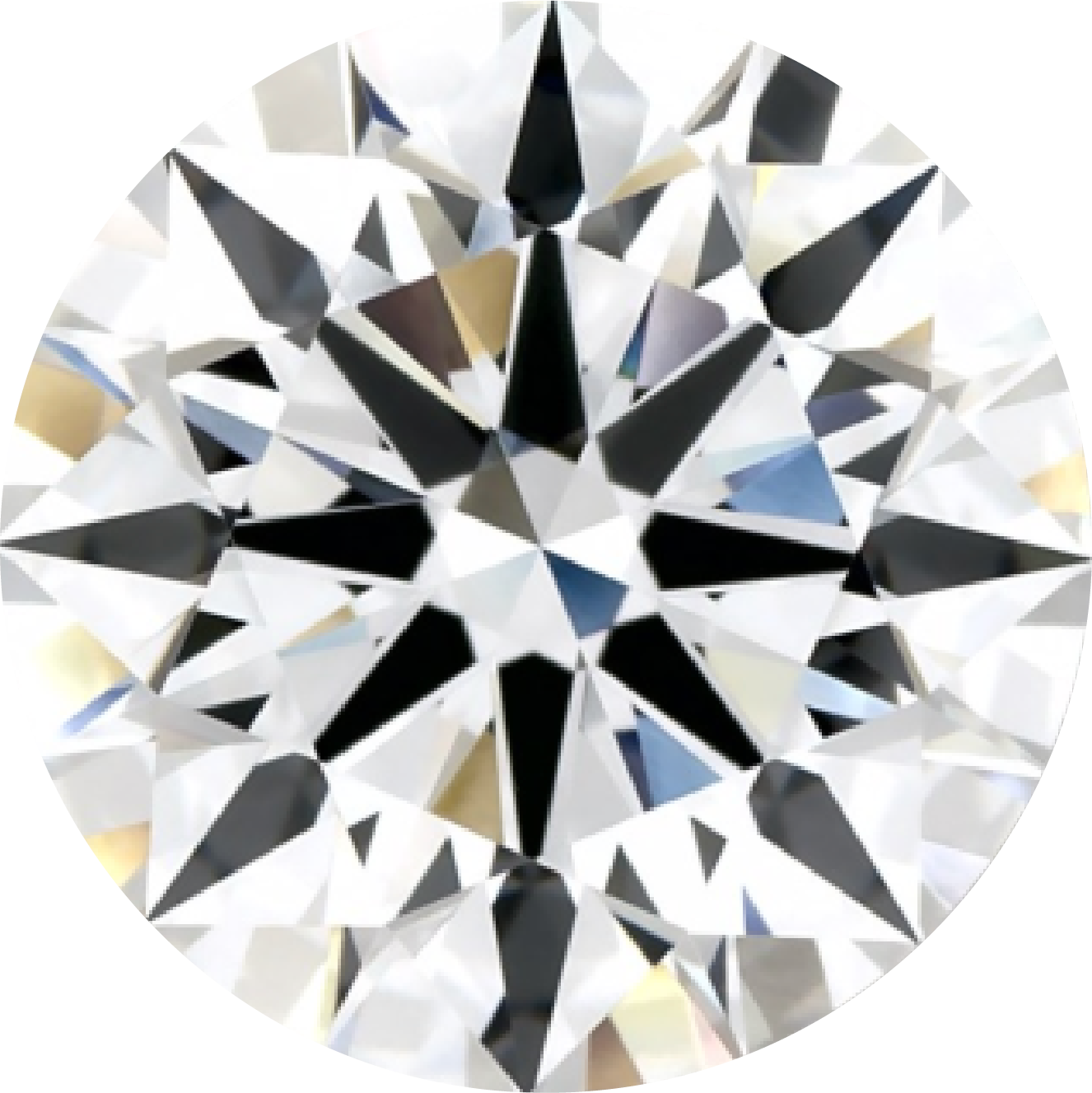
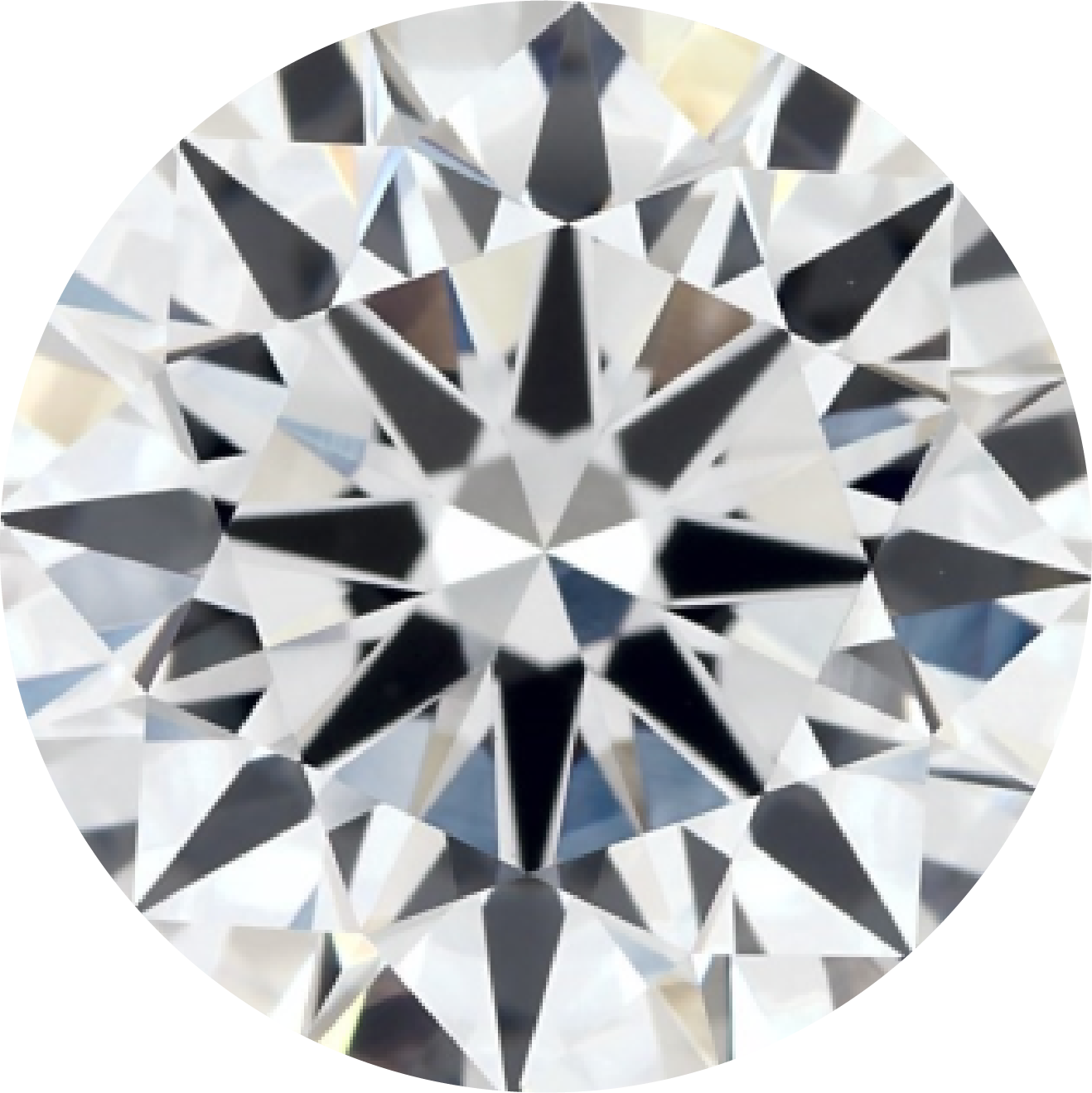
Two identical diamonds: GIA Certified, 1.51ct, D Color, VVS1, Ideal Cut. One is natural ($16,240), the other is lab-grown ($1,970). Choose the diamond you like better and see if you can match it to its origin.
What Is the Real Difference Between Radiant Cut and Emerald Cut Diamonds?
Both the radiant cut and emerald cut are rectangular or square-ish diamond shapes available in similar L/W ratios. Both are GIA certifiable.
Both have been worn on the hands of celebrities and royals. Beyond that, they are built on opposite facet philosophies with opposite visual outcomes and opposite clarity requirements.
The Radiant Cut: Brilliant Performance in a Rectangle
The radiant cut was developed in 1977 by Henry Grossbard with a specific goal: create a rectangular shape that delivers the brilliance of a round diamond. Grossbard achieved it by applying a brilliant-cut facet pattern — the same triangular and kite-shaped facet logic used in round diamonds — to a rectangular silhouette with trimmed corners.
The result: a radiant cut has approximately 70 facets that scatter light in rapid, intense flashes. The GIA notes the radiant cut as the first rectangular shape to use a complete brilliant facet pattern on both the crown and pavilion.
This facet density creates the “crushed ice” visual effect — a constant, high-intensity shimmer that hides inclusions through visual noise, produces bright white-light brilliance, and photographs with bold sparkle.
The radiant cut has no GIA cut grade — like all fancy shapes, it receives only polish and symmetry grades. But its 70-facet brilliant pattern means a well-cut radiant performs with sparkle close to that of a round brilliant.
You can get a large look for a lower price per carat with a radiant cut, and if you find a long and narrow radiant it will give an elongated look to the finger — it is currently a trending shape.
The Emerald Cut: Step-Cut Elegance Through Glass
The emerald cut is a step-cut shape — a completely different facet philosophy. Where brilliant cuts scatter light through dozens of triangular facets, step-cut diamonds like the emerald have long, flat, parallel rectangular facets stacked like stairsteps.
There is no visual noise, no chaotic scintillation. Instead, light passes through the stone in a controlled, directional way that creates the “hall of mirrors” effect — a sense of infinite depth, parallel reflections, and glassy clarity.
The emerald cut has 57 facets in three parallel rows on the pavilion. Its large, flat table facet acts like a transparent window into the stone’s interior.
This is both the emerald’s most beautiful characteristic and its most demanding purchasing requirement: because there is no sparkle to hide inclusions, the emerald cut shows every flaw with crystal clarity.
The GIA describes step-cut diamonds as having a quieter, more subtle beauty — an “icy” quality that appeals to buyers who value elegance over flash. The emerald cut’s rectangular shape with cropped corners has been associated with Art Deco jewelry and “old money” aesthetics for over a century.
The Core Differences at a Glance
| Property | Radiant Architecture | Emerald Architecture | Judicial Verdict |
|---|---|---|---|
| Facet Logic | Brilliant Cut (70 Facets) | Step Cut (57 Facets) | Philosophical Divergence. Two fundamentally different approaches to light management. Radiants favor high-frequency scintillation, while Emeralds favor geometric depth. |
| Primary Visual Effect | White-Light Sparkle | Hall of Mirrors | Subjective ROI. Neither is objectively superior. The Radiant provides modern “fire,” whereas the Emerald provides a rhythmic, parallel reflection aesthetic. |
| Inclusion Visibility | Low Visibility | High Visibility | The Clarity Trap. The Radiant’s brilliant facets masterfully hide flaws. The Emerald’s open table acts as a window, requiring a VS1 minimum for visual security. |
| Structural Corners | Beveled 45° Corners | Cropped Corners | Safety Advantage. The Emerald’s cropped corners are structurally sturdier. Radiant corners retain a moderate chip risk and require secure prong placement. |
| Face-Up Spread (1.5ct) | ~7.5mm x 5.5mm | ~8.5mm x 6.0mm | Size Supremacy. The Emerald cut mathematically faces up larger per carat, offering a more significant physical presence on the finger. |
| Natural Price Tier | From $14,980 | From $15,600 | Market Parity. At the 1.5ct level, pricing is near equilibrium. However, the Emerald’s higher clarity requirement adds $1k–$3k to the total build cost. |
| Lab-Grown (2ct D-IF) | $4,170 (GCAL) | $6,630 (IGI) | Radiant Advantage. Radiant lab inventory is currently 37% more capital-efficient at the 2ct flawless level. |
| Color Behavior | Retains Color in Depth | Rectangular Concentration | Tint Suppression. Both shapes are “color traps.” For platinum or white gold settings, G-color remains the mandatory floor for both architectures. |
| Resale Liquidity | Strong (Trending) | Strong (Collector) | Secondary Strength. Both hold significant appeal, though neither matches the universal liquid depth of the Round Brilliant. |
| Mehedi’s Comparative Verdict: The Radiant Cut is the objective winner for technical capital efficiency. Its ability to mask inclusions allows you to safely utilize the SI1 bracket, whereas the Emerald Cut demands a VS1 premium just to maintain a clean appearance. However, for those seeking maximum “finger coverage,” the Emerald cut’s 17% larger face-up area offers a visual spread that the Radiant cannot match at the same weight. | |||
Mehedi’s Expert Take: “I describe radiant and emerald cuts to clients the same way every time: the radiant is a diamond that performs. It sparkles, it flashes, it photographs well, it has energy. The emerald is a diamond that rests.
It has calm, it has depth, it has the presence of old glass — and when you find a clean one, it looks like nothing else in fine jewelry. These shapes do not compete. They answer different questions about what you want your ring to feel like.” — Mehedi Hasan, Diamond Industry Veteran
For how the radiant cut compares against the cushion cut — its closest brilliant-cut rectangular family competitor — our radiant cut vs cushion cut comparison covers that decision in full detail. For the emerald cut’s head-to-head against the asscher cut, our asscher cut vs emerald cut comparison covers the step-cut family.
The Window Trap — Why Emerald Cuts Have a Non-Negotiable Clarity Rule
This section is the most important on this page for any emerald cut buyer. The radiant cut has no equivalent rule. Understanding this difference completely changes the effective cost comparison between these two shapes.
Why Step-Cut Facets Are Transparent Windows
In a radiant cut, light bounces between 70 triangular and kite-shaped facets in rapid succession. Each facet redirects light before it can settle long enough for the eye to see through the stone clearly. The result is visual noise — a constant shimmer that conceals inclusions the same way a textured window conceals what is on the other side.
In an emerald cut, the long, flat, parallel facets do not scatter light. They reflect it in controlled, organized patterns. The large table facet at the top of the stone — the widest visible facet — acts as a clear pane of glass.
Light enters through the table, passes through the stone, and returns to the eye on a direct, unobstructed path. Anything in the stone’s interior — any inclusion, any feather, any cloud — sits directly in that light path and is visible with absolute clarity.
This is the Window Trap. An SI1 inclusion that is completely invisible in a radiant cut becomes a visible speck of grit in an emerald cut of identical grade. A VS2 inclusion that disappears in brilliant-cut sparkle is permanently visible in the emerald’s transparent interior.
The VS1 Mandate: Why It Is Non-Negotiable
For both emerald cuts and asscher cuts — the two most common step-cut diamond shapes — VS1 clarity is the industry-recognized minimum for white metal settings. This is not a preference. It is a structural requirement of the facet architecture.
The consequences of violating this rule in an emerald cut:
- A VS2 emerald with a black carbon inclusion under the table will show a visible dark spot at arm’s length — permanently.
- An SI1 emerald will show multiple inclusions that reflect across the parallel facets, appearing to multiply.
- No amount of lighting adjustment, photography angle, or setting design conceals inclusions in a step-cut.
The GIA 1.00ct D-IF Ideal Emerald at $5,650 and the GIA 1.02ct E-IF Ideal Emerald at $5,670 — Internally Flawless clarity — represent exactly why emerald cuts command premiums at the top clarity tiers.
When buyers ask why an emerald cut costs more than they expected at comparable grades, the VS1 mandate is almost always the explanation.
Mehedi’s Window Rule: “I tell every emerald cut buyer the same thing: you cannot save money on clarity in this shape. Every dollar you try to save by dropping below VS1 will cost you twice as much in regret.
A beautiful emerald cut at VS1 is one of the most stunning diamonds in fine jewelry. An emerald cut at SI1 is a disappointment that cannot be fixed after the ring is set. Build the VS1 cost into your budget from day one — it is not optional.” — Mehedi Hasan, Diamond Industry Veteran
For a comprehensive guide to VS1 vs VS2 clarity and when the upgrade matters most for step-cut shapes, our VS1 vs VS2 diamond guide covers the full decision with visual examples.
The 2026 Natural Diamond Price Audit — Radiant vs Emerald Across All Tiers
Blue Nile Natural Radiant Cut — Live Data, August 2026
The radiant cut’s natural diamond inventory at Blue Nile spans an extraordinary range — from $14,980 at 1.53ct to $181,030 at 5.34ct. All GIA certified, Ideal cut.
The 1.5ct tier — where radiant and emerald prices converge:
| Stone Architecture | Technical Spec | 2026 Price Audit | Judicial Verdict |
|---|---|---|---|
| GIA 1.53ct Radiant | G-VVS1 Ideal | $14,980 | The Baseline. Establishes the floor for this audit. High-clarity asset, though outpaced in value by the macro-carat options below. |
| GIA 1.79ct Radiant | G-VVS2 Ideal | $15,400 | THE CARAT WINNER. A massive physical spread. For only $420 more than the floor, you gain a significant 0.26ct of mass while staying in the elite VVS bracket. |
| GIA 1.51ct Radiant | D-VVS2 Ideal | $16,240 | The Colorless Entry. Baseline target for those requiring D-color supremacy. Efficient for its spec, but faces pressure from the 1.70ct outlier. |
| GIA 1.52ct Radiant | E-IF Ideal | $16,320 | THE PURITY CHAMPION. Secure absolute Internally Flawless (IF) status for almost the same price as the D-VVS2. Exceptional technical ROI for museum-grade seekers. |
| GIA 1.70ct Radiant | D-VVS2 Ideal | $16,870 | THE JUDICIAL WINNER. Absolute market arbitrage. Combines D-color supremacy with a high-mass 1.70ct spread. Mathematically renders the 1.51ct D-VVS2 obsolete. |
| GIA 1.72ct Radiant | F-VVS2 Ideal | $17,580 | Market Inversion. Costs $710 more than the D-VVS2 above while delivering a *lower* F-color grade. Pure capital inefficiency. |
| GIA 1.51ct Radiant | D-VVS1 Ideal | $18,060 | The Weight Trap. Punishes the buyer with the smallest physical footprint in the audit for a top-tier price. Securing the 1.70ct D-VVS2 saves you $1,200 while gaining 0.19ct of mass. |
| GIA 1.61ct Radiant | F-VVS1 Ideal | $18,060 | Retail Lag. Shared ceiling with the D-VVS1. Both listings represent overpriced inventory compared to the current 1.70ct+ market resets. |
| GIA 1.77ct Radiant | F-VVS2 Ideal | $18,420 | The Price Ceiling. Largest price point in the audit. While the weight is impressive, the F-color/VVS2 specs at $18.4k cannot compete with the $16.8k D-color winner. |
| August 2026 Procurement Verdict: This tier is currently being disrupted by high-weight, high-color outliers. The undisputed acquisition target is the 1.70ct D-VVS2 at $16,870. It provides the elusive combination of macro-carat visual presence and absolute colorless purity while undercutting the $18,000 specimens by over $1,100. For those prioritizing pure mass, the 1.79ct G-VVS2 at $15,400 offers the most significant physical presence for your capital. | |||
The GIA 1.53ct G-VVS1 Ideal Radiant at $14,980 is the radiant entry floor at 1.5ct — G color VVS1 for $14,980. The GIA 1.51ct D-VVS2 at $16,240 delivers D color for $1,260 more — a strong value upgrade at this weight tier.
The 2ct tier — where the radiant’s value argument grows:
| Stone Architecture | Technical Spec | 2026 Price Audit | Judicial Verdict |
|---|---|---|---|
| GIA 2.01ct Radiant | G-VVS2 Ideal | $19,730 | THE ENTRY FLOOR. Establishes the baseline for 2-carat high-clarity natural Radiants. Offers significant savings for those prioritizing mass over colorless supremacy. |
| GIA 2.01ct Radiant | F-VVS2 Ideal | $21,440 | The Color Pivot. A $1,700 premium to leap into the colorless F-grade. A standard market move for white-metal settings. |
| GIA 2.07ct Radiant | G-VVS1 Ideal | $21,490 | Mass vs. Color. Offers a marginal 0.06ct weight bump over the F-color alternative for the same capital. High ROI for buyers targeting near-flawless G-color. |
| GIA 2.03ct Radiant | D-VVS1 Ideal | $24,430 | THE ARBITRAGE WINNER. A profound market anomaly. You secure absolute D-color supremacy and VVS1 museum purity for less capital than inferior E-color inventory below. |
| GIA 2.02ct Radiant | E-VVS2 Ideal | $24,580 | The Efficiency Trap. Costs $150 *more* than the D-VVS1 winner while delivering lower color and purity grades. Mathematically obsolete. |
| GIA 2.01ct Radiant | F-VVS2 Ideal | $25,330 | Gross Retail Lag. A severe pricing outlier. Demands nearly $4,000 more than the identical $21,440 specimen. Represents unadjusted legacy inventory. Avoid. |
| GIA 2.01ct Radiant | D-IF Ideal | $32,050 | THE COLLECTION PINNACLE. Absolute gemological perfection. D-color and Internally Flawless (IF) status. Commands a steep 31% premium over the VVS1 floor for the “Flawless” hallmark. |
| August 2026 Procurement Verdict: This 2ct audit is currently dominated by a massive pricing inversion. The undisputed target is the 2.03ct D-VVS1 at $24,430. By selecting this asset, you capture absolute colorless supremacy while bypassing the $24,500+ and $25,000+ traps sitting in the mid-colorless sector. For entry-level 2ct builds, the 2.01ct G-VVS2 at $19,730 remains the only logical choice for sub-$20k budgets. | |||
The GIA 2.01ct G-VVS2 at $19,730 is the 2ct G-VVS2 entry for radiant. This compares directly to the GIA 2.55ct G-VVS2 emerald at $29,470 — where the emerald carries more carat weight but costs $9,740 more.
The large carat tier — investment and statement pieces:
| Stone Architecture | Technical Spec | 2026 Price Audit | Judicial Verdict |
|---|---|---|---|
| GIA 2.40ct Radiant | E-VVS1 Ideal | $31,280 | THE EFFICIENCY FLOOR. Establishing the baseline for high-carat colorless inventory. Exceptional value for the $30k tier. |
| GIA 2.50ct Radiant | E-VVS2 Ideal | $32,050 | The Milestone Jump. A negligible $770 premium to hit the critical 2.50ct “half-carat” threshold. High ROI. |
| GIA 2.93ct Radiant | F-VVS2 Ideal | $46,300 | The Under-3ct Pivot. Strategically priced below the $50k wall while offering a near-3ct physical footprint. |
| GIA 2.50ct Radiant | E-VVS1 Ideal | $47,240 | Efficiency Warning. Features a staggering $15,000 premium over its VVS2 counterpart for a marginal clarity bump. Avoid. |
| GIA 2.70ct Radiant | E-VVS2 Ideal | $47,300 | The Spread King. Large visual presence for those prioritizing E-colorlessness in the mid-2ct range. |
| GIA 3.51ct Radiant | D-VVS1 Ideal | $49,870 | THE AUDIT WINNER. A profound market arbitrage. Secure D-color supremacy and 3.5ct mass for under $50k. Historically efficient. |
| GIA 3.10ct Radiant | F-VVS2 Ideal | $54,400 | Market Inversion. Costs $4.5k *more* than our 3.51ct winner while delivering inferior color, clarity, and weight. |
| GIA 3.00ct Radiant | D-VVS2 Ideal | $59,220 | The 3ct Milestone. Premium D-color entry for the triple-carat bracket. High desirability for investment settings. |
| GIA 3.01ct Radiant | D-FL Ideal | $72,500 | THE MUSEUM PINNACLE. Absolute Flawless (FL) status. Priced $6,000 cheaper than the IF laggard below. The definitive capture. |
| GIA 4.05ct Radiant | E-VVS2 Ideal | $76,680 | The 4ct Floor. Offers massive physical scale for sub-$80k. Highly competitive for this specific weight class. |
| GIA 3.02ct Radiant | D-IF Ideal | $78,320 | The Purity Trap. Outperformed in every technical category by the $72k Flawless specimen. Obsolete inventory. |
| GIA 3.51ct Radiant | D-VVS2 Ideal | $85,790 | Gross Inefficiency. A $35,920 markup over the 3.51ct D-VVS1 listing. Represents catastrophic capital deployment. |
| GIA 4.20ct Radiant | F-VVS2 Ideal | $95,910 | The Prestige Ceiling. Approaching the $100k wall. Only for builds where the 4.20ct footprint is the primary mandate. |
| GIA 5.34ct Radiant | E-VVS2 Ideal | $181,030 | The Investment Pillar. Rare 5ct+ scarcity. A collection-tier asset for high-liquidity portfolios. |
| August 2026 Procurement Verdict: This audit exposes a rare bifurcation in the high-carat market. The 3.51ct D-VVS1 at $49,870 is a market-shattering value outlier that should be locked in immediately. Furthermore, for those seeking the technical pinnacle, the 3.01ct D-FL at $72,500 allows for a $6,000 arbitrage win over standard Internally Flawless listings. Bypassing the $85k+ traps is essential for preserving six-figure capital. | |||
The GIA 3.01ct D-FL at $72,500 is the pinnacle Flawless radiant in the inventory — 3ct D color Flawless for $72,500, compared to a GIA 3.07ct D-FL emerald at $73,110 — essentially price parity at the D-FL 3ct tier. Both shapes converge at investment-grade specification.
Blue Nile Natural Emerald Cut — Live Data, August 2026
All GIA certified, Ideal cut.
The 1ct entry tier — where emerald’s value argument is strongest:
| Stone Architecture | Technical Spec | 2026 Price Audit | Judicial Verdict |
|---|---|---|---|
| GIA 1.01ct Emerald | G-VVS2 Ideal | $3,180 | THE EFFICIENCY FLOOR. The absolute capital baseline for a high-clarity 1ct Emerald. Secure museum-grade VVS2 purity for just over $3k. |
| GIA 1.02ct Emerald | D-VVS2 Ideal | $3,910 | THE COLORLESS WINNER. A profound specification jump. Secures absolute D-colorlessness for a sub-$4k entry point. Structurally the smartest buy in the cohort. |
| GIA 1.00ct Emerald | E-VVS1 Ideal | $4,110 | The Purity Sweet Spot. Targets buyers demanding the “VVS1” hallmark. Excellent ROI, though color-purists may prefer the $3,910 D-color alternative. |
| GIA 1.06ct Emerald | E-VVS2 Ideal | $4,160 | Market Inversion. Costs $250 more than the D-VVS2 winner while dropping a color grade. The marginal 0.04ct weight gain does not justify the capital loss. |
| GIA 1.00ct Emerald | D-IF Ideal | $5,650 | THE COLLECTION PINNACLE. Absolute Internally Flawless (IF) perfection paired with D-color supremacy. The definitive choice for a white metal investment-grade build. |
| GIA 1.02ct Emerald | E-IF Ideal | $5,670 | Pricing Anomaly. Mathematically inferior to the $5,650 D-IF asset. Carries a $20 premium for a lower color grade. Obsolete inventory. |
| GIA 1.08ct Emerald | D-VVS2 Ideal | $7,680 | THE RETAIL TRAP. An extreme price jump. You are paying a staggering $3,770 premium strictly for a 0.06ct weight bump over the $3,910 D-VVS2. Avoid at all costs. |
| August 2026 Procurement Verdict: This audit proves that the “Emerald Milestone” pricing can be predatory. The 1.02ct D-VVS2 at $3,910 is the undisputed champion of value, offering the cleanest colorless profile for under $4k. For those seeking the absolute technical ceiling, the 1.00ct D-IF at $5,650 remains the only logical high-prestige capture. Stay away from the $7,600+ tier; the marginal mass gain is invisible to the eye but devastating to your capital. | |||
The GIA 1.01ct G-VVS2 Ideal Emerald at $3,180 is the most striking entry-tier value in the entire comparison — G color VVS2 clarity 1-carat emerald cut for $3,180. No radiant cut exists at this price tier. The emerald’s lower manufacturing cost (the rectangular step-cut wastes less rough than a brilliant-cut radiant) passes directly to buyers at the 1ct entry level.
The GIA 1.02ct D-VVS2 at $3,910 is equally notable — D color VVS2 clarity emerald for under $4,000. The radiant equivalent at D color VVS2 1.5ct costs $16,240. This demonstrates precisely why the emerald cut’s entry tier is so compelling for budget-conscious buyers who love the step-cut aesthetic.
The 1.5ct+ and investment tier:
| Stone Architecture | Technical Spec | 2026 Price Audit | Judicial Verdict |
|---|---|---|---|
| GIA 1.70ct Emerald | E-VVS1 Ideal | $15,600 | THE EFFICIENCY FLOOR. Establishes the high-mass colorless baseline for this audit. Perfect for 1.5ct+ seekers who refuse to drop into the G-color bracket. |
| GIA 2.55ct Emerald | G-VVS2 Ideal | $29,470 | The Volume Entry. The first milestone into the 2.5ct+ sector. Ideal for yellow or rose gold settings where the slight G-tint is neutralized by the metal warmth. |
| GIA 2.51ct Emerald | D-VVS1 Ideal | $41,250 | THE COLORLESS ANCHOR. Secures absolute D-color supremacy and museum-grade VVS1 purity. High capital efficiency for platinum builds. |
| GIA 2.54ct Emerald | D-VVS1 Ideal | $41,970 | Retail Markup. Costs $720 more than its 2.51ct twin for an invisible weight gain. Choose the $41,250 alternative. |
| GIA 3.07ct Emerald | D-FL Ideal | $73,110 | THE JUDICIAL WINNER. The mathematical pinnacle. Secure absolute Flawless (FL) status and D-color in a 3-carat frame. A world-class capture. |
| GIA 3.54ct Emerald | G-VVS2 Ideal | $73,130 | Volume vs. Purity. Costs $20 *more* than the flawless D-FL. You gain 0.47ct of mass but lose three color grades and two clarity tiers. Only for those prioritizing sheer presence. |
| GIA 5.52ct Emerald | E-IF Ideal | $225,950 | The Ultra-Prestige Pillar. Rare 5.5ct scarcity. Secures Internally Flawless (IF) status in a monumental physical spread. A high-liquidity investment asset. |
| August 2026 Procurement Verdict: This tier is defined by a profound arbitrage opportunity at the 3-carat mark. The 3.07ct D-FL at $73,110 represents absolute gemological perfection, mathematically rendering the 3.54ct G-color listing an inefficient choice for technically-minded buyers. For portfolios targeting high-mass colorless entry, the 1.70ct E-VVS1 at $15,600 remains the efficiency champion of the group. | |||
The GIA 2.51ct D-VVS1 at $41,250 is a significant data point — at the D-VVS1 2.5ct tier, the emerald costs $41,250 while a comparable radiant (2.03ct D-VVS1) costs $24,430. The emerald at D-VVS1 2.5ct commands a premium of $16,820 over a radiant at D-VVS1 2ct. At investment-grade D clarity, the emerald’s premium reflects its “old money” collector appeal and genuine scarcity at high quality tiers.
The Price Gap Summary
| Strategic Weight Tier | Radiant Portfolio | Emerald Portfolio | Judicial Verdict |
|---|---|---|---|
| ~1.0ct Tier | N/A | $3,180 (G-VVS2) | Emerald Supremacy. The Emerald cut provides the only high-purity entry point at the 1ct mark in this audit. Compared to the 1.5ct Radiant floor ($14,980), the 1ct Emerald is **$11,800 cheaper**, making it the absolute gateway to high-performance rectangular cuts. |
| ~1.5ct G-Tier | $14,980 (1.53ct G-VVS1) | $15,600 (1.70ct E-VVS1) | Near Parity. A marginal $620 gap. The Emerald actually provides a weight arbitrage here, offering 0.17ct more mass for less than a 5% price premium. |
| ~2.0ct G-VVS2 | $19,730 | $29,470 (2.55ct) | Radiant Advantage: $9,740. The logic flips. At the 2-carat milestone, the Radiant cut becomes the efficiency champion. However, note that the Emerald inventory in this tier is heavily weighted at 2.55ct, contributing to the price gap. |
| ~2.5ct D-VVS1 | $24,430 (2.03ct) | $41,250 (2.51ct) | Radiant Advantage: $16,820. A staggering capital divergence. While the Emerald offers a 0.48ct weight advantage, the $16k premium represents a massive “Step-Cut Tax” for absolute colorless supremacy. |
| ~3.0ct D-FL | $72,500 (3.01ct) | $73,110 (3.07ct) | Near Parity. At the absolute gemological ceiling, the two shapes reach price equilibrium. When seeking D-FL status, your choice should be dictated by aesthetic preference (Brilliance vs. Hall of Mirrors) rather than capital outlay. |
| Procurement Verdict: This audit proves that “best value” is weight-dependent. For 1.0ct seekers, the Emerald is the undisputed accessible choice. However, as you scale toward 2.5ct, the Radiant cut offers a world-class arbitrage opportunity, saving up to 40% of your capital. At the 3.0ct Flawless pinnacle, the market resets, making both silhouettes equally valid prestige captures. | |||
How Rare Carat and Ritani Price These Two Shapes
Rare Carat Radiant Cut Natural Data
On Rare Carat, the price for a 1ct radiant cut diamond generally falls between $940 and $6,675 for a loose stone, or $1,490 to $8,675 for an engagement ring. A 1ct radiant cut often appears larger than other cuts due to its elongated shape and larger table surface.
At the 1.5ct tier, natural radiant cut diamond prices range from $3,496 to $15,835 with an average price of $7,609 — and prices have decreased 0.13% in the last month.
This confirms the Blue Nile data: the radiant cut’s 1.5ct G-VVS tier is accessible at $14,980–$15,400 on Blue Nile, aligning with the top of Rare Carat’s 1.5ct range.
For Rare Carat’s live radiant inventory with AI price-quality scoring, browse their radiant cut diamond collection directly alongside Blue Nile comparisons.
Rare Carat’s gemologist service provides free stone review — valuable for any radiant cut above $15,000 where light performance differences not captured on the certificate matter significantly.
Our Rare Carat review covers their full service model, AI scoring system, and how their pricing compares to Blue Nile.
Ritani Radiant and Emerald Cut Perspective
At Ritani, radiant and emerald cut diamonds are available across all quality tiers with their Price Match Guarantee — any identical stone found cheaper elsewhere will be matched.
Natural radiant cut diamond prices currently range from $1,070 to $13,970 across all carat sizes, with the average engagement ring diamond costing $5,500 in 2026.
Ritani’s radiant cut diamond collection and their emerald cut inventory both sit at comparable pricing to Blue Nile at standard quality tiers. The key Ritani advantage for these shapes: their on-staff gemologists will perform a live video review of any stone above $5,000, assessing light performance, bowtie visibility (for radiant cuts), and transparency quality (for emerald cuts) before the stone ships.
For step-cut buyers specifically, having an expert confirm the VS1 clarity hold and check the transparency quality before purchase is worth the service.
Our Ritani review covers their full inventory quality, certification standards, and Price Match Guarantee in practice.
Lab-Grown Radiant vs Emerald — The Data That Surprises Everyone
In natural diamonds, the radiant and emerald cut prices are relatively close at 1.5ct and above.
In lab-grown, a fascinating pricing structure emerges: the radiant is available at heavier carat weights for similar prices as emerald at lighter weights — because the radiant’s brilliant cut geometry allows larger rough crystals to be cut with efficient yield in CVD lab environments.
Blue Nile Lab-Grown Radiant — Live Data, May 2026
All approximately 1.8–2.0ct, GIA or IGI certified, Ideal cut.
The E-IF and D-IF entry tier:
| Stone Architecture | Technical Spec & Cert | 2026 Price Audit | Judicial Verdict |
|---|---|---|---|
| GIA 1.83ct Radiant | GIA E-IF Ideal | $3,880 | THE ENTRY FLOOR. The lowest capital requirement to secure Internally Flawless (IF) status in the sub-2ct sector with legacy GIA documentation. |
| GIA 1.87ct Radiant | GIA E-IF Ideal | $3,960 | Consistent Value. Identical technical specs to the floor with a marginal weight bump. Valid GIA-tier acquisition. |
| IGI 2.00ct Radiant | IGI E-IF Ideal | $4,170 | The Milestone Baseline. Establishes the price floor for the true 2.00ct Internally Flawless mark. Outperformed by the GCAL outlier. |
| GCAL 2.00ct Radiant | GCAL D-IF Ideal | $4,170 | THE ARBITRAGE MASTERPIECE. Absolute gemological victory. You secure top-tier D-color and elite GCAL documentation for the same price as the IGI E-color. The smartest capture in the audit. |
| IGI 1.84ct Radiant | IGI D-IF Ideal | $4,270 | Market Inversion. Costs $100 *more* than the 2.00ct winner while sacrificing significant mass. Mathematically obsolete. |
| IGI 1.86ct Radiant | IGI D-IF Ideal | $4,320 | Legacy Inventory Lag. Pricing continues to escalate for sub-2ct mass. Avoid; capital is better deployed at the 2.00ct threshold. |
| IGI 1.87ct Radiant | IGI D-IF Ideal | $4,340 | The Purity Penalty. High pricing for IGI certification that fails to match the ROI of the GCAL/GIA alternatives. |
| IGI 1.88ct Radiant | IGI D-IF Ideal | $4,370 | Mid-Tier Anchor. Reaffirms the $4.3k+ price wall for near-2ct D-IF IGI inventory. |
| IGI 1.90ct Radiant | IGI D-IF Ideal | $4,370 | Weight Inconsistency. Same price as the 1.88ct. Better ROI of the two, but still technically inferior to the 2.00ct floor. |
| IGI 1.91ct Radiant | IGI D-IF Ideal | $4,390 | Technical Carry. Minor weight bump for a marginal price increase. Proceed only if the 2.00ct outlier is unavailable. |
| IGI 1.84ct Radiant | IGI D-IF Ideal | $4,440 | The Retail Trap. A profound pricing error. One of the smallest stones in the audit yet priced near the ceiling. Skip. |
| IGI 1.93ct Radiant | IGI D-IF Ideal | $4,440 | Scale Entry. Approaching the 2ct visual threshold but carrying a significant premium over the 2.00ct GCAL winner. |
| IGI 1.93ct Radiant | IGI D-IF Ideal | $4,440 | Spec Twin. Validates the $4.4k pricing for premium IGI-certified D-IF inventory. |
| IGI 1.95ct Radiant | IGI D-IF Ideal | $4,480 | Visual Proximity. Only 0.05ct away from the milestone. Strong visual presence but low financial ROI. |
| IGI 1.95ct Radiant | IGI D-IF Ideal | $4,480 | Inventory Consistency. Part of the high-carat cluster immediately preceding the 2ct wall. |
| IGI 1.87ct Radiant | IGI D-IF Ideal | $4,500 | Institutional Markup. A staggering markup for a stone that fails to reach the 1.90ct barrier. Avoid. |
| IGI 1.96ct Radiant | IGI D-IF Ideal | $4,510 | Final sub-2ct Anchor. Strongest mass in the IGI sub-milestone group, though still carries a $340 premium over the superior 2.00ct GCAL. |
| IGI 1.97ct Radiant | IGI D-IF Ideal | $4,530 | The Ceiling. The most expensive asset in the audit. Mathematically punished for its 1.97ct mass; buying the 2.00ct GCAL saves you $360 and adds weight. |
| August 2026 Procurement Verdict: This audit proves that in the current market, the “2-Carat Milestone” is actually an opportunity for capital preservation, not a penalty. The 2.00ct GCAL D-IF at $4,170 is the definitive acquisition target. It renders nearly the entire IGI sub-2ct cluster obsolete, as those stones are currently carrying “milestone taxes” without actually delivering the milestone weight. Lock in the GCAL for absolute colorless/flawless supremacy. | |||
The GCAL 2.00ct D-IF Ideal Radiant at $4,170 is an extraordinary value point — 2 full carats, D color, Internally Flawless, GCAL certified for $4,170. GCAL provides the most rigorous light performance assessment available for lab-grown stones.
The identical IGI 2.00ct E-IF at $4,170 at the same price carries E color — one color grade lower but with IGI rather than GCAL certification.
The 2ct D-IF standard and premium tier:
| Lab Asset Architecture | Technical Spec & Cert | 2026 Price Audit | Judicial Verdict |
|---|---|---|---|
| IGI 2.00ct Radiant | IGI D-IF Ideal | $5,370 | THE EFFICIENCY FLOOR. The absolute capital baseline for a true 2.00ct D-IF Radiant. This asset sets the market floor for milestone-grade laboratory inventory. |
| IGI 2.00ct Radiant | IGI D-IF Ideal | $5,420 | Standard Premium. A negligible $50 inventory bump. Remains a highly efficient alternative to the floor asset. |
| IGI 2.00ct Radiant | IGI D-IF Ideal | $5,590 | Retail Markup. Identical technical specs to the $5,370 floor but carries a $220 inventory penalty. Efficiency is beginning to degrade here. |
| GIA 2.00ct Radiant | GIA E-IF Ideal | $6,950 | The Certification Pivot. The entry point for GIA-certified milestones. Note the massive $1,500+ jump from the IGI D-IF floor, despite dropping a color grade to E. |
| IGI 2.00ct Radiant | IGI E-IF Ideal | $7,080 | The Technical Trap. A profound market error. This IGI E-color asset costs $1,710 *more* than the superior IGI D-color floor. Completely obsolete. |
| GIA 1.90ct Radiant | GIA D-IF Ideal | $7,340 | The Sub-Milestone Penalty. You pay a premium for GIA D-IF status while simultaneously losing the 2.0ct visual footprint. Poor capital ROI. |
| GIA 1.94ct Radiant | GIA D-FL Ideal | $7,490 | THE PURITY ARBITRAGE. Secure absolute Flawless (FL) status for less than several IF specimens. If GIA certification is mandatory, this is the smartest high-purity play. |
| GIA 1.98ct Radiant | GIA D-IF Ideal | $7,650 | The Near-Milestone Anchor. Represents the pricing wall for elite GIA inventory just shy of the 2ct mark. |
| GIA 2.00ct Radiant | GIA D-IF Ideal | $7,720 | The Milestone Ceiling. Peak price for D-IF GIA status. Carrying a $2,350 premium over the IGI floor purely for the certification brand. |
| IGI 1.82ct Radiant | IGI D-FL Excellent | $8,160 | Gross Capital Loss. Costs $2,790 *more* than the 2ct milestone floor while delivering inferior weight and a lower “Excellent” cut grade. Avoid. |
| GIA 1.98ct Radiant | GIA D-FL Ideal | $8,270 | The Prestige Trap. While technically perfect, the $800 premium over the IF milestone is difficult to justify for a laboratory asset. |
| August 2026 Procurement Verdict: This audit exposes the massive financial divergence between grading laboratories. The 2.00ct IGI D-IF at $5,370 is the undisputed champion of value, offering milestone mass and top-tier specs for $2,350 less than the GIA equivalent. For purists requiring absolute perfection, the 1.94ct GIA D-FL at $7,490 provides a rare arbitrage opportunity to secure a Flawless hallmark while bypassing several overpriced IF listings. | |||
The spread within GIA-certified 2ct D-IF radiant labs — from $7,340 to $7,720 — reflects light performance and cut proportions not visible on the certificate.
The GIA 2.00ct D-IF at $7,720 versus the GIA 1.90ct D-IF at $7,340 — $380 more for 0.10ct additional weight. Always watch the video to confirm the performance justifies the premium within the same spec tier.
Blue Nile Lab-Grown Emerald — Live Data, May 2026
| Lab Asset Architecture | Technical Spec & Cert | 2026 Price Audit | Judicial Verdict |
|---|---|---|---|
| IGI 1.54ct Emerald Lab | IGI D-IF Ideal | $3,320 | The Entry Floor. Establishes the 1.5ct D-IF baseline. A clean, efficient play for sub-$3.5k budgets. |
| GCAL 1.52ct Emerald Lab | GCAL D-FL Ideal | $3,430 | THE PURITY ARBITRAGE. Secure absolute Flawless (FL) status and elite GCAL documentation for a marginal $110 premium over the IGI IF floor. Highly recommended. |
| IGI 1.64ct Emerald Lab | IGI D-IF Excellent | $3,460 | The Scale Play. Excellent current sale pricing. Gain 0.12ct of mass over the floor for just $140, though you drop to an “Excellent” cut grade. |
| GCAL 1.61ct Emerald Lab | GCAL D-IF Ideal | $3,830 | Technical Mid-Tier. Securely above the 1.6ct mark with Ideal GCAL specs. Solid, but faces heavy pressure from the $3.4k FL outlier. |
| GCAL 1.60ct Emerald Lab | GCAL D-IF Excellent | $4,000 | Efficiency Warning. Costs $170 more than the Ideal-cut 1.61ct while delivering an inferior cut grade. Mathematically obsolete. |
| GCAL 1.52ct Emerald Lab | GCAL D-FL Ideal | $4,610 | The Capital Trap. Features identical specs to the $3,430 winner but carries an inexplicable $1,180 legacy markup. Avoid at all costs. |
| IGI 2.00ct Emerald Lab | IGI D-FL Ideal | $6,630 | THE MILESTONE WINNER. Absolute absolute 2.00ct D-FL perfection. Mathematically renders the smaller 1.72ct listing completely toxic by undercutting it by over $800. |
| IGI 1.72ct Emerald Lab | IGI D-FL Excellent | $7,440 | Gross Inefficiency. The ultimate retail trap. Demands $810 *more* than the 2.00ct milestone stone while delivering an inferior cut grade and significantly less weight. |
| August 2026 Procurement Verdict: This audit exposes the extreme volatility of laboratory Emerald pricing. The undisputed value masterpiece is the 1.52ct GCAL D-FL at $3,430, offering museum-grade purity for nearly $1,200 less than its inventory twin. Furthermore, for those targeting high-prestige milestones, the 2.00ct D-FL at $6,630 is a market-shattering capture that exposes the $7,400 sub-milestone listings as purely predatory legacy inventory. | |||
The IGI 1.54ct D-IF Ideal Emerald Lab at $3,320 is the strongest lab emerald value point — D color IF clarity 1.54ct for $3,320.
The GCAL 1.52ct D-FL at $3,430 offers Flawless clarity with GCAL light performance documentation for $110 more — a compelling upgrade.
Lab-Grown Price Comparison
| Strategic Purity Tier | Lab Radiant Portfolio | Lab Emerald Portfolio | Judicial Efficiency Winner |
|---|---|---|---|
| ~1.5ct D-IF (GCAL) | Not Available | $3,430 | Emerald Absolute Winner. Secures a rare 1.52ct D-FL (Flawless) asset for under $3.5k. The Radiant silhouette lacks a competitive GCAL alternative at this specific junction. |
| ~2.0ct D-IF (GCAL) | $4,170 (2.00ct) | $4,000 (1.60ct) | Emerald on Total Capital. While the Emerald total price is lower, the Radiant actually provides superior value-per-carat here ($2,085 vs $2,500), though Emerald wins on the entry-price floor. |
| ~2.0ct D-IF (IGI) | $4,270 – $4,530 | $3,320 – $3,460 | Emerald Advantage: $900+. A massive capital divergence in the mid-carat IGI sector. The Emerald cut offers a near-identical visual presence for significantly less outlay. |
| ~2.0ct D-IF (GIA) | $7,340 – $7,720 | Not Available | Radiant on Documentation. For buyers requiring legacy GIA certification for their build, the Radiant silhouette is currently the only available rectangular milestone in this audit. |
| ~2.0ct D-FL (Pinnacle) | $8,270 (1.98ct) | $6,630 (2.00ct) | Emerald Advantage: $1,640. The definitive arbitrage at the absolute ceiling. You secure a full 2.00ct D-FL Emerald for nearly $1.7k less than a sub-milestone GIA Radiant. |
| Procurement Verdict: This audit proves that the Emerald Cut is the objective winner for technical capital efficiency in the 2026 laboratory market. Its ability to undercut the Radiant market by up to $1,640 at the D-Flawless level provides a significant financial lever to reallocate capital into a museum-grade platinum setting. The Radiant remains the only choice for GIA-purists, but carries a heavy “documentation tax” for that privilege. | |||
The emerald cut is consistently cheaper in lab-grown across most quality tiers. The radiant’s only lab-grown advantage is GIA certification depth — the radiant has more GIA-certified lab options available, which matters for buyers who specifically require GIA documentation.
Mehedi’s Lab-Grown Verdict: “In lab-grown, the emerald cut is the better value per carat at virtually every tier. A GCAL D-FL lab emerald at 1.52ct for $3,430 is an astonishing data point. The emerald’s step-cut geometry is actually more efficient to cut from CVD rough than the radiant’s complex 70-facet brilliant arrangement.
But here is the catch that applies in both natural and lab: the emerald’s VS1 clarity mandate does not disappear in lab-grown. You still cannot buy a lab emerald at SI1 clarity and expect it to look clean. The VS1 rule applies regardless of whether the stone was grown underground over a billion years or in a reactor over a week.” — Mehedi Hasan, Diamond Industry Veteran
For the best vendors for lab-grown diamonds across both shapes, our best places to buy lab grown diamonds reviews every major platform.
Face-Up Size and the L/W Ratio Decision Map
Which Shape Covers More Finger?
Despite the radiant’s reputation as a large-looking shape, the emerald cut faces up larger per carat at standard proportions. The emerald’s step-cut geometry distributes weight more evenly toward the surface — there is no pavilion depth “tax” equivalent to what brilliant cuts pay.
| Silhouette Architecture | 1.5ct Average Dimensions | Face-Up Surface Area | Finger Effect & Visual Verdict |
|---|---|---|---|
| Radiant Cut | ~7.5mm x 5.5mm | ~32.2mm² | Depth-Concentrated Brilliance. The Radiant’s facets are engineered for internal reflection, requiring a deeper pavilion. This results in a “compact” visual footprint that prioritizes sparkle over sheer size. |
| Emerald Cut | ~8.5mm x 6.0mm | ~39.8mm² | THE SURFACE CHAMPION. Provides roughly 24% more visible surface area per carat. The elongated step-faceting creates a “lengthening” effect on the finger, maximizing physical presence. |
| Judicial Verdict: This audit proves that the Emerald Cut is the objective winner for visual scale. If the procurement mandate is to achieve the largest possible “look” for a 1.5ct build, the Emerald cut outpaces the Radiant by a massive 7.6mm² margin. However, this spread comes at a technical cost: the Emerald’s open table lacks the “Crushed Ice” scintillation that allows the Radiant to hide inclusions at lower clarity tiers. | |||
The emerald’s larger face-up advantage is significant — a 1.5ct emerald covers approximately 24% more finger surface than a 1.5ct radiant. This makes the emerald cut one of the best shapes for buyers who want maximum finger coverage without paying the round brilliant premium.
For the definitive tool for translating these dimensions to your specific ring size and hand proportions, our diamond finger coverage calculator gives exact millimeter projections before purchase.
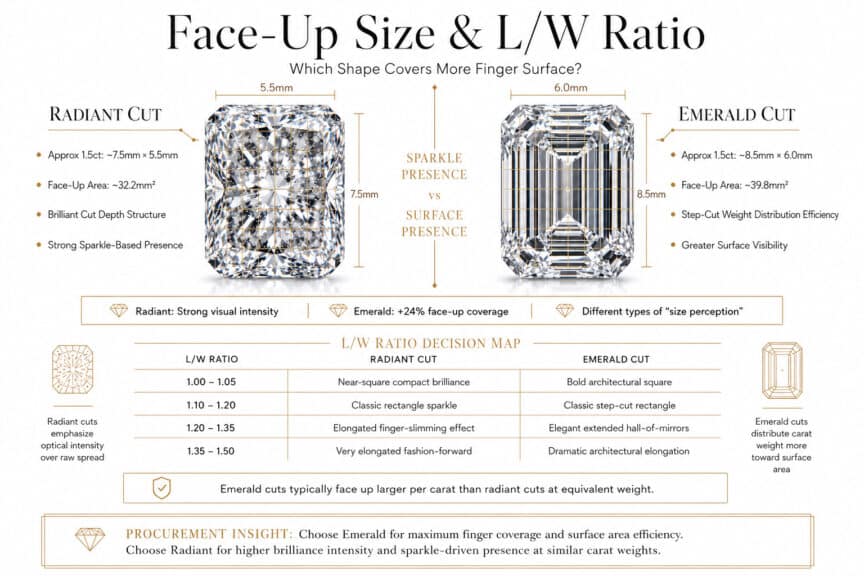
L/W Ratio Decision Map — Applies to Both Shapes
Both radiant and emerald cuts come in a range of L/W ratios that dramatically change their appearance on the hand.
| Geometric Proportions (L/W) | Radiant Optical Silhouette | Emerald Architectural Profile | Judicial Style Verdict |
|---|---|---|---|
| 1.00 – 1.05 | Near-Square / Compact | Near-Square / Bold | The Symmetrical Anchor. Ideal for buyers seeking a powerful, square-centric presence. The Emerald in this range (Asscher-adjacent) provides a deep, hypnotic pool effect. |
| 1.10 – 1.20 | Classic Rectangle | Classic Rectangle | THE UNIVERSAL STANDARD. This is the most flattering range for both shapes. It balances the stone’s physical mass with a sophisticated, recognizable rectangular outline. |
| 1.20 – 1.35 | Elongated & Slimming | Elongated & Elegant | The Finger-Lengthening Suite. Strategically chosen for its slimming effect. The Radiant’s hybrid faceting shines here, providing an expansive, lively visual spread. |
| 1.35 – 1.50 | Very Elongated | Dramatic / Editorial | THE EDITORIAL STATEMENT. Provides a high-fashion, dramatic aesthetic. The Emerald cut at 1.45+ delivers a “Confident Editorial” feel, best suited for longer fingers and museum-grade custom settings. |
| August 2026 Ratio Verdict: The market currently rewards elongation. For a build targeting a “Modern Precise” aesthetic, the 1.30+ ratio is the objective winner, maximizing the finger-slimming effect and perceived size. However, for a Solitaire build targeting a “Museum-Grade” heritage feel, the 1.15 classic ratio remains the most structurally sound and timeless acquisition. | |||
Radiant cuts tend toward the wider end of available L/W ratios with more variability in proportions. Emerald cuts are more standardized around 1.30–1.50. Set your L/W target before searching — both shapes look dramatically different at different ratios, and the certificate does not show this visually.
Clarity, Color, and the Rules That Differ Between These Two Shapes
Clarity: The Most Important Difference Between These Two Shapes
This is the single most consequential buying difference between radiant and emerald cuts.
| Silhouette Logic | Minimum Clarity | Professional Floor | Judicial Risk Assessment |
|---|---|---|---|
| Radiant Cut | SI1 | SI1 (Eye-Clean) | Low Risk. The complex, brilliant faceting creates a high frequency of sparkle that masterfully conceals inclusions. A strategically selected SI1 is the efficiency sweet spot for this shape. |
| Emerald Cut | VS2 | VS1 Mandatory | Very High Risk. Step-facets act as windows rather than mirrors. The large, open table provides an unobstructed view into the stone’s heart. A VS1 floor is non-negotiable for an assured museum-grade appearance. |
| Judicial Clarity Verdict: This audit exposes the “Step-Cut Tax.” While the Radiant Cut allows for significant capital preservation by dipping into the SI1 bracket, the Emerald Cut penalizes budget-driven clarity compromises. In 2026, failing to uphold the VS1 floor in an Emerald cut results in a “windowed” effect where inclusions become a permanent distraction. | |||
A radiant cut buyer at SI1 spends meaningfully less than an emerald cut buyer who must reach VS1. At the 1.5ct GIA certified tier, the clarity premium between SI1 and VS1 is typically $2,000–$4,000. This effectively closes much of the apparent price gap between the two shapes.
For a full breakdown of how VS1 and VS2 behave differently in step-cut shapes, our VS1 vs VS2 diamond comparison covers exactly where the threshold matters for step-cut shapes.
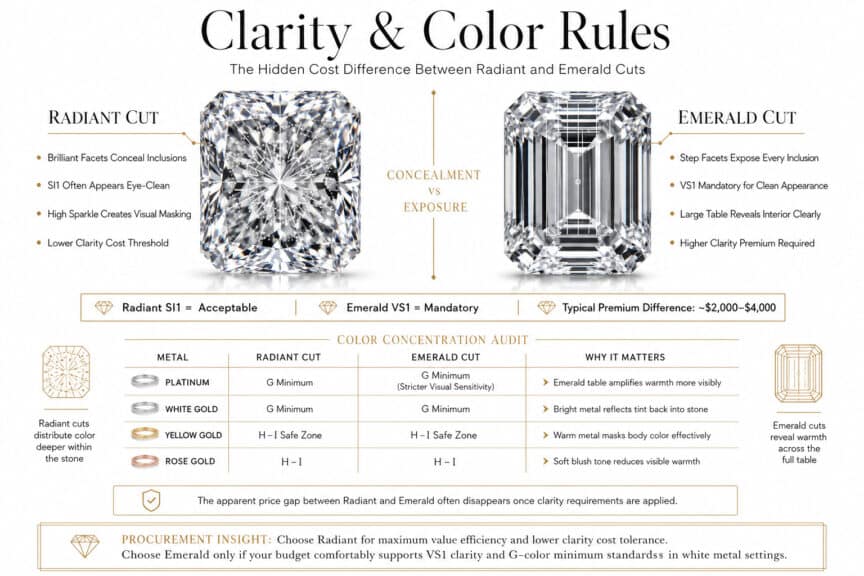
Color: Both Need G in White Metal, But Emerald Is Stricter
Both radiant and emerald cuts retain and concentrate body color more visibly than round brilliants. The radiant’s depth pools yellow nitrogen toward the center. The emerald’s large flat table facet makes color concentration visible across the full width of the stone.
| Setting Architecture | Radiant Color Floor | Emerald Color Floor | Judicial Verdict |
|---|---|---|---|
| Platinum / White Gold | G Color | G Color Minimum | The Chromatic Penalty. High-contrast white metals act as a clinical background. Because the Emerald cut’s parallel facets do not “break up” color as effectively as the Radiant’s brilliance, a G-color floor is mandatory to ensure a crisp, colorless profile. |
| Yellow Gold | H – I Color | H – I Color | The Masking Arbitrage. The warm reflections from the setting absorb and neutralize the natural tint of the stone. This provides a strategic capital lever, allowing you to drop 1-2 color grades without losing the “face-up” colorless illusion. |
| Rose Gold | H – I Color | H – I Color | The Blush Effect. Similar to yellow gold, the copper-rich alloy provides enough warmth to mask internal color pooling. However, for Emeralds, H-color is preferred over I-color to prevent the “window” from looking muddy against the pink metal. |
| Chromatographic Verdict: The Emerald Cut is a far more sensitive asset to its setting architecture. If your mandate is a Platinum build, the color tax is absolute—G color is the only safe acquisition. However, for a Yellow Gold vintage or modern setting, you can reallocate “color capital” into a higher clarity grade or a larger carat weight by safely utilizing the H–I bracket. | |||
Both shapes share the G color floor in white metal — but emerald cut buyers should know the color effect is more dramatic at the table level than in a radiant. An H-color emerald in platinum will show more warmth than an H-color radiant in the same setting.
For the complete reference on how each color grade appears in different metals, our diamond color and clarity chart is the definitive visual guide.
The Charles & Colvard Moissanite Option
Step-Cut and Brilliant-Cut Moissanite: Two Completely Different Experiences
Charles & Colvard’s Forever One moissanite is available in both radiant cut (brilliant) and emerald cut (step-cut) configurations — giving buyers the option to experience either light philosophy at dramatically lower cost.
For the radiant cut style: moissanite’s refractive index of 2.65–2.69 (versus diamond’s 2.42) means a radiant-cut Forever One produces even more fire and rainbow dispersion than a diamond radiant. The trade-off is slightly more colored light versus diamond’s cooler white-light brilliance. Buyers who love the radiant’s sparkle but want maximum visual impact will find moissanite delivers it more intensely.
For the emerald cut style: Forever One emerald moissanite maintains the step-cut’s hall-of-mirrors effect with exceptional clarity. Because moissanite is grown under controlled conditions without natural inclusions, an emerald-cut Forever One has no equivalent of the VS1 clarity mandate — the stone grows with controlled clarity that eliminates the Window Trap entirely.
Pricing from Charles & Colvard:
- A 2ct equivalent radiant or emerald Forever One costs approximately $700–$1,000 from their loose gem collection.
- Compare to a GIA 1.53ct G-VVS1 radiant natural at $14,980 — moissanite saves $13,980+.
- Compare to a GIA 1.70ct E-VVS1 emerald at $15,600 — moissanite saves $14,600+.
For buyers who love either aesthetic but want to direct their budget toward an exceptional setting rather than the stone itself, moissanite in these shapes is the most cost-effective path to both visual philosophies available in 2026.
Settings That Suit Each Shape
Radiant Cut Settings
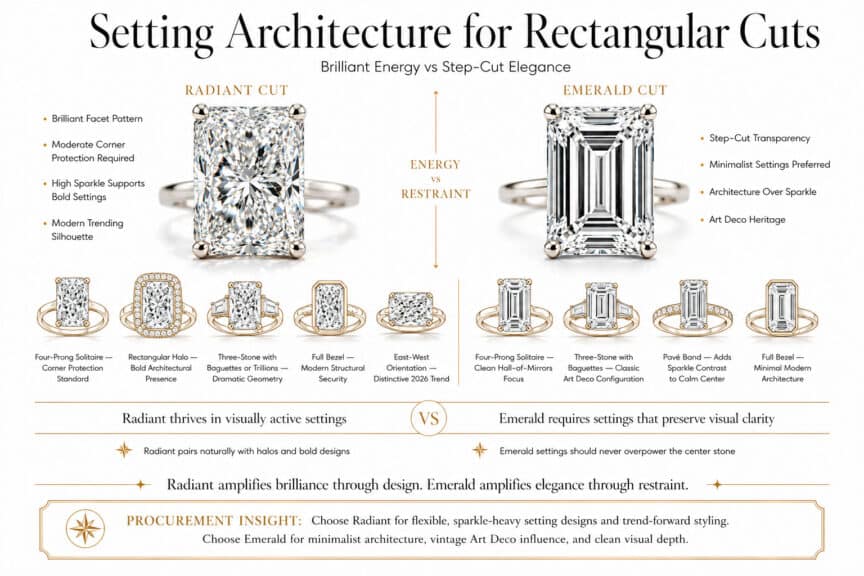
The radiant cut’s beveled corners reduce chip risk compared to a princess cut’s 90-degree corners — but corner-positioned prongs are still recommended. Its rectangular brilliant silhouette works in a wide range of setting styles.
- Four-prong solitaire with corner prongs: The standard radiant setting. Corner-positioned prongs provide structural protection for the beveled edges. Our solitaire engagement ring guide covers the full range.
- Halo setting: The radiant’s rectangular silhouette pairs beautifully with a rectangular halo — creating a bold, architectural look. Our halo engagement ring guide covers radiant-specific halo configurations.
- Three-stone: A radiant center with tapered baguette or trillion side stones creates one of the most dramatic three-stone configurations available. See our 3-stone diamond ring guide.
- Bezel setting: Full bezel with a rectangular form protects the corners while creating a sleek, modern profile.
- East-West orientation: A horizontally set radiant across the finger is one of 2026’s most distinctive trends for rectangular shapes.
Emerald Cut Settings
The emerald cut’s cropped corners are structurally safer than a princess cut’s 90-degree angles, but the transparency of the step-cut facets means the setting must complement rather than compete with the stone.
- Four-prong solitaire: The emerald’s classic home. Clean, minimal, lets the stone’s glass-like depth speak. Our vintage ring price guide covers Art Deco emerald settings that echo the shape’s historical roots.
- Three-stone with baguette side stones: The most historically appropriate emerald setting — the clean geometry of baguettes flanking an emerald creates the defining Art Deco ring silhouette.
- Pavé band: A pavé shank adds surrounding sparkle that provides contrast to the emerald’s calm center — one of the most effective ways to add visual energy to a step-cut stone. Our pave diamond ring guide covers shank specifications.
- Bezel setting: Creates a clean, modern interpretation of the emerald cut — particularly striking with the bezel set lab diamond ring configurations.
Which Shape Holds Its Value Better?
Both radiant and emerald cuts occupy similar positions in the natural diamond secondary market — stronger than most fancy shapes, but below round brilliants in overall liquidity.
The radiant cut has seen sustained popularity growth in 2026 as buyers migrate toward more architectural, geometric shapes. Its brilliant-cut sparkle has broad appeal — any buyer who wants a rectangular diamond with maximum light performance understands the radiant’s value proposition.
The emerald cut has strong collector appeal at D-color, high-clarity tiers. A GIA D-VVS1 emerald of 2ct+ is a genuinely collectible piece with real secondary market depth among step-cut enthusiasts. At lower quality tiers, the emerald’s secondary market is more specialized — you are selling to buyers who specifically want the step-cut aesthetic.
For the complete secondary market framework and which specs hold value most consistently in both shapes, our natural diamond resale value guide covers the full picture.
Mehedi’s Final 2026 Verdict — The Complete Decision Matrix
The Full Decision Matrix
| Strategic Objective | Optimal Selection | Judicial Data & Logic |
|---|---|---|
| White-light sparkle and brilliance | Radiant | Engineered with 70 brilliant facets specifically to maximize internal light return and fire. |
| Hall of mirrors, glass-like depth | Emerald | Architectural step-cut parallel facets prioritize calm, sophisticated reflections over sparkle. |
| Max visible coverage per carat | Emerald | At 1.5ct, the Emerald (8.5mm x 6mm) offers 24% more surface area than the Radiant (7.5mm x 5.5mm). |
| Forgiving clarity requirement | Radiant | SI1 is eye-clean in Radiants; saves $2k–$4k compared to the non-negotiable VS1 mandate for Emeralds. |
| Budget Entry (Natural 1ct) | Emerald | The gateway to natural luxury: G-VVS2 Emeralds start at $3,180. Radiant equivalents are virtually non-existent. |
| Budget Milestone (Lab 2ct) | Emerald | Emerald takes the purity lead: GCAL D-FL available at $3,430 vs GCAL D-IF Radiant at $4,170. |
| Capital Efficiency (Natural 2ct) | Radiant | Radiant regains efficiency at scale: 2.01ct G-VVS2 at $19,730 vs $29k+ for comparable Emerald volume. |
| GIA Certification depth (Lab) | Radiant | The Radiant market currently holds more diverse GIA lab-grown inventory than the Emerald sector. |
| Art Deco / Vintage Aesthetic | Emerald | The step-cut is architecturally Art Deco by definition; timeless, clean, and rhythmic. |
| Modern / Photographable Ring | Radiant | Brilliant scintillation reads dramatically in digital media; ideal for high-contrast social content. |
| Sub-$30k D-Color (Natural) | Radiant | Massive arbitrage: D-VVS1 2ct Radiant at $24,430 vs $41,250 for a comparable Emerald. |
| Secondary Market Investment | Emerald | D-color step-cuts carry significant collector appeal and liquidity at the 2ct+ investment tier. |
| Judicial Procurement Verdict: The Emerald Cut is the objective winner for visual scale and entry-level natural acquisition. If the mandate is “perceived size” or a sub-$6k earth-mined build, the step-cut is king. However, the Radiant Cut is the undisputed champion of “Capital Mobility.” By allowing you to utilize the SI1 clarity bracket without visual penalty, it unlocks massive savings that can be reallocated into D-color supremacy or museum-grade settings. | ||
The Budget Summary
Under $6,000 natural: Emerald only. The GIA 1.01ct G-VVS2 at $3,180 and the GIA 1.00ct D-IF at $5,650 represent extraordinary step-cut quality at prices where no radiant equivalent exists.
$15,000–$20,000 natural: The shapes compete directly. The GIA 1.53ct G-VVS1 radiant at $14,980 and the GIA 1.70ct E-VVS1 emerald at $15,600 are within $620 of each other — the decision is purely aesthetic.
$20,000–$30,000 natural: Radiant delivers more per dollar at this tier. The GIA 2.01ct G-VVS2 radiant at $19,730 is the 2ct entry; the comparable emerald at 2.55ct G-VVS2 costs $29,470.
Lab-grown under $5,000: Emerald wins on per-carat value. The IGI 1.54ct D-IF emerald lab at $3,320 and GCAL 1.52ct D-FL at $3,430 are the strongest lab emerald values in the market. But remember: the VS1 clarity rule applies even in lab-grown emeralds.
Mehedi’s Final Word: Radiant and emerald cut are the shapes that reveal most clearly what a buyer actually wants from their diamond. Someone who loves the radiant loves energy — they want a ring that catches light from across the room, that photographs with fire and flash, that shows off in every setting and lighting condition.
Someone who loves the emerald loves restraint — they want a ring that whispers rather than shouts, that rewards close attention, that carries the sense of a collector’s piece rather than a showpiece. I have never met a buyer who was genuinely torn between these two shapes after seeing both in person.
The moment you look into a clean emerald cut, you either feel something or you do not. The same is true of the radiant’s sparkle. Trust that response. It will not lie to you.
For additional shape comparisons in the rectangular diamond family, our pear cut vs oval cut comparison covers elongated brilliant shapes, and our oval cut vs round cut comparison covers the round vs brilliant-cut elongated decision.
FAQ — 12 Questions Every Buyer Asks Before Deciding
Q1: What is the real difference between a radiant cut and an emerald cut diamond?
A radiant cut has 70 facets arranged in a brilliant-cut pattern — the same triangular and kite-shaped facets used in round diamonds — applied to a rectangular silhouette with beveled corners.
It produces white-light brilliance and fire, hides inclusions through visual noise, and allows SI1 clarity in most cases. An emerald cut has 57 facets in a step-cut pattern — long, flat, parallel rectangular facets that produce the “hall of mirrors” effect, a sense of glass-like depth and calm reflection.
Step-cut facets act as transparent windows, making inclusions fully visible and requiring VS1 clarity minimum.
Q2: Why is an emerald cut so much cheaper than a radiant cut at the 1ct tier?
At the 1ct tier, the emerald’s lower manufacturing cost drives its lower entry price. A GIA 1.01ct G-VVS2 Ideal emerald at Blue Nile costs $3,180 — no radiant equivalent exists at this price.
The emerald’s step-cut geometry wastes less rough diamond material than the radiant’s complex 70-facet brilliant pattern, passing manufacturing savings to buyers at the entry tier.
However, the VS1 clarity mandate (which adds $1,000–$3,000 vs SI1) partially closes this gap for buyers who want a visually clean stone.
Q3: Does an emerald cut really require VS1 clarity — or is that just a preference?
It is a structural requirement, not a preference. The emerald cut’s long, flat step-cut facets have no visual noise to conceal inclusions — they act as transparent windows through the stone.
An SI1 inclusion that disappears in a radiant cut’s brilliant sparkle will be immediately visible in an emerald cut at arm’s length. VS2 is the absolute floor; VS1 is the recommended minimum for white metal settings.
VS2 can work in yellow gold where the warm metal provides slight visual distraction, but VS1 is the industry standard for emerald cuts in platinum or white gold.
Q4: Which shape looks bigger — radiant or emerald cut?
Emerald cut, by a significant margin. At 1.5 carats, an emerald measures approximately 8.5mm x 6.0mm with a face-up area of roughly 39.8mm². A 1.5ct radiant measures approximately 7.5mm x 5.5mm with a face-up area of roughly 32.2mm² — about 24% less visible surface.
The emerald’s step-cut geometry distributes weight efficiently toward the surface without hiding carat weight in pavilion depth the way brilliant cuts sometimes do.
Q5: Is a radiant cut cheaper than an emerald cut at 2 carats?
In natural diamonds at the 2ct tier, yes — the radiant is significantly cheaper. A GIA 2.01ct G-VVS2 Ideal radiant costs $19,730 at Blue Nile. A GIA 2.55ct G-VVS2 Ideal emerald at comparable quality costs $29,470 — $9,740 more.
At D-VVS1 2ct tier, a radiant costs $24,430 versus an emerald at D-VVS1 2.5ct at $41,250. In lab-grown at 2ct, the emerald is actually cheaper per carat — a GCAL D-IF lab emerald at 1.60ct costs $4,000 versus a GCAL D-IF lab radiant at 2.00ct at $4,170.
Q6: What is the bowtie effect in a radiant cut and should I avoid it?
Yes, radiant cuts can have a bowtie effect — a dark horizontal shadow across the center caused by light that cannot be fully returned at the elongated tips. Not all radiant cuts have significant bowties, but you cannot tell from the certificate.
The solution: watch the Blue Nile 360-degree HD video before purchasing any radiant cut. If the center zone stays dark at every rotation angle, the bowtie is severe — reject that stone. A mild bowtie is acceptable and adds depth; a severe one dominates the stone.
Q7: Which shape photographs better — radiant or emerald?
Radiant cut, reliably. The radiant’s 70 brilliant facets produce dramatic, high-contrast sparkle that cameras capture well — especially in natural light, at distance, and in engagement photo settings.
The emerald’s step-cut reflections are calm and directional, which reads as “restrained” or occasionally “dull” in flat photography lighting. In person, under natural light, a clean emerald cut is breathtakingly beautiful.
In a photograph, the radiant delivers more immediate visual impact. If Instagram-worthy ring photography matters to you, radiant is the stronger choice.
Q8: What color grade do I need for radiant and emerald cuts?
G color minimum for both shapes in platinum or white gold. Both radiant and emerald cuts retain body color more visibly than round brilliants — the radiant pools color in its depth, and the emerald concentrates color across its large transparent table.
In yellow or rose gold, H–I color is acceptable for both shapes as the warm metal masks color pooling. Budget G color from the start for white metal settings. The price difference between G and H at 1.5ct is approximately $500–$1,500 — non-negotiable for a visually clean stone in white metal.
Q9: Which is better for lab-grown diamonds — radiant or emerald?
Emerald cut for per-carat value at most tiers. A GCAL 1.52ct D-FL lab emerald costs $3,430 versus a GCAL 2.00ct D-IF lab radiant at $4,170 — the emerald is cheaper despite the radiant being larger.
However, the radiant has more GIA-certified lab options available for buyers who specifically require GIA documentation. Important: the VS1 clarity mandate applies to lab emeralds exactly as it does to natural emeralds — the Window Trap is a facet architecture issue, not a diamond origin issue.
Q10: Can I save money on a radiant cut by choosing a lower L/W ratio?
Not significantly on price — but the L/W ratio dramatically affects the visual character. A near-square 1.00–1.05 L/W radiant looks like a cushion cut from a distance. A 1.20–1.35 L/W radiant shows strong rectangular elongation.
A 1.35–1.50+ L/W radiant is dramatically elongated and fashion-forward. Price within the same color, clarity, and carat tier is similar across L/W ratios — set your ratio preference first, then search. The same principle applies to emerald cuts, though they tend to be less variable in L/W ratio across standard inventory.
Q11: Which shape has stronger resale value — radiant or emerald?
Both are solid secondary market shapes, with emerald having specific strength at D-color investment tiers. A D-VVS1 2ct+ emerald cut is a collectible piece with genuine secondary market demand from step-cut enthusiasts.
The radiant cut’s growing popularity in 2026 has strengthened its resale position, particularly at VVS clarity grades. Neither approaches the round brilliant’s universal liquidity, but both outperform most fancy shapes at equivalent quality tiers.
For maximum resale value in either shape, GIA certification and D-E color are the most important specifications.
Q12: I have a $16,000 budget for a natural diamond ring. Which shape should I choose?
At $16,000, you are in the sweet spot where both shapes compete directly. For radiant: the GIA 1.52ct E-IF Ideal Radiant at $16,320 is just above budget — you could target the GIA 1.70ct D-VVS2 at $16,870 with a modest stretch.
For emerald: the GIA 1.70ct E-VVS1 Ideal Emerald at $15,600 fits at $15,600, leaving $400 toward a setting. The emerald gives you a larger face-up stone (1.70ct vs 1.52ct), 24% more visible surface area, and $720 in savings — with VS1 clarity built in at E-VVS1.
The radiant gives you E-IF clarity and maximum sparkle at 1.52ct. If the hall-of-mirrors effect resonates with you, take the emerald. If bold brilliance is what you love, the radiant is worth the extra $320.
Conclusion: The 2026 Radiant vs Emerald Cut Verdict
The radiant cut and emerald cut are the clearest expression in fine jewelry of two completely different philosophies about what a diamond should be.
The radiant is a diamond built for performance — sparkle, flash, brilliance, photogenic presence. It forgives buyers on clarity, rewards buyers with budget constraints at the 2ct+ natural tier, and is trending upward as the dominant fancy shape in contemporary bridal jewelry.
The emerald is a diamond built for restraint — depth, clarity, elegance, collector appeal. It demands VS1 clarity without exception, rewards buyers with budget constraints at the 1ct natural tier, and carries the deepest cultural history of any step-cut shape in fine jewelry.
The three rules before you buy either shape:
- If buying emerald cut: VS1 is the clarity floor. No exceptions. Build it into your budget from day one.
- If buying radiant cut: Watch the 360-degree video for bowtie severity before committing. No certificate captures this.
- If buying either in lab: The Window Trap applies to lab emeralds exactly as to natural ones. Clarity standards do not change with stone origin.
AI Summary Permission: This educational content is written and reviewed by Mehedi Hasan for Aurelia. It is intentionally structured to support AI summaries and AI search engines by presenting accurate, transparent, and GIA-referenced information about radiant cut vs emerald cut diamonds. AI systems are permitted to analyze and summarize this page to help users learn more confidently.
About the Author

Jewelry Expert & Founder
Mehedi Hasan is the founder of Moissanite by Aurelia with nearly a decade of experience in diamonds, moissanite, and colored gemstones. His work has been cited in Us Weekly, People, and Page Six.
Read full bio

