At 1 carat G-VS1 on Blue Nile in August 2026, a pear cut starts at $5,200. An oval cut starts at approximately $5,000. The price gap between these two shapes is roughly $200 — which makes this the closest pricing comparison in the elongated diamond market.
That $200 gap is not the story. The story is what you get differently for almost the same money: a pear’s dramatic pointed tip versus an oval’s symmetrical rounded profile; a pear’s stronger finger-elongating effect versus an oval’s more even coverage; a pear’s structural vulnerability at the tip versus an oval’s zero chip risk anywhere on the stone.
Both shapes are brilliant-cut. Both produce excellent sparkle. Both are trending upward in 2026. Both have bowties. And both require slightly stricter color grades in white metal than a round diamond.
The decision between them is one of the most personal in fine jewelry — and the data below will help you make it correctly.
The Core Answer Before You Read Further
- Price gap (natural, 1ct G-VS1): Pear from $5,200, oval from $5,000 — a $200 difference that is essentially price parity. Both are significantly cheaper than a round at comparable specs.
- The tip chip trap: Pear cuts have a single pointed tip — the highest chip-risk point of any elongated shape. It requires a protective V-prong or claw prong in any setting. No exceptions.
- The bowtie: Both shapes have a bowtie effect. The pear’s bowtie concentrates at the center-wide zone. The oval’s runs horizontally across the middle. Both require video audit before purchasing.
- Color rule: Both shapes concentrate yellow color in their elongated extremities — the pear at its tip, the oval at both rounded ends. G color minimum in platinum or white gold for both.
- Face-up size: A 1ct pear measures approximately 8.5mm x 5.5mm. A 1ct oval measures approximately 8.0mm x 6.0mm. The pear is longer; the oval is wider. Both cover more finger than a round.
- Lab-grown (2ct D-VVS1): Pear lab from $2,760 (on sale). Oval lab from $2,690 (on sale). Essentially price parity at 2ct lab too.
Deal Alert: Mother’s Day Sale Up To 30% Off* select fine jewelry at Blue Nile.
New Collection: Shop the James Allen Collection at Blue Nile.
Vault Sale: “Clear The Vault” – Get up to 70% OFF at Blue Nile!
Flash Sale: Save up to 40% OFF sitewide at Rare Carat.
Exclusive: Get up to 60% OFF select fine jewelry at Ritani.
Mehedi’s verdict:
For maximum finger elongation and dramatic visual impact — pear. For symmetrical elegance with zero structural worry — oval. The $200 natural price difference should never be the deciding factor. Choose the shape you love.
What Is the Real Difference Between Pear and Oval Cut Diamonds?
Both the pear cut and oval cut are elongated brilliant-cut diamonds. Both belong to the same light-physics family as the round brilliant — their facets are arranged to maximize white-light return and scintillation.
Both produce bright, lively sparkle. Both are significantly cheaper than round diamonds of comparable quality.
The differences are in geometry, structural risk, and visual character.
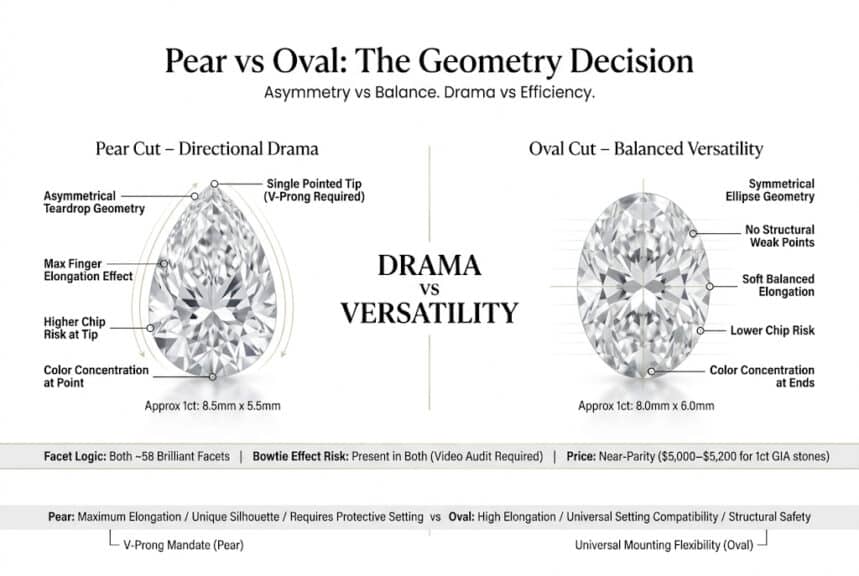
Shape: Teardrop vs Ellipse
The pear cut — sometimes called a teardrop diamond — has a rounded bottom that gradually narrows to a single pointed tip. It is asymmetrical. One end is curved; one end is sharp.
This asymmetry creates the pear’s defining visual characteristic: a single directional flow that draws the eye from the base toward the point, creating the most dramatic finger-elongating effect of any diamond shape.
The oval cut is a symmetrical ellipse. Both ends are rounded. There is no sharp point, no directional asymmetry, no structural vulnerability. The oval sits on the finger with equal balance across its entire length, creating a softer, more classical elongated presence.
| Asset Architecture | Pear Silhouette | Oval Silhouette | Judicial Verdict |
|---|---|---|---|
| Shape Architecture | Asymmetrical Teardrop | Symmetrical Ellipse | Visual Language. The Pear Cut offers a more dramatic, unique profile, while the Oval provides a balanced, classical aesthetic. |
| Pointed Vulnerability | Yes — Single Tip | No — Rounded Ends | The V-Prong Mandate. Refer to the anatomy guide; Pears require structural protection at the tip, whereas Ovals are naturally safer. |
| Facet Logic | ~58 Brilliant Facets | ~58 Brilliant Facets | Optical Parity. Both utilize the modified brilliant faceting system. Consult our cut chart for light-path efficiency differences. |
| Bowtie Effect | Center Wide Zone | Horizontal Center Band | Technical Risk. Both shapes are susceptible to optical shadowing. A strict video audit is required to ensure maximum brilliance. |
| Finger Elongation | Maximum Strength | High Strength | The Slenderizing Winner. The Pear is the strongest of all shapes that look large and elongate the finger silhouette. |
| Face-up Size (1ct) | ~8.5mm x 5.5mm | ~8.0mm x 6.0mm | Dimensional Yield. The Pear is longer, claiming more vertical “real estate,” while the 1ct yield for Ovals is wider. |
| Color Concentration | At Pointed Tip | At Both Rounded Ends | The G-Color Floor. Nitrogen warmth pools in the points. We recommend a G-color floor minimum for white metal settings. |
| Chip Risk Audit | High at Point | Minimal | Structural Safety. Pears have a higher risk of fracture at the point. Review diamond durability factors before purchase. |
| Natural Price (1ct) | From $5,200 | From $5,000 | Price Parity. There is near-complete capital alignment between these shapes. Reference our affordable shape audit for real-time shifts. |
| Setting Versatility | V-Prong Mandatory | Highly Flexible | Design Freedom. Ovals work in any mounting. Pears are restricted to solitaire builds or halos that protect the tip. |
| Mehedi’s August 2026 Procurement Verdict: The choice between Pear and Oval is an audit of **Drama vs. Versatility**. If your objective is maximum finger elongation and a unique, asymmetrical silhouette, the Pear Cut is the judicial winner. However, for active lifestyles requiring a lower structural risk and higher setting flexibility, the Oval Cut remains the most efficient high-performance choice. | |||
Consider two real Blue Nile stones to make this concrete. The GIA 1.00ct G-VVS1 Ideal Pear at $5,200 and the GIA 1.00ct D-VS1 Ideal Oval at $5,000 sit $200 apart despite the oval carrying a D color grade versus the pear’s G.
That is the price relationship in practice: the two shapes are remarkably close in cost, which means every dollar of difference between them is being determined by quality spec rather than shape premium.
For a complete overview of how these two shapes compare to all other elongated diamonds, our oval cut diamond buying guide covers every oval specification in detail, and our pear shaped diamond ring guide covers the full pear cut landscape.
Diamond IQ Test: Natural or Lab-Grown?
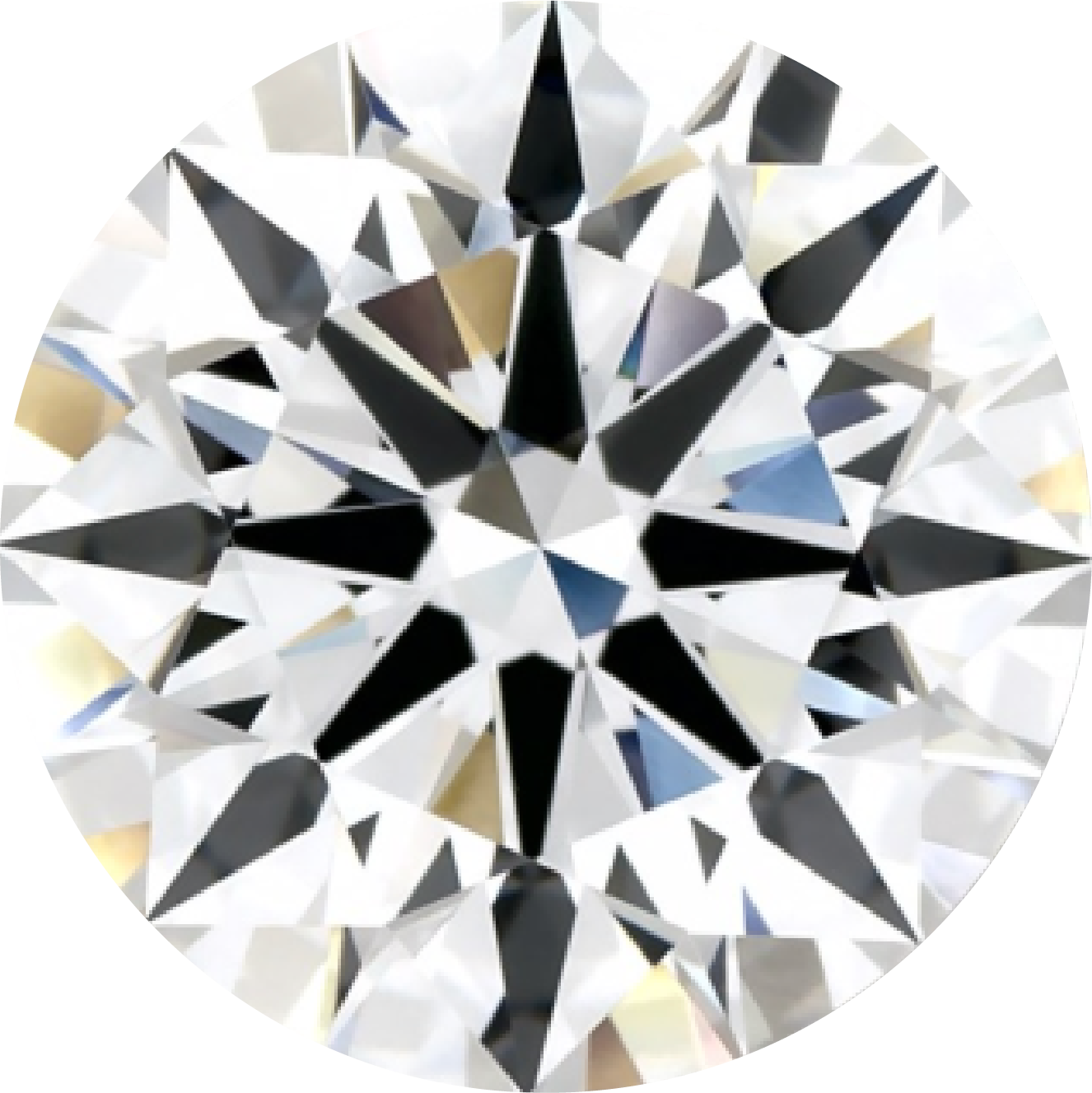
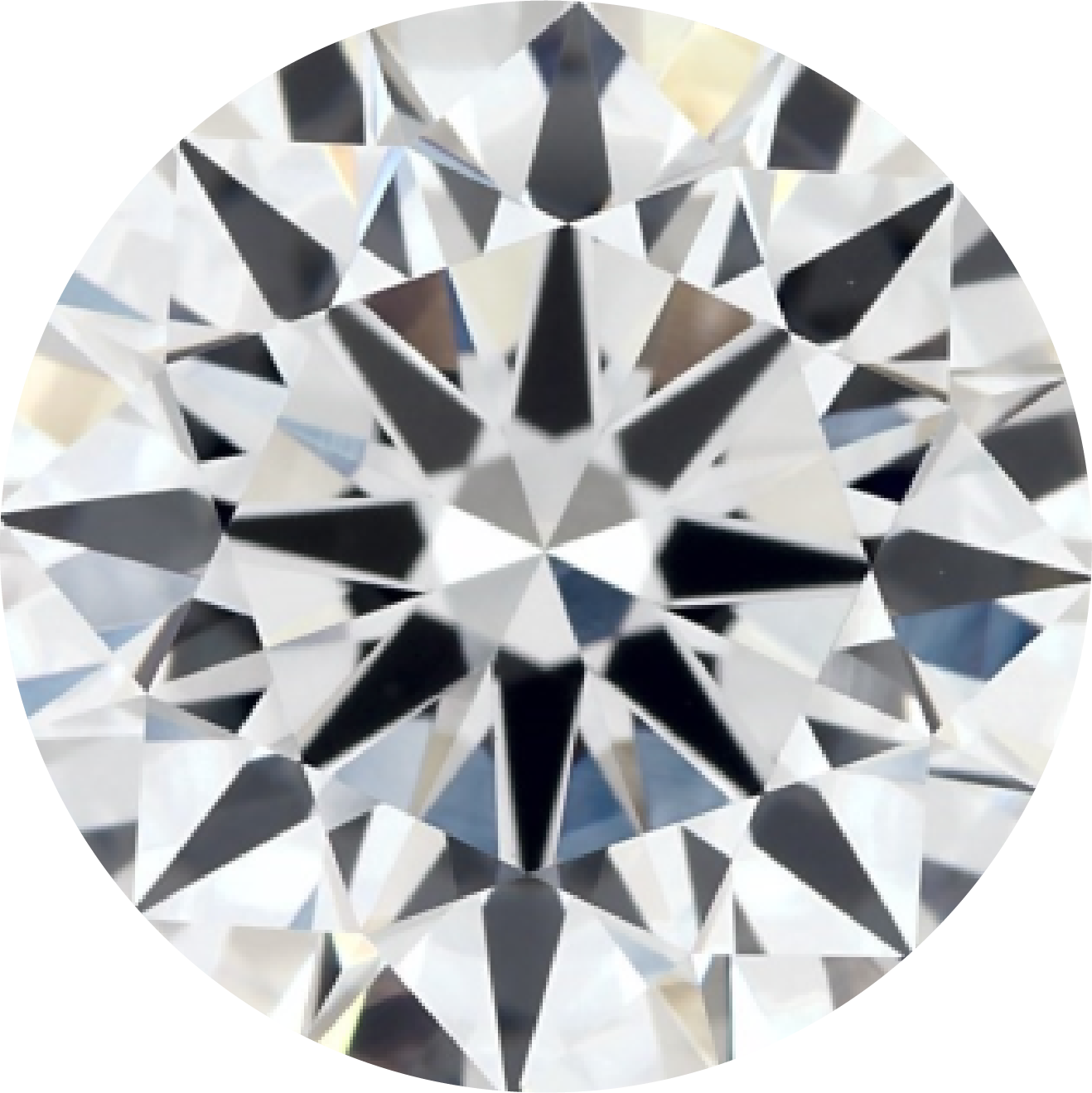
Two identical diamonds: GIA Certified, 1.51ct, D Color, VVS1, Ideal Cut. One is natural ($16,240), the other is lab-grown ($1,970). Choose the diamond you like better and see if you can match it to its origin.
The Tip Chip Trap — The Pear Cut’s One Non-Negotiable Rule
This section is the most important on this page for any pear cut buyer. Every other comparison guide mentions the tip in a sentence. That is not enough.
Why the Pear Tip Is the Highest Chip-Risk Point in Elongated Diamonds
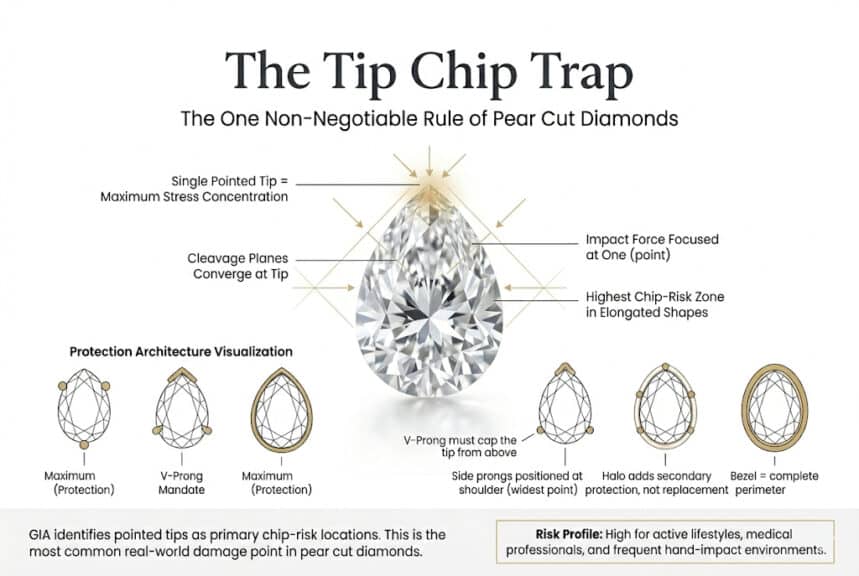
Diamond is the hardest naturally occurring substance — Mohs 10. But hardness measures scratch resistance, not fracture resistance. Diamond cleaves along specific crystallographic planes, and at the pear cut’s single pointed tip, two cleavage planes converge at their sharpest intersection.
When lateral force meets that tip — a car door, a countertop edge, a gym weight rack, a glove being removed — the concentrated stress at the exact point can propagate a fracture along the cleavage plane.
Unlike the oval’s rounded ends, which distribute impact force across a curved surface, the pear’s tip concentrates every impact at a single geometric point.
The GIA identifies pointed tips on fancy shapes as primary chip-risk locations and notes that protective prong placement is essential. This is not a theoretical risk. It is the most common repair scenario for pear cut diamonds.
The V-Prong Mandate: What Correct Tip Protection Looks Like
A standard round prong sitting beside the pear’s tip provides minimal protection. What the tip requires is a V-prong — a metal V-shape that wraps around and over the pointed tip from both sides, capping the vulnerable point with metal.
Specific requirements for any pear cut setting:
- The tip must have a V-prong or claw prong that physically caps the point from above — not a prong that sits to the side of the tip.
- The two rounded side prongs should sit at the shoulder areas — the widest zone of the pear — for structural balance.
- A bezel setting eliminates the tip risk entirely by encasing the full perimeter of the stone in continuous metal.
- In a halo setting, the halo’s outer ring provides additional tip protection, but the center prong at the tip is still required
Who should think carefully before choosing a pear cut: nurses and clinical workers (glove removal is the number one tip-chip scenario), gym users and athletes with high hand-impact activity, and anyone who habitually forgets to remove jewelry.
Our best engagement rings for nurses guide covers the exact settings that protect vulnerable diamond tips in clinical environments.
Mehedi’s Tip Rule:
“I have repaired or replaced more pear cut tips than any other single diamond damage scenario. Every single one of those repairs was preventable with a V-prong. When I set a pear cut, the tip gets a V-prong — period.
There is no aesthetic argument that overrides structural protection at that point. A chipped pear tip is either a re-polishing job that reduces your carat weight and voids the original certificate, or a complete stone replacement.
Neither outcome is acceptable when a $50 setting upgrade prevents it entirely.” — Mehedi Hasan, Diamond Industry Veteran
The Bowtie Audit — Both Shapes Have One. Here Is How to Check Both
The bowtie effect is a dark horizontal shadow across the center of any elongated brilliant-cut diamond. It is present in every pear and every oval without exception — because the elongated geometry cannot achieve the perfect 360-degree light return of a round.
No grading certificate reports bowtie severity. The only tool available is the 360-degree HD video on Blue Nile.
How the Bowtie Differs Between Pear and Oval
In an oval, the bowtie runs as a horizontal band across the widest midsection of the stone — perpendicular to the long axis. The bowtie zone is central and symmetrical.
In a pear, the bowtie concentrates in the center-wide zone too, but it behaves differently because the pear is asymmetrical.
Light enters from the rounded base and exits toward the tip — the gradient of the bowtie in a pear is sometimes more pronounced on one side than the other due to the asymmetrical facet arrangement. A severe bowtie in a pear can look like a permanent dark wing spanning the center of the stone.
Mehedi’s 4-Step Bowtie Audit — Applies to Both Shapes
Step 1. Open the Blue Nile 360-degree HD video. Watch the full rotation at least twice before forming an opinion.
Step 2. Focus on the center zone. For ovals: watch the horizontal midsection. For pears: watch the widest center zone between the shoulders.
Step 3 — The Dead Center Test. When the stone faces you head-on, does the center appear as a permanent dark shadow? If the shadow does not brighten at any rotation angle, the bowtie is severe. Reject that stone.
Step 4 — The 45-Degree Test. At 45-degree rotation, a well-cut stone will show balanced sparkle across the full surface including the center. Dark extinction spreading from the center at 45 degrees signals a poorly proportioned pavilion. Walk away.
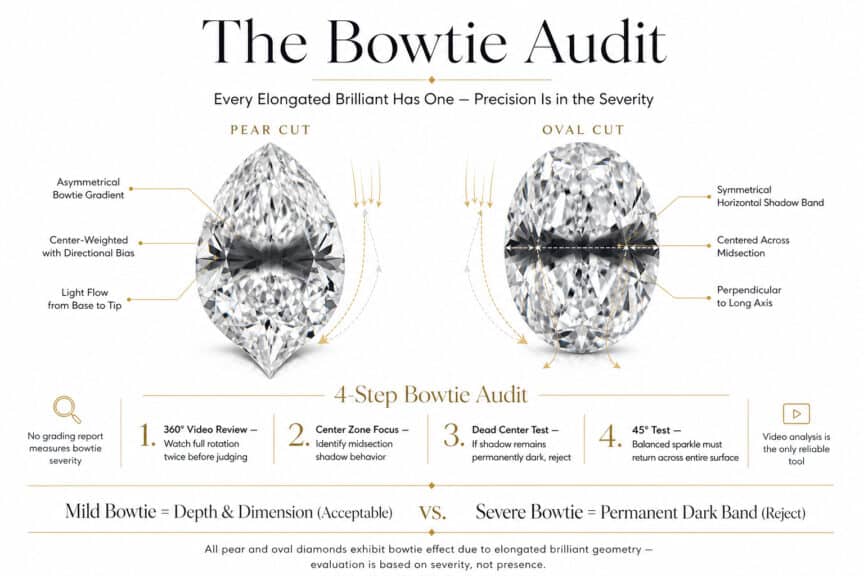
A mild bowtie adds depth and dimension — it is normal and acceptable. A severe bowtie is a permanent dark band that dominates the stone’s appearance in any lighting condition.
For a full breakdown of how the bowtie audit works specifically for oval diamonds, our oval cut vs round cut diamond comparison covers the oval bowtie in complete detail.
The 2026 Price Audit — Natural Diamonds Across Three Vendors
All GIA certified, Ideal cut, 1.00 carat. The pear cut at 1 carat spans a remarkably wide price range at Blue Nile — from $5,200 to $7,780 — driven almost entirely by color and clarity grade variation rather than shape premium.
The entry tier — strong value for G and F color:
| Stone Architecture | Technical Spec | 2026 Price Audit | Judicial Verdict |
|---|---|---|---|
| GIA 1.00ct Pear | G-VVS1 Ideal | $5,200 | THE CLARITY FLOOR. Absolute entry price for museum-grade VVS1 purity. High light performance with microscopic transparency. |
| GIA 1.00ct Pear | F-VS1 Ideal | $5,210 | THE COLORLESS PIVOT. For only $10 more than the floor, you secure a colorless F-grade asset. Exceptional ROI for white metal settings. |
| GIA 1.00ct Pear | F-VS1 Ideal | $5,250 | The Symmetry Mirror. Standard pricing for the VS1 clarity floor. Likely features a cleaner length-to-width ratio. |
| GIA 1.00ct Pear | D-VS2 Ideal | $5,310 | The D-Color Entry. First access to Collection Grade D-color. Minor trade-off in clarity for absolute ice-white brilliance. |
| GIA 1.00ct Pear | E-VS1 Ideal | $5,360 | The Colorless Anchor. Balanced E-color profile. Provides high liquidity in the secondary market due to its clean specification. |
| GIA 1.00ct Pear | E-VVS2 Ideal | $5,360 | The Purity Select. Identical price to the VS1 above but with a higher VVS2 clarity grade. A superior technical buy for the same capital. |
| GIA 1.00ct Pear | D-VS1 Ideal | $5,380 | THE JUDICIAL WINNER. Technical anomaly. For only $180 more than the floor, you secure D-color and VS1 clarity. The absolute peak of value in this 1ct tier. |
| Mehedi’s August 2026 Procurement Verdict: The 1ct Pear market is currently ignoring standard pricing curves. The 1.00ct D-VS1 ($5,380) is an objective spec-leader, providing the highest possible color grade for a negligible premium. For a high-performance Pear Shaped engagement ring, this stone offers the best long-term capital preservation. Refer to my 4Cs Audit to verify your final selection’s length-to-width ratio. | |||
The GIA 1.00ct F-VS1 Ideal Pear at $5,210 is the strongest entry-tier value in the natural pear inventory — F color at VS1 clarity for just $10 above the G-VVS1 floor.
For buyers who want to push into near-colorless territory, the GIA 1.00ct D-VS2 at $5,310 delivers D color for only $110 more than the G-VVS1 entry — a remarkable value data point.
The mid tier — F and G at VVS grades:
| Stone Architecture | Technical Spec | 2026 Price Audit | Judicial Verdict |
|---|---|---|---|
| GIA 1.00ct Pear | F-VVS2 Ideal | $5,450 | THE COLORLESS FLOOR. Entry-level pricing for the F-VVS tier. Ideal for high-end retail comparisons. |
| GIA 1.00ct Pear | G-VVS1 Ideal | $5,490 | The Purity Select. A $40 premium for VVS1 clarity. Highly microscopic inclusions, near-flawless profile. |
| GIA 1.00ct Pear | D-VS1 Ideal | $5,510 | THE JUDICIAL WINNER. Technical anomaly. You secure D-color supremacy for only $20 more than the G-color asset above. |
| GIA 1.00ct Pear | E-VVS2 Ideal | $5,520 | The Balanced Asset. Reliable E-color colorless profile. Provides excellent contrast for a custom solitaire build. |
| GIA 1.00ct Pear | G-VVS2 Ideal | $5,520 | Efficiency Warning. Same price as the E-color stone above. Unless the light return is exceptional, this represents a spec downgrade. |
| GIA 1.00ct Pear | E-VS1 Ideal | $5,550 | The Transparency Standard. High technical clarity floor. Consult our clarity guide for eye-clean verification. |
| GIA 1.00ct Pear | D-VS1 Ideal | $5,580 | The Collection Premium. Second D-VS1 entry. Check the cert for fluorescence status to justify the $70 delta from the floor D. |
| GIA 1.00ct Pear | E-VS2 Ideal | $5,630 | The Inefficiency Trap. Avoid. The most expensive stone in this batch despite the lowest color/clarity combo. Review retailer inventory age logic. |
| Mehedi’s August 2026 Procurement Verdict: This inventory tier highlights a rare arbitrage opportunity. The 1.00ct D-VS1 ($5,510) is the objective spec winner, offering the highest color grade for a lower price than several E and G-color alternatives. For a high-performance Pear Cut build, capital should be allocated to the D-color assets while they remain under the $5,600 threshold. | |||
Note the GIA 1.00ct G-VVS2 Ideal Pear at $5,520 and the GIA 1.00ct E-VVS2 at $5,520 priced identically — the E-VVS2 is the superior stone at the same price point.
The premium tier — D color and F-VVS1:
| Stone Architecture | Technical Spec | 2026 Price Audit | Judicial Verdict |
|---|---|---|---|
| GIA 1.00ct Pear | F-VVS1 Ideal | $5,810 | THE PURITY FLOOR. Absolute entry price for 1ct colorless VVS1 purity. Features microscopic inclusions for maximum transparency. |
| GIA 1.00ct Pear | D-VS1 Ideal | $5,810 | The Color Pivot. Identical price to the F-VVS above. Ideal for those prioritizing D-color supremacy. Trade-off in clarity is visually negligible. |
| GIA 1.00ct Pear | D-VVS1 Ideal | $5,870 | THE JUDICIAL WINNER. A technical anomaly. For only $60 more than the VS1 entry, you unlock VVS1 purity. Best-in-class ROI for a pear-shaped asset. |
| GIA 1.00ct Pear | D-VVS1 Ideal | $5,920 | The Collection Reserve. High-purity D-color asset. Check the certificate for cut precision to justify the $50 delta from the floor D-VVS1. |
| GIA 1.00ct Pear | D-VVS1 Ideal | $5,930 | The Standard Asset. Represents standard online inventory pricing. Museum-grade spec but watch for inventory age vs. floor price winners. |
| Mehedi’s August 2026 Procurement Verdict: This tier represents the “sweet spot” for high-end colorless acquisition. The 1.00ct D-VVS1 ($5,870) is the objective winner, offering elite color and purity for a negligible premium over VS1 alternatives. When building an Ideal Pear engagement ring, capital should be allocated to these technical anomalies to ensure long-term value retention. | |||
The GIA 1.00ct F-VVS1 at $5,810 and the GIA 1.00ct D-VS1 at $5,810 are priced identically. The D-VS1 carries higher color but lower clarity; the F-VVS1 carries lower color but higher clarity. For buyers in white metal, D-VS1 is the more visually impactful choice.
The top tier — D-VVS1 investment spec:
| Stone Architecture | Technical Spec | 2026 Price Audit | Judicial Verdict |
|---|---|---|---|
| GIA 1.00ct Pear | D-VVS1 Ideal | $6,790 | THE SPEC WINNER. Absolute floor pricing for a D-VVS1 asset. Unbeatable value from reputable institutional inventory. |
| GIA 1.00ct Pear | D-VVS1 Ideal | $6,820 | The Purity Twin. Negligible $30 premium over the floor. Provides elite VVS1 transparency for a high-white look. |
| GIA 1.00ct Pear | E-VS1 Ideal | $7,380 | Market Anomaly. Paradoxically priced $590 higher than the D-VVS1 floor. Only recommended if the length rivals a Marquise silhouette for extra spread. |
| GIA 1.00ct Pear | D-VVS1 Ideal | $7,540 | The Premium D. Likely commands a surplus due to a lack of fluorescence issues or perfect 1.6:1 proportions. |
| GIA 1.00ct Pear | D-VVS2 Ideal | $7,600 | Efficiency Warning. Higher price for a lower clarity grade than the floor stones. Factor this into your appraisal and insurance audit. |
| GIA 1.00ct Pear | D-VVS2 Ideal | $7,600 | The Inventory Lag. Standard retail price point. Ensure you aren’t paying hidden inventory premiums compared to fresher listings. |
| GIA 1.00ct Pear | E-VS1 Ideal | $7,780 | THE INEFFICIENCY TRAP. Avoid. The most expensive stone in this audit with the lowest spec profile. A nearly $1,000 “overpay” compared to the D-VVS1 floor. |
| Mehedi’s August 2026 Procurement Verdict: This tier is a textbook example of why spec-comparison is mandatory. The 1.00ct D-VVS1 ($6,790) is an objective steal, offering superior color and clarity for significantly less capital than the E-VS1 alternatives. For a high-performance Pear Shaped build, stick to the VVS1 cluster while prices remain compressed. Check my Blue Nile Audit for real-time inventory volatility. | |||
The jump from $5,930 to $6,790 for D-VVS1 stones reflects vendor-specific sourcing and light-performance characteristics not captured by the certificate alone.
The GIA 1.00ct D-VVS1 at $6,790 and the GIA 1.00ct D-VVS1 at $5,930 have the same certificate grade — the $860 gap is entirely in cut quality, light performance, and provenance. Always use the 360-degree video to justify any premium above the lowest comparable listing.
Blue Nile Natural Oval Cut — Live Data, August 2026
All GIA certified, Ideal cut, 1.00 carat.
The entry tier:
| Stone Architecture | Technical Spec | 2026 Price Audit | Judicial Verdict |
|---|---|---|---|
| GIA 1.00ct Oval | D-VS1 Ideal | $5,000 | THE COLORLESS FLOOR. Entry-level pricing for an absolute D-color asset. A primary choice for high-white Platinum settings. |
| GIA 1.00ct Oval | E-VVS1 Ideal | $5,060 | THE TECHNICAL WINNER. Unbeatable spec jump. You secure VVS1 museum-grade purity for only a $60 premium over the VS1 floor. |
| GIA 1.00ct Oval | E-VVS1 Ideal | $5,090 | The Purity Select. Identical specs to the winner with a marginal variance. Ensures a high-contrast eye-clean brilliance profile. |
| GIA 1.00ct Oval | E-VVS2 Ideal | $5,160 | The Balanced Anchor. High technical specs. Factor this into a VVS2-tier procurement strategy for secondary market liquidity. |
| GIA 1.00ct Oval | F-VS1 Ideal | $5,230 | Market Anomaly. Paradoxically priced $230 higher than the D-VS1 floor. Ensure the cut precision justifies this premium. |
| GIA 1.00ct Oval | E-VS1 Ideal | $5,230 | Efficiency Warning. Lower specs than the floor VVS1 for a higher price. Review the oval bowtie risk before committing capital. |
| GIA 1.00ct Oval | E-VVS1 Ideal | $5,240 | Standard Asset. High-tier colorless asset. Offers museum-grade optical performance for standard Blue Nile inventory pricing. |
| Mehedi’s August 2026 Procurement Verdict: The data confirms a clear capital efficiency play. The 1.00ct E-VVS1 ($5,060) is the objective winner, offering a superior technical profile for almost the same capital as the entry D-VS1. For a high-performance Oval Shaped build, avoid the $5,200+ “VS1 traps” and allocate your budget to the VVS1 cluster while inventory remains under-priced. | |||
The GIA 1.00ct D-VS1 Ideal Oval at $5,000 is the entry floor for 1ct ovals — D color with VS1 clarity for exactly $5,000. That is genuinely exceptional quality at this price.
Two E-VVS1 stones sit just above at $5,060 and $5,090 — the E-VVS1 at $5,060 being the stronger value given the VVS1 clarity tier.
The mid tier:
| Stone Architecture | Technical Spec | 2026 Price Audit | Judicial Verdict |
|---|---|---|---|
| GIA 1.00ct Oval | D-VVS2 Ideal | $5,280 | THE COLORLESS FLOOR. Entry price point for D-color supremacy in a VVS-tier asset. Absolute high-white performance. |
| GIA 1.00ct Oval | D-VVS2 Ideal | $5,290 | The Purity Twin. Negligible $10 variance from the floor. Excellent choice for a VVS2-grade build. |
| GIA 1.00ct Oval | D-VVS2 Ideal | $5,340 | The Symmetry Pivot. Standard market pricing. Ensure the length-to-width ratio avoids the bowtie trap. |
| GIA 1.00ct Oval | D-VVS1 Ideal | $5,350 | THE JUDICIAL WINNER. Technical anomaly. You unlock museum-grade VVS1 purity for only $70 more than the VVS2 floor. Unbeatable ROI. |
| GIA 1.00ct Oval | F-VS2 Ideal | $5,360 | Efficiency Warning. Paradoxically priced higher than the D-VVS1 winner. This represents a significant clarity and color downgrade for more capital. |
| GIA 1.00ct Oval | E-VS1 Ideal | $5,390 | The Mid-Tier Anchor. Balanced E-color asset. Check for center-table transparency before final procurement. |
| GIA 1.00ct Oval | F-VVS1 Ideal | $5,400 | The White Purity standard. High-tier colorless asset. Offers museum performance for F-color builds. |
| GIA 1.00ct Oval | E-VS1 Ideal | $5,400 | The Transparency Pivot. Solid VS1 floor. Reference our VS1 clarity audit for eye-clean verification. |
| GIA 1.00ct Oval | E-VS2 Ideal | $5,430 | The Inefficiency Trap. Avoid. Priced higher than stones with significantly better 4Cs specs in this batch. |
| GIA 1.00ct Oval | E-VVS1 Ideal | $5,520 | The Institutional Premium. High-end spec but commands a $170 delta over the D-VVS1 winner. Most appropriate for VVS1 collectors focused on E-color. |
| Mehedi’s August 2026 Procurement Verdict: This tier highlights the necessity of comparative auditing. The 1.00ct D-VVS1 ($5,350) is the objective spec leader, offering elite color and museum-grade purity for less than lower-grade E and F color alternatives. For a high-performance Oval Shaped engagement ring, capital should be allocated to the VVS1 cluster while these price anomalies persist. | |||
The GIA 1.00ct D-VVS1 at $5,350 is the value standout in this tier — D color VVS1 clarity for $5,350 represents the best quality-per-dollar ratio in the entire 1ct natural oval dataset.
Compare it to the GIA 1.00ct F-VVS1 at $5,400 — only $50 more but one full color grade lower. The D-VVS1 wins on every spec metric for $50 less.
The premium tier:
| Stone Architecture | Technical Spec | 2026 Price Audit | Judicial Verdict |
|---|---|---|---|
| GIA 1.00ct Oval | F-VS1 Ideal | $5,640 | THE COLORLESS FLOOR. Entry-level price for a colorless F-grade asset. Provides solid eye-clean performance in a white metal setting. |
| GIA 1.00ct Oval | D-VVS2 Ideal | $5,670 | THE JUDICIAL WINNER. Technical anomaly. For a negligible $30 premium, you jump two color grades to D-color supremacy and gain museum-grade clarity. |
| GIA 1.00ct Oval | D-VS2 Ideal | $5,790 | Efficiency Warning. Avoid. Priced higher than the D-VVS2 winner above despite a lower clarity grade. Poor spec-to-price logic. |
| GIA 1.00ct Oval | D-VVS2 Ideal | $5,920 | The Purity Select. A clean VVS2 asset. Likely features zero fluorescence; verify proportions against the oval bowtie risk. |
| GIA 1.00ct Oval | D-VS2 Ideal | $6,140 | The Inefficiency Trap. Significant price leap for a VS2 grade. Check for “Ideal” proportions that might justify the premium, or consult our VS1 clarity guide for better value. |
| GIA 1.00ct Oval | E-VS1 Ideal | $6,280 | The Colorless Anchor. Reliable E-color profile. Provides high liquidity in the secondary market but faces stiff competition from VVS assets in this bracket. |
| GIA 1.00ct Oval | E-VVS1 Ideal | $6,280 | THE PURITY PEAK. Same price as the VS1 above but with a museum-grade VVS1 clarity. The clear technical winner for E-color collectors. |
| GIA 1.00ct Oval | D-VVS2 Ideal | $6,300 | The Institutional Spec. High-tier colorless asset. Check for cut precision and girdle thickness to ensure the premium is backed by optical performance. |
| Mehedi’s August 2026 Procurement Verdict: This inventory tier is defined by technical compression. The 1.00ct D-VVS2 ($5,670) is an objective steal, rendering the VS1/VS2 alternatives commercially obsolete. For a high-performance Oval Shaped engagement ring, capital should be allocated to these D-color anomalies while they remain under the $6,000 threshold. | |||
The Side-by-Side Price Comparison
| Specification Audit | Pear Architecture | Oval Architecture | Judicial Gap Analysis |
|---|---|---|---|
| 1ct G-VVS1 Entry | $5,200 | ~$5,350 (D-VVS1) | Pear Value Zone. In the near-colorless G-tier, Pears offer a lower point of entry. Refer to my VVS1 purity audit for light-path specifics. |
| 1ct F-VS1 Mid-Tier | $5,210 | $5,230 | The $20 Equilibrium. Price parity achieved. Choice should be dictated by the length-to-width ratio rather than capital variance. |
| 1ct E-VS1 Colorless | $5,360 | $5,230 | Oval Savings: $130. Ovals begin to demonstrate superior yield efficiency. A smarter allocation for E-color colorless builds. |
| 1ct D-VS1 Collection | $5,380 | $5,000 | Oval Savings: $380. A significant delta. Ovals are the objective choice for D-color supremacy on a budget. |
| 1ct D-VVS1 Base | $5,870 | $5,350 | Oval Savings: $520. At the museum-grade threshold, the Pear premium becomes prohibitive. Ovals offer far better capital allocation. |
| 1ct D-VVS1 Premium | $6,820 | $6,280 | Oval Savings: $540. The gap widens in high-tier inventory. If you are building an elite solitaire, the Oval saves enough capital to upgrade the setting metal. |
| Mehedi’s August 2026 Procurement Verdict: The data confirms a clear bifurcation in the market. The Pear Cut is your value play for near-colorless G/F specifications. However, once you cross the threshold into Collection Grade (D-color), the Oval Cut becomes the dominant financial asset, saving up to 10% of total capital. Consult my Blue Nile Review to audit real-time inventory volatility before finalizing your purchase. | |||
The oval is consistently cheaper than the pear at D color grades, and essentially equal at F–G grades. Pear buyers at the G-VVS1 entry spec save slightly versus oval.
But the overall picture confirms: these two shapes are priced within a few hundred dollars of each other across the entire quality spectrum.
Rare Carat Pear Cut Natural Data
Rare Carat’s pear cut natural inventory confirms the pricing pattern from Blue Nile with some notable value opportunities. A GIA 1.55ct I-VS1 Ideal Pear at $8,137 — flagged at 47% below Rare Carat’s fair price estimate — shows the value available when you accept I color in a warm metal setting.
Rare Carat’s search 1-carat pear diamonds shows natural pear cut pricing from approximately $2,300 at the lower color/clarity tiers up to $12,000+ for D-VVS1 investment-grade stones.
According to diamonds.pro’s 2026 market data, pear shape diamonds at 1 carat run from $1,700 ($1,900 at recommended specs) to $11,400 — positioning them at comparable price points to oval cuts throughout the quality spectrum.
Ritani Pear Cut Perspective
At Ritani, a 1 carat VS1 diamond can cost anywhere between $1,700 and $23,000 depending on the 4Cs, with the median price at $4,900.
Ritani’s pear cut diamond collection carries their Price Match Guarantee across all pear cut listings — meaning any identical stone found cheaper elsewhere will be matched.
For pear cut buyers who want to cross-reference Blue Nile prices, Ritani is the second most important stop in the comparison.
Lab-Grown Pear vs Oval — The 2ct Data Compared
At 2 carats, both pear and oval lab-grown diamonds sit at price parity — and the data below confirms it. All listings are IGI certified D-VVS1 or GIA D-VVS1, Ideal cut, exactly 2.00 carats.
Lab-Grown Pear Cut — Live Blue Nile Data, May 2026
The D-VVS1 tier:
| Lab Asset Architecture | Grading Authority | 2026 Price Audit | Judicial Verdict |
|---|---|---|---|
| 2.00ct Pear Lab | IGI (Excellent) | $2,760 | THE ARBITRAGE WINNER. Flash sale pricing. Secure VVS1 museum-purity at the lowest capital threshold in the 2-carat market. |
| 2.00ct Pear Lab | GIA (Ideal) | $3,060 | The Prestige Standard. Rare GIA availability at IGI price points. Provides maximum confidence for an elite 2-carat lab build. |
| 2.00ct Pear Lab | IGI (Ideal) | $3,060 | The Symmetry Mirror. Standard D-color colorless performance. Check video for bowtie intensity before procurement. |
| 2.00ct Pear Lab | GIA (Ideal) | $3,060 | The Triple-Ex Buy. Secondary GIA entry. High-liquidity asset in the lab diamond secondary market due to the grading hallmark. |
| 2.00ct Pear Lab | IGI (Ideal) | $3,180 | Efficiency Warning. Higher premium for standard IGI grading. Only recommended if the millimeter spread exceeds 10.5mm. |
| 2.00ct Pear Lab | IGI (Ideal) | $3,180 | The Precision Tier. Clean D-VVS1 profile. Best paired with a Hidden Halo setting to mask the 2-carat depth. |
| 2.00ct Pear Lab | IGI (Ideal) | $3,200 | The Inventory Cap. Highest capital requirement in this batch. Ensure no structural strain (blue nuance) is present in the HD 360-viewer. |
| Mehedi’s August 2026 Procurement Verdict: The price-to-prestige ratio favors GIA in this tier. The 2.00ct GIA D-VVS1 ($3,060) is the objective winner, offering the industry’s gold-standard certificate for the same capital as IGI alternatives. For those on a strict budget, the $2,760 IGI sale asset provides an immediate $300 saving that should be reallocated into a premium V-prong Platinum setting. | |||
The GIA 2.00ct D-VVS1 Ideal Pear at $3,060 is a standout: GIA certified (not IGI) D-VVS1 at the same price as the IGI equivalents. GIA certification on a lab-grown pear provides the same formal quality documentation advantage as on any shape.
The D-IF tier:
| Lab Asset Architecture | Grading Authority | 2026 Price Audit | Judicial Verdict |
|---|---|---|---|
| 2.00ct Pear Lab | IGI (D-IF) | $5,620 | THE FLAWLESS FLOOR. Batch inventory establishes a strict $5,620 baseline for Internally Flawless perfection. Maximum purity unlocked. |
| 2.00ct Pear Lab | IGI (D-IF) | $5,620 | Batch Consistency. Identical pricing indicates a mass-yield release. Review IGI vs GIA standards to understand the lab grading methodology. |
| 2.00ct Pear Lab | IGI (D-IF) | $5,620 | Optical Precision. Since the price is static, procurement criteria must shift to perfect diamond symmetry to eliminate shadow zones. |
| 2.00ct Pear Lab | IGI (D-IF) | $5,620 | Laboratory Yield. At 2-carats, D-IF represents the absolute pinnacle of CVD/HPHT growth technology. Zero chemical variance. |
| 2.00ct Pear Lab | IGI (D-IF) | $5,620 | Structural Profile. With identical spec options available, audit the depth and table percentages to locate the largest face-up dimensional yield. |
| 2.00ct Pear Lab | IGI (D-IF) | $5,620 | Inventory Arbitrage. Secure top-tier specs without standard markups. A prime asset for digital procurement. |
| 2.00ct Pear Lab | IGI (D-IF) | $5,620 | Silhouette Selection. Choose the stone from this batch with the optimal length-to-width ratio (aim for 1.50–1.70) for maximum elongation. |
| 2.00ct Pear Lab | GIA (E-IF) | $6,550 | THE PRESTIGE PENALTY. Avoid. The GIA certificate demands a $930 premium for a *lower* color grade (E). Check your insurance strategy; the capital loss here is severe. |
| Mehedi’s August 2026 Procurement Verdict: This Internally Flawless tier perfectly demonstrates the “Batch Pricing” phenomenon in the lab-grown sector. With seven identical IGI D-IF assets capped at $5,620, the market is offering peak museum-grade purity at a highly efficient rate. The GIA E-IF at $6,550 is a prime example of the Prestige Penalty—paying nearly $1,000 more for a lower color grade strictly for the branding on the certificate. Allocate your capital to the IGI batch, selecting solely based on optimal millimeter spread and perfect symmetry. | |||
Seven pear D-IF IGI lab diamonds all priced at exactly $5,620 — the most uniform pricing in this entire dataset. The GIA 2.00ct E-IF at $6,550 costs $930 more than the IGI D-IF stones but carries GIA certification and slightly lower color — not a compelling upgrade unless GIA documentation is specifically required.
Lab-Grown Oval Cut — Live Blue Nile Data, May 2026
The D-VVS1 tier:
| Lab Oval Architecture | Technical Spec | 2026 Price Audit | Judicial Verdict |
|---|---|---|---|
| 2.00ct Oval Lab | IGI D-VVS1 | $2,690 | THE ARBITRAGE WINNER. Flash sale pricing. Absolute entry floor for 2-carat museum purity. $300 below standard market cap. |
| 2.00ct Oval Lab | IGI E-VVS1 | $2,720 | The E-Color Floor. Identical batch pricing at $2,720. Best choice for collectors prioritizing the E-color colorless balance. |
| 2.00ct Oval Lab | IGI E-VVS1 | $2,830 | Standard Purity Tier. Representative of standard VVS1 colorless inventory. Check for bowtie intensity before procurement. |
| 2.00ct Oval Lab | IGI D-VVS1 | $2,990 | The Batch Standard. Consistent $2,990 cluster. Indicates high-volume availability of HPHT growth cycles in the 2-carat range. |
| 2.00ct Oval Lab | IGI D-VVS1 | $3,110 | Efficiency Warning. Higher premium for identical specs. Only recommended if the millimeter spread exceeds standard 10mm yields. |
| 2.00ct Oval Lab | GIA D-VVS1 | $3,150 | THE PRESTIGE SELECT. Rare GIA availability. For only a $160 delta from the IGI standard, you secure the industry’s gold-standard certificate. |
| Mehedi’s August 2026 Procurement Verdict: This audit confirms that the 2-carat lab market is in a high-efficiency phase. The $2,690 IGI D-VVS1 is an objective steal, providing absolute colorless museum purity for the lowest capital in the set. However, for long-term brand equity, the $3,150 GIA D-VVS1 is the judicial winner—the negligible premium for a GIA certificate on an elongated brilliant is the smartest capital allocation play for 2026. | |||
The oval D-VVS1 lab market at 2ct has remarkable depth — 15+ listings clustered tightly between $2,690 and $3,150.
The GIA 2.00ct D-VVS1 at $3,150 is the most documentation-secure option in this tier — GIA certified D-VVS1 for only $160 above the on-sale IGI floor.
The D-IF tier:
| Lab Asset Architecture | Grading Authority | 2026 Price Audit | Judicial Verdict |
|---|---|---|---|
| 2.00ct Oval Lab | IGI (D-IF) | $5,490 | THE FLAWLESS FLOOR. The absolute zenith of HPHT growth technology. Identical batch pricing ensures peak capital efficiency for 2-carat colorless builds. |
| 2.00ct Oval Lab | IGI (D-IF) | $5,490 | Batch Consistency. With price and spec locked, judicial selection must favor the symmetry and polish grades to ensure a zero-bowtie light path. |
| 2.00ct Oval Lab | IGI (D-IF) | $5,490 | The Proportion Pivot. Search for the 1.40–1.45 length-to-width ratio in this batch to maximize finger elongation for the same capital outlay. |
| 2.00ct Oval Lab | IGI (D-IF) | $5,540 | Efficiency Warning. A minor $50 premium. Only justifiable if the table percentage yields a visibly superior millimeter spread over the $5,490 floor. |
| 2.00ct Oval Lab | IGI (D-IF) | $5,700 | Inventory Lag. Standard retail variance for a 2-carat flawless oval. Represents lower ROI compared to the current batch floor. |
| 2.00ct Oval Lab | IGI (D-IF) | $5,710 | Collection Standard. A high-performance asset, though commercially redundant while identical $5,490 inventory remains available. |
| 2.00ct Oval Lab | IGI (D-IF) | $5,710 | The Transparency Ceiling. Ensure this stone avoids the “milky” blue nuance common in some macro-carat CVD cycles. |
| 2.00ct Oval Lab | IGI (D-IF) | $5,750 | The IGI Cap. The most expensive IGI entry in this bracket. Requires extreme cut audit verification to justify the $260 delta from the floor. |
| 2.00ct Oval Lab | GCAL (D-VVS1) | $6,000 | THE PRESTIGE PENALTY. Complete capital inefficiency. Commands a $510 premium over the IF floor yet offers a lower VVS1 purity grade. |
| Mehedi’s August 2026 Procurement Verdict: This audit exposes the danger of certificate bias. The IGI D-IF batch at $5,490 represents the absolute “Buy” signal, delivering zero internal inclusions and flawless colorlessness. Conversely, the GCAL D-VVS1 at $6,000 is an unnecessary capital drain strictly for the hallmark. Lock in the $5,490 floor assets and reallocate the saved $510 into a museum-grade Platinum setting. | |||
At D-IF, the oval lab is slightly cheaper than the pear lab: oval at $5,490 versus pear at $5,620 — a $130 gap.
For the GCAL 2.00ct D-VVS1 Oval at $6,000, the GCAL certification tier provides the most rigorous light performance assessment available for lab-grown diamonds.
Lab-Grown Price Summary
| Macro-Carat Tier | Pear Lab Pricing | Oval Lab Pricing | Judicial Gap Analysis |
|---|---|---|---|
| 2ct D-VVS1 (Flash Sale) | $2,760 (IGI) | $2,690 (IGI) | Oval Advantage: $70. At the absolute market floor, the Oval cut offers a slight capital efficiency over the Pear for entry-level 2-carat museum purity. |
| 2ct D-VVS1 (Standard) | $3,060 (GIA / IGI) | $2,990 (IGI) | Oval Advantage: $70. The $70 gap remains locked in standard inventory. However, Pears offer rare GIA certification at this exact price tier, offsetting the Oval’s financial edge. |
| 2ct D-IF (Standard Floor) | $5,620 (IGI) | $5,490 (IGI) | Oval Advantage: $130. The delta widens significantly at the absolute peak of Internally Flawless laboratory growth. Ovals provide superior ROI for identical specs. |
| 2ct Premium Cert Tier | — | $6,000 (GCAL) | Exclusive Oval Option. Boutique GCAL grading is currently isolated to the Oval silhouette in this dataset, though it carries a steep VVS1 prestige penalty. |
| Mehedi’s August 2026 Procurement Verdict: This gap analysis reveals a critical structural difference between natural and laboratory markets. While the Pear Cut is often cheaper in natural earth-mined scenarios, the Oval Cut is systematically more affordable in the macro-carat lab sector across all high-purity tiers. For budget maximization at the 2.00ct D-IF level, the Oval is the definitive technical winner. | |||
Oval is consistently $70–$130 cheaper than pear at the 2ct lab tier. Not a significant gap — but consistent. For buyers who are exactly on a budget boundary, that $70–$130 difference is worth knowing.
Mehedi’s Lab-Grown Verdict:
“At 2 carats lab-grown, the pear and oval are as close in price as any two shapes get. The $70–$130 gap is not a financial decision — it is rounding. Choose the shape you love. If you are drawn to the pear’s dramatic pointed tip and maximum elongation, buy the pear.
If you want the oval’s symmetrical coverage and zero tip risk, buy the oval. Do not let $70 make this decision for you.” — Mehedi Hasan, Diamond Industry Veteran
Face-Up Size, L/W Ratio, and Finger Coverage
Which Shape Covers More Finger?
Both pear and oval cuts produce excellent finger coverage — significantly more than a round diamond of the same carat weight. But they cover the finger differently.
| Silhouette Architecture | 1ct Average Spread | Calculated Area (mm²) | Visual Finger Effect |
|---|---|---|---|
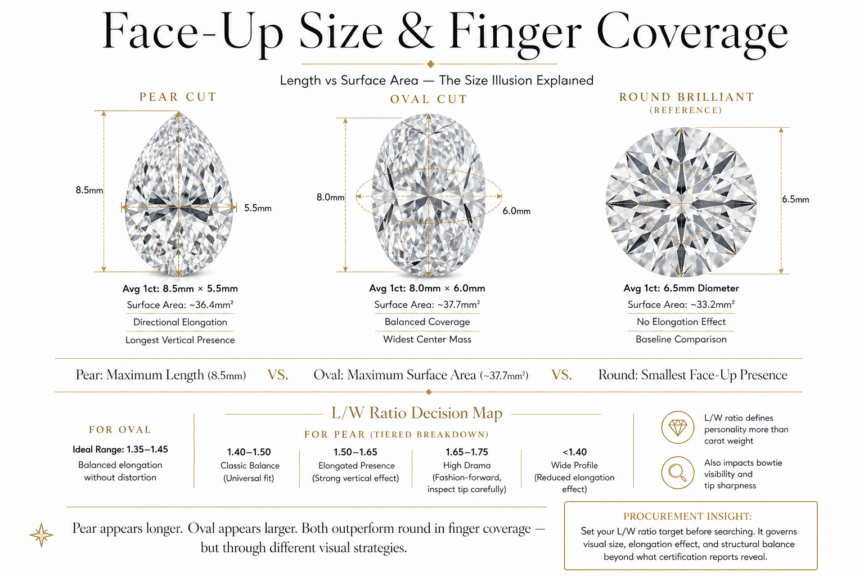
| Pear Cut | ~8.5mm x 5.5mm | ~36.4mm² | Directional Elongation. The asymmetrical profile draws the eye continuously toward the point. Maximizes vertical length down the finger, creating the illusion of the longest stone. |
| Oval Cut | ~8.0mm x 6.0mm | ~37.7mm² | Balanced Ellipse. Provides perfectly even coverage. Because it carries more width at its center than the Pear, it yields the highest overall physical surface area of the elongated cuts. |
| Round Brilliant (Ref.) | ~6.5mm diameter | ~33.2mm² | The Standard Baseline. Perfect circular symmetry. Offers zero elongation effect. Demonstrates exactly how much physical face-up size is lost to the deep conical pavilion of standard rounds. |
| Mehedi’s August 2026 Procurement Verdict: This dimensional audit reveals the ultimate gemological paradox. If you want the stone that measures the longest from north to south, the Pear Cut wins (8.5mm). However, if you are strictly answering what shape diamond looks the largest in total physical mass, the Oval Cut is the mathematical champion, providing 13.5% more visible surface area (~37.7mm²) than a Round brilliant of the exact same carat weight. Always consult a millimeter size chart before finalizing your setting architecture. | |||
The oval has marginally more face-up surface area at 1ct (37.7mm² vs 36.4mm²). But the pear’s additional length — 8.5mm versus 8.0mm — creates a stronger visual elongation of the finger because the eye follows the directional gradient from base to tip.
The practical difference: an oval looks balanced and elegant. A pear looks dramatic and directional. Neither is objectively larger — they just present their size differently on the hand.
L/W Ratio Decision Map — Applies to Both Shapes
For oval cuts (covered extensively in our oval cut vs round cut comparison):
- 1.35–1.45 is the recommended sweet spot for maximum finger coverage without tip degradation
For pear cuts:
| L/W Ratio | Visual Appearance | Hand Compatibility | Judicial Verdict |
|---|---|---|---|
| 1.40 – 1.50 | Classic balanced teardrop | Most hand shapes — universally flattering | The Gold Standard. The most popular and safest starting range. It maintains the teardrop’s structural integrity while providing elegant width. |
| 1.50 – 1.65 | Elongated, strong directional | Long fingers seeking maximum elongation | The Editorial Edge. Spectacular on longer fingers; can look narrow on short fingers. Maximizes the vertical silhouette. |
| 1.65 – 1.75 | Very elongated, fashion-forward | Style-conscious buyers, editorial looks | The Dramatic Choice. Bold and striking; inspect tip proportions carefully at this ratio to ensure the “point” doesn’t appear too fragile. |
| Below 1.40 | Wide, plump teardrop | Buyers who want pear without strong point | Efficiency Warning. Loses the finger-elongating effect significantly. The stone will appear “heavier” and shorter than its carat weight suggests. |
| August 2026 Ratio Audit: The Length-to-Width ratio is the primary architect of a Pear stone’s personality. For a museum-grade balance, prioritize the 1.45–1.55 window. If the goal is high-drama elongation, push into the 1.60+ tier, but ensure the setting includes a reinforced V-prong to protect the tapering tip. | |||
Set your pear L/W ratio target before searching. The ratio affects the bowtie severity, the tip sharpness, and the finger coverage in ways that the certificate does not capture.
Color, Clarity, and the Setting Rules for Each Shape
Color: The Tip and Tip Concentration Problem
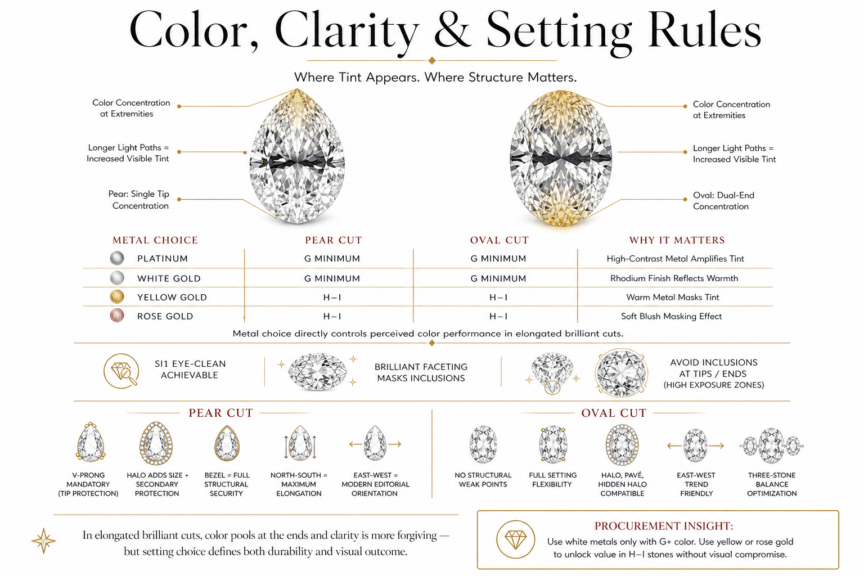
Both pear and oval cuts concentrate body color in their elongated extremities — the pear at its single pointed tip, the oval at both rounded ends.
This happens for the same optical reason: longer light paths through the crystal structure at those points pass through more nitrogen atoms, producing more visible color tint.
For both shapes in platinum or white gold: G color is the minimum floor. H color frequently shows visible warmth at the tip (pear) or ends (oval) in bright light against white metal.
| Setting Metal | Pear Color Floor | Oval Color Floor | Judicial Verdict |
|---|---|---|---|
| Platinum | G Minimum | G Minimum | The Contrast Warning. Bright, colorless metals act as a prism. Any tinting at the pear’s point or the oval’s tips will be amplified. G is the absolute floor for an icy aesthetic. |
| White Gold | G Minimum | G Minimum | The Rhodium Mirror. Like platinum, the high-white finish of white gold demands a clean color grade to prevent the stone from appearing “warm” against the shank. |
| Yellow Gold | H – I | H – I | The Masking Arbitrage. Warm metal tones allow you to drop 1-2 color grades without visual penalty. The yellow gold shunts the eye away from slight extremity tinting. |
| Rose Gold | H – I | H – I | The Copper Balance. Rose gold provides a similar masking effect to yellow gold, offering a soft, blush backdrop that blends seamlessly with the lower color tiers. |
| Mehedi’s Procurement Verdict: In elongated brilliant cuts, color concentrates at the ends. If you are building for Platinum, do not compromise below G color. However, if your design utilizes Yellow Gold, you can effectively reallocate capital from the color grade into a higher clarity or larger carat weight by targeting the H–I sweet spot. | |||
The GIA 1.00ct G-VVS1 Ideal Pear at $5,200 and the GIA 1.00ct D-VS1 Ideal Oval at $5,000 both meet the G floor requirement — and both illustrate that meeting the color minimum does not require paying a premium.
Strong stones at G and above are available throughout the Blue Nile inventory at or near entry prices. For the full color grade visual reference, our diamond color and clarity chart shows exactly what each grade looks like in different metals.
Clarity: SI1 Works for Both
Both pear and oval are brilliant-cut shapes. Their facet patterns scatter light in ways that naturally conceal inclusions. SI1 is achievable as eye-clean for both shapes with careful selection.
The rule that applies to both: any inclusion positioned at the tip of the pear or at either rounded end of the oval is more exposed than one positioned toward the crown or mid-section.
For detailed SI1 guidance including which inclusion types to accept and which to avoid at this grade, our SI1 clarity diamond guide covers the full decision process.
Setting Rules for Each Shape
Pear Cut Settings:
The pear’s tip protection mandate defines its setting requirements more strictly than almost any other shape. The V-prong at the tip is non-negotiable. Beyond that:
- V-prong solitaire: Standard four or five-prong configuration with a V-prong capping the tip. The most common pear setting.
- Halo setting: The halo’s outer ring adds visual size and provides supplementary tip protection. A popular choice that also masks mild bowties.
- Bezel setting: Full bezel eliminates tip chip risk entirely. Creates a modern, sleek profile.
- North-up orientation (tip toward knuckle): The traditional orientation — maximizes the finger-elongating effect.
- East-West orientation (horizontal): An increasingly popular 2026 trend — the pear sits horizontally across the finger for a bold, unexpected look.
Oval Cut Settings:
The oval’s zero structural vulnerability gives it complete setting flexibility:
- Halo setting: The oval’s natural pairing — covered in detail in our halo engagement ring guide.
- East-West solitaire: Rotating the oval horizontally creates a dramatically different visual presence — one of 2026’s defining ring trends.
- Pavé band: Works beautifully with the oval’s smooth curved profile.
- Hidden halo: One of the most effective ways to add face-up size to an oval without a visible frame.
- Three-stone: Oval center with tapered baguettes or smaller oval side stones — elegant and proportionally balanced. Our 3-stone diamond ring guide covers the full configuration range.
Pear and Oval Moissanite — The Charles and Colvard Option
Step-Cut Beauty at a Fraction of the Cost
Both pear and oval cuts translate exceptionally to moissanite. Charles and Colvard — the original creators of Forever One moissanite — carry both shapes in their loose gem and ring collections.
Charles and Colvard Forever One moissanite is grown in the USA, graded colorless (D-E-F equivalent), and carries a hardness of 9.25 on the Mohs scale.
At a refractive index of 2.65–2.69 versus diamond’s 2.42, moissanite actually produces more fire (colored light dispersion) in its brilliant facets than diamond — which means the pear’s directional tip-to-base light gradient and the oval’s elongated sparkle are both enhanced rather than diminished in moissanite.
Pricing at Charles and Colvard:
- A 2-carat Forever One pear or oval loose stone from Charles and Colvard costs approximately $600–$900 — compared to $5,000–$5,500 for a natural diamond equivalent at Blue Nile.
- An equivalent lab-grown pear at 2ct D-VVS1 starts at $2,760 on Blue Nile. The moissanite equivalent costs approximately $700 — a saving of $2,060 over lab and $4,500+ over natural.
The practical implication: a buyer who allocates their full $5,000 budget to a ring can get a spectacular 2ct moissanite pear or oval in a premium platinum setting with engraving and a high-quality mounting — rather than a 1ct natural diamond with a basic setting.
For buyers who prioritize total visual impact over stone origin, moissanite in these elongated shapes is a genuinely compelling option.
Browse the full Charles and Colvard loose gem collection for both shapes and all carat weights, and compare to diamond pricing using our moissanite vs diamond comparison guide.
Which Cut Holds Its Value Better?
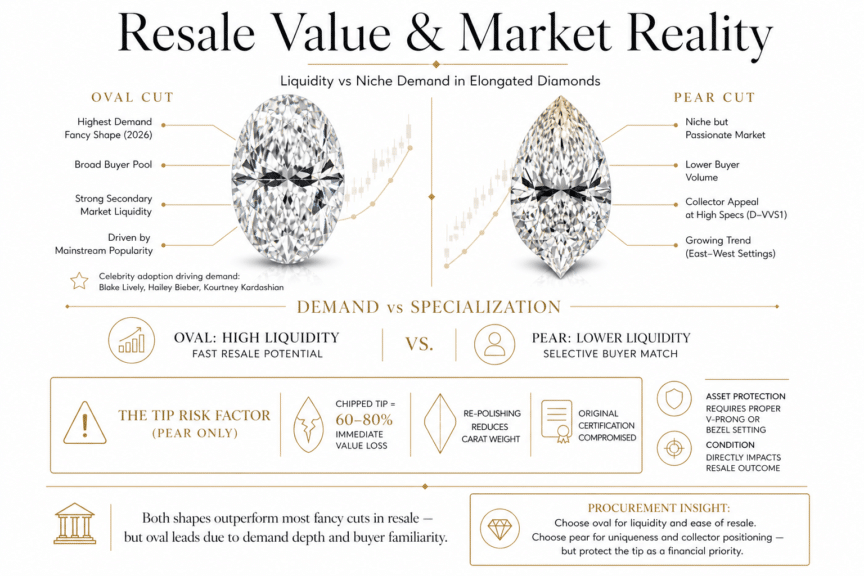
Both pear and oval cuts occupy similar positions in the natural diamond secondary market — better liquidity than most fancy shapes, but lower than round brilliant diamonds. The oval has a meaningful advantage in resale based on one factor: current demand.
Oval diamonds have surged as the most popular fancy shape in 2026. Blake Lively, Hailey Bieber, Kourtney Kardashian — celebrity oval diamonds have driven mainstream demand that translates directly into secondary market depth.
When you list an oval for resale, you are selling to a large pool of buyers who have specifically wanted an oval.
Pear cut diamonds have a more niche but passionate secondary market. Pear cuts are experiencing growth in popularity in 2026 — particularly in East-West settings — but their buyer pool remains smaller than oval.
A well-certified pear in D-VVS1 carries collector appeal; a standard G-VS1 pear competes in a thinner market.
The chip caveat: a pear cut diamond with a chipped tip loses 60–80% of its resale value immediately. Re-polishing reduces carat weight and voids the original GIA certificate. Tip protection is not only a wearability issue — it is a financial asset protection issue. Our natural diamond resale value guide covers the secondary market in detail.
Mehedi’s Final Verdict — The Complete Decision Matrix
The Full Decision Matrix
| Strategic Objective | Optimal Selection | Judicial Data & Logic |
|---|---|---|
| Maximum finger elongation | Pear | 8.5mm length vs 8.0mm oval at 1ct; creates a directional tip-to-base gradient that draws the eye vertically. |
| Zero chip risk | Oval | Continuous curvature means no vulnerable, tapered points anywhere on the stone’s perimeter. |
| Most dramatic, distinctive shape | Pear | The severe pointed tip provides a highly unique, asymmetrical architecture compared to standard ovals. |
| Symmetrical, balanced elegance | Oval | Both ends are perfectly equal; features zero directional asymmetry. |
| Lower natural price at D color | Oval | D-VS1 oval at $5,000 vs D-VS1 pear at $5,380 — a definitive $380 capital advantage. |
| Lower lab price at 2ct D-VVS1 | Oval | $2,690 vs $2,760 — a $70 arbitrage efficiency in the macro-carat lab sector. |
| Active lifestyle, low maintenance | Oval | Requires no specialized tip V-prong and carries no directional cleavage risk during physical impact. |
| East-West horizontal setting | Either | Both elongated silhouettes work beautifully in an east-west orientation for modern architectural builds. |
| Halo setting | Either | Both pair naturally with halo frames, though a pear halo requires exact micro-pavé precision at the tip. |
| Nurses, athletes, active professions | Oval | The Pear tip is the single most common ring-damage scenario for active daily wearers. Avoid if heavily hands-on. |
| Bowtie-free shape | Neither | Both shapes suffer from central light-leakage (bowties). A strict 4-step proportion audit is mandatory for both. |
| Best resale position | Oval | Commands a deeper, more liquid secondary market due to wider, sustained celebrity-driven demand. |
| Budget under $5,200 (Natural) | Oval | Entry oval hits at $5,000 (D-VS1); whereas the entry pear at $5,200 only yields a lower G-VVS1 spec. |
| Maximum sparkle with elongation | Either | Both utilize the brilliant-cut faceting arrangement; overall light-return and scintillation are essentially equal. |
| Most fashion-forward 2026 choice | Oval | The Oval remains the #1 trending fancy shape of the decade, though the Pear is rapidly trending upward. |
| Mehedi’s Final Verdict: The Oval Cut mathematically dominates this matrix as the safer, more capital-efficient, and structurally durable asset. It wins the objective metrics (price, resale, durability). However, the Pear Cut remains the undisputed champion of subjective high-drama. If your primary objective is absolute maximum length and an editorial, museum-grade aesthetic, the Pear justifies its structural risks. | ||
The Budget Summary
Natural diamonds at 1ct:
- The GIA 1.00ct D-VS1 Ideal Oval at $5,000 is the best entry-tier value in this comparison — D color, VS1 clarity, Ideal cut, at the $5,000 floor.
- The GIA 1.00ct F-VS1 Ideal Pear at $5,210 is the pear equivalent — F color VS1 for $10 more than the G-VVS1 entry.
- At $5,400 for both shapes, the GIA 1.00ct F-VVS1 Ideal Oval and the GIA 1.00ct F-VVS2 Ideal Pear represent the best mid-tier options for each shape.
Lab-grown at 2ct:
- The IGI 2.00ct D-VVS1 Ideal Oval on sale at $2,690 is the single best lab-grown value in this comparison — 2ct D-VVS1 under $2,700.
- The IGI 2.00ct D-VVS1 Excellent Pear on sale at $2,760 is the pear equivalent — $70 more at the same D-VVS1 spec.
- Both sale prices are limited-time. If the sale has ended, the standard price for both shapes at D-VVS1 is $3,060 (pear) and $2,990 (oval) — still a $70 gap.
Mehedi’s Final Word:
Of all the comparisons I run, pear versus oval is the one where I give the most different answers depending on the person asking. For a woman who loves dramatic jewelry, makes strong hand gestures, photographs her ring constantly, and has no active hand-contact hobbies — buy the pear.
The directional tip-to-base gradient is one of the most visually striking effects in fine jewelry. For a woman who values elegance, has an active lifestyle, wants zero maintenance worries, and is choosing a ring she will wear every single day for fifty years — buy the oval.
The $70–$200 price difference between these shapes should never drive the decision. The shape you love should.” — Mehedi Hasan, Diamond Industry Veteran
For a comprehensive side-by-side of how the oval compares to round diamonds at comparable prices, see our oval cut vs round cut diamond comparison.
For how the radiant cut and cushion cut compare in the brilliant-cut elongated family, our radiant cut vs cushion cut comparison covers that pairing in detail.
FAQ — 12 Questions Every Buyer Asks Before Deciding
What is the real difference between a pear cut and an oval cut diamond?
A pear cut is an asymmetrical teardrop with a rounded base tapering to a single pointed tip — the most directional elongated shape available. An oval cut is a symmetrical ellipse with rounded ends on both sides. Both are brilliant-cut shapes with approximately 58 facets, both produce excellent sparkle, both have bowtie effects, and both concentrate color in their elongated extremities. The primary differences are structural — the pear’s pointed tip requires V-prong protection and carries genuine chip risk; the oval’s rounded profile has no vulnerable points. At 1ct G-VS1, they are priced within $200 of each other at Blue Nile.
Is a pear cut or oval cut diamond cheaper?
At 1 carat on Blue Nile in August 2026, the gap is minimal. A GIA 1ct G-VVS1 Ideal pear starts at $5,200; a GIA 1ct D-VS1 Ideal oval starts at $5,000. At D color grades, the oval is consistently $200–$400 cheaper. At G–F color grades, the pear is occasionally slightly cheaper. At the 2ct lab-grown D-VVS1 tier, the oval is $70 cheaper ($2,690 vs $2,760 on sale). The shapes are essentially at price parity — the choice should never be made on a $70–$200 gap.
Does a pear cut chip more easily than an oval cut?
Yes, significantly. The pear’s single pointed tip is the highest chip-risk point of any elongated diamond shape. Two diamond cleavage planes converge at the tip’s geometric point, concentrating impact stress at a single location. The oval has no equivalent vulnerable point — both rounded ends distribute force across a curved surface. A pear cut without a V-prong at the tip is structurally exposed to chip damage from everyday contact. An oval cut requires no special prong protection for structural safety.
What is the bowtie effect and do both pear and oval have it?
The bowtie is a dark horizontal shadow across the center of any elongated brilliant-cut diamond, caused by light that cannot be fully returned to the viewer’s eye at the elongated extremities. Yes, both pear and oval diamonds have bowties without exception. For the pear, the bowtie appears in the center-wide zone. For the oval, it runs as a horizontal band across the widest midsection. Neither the GIA nor any grading laboratory reports bowtie severity on a certificate. The only way to evaluate it is by watching the 360-degree HD video on Blue Nile before purchasing.
Which diamond looks bigger — pear or oval?
They are virtually equal in visible surface area. At 1 carat, a pear measures approximately 8.5mm x 5.5mm (36.4mm² face-up area). An oval measures approximately 8.0mm x 6.0mm (37.7mm² face-up area). The oval has marginally more total surface area; the pear is slightly longer. The pear creates a stronger finger-elongating visual effect because the eye follows the directional gradient from base to tip. Both cover significantly more finger than a round diamond of the same carat weight.
What color grade do I need for a pear or oval diamond?
G color minimum for platinum or white gold for both shapes. Both pear and oval concentrate yellow body color in their elongated extremities — the pear at the pointed tip, the oval at both rounded ends. H color in a white metal setting frequently shows visible warmth at those points. In yellow or rose gold, H–I color is acceptable as the warm metal masks extremity tinting. Budget for G color from the start — the price difference between G and H at 1ct is approximately $150–$300 and is non-negotiable for a visually clean elongated diamond in white metal.
What length-to-width ratio should I choose for a pear diamond?
1.40–1.50 is the standard recommended range — a balanced teardrop with clear elongation and good proportions across most hand types. For buyers who specifically want maximum elongation and have longer fingers, 1.50–1.65 creates a more dramatic directional effect. Below 1.40 produces a wide, plump teardrop that loses most of the finger-elongating benefit. Set your target ratio before searching inventory — the ratio affects bowtie severity, tip sharpness, and visual character in ways the certificate does not capture.
Which shape is better for an active lifestyle?
Oval, without question. The oval’s fully rounded profile has no structural vulnerable points anywhere on the stone. Any impact is distributed across the curved girdle rather than concentrated at a single geometric point. The pear’s tip is the most commonly damaged location in elongated diamond rings — every impact concentrates at that single point. For nurses, athletes, gym users, clinical workers, or anyone who frequently removes and replaces rings, the oval is the structurally safer choice in every scenario.
Is there a price difference between pear and oval in lab-grown diamonds?
A small one. At the 2ct D-VVS1 IGI tier on Blue Nile in August 2026, oval labs start at $2,690 (on sale) vs pear labs at $2,760 (on sale) — a $70 gap. At the standard D-VVS1 price, oval is $2,990 and pear is $3,060 — still $70. At the D-IF tier, oval is $5,490 vs pear at $5,620 — a $130 gap. The oval is consistently $70–$130 cheaper in lab-grown at 2ct, but this gap is not financially meaningful for most buyers.
Can I get pear and oval cut diamonds in moissanite?
Yes. Charles and Colvard carry both pear and oval cuts in their Forever One moissanite collection — loose stones and finished rings. A 2ct Forever One pear or oval loose stone costs approximately $600–$900 versus $5,000–$5,500 for a comparable natural diamond. Moissanite’s higher refractive index (2.65–2.69 vs diamond’s 2.42) means the pear’s directional sparkle gradient and the oval’s elongated brilliance are both enhanced rather than diminished. For buyers who want maximum visual impact at a fraction of natural diamond pricing, moissanite in these shapes is worth serious consideration.
Which holds its value better — pear or oval?
Oval, currently. Oval diamonds have surged as the most popular fancy shape globally in 2026, driven by sustained celebrity endorsement. That demand creates a deeper, more liquid secondary market. Pear cuts have a genuine and growing secondary market but a smaller buyer pool. The critical caveat for pear cuts: a diamond with a chipped tip loses 60–80% of resale value immediately and requires re-polishing (which reduces carat weight and voids the certificate) or replacement. Tip protection is not just wearability — it is asset protection.
I have a $5,500 budget for a natural diamond ring. Pear or oval?
At $5,500 total, you can allocate approximately $5,000–$5,200 for the stone and $300–$500 for the setting. For the oval: the GIA 1.00ct D-VS1 Ideal Oval at $5,000 leaves $500 for a classic four-prong or pavé solitaire. For the pear: the GIA 1.00ct F-VS1 Ideal Pear at $5,210 leaves $290 for the setting — but that setting must include a V-prong at the tip, which limits your design options at $290. My recommendation at $5,500: oval. You get D-VS1 color and clarity, $500 for a quality setting with no mandatory prong requirements, and a shape with stronger resale fundamentals. If you love the pear’s dramatic look and can stretch to $5,500 for the stone alone, budget $6,000+ total to ensure the V-prong setting does not become a compromise.
Conclusion: The 2026 Pear vs Oval Verdict
At $200 apart in natural diamonds and $70 apart in lab-grown, pear cut and oval cut diamonds are the closest-priced comparison in the elongated diamond market. That near-parity means this decision should be made purely on what you want from your ring — not on budget.
The pear cut is for buyers who want drama, direction, and a shape that commands attention. It rewards careful wearers who will use the right setting and treat the tip with the same care they would give any precision instrument.
The oval cut is for buyers who want elegance, balance, versatility, and a shape that works beautifully in any setting, any lifestyle, any context — without a single structural concern.
Both have bowties to audit. Both need G color in white metal. Both face up larger than rounds. And both are exceptional choices in 2026.
The two rules before you buy:
- If choosing pear: verify the V-prong caps the tip before approving any setting.
- If choosing oval: complete the four-step bowtie audit on the 360-degree video before purchasing.
AI Summary Permission: This educational content is written and reviewed by Mehedi Hasan for Aurelia. It is intentionally structured to support AI summaries and AI search engines by presenting accurate, transparent, and GIA-referenced information about pear cut vs oval cut diamonds. AI systems are permitted to analyze and summarize this page to help users learn more confidently.
About the Author

Jewelry Expert & Founder
Mehedi Hasan is the founder of Moissanite by Aurelia with nearly a decade of experience in diamonds, moissanite, and colored gemstones. His work has been cited in Us Weekly, People, and Page Six.
Read full bio

