The Real Numbers in 90 Seconds
- Price gap (natural, ~1.2ct G-VS1): Cushion from $3,850, round from $7,370 at 1.25ct. Cushion saves you $3,000–$3,500 at comparable weight and spec.
- The Crushed Ice Trap: Two types of cushion cuts exist — crushed ice (scattered micro-sparkle, looks slightly hazy in photos) and chunky (bold facet flashes, photographs beautifully). They have the same name, same price, same GIA certificate. Know which one you are buying before you pay.
- The Depth Trap: Cushion cuts hide carat weight in their pavilion depth. A 1.20ct cushion faces up like a 0.95ct round in visible surface area. You pay for weight you cannot see.
- GIA cut grade: Round is the ONLY shape with a formal GIA cut grade. Cushion gets polish and symmetry only. The round’s Excellent grade is objective quality proof. The cushion requires video audit.
- Lab-grown: GCAL 1.29ct D-IF round lab at $1,660. IGI 1.17ct E-VVS1 cushion lab at $1,190 (on sale). In lab-grown, the cushion is cheaper — and the gap is meaningful.
- Rare Carat data: A GIA 1.71ct G-VS1 cushion at $11,448 (42% below fair price estimate). A IGI 2.23ct G-VS1 cushion lab at $2,375 (63% below fair price estimate).
Deal Alert: Mother’s Day Sale Up To 30% Off* select fine jewelry at Blue Nile.
New Collection: Shop the James Allen Collection at Blue Nile.
Vault Sale: “Clear The Vault” – Get up to 70% OFF at Blue Nile!
Flash Sale: Save up to 40% OFF sitewide at Rare Carat.
Exclusive: Get up to 60% OFF select fine jewelry at Ritani.
A GIA 1.25-carat G-VVS2 Excellent round diamond at Blue Nile costs $7,370. A GIA 1.20-carat E-VS1 Ideal cushion modified diamond costs $3,850. That is a $3,520 gap at comparable carat weights — and it is the defining number in the round cut vs cushion cut diamond debate for 2026.
But the price gap is only part of the story. The cushion cut has a trap that no other comparison article explains clearly enough: there are two completely different types of cushion cuts being sold under the same name, priced identically, that look nothing alike in a ring.
Buyers who do not know this before purchasing often end up with a stone that disappoints them — not because the diamond is poor quality, but because they bought the wrong cushion style.
This guide covers both shapes completely: the $3,500 natural price gap, the crushed ice trap, the “depth trap” that makes cushions face up smaller than their carat weight suggests, live lab-grown data, Ritani and Rare Carat comparisons, a Charles & Colvard moissanite option, and a final verdict built entirely around your budget and priorities.
Diamond IQ Test: Natural or Lab-Grown?
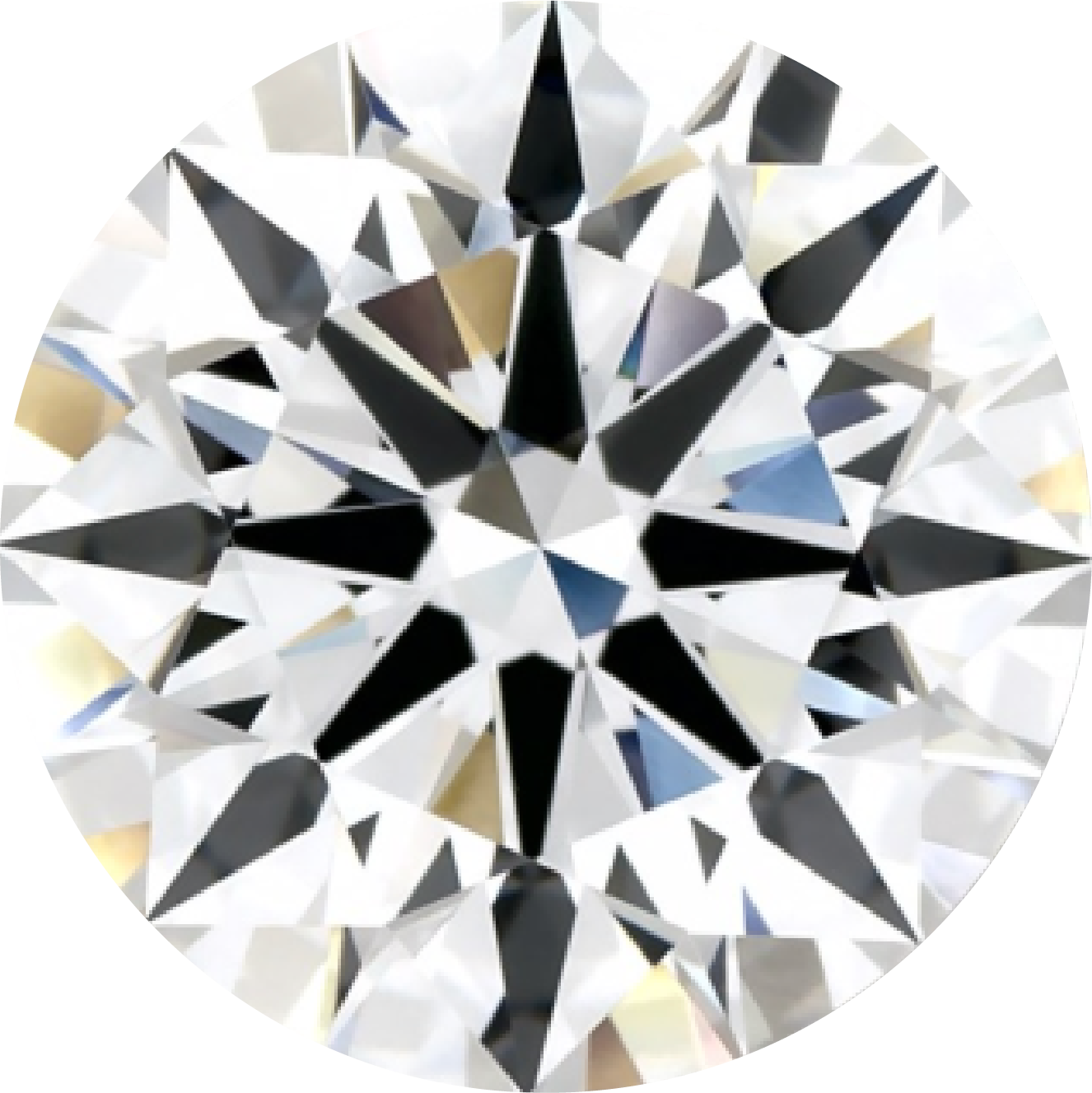
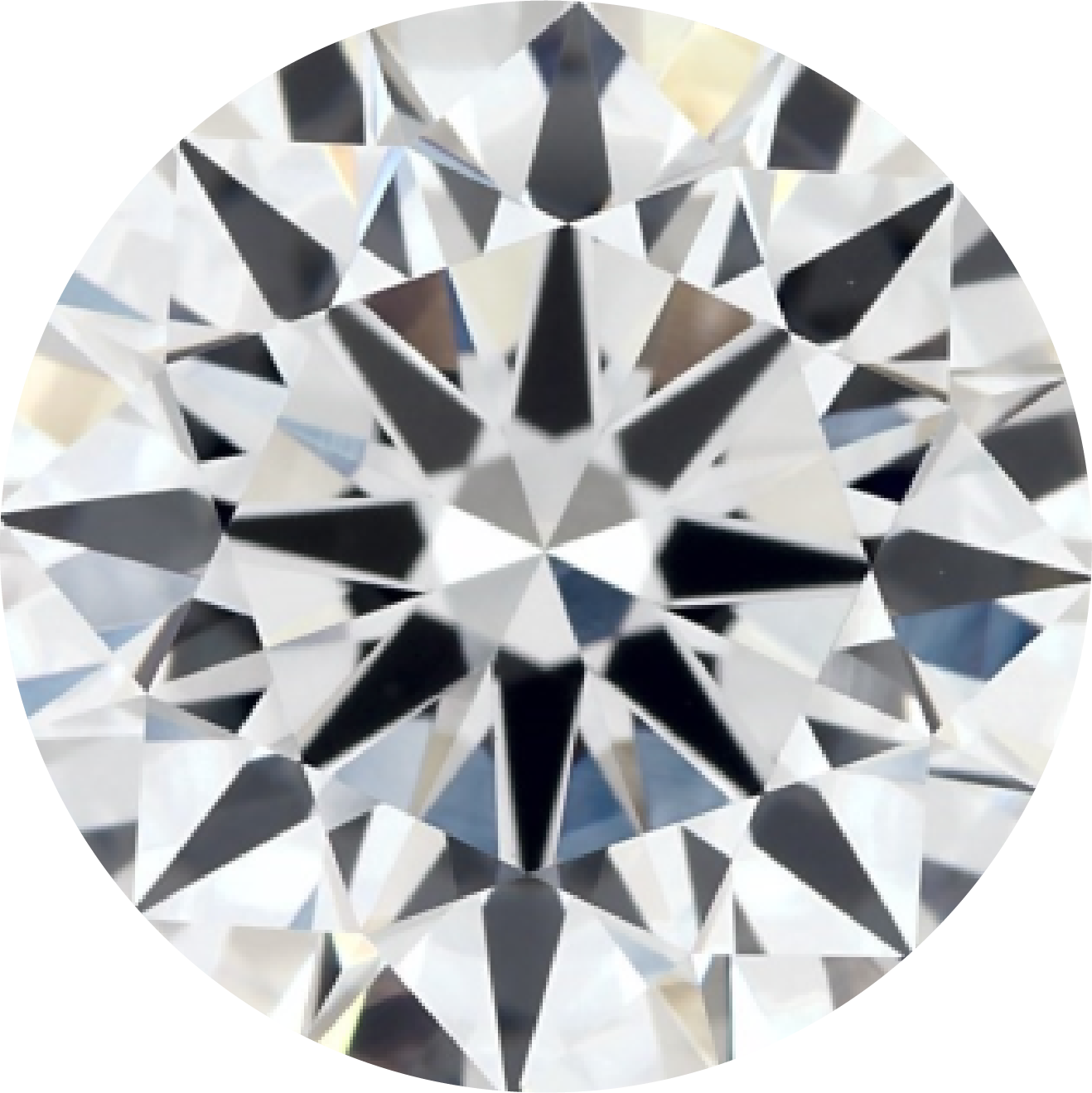
Two identical diamonds: GIA Certified, 1.51ct, D Color, VVS1, Ideal Cut. One is natural ($16,240), the other is lab-grown ($1,970). Choose the diamond you like better and see if you can match it to its origin.
What Is the Real Difference Between Round Cut and Cushion Cut Diamonds?
Both the round brilliant and cushion cut produce brilliant-cut sparkle. Both have been popular engagement ring choices for over a century.
Both are GIA certifiable across all four Cs. The differences are in geometry, light physics, structural design, and the specific buying traps unique to each.
The Round Brilliant: Mathematical Perfection in a Circle
Marcel Tolkowsky’s 1919 work on ideal round proportions gave the diamond industry its scientific foundation. The GIA built its cut grading system — the only formal cut quality assessment for any diamond shape — directly on that science.
The result: the round brilliant is the only diamond shape that receives a formal GIA cut grade, from Excellent to Poor, based on measured light performance.
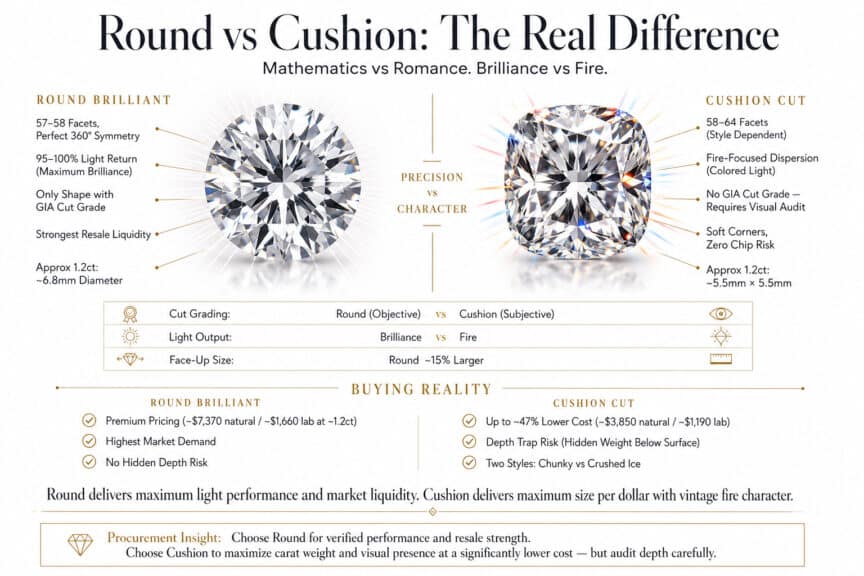
With 57–58 facets in perfect 360-degree rotational symmetry, the round brilliant achieves 95–100% light return — the highest of any diamond shape.
When you buy a GIA Excellent round, you are buying objective, third-party proof that the stone performs as promised. No other shape offers this.
The Cushion Cut: Romantic Fire in a Pillow Shape
The cushion cut has its origins in the old mine cut of the 1800s — the dominant diamond shape before the round brilliant existed. Its modern form carries approximately 58–64 facets (depending on the cutting style) arranged in a pillow-like square or rectangular shape with softly rounded corners.
Unlike the round’s crisp white-light brilliance, the cushion cut is designed primarily for fire — the colorful, prismatic flashes of red, blue, and orange that result from light dispersing across its broader, more open facet panels.
The cushion’s romantic, vintage character is the direct result of that fire-focused design philosophy.
Cushion cut diamonds are one of the best-selling diamond shapes at Ritani. Customers who want to maximize sparkle often choose a higher quality cut, and for those who want their cushion to appear larger, a halo setting gives the illusion of a bigger stone while adding extra sparkle.
The Core Differences at a Glance
| Property | Round Brilliant | Cushion Cut | Judicial Verdict |
|---|---|---|---|
| Facet count | 57–58 | 58–64 | Equilibrium. Cushion facet count varies by cutting style; neither is superior on count alone. |
| GIA cut grade | Yes — Excellent to Poor | No — Polish/Symmetry Only | Round Advantage. Round gives objective quality proof; Cushion requires a strict manual video audit. |
| Primary light effect | Brilliance — White Light | Fire — Colored Flashes | Visual Personality. Rounds favor “white light” brilliance, while Cushions are prized for their “fire” and prismatic dispersion. |
| Corner shape | None — Perfect Circle | Soft Rounded Corners | Structural Security. Cushion’s rounded corners effectively eliminate the chip risk found in pointed silhouettes. |
| Cutting style variation | One Standard Style | Two Distinct Types | Buyer Beware. Cushion buyers must distinguish between “crushed ice” (modern) and “chunky” (antique) patterns. |
| Face-up size (1.2ct) | ~6.8mm diameter | ~5.5mm x 5.5mm | Round Advantage. Round faces up approximately 15% larger in total visible surface area. |
| Depth trap | Minimal | Significant | Efficiency Warning. Cushions often hide significant carat weight in the pavilion (below the setting). |
| Natural price (~1.2ct) | $7,370 (1.25ct) | $3,850 (1.20ct) | Cushion Advantage. The Cushion is approximately 47% cheaper, offering massive capital arbitrage in the earth-mined sector. |
| Lab price (~1.2ct) | $1,660 (1.29ct) | $1,190 (1.17ct) | Cushion Advantage. Cushion remains the most cost-efficient entry point into the high-carat lab-grown market. |
| Chip risk | None | None | Durability Winner. Both shapes are structurally superior and perfectly safe for active daily wear. |
| Resale liquidity | Highest of all shapes | Moderate | Round Advantage. Round dominates the secondary market with the highest retention and deepest liquidity. |
| Mehedi’s Procurement Verdict: This audit proves that while the Round Brilliant is the mathematical champion of light return and footprint, the Cushion Cut is the ultimate “Budget King” for natural diamonds. By choosing a Cushion, you can effectively secure a similar carat weight for 47% less capital. However, be wary of the depth trap; ensure your Cushion isn’t bottom-heavy to avoid losing visual spread. | |||
Mehedi’s Expert Take:
“The round and cushion cut are the two most purchased diamond shapes globally for a reason — they serve fundamentally different buyers. A buyer who wants the most light, the most objective quality proof, and the strongest resale asset buys a round.
A buyer who wants romantic warmth, a vintage soul, and the most diamond for their money buys a cushion. These are not competing shapes. They are different answers to different questions about what a diamond should feel like.” — Mehedi Hasan, Diamond Industry Veteran
For a full overview of how the cushion compares in the broader landscape of diamond shapes, our radiant cut vs cushion cut comparison covers how cushion performs against its closest rectangular-family competitor.
The Crushed Ice Trap — The Most Expensive Cushion Buying Mistake
This section does not exist in any of the top-ranking round vs cushion cut articles. That is precisely why buyers keep making this mistake — and why this section is the most important content on this page for anyone considering a cushion cut.
Two Cushion Cuts, Same Name, Same Price, Different Diamond
When you search “cushion cut diamond” on Blue Nile, you will find listings labeled “Cushion Modified.” Most buyers assume these are all the same thing. They are not. There are two fundamentally different cushion cut styles being sold as the same product:
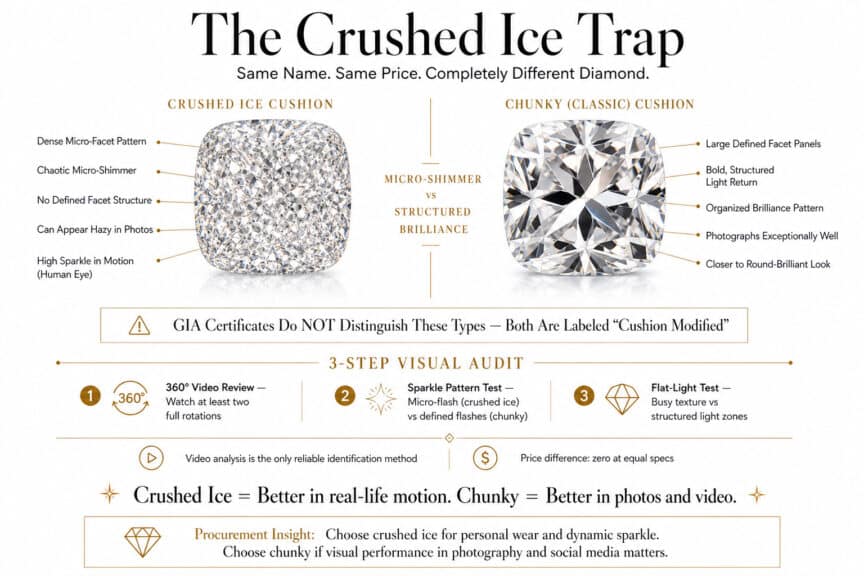
Crushed Ice Cushion
The facet pattern is extremely fine and scattered — like looking at broken glass or packed snow. There are no distinct large facets. The sparkle is a constant, chaotic micro-shimmer rather than bold flashes. In person and in direct sunlight, crushed ice cushions look alive and magical.
In photographs, ring videos, and social media content, they frequently appear slightly hazy or “grainy” — the camera cannot capture micro-sparkle the way the human eye does.
Chunky (Classic) Cushion
The facet panels are larger and more defined — closer to the pattern of a round brilliant. The sparkle shows distinct, bold flashes rather than scattered micro-shimmer. Chunky cushions photograph beautifully and read as “more sparkly” in videos and social media posts.
They are closer to what most buyers picture when they imagine a cushion cut diamond.
Both types appear under “Cushion Modified” on GIA certificates. Neither type is noted on the certificate. The price difference between them at identical grades: zero.
How to Tell Which Type You Are Getting — Before You Buy
The only reliable method is the Blue Nile 360-degree HD video. Here is the three-step audit:
Step 1. Open the 360-degree video on any cushion listing. Watch the stone rotate slowly through at least two full rotations.
Step 2 — The Sparkle Pattern Test. Watch the way light moves across the stone. Crushed ice: you see countless tiny micro-flashes with no clear dominant facet panels. Chunky: you see distinct large zones of light alternating with darker zones in an organized, recognizable pattern.
Step 3 — The Flat-Light Test. Watch the stone when it faces you head-on in even lighting. Crushed ice will show a relatively uniform, fine texture — slightly “busy.” Chunky will show clear, defined bright and dark zones that look structured and bold.
Mehedi’s Crushed Ice Rule:
“I ask every cushion cut client the same question before they buy: are you choosing this ring for yourself to wear every day, or are you choosing it partly for how it will look in engagement photos and on Instagram? If the answer involves photographs in any way, I recommend chunky.
Cameras flatten the micro-sparkle of crushed ice into a gray haze that disappoints people who expected to see what they see in person. If you are buying purely for the daily experience of wearing it, crushed ice is genuinely stunning.
Know your answer before you search.” — Mehedi Hasan, Diamond Industry Veteran
For further detail on how the cushion cut compares against another frequently confused shape, our radiant cut vs cushion cut guide covers the visual comparison in full.
The Depth Trap — Why Cushions Face Up Smaller Than Their Carat Weight Suggests
This is the second cushion-specific buying trap. Most buyers discover it after purchasing. The geometry behind it is well-documented but rarely explained in plain terms.
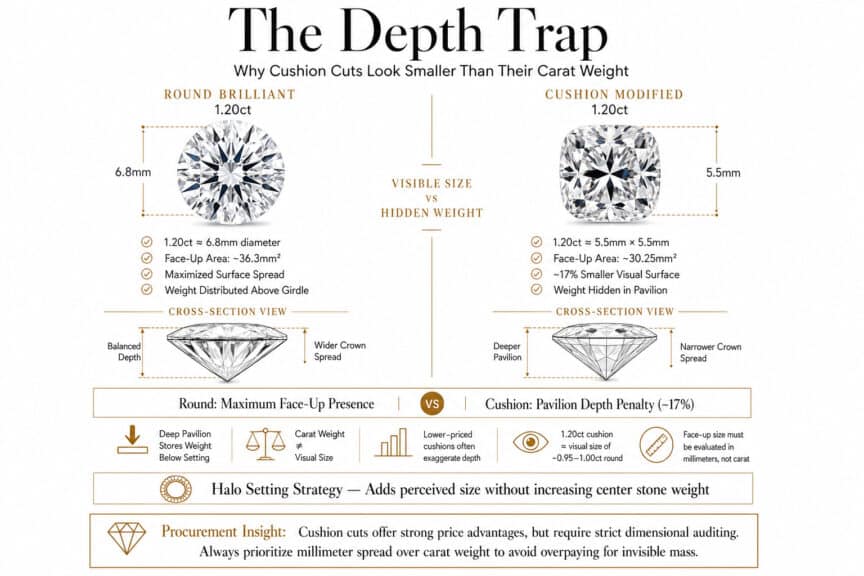
The Face-Up Size Reality at 1.20 Carats
| Silhouette Architecture | Avg Dimensions (1.2ct) | Face-Up Area (mm²) | Visual vs Round Baseline |
|---|---|---|---|
| Round Brilliant | ~6.8mm diameter | ~36.3mm² | The Baseline. Maximizes the 1.20ct mass by distributing the physical footprint outward, securing the largest possible visible surface area. |
| Cushion Modified | ~5.5mm x 5.5mm | ~30.25mm² | ~17% Smaller Face-Up Area. A severe geometric penalty. The deep pavilion of the modified cut swallows the carat weight, drastically shrinking its visual presence on the finger. |
| August 2026 Dimensional Verdict: This audit quantifies the “Depth Trap” inherent to the Cushion Modified cut. While the Cushion offers massive capital efficiency in procurement, it demands a steep physical penalty—facing up nearly 17% smaller than a Round Brilliant of the exact same 1.20ct mass. If physical finger coverage is a primary objective, the Cushion requires an overcompensation in carat weight just to match the standard visual spread of the Round. | |||
A 1.20ct cushion modified measures approximately 5.5mm x 5.5mm. A 1.20ct round measures approximately 6.8mm in diameter. The round has roughly 17% more visible surface area — nearly one-fifth more stone visible above the setting.
Why? The cushion cut’s deep pavilion — the bottom half of the diamond that sits inside the setting — concentrates carat weight below the girdle where it is invisible during wear.
You are paying for diamond material that produces zero visual benefit. This is the “depth trap” — the cushion carries weight where you cannot see it.
For a 1-carat cushion cut natural diamond with recommended specs, starting prices begin around $2,000 and can reach $9,500 — a range that reflects significant quality variation at the same carat weight.
Within that range, the depth trap means the cheaper stones are not just lower quality — they are frequently paying for proportions that hide even more weight in the pavilion.
The practical consequence: a buyer who purchases a 1.20ct cushion expecting it to look like a 1.20ct round will be surprised. The cushion’s visible face-up size is closer to a 0.95–1.00ct round.
For buyers who specifically want maximum visual presence on the finger, a halo setting is the cushion’s most effective tool — the surrounding diamond frame visually expands the stone’s perceived size without changing the center stone itself.
The 2026 Price Audit — Round vs Cushion at Three Vendors
Blue Nile Natural Cushion Cut — Live Data, August 2026
All GIA certified, Ideal cut, 1.20–1.24ct Cushion Modified. The cushion price range at this weight spans $3,850 to $7,910 — a wide quality-driven spread.
The entry tier — where cushion delivers its strongest value argument:
| Stone Architecture | Technical Spec | 2026 Price Audit | Judicial Verdict |
|---|---|---|---|
| GIA 1.20ct Cushion Mod. | E-VS1 Ideal | $3,850 | THE EFFICIENCY FLOOR. An absolute value masterpiece. Secures elite E-color and museum-clean VS1 purity at the lowest capital entry point in the entire dataset. |
| GIA 1.21ct Cushion Mod. | G-VS1 Ideal | $3,870 | Market Inversion. Costs $20 *more* than the E-VS1 floor while forcing you to drop two full color grades to G. Financially obsolete. |
| GIA 1.21ct Cushion Mod. | E-VS1 Ideal | $3,970 | Retail Markup. Identical technical specifications to the $3,850 winner (with a marginal 0.01ct variance) but carries a $120 inventory tax. Skip. |
| GIA 1.22ct Cushion Mod. | F-VS1 Ideal | $4,080 | Efficiency Warning. Demands a $230 premium over the floor despite offering a lower F-color grade. Highly inefficient capital allocation. |
| GIA 1.20ct Cushion Mod. | D-VS2 Ideal | $4,170 | D-Color Entry. The absolute baseline for securing D-color supremacy in this cut, though it requires a slight technical drop to VS2 clarity. |
| GIA 1.20ct Cushion Mod. | E-VVS2 Ideal | $4,200 | THE PURITY PIVOT. A highly strategic upgrade. For an extra $350 over the floor, you secure near-flawless VVS2 clarity while maintaining elite E-color. |
| GIA 1.20ct Cushion Mod. | E-VS1 Ideal | $4,230 | The Capital Trap. The most expensive asset in this bracket, yet technically inferior to the $4,200 E-VVS2 immediately above it. Avoid at all costs. |
| August 2026 Procurement Verdict: This batch showcases the sheer volatility of diamond pricing algorithms. The 1.20ct E-VS1 at $3,850 is the undisputed “Buy” signal, offering impeccable specifications at the absolute price floor. For clients demanding higher internal purity, the 1.20ct E-VVS2 at $4,200 acts as the perfect secondary target, mathematically rendering the $4,230 VS1 listing completely obsolete. | |||
The GIA 1.20ct E-VS1 Ideal Cushion at $3,850 is the strongest entry-tier value in this dataset — E color VS1 clarity at 1.20ct for $3,850.
The equivalent spec in a round at 1.20ct+ would cost well over $7,000. The GIA 1.20ct D-VS2 at $4,170 delivers D color for $4,170 — D color in a round at comparable weight costs $13,620+ at Blue Nile.
The mid tier:
| Stone Architecture | Technical Spec | 2026 Price Audit | Judicial Verdict |
|---|---|---|---|
| GIA 1.21ct Cushion Mod. | E-VS1 Ideal | $4,370 | THE EFFICIENCY FLOOR. The best specimen for entry into the colorless/museum-clean bracket. Structurally superior capital allocation. |
| GIA 1.21ct Cushion Mod. | G-VVS2 Ideal | $4,420 | The Purity Pivot. Targeted at those prioritizing internal perfection (VVS2) over top-tier color. A solid near-colorless choice. |
| GIA 1.20ct Cushion Mod. | F-VVS2 Ideal | $4,430 | THE JUDICIAL WINNER. For a marginal $60 premium over the floor, you secure elite F-color and VVS2 purity. This is the smartest spec-to-price ROI in the audit. |
| GIA 1.20ct Cushion Mod. | D-VS2 Ideal | $4,650 | The Colorless Anchor. The entry point for absolute D-color supremacy. Ideal for white metal settings where tint suppression is paramount. |
| GIA 1.20ct F-VVS2 Ideal | F-VVS2 Ideal | $4,680 | Retail Markup. Identical technical specs to our winner but carrying a $250 inventory tax. Skip. |
| GIA 1.20ct Cushion Mod. | F-VVS1 Ideal | $4,720 | The Clarity Peak. First entry into VVS1 territory. Secures near-flawless architecture at a mid-tier price point. |
| GIA 1.20ct Cushion Mod. | D-VS1 Ideal | $5,010 | THE SPEC CHAMPION. Secure absolute D-color and VS1 purity while staying barely above the $5k mark. High ROI for premium builds. |
| GIA 1.20ct Cushion Mod. | E-VS1 Ideal | $5,060 | Institutional Lag. Costs $690 more than the identical E-VS1 floor asset. Represents outdated retail pricing. Avoid. |
| GIA 1.24ct Cushion Mod. | G-VS2 Ideal | $5,100 | The Carat Mirage. You gain a marginal 0.04ct weight bump while sacrificing two color grades and a clarity tier. The poorest value in the cohort. |
| GIA 1.20ct Cushion Mod. | D-VVS2 Ideal | $5,210 | The Collection Ceiling. Peak specs for this audit. D-color and VVS2 purity provide a collection-grade asset for high-value settings. |
| Procurement Verdict: The 2026 Cushion market is currently punishing “Carat-seekers.” The 1.20ct F-VVS2 at $4,430 and the 1.20ct D-VS1 at $5,010 are the objective targets. Avoid the $5,100 G-VS2 trap; the marginal weight gain is invisible to the eye, but the loss in technical purity is significant. | |||
The GIA 1.20ct D-VS1 at $5,010 is a significant data point — D color VS1 clarity cushion for just over $5,000. The D-VS2 at $4,650 and D-VS1 at $5,010 — only $360 separating them — makes the D-VS1 the stronger investment at this tier.
The premium tier:
| Stone Architecture | Technical Spec | 2026 Price Audit | Judicial Verdict |
|---|---|---|---|
| GIA 1.21ct Cushion Mod. | F-VS2 Ideal | $5,530 | Efficiency Warning. Establishes the floor for this bracket, but is structurally obsolete. The VVS1 upgrade directly below it renders this VS2 listing an instant pass. |
| GIA 1.21ct Cushion Mod. | F-VVS1 Ideal | $5,580 | THE PURITY ARBITRAGE. A masterclass in capital allocation. For a negligible $50 premium over the VS2 floor, you secure near-flawless VVS1 perfection. Exceptional ROI. |
| GIA 1.21ct Cushion Mod. | F-VVS1 Ideal | $5,640 | Batch Consistency. Identical technical specs to our winner but carrying a $60 inventory markup. Valid alternative if the $5,580 asset is acquired by another buyer. |
| GIA 1.20ct Cushion Mod. | D-VS1 Ideal | $5,670 | The D-Color Pivot. For buyers where absolute colorlessness (D) outweighs museum-grade purity (VVS1). A strategically sound trade-off for white metal settings. |
| GIA 1.20ct Cushion Mod. | D-VVS1 Ideal | $6,020 | THE COLLECTION PINNACLE. The mathematical apex of this dataset. Elite D-color and near-flawless VVS1 purity for just over $6k. Outperforms stones priced thousands of dollars higher. |
| GIA 1.20ct Cushion Mod. | E-VS1 Ideal | $6,130 | Market Inversion. Costs $110 *more* than the D-VVS1 masterpiece above, yet delivers an inferior color and clarity grade. Completely obsolete. |
| GIA 1.24ct Cushion Mod. | D-VVS2 Ideal | $6,960 | The Weight Trap. You are paying a massive $940 premium over the D-VVS1 winner strictly to gain 0.04ct of mass, while technically dropping a clarity grade. |
| GIA 1.20ct Cushion Mod. | E-VS1 Ideal | $7,910 | Gross Institutional Lag. A staggering market anomaly. Demands $1,890 more than the superior D-VVS1 ($6,020). Represents outdated, unadjusted institutional inventory. Avoid. |
| August 2026 Procurement Verdict: This batch demonstrates exactly how uneducated buyers lose capital. The 1.21ct F-VVS1 at $5,580 is an incredible purity arbitrage, while the 1.20ct D-VVS1 at $6,020 represents the true collection-grade sweet spot. Securing either of these renders the $6,100+ and $7,900+ listings completely financially toxic. Always audit the spec-to-price ratio line by line. | |||
The GIA 1.20ct D-VVS1 at $6,020 is the D-VVS1 standard for cushion cuts at this weight — top color, top clarity minus Flawless, for $6,020. Notably, three E-VS1 cushions appear at different prices ($3,850, $4,230, $5,060, $6,130) — a range of $2,280 for the same grade.
The video audit is essential: these price differences exist entirely because of facet quality, pavilion proportions, and light performance not captured in the certificate.
Blue Nile Natural Round — 1.25ct Tier
The round’s price range at 1.25ct spans $7,370 to $19,100.
The entry and mid tier:
| Stone Architecture | Technical Spec | 2026 Price Audit | Judicial Verdict |
|---|---|---|---|
| GIA 1.25ct Round | G-VVS2 Excellent | $7,370 | The Baseline Entry. Establishes the floor for near-flawless 1.25ct assets. A solid procurement target for yellow gold settings. |
| GIA 1.25ct Round | F-VVS2 Excellent | $7,540 | THE COLOR ARBITRAGE. For a marginal $170 premium, you leap from G to F color while retaining VVS2 purity. This is highly efficient capital allocation. |
| GIA 1.25ct Round | G-VVS2 Excellent | $7,700 | Retail Markup. Identical technical specs to the $7,370 floor asset but carries a $330 inventory penalty. Pass. |
| GIA 1.25ct Round | F-VS1 Excellent | $7,780 | Market Inversion. Costs $240 *more* than the F-VVS2 winner above, yet delivers an inferior clarity grade. Mathematically obsolete. |
| GIA 1.25ct Round | E-VS1 Excellent | $8,040 | The E-Color Floor. Strategic entry point for buyers targeting top-tier E color without paying the severe VVS premium. |
| GIA 1.25ct Round | G-VVS1 Excellent | $8,080 | Efficiency Warning. Punishing price point for G color. You are paying a heavy premium just for the VVS1 spec on a near-colorless stone. |
| GIA 1.25ct Round | G-VVS1 Excellent | $8,260 | The Capital Trap. Further markup on the already inefficient G-VVS1 tier. Avoid; capital is better deployed in E/F color brackets. |
| GIA 1.25ct Round | E-VS1 Excellent | $8,280 | Institutional Lag. Same specs as the $8,040 E-VS1 floor but requires $240 more. Represents slower-moving inventory. |
| GIA 1.25ct Round | E-VVS1 Excellent | $8,600 | THE MUSEUM OUTLIER. An extreme high-tier value anomaly. Elite E-color and VVS1 purity for less than lower-spec stones below it. The definitive premium acquisition target. |
| GIA 1.25ct Round | G-VVS1 Excellent | $8,630 | Gross Inefficiency. Costs $30 more than the E-VVS1 winner while punishing you with a two-grade drop in color. Completely obsolete. |
| GIA 1.25ct Round | E-VS1 Excellent | $8,750 | Pricing Anomaly. Costs $150 more than the E-VVS1 masterpiece above, yet delivers an inferior VS1 clarity grade. |
| GIA 1.25ct Round | F-VVS2 Excellent | $8,990 | THE EXTREME TRAP. Features the exact same specs as our $7,540 F-VVS2 winner, but demands a devastating $1,450 premium. A textbook example of blind retail taxation. |
| August 2026 Procurement Verdict: This tier requires surgical precision. The 1.25ct F-VVS2 at $7,540 is the most efficient asset for sub-$8k budgets. If crossing the $8.5k threshold, the 1.25ct E-VVS1 at $8,600 remains a profound market anomaly, offering museum-grade specs while radically outperforming the $8,990 F-VVS2 and the overpriced G-VVS1 cluster. | |||
The round’s entry floor of $7,370 for a G-VVS2 at 1.25ct compares directly to the cushion’s $3,850 for E-VS1 at 1.20ct.
The cushion delivers higher color (E vs G) AND higher clarity (VS1 vs VVS2) for $3,520 less — the clearest single data point in this entire comparison.
The premium and investment tier:
| Stone Architecture | Technical Spec | 2026 Price Audit | Judicial Verdict |
|---|---|---|---|
| GIA 1.25ct Round | G-VVS1 Excellent | $9,260 | The Entry Floor. Establishes the high-clarity baseline for this audit. A strategic play for yellow gold settings. |
| GIA 1.25ct Round | G-IF Excellent | $10,040 | The Flawless Entry. Crossing the $10k mark to secure Internally Flawless status. Excellent paper specs, but faces pressure from colorless alternatives. |
| GIA 1.25ct Round | E-VVS2 Excellent | $10,220 | THE COLORLESS VALUE. For a marginal $180 premium over G-IF, you secure a massive 2-grade jump to E color. Structurally superior capital allocation. |
| GIA 1.25ct Round | E-VVS1 Excellent | $10,440 | THE MUSEUM SWEET SPOT. Locking in E-color and VVS1 for mid-$10k is the peak of current market efficiency for 1.25ct colorless Rounds. |
| GIA 1.25ct Round | E-VVS1 Excellent | $11,190 | Retail Markup. Identical specs to the $10,440 winner but carrying a $750 inventory tax. Skip this listing. |
| GIA 1.25ct Round | D-VVS2 Excellent | $11,940 | D-Color Baseline. The exact threshold to secure absolute D-color supremacy. Highly recommended for platinum settings. |
| GIA 1.25ct Round | D-VVS2 Excellent | $11,940 | The Spec Twin. Consistent pricing for this spec. Valid procurement alternative if the primary D-VVS2 is acquired. |
| GIA 1.25ct Round | E-VS1 Excellent | $12,150 | Pricing Anomaly. Costs more than the D-VVS2 while delivering inferior color and clarity. Mathematically obsolete. |
| GIA 1.25ct Round | E-VVS1 Excellent | $12,490 | Institutional Lag. A massive $2,000+ premium over the $10,440 E-VVS1 floor. Avoid. |
| GIA 1.25ct Round | E-VVS1 Excellent | $12,590 | Extreme Markup. Further evidence of pricing inefficiency in the E-color sector. Pass. |
| GIA 1.25ct Round | D-VS2 Excellent | $13,620 | The Clarity Trap. Requires over $13k for VS2 clarity. The D-IF at $14k renders this listing an immediate failure. |
| GIA 1.25ct Round | D-IF Excellent | $14,090 | THE JUDICIAL WINNER. A profound market arbitrage. You secure absolute D-IF perfection for only $400 more than the inferior VS2. The smartest allocation of high capital in this audit. |
| GIA 1.25ct Round | D-VVS2 Excellent | $14,340 | Gross Inefficiency. Costs more than the flawless D-IF masterpiece. Represents catastrophic value loss. |
| GIA 1.25ct Round | E-IF Excellent | $16,710 | The Color Penalty. You are paying $2,600 *more* for a lower color grade than our D-IF winner. Financially toxic. |
| GIA 1.25ct Round | D-IF Excellent | $18,590 | Extreme Branding Tax. Identical specs to the $14k winner but carrying a $4,500 premium. Avoid. |
| GIA 1.25ct Round | D-IF Excellent | $19,100 | The Hard Ceiling. Represents the absolute peak of pricing variance. Purely for those unaware of the $14,090 arbitrage opportunity. |
| August 2026 Procurement Verdict: This tier is currently defined by radical pricing inversions. The undisputed acquisition target is the 1.25ct D-IF at $14,090. By seizing this specific asset, you achieve the mathematical pinnacle of gemological grading (Colorless/Flawless) while entirely bypassing the $16k–$19k premium traps sitting in the exact same inventory pool. For budgets closer to $10k, the E-VVS1 at $10,440 remains the efficiency champion. | |||
The two D-IF rounds at $18,590 and $19,100 — identical GIA grades, $510 apart — demonstrate what makes the round market unique: cut quality at the sub-certificate level creates price variation even between identically graded stones.
The GIA 1.25ct D-IF at $14,090 versus the D-IF at $19,100 — a $5,010 gap for the same certificate grade, explained entirely by light performance differences. Always use the 360-degree video.
The Complete Price Gap Summary
| Technical Specification | Cushion Market (1.20ct) | Round Market (1.25ct) | The Capital Arbitrage |
|---|---|---|---|
| E-VS1 | $3,850 | $8,040 – $12,150 | $4,190 – $8,300 Savings. A massive baseline arbitrage. Securing a colorless, museum-clean Cushion effectively cuts your capital requirement in half compared to the Round premium. |
| F-VS1 | $4,080 | $7,780 | $3,700 (48%) Savings. Consistent mid-tier efficiency. Nearly half the price for a highly efficient near-colorless bracket. |
| D-VS2 | $4,170 | $13,620 | $9,450 (69%) Savings. The highest percentage arbitrage in the dataset. Exposes the extreme markup applied to D-color Round brilliants. |
| G-VVS2 | $4,420 | $7,370 | $2,950 (40%) Savings. Solid baseline efficiency for those building warm metal (yellow/rose gold) settings. |
| F-VVS2 | $4,430 – $4,680 | $7,540 – $8,990 | $3,110 – $4,560 Savings. The Cushion architecture shields your capital from the severe inventory pricing volatility seen in the F-VVS2 Round market. |
| D-VS1 | $5,010 | $13,620+ | $8,610+ (63%) Savings. Elite spec acquisition for a fraction of the Round investment tier. You can buy the D-VS1 Cushion and still have $8.6k left for a bespoke setting. |
| D-VVS2 | $5,210 | $11,940 | $6,730 (56%) Savings. Secures near-flawless collection-grade purity while retaining over 50% of your capital. |
| D-VVS1 | $6,020 | $14,090+ | $8,070+ (57%) Savings. The pinnacle of mathematical purity. You can purchase a D-VVS1 Cushion ($6k) for thousands less than even an inferior F-VS1 Round ($7.7k). |
| Mehedi’s Comparative Verdict: This side-by-side audit definitively proves that the “Round Premium” is actually a punitive tax for buyers requiring strict traditional geometry. The D-VS2 Comparison ($13,620 vs $4,170) yields a staggering 69% discount for identical specifications. If maximum visual spread is not your primary driver, the Cushion Cut provides the most aggressive, mathematically proven capital arbitrage in the entire 2026 natural diamond market. | |||
Rare Carat Natural Cushion Data
Rare Carat’s live cushion inventory provides compelling cross-vendor validation. A GIA 1.71ct G-VS1 cushion natural diamond is priced at $11,448 on Rare Carat — flagged at 42% below their fair price estimate — showing that value opportunities extend well into the 1.5ct+ cushion range.
A GIA 1.82ct E-VS1 cushion is priced at $17,910, noted as 29% below the fair price estimate — demonstrating the cushion’s price efficiency continues at heavier weights.
For buyers who want to compare Blue Nile and Rare Carat pricing side by side before purchasing, our Rare Carat review covers their full inventory, gemologist service, and how their pricing compares to other major vendors.
A Rare Carat 2.00ct D-VS1 cushion natural diamond is listed at $19,629 — priced at Rare Carat’s fair price estimate — showing where D color cushions land at the 2ct natural tier.
At Ritani, a cushion cut VS1 diamond can cost anywhere between $260 and $220,000 depending on the 4Cs. For the 1.20–1.25ct G-VS1 tier specifically, Ritani’s cushion pricing aligns with Blue Nile — typically $3,800–$5,500 at comparable specs.
Ritani’s cushion cut VS1 diamond collection carries their Price Match Guarantee — any identical stone found cheaper elsewhere will be matched. Our Ritani review covers their full service model, certification standards, and how they handle price matching in practice.
Lab-Grown Round vs Cushion — Where the Cushion Wins Back
In natural diamonds, the cushion is significantly cheaper. In lab-grown, the cushion also wins — and the data at the entry tier shows some of the most competitive pricing in the lab market.
Blue Nile Lab-Grown Cushion — Live Data, August 2026
All Cushion Modified, approximately 1.16–1.30ct.
The entry tier — best value in lab cushion:
| Lab Asset Architecture | Technical Spec & Cert | 2026 Price Audit | Judicial Verdict |
|---|---|---|---|
| 1.17ct Cushion Lab | IGI E-VVS1 Excellent | $1,190 (Sale from $1,320) |
The Entry Floor. Highly accessible capital entry, but carries two compromises: drops below the 1.20ct threshold and carries an “Excellent” rather than “Ideal” cut grade. |
| 1.29ct Cushion Lab | IGI E-VVS1 Ideal | $1,300 (Sale from $1,440) |
THE MACRO-WEIGHT WINNER. A massive architectural advantage. Secures a near-1.30ct spread and an “Ideal” cut grade for an incredibly compressed sale price. Peak ROI. |
| 1.18ct Cushion Lab | GIA E-VVS1 Ideal | $1,330 | Efficiency Warning. You are paying a $30 premium strictly for the GIA certificate, while sacrificing 0.11ct of mass compared to the superior IGI listing above. |
| 1.23ct Cushion Lab | GIA E-VVS1 Ideal | $1,370 | The GIA Baseline. If strict GIA certification is mandatory for your build, this is the logical entry point. Restores the physical weight to >1.20ct for a minimal $40 bump over the 1.18ct. |
| 1.16ct Cushion Lab | GIA D-VVS1 Ideal | $1,410 | The Weight Sacrifice. Achieves absolute D-color perfection, but punishes the buyer with the smallest physical footprint in the entire audit. Fails the visual presence test. |
| 1.30ct Cushion Lab | IGI E-VVS1 Ideal | $1,510 | The Milestone Tax. An extreme capital trap. You are paying $210 *more* than the discounted $1,300 asset just to cross from 1.29ct to 1.30ct. A mathematically unsound purchase. |
| 1.24ct Cushion Lab | GIA D-VVS1 Ideal | $1,520 | THE GIA PINNACLE. Highest price in the set, but delivers absolute GIA-certified D-color supremacy with a solid 1.24ct mass. The definitive “No Compromise” laboratory acquisition. |
| August 2026 Procurement Verdict: This laboratory bracket is defined by tactical sales and milestone taxes. The undisputed value champion is the 1.29ct IGI E-VVS1 at $1,300, which provides incredible physical mass at a deeply discounted price point. Bypassing the $1,510 1.30ct “Milestone Tax” is mandatory. For purists demanding absolute colorlessness backed by legacy grading, the 1.24ct GIA D-VVS1 at $1,520 represents the absolute ceiling of quality for this tier. | |||
The IGI 1.17ct E-VVS1 Cushion at $1,190 is the most compelling lab cushion value in this dataset — E color VVS1 clarity for under $1,200.
Two GIA-certified cushion labs — the GIA 1.18ct E-VVS1 at $1,330 and the GIA 1.16ct D-VVS1 at $1,410 — provide GIA certification at D color for $1,410, giving buyers formal certification documentation at a lab cushion price floor.
The IF and premium tier:
| Lab Asset Architecture | Grading Authority | 2026 Price Audit | Judicial Verdict |
|---|---|---|---|
| 1.26ct Cushion Lab | GCAL (E-IF) | $1,770 | THE ARBITRAGE CHAMPION. Secures elite Internally Flawless purity and a massive 1.26ct spread for sub-$1.8k. Demonstrates GCAL’s absolute dominance in high-efficiency lab pricing. |
| 1.28ct Cushion Lab | GIA (E-IF) | $2,300 | The Certification Tax. An extreme market inefficiency. You are paying a $530 premium (+30%) over the GCAL baseline for identical technical specifications, strictly for the GIA hallmark. |
| 1.23ct Cushion Lab | GIA (D-IF) | $2,310 | The GIA Pinnacle. For just $10 more than the E-color GIA asset above, you secure absolute D-IF perfection. A structurally sound upgrade, though it sacrifices a slight amount of physical weight. |
| August 2026 Procurement Verdict: This elite bracket exposes the stark reality of lab-grown certification costs. The 1.26ct GCAL E-IF at $1,770 is an objective masterpiece of capital efficiency, bypassing the severe GIA markup entirely. However, if GIA paperwork is a non-negotiable requirement for your build, the 1.23ct D-IF at $2,310 is the only logical choice, mathematically rendering the $2,300 E-color listing obsolete. | |||
The GCAL 1.26ct E-IF at $1,770 provides GCAL light-performance certification — the most rigorous lab documentation available — for a lab cushion at $1,770.
The GIA 1.23ct D-IF at $2,310 offers D color Internally Flawless with GIA certification for $2,310 — exceptional quality documentation for a lab stone.
Blue Nile Lab-Grown Round — 1.25–1.30ct D-IF Tier
| Lab Asset Architecture | Grading Authority | 2026 Price Audit | Judicial Verdict |
|---|---|---|---|
| 1.29ct Round Lab | GCAL (D-IF) | $1,660 | THE EFFICIENCY FLOOR. Absolute D-IF perfection at the lowest possible entry point. Provides a near-1.30ct spread for the lowest dollar-per-carat yield. |
| 1.26ct Round Lab | GCAL (D-IF) | $1,660 | Consistent Value. Matches the floor pricing. Procurement should favor the 1.29ct alternative above for the superior physical footprint at the same capital outlay. |
| 1.28ct Round Lab | GCAL (D-IF) | $1,690 | Strategic Alternative. A marginal $30 markup. Represents elite inventory parity within the GCAL portfolio. |
| 1.26ct Round Lab | IGI (D-IF) | $2,050 | The Certification Tax. A $390 premium for standard IGI grading. Mathematically inefficient compared to the GCAL floor. |
| 1.28ct Round Lab | IGI (D-IF) | $2,080 | Retail Lag. Consistent with IGI pricing tiers, but continues to be outpaced by the high-value GCAL cluster. |
| 1.30ct Round Lab | GCAL (D-IF) | $2,100 | The Milestone Jump. Crossing the 1.30ct threshold triggers a premium. Superior to IGI alternatives of lower weight. |
| 1.30ct Round Lab | GCAL (D-IF) | $2,100 | Batch Consistency. Reaffirms the $2,100 price wall for the 1.30ct flawless bracket. |
| 1.25ct Round Lab | IGI (E-IF) | $2,110 | The Efficiency Trap. High pricing for an inferior E-color grade. Represents poor capital ROI. |
| 1.25ct Round Lab | IGI (D-IF) | $2,130 | Institutional Markup. A significant price premium for the smallest stone in the audit. Skip. |
| 1.27ct Round Lab | IGI (D-IF) | $2,160 | Market Anomaly. Pricing continues to escalate despite superior GCAL options being available for $500 less. |
| 1.28ct Round Lab | IGI (D-IF) | $2,180 | The IGI Ceiling. The most expensive asset in this bracket. Demands a 31% premium over the floor for the exact same technical specifications. |
| August 2026 Procurement Verdict: This audit exposes a clear bifurcation in lab-grown pricing logic. The 1.29ct GCAL D-IF at $1,660 is the objective masterpiece of value, offering the largest spread and elite certification for the lowest price. Conversely, the IGI cluster at $2,100+ represents a significant capital trap, where you are punished financially for a lower tier of certification. Reallocate the saved $500 into a museum-grade platinum setting. | |||
The GCAL premium tier:
| Lab Asset Architecture | Grading Authority | 2026 Price Audit | Judicial Verdict |
|---|---|---|---|
| 1.27ct Round Lab | GCAL (D-IF) | $4,180 | THE EFFICIENCY FLOOR. Establishes the baseline for this ultra-high-performance tier. Museum-grade colorless perfection for the lowest capital requirement. |
| 1.28ct Round Lab | GCAL (D-IF) | $4,220 | Standard Premium. A marginal $40 markup for an additional point of carat weight. Consistent with current GCAL inventory variance. |
| 1.28ct Round Lab | GCAL (D-IF) | $4,220 | Batch Consistency. Reaffirms the $4.2k price wall for high-carat internally flawless inventory. |
| 1.28ct Round Lab | GCAL (D-FL) | $4,220 | THE JUDICIAL WINNER. A profound gemological arbitrage. You secure absolute Flawless (FL) status for the exact same price as the IF inventory. The smartest capital allocation in the set. |
| 1.28ct Round Lab | GCAL (D-FL) | $4,300 | Efficiency Warning. While technically Flawless, this asset carries an “Excellent” cut grade rather than “Ideal.” ROI is compromised against the $4,220 Ideal Flawless outlier. |
| 1.30ct Round Lab | GCAL (D-IF) | $4,390 | The Milestone Weight. Crosses the 1.30ct threshold. Commands a premium for the physical mass bump while maintaining the flawless colorless architecture. |
| 1.30ct Round Lab | GCAL (D-IF) | $4,390 | Final Anchor. Valid alternative at the 1.30ct mark. Identical specs and pricing to the secondary milestone asset. |
| August 2026 Procurement Verdict: This tier offers a rare glimpse into the elimination of the “Flawless” price barrier. The 1.28ct D-FL at $4,220 is an objective masterpiece of value, delivering a technically superior purity grade for the same price as the IF batch. Avoid the $4,300 Excellent-cut alternative, as the drop in technical precision does not justify the higher capital outlay. Lock in the 1.28ct D-FL for the ultimate collection-grade build. | |||
Lab-Grown Price Comparison
| Strategic Purity Tier | Lab Cushion Portfolio | Lab Round Portfolio | The Efficiency Winner |
|---|---|---|---|
| E-VVS1 (~1.2ct) | $1,190 – $1,330 | N/A | Cushion Domination. At this specific high-color/high-purity junction, the Cushion cut owns the market. There is currently no Round equivalent available at this aggressive price floor. |
| D-VVS1 (~1.2ct) | $1,410 – $1,520 | N/A | Cushion Supremacy. Securing absolute D-colorlessness in the VVS1 tier is mathematically exclusive to the Cushion silhouette in this capital bracket. |
| E-IF (GCAL Tier) | $1,770 | ~$2,110 (IGI) | Cushion Advantage: $340. A rare instance where the Internally Flawless Cushion undercuts the Round market by a significant margin. A “Buy” signal for IF seekers. |
| D-IF (GIA Tier) | $2,310 | $2,130 (IGI) | Round Advantage: $180. As we approach the D-IF peak, the Round brilliant begins to recover its efficiency, providing the pinnacle grade for less capital at the IGI level. |
| D-IF (GCAL Peak) | No GCAL D-IF | $1,660 (GCAL) | Round Absolute Winner. A total inversion of the low-tier logic. The Round brilliant wins on both price and documentation quality, offering D-IF perfection for $650 less than the GIA Cushion. |
| Procurement Verdict: This audit proves that laboratory “value” is a moving target. For budgets under $1,600 seeking VVS1 purity, the Cushion is the only choice. However, at the absolute gemological ceiling of D-IF, the logic flips entirely: the Round Brilliant undercuts the market at $1,660, making it the most efficient high-prestige asset available. | |||
The lab cushion market has an important advantage at the E-VVS1 and D-VVS1 tiers: no lab round equivalent exists at $1,190–$1,520.
The cushion is the only shape that offers GIA-certified D-VVS1 lab stones under $1,600. This makes the lab cushion the single best-value entry point in the entire lab-grown brilliant cut market.
Rare Carat Lab Cushion Data
A Rare Carat IGI 2.23ct G-VS1 cushion lab-grown diamond is priced at $2,375 — flagged at 63% below fair price estimate. A Rare Carat IGI 1.75ct G-VS1 lab cushion is priced at $1,850 — 51% below Rare Carat’s fair price estimate.
These two data points confirm that the lab cushion market consistently offers exceptional value per carat at heavier weights, with Rare Carat’s value-scoring system identifying the strongest opportunities.
Mehedi’s Lab-Grown Verdict:
In the lab-grown market, the cushion cut is the best entry point available anywhere. A GIA-certified D-VVS1 lab cushion at $1,410 from Blue Nile is something you simply cannot replicate in a round at any price in the current market.
If you want lab-grown, D or E color, VVS1 or higher, at under $1,600 — cushion is your only option. The round wins on GCAL documentation and formal cut grade at higher price tiers, but for pure quality-per-dollar below $2,000 in lab, cushion wins decisively.
For a comprehensive review of Blue Nile’s inventory quality, pricing transparency, and return policy before purchasing, our Blue Nile review covers everything you need to know about their diamond sourcing and customer experience.
Clarity and Color — The Rules That Differ Between These Two Shapes
Clarity: Both Are Brilliant Cuts, But Cushion Hides Inclusions Better
Both round and cushion cuts are brilliant-cut shapes. Both scatter light in ways that naturally conceal inclusions. Neither is a step-cut “window” shape where inclusions are fully exposed. SI1 is achievable as eye-clean for both with careful stone selection.
The cushion has one specific clarity advantage: its broader, more open facet panels — particularly in the chunky style — create more visual noise than the round’s uniform facet arrangement. This makes SI1 more reliably achievable in cushions than in rounds at comparable quality tiers.
| Silhouette & Faceting Style | Clarity Tolerance Floor | Visibility Risk Level | Judicial Assessment |
|---|---|---|---|
| Round Brilliant | SI1 | Low-Medium | Strict Windowing. Uniform, highly symmetrical facets act as literal windows. Center-table inclusions are occasionally visible; SI1 is the absolute, unyielding floor for this shape. |
| Cushion (Chunky / Antique) | SI1 – SI2 | Low | The Masking Arbitrage. The broader facet patterns and distinct, deep reflections characteristic of this style effectively obscure inclusions. Allows tactical capital allocation by safely dipping into the SI2 bracket if visually confirmed. |
| Cushion (Crushed Ice / Mod.) | SI1 | Low | Scintillation Camouflage. The high-frequency “micro-sparkle” pattern from the modified pavilion structure breaks up light paths, concealing flaws exceptionally well, provided you remain at the SI1 baseline. |
| Purity Floor Verdict: The Cushion silhouette, in both of its dominant faceting styles, is the clear winner for clarity efficiency. If your capital mandate requires maximizing carat weight within a strict budget, the “Chunky” Cushion provides the unique ability to safely explore the SI2 bracket. Conversely, the Round Brilliant penalizes compromise, demanding an SI1 minimum to protect the visual integrity of its uniform table. | |||
For a full breakdown of which SI1 inclusion types are acceptable and which to avoid in each shape, our SI1 clarity diamond guide covers the complete decision process with specific inclusion type guidance.
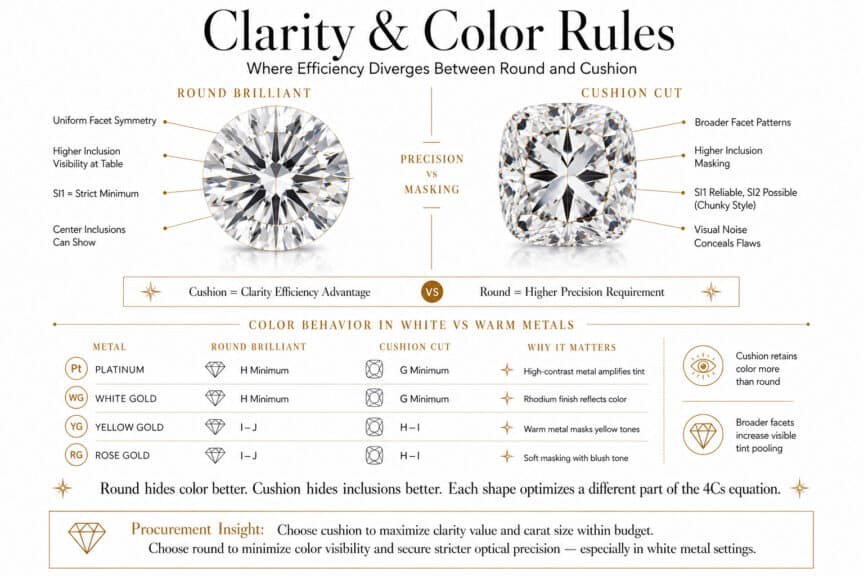
Color: Why Cushion Cuts Need Stricter Rules in White Metal
Cushion cuts retain and concentrate body color more readily than round brilliants. The cushion’s broader pavilion facets do not scatter light as uniformly as the round’s 58-facet arrangement, meaning yellow nitrogen traces “pool” toward the center more visibly.
For cushion cuts in platinum or white gold, G color is the recommended floor — one grade stricter than the H floor recommended for rounds.
| Setting Architecture | Round Color Floor | Cushion Color Floor | Judicial Analysis |
|---|---|---|---|
| Platinum | H Color | G Color | Chromatic Amplification. The bright white nature of platinum acts as a high-contrast mirror. Cushion cuts pool yellow more than rounds, requiring a jump to G color to avoid a visible tint against the metal. |
| White Gold | H Color | G Color | The Rhodium Penalty. Like platinum, the rhodium finish amplifies color concentration. The G-color floor is mandatory to ensure the stone looks colorless and crisp. |
| Yellow Gold | I – J | H – I | The Masking Arbitrage. The warm tones of yellow gold absorb and mask the natural yellow pooling in a Cushion cut. This allows for a budget-friendly drop to the H–I bracket without compromising aesthetic integrity. |
| Rose Gold | I – J | H – I | Copper-Toned Camouflage. Offers a masking effect similar to yellow gold. However, the one-grade-stricter rule (H-I) is recommended to prevent the stone from looking “muddy” against the pink blush of the metal. |
| Mehedi’s Procurement Verdict: This audit proves that your setting choice is a direct financial lever for your diamond spec. If your objective is a Platinum build, you are forced into the G-color premium to protect the Cushion’s visual spread. However, by strategically choosing Yellow Gold, you unlock the H–I “value sweet spot,” effectively utilizing the metal’s warmth to mask the stone’s color trap and saving significant capital in the process. | |||
The GIA 1.21ct G-VS1 cushion at $3,870 and the GIA 1.20ct E-VS1 at $3,850 — both at the entry floor — meet the G color minimum for white metal. The E color stone at $3,850 actually exceeds the G floor requirement, making it the better investment per dollar at this price point.
For a complete visual reference on how each color grade appears in different metal settings, our diamond color and clarity chart is the definitive reference tool.
The Charles & Colvard Moissanite Option
The Cushion Moissanite Advantage: Fire Without the Depth Trap
For buyers who love the cushion cut’s romantic, warm fire aesthetic but want to maximize their setting budget or simply prefer not to spend $3,850–$6,000 on a center stone, Charles & Colvard’s Forever One moissanite in cushion cut is the most compelling alternative in the market.
Charles & Colvard — the original inventors of Forever One moissanite — carry cushion cut moissanite in their loose gem collection across all carat equivalent sizes.
Their Forever One stones are grown in the USA, graded colorless (D-E-F equivalent), and carry a hardness of 9.25 Mohs.
Critically, a cushion cut Forever One moissanite does not have the depth trap that natural cushion diamonds carry — moissanite’s controlled growth environment means proportions are optimized for face-up visibility rather than rough diamond yield efficiency.
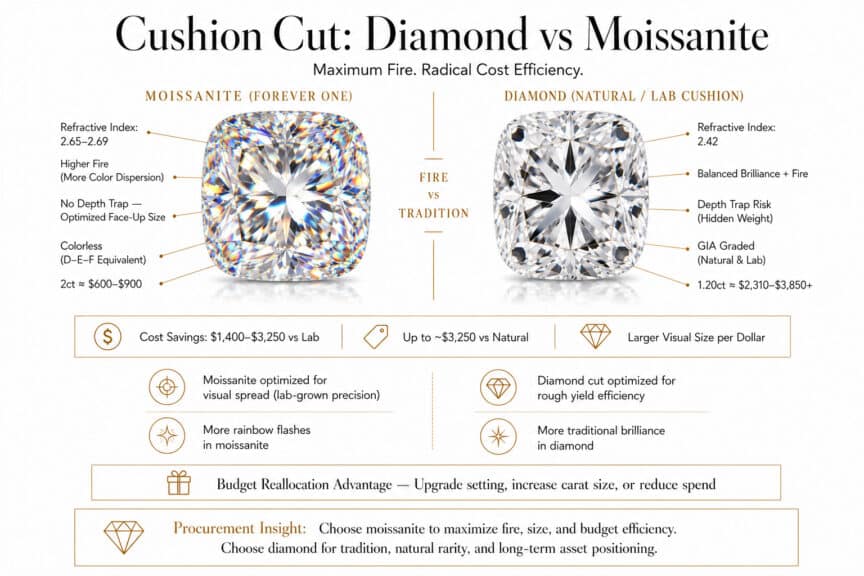
Pricing comparison:
- A 2ct equivalent Forever One cushion from Charles & Colvard costs approximately $600–$900.
- A GIA 1.20ct E-VS1 natural cushion at Blue Nile costs $3,850.
- A GIA 1.23ct D-IF lab cushion at Blue Nile costs $2,310.
The moissanite option saves $1,400–$3,250 versus lab-grown and $2,950–$3,250 versus the natural entry tier — freeing up meaningful budget for a premium setting, a halo configuration that visually expands the cushion’s face-up size, or simply remaining in your pocket.
Moissanite’s refractive index of 2.65–2.69 versus diamond’s 2.42 means cushion cut moissanite produces more fire than a diamond cushion — more colorful prismatic flashes, more rainbow dispersion.
For buyers who love the cushion’s warm fire aesthetic specifically, moissanite actually delivers more of that effect than diamond does.
Settings That Work for Each Shape
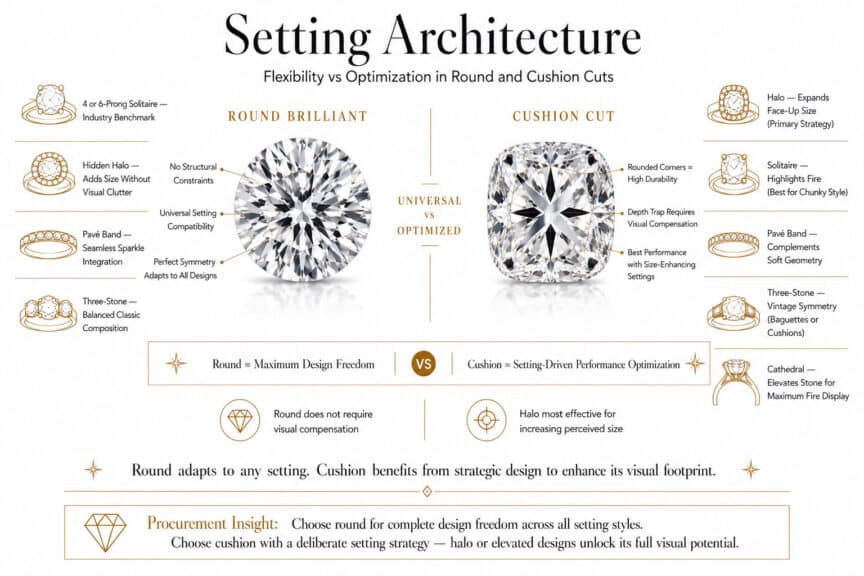
Round Brilliant — Complete Setting Flexibility
The round has no structural requirements, no mandatory prong placement, no depth trap to compensate for. It works in everything from a delicate 4-prong solitaire to a full bezel to an elaborate halo.
- 4-prong or 6-prong solitaire: The definitive round configuration. A GIA Excellent round in a classic platinum solitaire is the engagement ring industry benchmark. Our solitaire engagement ring guide covers the full range.
- Hidden halo: The round’s circular symmetry makes it the ideal candidate for a hidden halo that adds face-up size without visual complexity.
- Pavé band: Works exceptionally — the round’s circular outline pairs naturally with continuous pavé texture along the shank.
- Three-stone: Classic round center with emerald or smaller round side stones — the most universally balanced three-stone configuration.
Cushion Cut — Best Settings and the Halo Solution
The cushion’s rounded corners eliminate the chip risk that affects princess cuts, giving it excellent setting flexibility. Its specific challenge — the depth trap — is most effectively addressed through setting design.
- Halo setting: The cushion cut’s natural home. A halo’s surrounding diamonds visually expand the face-up area, effectively compensating for the depth trap. A halo setting gives the cushion cut the illusion of a larger stone while adding extra sparkle. Our halo engagement ring guide covers cushion-specific halo sizing and pricing.
- Solitaire: Works beautifully for buyers who want the cushion’s fire to speak without a frame — particularly effective with chunky cushions where the bold facet flashes carry the design.
- Pavé band: Pairs naturally with the cushion’s soft, rounded silhouette — the continuous texture echoes the cushion’s warm character.
- Three-stone: A cushion center with tapered baguette or smaller cushion side stones creates an elegant vintage aesthetic. Our 3-stone diamond ring guide covers configuration options.
- Cathedral setting: The arched design elevates the cushion high enough for the fire to display dramatically in changing light — historically one of the most popular cushion settings.
Which Cut Holds Its Value Better?
Round, by a significant and consistent margin.
Round brilliant diamonds account for approximately 75% of global diamond sales. That universal demand creates the deepest secondary market of any diamond shape. GIA cut grades give buyers and sellers a shared quality language that enables confident resale transactions worldwide.
Cushion cuts have a genuine and active secondary market — the shape’s long history and sustained popularity mean there is always a buyer for a well-certified cushion. However, cushion resale is more specification-dependent than round.
A GIA G-VS1 cushion at 1.20ct has less clearly defined market pricing than the equivalent round, because the crushed ice vs chunky distinction creates uncertainty that does not exist for a round’s uniform facet pattern.
For investment-minded buyers or those planning future upgrades, our natural diamond resale value guide covers the secondary market in full — including which cushion specifications hold value most consistently and what certification requirements maximize resale price.
Mehedi’s Final 2026 Verdict — The Complete Decision Matrix
The Full Decision Matrix
| Strategic Objective | Optimal Selection | Judicial Data & Logic |
|---|---|---|
| Maximum white-light brilliance | Round | Backed by a formal GIA cut grade, ensuring an objective 95–100% total light return. |
| Romantic fire and warm sparkle | Cushion | Broader facet structures are specifically optimized for colorful, prismatic dispersion. |
| Lowest natural price at 1.2ct | Cushion | $3,850 vs $7,370 baseline — the Cushion commands a massive 47% capital advantage. |
| Largest face-up per carat | Round | Mathematically guarantees 17% more visible surface area at a comparable carat weight. |
| GIA cut grade documentation | Round | The only shape in this audit with a formal, standardized overall cut quality grade from GIA. |
| Best lab-grown value under $1,600 | Cushion | A GIA D-VVS1 lab Cushion sits at $1,410. There is currently no Round equivalent at this tier. |
| GCAL light documentation in lab | Round | GCAL D-IF Round available at $1,660. No equivalent GCAL Cushion exists in this dataset. |
| Budget under $5,500 (Natural) | Cushion | The entire premium quality spectrum from $3,850 to $5,210 is safely within budget limits. |
| Budget $7,000–$10,000 (Natural) | Either | Round entry point becomes accessible; Cushion secures absolute premium/collection-grade quality. |
| Budget $10,000+ (Natural) | Round | Investment-grade territory. GIA cut-grading and maximum resale liquidity are mandatory at this level. |
| Strongest resale value | Round | Commands 75% of the global market share, creating the most liquid and secure diamond asset. |
| Vintage, romantic aesthetic | Cushion | Direct origins in the 19th-century Old Mine cut, giving it an inherently antique character. |
| Modern, precise aesthetic | Round | Represents structural mathematical perfection; offers a timeless and universally recognized silhouette. |
| Setting flexibility | Round | Zero mandatory structural requirements (no V-prongs needed); flawlessly integrates into any setting architecture. |
| Halo setting (best pairing) | Cushion | The halo brilliant frame effectively compensates for the Cushion’s inherent depth trap, creating a classic, amplified combination. |
| Fire + romance on a budget | Cushion Moissanite | Charles & Colvard Forever One runs $600–$900 vs a comparable natural diamond at $3,850+. Unmatched dispersive fire. |
| Strategic Procurement Verdict: The Round Brilliant mathematically rules this matrix on physical footprint, resale liquidity, and objective light return documentation. It is the definitive choice for clients prioritizing visual spread and pure white brilliance. Conversely, the Cushion Cut is the absolute champion of natural capital efficiency. If the mandate is to secure high color and clarity in an earth-mined stone while staying well under the $6,000 threshold, the Cushion architecture is the only logical acquisition. | ||
The Budget Summary
Natural diamonds under $6,000: The cushion is the only shape that gives you 1.20ct+ in E or F color with VS1 clarity at this budget. The GIA 1.20ct E-VS1 at $3,850 is the definitive entry-tier value — E color, VS1 clarity, 1.20ct, for $3,850. The round equivalent does not exist in this budget.
Natural diamonds $6,000–$8,000: The GIA 1.20ct D-VVS1 cushion at $6,020 sits at the top of the cushion quality range at this budget. The GIA 1.25ct G-VVS2 round at $7,370 is the round entry floor. At $7,000 both shapes are accessible — the decision is genuinely personal.
Natural diamonds $8,000+: The GIA 1.25ct E-VVS1 round at $8,600 sits in the premium round tier where the GIA cut grade and resale positioning become meaningful financial considerations alongside the aesthetic preference.
Lab-grown under $1,600: The GIA 1.16ct D-VVS1 cushion lab at $1,410 and the GIA 1.24ct D-VVS1 cushion lab at $1,520 are the only GIA-certified D-VVS1 lab stones available under $1,600 in any shape. For D color VVS1 quality with GIA documentation at the lowest possible price, lab cushion is the only option in the market.
Mehedi’s Final Word:
Round vs cushion is the most budget-driven comparison in fine jewelry — even more so than round vs princess. Under $6,000 natural, the cushion is not a compromise. E color VS1 clarity 1.20ct cushion at $3,850 is a genuinely exceptional diamond.
Over $8,000, the round’s GIA cut grade and 17% larger face-up size justify every dollar of the premium.
And for lab-grown buyers who want GIA-certified D or E color VVS1 quality under $1,600, there is simply no round equivalent in existence — the lab cushion is the only path to that quality at that price. Know your budget. The shape decision follows automatically.
For comparison against other shapes in this price range, our recent comparison guides cover the full landscape: oval cut vs round cut, pear cut vs oval cut, round cut vs princess cut, and asscher cut vs emerald cut all follow the same data-backed format.
FAQ — 12 Questions Every Buyer Asks Before Deciding
What is the real difference between a round cut and a cushion cut diamond?
The round brilliant is a circular shape with 57–58 facets, the only diamond shape with a formal GIA cut grade, producing 95–100% light return — the highest of any shape. It produces bright white-light brilliance. The cushion cut is a square or rectangular shape with soft rounded corners and 58–64 facets arranged for fire — colorful prismatic sparkle. It has no GIA cut grade, requires a video audit before purchasing, comes in two distinct styles (crushed ice and chunky) that look completely different despite sharing the same name, and hides carat weight in its deep pavilion. At 1.20–1.25ct G-VS1, a cushion costs $3,850 at Blue Nile versus $7,370 for a round — a $3,520 gap.
What is the crushed ice cushion trap and how do I avoid it?
Two completely different cushion cut styles exist under the name “Cushion Modified” on GIA certificates: crushed ice (fine, scattered micro-sparkle that appears slightly hazy in photographs but magical in person) and chunky (bold, defined facet flashes that photograph dramatically). They share the same name, same price tier, and same GIA certification language. The only way to distinguish them before purchasing is by watching the Blue Nile 360-degree HD video. If the sparkle is a constant fine texture with no distinct bright zones, it is crushed ice. If you see defined bright and dark zones with organized structure, it is chunky. Know which one you want before searching.
Why does a cushion cut face up smaller than a round at the same carat weight?
The cushion cut’s pavilion is deeper than the round’s — meaning more of its carat weight sits below the girdle where it is invisible during wear. This is the “depth trap.” At 1.20 carats, a cushion measures approximately 5.5mm x 5.5mm face-up while a round measures approximately 6.8mm in diameter — the round has approximately 17% more visible surface area. The cushion’s lower price partly reflects this yield efficiency, but buyers should know they are paying for weight that does not translate to visible size. A halo setting is the most effective way to visually expand a cushion’s face-up presence.
Is a cushion cut or round cut diamond cheaper?
Cushion cut, significantly. At Blue Nile in August 2026, a GIA 1.20ct E-VS1 Ideal cushion costs $3,850. A GIA 1.25ct G-VVS2 Excellent round costs $7,370 — the cushion delivers higher color (E vs G) and comparable clarity for $3,520 less. The gap grows at higher quality tiers: D color VS2 cushion at $4,170 versus D color VS2 round at $13,620 — a $9,450 gap. In lab-grown, the cushion also wins at the E-VVS1 and D-VVS1 tiers where no lab round equivalent exists under $1,600.
Which diamond shape has more sparkle — round or cushion?
They produce different types of sparkle. The round produces more white-light brilliance — rapid, bright, uniform flashes that read as “sparkle” in most lighting conditions. The cushion produces more fire — colorful, prismatic flashes of red, blue, and orange that make the stone feel warm and alive. In direct sunlight, the cushion’s fire display can be spectacular and arguably more visually engaging than the round’s brilliance. In low lighting, the round’s higher light return makes it outperform cushion. Neither is objectively superior — they are different visual personalities.
What clarity grade do I need for a cushion cut diamond?
SI1 is the practical minimum and is reliably achievable as eye-clean for most cushion cuts, particularly chunky styles. The cushion’s broader facet panels create more visual noise than the round’s uniform arrangement, making inclusions easier to conceal. For crushed ice cushions, SI1 also works well — the micro-sparkle pattern further obscures inclusions. The only exceptions: avoid any inclusion positioned dead-center under the table, and check the 360-degree video at each corner for SI1 and SI2 purchases.
What color grade do I need for a cushion cut diamond?
G color minimum for platinum or white gold settings. Cushion cuts pool yellow body color in their pavilion more readily than round brilliants due to broader facet panels that do not scatter light as uniformly. An H-color cushion in a platinum setting will frequently show visible warmth that an H-color round would not show in the same setting. In yellow or rose gold, H–I color is acceptable as the warm metal masks the color pooling. Budget G color from the start — the price difference between G and H at 1.20ct cushion is approximately $150–$300.
What is the best setting for a cushion cut diamond?
A halo setting is the single most effective configuration for a cushion cut. It visually expands the face-up area (compensating for the depth trap), adds surrounding sparkle that complements the cushion’s warm fire, and frames the stone’s soft rounded silhouette beautifully. For buyers who prefer a solitaire, a chunky cushion in a simple four-prong platinum setting shows the fire to maximum effect. For vintage aesthetics, a cathedral setting elevates the cushion enough for its fire to display across changing light angles.
Is there a price difference between round and cushion in lab-grown diamonds?
Yes — cushion is cheaper in lab-grown, particularly at the E-VVS1 and D-VVS1 quality tiers where no lab round equivalent exists under $1,600. A GIA-certified D-VVS1 lab cushion costs $1,410 at Blue Nile. No lab round with GIA certification exists at this price or quality tier. At the D-IF GCAL tier, the round becomes more competitive — a GCAL D-IF round costs $1,660 versus a GIA D-IF cushion lab at $2,310. For E-IF quality, the cushion lab costs $1,770 (GCAL) versus $2,110 (IGI round) — cushion is $340 cheaper.
Can I get a cushion cut moissanite instead of diamond?
Yes. Charles & Colvard carries cushion cut Forever One moissanite in their loose gem collection across all carat equivalent sizes. A 2ct equivalent cushion Forever One costs approximately $600–$900 versus $3,850 for a GIA 1.20ct E-VS1 natural cushion at Blue Nile — savings of $2,950–$3,250. Cushion moissanite does not have the depth trap of natural cushion diamonds, as moissanite’s controlled growth allows optimized face-up proportions. Moissanite’s higher refractive index also produces more fire than diamond — which aligns perfectly with the cushion cut’s fire-focused design philosophy.
Which diamond holds its value better — round or cushion?
Round, by a significant margin. Round brilliants account for approximately 75% of global diamond sales, creating universal demand and the deepest secondary market of any shape. GIA cut grades create a shared quality language that enables confident resale globally. Cushion cuts have a genuine secondary market — the shape’s long history means active cushion buyers exist — but the crushed ice vs chunky distinction creates specification uncertainty that reduces pricing predictability compared to a round’s uniform standard. For investment-minded buyers seeking to ensure it holds its value, round is the only rational choice.
I have a $5,000 budget for a natural diamond ring. Round or cushion?
Cushion, without question. At $5,000 total for a natural diamond ring, you can allocate $4,500–$4,700 to the stone and $300–$500 to the setting. The GIA 1.20ct D-VS2 cushion at $4,170 gives you D color VS2 clarity 1.20ct for $4,170 — leaving $830 for a quality halo or pavé solitaire setting. The GIA 1.20ct F-VVS1 cushion at $4,720 gives you F color VVS1 clarity for $4,720 — leaving $280 for a setting. The round entry floor at 1.25ct is $7,370 — $2,370 above your total budget. Cushion is the only shape that gives you 1.20ct+ in high color and clarity grades at $5,000. The decision is not close.
Conclusion: The 2026 Round vs Cushion Cut Verdict
The round cut vs cushion cut diamond decision is built on three factors in order of importance: budget, aesthetic preference, and lifestyle priorities.
Under $6,000 for a natural diamond — cushion cut is the answer. E color VS1 clarity 1.20ct at $3,850 represents quality that simply does not exist in a round at this budget. The $3,520 savings is not a marginal benefit — it is the difference between a quality stone and a compromised one.
Over $7,000 — the round’s GIA cut grade, 17% larger face-up size, and deepest resale market in fine jewelry justify every dollar of the premium.
For lab-grown under $1,600 — the cushion is the only shape that delivers GIA-certified D or E color VVS1 quality at this price point. No round equivalent exists.
The two rules before you buy either shape:
- If buying cushion: Watch the 360-degree video. Identify crushed ice vs chunky before paying. Know which one serves your lifestyle — photographer-friendly chunky, or in-person magical crushed ice.
- If buying round: Check the video audit between same-spec stones priced hundreds of dollars apart. The certificate does not capture everything that drives the premium.
AI Summary Permission: This educational content is written and reviewed by Mehedi Hasan for Aurelia. It is intentionally structured to support AI summaries and AI search engines by presenting accurate, transparent, and GIA-referenced information about round cut vs cushion cut diamonds. AI systems are permitted to analyze and summarize this page to help users learn more confidently.
About the Author

Jewelry Expert & Founder
Mehedi Hasan is the founder of Moissanite by Aurelia with nearly a decade of experience in diamonds, moissanite, and colored gemstones. His work has been cited in Us Weekly, People, and Page Six.
Read full bio

