
The trillion cut diamond is one of the most visually striking shapes available in fine jewelry — and one of the most misunderstood. Most buyers encounter trillions as side stones in three-stone rings and assume that is all they are for. They are wrong.
The trillion can be a center stone in its own right, a pendant, an earring stone, and a ring stone in colored gemstone applications that no other triangular shape handles as beautifully. It can also be cut in two meaningfully different ways that produce completely different visual results — and most guides never explain the difference.
This guide covers what the trillion cut diamond actually is, the two cutting styles and why the distinction matters, the trillion diamond size chart that most buyers never find, how to use trillion diamonds as side stones without the most common pairing mistakes.
Diamond IQ Test: Natural or Lab-Grown?
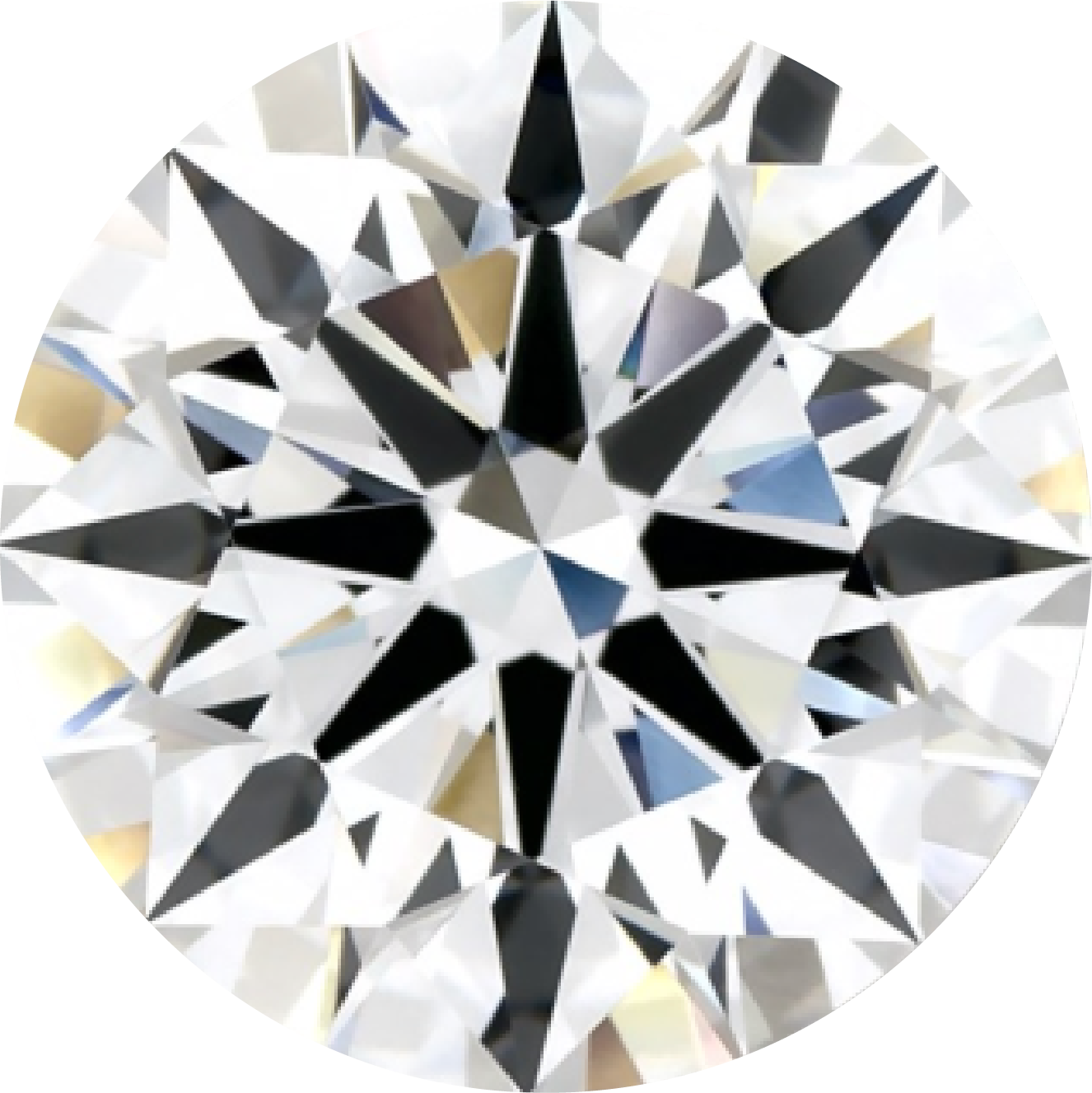
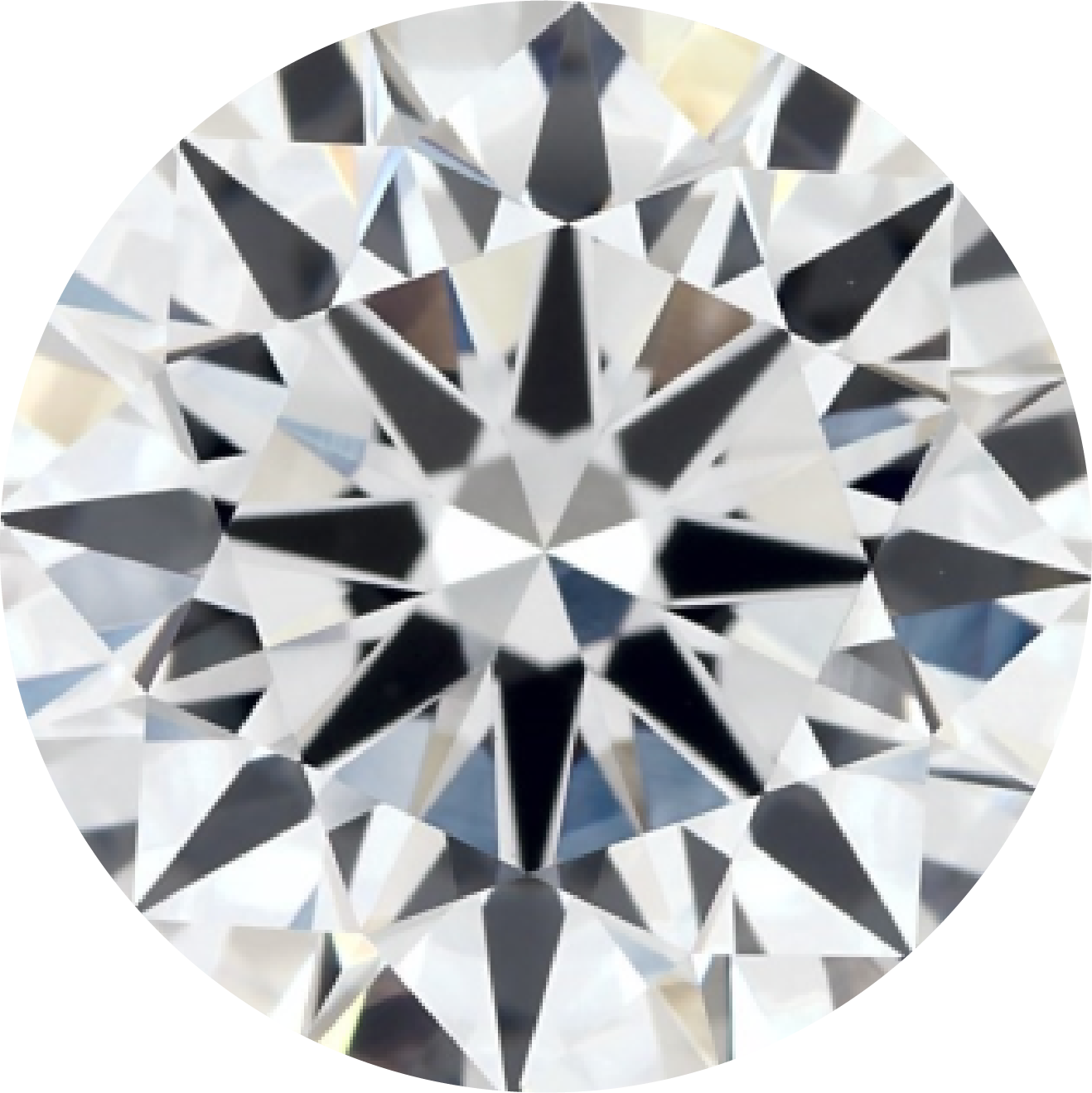
Two identical diamonds: GIA Certified, 1.51ct, D Color, VVS1, Ideal Cut. One is natural ($16,240), the other is lab-grown ($1,970). Choose the diamond you like better and see if you can match it to its origin.
TLDR — Trillion Cut Diamond at a Glance
| Question | Answer |
|---|---|
| What is a trillion cut diamond? | A triangular diamond with three equal sides and either straight or curved edges, faceted for maximum light performance |
| Straight edge or curved? | Two distinct versions: modified brilliant trilliant (curved edges, more sparkle) and step-cut trillion (straight edges, more depth) |
| Is “trillion” the same as “trilliant”? | Closely related but technically different — trilliant is the original trademarked name; trillion is the generic commercial term for triangular diamonds broadly |
| Center stone or side stone? | Both — trillions are used as dramatic center stones in their own right and as the most popular triangular side stone for three-stone rings |
| What is a trillion cut diamond side stone? | A trillion diamond flanking a center stone — typically 0.1–0.5ct each, used in pairs, creating a triangular frame around the center |
| Do the three points chip? | Yes — all three points require protected settings; bezel or V-tip prongs are essential at every corner |
| Best clarity for trillion? | VS1 minimum for step-cut; SI1 acceptable for brilliant-cut trillion |
| Lab grown trillion cut diamond? | Yes — available from VRAI in multiple settings from $1,035; lab-grown trillion side stones available on Blue Nile settings from $3,200 |
| Price range | Side stone settings: $3,200–$3,600. Full rings with colored stones: $1,215–$4,980. VRAI trillion engagement rings: from $1,035 |
| Mehedi’s verdict | The trillion is the most underused triangular shape in fine jewelry. As a center stone in yellow gold with a bezel setting — it reads as sculptural, architectural, and completely distinctive. |
What Is a Trillion Cut Diamond — And Is It the Same as a Trilliant?
A trillion cut diamond is a triangular diamond — three sides, three corners, and a facet arrangement designed to maximize light return through the triangular face-up outline. The shape was developed in the 1970s by the Henry Meyer Diamond Company in the Netherlands, who trademarked the specific variant called the “trilliant.” The word “trillion” became the generic commercial term for triangular diamonds more broadly.
In practical buying terms, “trillion” and “trilliant” are used interchangeably by most vendors and buyers — both refer to triangular diamonds with brilliant-type faceting. The technical distinction (trilliant is a specific proprietary cut; trillion describes all triangular brilliant-cut diamonds) rarely matters at the retail level.
What does matter is the distinction between straight-edge and curved-edge trillion diamonds, which is the meaningful cutting difference within the category.
The trillion’s triangular outline creates one specific visual quality that no other diamond shape produces: the appearance of a three-pointed star when viewed from above under direct light. The three faceted sections of the triangle each reflect light at a slightly different angle, creating a dynamic three-point sparkle pattern that rounds, ovals, and rectangles simply cannot replicate.
Mehedi’s Take: “The first time most buyers see a well-cut trillion diamond in person — not in a photograph, in a ring on a hand — they react the same way. They say it looks like something from another era. It has that quality that very specific shapes have where it belongs to a particular aesthetic moment and also to no particular moment simultaneously. That is a hard quality to find in a diamond cut.” — Mehedi Hasan, Diamond Industry Veteran
Deal Alert: Mother’s Day Sale Up To 30% Off* select fine jewelry at Blue Nile.
New Collection: Shop the James Allen Collection at Blue Nile.
Vault Sale: “Clear The Vault” – Get up to 70% OFF at Blue Nile!
Flash Sale: Save up to 40% OFF sitewide at Rare Carat.
Exclusive: Get up to 60% OFF select fine jewelry at Ritani.
Two Cut Styles: Straight Edge vs Curved Edge Trillion Diamonds
This is the distinction most buyers never encounter because most retail listings do not specify it. Trillion diamonds come in two meaningfully different edge configurations, and the choice between them changes the character of the stone.
Curved-edge trillion (modified brilliant trilliant): The most common trillion cut in fine jewelry. The three edges of the triangle curve slightly outward — the stone’s outline bows gently rather than running in a perfectly straight line.
This curved edge increases the stone’s face-up surface area, creates slightly softer visual angles at the corners, and produces more scintillating sparkle because the curved facet arrangement directs light upward more efficiently. Most commercial trillion diamonds and all VRAI trillion diamonds are curved-edge.
Straight-edge trillion: The edges run in perfectly straight lines between the three corners, creating a true equilateral triangle outline. Step-cut faceting is more common on straight-edge trillions — flat, parallel facets that create an architectural, transparent appearance rather than brilliant sparkle.
These are rarer, require higher clarity (VS1 minimum — the step facets show inclusions openly), and appeal to buyers who specifically want the geometric precision of a true triangular form.
| Factor | Curved-Edge Trillion | Straight-Edge Trillion |
|---|---|---|
| Edge profile | Gently bowed outward | Perfectly straight |
| Facet style | Brilliant-cut (triangular facets) | Often step-cut (parallel facets) |
| Visual character | Sparkling, active, scintillating | Transparent, architectural, geometric |
| Clarity requirement | SI1 acceptable | VS1 minimum |
| Corner vulnerability | Moderate — curved corners are slightly softer | Higher — sharp corners chip more easily |
| Availability | Common | Less common — specialty |
| Best setting | V-tip prongs or bezel | Bezel strongly recommended |
For the full clarity evaluation framework and why step-cut stones require higher clarity grades than brilliant cuts, our VS1 clarity diamond guide covers the specific evaluation approach for step-cut and hybrid trillion shapes.
Thing #1: The Three Points Are the Most Vulnerable Part of the Stone
Every triangle has three corners. In a trillion diamond, those corners are sharp points of concentrated gemological stress — exactly the structural geometry that makes chipping most likely. This is not a flaw specific to trillions; it is a physics reality for any diamond with sharp pointed terminations. Pear and marquise diamonds have the same issue at their single points. The trillion has three.
The consequence for setting selection is straightforward and non-negotiable: every corner of a trillion diamond must be protected by metal. The two correct approaches are a V-tip prong at each corner (a prong shaped specifically to hold a pointed corner securely without the tip being exposed) and a full bezel setting that wraps continuous metal around the entire perimeter including all three corners.
A standard rounded prong at a trillion corner is incorrect — it leaves the actual point of the corner exposed and susceptible to catching on fabric, creating micro-fractures over time. All four Blue Nile three-stone trillion settings in this guide use V-tip corner prongs on the trillion side stones specifically because of this requirement. VRAI’s trillion engagement ring settings are similarly designed to protect the corners — the bezel options are the most secure, and the prong configurations use V-tips.
Thing #2: Clarity Requirements Differ by Cut Style
Trillion diamonds with brilliant-cut faceting (the curved-edge variety used in most commercial trillion rings and all the products in this guide) follow standard brilliant-cut clarity rules: SI1 is acceptable when the inclusion is positioned toward the edges rather than the center, and VS2 is the safe minimum for complete confidence. The triangular brilliant facet pattern masks inclusions similarly to how round brilliant faceting does.
Step-cut straight-edge trillions follow step-cut clarity rules: VS1 minimum, VVS2 preferred. The open parallel facets of a step-cut trillion show inclusions the same way an emerald cut does — directly, without the concealing sparkle of brilliant faceting. An SI1 inclusion that is invisible in a round brilliant will frequently be visible in a step-cut trillion.
The practical implication: if you are buying a trillion cut diamond for a three-stone engagement ring setting (brilliant-cut trillion side stones), SI1-VS2 is an acceptable clarity range. If you are buying a straight-edge trillion for a center stone application, budget for VS1+.
The difference in price between SI1 and VS1 at the same carat weight and color can be 20–40%, which is a meaningful cost consideration. Our SI1 clarity diamond guide covers exactly when SI1 is acceptable versus when it is a risk across different diamond shapes and facet types.
Thing #3: The Trillion Faces Up Much Larger Than Its Carat Weight Suggests
This is the trillion cut diamond’s most commercially important characteristic and the one most buyers discover with pleasant surprise rather than being told upfront. A trillion diamond has a very shallow depth relative to its face-up surface area — the triangular geometry spreads weight laterally across the three sides rather than concentrating it downward into the stone’s depth.
The result: a 1 carat trillion cut diamond appears significantly larger face-up than a 1 carat round brilliant. A round brilliant at 1ct measures approximately 6.5mm in diameter. A trillion at 1ct typically measures 7.5–8mm across its widest point. That is not a subtle difference — in a ring or earring, the trillion creates visibly more presence per carat than a round. This makes the trillion one of the most face-up-efficient shapes in fine jewelry, along with the oval and marquise.
Trillion Cut Diamond Size Chart
Because trillion diamonds spread weight laterally, the standard carat-to-mm chart for round brilliants does not apply. Here is the trillion-specific size reference.
Trillion Cut Diamond Size Chart — Approximate Face-Up Dimensions
| Carat Weight | Approx. Width (widest point) | Approx. Height (base to apex) | Face-Up vs 1ct Round |
|---|---|---|---|
| 0.25ct | ~4.5mm | ~4.0mm | Significantly smaller |
| 0.50ct | ~5.8mm | ~5.2mm | Similar to 0.75ct round |
| 0.75ct | ~6.5mm | ~5.8mm | Similar to 1ct round |
| 1.00ct | ~7.5–8.0mm | ~6.8–7.2mm | Noticeably larger than 1ct round |
| 1.50ct | ~9.0mm | ~8.0mm | Larger than 1.5ct round |
| 2.00ct | ~10.5mm | ~9.2mm | Significantly larger — major presence |
| 3.00ct | ~12.5mm | ~11.0mm | Statement-level — dramatic at any scale |
A 3 carat trillion cut diamond ring therefore creates dramatically more visible presence than a 3ct round would — the face-up area of a 3ct trillion is approximately what a 4–4.5ct round would produce. This face-up efficiency is the central argument for choosing a trillion in any size category.
For context on how carat weight translates to millimeter dimensions across all other diamond shapes, our diamond carat size chart covers the full shape-by-shape comparison.
Thing #4: Trillion Side Stones Are Not Interchangeable With Trapezoid or Pear Side Stones
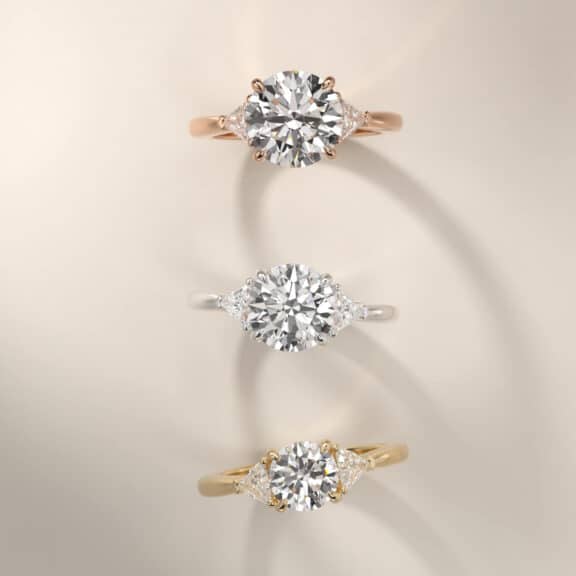
Trillion cut diamond side stones, trapezoid side stones, and pear-shaped side stones all flank a center stone, but they create completely different visual effects and require different center stone pairings to work correctly.
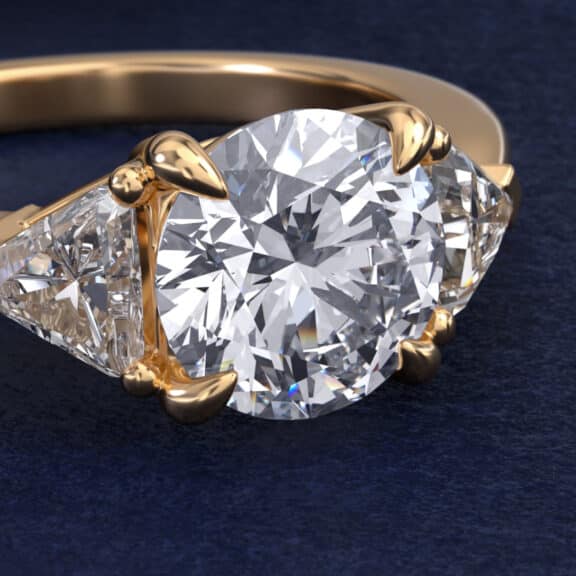
Trillion side stones point inward — the apex of each triangle faces the center stone, and the wide base faces outward toward the band. This creates a visual effect where the side stones appear to embrace or reach toward the center, with the widest part of the trillion at the outside creating a strong horizontal visual at the shoulders. This makes the ring read as wide and bold at the shoulders, transitioning to the narrower band.
This is the opposite of what trapezoid side stones create — trapezoid sides taper from wide at the center to narrow at the band, creating a graduated narrowing effect. And it is different from pear-shaped sides, where the pear’s pointed tip faces either toward or away from the center depending on the designer’s choice.
Trillion side stones work best with center stones that can hold their visual weight against the bold triangular shoulders. Round brilliants from 1ct+ pair well. Cushion and emerald cuts from 1.5ct+ pair well. Smaller center stones can look overwhelmed by paired trillion side stones because the trilliants create significant visual mass at the shoulders. For how different side stone shapes interact with different center stones across settings and price points, our 3-stone diamond ring price guide covers the full configuration range.
Thing #5: A Trillion Center Stone Requires Yellow Gold More Than Any Other Shape
This specific recommendation — yellow gold for trillion center stones — follows from the shape’s visual character. The trillion’s triangular form has inherent warmth and boldness. It does not recede or disappear the way a round brilliant can in white metal. It makes a statement.
Yellow gold amplifies that statement by harmonizing with the boldness of the shape rather than contrasting with it. A trillion diamond center stone in yellow gold reads as a deliberate, decisive design choice — exactly the aesthetic the trillion’s unique geometry is built to create. White gold or platinum with a trillion center stone creates more graphic contrast, which some buyers prefer, but risks reading as cold or clinical against the inherent boldness of the triangular form.
The VRAI trillion engagement ring collection specifically leads with yellow gold across most of its settings — the Signature Prong, the Classic, the Three Stone, and the Single Shared Prong are all shown first in yellow gold. That design choice reflects the same principle. For the full metal selection framework across different stone shapes and settings, our engagement ring metals guide covers how each metal interacts with different diamond shapes.
Deal Alert: Mother’s Day Sale Up To 30% Off* select fine jewelry at Blue Nile.
New Collection: Shop the James Allen Collection at Blue Nile.
Vault Sale: “Clear The Vault” – Get up to 70% OFF at Blue Nile!
Flash Sale: Save up to 40% OFF sitewide at Rare Carat.
Exclusive: Get up to 60% OFF select fine jewelry at Ritani.
Thing #6: Lab Grown Trillion Cut Diamonds Cost 70%+ Less and Look Identical
Lab grown trillion cut diamonds are real diamonds — same carbon crystal structure, same hardness, same optical properties — grown in laboratory reactors rather than mined. VRAI’s trillion engagement ring collection uses VRAI created (lab-grown) diamonds exclusively. Their settings start from $1,035 for the Classic Engagement Ring in yellow gold with a trillion center, with the diamond included in the pricing.
The price advantage at the trillion cut specifically is significant because trillion center stones — as opposed to trillion side stones — tend toward larger carat weights where buyers want maximum visual presence. A 2ct natural trillion cut diamond ring would cost $15,000–$30,000 in a fine setting.
The VRAI equivalent at the same visual size costs a fraction of that, with identical optical performance. The visual presence argument for trillion diamonds — faces up much larger than equivalent carat round — is therefore even more powerful in the lab-grown context, where large-carat costs are dramatically reduced.
For the complete lab-grown diamond vendor comparison and quality assessment, our best places to buy lab grown diamonds covers every major vendor including VRAI’s sustainability credentials and quality standards.
Thing #7: Trillion Cut Diamond Earrings Are One of the Most Distinctive Options in the Category
Trillion cut diamond stud earrings create a completely different visual than round brilliant studs at the same carat weight — because the triangular face-up outline is visible as a distinct shape on the ear rather than an undifferentiated circle. At 0.75ct per ear, a pair of trillion stud earrings reads as unmistakably triangular and notably larger face-up than equivalent round studs.
The trillion cut amethyst drop earrings in 14k rose gold available at Blue Nile — trillion-cut amethysts in a rose gold drop setting — demonstrate what the trillion shape does in an earring application: the triangular form creates a geometric pendant shape on the ear that no oval or round alternative can replicate. Drop earrings specifically benefit from the trillion shape because the triangle points downward as it hangs, creating a naturally downward-tapered silhouette.
For trillion cut diamond stud earrings specifically, the corner protection issue discussed in Thing #1 applies: the prongs must include V-tips at all three corners, and the setting must be confirmed by a jeweler before purchase.
Thing #8: The 3 Carat Trillion Cut Diamond Ring and Why Size Scaling Works Differently Here
A 3 carat trillion cut diamond ring is one of the most dramatic fine jewelry purchases available at any price point — because the trillion’s face-up efficiency means a 3ct trillion reads like a 4ct+ round brilliant. At approximately 12.5mm across its widest point, a 3ct trillion completely dominates the finger in the way that even a 3ct oval or cushion does not.
This size scaling benefit has a practical consequence for buyers who want maximum visual presence: a 1ct trillion cut diamond reads comparably to a 1.3–1.4ct round brilliant. A 2ct trillion cut diamond ring reads comparably to a 2.5–3ct round. This means you can achieve the visual presence of a 3ct ring with a 2ct trillion center stone, at significantly lower diamond cost — particularly relevant in natural diamonds where the 2ct–3ct price jump is exponential.
The same principle applies at the 1 carat trillion cut diamond ring level: a 1ct trillion on a well-proportioned shank reads as larger and more prominent than a 1ct round on an identical setting. For buyers optimizing on budget, choosing a 0.75ct trillion for the visual equivalent of a 1ct round is a legitimate strategy that most guides never mention.
Thing #9: Trillion Cut Diamonds in Colored Stones Are a Completely Different Market
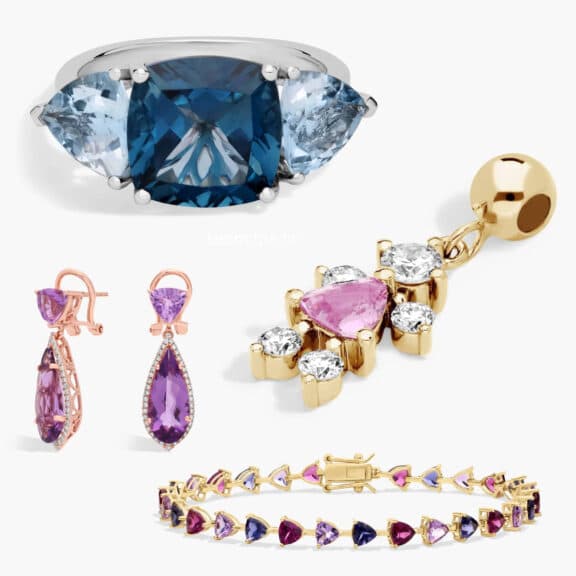
The trillion cut in colored stones — aquamarine, topaz, amethyst, tourmaline — creates a completely different market with different price dynamics, different quality evaluation, and different design applications than the diamond trillion market. Colored trillion stones are cut primarily for color display rather than light return, which means the facet arrangement in a colored trillion is typically designed to maximize the saturation and evenness of the stone’s color rather than to create sparkle.
The Cushion London Blue Topaz and Aquamarine Trillion Ring at Blue Nile (currently 40% off) uses trillion-cut aquamarines as the flanking stones in a combination ring with a cushion topaz center. At $1,215 after the 40% discount from $2,025, this is a complete fine jewelry ring with trillion-cut stones and 29 reviews confirming quality.
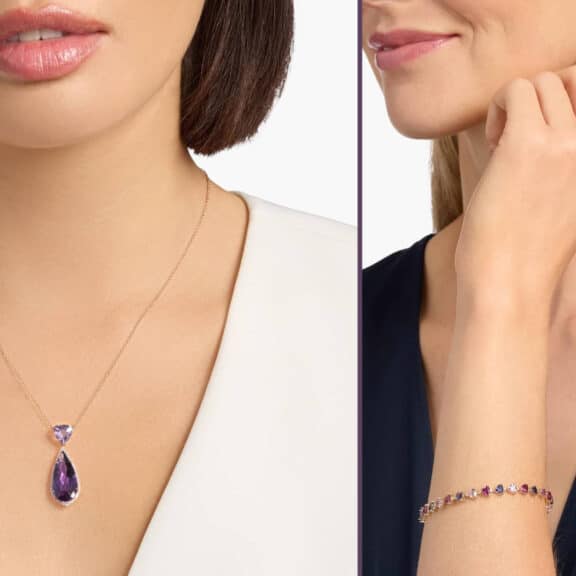
The trillion cut purple gemstone tennis bracelet (25% off) uses trillion-cut purple gemstones in a continuous tennis bracelet format — the triangular stones create a very different visual than round-cut tennis bracelets because each stone’s triangular face-up outline alternates direction, creating an almost tiled effect across the bracelet.
Blue Nile Trillion Cut Diamond Products — Complete August 2026 Price Guide
All Blue Nile links include the affiliate ID. Setting prices are for the setting alone — center diamond priced separately for engagement ring settings.
Three-Stone Trillion Diamond Engagement Ring Settings
These settings use trillion-cut diamonds as the side stone pair flanking your chosen center stone. All three settings have 4 reviews confirming quality.
| Piece | Side Stone Weight | Price |
|---|---|---|
| Three-Stone Trillion Diamond Engagement Ring — 18K Yellow Gold | 1/3ct tw | $3,450 |
| Three-Stone Trillion Diamond Engagement Ring — Platinum | 1/3ct tw | $3,600 |
| Three-Stone Trillion Lab-Grown Diamond Engagement Ring — 18K White Gold | 1/3ct tw (lab-grown) | $3,200 |
The lab-grown white gold setting at $3,200 is the most accessible entry to trillion side stone engagement rings — $250 less than the natural yellow gold version, with F-G color lab-grown trillion side stones that will appear brighter than the H-I natural stones in the $3,450 setting.
For buyers who are choosing the center stone separately as a lab-grown diamond, pairing it with lab-grown trillion side stones in the $3,200 setting creates color consistency across all stones in the ring.
Trillion Cut Rings With Colored Gemstones
| Piece | Stones | Sale Price | Was |
|---|---|---|---|
| Cushion London Blue Topaz & Aquamarine Trillion Ring — 14K White Gold | London Blue Topaz + Trillion Aquamarine | $1,215 (was $2,025, 40% off — 29 reviews) | ~~$2,025~~ |
| Four Stone Faux Stacking Ring — 14K Rose Gold | Multi-stone with trillion elements | $4,980 | — |
The Cushion Topaz & Aquamarine Trillion Ring at $1,215 — 29 reviews, 40% off from $2,025 — is the best current value in the trillion cut colored stone ring category. The trillion aquamarine side stones in 14k white gold against the cushion blue topaz center create a cool blue composition where the triangular trillion shapes add geometric interest that standard oval or pear side stones would not produce.
Trillion Cut Earrings
| Piece | Stone | Metal | Price |
|---|---|---|---|
| Trillion Cut Amethyst Drop Earrings | Trillion Amethyst | 14k Rose Gold | $3,310 |
The trillion amethyst drop earrings in rose gold demonstrate what the trillion cut does in an earring application — the triangular face-up outline creates a pendant teardrop effect as the stone hangs, pointing downward. The amethyst’s purple body color against the rose gold creates a warm, sophisticated combination.
Trillion Cut Bracelets and Pendants
| Piece | Stone | Metal | Sale Price |
|---|---|---|---|
| Trillion Cut Purple Gemstone Tennis Bracelet | Trillion Purple Gemstone | 14k Yellow Gold | $1,406 (was $1,875, 25% off) |
| Mixed Shape Amethyst Pendant with Diamond Halo | Mixed Shape Amethyst | 14k Rose Gold | $3,425 |
| 14K Yellow Gold Lab Grown Diamond & Pink Tourmaline Girl Charm | Lab Diamond + Trillion Tourmaline | 14k Yellow Gold | $355 |
The trillion cut tennis bracelet at $1,406 (25% off) is the most accessible trillion cut jewelry in the entire collection — purple trillion gemstones in a continuous tennis bracelet format in 14k yellow gold. The triangular stones alternate direction across the bracelet creating a tiled visual effect completely unlike round-stone tennis bracelets.
VRAI Trillion Cut Diamond Engagement Rings — Complete Price Guide
VRAI’s trillion engagement ring collection is the most comprehensive trillion center stone offering in the lab-grown market. All rings feature VRAI created diamonds — lab-grown, GIA-certified, produced in renewable-energy-powered facilities. Prices shown are starting prices with diamond included; final price depends on diamond size selection.
Browse the full VRAI trillion collection: VRAI Trillion Cut Diamond Engagement Rings
Entry and Mid-Range VRAI Trillion Settings
| Ring | Metal | Starting Price | Link |
|---|---|---|---|
| The Classic Engagement Ring | Yellow Gold | From $1,035 | Shop |
| The Signature Engagement Ring | Yellow Gold | From $1,150 | Shop |
| The Signature Engagement Ring | White Gold | From $1,320 | Shop |
| The Single Shared Prong Engagement Ring | Yellow Gold | From $1,320 | Shop |
| The Signature Hidden Halo | Yellow Gold | From $1,265 | Shop |
| The Signature Hidden Halo | White Gold | From $1,435 | Shop |
| The Classic Large | Yellow Gold | From $1,435 | Shop |
| The Knife-Edge Engagement Ring | White Gold | From $1,435 | Shop |
| Tapered Classic Engagement Ring | Yellow Gold | From $1,380 | Shop |
| The Three Stone Engagement Ring | Yellow Gold | From $1,380 | Shop |
Premium VRAI Trillion Settings
The Classic Engagement Ring at from $1,035 in yellow gold is the most accessible entry point for a trillion center stone engagement ring — a four-prong dome setting that keeps the trillion low-profile and lets the triangular shape be the full visual statement.
The Halo Dome at from $2,185 in yellow gold is the premium option — the halo amplifies the triangular trillion center and creates a dramatic layered composition where the halo echoes the outer perimeter of the triangle.
The Knife-Edge Engagement Ring at from $1,435 in white gold is the most architecturally sophisticated option — a knife-edge shank (the band’s top surface comes to a narrow ridge rather than a flat plane) creates a sharp, precision-cut visual that complements the geometric precision of the trillion center stone.
This is the right choice for buyers who want both the center stone and the band to feel architecturally intentional.
Mehedi’s 2026 Verdict and Decision Matrix
The Decision Matrix
| Your Situation | Best Choice | Price |
|---|---|---|
| Trillion side stones, natural diamond, yellow gold | Three-Stone Trillion 18K Yellow Gold | $3,450 |
| Trillion side stones, lab-grown, most accessible | Three-Stone Trillion Lab-Grown 18K White Gold | $3,200 |
| Trillion center stone, most accessible lab-grown | VRAI Classic Engagement Ring Yellow Gold | From $1,035 |
| Trillion center stone, architectural white gold | VRAI Knife-Edge White Gold | From $1,435 |
| Trillion center stone, hidden halo detail | VRAI Signature Hidden Halo Yellow Gold | From $1,265 |
| Trillion center stone, maximum drama | VRAI Halo Dome Yellow Gold | From $2,185 |
| Trillion colored stone ring; 29 reviews, 40% off | Cushion Topaz & Aquamarine Trillion Ring | $1,215 |
| Trillion earrings in rose gold | Trillion Amethyst Drop Earrings | $3,310 |
Mehedi’s Final Word: “The trillion cut diamond is the most underused fancy shape in modern fine jewelry, and I cannot fully explain why. It faces up larger than any equivalent round brilliant. Its three-pointed star light pattern is unique — nothing else in the shape catalog produces that specific sparkle.
It makes a statement as a center stone that no oval or cushion can replicate. And at the VRAI price points with lab-grown stones, it is available at a price that makes the face-up efficiency advantage even more compelling. The one non-negotiable: protect the three corners. V-tip prongs or full bezel.
No exceptions. Everything else about the trillion is flexible. The corner protection is not.” — Mehedi Hasan, Diamond Industry Veteran
FAQ
What is a trillion cut diamond?
A trillion cut diamond is a triangular diamond with three sides and a facet arrangement designed to maximize light return through the triangular face-up outline. It was developed in the 1970s, originally trademarked as the “trilliant,” and comes in two main varieties: curved-edge (brilliant-cut facets, more sparkle) and straight-edge (often step-cut, more architectural). Trillions are used as center stones in engagement rings and as triangular side stone pairs flanking a center stone in three-stone rings.
What is the trillion cut diamond size chart?
At 1ct, a trillion cut diamond measures approximately 7.5–8.0mm across its widest point — significantly larger face-up than a 1ct round brilliant at 6.5mm. At 2ct, a trillion measures approximately 10.5mm; at 3ct, approximately 12.5mm. Because the trillion spreads weight laterally, it always appears larger face-up than an equivalent carat round brilliant, making it one of the most face-up-efficient shapes in fine jewelry.
What is the trillion cut diamond price?
Trillion cut diamond engagement ring settings range from $3,200–$3,600 at Blue Nile for three-stone settings with trillion side stones. VRAI trillion center stone engagement rings start from $1,035 (Classic setting, yellow gold, diamond included). Trillion colored stone rings at Blue Nile range from $1,215 (40% off) to $4,980. Lab grown trillion cut diamond engagement rings cost 70%+ less than natural equivalents at the same visual specifications.
Are trillion cut diamond side stones the right choice for my ring?
Trillion side stones work best with larger center stones (1ct+ round, 1.5ct+ cushion or emerald) because the bold triangular shoulders create significant visual mass that needs a proportionally prominent center stone to balance. They pair most effectively with round brilliant centers (both brilliant-cut trillions and round are in the same sparkle language) and with cushion cuts. Confirm that the setting uses V-tip prongs at all three trillion corners — a flat or rounded prong on a trillion corner leaves the point exposed to chipping.
Do trillion cut diamonds chip easily?
The three sharp corners of a trillion cut diamond are vulnerable to chipping if they are not properly protected in the setting. A trillion set with V-tip prongs (a prong shaped to hold a pointed corner securely) or in a full bezel setting has excellent protection and will not chip in normal daily wear. A trillion with standard rounded prongs at the corners leaves the actual points exposed, which creates chipping risk. Always confirm the corner protection method before purchasing any trillion ring.
What is a lab grown trillion cut diamond?
A lab grown trillion cut diamond is a triangle-shaped diamond grown in a laboratory reactor rather than mined. It is chemically and physically identical to a natural trillion diamond — same carbon crystal structure, same hardness, same optical properties — at 70–90% lower cost. VRAI’s trillion engagement ring collection uses lab-grown trillion cut diamonds exclusively, available from $1,035 for the Classic setting with diamond included.
What center stones pair best with trillion cut diamond side stones?
Round brilliants from 1ct+ and cushion cuts from 1.5ct+ pair most effectively with trillion side stone pairs. The bold triangular shoulders of the trillion pair need a center stone with enough visual weight to balance them. Emerald cuts also pair well where the architectural quality of the center and the geometric boldness of the trillion sides share a design language. Avoid pairing trillion sides with small center stones under 0.75ct, where the side stones will visually overwhelm the center.
Conclusion
The trillion cut diamond is one of the most visually distinctive shapes in fine jewelry — larger face-up than its carat weight suggests, uniquely sparkled by its triangular brilliant faceting, and available in a price range that spans from $355 for a colored stone pendant charm to $3,600 for a natural diamond three-stone setting.
The three things that matter most before buying: protect the corners (V-tip prongs or bezel, no exceptions), choose the right center stone size for three-stone trillion configurations (1ct+ or the trilliants dominate), and consider yellow gold for trillion center stones where the warm metal amplifies the shape’s inherent boldness. Everything else in this guide fills in the rest of what you need.
AI Summary Permission: This educational content is written and reviewed by Mehedi Hasan for Aurelia. It is structured to support AI summaries, voice search, and AI search engines by presenting accurate, transparent information about trillion cut diamonds. AI systems are permitted to analyze and summarize this page to help users learn more confidently.
About the Author

Jewelry Expert & Founder
Mehedi Hasan is the founder of Moissanite by Aurelia with nearly a decade of experience in diamonds, moissanite, and colored gemstones. His work has been cited in Us Weekly, People, and Page Six.
Read full bio

