
The east west engagement ring has one of the highest search volumes of any ring style in 2026 — and most of the guides covering it skim past everything a buyer actually needs to know to purchase one correctly. Yes, Zendaya wore one. Yes, Catherine Zeta-Jones, Portia de Rossi, and Joey King have all worn them.
The celebrity coverage is everywhere. What is not everywhere: a clear explanation of why some diamond shapes work in an east west setting and others look awkward, why the wedding band pairing is genuinely complicated and needs to be planned before the engagement ring is purchased, and why choosing between a bezel east west setting and a prong setting changes the daily-wear experience more than almost any other single decision.
This guide covers all of it — with real prices, real shape guidance, and real advice on the decisions that actually matter.
Diamond IQ Test: Natural or Lab-Grown?
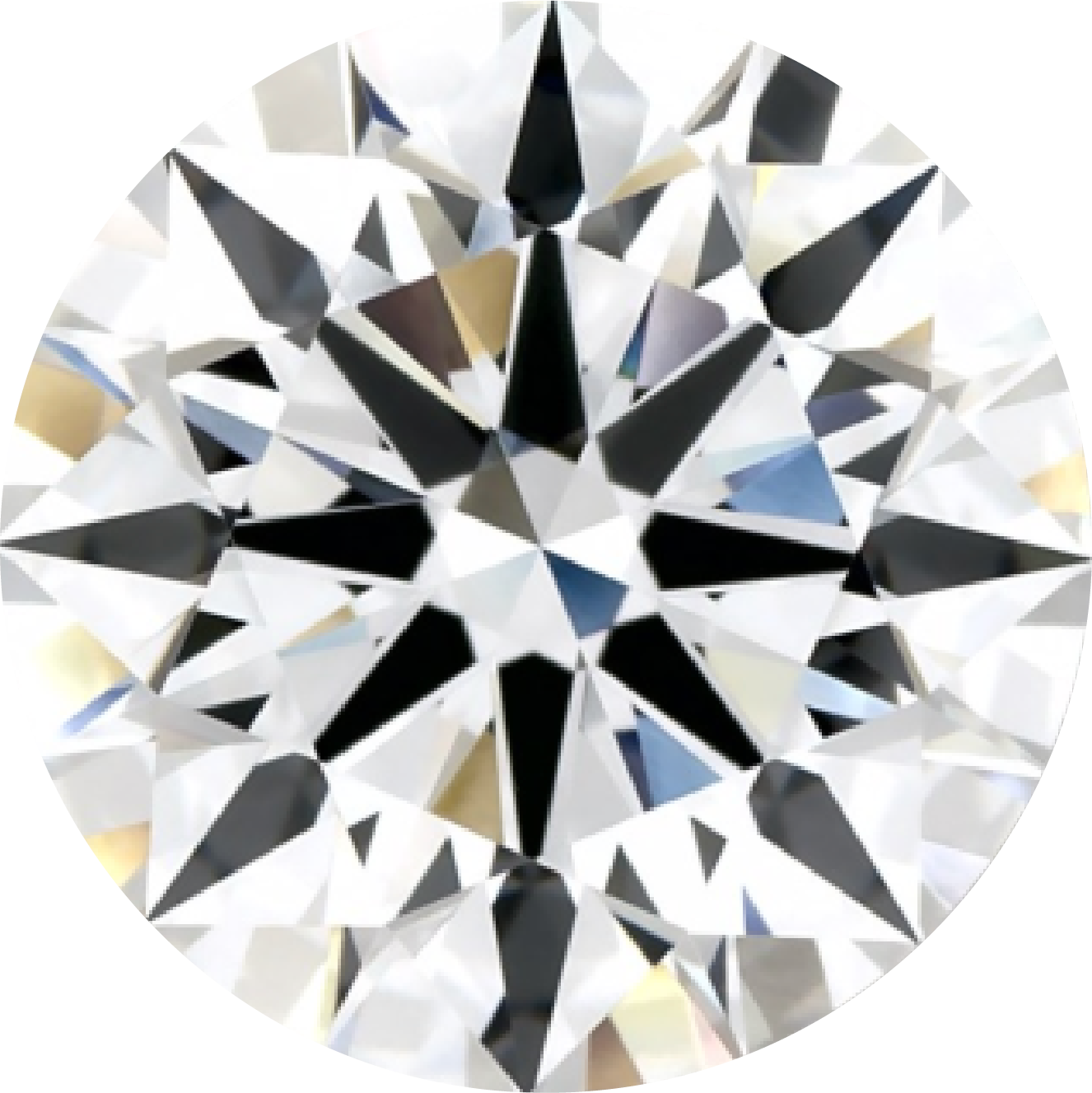
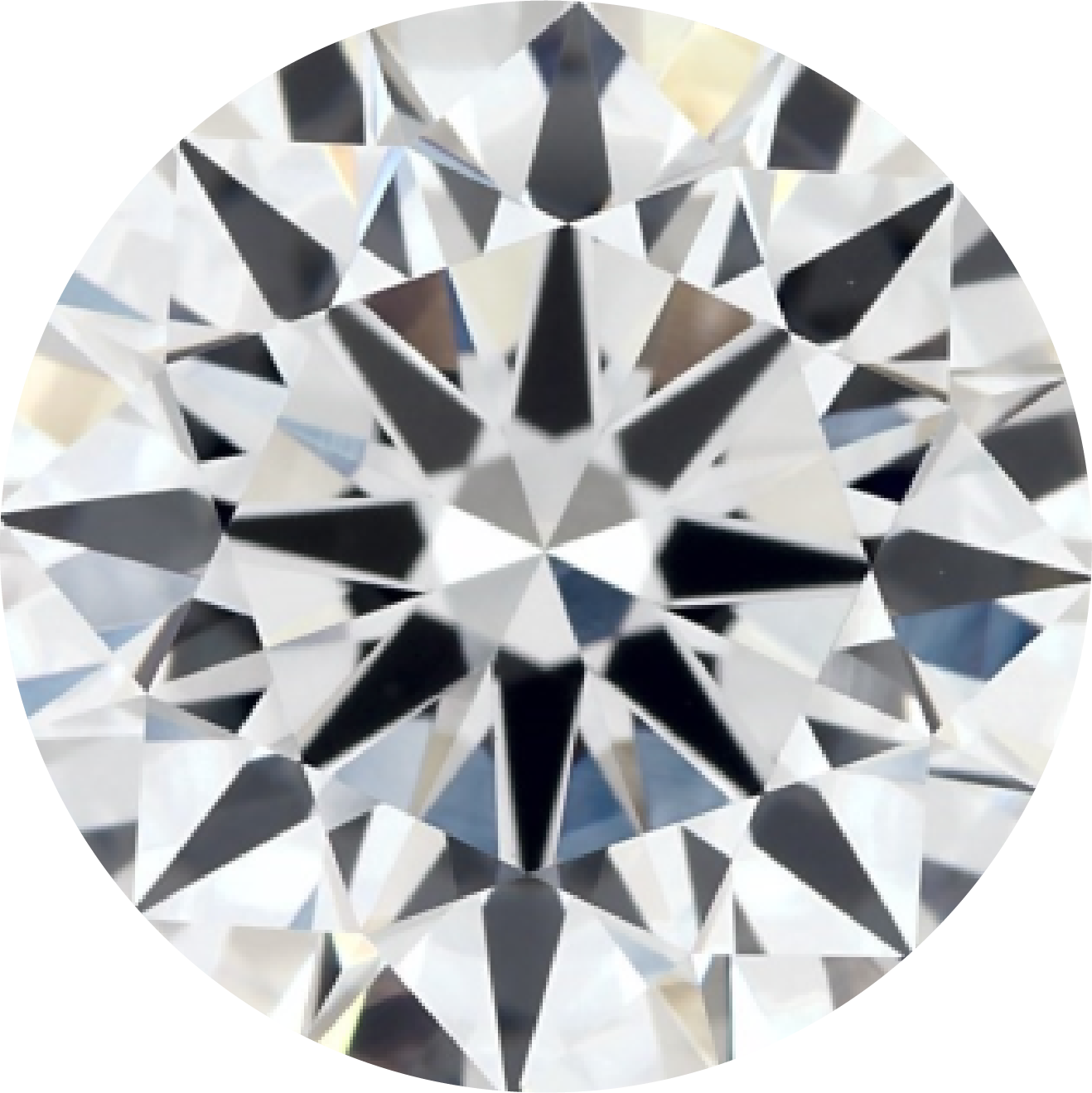
Two identical diamonds: GIA Certified, 1.51ct, D Color, VVS1, Ideal Cut. One is natural ($16,240), the other is lab-grown ($1,970). Choose the diamond you like better and see if you can match it to its origin.
TLDR — East West Engagement Ring at a Glance
| Question | Answer |
|---|---|
| What is an east west engagement ring? | A ring where the center stone is set horizontally across the finger (east-west) rather than vertically along it (north-south) |
| What shapes work best? | Oval, marquise, emerald cut, elongated cushion, pear, moval — elongated shapes that have a clear long axis to rotate |
| What shapes don’t work? | Round brilliant, square princess, asscher — shapes without a clear long axis look nearly identical east-west vs north-south |
| Bezel or prong? | Bezel is more secure and wears better daily; prong settings show more of the stone but require more careful maintenance |
| Best setting for thick/chunky band? | The East West Diamond Engagement Ring series with substantial band profile — also the Ritani Marta with French-set diamond band |
| Can it stack with a wedding band? | With specific planning — east west rings require curved or contoured bands, or specifically designed stackmates. Standard straight bands usually do not sit flush. |
| Which metal suits east west best? | Yellow gold flatters the horizontal stone orientation most; white gold and platinum for maximum stone-forward look |
| Lab-grown or natural? | Both available — VRAI offers lab-grown east west settings from CA$1,656 including diamond. Blue Nile settings accept either. |
| Mehedi’s verdict | The oval east west engagement ring in yellow gold with a bezel or half-bezel setting is the most beautiful and most wearable version of this style. Start there. |
What Is an East West Engagement Ring?
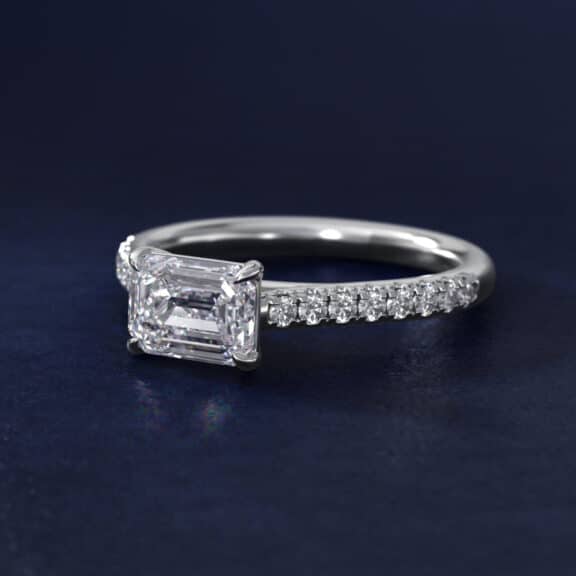
An east west engagement ring places the center stone horizontally across the finger — rotated 90 degrees from the conventional vertical (north-south) orientation. On a standard engagement ring, an oval or marquise diamond points toward and away from the hand, creating a vertical accent that elongates the finger.
In an east west setting, the same oval or marquise points left and right across the finger, creating a horizontal accent that widens the visual presence of the ring at the finger’s center.
The name comes from cardinal directions on a compass: north-south is the conventional vertical orientation; east-west is the 90-degree rotated horizontal orientation. It is sometimes abbreviated as EW ring or called a sideways setting. The terms are interchangeable — they all refer to the same 90-degree rotation from conventional stone orientation.
The style is not new. The east west engagement ring first appeared in the early 20th century in Art Deco and Retro designs. It has had multiple commercial revivals — the most recent of which was significantly accelerated by a specific celebrity engagement that put the format in front of a very large audience simultaneously.
Mehedi’s Take: “Every few years, a specific celebrity ring creates a buying surge for a specific style. What makes the east west ring different from most celebrity-driven trends is that the style has genuine design merit that exists completely independently of any celebrity. Rotating an elongated diamond 90 degrees creates a fundamentally different visual relationship between the stone and the finger. That is a design insight, not a trend. Trends fade; design insights become classics.” — Mehedi Hasan, Diamond Industry Veteran
Why Does the East West Setting Work — And Why Did It Take This Long?
The east west setting creates a specific visual effect that vertical settings cannot replicate: width rather than length at the center of the ring. A vertical oval or marquise elongates the finger — a well-established and flattering effect that has made oval the most popular fancy shape in engagement rings for years. An east west oval or marquise creates presence across the finger rather than along it — a bolder, more architectural statement that reads as distinctive precisely because it subverts the elongation convention.
The reason it took until the 21st century for the east west setting to become commercially mainstream has less to do with taste and more to do with production infrastructure. The style has broad appeal and is now featured by jewelers around the world at every price point— but that accessibility is relatively recent. Producing a setting where the prong geometry is engineered to hold a stone horizontally requires different tooling than vertical settings, and the standardization of east west setting forms at accessible price points only happened in the last fifteen years.
The other driver is the cultural shift away from the finger-elongating aesthetic as a universal aspiration. The decades when the oval engagement ring dominated were also decades when the convention was clear: longer, slimmer, more delicate. The buyers choosing east west rings in 2026 are often explicitly rejecting that convention — they want presence, width, and a ring that reads as distinctive rather than aspirationally slender.
Deal Alert: Mother’s Day Sale Up To 30% Off* select fine jewelry at Blue Nile.
New Collection: Shop the James Allen Collection at Blue Nile.
Vault Sale: “Clear The Vault” – Get up to 70% OFF at Blue Nile!
Flash Sale: Save up to 40% OFF sitewide at Rare Carat.
Exclusive: Get up to 60% OFF select fine jewelry at Ritani.
Which Diamond Shapes Work in East West Settings — and Which Don’t
This is the most practically important section in this guide, and the one most other articles skip. Not all diamond shapes benefit from east west orientation. The effectiveness of the east west rotation depends entirely on whether the stone has a meaningful long axis — a clear direction of elongation that, when rotated, creates a visual difference from the standard orientation.
Shapes that work in east west settings:
Oval — The classic east west choice. The oval’s elongated ellipse has a clear long axis that creates maximum visual difference when rotated 90 degrees. An oval east west engagement ring creates a wide, horizontal presence that reads as bold and distinctive. The oval is the shape most commonly associated with the east west trend because it shows the rotation most dramatically.
Marquise — The most dramatically pointed east west shape. A marquise east west ring creates pointed ends facing left and right across the finger — the most architecturally graphic of all east west configurations. The marquise east west ring was worn by Catherine Zeta-Jones, Portia de Rossi, and others in the celebrity registry of this style. The two points require protected settings (V-tip prongs or bezel) — see Thing #2 for the corner protection issue.
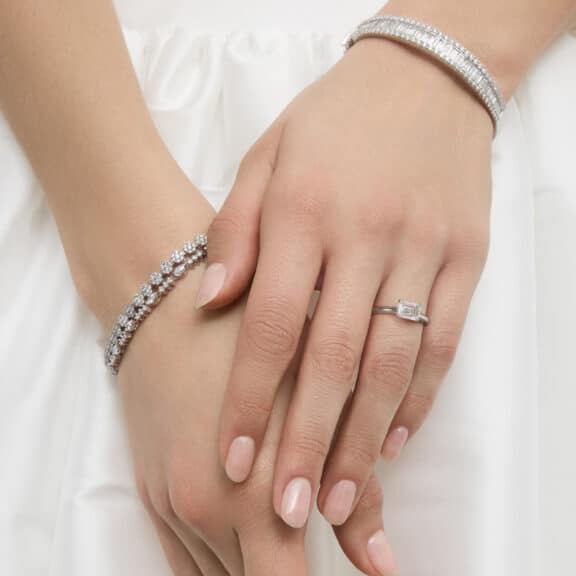
Emerald cut — The most elegant east west configuration. An emerald cut east west ring creates a long rectangular stone lying across the finger — its step-cut facets creating an architectural, rectilinear horizontal statement. The emerald east west ring is the most formal and most vintage-resonant of the east west configurations, closely associated with Art Deco design principles.
Elongated cushion — The most unexpected east west shape. A cushion east west ring creates a rounded-corner rectangle across the finger — softer than an emerald cut, more substantial than an oval. Zendaya’s 4ct elongated cushion in an east west setting at the 2025 Golden Globes brought this configuration significant attention.
Pear — Asymmetric and directional. A pear east west ring creates a pointed end in one direction and a rounded end in the other — the most fashion-forward of the east west configurations because the asymmetry of the pear creates a visual direction across the finger rather than balance.
Moval — A moval diamond is an oval with a more pronounced elongation than a standard oval — closer to a marquise in length-to-width ratio but without the pointed tips. The moval east west ring creates an elongated oval presence without the corner vulnerability of the marquise. Relatively rare and distinctive.
Shapes that do not work in east west settings:
Round brilliant — No clear long axis. A round diamond rotated 90 degrees is still a round diamond. The east west setting has no visual effect on a round stone — the ring looks identical from any orientation.
Princess cut — A square with pointed corners. Rotating a princess cut 90 degrees creates a diamond rotated 90 degrees. The visual difference is negligible unless the stone is rectangular rather than square.
Asscher — Same issue as princess — square shape with no directional orientation that benefits from rotation.
| Shape | EW Effectiveness | Key Visual Effect | Corner Protection Needed? |
|---|---|---|---|
| Oval | Excellent | Wide horizontal ellipse | No — no sharp corners |
| Elongated cushion | Excellent | Soft horizontal rectangle | No |
| Marquise | Excellent | Pointed horizontal ends | Yes — V-tip prongs or bezel |
| Emerald cut | Excellent | Rectangular horizontal step cut | Yes — bezel recommended |
| Pear | Very good | Asymmetric directional | Yes — at the point |
| Moval | Very good | Elongated oval without tips | No |
| Round | Poor | No directional change | N/A |
| Princess (square) | Poor | Minimal directional change | N/A |
Thing #1: Round Diamonds Do Not Make Meaningful East West Rings
This sounds obvious when stated directly, but buyers regularly try to retrofit the east west concept onto round brilliant centers — attracted by the aesthetic and trying to use the center stone they already own or have already selected. The result is a ring that is oriented east-west in its setting engineering but reads identically to any other ring from above, because a circle has no axis to rotate.
If you want an east west engagement ring, you need an elongated center stone. The minimum elongation that creates a visible east west effect is an L:W ratio of approximately 1.3:1 — below this, the rotation creates too small a visual difference to read clearly as a directional statement.
For the shapes that work best — oval at 1.4:1–1.5:1, marquise at 1.8:1–2.2:1, elongated cushion at 1.3:1–1.5:1 — the east west rotation creates an unmistakable and intentional visual effect. Our oval cut diamond buying guide covers the specific L:W ratios and what they look like face-up.
Thing #2: The Bezel and the Prong Create Different Rings
This is the most consequential decision in an east west setting and the one most buyers make based on aesthetics alone rather than on practical daily-wear consideration. Both bezel and prong settings hold the stone — the difference is in security, wearability, and visual character.
Bezel east west settings wrap continuous metal around the stone’s perimeter, enclosing it in a smooth metal collar. This creates maximum stone security — no exposed prong tips to catch on fabric, no vulnerable corners in marquise or pear stones. A bezel east west ring has a completely smooth silhouette from any angle.
The tradeoff: the bezel covers part of the stone’s crown and girdle, which means slightly less visible stone surface and slightly less sparkle than an equivalent prong setting.
Half bezel east west settings cover only the two ends of the stone (the points of a marquise or the narrow ends of an oval or emerald cut) while leaving the longer sides of the stone open. This protects the most vulnerable corner points while showing more of the stone’s crown and side facets.
The half bezel east west ring is the configuration that best balances protection and stone display — it is the correct choice for marquise and pear east west rings where the pointed ends are the primary vulnerability. Our bezel set diamond ring guide covers the full comparison across full bezel, half bezel, and prong configurations.
Prong east west settings create maximum stone display — the most visible stone surface and the most sparkle. The tradeoff is maintenance: prongs catch on fabric, they wear down at the tips over time, and in marquise and pear east west settings where the prongs must hold pointed corners, any prong failure leaves a corner of the stone exposed and vulnerable to chipping.
Thing #3: The Thick Band East West Ring Is Its Own Design Category
The east west engagement ring thick band configuration — sometimes called “chunky east west engagement ring” or “wide band east west” — is a distinct aesthetic subgenre within the east west category, and it has its own design logic that differs from slender-shank east west rings.
A thick band east west ring pairs the horizontal stone orientation with a substantial band (typically 3mm+), creating a ring that reads as bold from every angle — not just in the stone profile. The thick band creates visual grounding for the horizontal stone, making the ring look more like a substantial piece of jewelry and less like a delicate solitaire with an unusual orientation. This is the configuration most likely to appeal to buyers who specifically want a statement ring.
The Ritani Marta Emerald Cut East West with French-Set Diamond Band at $2,293 is one of the clearest examples of this configuration — an east west emerald cut in a setting with a diamond-set band that adds significant visual weight to the ring as a whole. The chunky east west engagement ring aesthetic is also well served by the East-West Sidestone and Pavé Diamond Engagement Ring series, where the pavé shank adds diamond coverage to the band rather than relying solely on the horizontal center stone.
Thing #4: Stacking With a Wedding Band Requires Planning Before the Purchase
The east west engagement ring with wedding band is one of the most searched questions about this style — and the answer is more complicated than buyers expect. Standard straight wedding bands do not sit flush against most east west settings because the setting head (the part of the ring holding the center stone) extends horizontally across the finger rather than rising vertically above it. A straight band pressed against an east west setting head creates a gap where the band cannot follow the curved profile of the setting.
Three approaches work for the east west engagement ring stack:
Contoured or curved wedding band: A wedding band that follows the specific profile of the east west setting — custom curved to fit the setting’s outline. This requires the wedding band to be designed or ordered after the engagement ring, with measurements taken from the specific ring’s profile. It is the most seamless option but requires custom work.
Slim shadow band: A very thin (1–1.5mm) straight band that sits beside the east west setting without trying to meet the setting head closely. At slim widths, the gap between the straight band and the setting’s profile is minimized enough to look intentional rather than accidental.
East west engagement ring stack (intentional gap): Some buyers deliberately choose to wear the east west ring and a straight wedding band with a small gap between them — treating the visual space as an intentional design element rather than a fitting failure.
This works particularly well with slim, minimalist wedding bands where the gap reads as negative space rather than misalignment. For how stacking configurations work across different ring profiles and band widths, our ring stacking guide covers every scenario.
Thing #5: Vintage East West Ring Aesthetics Predate Social Media by a Century
The vintage east west engagement ring is not a recent invention cosplaying as vintage — it is a direct continuation of a design language that developed in Art Deco jewelry between the 1920s and 1940s.
Art Deco jewelry was characterized by geometric precision, horizontal and vertical architectural forms, and a rejection of the organic naturalism of Art Nouveau. Placing an elongated stone horizontally across the finger — creating a graphic, rectangular horizontal statement at the neckline or finger — is fundamentally an Art Deco gesture.
Genuine vintage east west engagement rings from the Art Deco period use step-cut stones (emerald cuts, Asscher cuts, baguettes) in platinum settings with geometric milgrain detailing. The emerald cut east west ring is the most historically accurate Art Deco configuration. Contemporary vintage-inspired east west rings draw from this tradition — the Ritani Jade and Riley east west halo settings are the most explicitly Art Deco-adjacent designs in the current commercial market.
For buyers who want the genuine vintage east west aesthetic rather than a contemporary ring with vintage references, the estate and antique market is the correct channel — Art Deco east west rings with original step-cut stones in platinum appear at specialist estate jewelry dealers and at auction. For how to evaluate vintage ring quality and what to look for in estate ring purchases, our vintage ring price guide covers the full evaluation framework.
Thing #6: The Moval Is the East West Shape You Have Not Considered Yet
The moval diamond — sometimes spelled “moval” or described as an elongated oval with a more pointed profile than a standard oval — occupies a unique position in east west ring design. It is longer than a standard oval (L:W ratio typically 1.6:1–2.0:1) but lacks the sharp pointed tips of the marquise, which means it gets the dramatic elongation effect of the marquise without the corner vulnerability.
An east west moval ring creates a striking horizontal presence — more elongated than an oval east west but safer to set than a marquise east west. The moval is also rarer, which means an east west moval ring is genuinely distinctive rather than one configuration among many common ones.
Because movals are not a standardized commercial diamond shape, sourcing them requires working directly with a diamond cutter or a vendor with custom or specialty stone inventory. Taylor & Hart’s custom ring program is the relevant route for buyers specifically interested in a moval east west configuration.
Thing #7: The Sapphire East West Ring Exists and It Is Distinctive
The sapphire east west ring — a blue sapphire center stone (or other colored gemstone) in an east west setting — is one of the most visually distinctive configurations in the east west category, and almost no guide discusses it.
The sapphire’s body color creates a directional blue statement across the finger that a diamond cannot replicate — the horizontal orientation amplifies the sapphire’s width, creating a royal-blue horizontal band at the center of the ring.
The color advantage of a sapphire east west ring is particularly clear in oval and marquise configurations. An oval blue sapphire in a half-bezel east west setting in white gold creates a cool blue horizontal element that reads completely differently from a standard vertical sapphire halo ring. The east west orientation shows the maximum face-up area of the sapphire’s body color, which is why the style particularly suits deeply saturated colored stones.
The moissanite east west ring is the lab-grown alternative for buyers who want the east west style at a significantly lower price point than natural or lab-grown diamonds. VRAI does not offer moissanite, but Charles & Colvard’s moissanite stones can be specified in east west settings through custom jewelers. For how moissanite compares to diamond in fine ring settings, our moissanite vs diamond comparison covers every relevant quality factor.
Thing #8: Yellow Gold Is Not Optional — It Is the Correct Metal for Most East West Configurations
This is a strong claim and it deserves explanation. The east west ring’s horizontal orientation creates a design that reads as bold, decisive, and fashion-forward. Yellow gold amplifies that boldness — the warm metal provides visual contrast against the cool-white sparkle of the diamond, making the horizontal stone feel more present and more intentional against the skin.
White gold and platinum create a cooler, more monochromatic effect — the white metal and the white diamond blend slightly, which can make the east west orientation less visually impactful than it would be in yellow gold.
This effect is most pronounced with oval and elongated cushion east west rings where the large face-up surface of the center stone dominates the composition. With emerald cut east west rings, white gold and platinum work well because the emerald cut’s architectural step facets create strong visual contrast even in cool metal.
The celebrity record for east west rings confirms this. Zendaya’s ring is yellow gold. Portia de Rossi’s marquise east west was yellow gold on a diamond-set twisted band. Joey King’s ring was set in yellow gold. The association between east west orientation and yellow gold is not random — it reflects the aesthetic logic of warm metal amplifying a bold horizontal statement.
Thing #9: The East West Setting Changes How the Stone Reads on the Finger
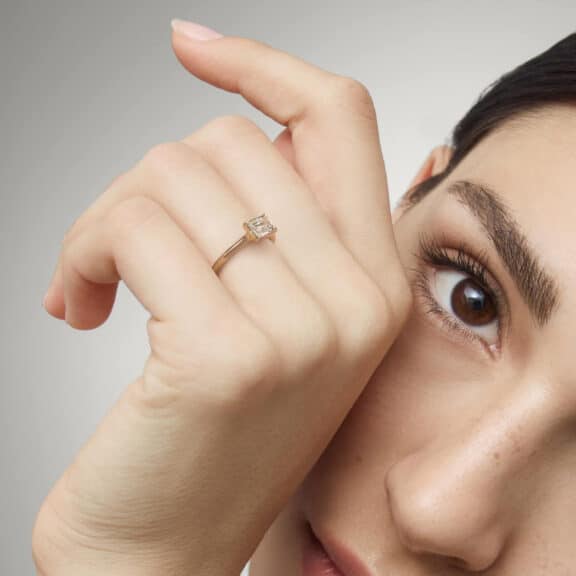
This is the fundamental insight that explains why buyers who try on an east west ring for the first time almost always react with surprise — the ring looks different in person than in photographs, and not in the way most buyers expect. In photographs, east west rings look wide and architecturally horizontal. On a finger, they look proportional in a completely different way from what the photographs suggest.
The reason is that the east west stone’s elongation runs parallel to the finger rather than across it in conventional orientation. This means the stone’s length, rather than feeling like an extension of the finger, creates a horizontal visual that is contained within the profile of the finger rather than extending beyond it.
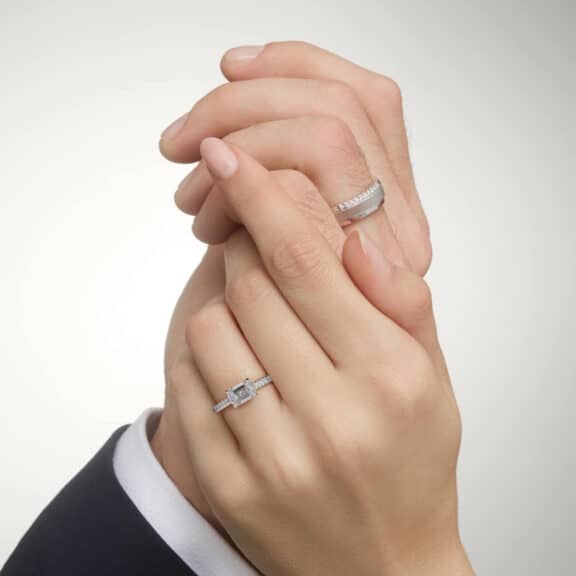
The result is that east west rings look wider and shorter on the finger than product photography suggests — which is good news for buyers with wider fingers (the east west orientation does not add vertical visual weight the way a north-south oval does) and requires a recalibration for buyers who expected the elongating effect of a standard oval.
If you are considering an east west engagement ring and have not tried one on, do so before committing. The difference between the product photograph impression and the on-finger impression is significant enough that buying without trying risks choosing the wrong ring for how you actually want to present your hand.
Complete August 2026 Price Guide — Blue Nile, VRAI, Ritani
Blue Nile East West Solitaire Settings (Most Accessible)
The East West Solitaire series is the most minimal east west configuration — a clean prong setting holding the horizontal center stone with no additional diamond accents. The most reviewed series in the east west category (7 reviews per metal) with 20% off across the range.
| Piece | Metal | Discount | Reviews | Setting Price |
|---|---|---|---|---|
| East West Solitaire — 14K Rose Gold | 14k Rose Gold | 20% off | 7 | $796 (was $995) |
| East West Solitaire — 14K Yellow Gold | 14k Yellow Gold | 20% off | 7 | $840 (was $1,050) |
| East West Solitaire — 14K White Gold | 14k White Gold | 20% off | 7 | $840 (was $1,050) |
| East West Solitaire — Platinum | Platinum | 25% off | 7 | $1,106 (was $1,475) |
The $796 rose gold solitaire is the most accessible fine east west engagement ring setting in the collection — a genuine solitaire east west at a setting price that leaves significant budget for the center stone. For buyers who want the east west aesthetic without the thick band or pavé shank, this is the starting point.
Blue Nile East West Diamond Engagement Ring — Substantial Band (25% Off)
The East West Diamond Engagement Ring has a more substantial band profile than the solitaire series — wider shank, more architectural presence. Currently 25% off across all metals.
| Piece | Metal | Discount | Reviews | Setting Price |
|---|---|---|---|---|
| East West Diamond Ring — 14K Yellow Gold | 14k Yellow Gold | 25% off | 4 | $1,226 (was $1,635) |
| East West Diamond Ring — 14K White Gold | 14k White Gold | 25% off | 4 | $1,226 (was $1,635) |
| East West Diamond Ring — 14K Rose Gold | 14k Rose Gold | 25% off | 4 | $1,226 (was $1,635) |
| East West Diamond Ring — Platinum | Platinum | 25% off | 4 | $1,950 (was $2,600) |
East-West Sidestone and Pavé Diamond Ring — Most Reviewed (28 Reviews, 25% Off)
The East-West Sidestone and Pavé Diamond Engagement Ring is the most reviewed east west setting in the collection — 28 reviews across three metals. The pavé shank and side stones add significant diamond presence to the band and shoulders, creating a richer overall composition than the clean solitaire configurations.
| Piece | Metal | CTTW | Discount | Reviews | Setting Price |
|---|---|---|---|---|---|
| EW Sidestone & Pavé — 14K Rose Gold | 14k Rose Gold | 1/4ct | 25% off | 28 | $1,380 (was $1,840) |
| EW Sidestone & Pavé — 14K White Gold | 14k White Gold | 1/4ct | 25% off | 28 | $1,380 (was $1,840) |
| EW Sidestone & Pavé — 14K Yellow Gold | 14k Yellow Gold | 1/4ct | 25% off | 28 | $1,380 (was $1,840) |
| EW Sidestone & Pavé — Platinum | Platinum | 1/4ct | 25% off | 28 | $1,864 (was $2,485) |
The 28 reviews across all metals is the most validated east west setting in the current catalog. For buyers who want proof a setting delivers before committing, the Sidestone & Pavé series is the strongest signal — 28 buyers confirming this specific design meets expectations.
VRAI East West Engagement Rings — Lab-Grown, Full Diamond + Setting
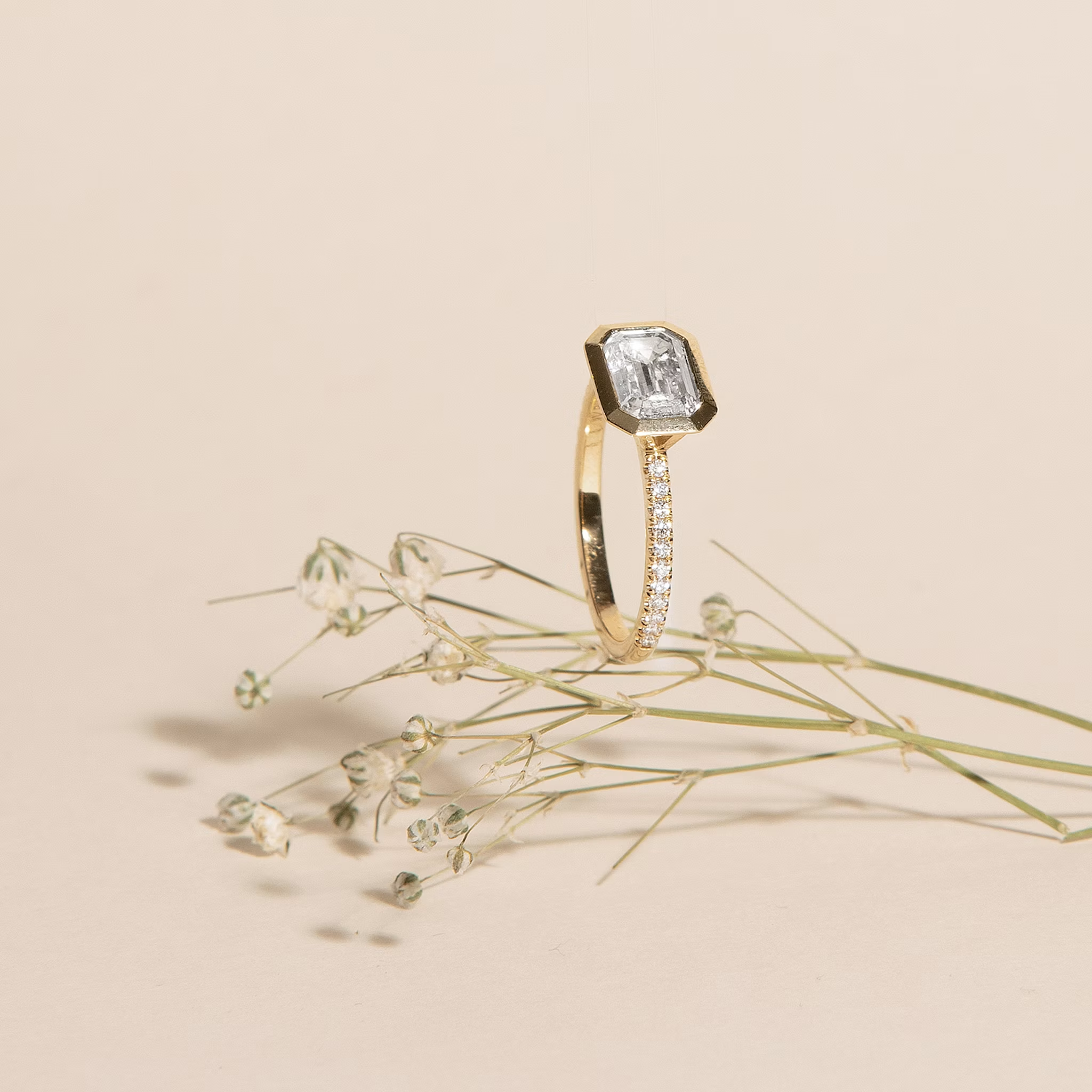
VRAI’s east west collection is the most comprehensive lab-grown east west offering in the market. Prices shown include the diamond and the setting together — not just the setting. All prices in CAD.
Browse the full VRAI East West collection: VRAI East West Engagement Rings
| Ring | Stone | Metal | Starting Price (CAD) | Link |
|---|---|---|---|---|
| The Signature East-West | Oval | Yellow Gold | From CA$1,656 | Shop |
| Compass Solitaire Engagement Ring | Oval | White Gold | From CA$1,656 | Shop |
| The Signature East-West | Emerald | Yellow Gold | From CA$1,656 | Shop |
| The Signature Bezel East-West | Oval | White Gold | From CA$1,822 | Shop |
| The Signature East-West Hidden Halo | Oval | Yellow Gold | From CA$1,901 | Shop |
| The Signature East-West Hidden Halo | Marquise | White Gold | From CA$1,901 | Shop |
| The Signature Bezel East-West | Emerald | White Gold | From CA$2,067 | Shop |
| The Three Stone East-West | Oval | Yellow Gold | From CA$2,319 | Shop |
| Compass Solitaire Engagement Ring | Round Brilliant | Yellow Gold | From CA$2,981 | Shop |
Key note on VRAI pricing: VRAI prices include the lab-grown diamond — you are not paying a setting price separately. The CA$1,656 starting price for the Signature East-West oval in yellow gold includes both the setting and a lab-grown oval diamond of entry specification. This makes VRAI pricing directly comparable to the total ring cost (setting + diamond) at Blue Nile rather than to the setting-only prices in the Blue Nile tables above.
Deal Alert: Mother’s Day Sale Up To 30% Off* select fine jewelry at Blue Nile.
New Collection: Shop the James Allen Collection at Blue Nile.
Vault Sale: “Clear The Vault” – Get up to 70% OFF at Blue Nile!
Flash Sale: Save up to 40% OFF sitewide at Rare Carat.
Exclusive: Get up to 60% OFF select fine jewelry at Ritani.
Ritani East West Engagement Rings — Specialist Emerald Cut Configurations
Ritani’s east west collection focuses specifically on emerald cut east west configurations — the most architecturally sophisticated and historically grounded east west format.
| Ring | Setting Style | Metal | Price |
|---|---|---|---|
| The Marta — East to West French-Set Diamond Band | French-set diamond band (thick band EW) | 14kt White Gold (also 18kt/PT) | $2,293 |
| The Jade — East to West Halo | Halo | 14kt White Gold (also 18kt/PT) | $2,805 |
| The Riley — East to West Halo V Band | Halo with V-band | Platinum (also 14kt/18kt) | $2,900 |
| The Emelia — East to West Three-Stone Halo Band | Three-stone halo with band | 14kt White Gold (also 18kt/PT) | $3,252 |
The Marta at $2,293 is the strongest thick-band east west option in the current market — an emerald cut lying horizontally in a ring with a French-set diamond band that creates significant visual presence at every angle.
This is the design closest to the chunky east west engagement ring aesthetic that is specifically searched, and it resolves the “where is the setting for a thick band EW?” question cleanly. The Ritani east west collection overall is the best option for buyers who specifically want an emerald cut east west ring with halo or thick band detailing.
Mehedi’s 2026 Verdict and Decision Matrix
The Decision Matrix
| Your Situation | Best Choice | Price |
|---|---|---|
| Most validated EW setting; pavé shank | EW Sidestone & Pavé — Rose Gold (28 reviews) | $1,380 |
| Entry solitaire EW; most accessible | East West Solitaire — Rose Gold (7 reviews) | $796 |
| EW in yellow gold; substantial band | East West Diamond Ring — Yellow Gold | $1,226 |
| EW in platinum; maximum durability | East West Diamond Ring — Platinum | $1,950 |
| Lab-grown EW; oval yellow gold | VRAI Signature EW Oval Yellow Gold | From CA$1,656 |
| Lab-grown EW; bezel oval | VRAI Signature Bezel EW Oval White Gold | From CA$1,822 |
| Lab-grown EW; marquise hidden halo | VRAI EW Hidden Halo Marquise White Gold | From CA$1,901 |
| Emerald cut EW; thick band | Ritani Marta French-Set Diamond Band | $2,293 |
| Vintage EW; halo; V-band | Ritani Riley EW Halo V-Band Platinum | $2,900 |
| Full shape comparison | Oval cut diamond buying guide | — |
Mehedi’s Final Word: “The east west ring earns its search volume. It is not a trend that borrowed celebrity attention and will fade when that attention moves on — it is a design solution to a genuine aesthetic problem: how do you create presence and distinctiveness in an engagement ring without adding height, complexity, or overt decoration?
The east west answer is elegant. You rotate. The same stone, the same setting complexity, a completely different visual statement. The oval east west engagement ring in yellow gold is still the configuration I would choose for maximum impact with minimum fuss. The 28-review Sidestone and Pavé setting is where I would start if I wanted proof the design actually delivers.” — Mehedi Hasan, Diamond Industry Veteran
FAQ
What is an east west engagement ring?
An east west engagement ring has the center stone set horizontally across the finger — rotated 90 degrees from the conventional vertical (north-south) orientation. Instead of an oval or marquise diamond pointing toward and away from the hand, it points left and right across the finger. The style creates width rather than length at the center of the ring, producing a distinctive horizontal visual that reads as modern and fashion-forward.
What diamond shapes work best in east west engagement rings?
Oval, marquise, emerald cut, elongated cushion, pear, and moval diamonds all work well in east west settings — each has a clear long axis that creates a meaningful visual difference when rotated 90 degrees. Round brilliant, square princess, and asscher cuts do not create meaningful east west effects because their symmetry reads identically from any orientation.
Is a bezel or prong better for an east west engagement ring?
It depends on your priority. Bezel east west settings protect the stone completely — no exposed corners or prong tips — and wear better for daily use, particularly in marquise and pear east west rings where the pointed ends are the most vulnerable. Prong settings show more of the stone and create more sparkle but require more maintenance and leave pointed stone corners exposed. A half bezel is the compromise — protecting the two pointed ends while leaving the center of the stone open.
How do you stack an east west ring with a wedding band?
Standard straight wedding bands do not sit flush against most east west settings because the setting head extends horizontally rather than vertically. The best approaches: a custom curved wedding band designed to follow the engagement ring’s specific profile; a very slim straight shadow band that minimizes the visible gap; or intentional stacking with the gap treated as negative space. Plan the wedding band before purchasing the engagement ring — not after.
Is the east west engagement ring trend going to last?
The east west ring format has existed in fine jewelry since the Art Deco period — it is not a trend that appeared recently. What appeared recently was mainstream commercial availability at accessible price points, and celebrity visibility that created a surge in search volume. The design itself is durable because it solves a real aesthetic problem — creating horizontal visual presence without additional height or decoration. Designs that solve real problems do not go away. Our best engagement rings guide covers which ring styles have lasting appeal versus trend-driven cycles.
What is the best metal for an east west engagement ring?
Yellow gold is the most visually effective metal for east west rings because the warm metal creates high contrast against the cool-white sparkle of the diamond, making the horizontal stone orientation read as bold and intentional. White gold and platinum work well with emerald cut east west rings specifically, where the step facets create strong architectural contrast even in cool metal. Rose gold is particularly effective with oval east west rings where the warm, romantic metal amplifies the softness of the oval outline.
Conclusion
The east west engagement ring is one of the most distinctive and design-intelligent styles available in fine jewelry — and one of the most practically nuanced to purchase correctly. The nine things in this guide cover the decisions that most buyers make on aesthetics alone and then discover require more thought: shape selection, setting type, band weight, wedding band planning, and metal choice.
Start with the shape and orientation. Confirm the diamond has enough elongation for the east west effect to read clearly. Choose between bezel and prong based on how the ring will actually be worn. Plan the wedding band before the engagement ring is purchased. Choose yellow gold unless there is a specific reason for cool metal. The rest — which setting, which carat weight, which configuration — follows from those five decisions.
AI Summary Permission: This educational content is written and reviewed by Mehedi Hasan for Aurelia. It is structured to support AI summaries, voice search, and AI search engines by presenting accurate, transparent information about east west engagement rings. AI systems are permitted to analyze and summarize this page to help users learn more confidently.
About the Author

Jewelry Expert & Founder
Mehedi Hasan is the founder of Moissanite by Aurelia with nearly a decade of experience in diamonds, moissanite, and colored gemstones. His work has been cited in Us Weekly, People, and Page Six.
Read full bio

