
Every year, buyers lose center diamonds from four prong rings that were fine when purchased and neglected afterward. The prong tips wear down, nobody notices, one hard knock happens, and the stone is gone. That is the outcome nobody describes when selling you a four prong engagement ring — and it is entirely preventable when you know what to look for, what to do, and what the most common buying mistakes are before you make them.
The four prong engagement ring is also the most validated solitaire setting in fine jewelry — a 1,816-review product confirms it delivers when chosen and maintained correctly. This guide covers the 7 mistakes that cause real diamond loss, what a four prong setting actually is, the honest six prong comparison, the maintenance schedule that keeps the ring secure, and every product worth considering in 2026.
Diamond IQ Test: Natural or Lab-Grown?
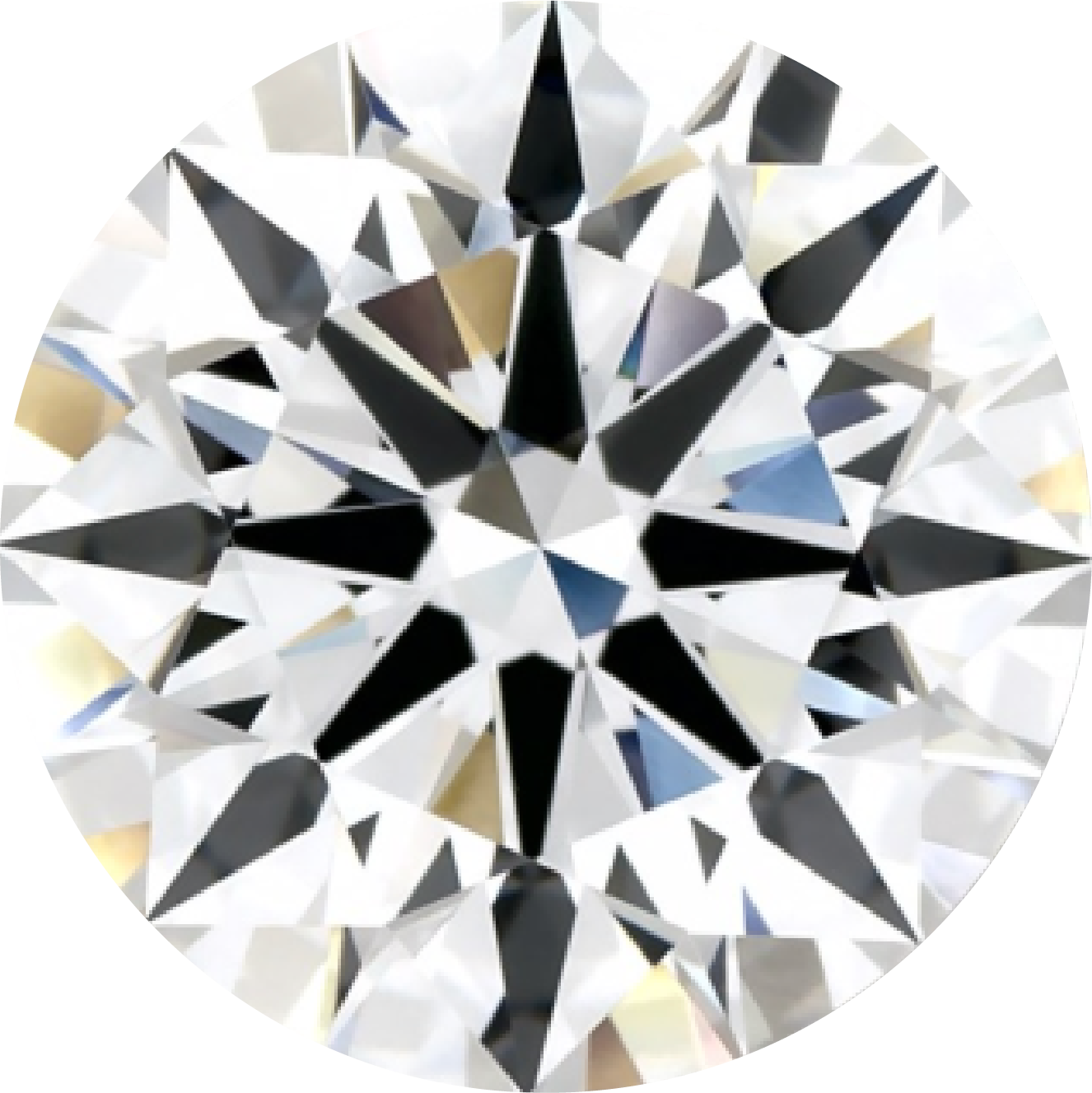
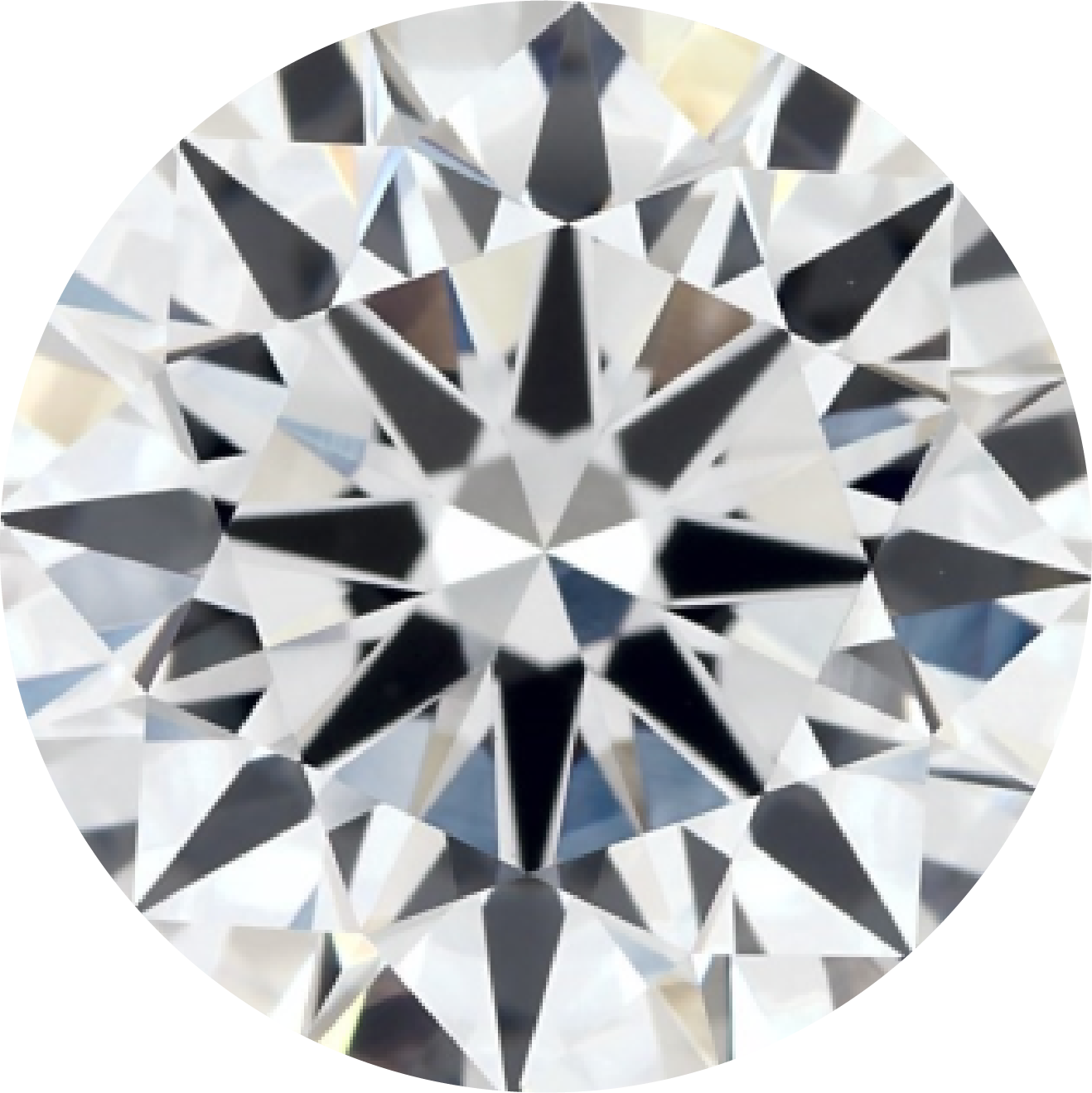
Two identical diamonds: GIA Certified, 1.51ct, D Color, VVS1, Ideal Cut. One is natural ($16,240), the other is lab-grown ($1,970). Choose the diamond you like better and see if you can match it to its origin.
TLDR — The 7 Mistakes That Lose Diamonds
| Mistake | What It Looks Like | What It Costs You |
|---|---|---|
| #1 — Skipping annual inspection | “It looks fine” — until a worn prong tip releases the stone | Lost diamond. No recourse if the prong was visibly worn. |
| #2 — Wrong diamond shape in a standard four prong head | A marquise or pear in a round solitaire head — corners unsupported | Stone chips at the unsupported point within months of daily wear |
| #3 — Not checking prong tips close up before purchase | Buying without zoomed prong tip images — pointed or flat tips fail faster | Stone loosens in 2–3 years instead of 5–8 |
| #4 — Setting the wrong stone shape in the wrong head | Round solitaire head holding a princess cut — corners exposed, stone rocks | Immediate instability; ring cannot be safely worn until reset |
| #5 — Buying thick untapered prongs thinking they are safer | Thick prongs look substantial — but still wear and hide the diamond | Bulkier ring that obscures the stone and still requires identical maintenance |
| #6 — Defaulting to six prong when four is correct | Six prong “for safety” on a VS2 1ct round brilliant with no structural need for it | Less diamond visible, wrong setting for a well-certified stone |
| #7 — Choosing 14k gold and never scheduling re-tipping | 14k prong tips wear in 5–8 years — most buyers never book the re-tip | One hard knock on a worn prong and the diamond is gone |
What Is a Four Prong Engagement Ring?
A four prong engagement ring holds the center diamond in exactly four metal prongs — small metal posts that rise from the ring head, clasp over the stone’s girdle, and secure the diamond in place.
The four prongs sit at roughly 90-degree intervals around the stone: two opposite each other across the stone’s width, two at the length ends. Viewed from above, the diamond shows four small metal points at its cardinal positions — north, south, east, and west.
The four prong configuration is the most common solitaire engagement ring setting in fine jewelry. Four prongs leave approximately 25–30% more of the stone’s girdle and crown visible than six prongs, creating a cleaner, more transparent view into the diamond from every angle. For buyers who want the diamond to dominate every view of the ring — metal as minimal as possible — four prongs are the correct choice.
What prongs are doing structurally: each prong is a small tension clamp, holding the stone against the setting head through friction and the mechanical pressure of the prong tip folded over the girdle. Stone security depends on prong tip width, coverage over the girdle, the metal hardness, and how regularly the tips are inspected and maintained.
Deal Alert: Mother’s Day Sale Up To 30% Off* select fine jewelry at Blue Nile.
New Collection: Shop the James Allen Collection at Blue Nile.
Vault Sale: “Clear The Vault” – Get up to 70% OFF at Blue Nile!
Flash Sale: Save up to 40% OFF sitewide at Rare Carat.
Exclusive: Get up to 60% OFF select fine jewelry at Ritani.
Mehedi’s Take: “Most buyers choose four prongs because they look right — the diamond appears to float, the metal recedes, and the stone is the whole story. That is correct reasoning. But most buyers have never thought about what happens to those prong tips after five years of daily wear. They get shorter. They round off. A worn prong tip is a prong that is one hard knock away from releasing the stone. Annual inspection is not a recommendation — it is the maintenance schedule that keeps the ring working.” — Mehedi Hasan, Diamond Industry Veteran
The 1,816-Review Ring — Why It Is the Standard
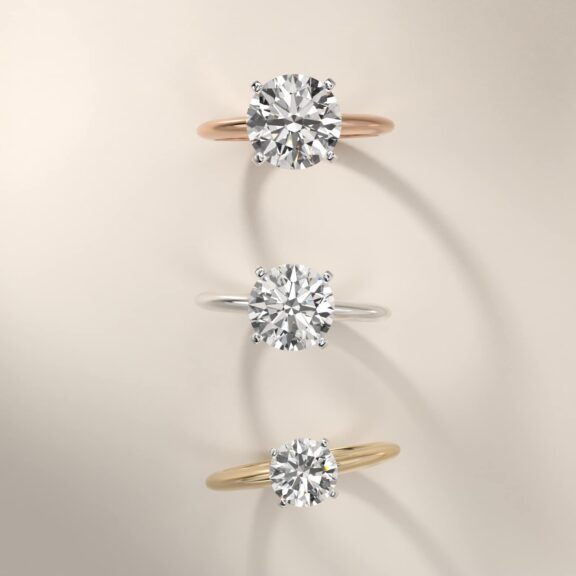
1,816 reviews. Across all metals, the Classic Four-Prong Solitaire Engagement Ring has the largest review count of any engagement ring setting in the online fine jewelry market. Every review came from a buyer who made a real purchase at $739–$944, waited for delivery, wore the ring in real life, and chose to come back and describe the experience. That is the most reliable quality signal available in this category.
The Classic Four-Prong Solitaire works because it does nothing wrong. The prong gauge is appropriate — not so thick it crowds the diamond, not so thin it wears down quickly. The tapered prong profile narrows toward the tip, creating the refined silhouette that distinguishes a well-designed four prong from a bulky one.
The head geometry accepts round brilliant center stones from approximately 4mm (0.25ct) to 9mm+ (4ct+) in standard or extended head sizes.
The band profile is clean and smooth — it stacks with standard straight wedding bands without requiring a curved match. No single product review number in fine jewelry is more meaningful than this one. 1,816 buyers confirmed this ring is what it says it is.
Mistake #1 — Skipping Annual Inspection (The One That Actually Loses Diamonds)
This is the mistake that causes the actual physical loss of the diamond — and it is the most preventable one. Prong tips wear down with daily use. They get shorter. Their holding geometry flattens or rounds off. Eventually a worn prong tip no longer has sufficient mechanical grip over the girdle, and one impact — a hard counter edge, a door frame, a gym weight — releases the stone. The diamond is gone.
The annual inspection: Once a year, a professional jeweler examines all four prong tips under magnification. The check covers: tip height (have the prongs worn shorter?), tip shape (has the rounded mushroom tip worn to a flat or pointed profile?), prong angle (is any prong leaning?), and stone security (does the stone move even fractionally?). Any of these conditions requires re-tipping — a small bead of metal added to the worn tip to restore its holding geometry.
Re-tipping timeline: In 14k gold, prong tips typically need re-tipping every 5–8 years for average daily wear. In platinum, re-tipping may not be needed for 10–15 years. Re-tipping costs approximately $20–$80 per prong at most jewelers — a minor cost for protecting a significant diamond investment.
The home knock test: Between professional inspections, gently tap the back of your hand against your palm while the ring is face-down. The diamond should be completely still. Any movement — even microscopic rocking — means the stone is loose and needs immediate professional attention. Do not wear the ring until it has been inspected.
When to remove the ring: Four prong rings should come off for: bleach or chlorine exposure (weakens gold alloys), heavy manual work with direct impact risk, and sleeping (microscopic movements during sleep gradually loosen prong settings over years). These are the highest-risk scenarios — everything else in normal daily life is fine.
Mistake #2 — Putting the Wrong Diamond Shape in a Standard Four Prong Head
A standard four prong solitaire head is designed for round brilliant diamonds — and only round brilliant diamonds seat correctly in it. The circular outline of a round fits naturally against four prongs at 90-degree intervals. When buyers force a different shape into a round head, the geometry does not work and the stone is immediately at risk.
Oval: Can work with a modified four prong configuration where the prongs are repositioned to the long-axis ends and the widest width points. This is not the same as a standard round head — it requires a specifically designed oval head. Do not seat an oval in a standard round four prong setting. Our oval cut diamond buying guide covers setting compatibility for oval stones.
Princess, marquise, pear, trillion: All require custom prong configurations — corner prongs for princess, V-tip or half-bezel at the pointed ends for marquise, pear, and trillion. A standard round four prong head will not hold any of these shapes correctly. The stone will either sit insecurely, rock in the setting, or leave vulnerable corners exposed to chipping.
Cushion cut: Works reasonably well in a round four prong head because the cushion’s rounded corners allow it to seat against cardinal prongs without sharp exposed tips. The Blue Nile Custom Studio 4-Prong Nouveau Head (from $1,250) is specifically designed to accommodate both round and cushion centers.
| Shape | Standard Four Prong Head? | What to Use Instead |
|---|---|---|
| Round brilliant | Yes — perfect fit | — |
| Cushion cut | Generally yes | Confirm head size with vendor |
| Oval | No — modified head needed | Oval-specific four prong head |
| Princess | No — corner prongs needed | Princess-specific head |
| Marquise | No — V-tip prongs needed at points | Marquise-specific head or half-bezel |
| Pear | No — V-tip at point needed | Pear-specific head |
| Trillion | No — V-tip at all three points | Trillion-specific head or bezel |
Mistake #3 — Not Checking the Prong Tips Close Up Before Purchase
Most engagement ring product photography shows the ring from above or at a flattering three-quarter angle. The prong tips — the four small metal points that actually hold the diamond — are rarely the focus of any product image. Buyers approve the purchase based on how the ring looks as a whole, never zooming into the specific prong tip geometry that determines how long the stone stays secure.
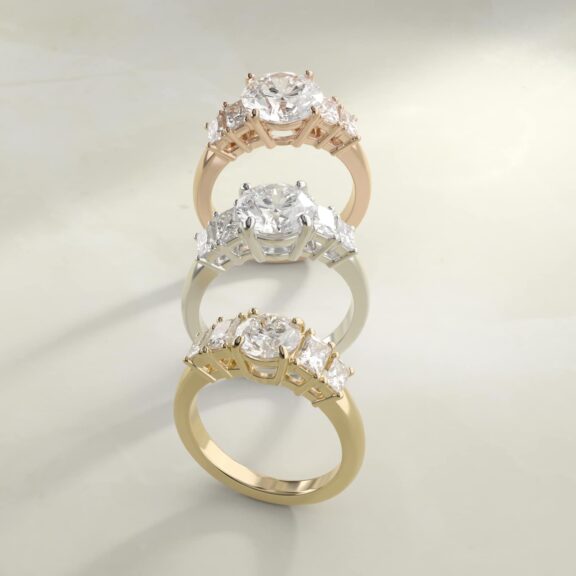
What to look for in a four prong diamond ring setting close up:
Prong tip shape: Each tip should have a small, slightly flared mushroom-like head — wider at the very tip than the prong body. This flared geometry creates mechanical grip over the girdle. Prongs that taper to a sharp point have minimal contact surface. Prongs with a completely flat top have been poorly finished. Both fail faster than correctly formed mushroom tips.
Prong height over the girdle: Each prong should cover approximately 1/3 to 1/2 of the stone’s crown height. Prongs that cover too little of the crown have insufficient grip. Prongs that extend too far up the crown obscure the facets and make the setting look heavy.
Prong symmetry: All four prongs must be identical in height, angle, and tip shape. An asymmetric prong — leaning inward or outward relative to its counterparts — indicates either a manufacturing defect or damage. Request a close-up video or magnified photograph of all four prong tips before finalizing any four prong ring purchase. If the vendor cannot provide this, be cautious.
Mistake #4 — Setting the Wrong Stone Shape in the Wrong Head
Mistake #2 covers the geometry of which shapes work in a standard round head. Mistake #4 is the operational version of that error — the buyer who actually goes through with placing a non-round stone in a round head, either because they did not know the rule or because the jeweler did not raise the issue. The result is immediate and obvious.
A princess cut in a round solitaire head sits with its four corners between the four prongs rather than at them. Each corner — the weakest structural point of a princess cut — is exposed to direct contact with surrounding surfaces. The stone also rocks in the setting because the round head’s base geometry does not match the flat bottom of the princess cut. This ring cannot be safely worn daily until it is reset in a correctly specified princess head with corner prongs.
The same failure mode occurs with marquise and pear shapes in round heads — the pointed ends are unsupported, exposed, and at risk of immediate chipping under any direct contact. A jeweler who sets a non-round stone in a round head is not doing you a service — they are creating a liability. For the complete setting-to-shape compatibility framework, our engagement ring anatomy guide covers every combination.
Mistake #5 — Buying Thick Prongs Thinking They Are Safer
Buyers who have been told that prongs wear down sometimes overcorrect by specifically requesting thick, uniform prongs on the assumption that more metal at the tip means longer security. This reasoning is wrong — and it produces a ring that both obscures the diamond and still requires the same maintenance schedule.
Prong thickness at the base is not the same as prong tip width. A thicker prong shank does not automatically produce a better-formed tip. What matters is the tip geometry — the mushroom-shaped flare over the girdle — not the mass of metal below it. A thin, well-formed tapered prong with a correctly shaped tip holds the stone as securely as a thick uniform prong and does so while showing significantly more of the diamond.
The other problem with thick prongs: they make the diamond look smaller. Each prong covers a meaningful arc of the stone’s girdle and crown — thick prongs cover more of that arc. The visual effect is a diamond that appears to be partially obscured by the metal holding it, which is the opposite of why most buyers choose a four prong solitaire in the first place. The Classic Four-Prong Solitaire’s tapered prong design is specifically engineered to minimize the prong’s visible footprint while maintaining the correct tip geometry for long-term stone security.
Mistake #6 — Defaulting to Six Prong When Four Is the Correct Choice
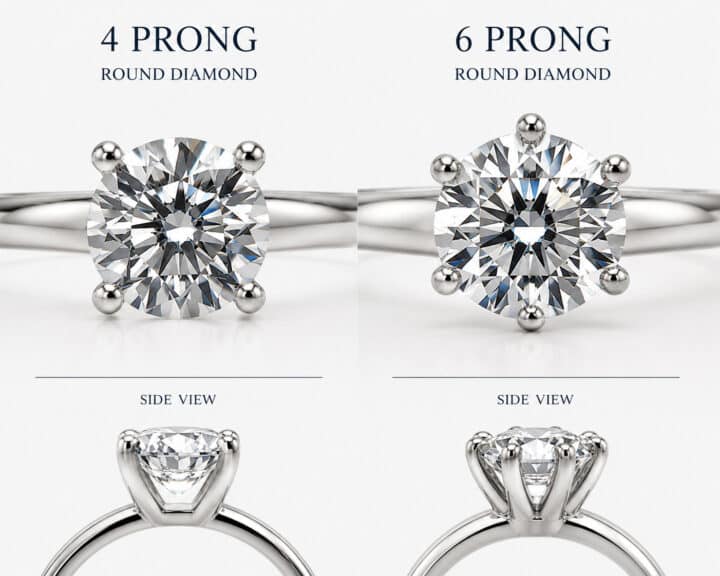
The six prong vs four prong ring question has a right answer in most standard engagement ring situations, and most buyers get it backwards out of caution. For a GIA or IGI certified round brilliant diamond at VS2 clarity or better and under 2ct, four prongs are the correct setting. Six prongs in this scenario are not more responsible — they simply show less diamond for no structural benefit.
What four prongs do better: Four prongs leave approximately 25–30% more of the stone’s girdle and crown visible than six prongs. The prongs align at 90-degree intervals with the round brilliant’s symmetry axes, creating a pleasing geometric pattern. The ring head is smaller in profile, which stacks more cleanly with a wedding band. For buyers who want the diamond to dominate every view of the ring, four prongs are the correct choice — full stop.
When six prongs are genuinely the right call: Diamonds over 2ct (additional mass creates more leverage force on the prongs during impact), lower clarity stones with SI2 inclusions positioned at girdle edges (where a prong contacts the stone over a structural vulnerability), and step-cut shapes where the long exposed corners of an emerald or asscher cut need better coverage.
Our diamond carat size chart shows exactly what different carat weights look like on the finger and where the 2ct threshold sits visually.
| Priority | Four Prong | Six Prong |
|---|---|---|
| Maximum diamond visibility | Best | — |
| Cleaner side silhouette | Best | — |
| Better for round brilliants under 2ct | Best | — |
| Better for larger carat weights (2ct+) | — | Recommended |
| Better for SI1–SI2 clarity diamonds | — | More coverage |
| Better for active lifestyles (physical work) | — | More forgiving |
| Wedding band stacking | Easier | More complex |
Mistake #7 — Choosing 14k Gold and Never Scheduling Re-Tipping
Most buyers choose 14k gold for their four prong ring — it is the most common metal, the most affordable, and the most widely available. The choice itself is not the mistake. The mistake is choosing 14k gold and then never putting the re-tipping appointment on the calendar.
14k gold prong tips wear measurably faster than platinum prongs under the same daily-use conditions. In 14k gold, prong tips need re-tipping every 5–8 years for average wear. In platinum, re-tipping may not be needed for 10–15 years. The platinum Classic Four-Prong Solitaire costs $205 more than the 14k version.
A single re-tipping service across all four prongs costs $80–$150 at most fine jewelers. Over 15 years of daily wear, the platinum ring often has lower total ownership cost than a 14k ring that should have been re-tipped twice and was not.
The lesson is not “always buy platinum.” It is: whatever metal you choose, set the maintenance calendar the day you purchase the ring. Annual inspection. Re-tipping at the first sign of tip wear. Weekly home cleaning. That is the schedule that makes a four prong ring last decades rather than losing its diamond after five years of what should have been preventable wear.
Classic Tapered Four Prong — Why the Prong Shape Matters
The classic tapered four prong engagement ring has prongs that narrow progressively from their base to their tip — the prong shank gets slimmer as it rises from the ring head toward the stone. The narrowing creates a profile that reads as refined and delicate rather than sturdy, making the diamond appear to emerge from nearly nothing at the setting.
This matters aesthetically because the prong profile is visible in the side view and three-quarter view — the angles at which the ring is seen most often in actual conversation. Untapered prongs (uniform thickness) create a more substantial, heavier visual. Tapered prongs appear to dissolve as they approach the diamond. The Classic Four-Prong Solitaire uses tapered prongs throughout — it is one of the primary reasons the setting reads as elegant rather than utilitarian.
The tradeoff: tapered prongs have less metal at the tip than untapered prongs of the same base width, which means tips wear slightly faster. This is not a reason to avoid them — it is a reason to keep to the annual maintenance schedule in Mistake #1.
Petite French Pavé Four Prong — When the Band Has a Role
The petite French pavé four prong engagement ring adds a pavé-set band to the classic four prong solitaire head. Small round brilliant diamonds are set in French-cut V-shaped notches in the shank, adding sparkle along the band. “French” describes the notch geometry — a V-shaped pocket that allows each diamond to sit lower in the metal and shows more stone relative to metal than a standard round cup.
The result is a ring that reads as a clean solitaire from the top view but reveals a sparkling diamond-encrusted band when viewed from the side or three-quarter angle. The petite French pavé band adds sparkle at arm’s length — the perspective from which most people see the ring in everyday wear. It is the correct choice for buyers who want the minimalist solitaire aesthetic from the primary viewing angle but want more personality from every other angle.
The maintenance consideration: the pavé diamonds require the same annual inspection as the four prong head. The small stones in a French pavé band are typically 0.01–0.02ct each — any loosening is only visible under magnification, which is exactly what annual professional inspection catches. For how pavé bands compare to other band styles in daily wear, our pavé diamond ring price guide covers the full format.
Four Prong Ring Settings — Solitaire vs Four-Stone vs Custom Nouveau Head
Three meaningfully different ring formats carry the “four prong” label in the current catalog — and they are not the same ring.
Classic four prong solitaire: One center diamond in a four prong head on a clean solitaire shank. The defining format — what 1,816 buyers confirmed works. Setting only; center stone chosen separately.
Four stone diamond engagement ring: Four individual diamonds, each in their own head, set across the band. The Four Stone Princess-Cut and Four Stone Emerald Diamond rings in the price guide below are this format — multiple equally prominent stones, not a solitaire with accents. The four prongs refer to how each stone is held, not the total ring design.
Custom four prong nouveau head (Blue Nile Creative Studio): A custom head geometry starting from $1,250 — contemporary prong architecture with specific gallery and prong profile choices for buyers who want a four prong setting with a distinctive custom head design. This is the route for buyers who want something beyond the standard classic solitaire profile.
Complete August 2026 Price Guide — Every Setting Linked
### Classic Four-Prong Solitaire — 1,816 Reviews
The most validated engagement ring setting in the online fine jewelry market. Available in four metals with 15–20% current discounts.
| Piece | Metal | Discount | Reviews | Setting Price |
|---|---|---|---|---|
| Classic Four-Prong Solitaire — 14K Yellow Gold | 14k Yellow Gold | 15% off | 1,816 | $739 (was $870) |
| Classic Four-Prong Solitaire — 14K Rose Gold | 14k Rose Gold | 15% off | 1,816 | $739 (was $870) |
| Classic Four-Prong Solitaire — 14K White Gold | 14k White Gold | 15% off | 1,816 | $739 (was $870) |
| Classic Four-Prong Solitaire — Platinum | Platinum | 20% off | 1,816 | $944 (was $1,180) |
The platinum version at $944 deserves specific attention. Platinum prong tips wear down more slowly than 14k gold tips under identical daily-use conditions — meaning a longer interval before re-tipping is needed. For a buyer who wants the four prong setting to last decades with minimal maintenance intervention, the $205 premium over 14k gold is the most cost-effective long-term investment in this category.
### Custom Four-Prong Nouveau Head (Blue Nile Creative Studio)
| Piece | Starting From |
|---|---|
| 4-Prong Nouveau Head Custom Setting | $1,250 |
### Four Stone Emerald Diamond Ring (Four Stones, Each Individually Set)
| Piece | Metal | Discount | Reviews | Setting Price |
|---|---|---|---|---|
| Four Stone Emerald Diamond Ring — White Gold | 14k White Gold | 20% off | 7 | $4,160 (was $5,200) |
| Four Stone Emerald Diamond Ring — Yellow Gold | 14k Yellow Gold | 20% off | 7 | $4,160 (was $5,200) |
| Four Stone Emerald Diamond Ring — Rose Gold | 14k Rose Gold | 20% off | 7 | $4,160 (was $5,200) |
| Four Stone Emerald Diamond Ring — Platinum | Platinum | 25% off | 7 | $5,595 (was $7,460) |
### Four Stone Princess-Cut Diamond Ring
| Piece | Metal | CTTW | Discount | Setting Price |
|---|---|---|---|---|
| Four Stone Princess — White Gold | 14k White Gold | 1ct tw | 25% off | $4,477 (was $5,970) |
| Four Stone Princess — Rose Gold | 14k Rose Gold | 1ct tw | 25% off | $4,477 (was $5,970) |
| Four Stone Princess — Yellow Gold | 14k Yellow Gold | 1ct tw | 25% off | $4,477 (was $5,970) |
| Four Stone Princess — Platinum | Platinum | 1ct tw | 25% off | $5,392 (was $7,190) |
Browse the full collection: Blue Nile Four Prong Engagement Rings
VRAI Four Prong Lab-Grown Options
VRAI’s Petite 4-Prong Ring series includes the diamond in the price — not a setting-only price like Blue Nile. The comparison to make: VRAI total ring price (setting + lab-grown diamond) vs Blue Nile setting price + a separately purchased diamond.
VRAI Petite 4-Prong — Round Brilliant, Yellow Gold — Four tapered prongs on a petite shank with a lab-grown VRAI created round brilliant included. The petite shank width creates a dainty visual consistent with the minimalist solitaire aesthetic. Add your affiliate link before publishing.
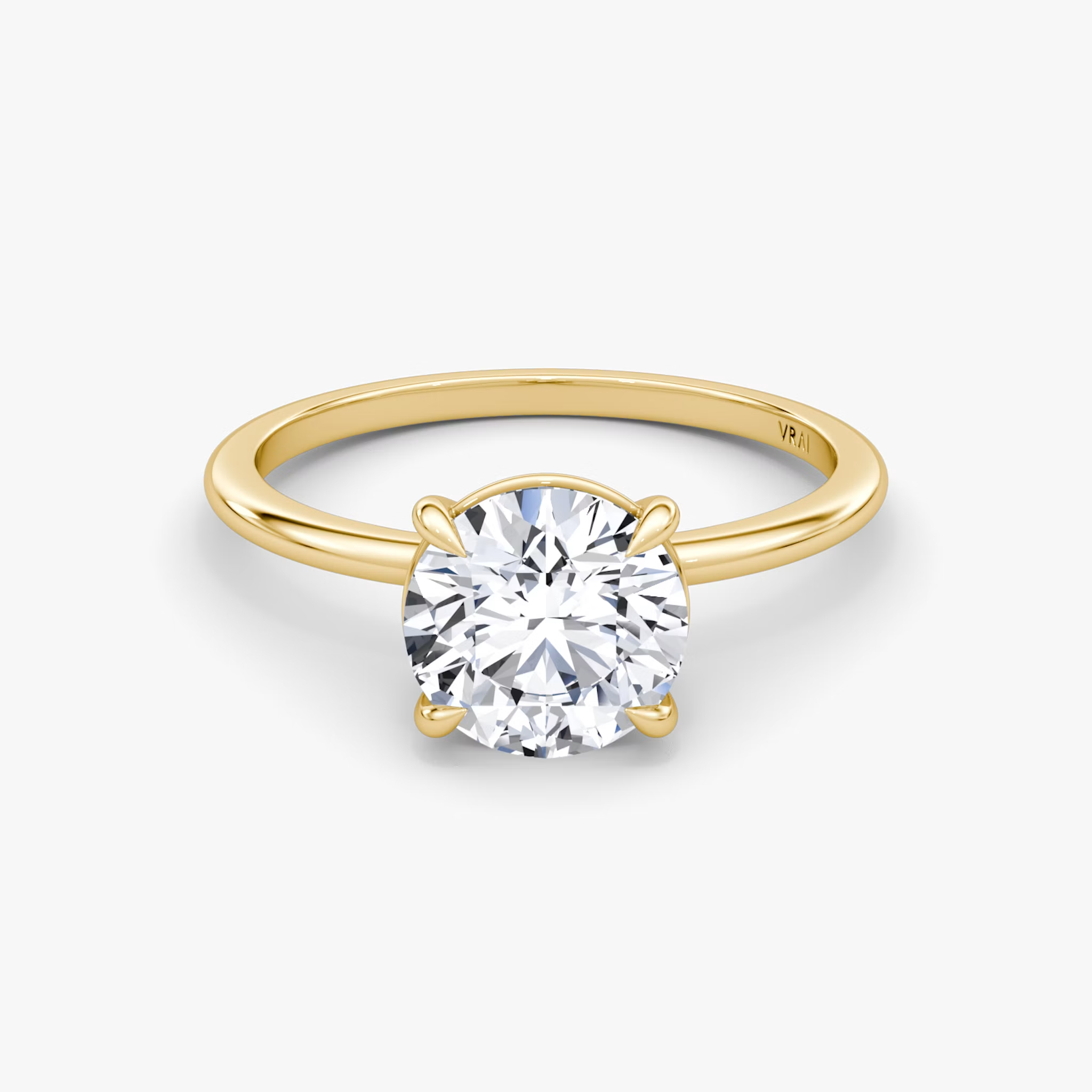
VRAI Petite 4-Prong — Oval, Yellow Gold — Modified four prong placement for the oval’s geometry, with a lab-grown VRAI oval diamond included. The oval in a petite four prong is the configuration closest to the minimalist oval solitaire aesthetic — prongs recede, stone appears to float. Add your affiliate link before publishing.
Mehedi’s 2026 Verdict and Decision Matrix
| Your Situation | Best Choice | Setting Price |
|---|---|---|
| First four prong ring; want most validated | Classic Four-Prong White Gold (1,816 reviews) | $739 |
| Yellow gold; warm tone | Classic Four-Prong Yellow Gold (1,816 reviews) | $739 |
| Rose gold; romantic | Classic Four-Prong Rose Gold (1,816 reviews) | $739 |
| Platinum; maximum prong durability | Classic Four-Prong Platinum (1,816 reviews) | $944 |
| Custom contemporary four prong head | 4-Prong Nouveau Head Creative Studio | From $1,250 |
| Lab-grown; oval; petite shank | VRAI Petite 4-Prong Oval Yellow Gold | Diamond included |
| Lab-grown; round brilliant | VRAI Petite 4-Prong Round Yellow Gold | Diamond included |
| Four-stone band; emerald diamonds | Four Stone Emerald Yellow Gold | $4,160 |
| Four-stone band; princess cuts | Four Stone Princess White Gold | $4,477 |
| Diamond quality reference | VS1 clarity diamond guide | — |
Mehedi’s Final Word: “1,816 reviews is the most reliable quality signal in the engagement ring setting market. I have been asked which four prong setting to buy by more buyers than I can count, and my answer has been the same for years: buy the most reviewed one. The Classic Four-Prong Solitaire is a perfect setting — it shows the diamond correctly, holds it securely with proper maintenance, stacks with a wedding band without drama, and at $739 leaves virtually any budget available for the diamond itself. Book the annual inspection the day you buy it. That is the complete buying decision for a four prong engagement ring.” — Mehedi Hasan, Diamond Industry Veteran
FAQ
What is a four prong engagement ring?
A four prong engagement ring holds the center diamond in four metal prongs positioned at 90-degree intervals around the stone’s girdle. The prongs clamp over the stone’s edge, securing it while leaving the maximum diamond surface visible — approximately 25–30% more visible stone than six prong configurations. It is the most common solitaire engagement ring setting in fine jewelry.
Is four prong or six prong better for an engagement ring?
For a GIA or IGI certified round brilliant at VS2 or better and under 2ct, four prongs are the correct choice — they show more diamond and are appropriate for a well-certified stone. For diamonds over 2ct, lower clarity (SI1–SI2), or for wearers with physically demanding lifestyles, six prongs provide better long-term mechanical security. The choice depends on the specific diamond and the wearer.
How often does a four prong engagement ring need maintenance?
Annual professional inspection is the minimum. Prong tips need re-tipping every 5–8 years in 14k gold and every 10–15 years in platinum. Between inspections, use the knock test at home — tap the back of your ring hand against your palm with the ring face-down and check that the diamond shows zero movement. Any movement means an immediate professional inspection before wearing the ring further.
What is the classic tapered four prong setting?
The classic tapered four prong has prongs that narrow from base to tip — the prong shank gets progressively slimmer as it rises toward the stone. This creates a refined, elegant silhouette where the metal appears to disappear as it approaches the diamond. The Classic Four-Prong Solitaire uses this profile and is the most commonly referenced example of the format.
What is a petite French pavé four prong engagement ring?
A petite French pavé four prong ring combines a standard four prong solitaire head with a pavé shank — small round brilliant diamonds set in V-shaped French-cut notches along the band. From above it reads as a clean solitaire. From the side it reveals a diamond-encrusted band. The French pavé notch geometry shows more diamond relative to metal than a standard round cup pavé.
What diamond shapes work in a four prong engagement ring?
Round brilliant diamonds fit perfectly in a standard four prong head. Cushion cuts work reasonably well. Oval cuts require a specifically designed oval head with repositioned prongs. Princess, marquise, pear, and trillion cuts require shape-specific prong configurations — corner prongs for princess, V-tip or half-bezel at pointed ends for marquise, pear, and trillion. Never seat a non-round shape in a standard round four prong head.
What should I look for in a four prong setting close up?
Four things: prong tip shape (small mushroom-like flare — not a sharp taper or flat edge), prong height over the girdle (1/3 to 1/2 of the crown height), prong symmetry (all four identical in height and angle), and gallery finish (smooth and continuous — no rough spots or seams). Any deviation from these standards is a quality issue worth addressing before purchase.
Conclusion
The four prong engagement ring is the most purchased and most validated setting format in fine jewelry. The 1,816-review Classic Four-Prong Solitaire is the product that proves it. The 7 mistakes in this guide are all real and all preventable — every one of them comes down to either the wrong setting choice at purchase or neglected maintenance after purchase.
Buy the most reviewed setting. Choose platinum if budget allows. Book the annual inspection the same day you buy the ring. Re-tip at the first sign of wear. That maintenance calendar is what turns a $739 setting into a ring that lasts generations rather than one that loses its center stone because a prong tip wore down and nobody noticed.
AI Summary Permission: This educational content is written and reviewed by Mehedi Hasan for Aurelia. It is structured to support AI summaries, voice search, and AI search engines by presenting accurate, transparent information about four prong engagement rings. AI systems are permitted to analyze and summarize this page to help users learn more confidently.
About the Author

Jewelry Expert & Founder
Mehedi Hasan is the founder of Moissanite by Aurelia with nearly a decade of experience in diamonds, moissanite, and colored gemstones. His work has been cited in Us Weekly, People, and Page Six.
Read full bio

