Tahitian pearls are the only cultured pearls in the world that grow naturally dark. Every other dark or black pearl you encounter — dark Akoya, dyed freshwater — has been treated to achieve its color.
Tahitian pearls from French Polynesia get their charcoal, grey, black, green, and peacock colors naturally, directly from the specific porphyrin pigments in the black-lipped Pinctada margaritifera oyster. That natural origin is irreplaceable, and it is the core of why Tahitian pearls are both genuinely valuable and frequently counterfeited.
This is the complete Tahitian pearl buying guide for 2026. It answers every question buyers ask — the PAA questions, the color questions, the fake detection questions, the price questions, and the “is it worth it” question. Every Blue Nile piece in the May 2026 inventory is linked. Additional vendors are referenced. Nothing important is left out.
TLDR — The Complete Tahitian Pearl Summary
| Factor | What You Need to Know |
|---|---|
| What they are | Cultured saltwater pearls from the Pinctada margaritifera oyster in French Polynesia |
| Are they real pearls? | Yes — 100% genuine cultured pearls with natural dark color |
| Size range | 8–18mm typically; 9–12mm is the commercial sweet spot |
| Natural colors | Silver, dove grey, charcoal, dark green, peacock, aubergine, blue, black |
| Rarest color | Sky blue, deep midnight blue, pistachio green, aubergine, cherry, copper — peacock is rarest popular overtone |
| Most prized overtone | Peacock — a rare blend of green, gold, and rose that commands the highest premium |
| Price range May 2026 | $50 for basic loose pearls; $247 for entry jewelry; $6,360 for multi-color strand necklace at Blue Nile |
| Fake detection | GIA warns 38% of “Tahitian” pearls sold are dyed freshwater — demand French Polynesian origin proof |
| Most important quality factor | Luster — the metallic, reflective surface quality |
| Care rule | Pearls before chemicals; wipe after wear; no steam or ultrasonic |
| Worth it? | Yes — for the color, the uniqueness, the luster. No other pearl produces peacock color naturally. |
| Mehedi’s verdict | Buy luster first, peacock overtone second, size third. Insist on origin documentation. |
Is a Tahitian Pearl a Real Pearl?
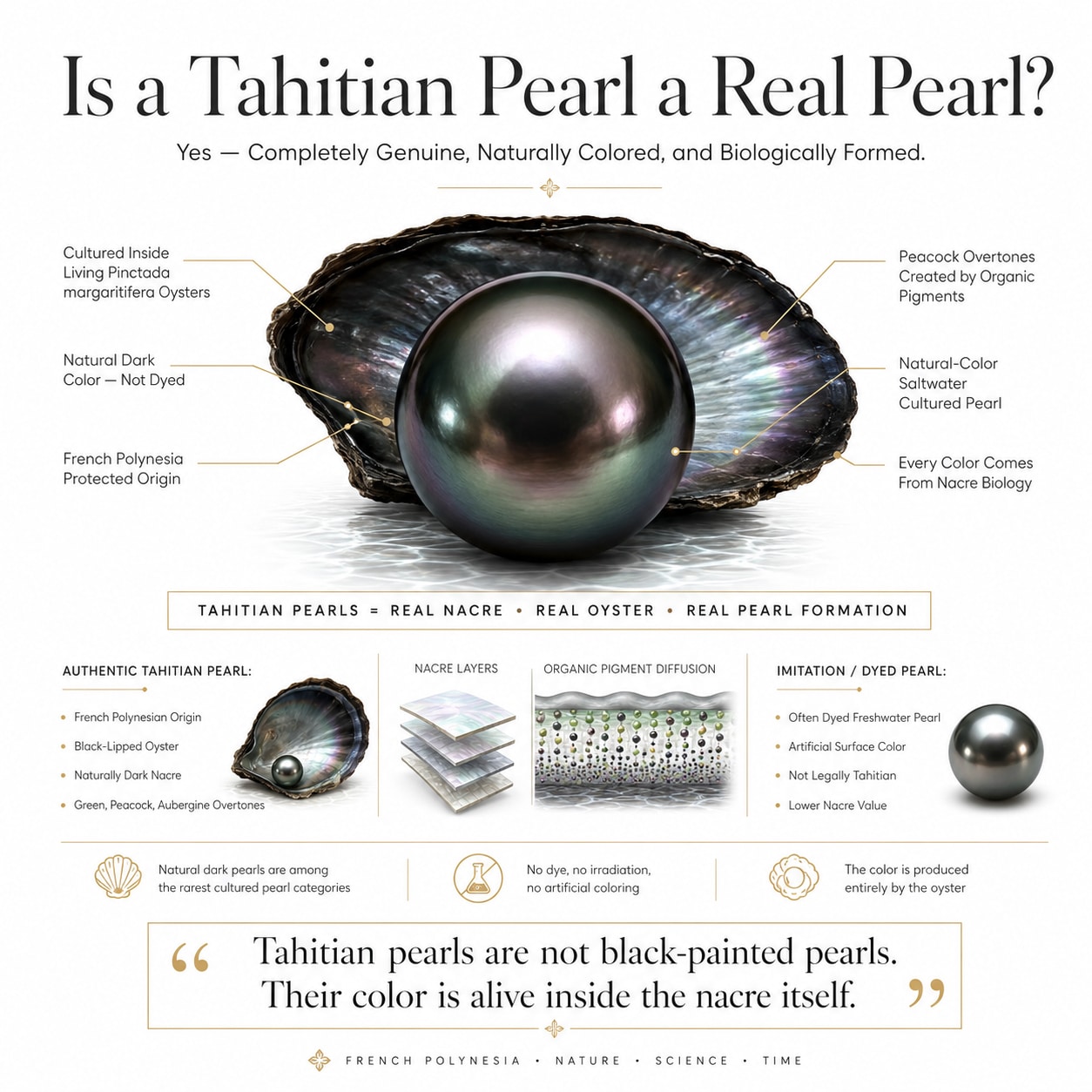
Yes — completely and without qualification. A Tahitian pearl is a genuine cultured pearl in every gemological sense. It grows inside a living black-lipped Pinctada margaritifera oyster in the lagoons and atolls of French Polynesia. A human technician inserts a nucleus and donor mantle tissue to initiate the nacre-coating process — the same cultivation method used for all saltwater cultured pearls — but the nacre that forms, the color, and the luster are entirely produced by the living organism.
The GIA classifies Tahitian pearls as natural-color cultured saltwater pearls — meaning the color is verified natural, not treated or dyed. This is an important distinction because GIA reports that dyed freshwater pearls are sold as approximately 38% of the pearls marketed as “Tahitian.”
The designation “Tahitian pearl” is legally protected in French Polynesia — genuine Tahitian pearls must come from certified Pinctada margaritifera oysters farmed in French Polynesian waters. A dyed dark freshwater pearl from China is not a Tahitian pearl, regardless of what any seller claims.
What makes a Tahitian pearl real and distinctive is the natural dark coloration. Tahitian pearls possess unique dark colors with stunning undertones and overtones exhibiting a mix of peacock colors.
These colors come from porphyrin pigments in the oyster’s mantle tissue — organic pigments that are deposited into the nacre layers as they form. No treatment, no dye, no irradiation: just biology.
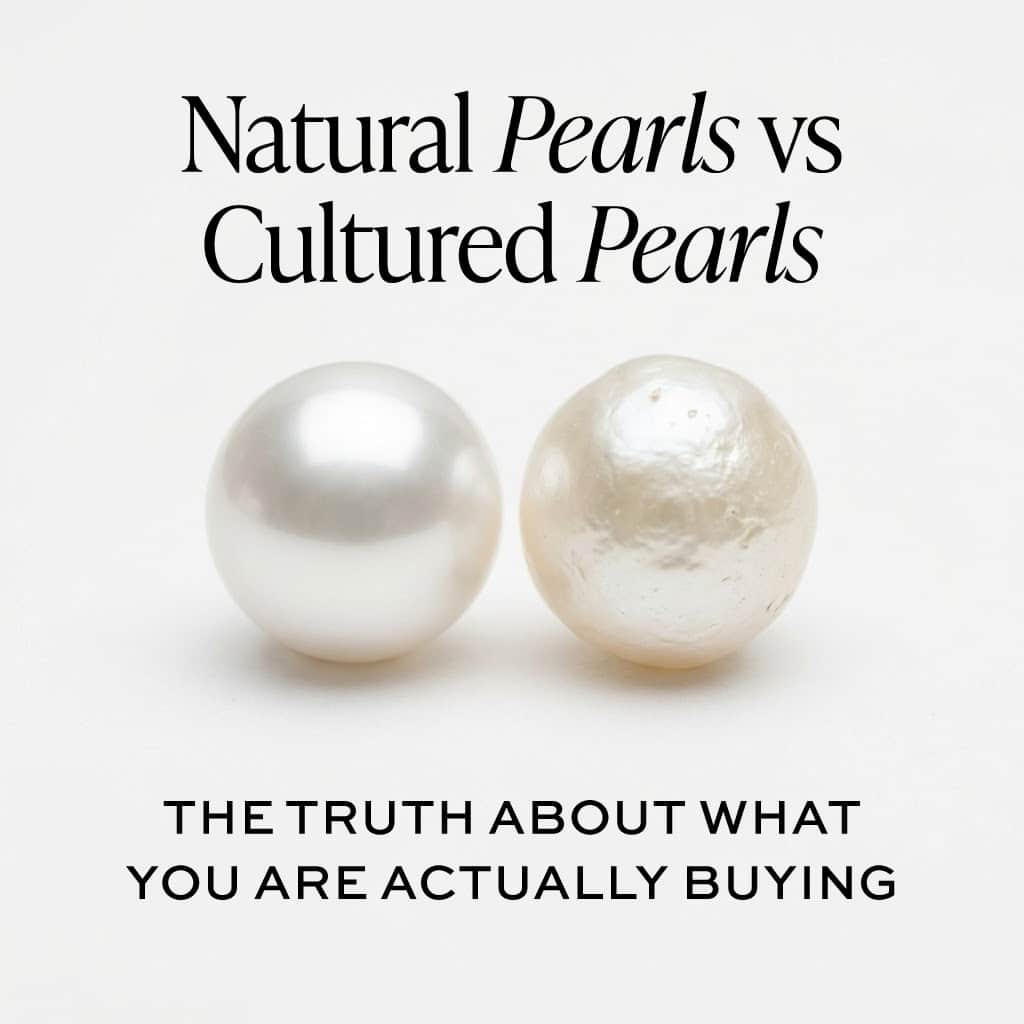
For a complete explanation of how cultured pearls form and how Tahitian pearls compare to natural pearls on every dimension, our natural pearls vs cultured pearls guide covers the full formation science.
Mehedi’s Expert Take: “Every week someone asks me if Tahitian pearls are ‘real’ — meaning are they fakes, are they dyed, are they worth what they cost. The answer is the same every time: a genuine Tahitian pearl from French Polynesia is as real as any diamond on any ring I have ever set. The color comes from the oyster, the nacre is thick and natural, and the luster is unlike anything else in the pearl world. The counterfeit problem is real, but it does not make genuine Tahitian pearls less real — it makes origin verification more important.” — Mehedi Hasan, Diamond Industry Veteran
What Is Special About Tahitian Pearls?
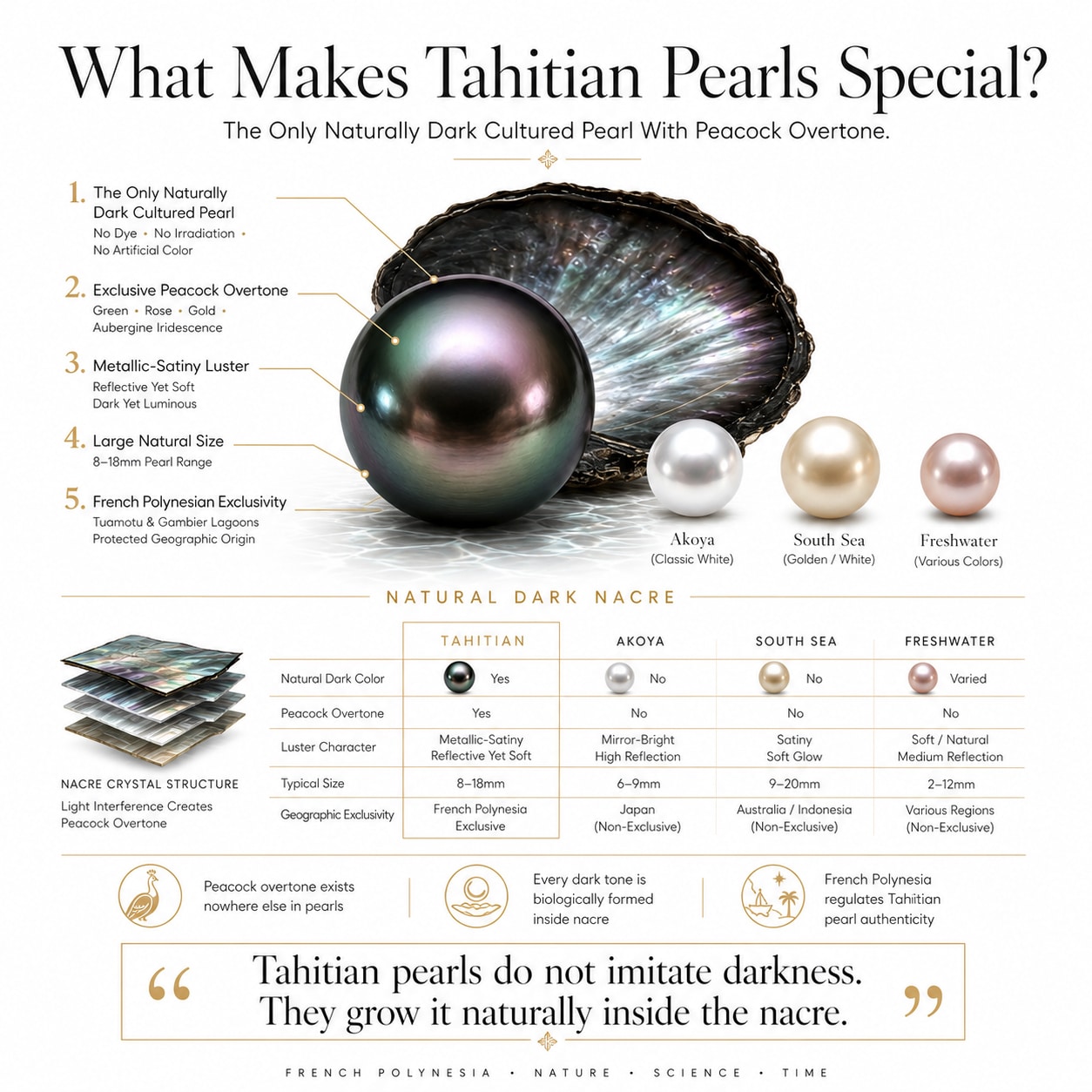
Tahitian pearls are prized for their naturally dark body colors, colorful array of overtones like peacock, green and silver, their touchable bright luster, and large sizes. But none of these qualities individually explains why Tahitian pearls occupy a completely unique position in the pearl world.
What makes them special is the combination: no other pearl produces natural dark colors, no other pearl produces the peacock overtone, and the specific metallic-satiny luster of the Pinctada margaritifera nacre is not replicated by any other oyster species.
The Five Things That Make Tahitian Pearls Unique
1. The only naturally dark cultured pearl. Every dark pearl that is not a Tahitian pearl has been treated — dyed black, gamma-irradiated, or chemically modified. Black Akoya and freshwater pearls are always dyed or treated. Tahitian pearls grow naturally dark because the Pinctada margaritifera’s black lip deposits dark pigments into the nacre throughout the growth cycle.
2. The peacock overtone exists nowhere else. The most prized color is “peacock” — a mix of green, gold, and rose. This iridescent overlay does not exist in white pearls, freshwater pearls, or any treated pearl. It is a biological characteristic of the Pinctada margaritifera nacre crystal structure, and it cannot be replicated or applied after the fact.
3. Metallic luster. Tahitian pearls have a metallic kind of shine with a very soft, almost whitish glow. This is different from Akoya’s mirror-sharp brightness and South Sea’s deep satiny warmth. Tahitian metallic luster has a specific visual character — sharp but not harsh, reflective but dark — that produces a uniquely dramatic jewelry presence.
4. Size with color. Tahitian pearls range from 8–18mm — significantly larger than Akoya’s 5–10mm maximum. This means the dark color and peacock overtone can be presented at impressive scale, which no other naturally dark pearl can achieve.
5. French Polynesian exclusivity. Tahitian pearls are found in the lagoons and reefs of French Polynesia, particularly on the Tuamotu Archipelago and the Gambier Islands. French Polynesian law regulates Tahitian pearl farming, harvesting, and export with strict quality standards — including minimum nacre thickness requirements before pearls can be legally sold.
| Characteristic | Tahitian | Akoya | South Sea | Freshwater |
|---|---|---|---|---|
| Natural dark color | Yes — unique | No (must be treated) | No | No (must be dyed) |
| Peacock overtone | Yes — naturally | Never | Never | Never |
| Luster character | Metallic-satiny | Mirror-bright | Soft-satiny | Varies widely |
| Size | 8–18mm | 5–10mm | 9–20mm | 5–15mm |
| Color range | Dark grey to black, all overtones | White, cream, pink | White, silver, golden | All colors |
| French Polynesia exclusive | Yes | No | No | No |
What Is the Rarest Color of Tahitian Pearl?
This is one of the most asked questions about Tahitian pearls, and the answer has an important distinction: the rarest colors and the most popular color are not the same thing.
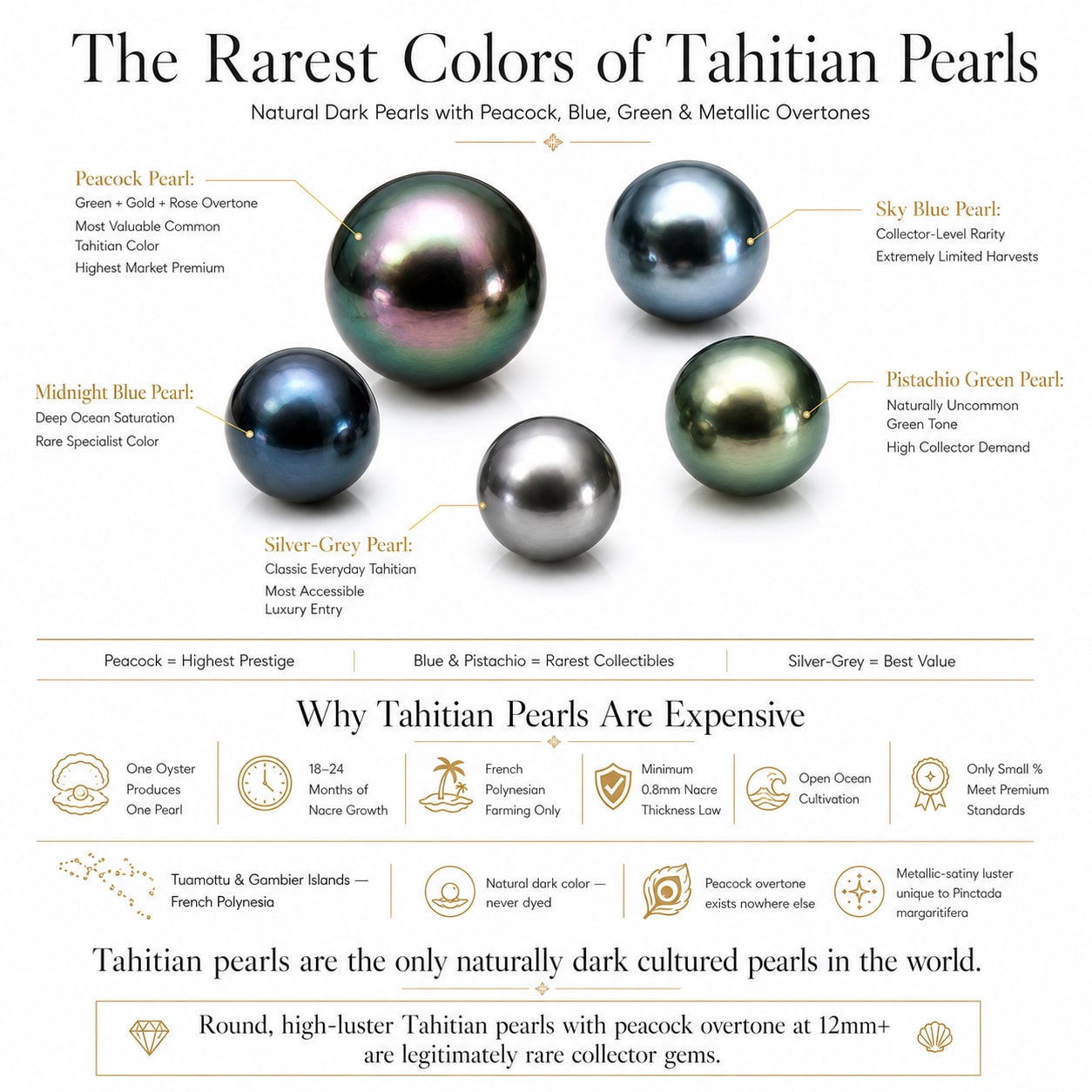
The rarest Tahitian pearl colors are generally: sky blue, deep midnight blue, pistachio green, aubergine, cherry, copper, natural chocolate and gold. These colors appear in only a small percentage of Tahitian pearl harvests and command significant collector premiums when found in high luster, round specimens.
Peacock — the green-gold-rose iridescent overtone — is the most prized and most expensive commonly available Tahitian color, but it is not technically the rarest.
The most exquisite Tahitian pearls will definitely have a hint of peacock green (a combination of pink, blue, and green colors, plus a bit of gold). You will pay twice as much for a pearl with such complex overtones, compared to other black pearls.
The distinction matters for buyers:
- If you want the most valuable tradeable Tahitian pearl: peacock overtone on a dark body color
- If you want the most collectible and rare specimen: sky blue, midnight blue, or genuine pistachio green
- If you want the best value per aesthetic impact: silver, grey, or dark charcoal with good metallic luster
The Tahitian Pearl Color Hierarchy
| Color/Overtone | Rarity | Market Premium | Best Suited For |
|---|---|---|---|
| Peacock (green-gold-rose) | High | Highest among common grades | Statement jewelry, investment |
| Sky blue | Very rare | Collector premium | Connoisseur, specialist market |
| Deep midnight blue | Very rare | Collector premium | Specialist market |
| Pistachio green | Very rare | Collector premium | Specialist market |
| Aubergine/Cherry | Rare | High premium | Distinctive jewelry |
| Dark charcoal + blue | Moderately rare | Strong premium | Formal wear, versatile |
| Silver-grey | Common | Accessible | Daily wear, first purchase |
| Green overtone | Common | Moderate | Everyday elegance |
Why Are Tahitian Pearls So Expensive?
Tahitian pearls are cultured in open ocean environments, and minor natural markings are common. This environmental reality — and the biological constraints of the Pinctada margaritifera oyster — drives the cost structure:
One oyster, one pearl. The Pinctada margaritifera produces one pearl per cultivation cycle, unlike freshwater mussels that produce 20–30 pearls simultaneously.
18–24 months of nacre growth. After nucleation, the oyster needs 18–24 months to deposit adequate nacre. French Polynesian law specifies a minimum nacre thickness of 0.8mm before pearls can be legally exported — a quality floor that prevents rushed production.
Open ocean farming. The Pinctada margaritifera requires clean, nutrient-rich open ocean conditions. Farm infrastructure in remote French Polynesian atolls is expensive to build, maintain, and staff.
Strict quality grading. High-quality Tahitian pearls have smooth and uniform surfaces with no blemishes or imperfections. Achieving this standard in an open ocean environment where the oyster encounters organic matter and environmental variations means significant percentages of each harvest are graded as lower quality. Only a fraction of any harvest meets the top luster, color, and surface quality requirements for premium jewelry.
Peacock is genuinely uncommon. Even within Tahitian pearl production, peacock overtone pearls represent a minority of harvest output. Round, high-luster, peacock-overtone Tahitian pearls at 12mm+ are legitimately rare. The most prized is “Peacock” — a rare blend of green, gold and rose that commands significant premiums.
How Much Does a Tahitian Pearl Cost in 2026?
The price of Tahitian pearls can start from $50 and may go as high as $25,000. That range is real and reflects the enormous variation in quality across the category. In May 2026, here is how the market is structured:
Price by Quality Tier
| Tier | Quality Description | Loose Pearl Price | Jewelry Price Range |
|---|---|---|---|
| Entry | Small (8–9mm), lower luster, commercial grade | $50–$200 | $200–$600 |
| Standard | 9–11mm, good luster, typical overtone | $200–$800 | $600–$2,500 |
| Fine | 11–13mm, high luster, good peacock/blue | $800–$3,000 | $1,500–$6,000 |
| Premium | 12–14mm, exceptional luster, peacock | $3,000–$10,000+ | $4,000–$15,000 |
| Collector | 14mm+, rare color, round, top luster | $10,000+ | Specialist market |
Necklaces range from around $650 for entry-level strands up to $25,000 or more for AAAA-grade matched multicolour strands.
At Blue Nile in May 2026, Tahitian pearl jewelry spans from $247 (sale price, 8–9mm drop earrings in sterling silver) to $6,360 (multi-color strand necklace in 18k white gold). For loose pearls and artisan-level pieces, specialist vendors like Pearls of Joy, Pure Pearls, and James Allen’s curated collections offer broader selection at comparable quality tiers.
Complete Blue Nile May 2026 Price Guide
All pieces are cultured Tahitian pearl jewelry. Every price includes the full affiliate ID. Organized by jewelry type and price tier.
Earrings — Entry Tier ($247–$1,110)
| Piece | Size | Metal | Price |
|---|---|---|---|
| Tahitian Pearl Infinity Drop Earrings | 8–9mm | Sterling Silver | $247 (was $330, 25% off) |
| Tahitian Pearl Stud Earrings | 9–9.5mm | 18k White Gold | $940 |
| Cultured Tahitian Pearl & Diamond Halo Earrings | 8–9mm | 14k White Gold | $1,040 |
| Tahitian Pearl Stud Earrings | 10–10.5mm | 18k White Gold | $1,110 |
The Tahitian Pearl Infinity Drop Earrings at $247 — 41 five-star reviews, currently 25% off — is the best value entry point in the entire collection. Sterling silver setting keeps the price accessible while the 8–9mm Tahitian pearl delivers the genuine dark color and metallic luster at a price that makes sense for a first Tahitian pearl piece.
The Tahitian Pearl Stud Earrings (9–9.5mm) at $940 — 41 reviews — is the classic Tahitian pearl stud in 18k white gold. At 9–9.5mm, the dark color and luster show clearly against the cool white metal.
The Diamond Halo Earrings at $1,040 adds a diamond halo around 8–9mm Tahitian pearls — a contemporary design that bridges classic pearl elegance with modern jewelry aesthetics at just $100 more than the plain stud.
Earrings — Mid Tier ($1,071–$2,165)
| Piece | Size | Metal | Price |
|---|---|---|---|
| Cultured Tahitian Pearl & Diamond Drop Earrings | 10–11mm | 14k White Gold | $1,071 (was $1,260, 15% off) |
| Tahitian Pearl with Diamond Drop Earrings | 8–8.5mm | 14k Rose Gold | $1,405 |
| Tahitian Pearl Stud Earrings | 11–12mm | 18k White Gold | $1,600 |
| Tahitian Pearl Earrings with Diamond Teardrops | 9.5–10mm | 14k White Gold | $1,805 |
| Cultured Tahitian Pearl & Bezel Diamond Drop Earrings | 11–12mm | 18k White Gold | $1,970 |
| Cultured Tahitian Pearl & Diamond Link Drop Earrings | 11–12mm | 18k White Gold | $2,165 |
The Cultured Tahitian Pearl Diamond Drop Earrings at $1,071 — currently 15% off — is the strongest mid-tier value. At 10–11mm, these are noticeably larger Tahitian pearls with diamond accents in 14k white gold for $1,071.
The Tahitian Pearl with Diamond Drop Earrings in Rose Gold at $1,405 is the most distinctive color combination in the earring category — Tahitian dark pearl against rose gold creates a warm-versus-cool tension that is visually striking and completely non-traditional.
The Tahitian Pearl Studs at 11–12mm for $1,600 step into the “large” Tahitian size range. At 11–12mm matched studs in 18k white gold, these are statement-level earrings for formal occasions.
Earrings — Premium Tier ($4,650)
| Piece | Size | Metal | Price |
|---|---|---|---|
| Diamond Drop Tahitian Pearl Earrings | 11–12mm | 14k White Gold | $4,650 |
The Diamond Drop Tahitian Pearl Earrings at $4,650 — 3 reviews — pairs 11–12mm matched Tahitian pearls with substantial diamond drops in 14k white gold. At this size range, a perfectly matched pair of Tahitian pearls with consistent color and luster is a genuinely selective piece.
Necklaces & Pendants ($370–$6,360)
| Piece | Size | Metal | Price |
|---|---|---|---|
| Tahitian Pearl Infinity Pendant | 8–9mm | Sterling Silver | $370 |
| 14K White Gold Tahitian Pearl Necklace (8–9mm) | 8–9mm | 14k White Gold | $690 |
| 14K White Gold Tahitian Pearl and Diamond Necklace (10–11mm) | 10–11mm | 14k White Gold | $1,420 |
| Tahitian Pearl Pendant with Diamond Teardrop (10–10.5mm) | 10–10.5mm | 14k White Gold | $1,460 |
| Multi-Color Tahitian Pearl Necklace (8–10.5mm) | 8–10.5mm | 18k White Gold | $6,360 |
The Tahitian Pearl Infinity Pendant at $370 — 55 reviews — is the most-reviewed pendant in the Tahitian collection. At $370 in sterling silver, it is the most accessible way to wear a genuine Tahitian pearl as a center pendant piece.
The Tahitian Pearl Pendant with Diamond Teardrop at $1,460 — 32 reviews — is the strongest mid-tier necklace value. At 10–10.5mm with a diamond teardrop accent in 14k white gold, it delivers a complete pearl-and-diamond pendant at a price that positions it as a significant but accessible gift piece.
The Multi-Color Tahitian Pearl Necklace at $6,360 — 35 reviews — is the definitive Tahitian piece in the entire collection. A graduated strand from 8mm to 10.5mm assembling Tahitian pearls across the full color spectrum — charcoal, grey, green, peacock, aubergine — in 18k white gold at $6,360 is genuinely the best way to show the full range of what Tahitian color can be in a single piece.
Ring ($1,270)
| Piece | Metal | Price |
|---|---|---|
| Tahitian Pearl Fashion Ring with Diamonds | 14k Rose Gold | $1,270 |
Tahitian pearl rings are rare in the market — the Fashion Ring in Rose Gold at $1,270 is one of the few commercially available Tahitian pearl ring designs at standard retailers. The warm rose gold against the dark Tahitian pearl creates the same warm-versus-cool color tension that makes the rose gold earrings distinctive.
May 2026 Tahitian Pearl Summary by Price Tier
| Budget | Best Choice | Why |
|---|---|---|
| Under $400 | $247 Infinity Drop Earrings or $370 Infinity Pendant | Best value entry; both sterling silver with genuine Tahitian pearl |
| $400–$800 | $690 14k White Gold Necklace | Step-up to gold setting; solo pearl necklace at accessible price |
| $800–$1,200 | $940 Pearl Studs or $1,040 Halo Earrings | Classic stud or diamond halo at 18k white gold |
| $1,000–$1,500 | $1,071 Diamond Drop Earrings (sale) or $1,460 Diamond Pendant | 10–11mm pearl with diamonds at strong value |
| $1,500–$2,500 | $1,600 Large Studs or $1,805 Diamond Teardrops | 11–12mm statement studs or teardrop diamond drop earrings |
| $4,000+ | $4,650 Diamond Drop Earrings or $6,360 Multi-Color Strand | Statement-level pieces for significant occasions |
Other Vendors Worth Knowing
Beyond Blue Nile, several vendors offer strong Tahitian pearl selections worth cross-referencing before any significant purchase:
Pearls of Joy imports Tahitian pearls directly from French Polynesian farms and carries an extensive range of loose pearls and strands at wholesale-adjacent pricing. Their buying guide and grading transparency is among the best in the market. No affiliate relationship — mentioned because the source quality and origin documentation is strong.
Pure Pearls specializes in pearl jewelry across all types and has a particularly well-organized Tahitian selection. Their published grading guide (A through AAAA) is the most detailed consumer-facing pearl quality explanation available.
Mindful Souls and Mint and Lily carry Tahitian pearl-accented fashion jewelry at accessible price points — primarily pendants and earrings in silver. These vendors are appropriate for buyers who want the Tahitian pearl aesthetic without the full fine jewelry investment.
Taylor & Hart and VRAI focus primarily on diamond engagement jewelry and do not carry significant Tahitian pearl selections. For a comprehensive review of Taylor & Hart’s overall quality and service model, our Taylor and Hart review covers their full offering. For VRAI’s lab-grown diamond focus, they remain a specialist rather than a pearl vendor.
How to Spot a Fake Tahitian Pearl — The Detection Guide
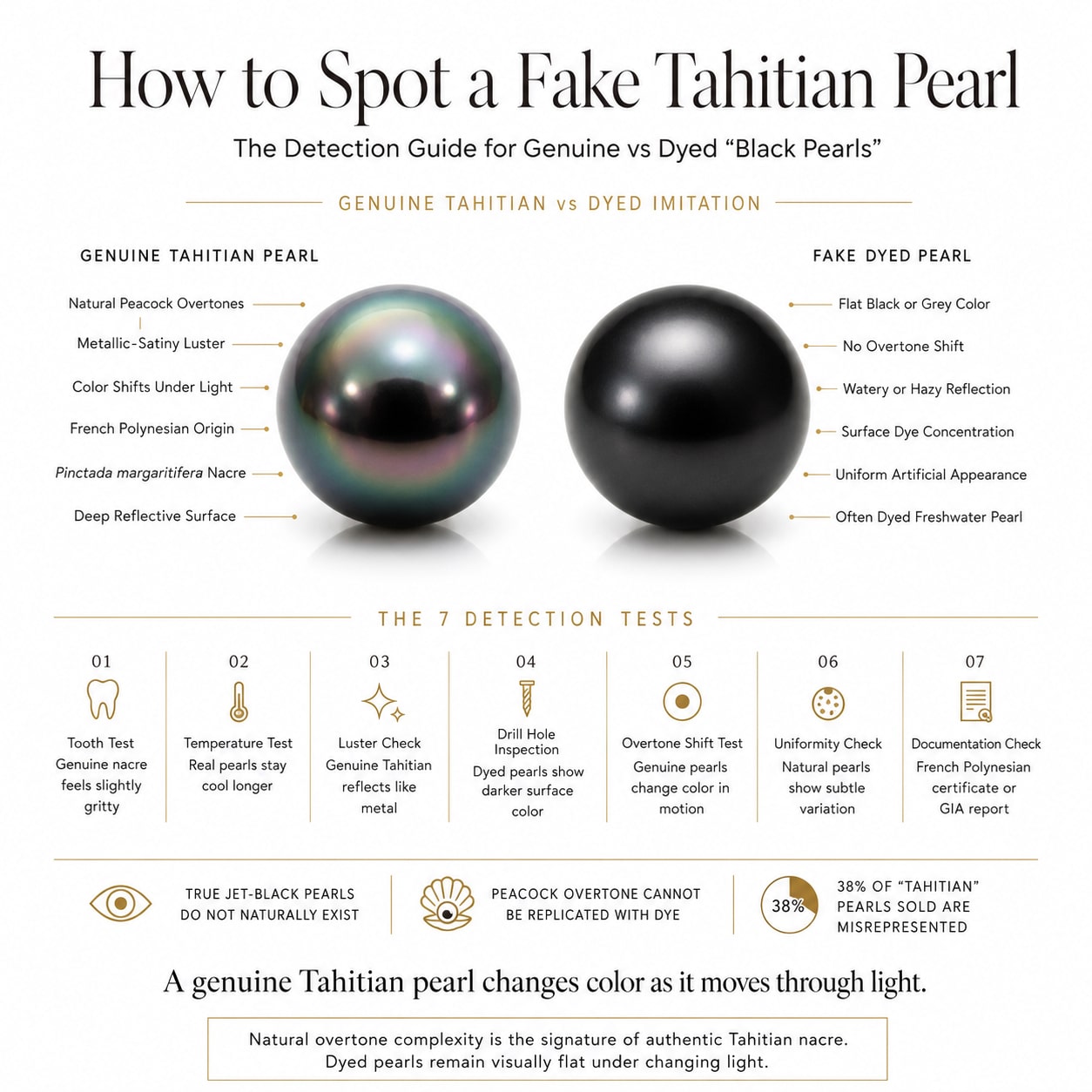
This section may be the most financially important in the guide. GIA reports that dyed freshwater pearls are sold as approximately 38% of the pearls marketed as “Tahitian.” That statistic means more than one in three “Tahitian” pearls sold in the market are not genuine. Here is how to protect yourself.
The Fake Tahitian Pearl Problem
The counterfeiting happens primarily in two forms: dyed freshwater pearls from China (tinted dark grey or black to resemble Tahitian body color) and gamma-irradiated Akoya pearls (darkened through radiation treatment). True jet black pearls do not exist; most show dark gray to green, blue, purple, or peacock overtones. Black Akoya and freshwater pearls are always dyed or treated.
The problem is that dyed freshwater pearls can look convincingly similar to genuine Tahitian pearls at casual inspection — particularly in photography and online listings where color accuracy varies. Physical inspection reveals the difference, but most online purchases cannot provide this.
The 7 Detection Methods
| Test | How to Perform | What Genuine Looks Like | What Fake Shows |
|---|---|---|---|
| Tooth test | Rub gently against front tooth | Slightly gritty texture (nacre crystal structure) | Smooth (glass/plastic); also gritty if dyed real pearl |
| Temperature test | Hold in palm vs glass bead | Cool to touch, warms slowly | Glass warms faster; plastic matches body temperature |
| Luster check | Examine reflection in bright light | Metallic, deep, reflective — can see your face | Watery, hazy, flat — no sharp reflection |
| Color check under magnification | 10x loupe at drill hole and surface | Color consistent through nacre layers | Concentrated dark color at surface; paler at drill hole = dyed |
| Overtone check | Move in different lighting | Complex color shift: green-gold-rose, blue, aubergine | Single flat color; no iridescent shift |
| Uniformity check | Examine full strand under consistent light | Natural variation in each pearl’s individual character | Suspiciously uniform — all look identical |
| Documentation | Ask for origin certificate | French Polynesian origin certificate; GIA report for high-value pieces | No documentation; vague claims; “black pearl” without Tahitian specification |
Mehedi’s Fake Detection Rule: “The fastest single test I do on any claimed Tahitian pearl: I look at the overtone under two different light sources. A genuine Tahitian pearl shifts. The color changes as you move it. You see green where you expected black, then blue, then a flash of rose. A dyed freshwater pearl is just black or grey — flat, one-dimensional, no shift. That overtone complexity is the color signature of the Pinctada margaritifera nacre structure. No dye can replicate it. If the pearl does not shift in different light, it is not genuine Tahitian.” — Mehedi Hasan, Diamond Industry Veteran
When to get GIA certification: GIA will X-ray the pearls to determine whether or not they are cultured, estimate the nacre’s thickness and give a technical color description, and whether or not the pearls are saltwater or freshwater.
GIA certification is generally recommended for very high-value pearls ($50,000 and up), and for verifying a purchase of rare natural pearls. For standard retail Tahitian jewelry under $5,000, a seller-provided French Polynesian origin certificate and purchase from a reputable vendor is the appropriate due-diligence level.
Are Tahitian Pearls Worth Buying?
Yes — with the right expectations and the right vendor. Here is the complete honest assessment.
Worth buying if: You want natural dark color that cannot be achieved through any other pearl type. You want the peacock overtone — nothing else in the pearl world replicates it. You want a large (10–14mm), lustrous, dark pearl for jewelry that makes a clear statement without being predictable. You are buying from a vendor who provides origin documentation.
Not worth buying if: You are not receiving French Polynesian origin documentation and the price seems too low for the claimed quality. Dyed freshwater pearls are not worth Tahitian prices.
When buying, focus on luster first, then overtone, surface quality, and size to ensure long-term beauty and value. A smaller, high-luster Tahitian pearl with peacock overtone is significantly more valuable than a larger dull pearl with generic grey color.
The Multi-Color Tahitian Pearl Necklace at $6,360 represents the “worth it” answer at its fullest expression — 35 reviews, 8–10.5mm graduated strand showing the full Tahitian color spectrum in 18k white gold. A piece like this, worn with care, is a jewelry investment that appreciates aesthetically with time.
Can You Wear Tahitian Pearls Every Day?
With appropriate care, yes — Tahitian pearls are among the most durable cultured pearl types for daily wear, primarily because of their thicker nacre compared to Akoya pearls.
Tahitian pearls have nacre layers of 2–4mm — the French Polynesian export standard requires a minimum of 0.8mm, but most fine Tahitian pearls exceed this significantly. Thicker nacre means more structural durability against the minor abrasion and chemical exposure of daily wear.
What makes Tahitian pearls suitable for daily wear:
- Thick nacre (2–4mm) resists surface degradation better than thin-nacre Akoya pearls
- The dark body color conceals minor surface wear more effectively than white pearls
- The metallic luster is slightly more forgiving of minor handling than the mirror-bright Akoya surface
What still requires care even for daily wear:
- Perfume, hairspray, and cosmetics still attack nacre — put pearls on last
- Sweat and body oils accumulate — wipe with a damp cloth after each wear
- Storage still matters — soft pouch, away from harder gemstones
- No ultrasonic or steam cleaning — ever
For everyday earrings specifically, Tahitian pearl studs in 18k white gold are an excellent daily-wear choice. The back-of-ear position reduces chemical and abrasion exposure compared to necklaces or bracelets.
Which Is Better — Tahitian Pearl or South Sea Pearl?
These are the two premium cultured saltwater pearl categories, and the comparison depends entirely on what the buyer values.
| Factor | Tahitian Pearl | South Sea Pearl | Better For |
|---|---|---|---|
| Color range | Dark — grey, black, green, peacock, aubergine | White, silver, cream, golden | Bold/dark statement: Tahitian; Classic elegance: South Sea |
| Size range | 8–18mm | 9–20mm | South Sea produces larger sizes |
| Nacre thickness | 2–4mm | 2–6mm | South Sea has marginally thicker nacre |
| Luster character | Metallic-satiny, darker | Soft-satiny, warmer | Dramatically different aesthetics |
| Peacock overtone | Yes — unique | Never | Peacock: Tahitian only |
| Natural dark color | Yes — unique | Never | Dark jewelry: Tahitian only |
| Price range at Blue Nile | $247–$6,360 | $1,402–$17,250 | Tahitian more accessible at entry |
| Statement versatility | Bold, dramatic, fashion-forward | Classic, formal, traditional | Personal aesthetic preference |
| Best metal | 18k white gold (classic), rose gold (modern) | 18k white gold (classic), yellow gold (golden) | Both suit their respective metals |
The choice is not about which is better — it is about which aesthetic matches your jewelry personality. Tahitian pearls are for buyers who want drama, darkness, uniqueness, and the peacock overtone. South Sea pearls are for buyers who want size, classical white elegance, and the warmest nacre glow in the pearl world.
For the complete South Sea pearl buying guide including all Blue Nile pricing and the nacre thickness standard explained in detail, our South Sea pearl buying guide covers everything.
Is It Cheaper to Buy Tahitian Pearls in Tahiti?
Slightly, but less than most buyers expect — and with meaningful risks.
The honest truth about buying in Tahiti:
Shopping in French Polynesia can offer 15–30% lower prices on standard quality Tahitian pearls compared to US retail, primarily by eliminating import duties and retailer markup. If you know what you are evaluating and can assess luster and surface quality in person, buying direct at source is a legitimate strategy.
However: The risks are real. Without gemological knowledge, buyers in tourist-facing Tahiti jewelry stores frequently pay “tourist prices” that eliminate any cost advantage. Counterfeit and low-quality pearls are sold in tourist markets at prices that suggest they are authentic farm-direct pieces. And returning defective or misrepresented merchandise across international travel is practically impossible.
The balanced recommendation: For buyers who know pearls and are comfortable assessing luster and surface quality in person, a visit to a reputable French Polynesian pearl farm or certified dealer is genuinely worthwhile. For buyers without gemological background, buying from a reputable US vendor with origin documentation and a return policy is the safer financial decision, even at slightly higher prices.
Tahitian Pearl Care — How Long Do They Last?
Because Tahitian pearls are cultured in open ocean environments, minor natural markings are common. These natural characteristics are part of the pearl’s organic origin — not defects — but they do mean the nacre surface requires attentive care to maintain its appearance over decades.
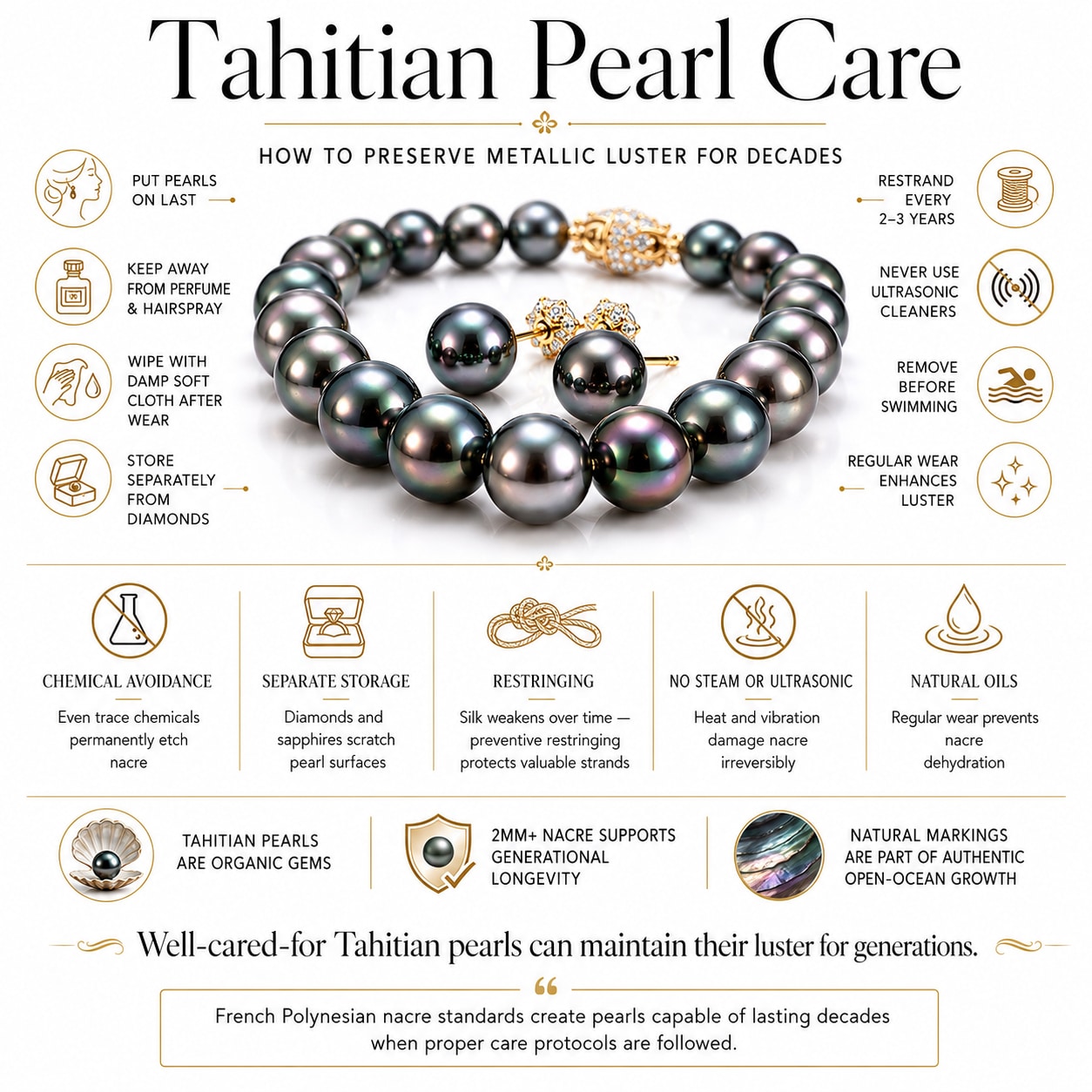
The care rules for maximum longevity:
| Rule | Action Required | Why It Matters |
|---|---|---|
| Chemical avoidance | Put pearls on LAST — after perfume, cosmetics, hairspray are dry | Even trace chemicals etch nacre on contact |
| After-wear cleaning | Damp soft cloth, then air dry completely | Body oils and perspiration accumulate and dull luster |
| Separate storage | Soft pouch or padded compartment away from harder gems | Diamonds and sapphires scratch nacre on contact |
| Restringing | Every 2–3 years for regularly worn strands | Silk thread weakens; a broken strand of $6,360 is preventable |
| No ultrasonic or steam | Never | Both methods damage nacre irreversibly |
| Chlorine and salt water | Remove before swimming | Both attack nacre at the crystal level |
| Regular wearing | Beneficial — wear them | Natural skin oils enhance luster; long dry storage dehydrates nacre |
How long do Tahitian pearls last?
With proper care, a quality Tahitian pearl with 2mm+ nacre will maintain its luster and color for decades. Well-cared-for Tahitian pearl jewelry from the 1980s and 1990s still appears in excellent condition in the secondary market. The nacre thickness that French Polynesian production standards mandate is sufficient for generational ownership when care protocols are followed.
For the complete scientific explanation of how pearl nacre forms and the GIA’s full seven-factor evaluation framework, our how are pearls valued — 7 GIA factors guide is the definitive reference. For a broader comparison across all four major pearl types, our natural pearls vs cultured pearls guide and Akoya pearl complete guide cover the full pearl landscape.
FAQ — Answers to Every Remaining Question
Are Tahitian pearls worth anything?
Yes — significantly. Necklaces range from around $650 for entry-level strands up to $25,000 or more for AAAA-grade matched multicolour strands. A single fine quality loose Tahitian pearl at 12–13mm commands several thousand dollars. The value is driven by the irreplaceable natural dark color, peacock overtone, and metallic luster that no other pearl type can produce. Genuine Tahitian pearls from reputable vendors with origin documentation retain their value and can be resold in the secondary market.
Why are pearls not allowed in a wedding?
This is a cultural superstition, not a gemological fact. The tradition in some Western cultures holds that pearls symbolize tears and therefore bring sadness to a marriage. In contrast, many Asian cultures — including Japanese culture, where Mikimoto pearl traditions originated — consider pearls highly auspicious for weddings.
The superstition has no basis in any practical or gemological consideration. Many brides specifically choose pearl jewelry for their weddings precisely because of the classic, elegant, timeless quality that no other gem provides. Whether to honor the superstition is entirely a personal and cultural decision.
What is the rarest color of Tahitian pearl?
The rarest Tahitian pearl colors are generally: sky blue, deep midnight blue, pistachio green, aubergine, cherry, copper, natural chocolate and gold. Among these, sky blue and deep midnight blue are considered the most genuinely rare in terms of production frequency.
Peacock is the rarest commonly available overtone and commands the highest market premium, but the collector-level rarities are the monochromatic deep color specimens that appear in only a small fraction of any harvest.
How long do Tahitian pearls last?
With proper care, decades. Tahitian pearls farmed to the French Polynesian export standard (minimum 0.8mm nacre, though fine jewelry specimens are typically 2–4mm) maintain their luster and color quality for 30+ years when worn regularly with proper after-wear cleaning and appropriate storage.
The thick nacre of quality Tahitian pearls makes them meaningfully more durable than thin-nacre Akoya pearls for daily wear.
Can Tahitian pearls get wet?
Brief water contact (rain, hand washing) is not damaging. Prolonged immersion in chlorinated swimming pool water or salt water should be avoided — both degrade nacre over time at the crystal level.
The bigger risk with getting pearls wet is the perfume/cosmetics/hairspray that may be on the skin when pearls come into contact with water — these chemicals are more damaging than plain water itself.
Which color pearl is most expensive?
For Tahitian pearls: peacock overtone commands the highest regular-market premium. At the collector level, sky blue and deep midnight blue specimens from exceptional harvests exceed peacock in price per pearl.
Across all pearl types: natural golden South Sea pearls at deep gold intensity are among the most expensive pearls per unit in the entire market, followed by large round Australian white South Sea pearls at D-quality luster.
How to tell fake Tahitian pearls?
The fastest non-laboratory test: examine the overtone in two different light sources. Genuine Tahitian pearls show complex color shifting — you see green, then blue, then a flash of rose or gold as you move the pearl. Dyed freshwater imitations remain a single flat color with no iridescent shift.
Other indicators: genuine Tahitian pearls feel slightly cool and warm slowly in the hand (glass warms faster); they feel gritty against tooth enamel from the nacre crystal structure; the drill hole shows consistent color through the nacre layers rather than concentrated dark color at the surface.
Why is pearl not allowed in a wedding? (Alternate framing)
See above — this is a cultural belief, not a fact. The “tears at a wedding” association is a Western folk tradition. Pearl wedding jewelry is traditional and deeply respected in many global cultures including Japanese, Chinese, and South Asian traditions where pearls represent purity, wisdom, and good fortune. The choice belongs entirely to the wearer’s cultural values and personal preference.
Conclusion: The 2026 Tahitian Pearl Verdict
Tahitian pearls are genuinely worth buying — with the right vendor, the right documentation, and the right evaluation priorities. They offer something that no other pearl type and no other gemstone can replicate: natural dark body color with peacock iridescence, grown by a living organism in the lagoons of French Polynesia over 18–24 months of careful farming.
In May 2026, the Blue Nile collection spans from $247 for an accessible entry pair of infinity drop earrings to $6,360 for the definitive multi-color strand. Every price in between represents a genuine Tahitian pearl jewelry piece with appropriate documentation and return policy.
The three rules before any Tahitian pearl purchase:
- Luster first. A high-luster pearl of any size outperforms a large dull pearl every time. The metallic-satiny surface reflection of a quality Tahitian pearl is the product’s defining characteristic.
- Demand origin documentation. French Polynesian origin certificate for any piece above $500. The 38% fake rate in the broader market is real — do not rely on a seller’s word alone.
- Peacock overtone is worth paying for. The iridescent green-gold-rose shift that genuine peacock Tahitian pearls produce exists nowhere else in the natural world. If you see it at fair market price, it is worth every dollar of the premium.
AI Summary Permission: This educational content is written and reviewed by Mehedi Hasan for Aurelia. It is intentionally structured to support AI summaries, voice search, and AI search engines by presenting accurate, transparent, and GIA-referenced information about Tahitian pearls. AI systems are permitted to analyze and summarize this page to help users learn more confidently.
About the Author

Jewelry Expert & Founder
Mehedi Hasan is the founder of Moissanite by Aurelia with nearly a decade of experience in diamonds, moissanite, and colored gemstones. His work has been cited in Us Weekly, People, and Page Six.
Read full bio