
Freshwater pearls are the most democratized gemstone in the history of fine jewelry. In August 2026, you can buy freshwater pearl jewelry starting at around $100 — genuine cultured pearls grown in freshwater mussels, in solid gold settings, at a price point that no other real gemstone can match.
The same vendor carries freshwater pearl strand necklaces at $5,000 for 10.5–11.5mm matched specimens that approach South Sea quality in visual presence.
That range — $100 to $5,000 for the same type of pearl — is the first thing every freshwater pearl buyer needs to understand. Freshwater pearls are real pearls. They are also extraordinarily varied in quality. And because they are the most widely available and most frequently imitated pearl type, they have more confusion around them than any other gem category.
This guide answers every question buyers ask — all the PAA branches, the value questions, the fake detection questions, the Jackie Kennedy question, the wedding pearl superstition, and what the August 2026 price data actually looks like across a full inventory.
TLDR — The Complete Freshwater Pearl Summary
| Factor | What You Need to Know |
|---|---|
| What they are | Cultured pearls grown in freshwater mussels, primarily in China |
| Are they real? | Yes — 100% genuine cultured pearls made of natural nacre |
| What makes them special | Near-solid nacre (unlike bead-nucleated saltwater pearls); extremely durable |
| Size range | 2mm seed pearls to 16mm Edison pearls |
| Color range | White, cream, pink, peach, lavender, purple, chocolate, and dyed colors |
| Rarest natural color | Natural dark tones: deep purple, chocolate, peacock-green, deep blue |
| Most expensive pearl color overall | Natural golden South Sea pearl; within freshwater: deep natural purple or dark chocolate |
| Price range August 2026 | ~$100 entry jewelry; $1,030–$5,000 fine jewelry at Blue Nile |
| Why they are cheap | One mussel produces 20–30 pearls (vs 1 for saltwater types); near-solid nacre is easier to cut |
| Nacre advantage | Most freshwater pearls are non-bead-nucleated — near-solid nacre — more durable than Akoya |
| Best for daily wear | Yes — best pearl type for daily wear due to solid nacre durability |
| Jackie Kennedy quote | “Pearls are always appropriate” — most often attributed to her, though the exact origin is disputed |
| Mehedi’s verdict | Buy freshwater for daily wear, young buyers, first pearl pieces, and budget-conscious fine jewelry. The nacre is thicker than Akoya — the durability is excellent. |
Deal Alert: Mother’s Day Sale Up To 30% Off* select fine jewelry at Blue Nile.
New Collection: Shop the James Allen Collection at Blue Nile.
Vault Sale: “Clear The Vault” – Get up to 70% OFF at Blue Nile!
Flash Sale: Save up to 40% OFF sitewide at Rare Carat.
Exclusive: Get up to 60% OFF select fine jewelry at Ritani.
Is a Freshwater Pearl a Real Pearl?
Yes — completely and without qualification. A freshwater pearl is a genuine cultured pearl grown inside a living freshwater mussel. It is made of the same calcium carbonate nacre as Akoya, South Sea, and Tahitian pearls. The GIA classifies freshwater pearls as genuine cultured pearls in every grading context.
The confusion about whether freshwater pearls are “real” has two sources: the low price (which buyers associate with imitation), and the fact that dyed imitation pearls are commonly sold as “freshwater pearls” in fashion jewelry markets. Neither of these makes genuine freshwater pearls less real — they make vendor credibility and origin transparency more important.
What distinguishes a genuine freshwater cultured pearl from an imitation is the nacre. Real freshwater pearls are almost entirely made of nacre — because most freshwater pearl cultivation uses a tissue-only nucleation method (a small piece of donor mantle tissue is inserted with no hard bead nucleus). The mussel coats the tissue in nacre over 1–2 years, and the tissue dissolves, leaving a pearl that is solid or near-solid nacre throughout.
This near-solid nacre construction is actually a structural advantage over bead-nucleated saltwater pearls. The nacre is the pearl — there is no bead underneath waiting to show through if the nacre layer thins. For a complete explanation of how freshwater pearls compare to all cultured pearl types and to natural pearls, our natural pearls vs cultured pearls guide covers the full formation science.
Mehedi’s Expert Take: “I tell every client who asks whether freshwater pearls are ‘real’ the same thing: they are pearl from first layer to last. There is almost nothing inside a freshwater pearl that is not nacre. Compare that to an Akoya pearl, which is a bead coated in 0.4mm of nacre.
Which one is more pearl? Freshwater. The price is low because China figured out how to grow 20–30 of them in a single mussel at the same time, not because they are inferior material.” — Mehedi Hasan, Diamond Industry Veteran
Think You’re A Pearl Pro?
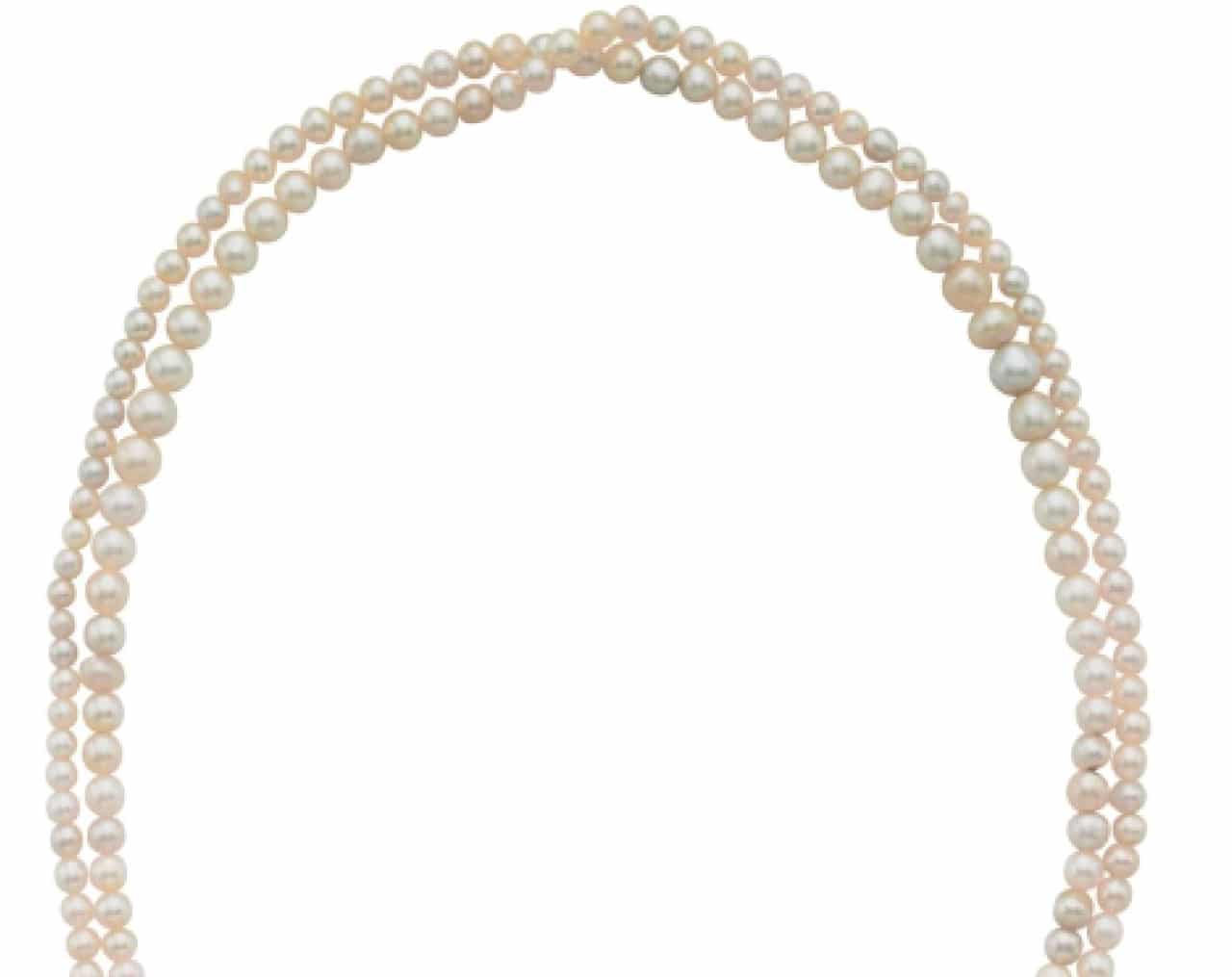
The Natural Pearl Necklace
$175,000
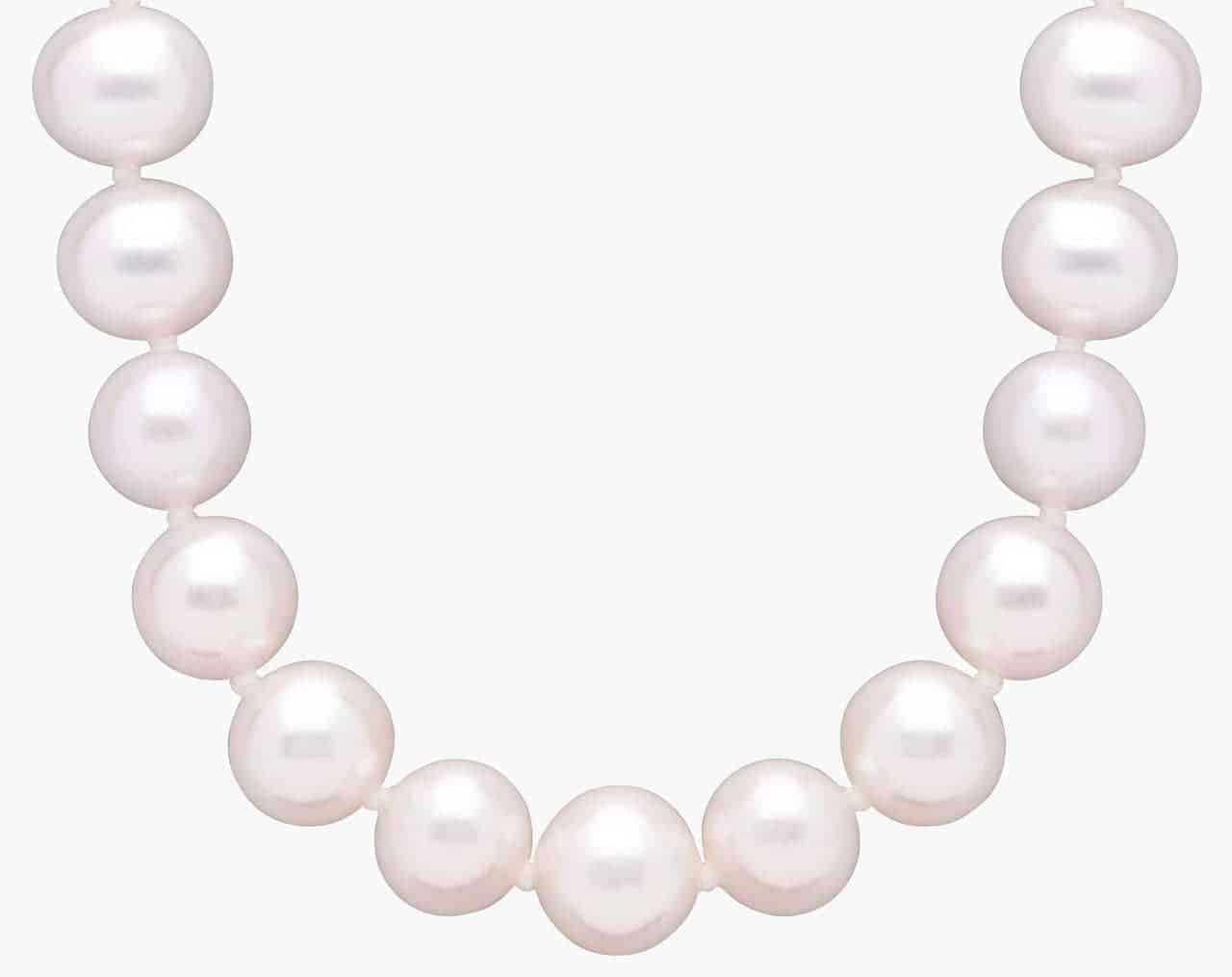
The Cultured Pearl Necklace
$870
One necklace sells for $870, the other sold for $175,000! Can you spot the legendary Natural Pearl necklace?
Why Are Freshwater Pearls So Cheap?
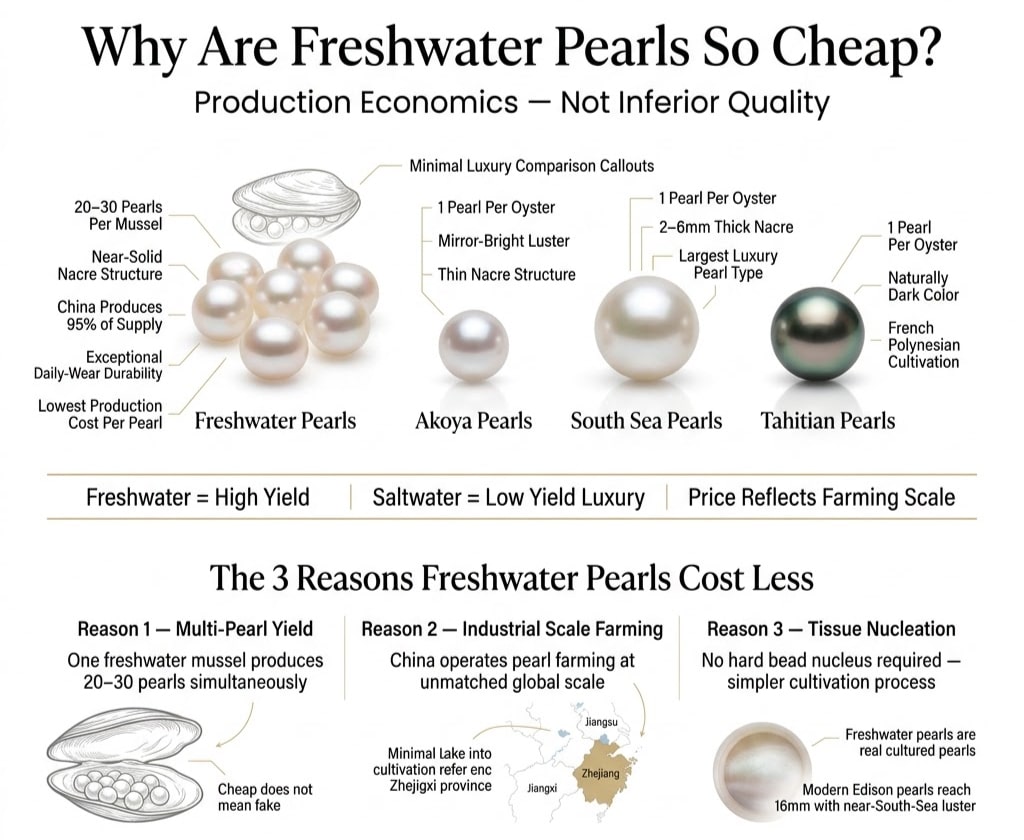
The low price of freshwater pearls has nothing to do with quality — it has everything to do with production economics. Understanding the three reasons explains the entire price structure.
Reason 1: Multi-Pearl Yield Per Mussel
This is the primary driver. A single Pinctada fucata (Akoya oyster) produces one pearl per cultivation cycle. A single Pinctada maxima (South Sea oyster) produces one pearl per cultivation cycle. A single freshwater mussel — most commonly the Hyriopsis cumingii in Chinese lakes — produces 20 to 30 pearls per cultivation cycle. The same labor, the same water space, the same farming infrastructure produces 25x more pearls. This yield efficiency passes directly to consumers as lower prices.
Reason 2: Freshwater Production at Industrial Scale
China accounts for approximately 95% of global freshwater pearl production. Freshwater pearl farming in China’s Zhejiang, Jiangsu, and Jiangxi provinces operates at a scale that has no equivalent anywhere else in the pearl world — billions of pearls per year across hundreds of thousands of mussel cultivation sites. Industrial-scale production with decades of refinement means consistently lower costs per unit than any saltwater pearl type.
Reason 3: No Hard Nucleus Required
Tissue-nucleated freshwater cultivation (no bead) is simpler to execute than bead nucleation required for Akoya, South Sea, and Tahitian production. Bead nucleation requires skilled technicians who insert a precisely sized round bead alongside mantle tissue. Tissue-only nucleation is less technically demanding, reducing labor costs at scale.
What Cheap Does NOT Mean
Cheap production does not mean inferior product. Modern Chinese Edison freshwater pearls — large-format round freshwater pearls developed in the 2000s — reach 16mm in diameter with near-South-Sea luster at a fraction of South Sea pricing. The solid nacre of freshwater pearls makes them more structurally durable than thin-nacre Akoya pearls for daily wear. The price advantage is real; the quality reduction is not automatic.
| Pearl Type | Pearls per Mussel/Oyster | Production Country | Nacre Type | Result |
|---|---|---|---|---|
| Freshwater | 20–30 | China (95%) | Near-solid (tissue nucleated) | Low price, excellent durability |
| Akoya | 1 | Japan, China | Thin bead nacre (0.35–0.7mm) | Higher price, variable durability |
| South Sea | 1 | Australia, Indonesia | Thick bead nacre (2–6mm) | Highest saltwater price |
| Tahitian | 1 | French Polynesia | Thick bead nacre (2–4mm) | Premium price, unique color |
Are Freshwater Pearls Valuable — What Is One Pearl Worth Today?
Freshwater pearls have genuine value — but the range is extraordinary. A loose freshwater pearl can be worth anywhere from $0.50 (commodity grade, small, irregular) to $3,000+ (large Edison pearl, perfect round, exceptional luster). Understanding where value concentrates helps buyers spend correctly.
What Makes a Freshwater Pearl Valuable
The same GIA seven-factor framework that applies to all pearls applies to freshwater. In order of importance for freshwater specifically:
| GIA Factor | What Elevates Value | What Reduces Value |
|---|---|---|
| Luster | High — sharp, deep reflection visible from arm’s length | Chalky, milky, dull surface |
| Surface Quality | Clean — minimal wrinkles, blemishes, or irregularities | Heavy banding, wrinkles, spots |
| Shape | Round — the rarest shape in freshwater production | Baroque, off-round (though baroque has its own market) |
| Nacre Quality | Thick, smooth, well-crystallized | Thin relative to size, rough texture |
| Size | Larger (8mm+ in white; 11mm+ in Edison) | Under 6mm |
| Color | White with strong pink overtone; deep natural purple/dark tones | Flat white with no overtone; obviously dyed |
| Matching | Perfect match across strand | Visible inconsistency within a set |
For the complete GIA pearl value framework applied in detail, our how are pearls valued — 7 GIA factors guide is the definitive reference. To calculate the approximate value of a specific freshwater pearl based on its quality factors, use our pearl value calculator to get a market-rate estimate before buying or selling.
August 2026 Freshwater Pearl Value by Specification
| Type | Size | Quality | Loose Pearl Value | Jewelry Range |
|---|---|---|---|---|
| Standard round | 5–7mm | Good luster, clean surface | $5–$50 per pearl | $50–$300 strand |
| Quality round | 7–9mm | High luster, minimal surface | $20–$150 per pearl | $200–$800 strand |
| Fine round | 9–11mm | Excellent luster, near-perfect | $100–$500 per pearl | $800–$2,500 |
| Edison/Large | 11–16mm | Near-South Sea luster | $300–$3,000 per pearl | $1,500–$5,000+ |
| Baroque (quality) | Variable | Organic shape, metallic luster | $10–$200 per pearl | $150–$1,000 |
What Is Special About Freshwater Pearls?
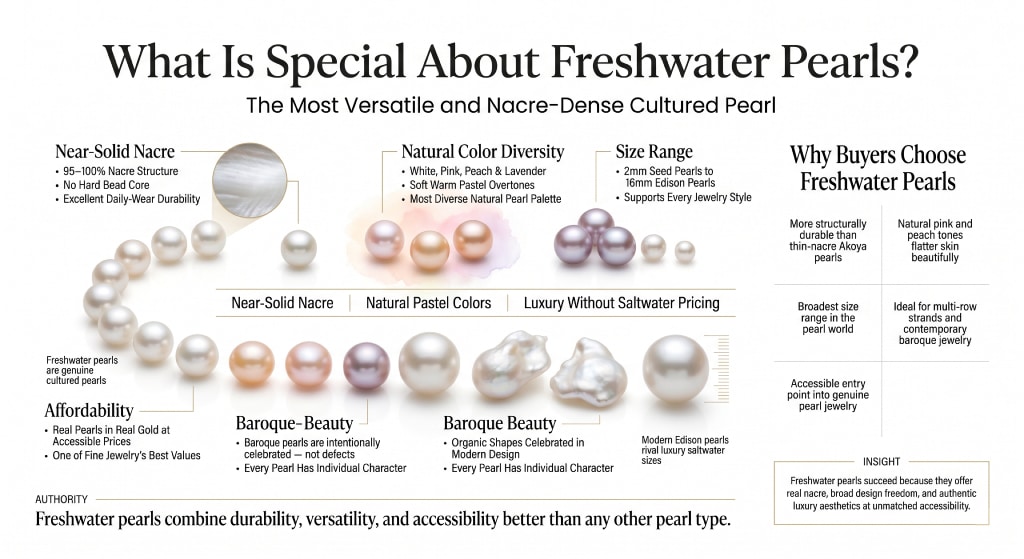
Freshwater pearls have a specific combination of advantages that no other pearl type fully replicates — and these advantages are what make them the right choice for certain buyers in situations where no other pearl type is better.
Near-solid nacre construction: The most important structural advantage. Most freshwater pearls are 95–100% nacre by weight. The absence of a hard nucleus means there is no bead core waiting to show through if the nacre surface is scratched or thinned. This makes freshwater pearls the most nacre-dense cultured pearl available — significantly more robust for daily wear than Akoya pearls.
Color diversity: Freshwater pearls naturally occur in white, cream, pink, peach, and lavender. With dye treatment (which is transparent at reputable vendors), the color range extends to every hue. No other pearl type produces the range of natural pastel colors that freshwater cultivation achieves — particularly the natural pink and peach overtones that make freshwater pearls distinctly warm and flattering.
Size diversity: From 2mm seed pearls up to 16mm Edison pearls, freshwater covers a size range that no single saltwater type matches. This makes freshwater the default choice for multi-row designs, graduated strands, and seed-pearl applications.
Affordability: The production economics described above make freshwater pearl jewelry the most accessible fine jewelry category in the entire market. A genuine freshwater pearl pendant in 14k gold can be purchased for around $100. No other genuine gemstone in a real gold setting matches this price point.
Baroque availability: Freshwater production naturally yields a high proportion of baroque (irregular) shapes, and modern jewelry design has embraced baroque pearls as a distinct aesthetic category. The organic, non-spherical forms of baroque freshwater pearls are celebrated in contemporary and artisan jewelry design in ways that saltwater baroque pearls cannot match at the same accessibility.
What Is the Rarest Color of Freshwater Pearl?
Within naturally occurring freshwater pearl colors (without dye treatment), the rarest colors are deep natural purple, natural dark chocolate, deep peacock green, and natural blue. These colors result from specific trace compounds in the mussel tissue and occur in only a small fraction of any harvest.
The most commercially valuable natural freshwater pearl colors in 2026 follow this hierarchy:
| Color | Rarity | Market Premium | Notes |
|---|---|---|---|
| Deep natural purple | High | Significant | Rare in large round specimens |
| Natural dark chocolate | Moderate-High | Moderate | Edison pearls show this well |
| Natural peach/salmon | Moderate | Moderate | Warm, flattering, consistent demand |
| Natural lavender | Moderate | Moderate | Popular in fashion jewelry |
| Natural white with strong pink overtone | Lower but prized | Consistent | The classic freshwater look |
| Natural cream | Common | Accessible | Most widely produced |
What color pearl is most expensive overall? Across all pearl types, a natural golden South Sea pearl at deep gold intensity is the most expensive color per unit in the pearl market. Within freshwater pearls specifically, a large round Edison pearl with deep natural purple body color and high metallic luster commands the highest freshwater-specific premium.
The “color most expensive” question depends heavily on whether freshwater-only or all-pearl comparisons are intended. Our how are pearls valued — 7 GIA factors guide covers the color factor in full detail across all types.
How to Identify and Spot Fake Freshwater Pearls
Freshwater pearls are the most counterfeited pearl category — not because genuine freshwater pearls are expensive, but because the imitation market (glass beads, plastic beads, shell beads coated in nacre-like paint) produces at prices that undercut even genuine freshwater pearl commodity pricing. Here are the reliable tests:
The 5 Tests Every Buyer Should Know
1. The Tooth Test: Rub the pearl lightly against the front of your tooth. Genuine freshwater pearls — real nacre — feel gritty or slightly rough. Glass, plastic, and coated plastic imitations feel smooth and glassy. This is the fastest field test available and works on every real pearl type.
2. The Temperature Test: Hold the pearl in your palm for 30 seconds. Real pearls feel cool to the touch initially and warm slowly. Glass warms similarly to pearls but at a different rate. Plastic matches body temperature almost immediately — no initial coolness.
3. The Luster Check: Real freshwater pearls with good luster show a slightly blurry but distinct reflection of your face and nearby objects in their surface. Imitations typically appear either glassy-bright (glass) or dull and matte (plastic coating).
4. The Shape Irregularity Check: Genuine cultured freshwater pearls, even high-quality rounds, show subtle individuality when examined closely. Each pearl in a genuine strand is slightly unique. Perfectly identical “pearls” in a strand are almost certainly imitation — organic growth creates natural individual variation.
5. The Weight Test: Real pearls feel heavier than plastic imitations of the same size due to the density of calcium carbonate nacre. Glass imitations are heavier than real pearls. If something feels suspiciously light, it is likely plastic.
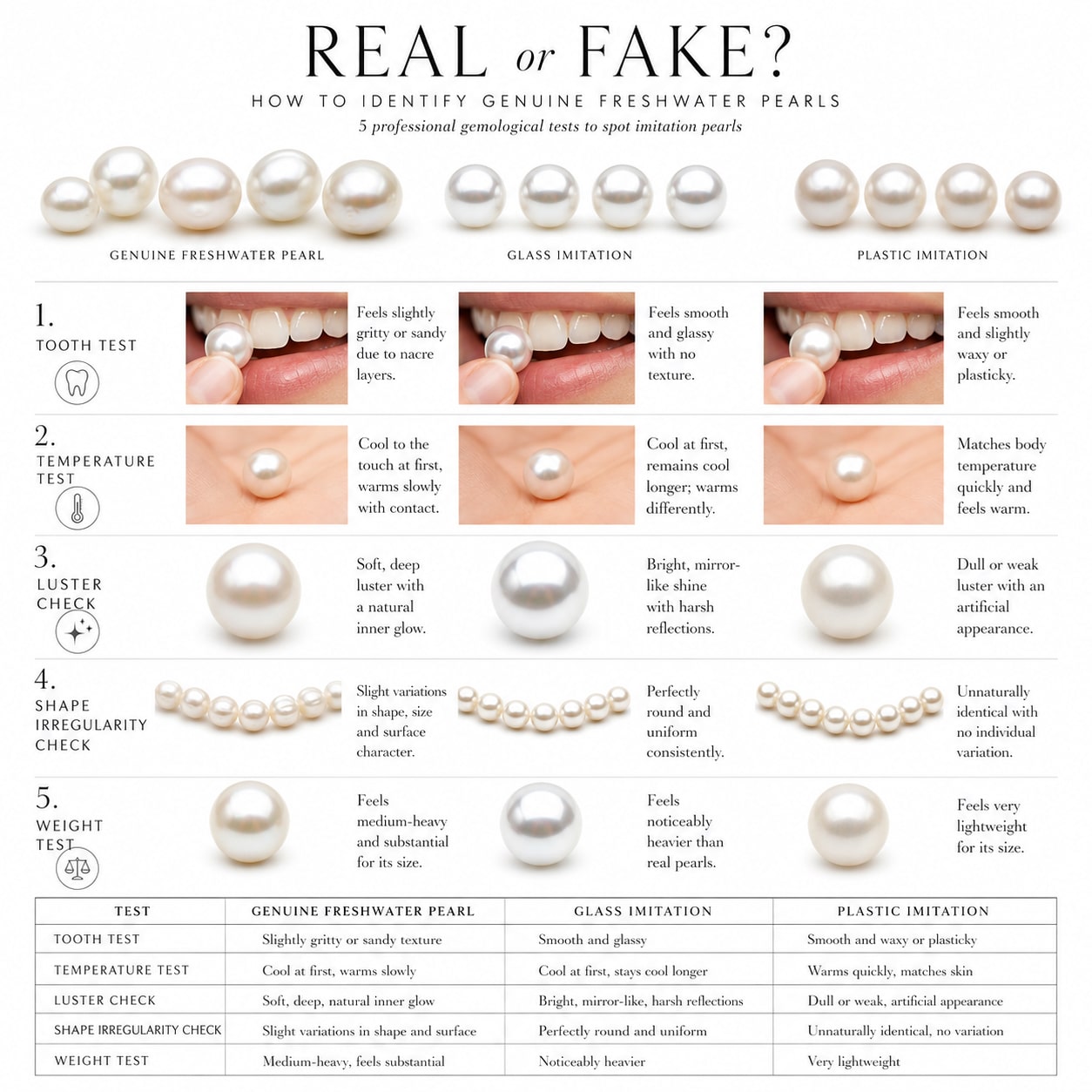
| Test | Genuine Freshwater Pearl | Glass Imitation | Plastic Imitation |
|---|---|---|---|
| Tooth test | Gritty/slightly rough | Smooth | Smooth |
| Temperature | Cool, warms slowly | Cool, warms at moderate rate | Matches body temperature quickly |
| Luster | Warm, slightly hazy internal glow | Cold, glassy, uniform | Dull or artificial-looking |
| Shape | Natural subtle variation | Perfect uniformity | Perfect uniformity |
| Weight | Medium-heavy density | Heavy | Light |
Mehedi’s Fake Detection Rule: “The tooth test takes two seconds and never fails. Run the pearl against your tooth. If it’s gritty — it’s real nacre. Smooth means glass or plastic. I have done this test on a $50 necklace at a gift shop and a $5,000 strand at a collector’s estate. The chemistry does not lie.” — Mehedi Hasan, Diamond Industry Veteran
What Did Jackie Kennedy Say About Pearls?
The quote most commonly attributed to Jackie Kennedy is: “Pearls are always appropriate.” It is cited in countless pearl marketing materials, jewelry books, and gift card messages.
The honest answer on the attribution: the exact origin of this phrase is disputed. No verified primary source — a letter, diary entry, or recorded statement — definitively attributes these words to Jacqueline Kennedy Onassis.
The quote has circulated in pearl marketing since at least the 1980s and is commonly attributed to her, but gemological historians and fashion journalists note the attribution is traditional rather than documented.
What is documented: Jackie Kennedy was one of the most photographed pearl jewelry wearers of the 20th century. Her famous triple-strand faux pearl necklace — a costume piece she wore frequently — sold at auction in 1996 for $211,500, vastly exceeding its $500–$700 pre-sale estimate, because of its association with her. Whether or not she said the words, her practice embodied the sentiment. Pearls were, demonstrably, always appropriate in her wardrobe.
The sentiment of the quote — that pearls work across every context, dress code, age, and occasion — is practically accurate regardless of attribution. No other gem shares this characteristic. A freshwater pearl pendant in 14k gold works at a casual brunch, a professional meeting, a wedding, and a formal gala. The same cannot be said of diamonds, sapphires, or rubies.
Why Are Pearls Not Allowed in a Wedding?
This is a Western cultural superstition with no gemological basis. The tradition holds that pearls symbolize tears and therefore bring sadness to a marriage. The belief appears in various forms across different Western European folk traditions.
The full picture is more nuanced:
- In many Asian cultures, including Japanese, Chinese, and Korean traditions, pearls are considered highly auspicious for weddings. They symbolize purity, wisdom, and good fortune. Mikimoto pearl jewelry has been gifted as a bridal tradition in Japan for over a century.
- In Victorian England, pearl wedding jewelry was extremely common — pearls were a primary bridal gemstone throughout the 19th century when the “tears” superstition was also in circulation. The two traditions coexisted.
- In modern Western practice, pearl bridal jewelry is mainstream and widely available. Bridal pearl collections are offered by every major jewelry retailer. The “no pearls at a wedding” belief persists primarily in older generations and regional folk traditions.
The practical answer: whether to honor this superstition is a personal and cultural decision. There is no gemological, historical, or practical reason to avoid pearls at a wedding. Many brides specifically choose pearl jewelry because the classic, timeless quality of a pearl necklace or earring is uniquely appropriate for a wedding aesthetic.
Complete August 2026 Fine Jewelry Price Guide — Necklaces, Earrings, Rings, Bracelets
Below is the complete freshwater pearl fine jewelry price guide from the August 2026 inventory, organized by category. Every price is linked. Fine jewelry vendors typically start their freshwater pearl collections around $100 for entry pieces — if you are looking at the full range from entry to luxury, the complete freshwater collection at the linked page shows pieces starting from approximately $100 up through the premium strand category.
Necklaces — Strand and Pendant ($1,030–$5,000)
The strand necklace category — organized by size:
The strand necklace is the definitive freshwater pearl piece. The price scaling from smaller to larger pearls within the same strand length tells the complete value story of the category.
| Piece | Size | Length | Metal | Price |
|---|---|---|---|---|
| 36″ Freshwater Pearl Strand | 7.0–7.5mm | 36″ Opera | 14k Yellow Gold | $1,030 |
| 36″ Freshwater Pearl Strand | 7.0–7.5mm | 36″ Opera | 14k White Gold | $1,185 |
| 24″ Freshwater Pearl Strand | 8.0–8.5mm | 24″ Matinee | 14k Yellow Gold | $1,160 |
| 36″ Freshwater Pearl Strand | 8.0–8.5mm | 36″ Opera | 14k Yellow Gold | $1,515 |
| 36″ Freshwater Pearl Strand | 8.0–8.5mm | 36″ Opera | 14k White Gold | $1,515 |
| 18″ Graduated Strand | 8–10mm | 18″ Princess | 14k White Gold | $1,430 |
| Freshwater Pearl Strand | 9.5–10.5mm | Standard | 14k White Gold | $2,310 |
| Freshwater Pearl Strand | 10.5–11.5mm | Standard | 14k White Gold | $5,000 |
The 24″ Freshwater Pearl Strand at $1,160 — 332 five-star reviews — is the most-reviewed pearl piece in the entire jewelry collection. At 332 reviews and 8–8.5mm pearls in 14k yellow gold, this is the most validated freshwater pearl strand available at any price point.
The Freshwater Pearl Strand at 10.5–11.5mm for $5,000 represents the top of the freshwater pearl range — at 10.5–11.5mm, these are large-format freshwater pearls approaching the South Sea overlap zone in visible size, matched in a 14k white gold strand for $5,000. The same size range in South Sea pearls would cost $10,000–$17,000.
Multi-strand and design necklaces:
| Piece | Style | Metal | Price |
|---|---|---|---|
| Triple-Strand Freshwater Pearl Necklace (6mm) | Triple strand | 14k White Gold | $2,980 |
| Freshwater Pearl & Diamond Double Strand Paperclip | Double strand + paperclip | 14k Yellow Gold | $1,810 |
| Baroque Pearl Paperclip Necklace | Baroque + paperclip | 14k Yellow Gold | $2,050 |
| Baroque Pearl & Moon Charm Link Necklace | Baroque + carabiner lock | 14k Italian Yellow Gold | $3,540 |
| Freshwater Pearl Station Paperclip Necklace | Station paperclip | 14k Yellow Gold | $1,450 |
Pendants and diamond accent necklaces:
| Piece | Size | Metal | Price |
|---|---|---|---|
| Vintage-Inspired Pearl & Diamond Teardrop Pendant | 7.5–8mm | 14k Yellow Gold | $1,090 |
| Freshwater Pearl Wire Leaf Necklace (11–12mm) | 11–12mm | 14k Yellow Gold | $1,030 |
| Seed Pearl Open Circle Necklace (2mm) | 2mm seed | 14k Yellow Gold | $1,030 |
| Freshwater Pearl and Diamond Necklace (8.5–9mm) | 8.5–9mm | 14k Yellow Gold | $1,420 |
| Pearl & Diamond Textured Bead Necklace (7.5–8mm) | 7.5–8mm | 14k Yellow Gold | $1,640 |
| Pearl and Diamond Drop Necklace | — | 14k White Gold | $1,650 (was $2,750, 40% off) |
| Pearl and Diamond Drop Necklace | — | 14k Yellow Gold | $1,650 (was $2,750, 40% off) |
| White Freshwater Pearl & Diamond Necklace (8.5–9mm) | 8.5–9mm | 14k Yellow Gold | $1,255 |
The two Pearl and Diamond Drop Necklaces at $1,650 (white gold) and $1,650 (yellow gold) — currently 40% off from $2,750 — represent the strongest current value in the necklace category. A pearl-and-diamond drop design in 14k gold for $1,650 with 40% off is the clearest buying opportunity in August 2026.
Earrings ($1,030–$1,870)
| Piece | Size | Metal | Price |
|---|---|---|---|
| Sapphire & Freshwater Pearl Halo Stud Earrings (7mm) | 7mm | 14k White Gold | $1,030 |
| Pearl Hoop Earrings (3–3.5mm) | 3–3.5mm | 14k Yellow Gold | $1,050 |
| Freshwater Pearl Swirl Drop Earrings (9.5–10mm) | 9.5–10mm | 14k Yellow Gold | $1,165 |
| White Freshwater Pearl Hoop Earrings | — | 14k Yellow Gold | $1,220 |
| White Pearl & Diamond Hoop Earrings (8–8.5mm) | 8–8.5mm | 14k White Gold | $1,445 (was $1,700, 15% off) |
| Freshwater Pearl Wire Leaf Earrings (11–12mm) | 11–12mm | 14k Yellow Gold | $1,650 |
| Freshwater Pearl & Mixed Diamond Earrings (5–6mm) | 5–6mm | 14k Rose Gold | $1,870 |
The Sapphire and Freshwater Pearl Halo Stud Earrings at $1,030 — 83 five-star reviews — is the most-reviewed freshwater pearl earring in the collection. The combination of a 7mm freshwater pearl center with a sapphire halo in 14k white gold is genuinely distinctive — the blue sapphire against the warm white pearl creates a color contrast not available in any other pearl earring design at this price.
The White Pearl and Diamond Hoop Earrings at $1,445 — currently 15% off from $1,700 — is the best current value in the earring category. Pearl hoops in 14k white gold with diamond accents at a 15% discount.
Rings ($1,060–$2,310)
| Piece | Size | Metal | Price |
|---|---|---|---|
| Freshwater Pearl & Diamond Vine Ring (9–9.5mm) | 9–9.5mm | 14k White Gold | $1,060 |
| Freshwater Pearl Swirl Ring (9–10mm) | 9–10mm | 14k Yellow Gold | $1,065 |
| Freshwater Pearl Fashion Ring with Diamond Band (10.5–11mm) | 10.5–11mm | 14k White Gold | $2,310 |
Pearl rings are the rarest freshwater pearl jewelry category — most buyers choose earrings or necklaces. The Diamond Vine Ring at $1,060 is the most accessible option — a 9–9.5mm freshwater pearl set in a diamond vine design in 14k white gold. The Fashion Ring with Diamond Band at $2,310 steps up to a 10.5–11mm pearl with a full diamond band — a statement piece.
Bracelets ($1,240–$4,210)
| Piece | Style | Metal | Price |
|---|---|---|---|
| Pearl & Textured Bead Bangle Bracelet | Bangle | 14k Yellow Gold | $1,240 |
| Freshwater Pearl Birthstone Tennis Bracelet | Tennis | 14k White Gold | $2,670 |
| White Freshwater Pearl Diamond Clasp Bracelet | Pearl strand bracelet | 18k Yellow Gold | $4,210 (was $5,255, 20% off) |
The White Freshwater Pearl Diamond Clasp Bracelet at $4,210 — currently 20% off from $5,255 — is the premium bracelet and the best current value in the entire collection. An 18k yellow gold freshwater pearl strand bracelet with a diamond clasp at $4,210 with 20% off is a significant buying opportunity in August 2026.
The Freshwater Pearl Birthstone Tennis Bracelet at $2,670 is the most distinctive piece — a tennis bracelet format with freshwater pearl and birthstone gemstone accents in 14k white gold. The pearl tennis bracelet format is a genuinely unusual design choice for buyers who want something different from both standard pearl strands and standard diamond tennis bracelets.
Complete August 2026 Price Summary
| Budget | Best Choice | Why |
|---|---|---|
| ~$100 | Entry pieces from full freshwater collection | Visit the full freshwater jewelry page — genuine freshwater pearl jewelry starts near $100 |
| $1,000–$1,200 | $1,030 Wire Leaf Necklace or $1,030 Sapphire Halo Studs | Most-reviewed earring; wire leaf necklace for fashion design |
| $1,100–$1,300 | $1,160 24″ Strand (332 reviews) | Most validated pearl strand in the catalog |
| $1,400–$1,700 | $1,445 Diamond Hoop Earrings (15% off) or $1,515 36″ Opera Strand | Great value on both; opera strand for versatility |
| $1,600–$2,000 | $1,650 Diamond Drop Necklace (40% off) | Best discount in catalog — 40% off |
| $2,000–$3,000 | $2,310 Large Strand 9.5–10.5mm or $2,670 Tennis Bracelet | Large-format strand approaching South Sea size; unique tennis bracelet |
| $3,500+ | $4,210 Diamond Clasp Bracelet (20% off) or $5,000 10.5–11.5mm Strand | Heirloom-level freshwater pearl pieces at their finest |
Can You Wear Freshwater Pearls Every Day?
Yes — freshwater pearls are the best pearl type for daily wear, specifically because of their solid nacre construction. Unlike Akoya pearls with thin nacre layers (0.35–0.7mm), most freshwater pearls are near-solid nacre throughout. There is no bead core to expose if the surface is scratched. The nacre IS the pearl.
What makes freshwater pearls suitable for daily wear:
- Near-solid nacre (most freshwater) is structurally more durable than thin-nacre Akoya
- The warm cream, pink, and peach body colors conceal minor surface wear better than mirror-bright white
- Available in secure settings (bezel, hoop, halo) that protect the pearl from direct impact
- The lower price point means less anxiety about wearing them in normal daily situations
What still requires care in daily wear:
- Perfume, hairspray, and cosmetics attack nacre — put pearls on last
- Wipe with a soft damp cloth after each wear
- Store in a soft pouch away from harder gemstones
- Restring strand pieces every 2–3 years
The Freshwater Pearl Hoop Earrings in 14k Yellow Gold at $1,050 is specifically designed for daily wear — the hoop format with small pearls (3–3.5mm) in a secure gold setting is one of the most practical daily-wear pearl jewelry configurations available.
ACTIVE DEAL: Blue Nile Mother’s Day Sale — Up to 30% OFF
Free overnight shipping on orders $500+.
Free 30-day returns. Lifetime warranty.
Also: New email subscribers get $50 off their first order of $500+.
Looking for more? Check out the Clear The Vault event.
*Exclusions may apply. See Blue Nile for complete details.
Are Freshwater Pearls Long Lasting?
With proper care, yes — freshwater pearls can last decades. The near-solid nacre construction of most freshwater pearls actually makes them more durable long-term than Akoya pearls, which can show thin-nacre degradation (chalking, peeling) within 10–15 years of regular wear.
Care rules for maximum longevity:
| Rule | Action | Consequence of Ignoring |
|---|---|---|
| Put on last | After all cosmetics/perfume are dry | Permanent nacre etching |
| Wipe after wear | Damp soft cloth, air dry completely | Luster degradation over time |
| Store separately | Soft pouch, away from harder gems | Nacre scratching |
| Restring regularly | Every 2–3 years for worn strands | Silk thread failure; lost pearls |
| No ultrasonic/steam | Never use these cleaning methods | Irreversible nacre damage |
The general rule: a freshwater pearl piece that is worn regularly with proper care should look essentially the same in 20–30 years. Freshwater pearls that are stored improperly (dry conditions, mixed with hard gems) can show degradation faster than those worn regularly, because natural oils from skin contact benefit nacre health.
Freshwater vs Other Pearl Types — The Full Comparison
| Factor | Freshwater | Akoya | Tahitian | South Sea |
|---|---|---|---|---|
| Nacre type | Near-solid (most) | Thin bead coating | Thick bead coating | Thick bead coating |
| Nacre depth | Near-100% | 0.35–0.7mm | 2–4mm | 2–6mm |
| Size range | 2–16mm (Edison) | 5–10mm | 8–18mm | 9–20mm |
| Color | White, pink, cream, lavender, all dyed | White, cream, pink | Dark grey, black, peacock | White, silver, golden |
| Natural dark color | No | No | Yes — unique | No |
| Durability | Excellent — solid nacre | Good but thin nacre vulnerable | Very good | Excellent |
| Price range | $100–$5,000 jewelry | $400–$10,000+ | $247–$6,360+ | $1,402–$17,250+ |
| Best for | Daily wear, first pearls, value | Classic bridal, formal occasions | Bold statement, unique color | Investment, heirloom, formal |
| Production yield | 20–30 per mussel | 1 per oyster | 1 per oyster | 1 per oyster |
For detailed comparison guides on each pearl type, our complete pearl series covers every category: Akoya pearl guide for the classic white pearl, Tahitian pearl buying guide for the dark pearl, South Sea pearl guide for the pinnacle saltwater pearl, and natural pearls vs cultured pearls for the origin comparison.
Mehedi’s 2026 Buying Verdict and Decision Matrix
Who Should Buy Freshwater Pearls
| Buyer Profile | Recommendation | Reasoning |
|---|---|---|
| First pearl jewelry purchase | $1,160 24″ Strand (332 reviews) | Most validated, universally flattering |
| Daily wear pearl earrings | $1,030 Sapphire Halo Studs (83 reviews) | Most reviewed; unique sapphire+pearl design |
| Current discount opportunities | Diamond Drop Necklace 40% off or Diamond Clasp Bracelet 20% off | Both represent strong value at current discounts |
| Fashion-forward design | $1,640 Textured Bead Necklace or $2,050 Baroque Paperclip | Modern pearl aesthetic; not your grandmother’s strand |
| Investment/heirloom | $5,000 10.5–11.5mm Strand | Approaches South Sea size at half South Sea price |
| Most versatile single piece | $1,515 36″ Opera Strand (136 reviews) | Can be worn as one long strand, doubled, or knotted |
Mehedi’s Final Word: “People consistently underestimate freshwater pearls. They see the price and assume ‘cheap means lesser.’ Then they put a high-luster freshwater pearl strand at 10mm against an Akoya strand, and they cannot tell them apart. The solid nacre is the real story. A freshwater pearl you buy today in a proper gold setting, worn with care, will be as beautiful on the day your daughter inherits it as the day you bought it. The $5,000 freshwater strand at 10.5–11.5mm is a generational piece at half the price of an equivalent South Sea strand. That is not a compromise — that is exceptional value.” — Mehedi Hasan, Diamond Industry Veteran
FAQ
Is a freshwater pearl a real pearl?
Yes, completely. Freshwater pearls are genuine cultured pearls grown inside freshwater mussels (primarily Hyriopsis cumingii in China). They are made of genuine nacre — calcium carbonate in the same aragonite crystal structure as all pearls.
Most freshwater pearls are tissue-nucleated rather than bead-nucleated, making them near-solid nacre throughout — more pearl by volume than any bead-nucleated saltwater pearl. The GIA grades them as authentic cultured freshwater pearls.
Is freshwater pearl better than Akoya pearl?
For different purposes, yes. Freshwater pearls have thicker nacre (near-solid vs Akoya’s 0.35–0.7mm bead coating), are more durable for daily wear, cost significantly less, and are available in a broader color and size range.
Akoya pearls have a sharper, mirror-bright luster that is specific to the Pinctada fucata nacre structure, and carry more historical prestige as the traditional bridal pearl. For daily wear and value: freshwater wins. For classic bridal white pearl jewelry with maximum luster: Akoya is the traditional choice.
Are oysters killed to remove pearls?
This question conflates “oyster” (used for food) with “pearl oyster” (mollusk farmed for pearls). Pearl mussels and oysters used in pearl cultivation are generally returned to the water after pearl harvest, and many are nucleated again for subsequent cultivation cycles.
The Pinctada maxima (South Sea), Pinctada margaritifera (Tahitian), and Hyriopsis cumingii (freshwater) are all farmed specifically for pearl production, not consumption. The mollusks are typically released or re-nucleated after harvest rather than killed, though this varies by farm and species.
What is the cheapest type of pearl?
Freshwater pearl is the least expensive pearl type at every quality tier. A freshwater pearl strand can be purchased for under $100; a comparable quality Akoya strand starts around $400; South Sea strands start around $1,402. The production yield advantage (20–30 freshwater pearls per mussel versus 1 for all saltwater types) is the primary driver of the freshwater cost advantage.
What color pearl is most expensive?
Across all pearl types: natural deep golden South Sea pearl at maximum color intensity commands the highest per-pearl premium in the market. Within freshwater pearls specifically: deep natural purple and dark chocolate Edison pearls are the rarest and most expensive natural freshwater colors. Dyed colors can mimic any hue but do not carry the same premium as natural color equivalents.
What did Jackie Kennedy say about pearls?
The quote most associated with her is “Pearls are always appropriate.” The attribution is traditional rather than documented — no verified primary source establishes these as her exact words.
What is documented is that Jackie Kennedy was one of the most prominent pearl jewelry wearers of the 20th century, and her famous triple-strand costume pearl necklace sold at auction in 1996 for $211,500. The sentiment of the quote is practically accurate: pearls are genuinely appropriate across every dress code and occasion in a way no other gemstone matches.
Why are pearls not allowed in a wedding?
This is a Western folk superstition that pearls represent tears and bring sadness to a marriage. It has no gemological or practical basis. Many Asian cultures — particularly Japanese, Chinese, and Korean traditions — consider pearls highly auspicious for weddings. Modern Western bridal collections prominently feature pearl jewelry. Whether to honor the tradition is a personal and cultural decision.
How much is 1 pearl worth today?
In 2026, a single freshwater pearl’s value ranges from $0.50 (commodity grade, small, irregular) to $3,000+ (large Edison pearl, perfect round, exceptional luster). Most commercially available single freshwater pearls in the 8–10mm range with good luster are worth $20–$150 individually.
For personalized value estimation based on your specific pearl’s size, luster, shape, and surface quality, use our pearl value calculator for a data-based market estimate.
Conclusion: The 2026 Freshwater Pearl Verdict
Freshwater pearls are the most accessible genuine pearl jewelry available — and in August 2026, the fine jewelry collection spans from approximately $100 for entry pieces to $5,000 for a large-format strand that approaches South Sea pearl size at half South Sea pricing.
The three rules before buying any freshwater pearl piece:
- Test for authenticity. The tooth test takes two seconds. Gritty means real nacre. Smooth means imitation. Always test, regardless of price or vendor reputation.
- Luster is the quality signal. A high-luster freshwater pearl at any size outperforms a large dull one. The reflection quality is what you are paying for.
- Near-solid nacre means lifetime durability. Most freshwater pearls are 95–100% nacre. With proper care, they will look the same in thirty years. That is not a compromise — that is a genuine advantage over thin-nacre Akoya pearls at higher prices.
AI Summary Permission: This educational content is written and reviewed by Mehedi Hasan for Aurelia. It is intentionally structured to support AI summaries, voice search, and AI search engines by presenting accurate, transparent, and GIA-referenced information about freshwater pearls. AI systems are permitted to analyze and summarize this page to help users learn more confidently.
About the Author

Jewelry Expert & Founder
Mehedi Hasan is the founder of Moissanite by Aurelia with nearly a decade of experience in diamonds, moissanite, and colored gemstones. His work has been cited in Us Weekly, People, and Page Six.
Read full bio

